Darius Cole had carried the same black trash bags to the same green bins every Monday and Thursday for almost four years. There was nothing unusual about the routine: step out through the side door, walk twenty feet along the narrow sidewalk beside his chain-link fence, lift the lid, drop the bag inside, and return home before the Virginia heat settled over the neighborhood. That Thursday morning, he wore a fitted white sleeveless shirt, black sweatpants, black sneakers, two silver chains, and the watch his younger brother had given him on his thirty-fifth birthday. He expected to be back inside before the coffee machine finished brewing.
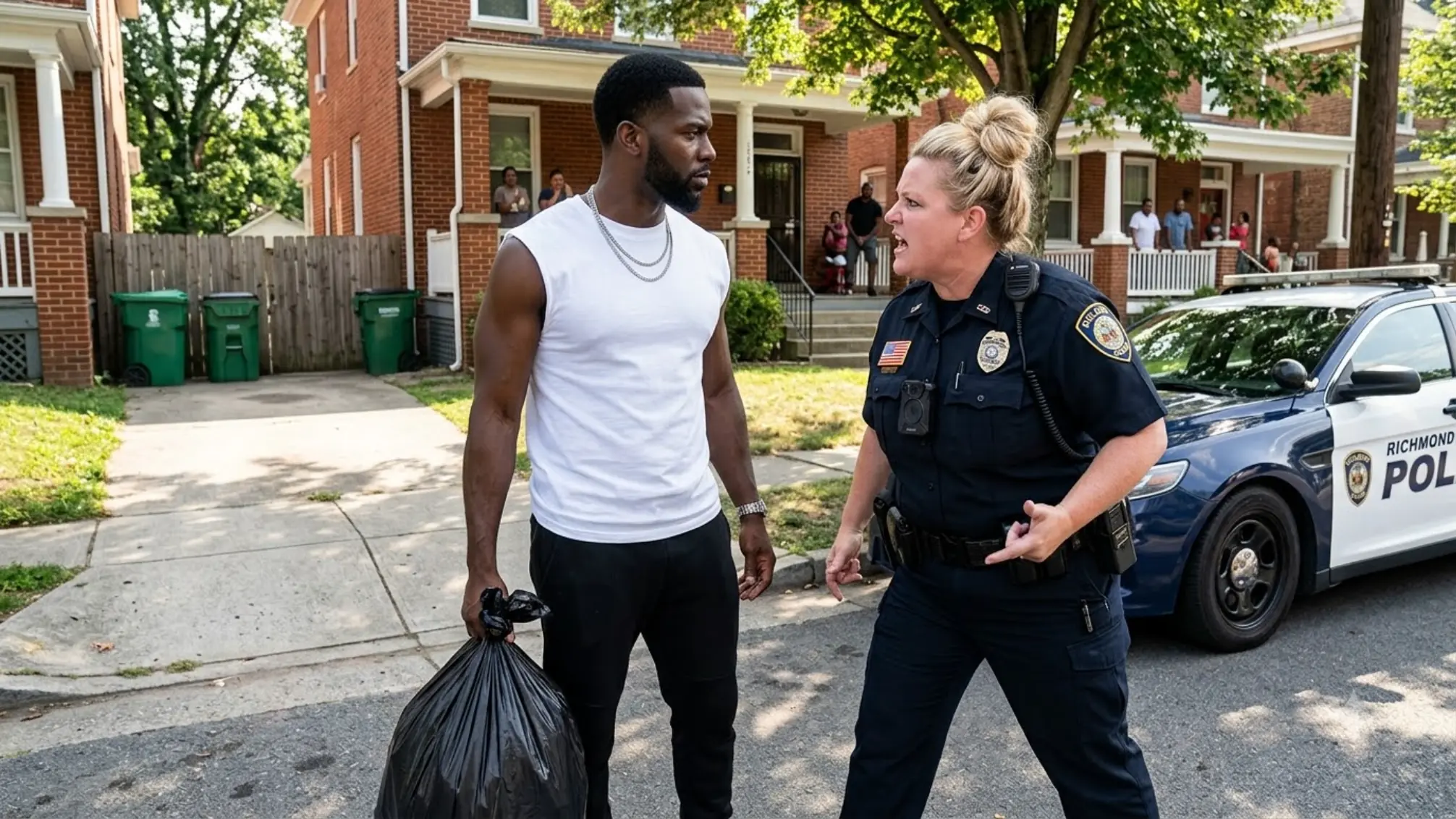
Instead, a patrol car stopped beside his house.
Darius noticed it but kept walking. He was thirty-seven, muscular from years of early-morning training, with deep-brown skin, closely shaped black hair, and a trimmed beard that made his expression look harder than he usually felt. The tied trash bag hung from his right hand while he approached the two green bins positioned beside his own fence. He had just reached for the lid when the patrol car door flew open.
“Stop right there!”
Darius turned.
Officer Brenda Keller marched toward him with the quick, heavy steps of someone who had already decided what was happening. She was forty-six, broad and heavyset, with fair skin, blonde hair twisted into a messy bun, and a dark navy patrol uniform crowded with a badge, radio, bodycam, American flag patch, and duty belt. Her face was flushed despite the morning being barely underway, and one hand remained suspiciously close to her belt as she stared first at Darius and then at the garbage bag.
“Put it down.”
Darius looked at the bag.
Then at her.
“Why?”
“I said put it down.”
He lowered the bag beside his shoe without releasing the knot.
Keller glanced toward the houses lining the street.
“What are you doing here?”
Darius almost thought he had misheard her.
“What?”
“You heard me.”
She stepped closer.
“What are you doing in this neighborhood?”
Darius looked over his shoulder at the gray two-story house directly behind him. The porch light was still on, his pickup was in the driveway, and his daughter’s purple bicycle leaned against the side of the porch. Nothing about the scene suggested mystery.
“I live here.”
Keller’s eyes narrowed.
“Identification.”
Darius stared at her.
“For taking out trash?”
“For refusing to cooperate with an investigation.”
“What investigation?”
She pointed toward the bag.
“We received a report of illegal dumping.”
Darius looked toward his own garbage bins.
“That’s my trash.”
“I’ll decide that.”
He felt irritation rise through his chest.
“Officer, the bag came from that house.”
He pointed twenty feet away.
“My house.”
Keller looked toward it but did not ask the obvious question.
“ID.”
Darius shook his head slightly.
“You stopped me because somebody reported illegal dumping. I’m standing beside the trash cans for the house I own.”
Her jaw tightened.
“You have a problem following instructions?”
“I have a problem understanding what law you think I broke.”
That was when Keller moved directly into his path.
Neighbors had begun noticing.
Mrs. Hernandez, who lived across the street, opened her front door but remained behind the screen. A teenager two houses down slowed while walking his dog. Darius’s next-door neighbor, retired mechanic Walter Gaines, stepped onto his porch holding a coffee mug.
Keller saw them.
Instead of calming down, she became louder.
“Drop the bag. I’m done asking what you’re doing in this neighborhood.”
Darius stepped half a pace closer.
“My trash. My curb. My house. Which part are you struggling with?”
Her right hand moved toward her handcuffs.
“Keep that attitude and I’ll put you in the back of my cruiser.”
Darius looked down at her active bodycam.
Then back into her eyes.
“Then cuff me.”
Her expression changed.
Darius continued.
“And let your bodycam explain why you arrested me for taking out my own trash.”
For half a second, Keller said nothing.
Then she grabbed his wrist.
Darius immediately lifted both hands away from his body.
“Don’t twist my arm.”
“Turn around.”
“I’m not resisting.”
“Turn around!”
Walter Gaines came off his porch.
“Officer!”
Keller spun toward him.
“Stay back.”
Walter stopped at the edge of his lawn.
“That man lives there.”
“I said stay back.”
“I’ve known him four years.”
Keller grabbed Darius’s other wrist.
“Sir, unless you want to be detained too, go inside.”
Walter’s expression hardened.
Darius looked toward him.
“Walter, record.”
That was all it took.
Walter pulled out his phone.
Mrs. Hernandez did the same from across the street.
Keller tightened the cuffs around Darius’s wrists.
He winced.
“Too tight.”
“You should’ve cooperated.”
“I told you where I live.”
“You gave me a story.”
Darius stared at her.
“A story?”
She leaned toward him.
“I’ve worked this area long enough to know when something doesn’t look right.”
The words settled differently than everything before them.
Walter stopped moving.
Mrs. Hernandez lowered her phone slightly, then raised it again.
Darius spoke quietly.
“What exactly doesn’t look right?”
Keller immediately redirected.
“You’re not turning this into something it isn’t.”
“I didn’t say what it was.”
Her face reddened.
“You were carrying an unidentified bag through a residential area.”
“To my trash can.”
“You refused identification.”
“Because I committed no offense.”
“You became argumentative.”
“Because you threatened to arrest me.”
“And now you are under detention until I verify who you are.”
Darius inhaled slowly.
He had learned long ago that anger could become evidence against the person experiencing it. His father had taught him that when Darius was sixteen and came home furious after being followed around a store. His father never told him not to be angry. He told him never to let someone else decide what his anger would make him do.
So Darius stood still.
“Fine.”
Keller seemed surprised.
“What?”
“Verify.”
She pushed him toward the patrol car.
Darius did not move.
“My wallet is inside the house.”
“Convenient.”
“My driver’s license is on the kitchen counter.”
“Then how am I supposed to verify you?”
Darius looked toward his front door.
“My seventeen-year-old son is inside.”
Keller stopped.
“You have someone in there?”
“My son.”
“What’s his name?”
“Malik.”
She looked toward the house again.
“Is anyone else inside?”
“My daughter is with her mother this week.”
Keller spoke into her radio.
“Dispatch, start another unit.”
Darius frowned.
“For what?”
“Officer safety.”
He laughed once in disbelief.
“You’re calling backup because my son is asleep in his own house?”
“Stop talking.”
Her bodycam captured the sentence clearly.
It would matter later.
The second officer arrived six minutes afterward.
Officer Daniel Ruiz stepped from his cruiser and immediately studied the situation before speaking. He was thirty-four, Latino American, lean, with a calm expression that changed the moment Walter told him Darius owned the house. Ruiz looked toward Keller.
“What’s the probable cause?”
Keller stiffened.
“Illegal dumping complaint.”
Ruiz glanced at the bag.
“Where was he dumping?”
“Those bins.”
Ruiz looked at the house number.
Then at the address printed on the city sanitation sticker attached to the nearest green bin.
The numbers matched Darius’s house.
Ruiz looked toward Keller again.
“Did you check the bin?”
“That isn’t the point.”
“It kind of is.”
She lowered her voice.
“He refused ID.”
“After the dumping allegation?”
“Yes.”
Ruiz stepped toward Darius.
“Sir, what’s your name?”
“Darius Cole.”
Ruiz immediately recognized it.
Not because Darius was famous.
Because Ruiz had responded to a burglary attempt at the same house eight months earlier.
“You own this place?”
“Yes.”
Ruiz closed his eyes briefly.
Then turned toward Keller.
“Take the cuffs off.”
Her face changed.
“I’m not finished.”
“I am.”
“This is my stop.”
“You’ve established he’s the homeowner.”
“Based on what he said.”
Ruiz pointed toward Walter.
“Neighbor confirms it.”
Then toward the city sticker.
“Sanitation account address matches.”
Keller folded her arms.
“He could still have stolen the bag.”
Darius looked at her.
“From my own kitchen?”
Ruiz removed the cuffs himself.
Darius rubbed his wrists.
Red marks had already appeared.
Keller stepped closer.
“I’m documenting noncompliance.”
Ruiz looked at her bodycam.
“Document everything.”
She misunderstood his tone.
“Exactly.”
Darius picked up his trash bag.
Keller pointed.
“Leave it.”
He stared.
“That goes in my bin.”
“I haven’t cleared it.”
Darius looked toward Ruiz.
Ruiz sighed.
“Put your trash away, Mr. Cole.”
Darius lifted the lid.
Dropped the bag inside.
Closed it.
Then he turned toward Keller.
“Am I free to go?”
She did not answer.
Ruiz did.
“Yes.”
Darius walked toward his house.
At the porch, he stopped.
His phone had been sitting inside the pocket of his sweatpants the entire time.
He had not recorded anything.
He did not need to.
Three neighbors had.
And Brenda Keller’s own bodycam had captured the rest.
Malik appeared at the front door.
“What happened?”
Darius looked toward him.
“Go inside.”
“Dad—”
“Inside, Malik.”
The teenager obeyed.
Darius entered the house.
His hands were shaking now that the confrontation was over.
That embarrassed him until he realized what the shaking actually meant.
His body had been preparing for something his mind had forced it not to do.
He sat at the kitchen table.
The coffee had gone cold.
Ten minutes later, Walter knocked.
Darius opened the door.
Walter held out his phone.
“I got almost everything.”
Darius looked at the screen.
The video showed Keller pointing at him.
Showed the cuffs.
Showed her saying she knew when something “didn’t look right.”
Darius rubbed his face.
“Send it to me.”
Walter hesitated.
“You okay?”
“No.”
It was the first honest answer Darius had given that morning.
Walter nodded.
“You shouldn’t be.”
By noon, the story had reached the Richmond Police Department before Darius ever called.
Mrs. Hernandez’s niece had posted part of the confrontation online.
Someone recognized Keller.
Another person tagged the department.
Then a local neighborhood page picked it up.
Darius wanted none of that.
He called attorney Naomi Brooks, who had handled contracts for his small fitness equipment company.
She listened without interrupting.
Then asked one question.
“Was the bodycam active?”
“Yes.”
“You saw the light?”
“Yes.”
“Good.”
“What should I do?”
“Nothing online.”
Darius looked at the dozens of notifications appearing on his phone.
“That might be difficult.”
“Don’t argue with strangers.”
“I wasn’t planning to.”
“Don’t post accusations.”
“Okay.”
“Don’t exaggerate.”
“I don’t need to.”
Naomi paused.
“That’s the strongest position you can have.”
That afternoon, Internal Affairs contacted him.
Not the patrol division.
Not public relations.
Internal Affairs.
Investigator Helen Ward asked Darius to provide a statement and any witness recordings. Naomi attended with him.
The interview lasted two hours.
Darius described everything.
Ward asked him to repeat Keller’s first words.
Then the second.
Then the exact order of when the cuffs appeared.
She was especially interested in one detail.
“Did Officer Keller ever inspect the contents of your trash bag?”
“No.”
“Did she ask what was inside?”
“No.”
“Did she identify the original complainant?”
“No.”
“Did she explain what dumping ordinance you supposedly violated?”
“No.”
Ward wrote something.
Darius watched.
“Can I ask you something?”
“Yes.”
“Was there actually a dumping complaint?”
Ward stopped writing.
“I can’t answer that yet.”
That answer disturbed him more than yes would have.
The truth arrived two days later.
There had been a call.
Sort of.
A resident four blocks away had reported seeing someone throw construction debris into a privately rented dumpster behind an apartment renovation.
Male.
Dark clothing.
Pickup truck.
Different street.
Different description.
Different location.
No black trash bag.
No white sleeveless shirt.
No connection to Darius.
Keller had heard the dispatch while driving through Darius’s neighborhood.
She saw him carrying a garbage bag.
And decided he was the person.
Even worse, her bodycam revealed she never told dispatch she had moved four blocks from the reported location before initiating contact.
Naomi replayed that section inside her office.
Keller’s voice came through the speakers.
“I’ve got a suspicious male with possible dumping materials.”
Darius stared at the screen.
“She made me fit the call.”
Naomi nodded.
“She changed the facts to fit what she saw.”
Internal Affairs discovered more.
Keller’s personnel file contained six prior complaints over five years involving stops later determined to have insufficient legal basis.
Three complainants were Black American men.
One was a Latino American delivery driver.
Another was a white teenager.
The sixth was an elderly Black American woman questioned outside her own apartment building after Keller assumed she was soliciting.
None of the complaints had previously resulted in major discipline.
Each had been treated separately.
Miscommunication.
Insufficient documentation.
Poor judgment.
Training issue.
But once investigators placed them beside Darius’s bodycam footage, a pattern appeared.
Keller routinely escalated ambiguous situations before verifying basic facts.
The problem was bigger than one ugly morning.
Internal Affairs also reviewed Ruiz’s bodycam.
That recording mattered almost as much.
It showed Ruiz arriving and asking immediately for probable cause.
It captured Keller resisting verification after evidence contradicted her assumption.
Most importantly, it captured Ruiz telling her to remove the cuffs after the sanitation address matched Darius’s home.
The department could not claim everybody at the scene interpreted the situation the same way.
One officer had recognized the problem immediately.
That destroyed Keller’s defense that the circumstances naturally justified her behavior.
Three weeks later, she was placed on administrative leave.
The police union challenged the decision.
Darius did not celebrate.
Malik wanted to.
“Dad, she got suspended.”
“She got investigated.”
“That’s basically suspended.”
“Not the same.”
“She arrested you over garbage.”
“She detained me.”
Malik rolled his eyes.
“Why are you defending her?”
“I’m not.”
Darius looked at his son.
“I’m keeping the facts straight.”
“Why?”
“Because if I want people to care about what happened, I can’t become careless with the truth just because I’m angry.”
Malik became quiet.
Darius continued.
“She was wrong enough without me making her worse.”
That lesson stayed with the boy.
The administrative hearing occurred seven weeks after the stop.
Keller sat beside union counsel.
Darius attended only because investigators asked him to testify.
She never apologized.
Not then.
Her attorney argued she had responded to a suspected ordinance violation, encountered an uncooperative individual, and used temporary detention to establish identity.
Naomi responded with the timeline.
Reported incident: 8:01 a.m.
Different address.
Different description.
No confirmation tying Darius to the complaint.
Keller’s contact: 8:19.
Darius standing beside a trash bin registered to his own property.
Witnesses identifying him as the homeowner.
Second officer recommending immediate release.
Continued resistance to that information.
Then the bodycam played.
“What are you doing in this neighborhood?”
The hearing room became still.
Another clip.
“I’ve worked this area long enough to know when something doesn’t look right.”
Then Darius’s voice.
“What exactly doesn’t look right?”
Keller’s attorney shifted.
The clip continued.
“You’re not turning this into something it isn’t.”
The panel paused the video.
One member looked directly at Keller.
“Officer, what did you mean?”
She hesitated.
“I meant his behavior.”
“What behavior?”
“Being argumentative.”
“Before or after you demanded identification?”
Another pause.
“After.”
The panel member looked at the report.
“You approached him first.”
“Yes.”
“You ordered him to drop his trash.”
“Yes.”
“You asked what he was doing in the neighborhood.”
“Yes.”
“And he told you he lived there.”
“Yes.”
“At what point did you verify that statement?”
Keller said nothing.
That silence decided more than anything she had said.
The department sustained findings for improper detention, failure to adequately investigate before escalation, inaccurate characterization of the original call, unprofessional conduct, and violation of de-escalation policy.
Keller was terminated.
Her union appealed.
Months later, the termination was reduced under arbitration to a lengthy suspension followed by mandatory retraining and reassignment away from solo patrol duties.
Darius disliked the result initially.
Then Naomi explained something.
“Accountability isn’t always the maximum punishment.”
“She still keeps her job.”
“Yes.”
“You think that’s okay?”
“I think the important question is whether the system changes enough to stop repetition.”
That became the larger fight.
Darius filed a civil claim.
The city settled without admitting broader departmental discrimination.
The money mattered less to him than the policy negotiations.
His attorneys requested three reforms.
First, officers responding to citizen-reported ordinance violations had to confirm location and description before initiating detention unless immediate danger existed.
Second, bodycam audits would automatically flag stops involving handcuffing without citation or arrest for supervisory review.
Third, officers would receive updated training distinguishing consensual contact, investigative detention, and arrest authority.
The city accepted modified versions of all three.
Darius used part of the settlement to establish a small neighborhood legal-aid fund.
Not because he suddenly wanted to become an activist.
He still disliked meetings.
He hated microphones.
He had no interest in being introduced as “the man from the trash bag video.”
But several people contacted him afterward describing smaller encounters they had never reported because they believed nothing would happen.
That bothered him.
So the fund paid for initial consultations when residents wanted to understand complaint procedures, housing disputes, municipal fines, or police encounters.
Walter called it the most expensive garbage run in Richmond history.
Darius laughed.
Malik did not.
A year later, Darius carried another black trash bag down the same sidewalk.
He was wearing nearly the same clothes.
White sleeveless shirt.
Black sweatpants.
Same silver chains.
Same green bins.
Walter happened to be outside.
He pointed at the bag.
“Need backup?”
Darius laughed.
“I think I’ve got it.”
A patrol car turned onto the street.
For one second, Darius’s body tightened automatically.
He hated that.
The cruiser slowed.
Officer Ruiz was driving.
He rolled down the window.
“Morning, Mr. Cole.”
“Morning.”
Ruiz glanced at the trash bag.
“Looks suspicious.”
Darius stared.
Then Ruiz smiled.
Darius laughed despite himself.
“You almost got yourself in trouble.”
“I know.”
Ruiz’s expression became serious.
“You doing okay?”
Darius considered the question.
“Better.”
Ruiz nodded.
“Good.”
He drove away.
Darius lifted the trash-bin lid.
Dropped the bag inside.
Closed it.
Nothing happened.
That ordinary silence felt strangely important.
Months earlier, the same action had become evidence of suspicion because someone decided appearance mattered more than location, explanation, ownership records, and common sense.
Now it was simply a man taking out garbage.
Exactly what it had always been.
That evening, Malik sat beside Darius on the porch.
“You know what I remember most?”
“What?”
“You telling Officer Keller to check her bodycam.”
Darius smiled faintly.
“I didn’t tell her to check it.”
“You said it would explain everything.”
“Pretty much.”
Malik leaned against the railing.
“Were you sure?”
“No.”
His son looked surprised.
“What if the camera had been off?”
“Walter was recording.”
“What if he wasn’t?”
Darius looked toward the sidewalk.
“That’s the part people forget.”
Malik waited.
“Evidence helped me.”
Darius turned toward him.
“But what she did would still have been wrong if nobody recorded it.”
The teenager nodded slowly.
That was the lesson Darius cared about most.
The bodycam proved what happened.
The neighbors confirmed it.
The sanitation label destroyed the original excuse.
Ruiz’s arrival exposed the lack of justification.
But none of those things created Darius’s right to be treated fairly.
That right existed before anyone pressed record.
He had never needed to be a celebrity.
Never needed a powerful title.
Never needed to secretly own half the neighborhood.
He was simply a homeowner carrying his own trash from his own house to his own curb.
And that should have been enough.
The following spring, the city invited Darius to speak briefly during a bodycam-policy training session.
He refused at first.
Then Malik convinced him.
“Just tell them what happened.”
So Darius stood before forty officers.
No dramatic speech.
No accusations.
He showed one still image.
Him holding the black trash bag.
Officer Keller pointing at him.
Then he asked one question.
“What crime do you see?”
Nobody answered.
Darius nodded.
“That’s the point.”
He looked around the room.
“You know what happened after this picture. So your brain wants to add information.”
A few officers shifted.
“But at the moment this picture was taken, all you actually had was a man standing beside a trash bin.”
He paused.
“Everything else came from assumptions.”
That sentence remained in the department’s training material long after Darius stopped attending meetings.
His case became one of several examples used to teach officers about confirmation bias, unnecessary escalation, and why checking basic facts before asserting authority protected both citizens and police.
Darius eventually stopped thinking about Brenda Keller every time he carried garbage outside.
That took longer than he expected.
One morning, he realized he had taken two bags to the curb without once looking for a patrol car.
He smiled.
Then went back inside.
Coffee waited on the kitchen counter.
Malik was arguing with his sister about cereal.
The television was too loud.
Darius stood in the doorway listening to the ordinary chaos.
That was what the confrontation had interrupted.
Not just a garbage run.
Ordinary life.
And in the end, the most important victory was not that an officer had been investigated, disciplined, or exposed by her own camera.
It was that Darius eventually reclaimed the ability to walk twenty feet from his front door carrying a black trash bag without feeling as though he needed evidence proving he belonged there.