Lila Mae Turner woke before the sun because worry never let her sleep until daylight anymore.
The old farmhouse held the night’s cold in its walls, and the floorboards creaked beneath her bare feet as she crossed the kitchen.
She wrapped a faded wool shawl around her shoulders, set a dented kettle on the stove, and struck a match with hands rough from years of work.
Outside, the fields waited in the dark.
So did the debt.
Lila Mae was forty-nine years old, an African American widow with thirty-seven acres of stubborn Georgia soil, two broken machines, one working pump, and a stack of bank notices hidden under a flowered cookie tin on the kitchen table. She had once shared that table with her husband, Curtis, who believed land could love a family back if they were patient enough with it.
Curtis had dreamed big.
Too big, some neighbors said after he was gone.
He bought the green combine, the irrigation line, and the grain dryer that was supposed to save labor and double their yield. He signed papers with hands full of hope. He told Lila Mae, “One good season, baby. That’s all we need. One good season and this place will finally breathe.”
But sickness came faster than the harvest.
Curtis died before autumn ended, and the debt stayed behind like a guest who refused to leave.
Now the combine leaned in the shed with a torn belt and tired hydraulics. The pump coughed every other morning. The grain dryer made a sound like it was arguing with itself. Every week, the bank sent letters with words that sounded clean on paper and cruel in real life.
Liquidation.
Default.
Asset recovery.
Final review.
Lila Mae knew the meaning without needing a banker to explain it.
They wanted the land.
She drank coffee without sugar because sugar cost money, pulled on her boots, and stepped outside as the sky began turning gray.
The yard looked less like a farm and more like a battlefield after everyone had gone home. Mud clung to the tires. The old chicken coop sagged at one corner. A rusted gate hung crooked near the road. The barn roof still held, but only because Lila Mae had patched it with tin, tar, and prayer.
She checked the hens first, then the pump, then the fuel drum.
The gauge barely moved.
She tapped it once.
“Hollow as a politician’s promise,” she muttered.
Curtis would have laughed at that.
The thought caught her by surprise, and for one second, the morning softened.
Then the pump sputtered, and the day returned to work.
By noon, she had tightened two valves, spliced a fence wire, cleared grit from the pump line, and cut her knuckle on a rusted bracket. She wrapped it in cloth, warmed the last of yesterday’s beans, and ate standing over the sink with a heel of stale cornbread in one hand.
A white SUV slowed on the road.
Mrs. Darlene Parker from across the way rolled down her window.
“You ought to sell before the bank takes it all, Lila Mae,” she called. “No shame in knowing when the fight’s done.”
Lila Mae looked at her.
Then she looked at the fields behind the woman’s clean vehicle.
“My husband is buried under that cedar tree,” she said. “I’ll decide when the fight is done.”
Mrs. Parker’s mouth tightened. The window rolled up, and the SUV drove on.
Lila Mae returned to the shed.
By late afternoon, clouds had gathered, low and bruised above the fields. She dragged a toolbox toward the combine and tried again to free a bolt that had not moved in years. Her shoulder ached. Her back burned. Her stomach reminded her that beans and cornbread were not enough for a full day of labor.
She kept working anyway.
The phone rang inside the house just before sunset.
Then she thought of the bank and wiped her hands on her jeans before answering.
“Mrs. Turner,” said a man’s voice, crisp and impatient. “This is Gregory Malloy from First Southern Agricultural Bank.”
“I know who you are.”
“We need to confirm access to the property next Tuesday for asset inventory.”
The words moved through her like cold water.
“You said final review.”
“Yes, ma’am. The review has been completed.”
She gripped the receiver.
“You haven’t even seen my updated yield estimate.”
“Mrs. Turner, with respect, estimates do not cure default.”
Lila Mae looked at the cookie tin on the table. Beneath it sat every notice she had not wanted to read twice.
“What time Tuesday?”
“Nine in the morning.”
She closed her eyes.
“I’ll be here.”
After she hung up, she stood in the kitchen for a long time. The kettle had gone cold. Rain began tapping the window. The house smelled of old wood, lye soap, and the faint diesel scent that never left Curtis’s coat still hanging by the back door.
Lila Mae pulled the bank notices from under the tin and spread them across the table.
The numbers did not change.
No matter how many times she read them, they did not become smaller.
She took out her spiral notebook and tried to make order from scraps. Diesel receipts. Seed invoices. Handwritten notes. A grocery receipt with irrigation calculations on the back. A jelly jar full of folded papers. A calculator with a missing number two.
At ten that night, she gave up and put the notices back under the tin.
Then she heard the sound.
Not thunder.
Not a truck.
A low scrape from the ditch beyond the fence.
Lila Mae froze.
Another sound came, softer this time. A groan. Then a woman’s frightened voice.
“Please. Help us.”
Lila Mae grabbed the lantern.
The rain had turned the yard slick. She crossed the grass, passed through the gate, and lifted the lantern toward the ditch line.
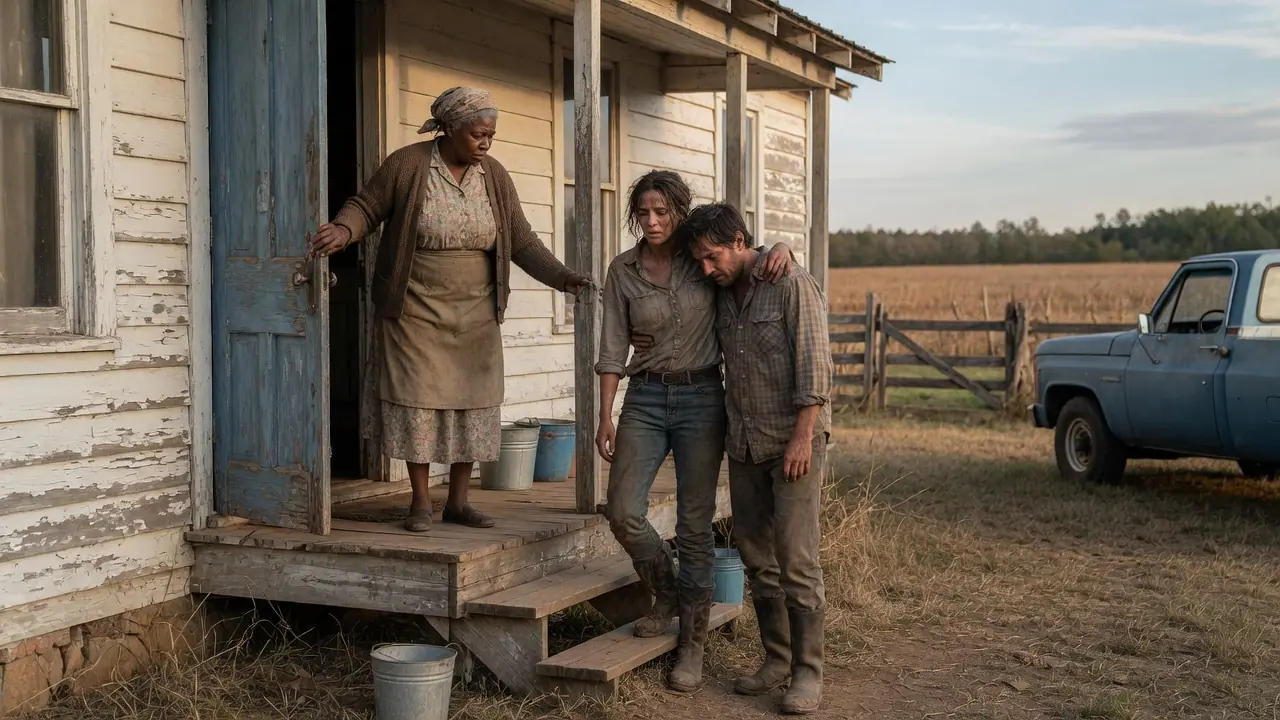
Two figures lay tangled near the drainage pipe.
A man, maybe in his early fifties, was trying to sit up while holding one arm close to his chest. His shirt was torn, his face pale under streaks of mud. Beside him, a woman with short dark hair and a split sleeve tried to help him rise but could barely stand herself.
They looked half frozen, soaked through, and desperate.
Lila Mae did not ask who they were.
She did not ask where they came from.
She did not ask why two strangers had collapsed near her land after dark.
There would be time for questions if they made it through the night.
She set the lantern down, got under the man’s good arm, and hauled him up with more strength than her tired body should have had.
“Can you walk?”
The man nodded weakly.
The woman whispered, “I’m sorry.”
“Be sorry later,” Lila Mae said. “Move now.”
It was a slow, ugly walk back to the farmhouse. The man nearly fell twice. The woman trembled so badly Lila Mae thought she might drop before reaching the porch.
Inside, Lila Mae guided them to the rug near the stove. She put water on to boil, threw more wood into the fire, and found the old medicine basket from beneath the sink.
“What happened?” she asked at last.
The woman looked at the man.
The man shook his head slightly.
Lila Mae saw it.
Secrets.
Fear.
Maybe trouble.
She should have sent them away.
Instead, she said, “Never mind. Sit still.”
She cleaned the man’s scraped arm with soap and warm water. He hissed through his teeth but did not complain. She wrapped the woman’s wrist and pressed a clean cloth against a shallow cut near her temple. Then she heated the last of the beans, sliced the final piece of cornbread in half, and set both portions on plates.
The woman stared at the food.
“You don’t have enough for yourself.”
Lila Mae turned back to the stove.
“I already ate.”
That was not entirely true.
The woman seemed to know it, but hunger won.
They ate slowly at first, then faster, trying to remain polite and failing.
The man’s hands stopped shaking after the first few bites. The woman cried quietly into her collar while chewing.
Lila Mae pretended not to notice.
When they finished, she gave them the bed in the small downstairs room and took the rocking chair near the stove for herself. The man tried to object.
“Ma’am, we can’t take your bed.”
“You can if you want to wake up breathing.”
The woman looked at her with wet eyes.
“What’s your name?”
“Lila Mae Turner.”
“I’m Mara,” the woman said softly. “This is Elias.”
Lila Mae nodded.
“That’s enough names for tonight.”
They were gone before dawn.
The bed was neatly made. The plates had been washed and set beside the sink. On the kitchen table lay a folded piece of notebook paper.
Lila Mae opened it.
Mrs. Turner,
You helped us without asking if we deserved it.
We will not forget.
Mara and Elias
There was no address.
No phone number.
Nothing useful.
Lila Mae folded the note smaller and slid it into a drawer.
Then she went outside and started the day.
For the next week, nothing miraculous happened.
The pump still struggled. The combine still would not run. Mrs. Parker still slowed down near the fence, pretending not to stare. The phone rang twice, and Lila Mae let it go to voicemail because she already knew what the bank wanted.
On Monday night, she walked to the cedar tree where Curtis had sharpened mower blades during their better years. The bark still held one smooth scar from his knife.
“They’re coming tomorrow,” she whispered.
The wind moved through the branches.
She pressed her palm against the tree.
“I tried.”
At nine o’clock Tuesday morning, three sedans turned into her driveway.
Men in suits stepped out.
One carried a clipboard. One held a camera. Two movers climbed from a truck behind them and opened the back doors as if they had done this too many times to feel anything.
Neighbors appeared along the fence line almost immediately.
Mrs. Parker stood near her mailbox with a cardigan wrapped tight around her. A man from the co-op parked across the road. Two women whispered near a truck bed. Everyone had something to look at now.
Lila Mae stood on the porch in her cleanest work shirt.
Gregory Malloy approached with a folder.
“Mrs. Turner.”
“You’re standing on Turner land,” she said. “Say it right.”
He blinked.
“Excuse me?”
“My name. My husband’s name. You’re about to take everything attached to it. At least say it right.”
A faint flush crossed his face.
“Mrs. Turner,” he repeated. “As you know, the bank has initiated recovery proceedings due to unresolved default.”
The movers entered the house.
The first thing they carried out was the kitchen chair Curtis had repaired twice.
They set it in the yard.
Then came a box of dishes.
Then the small table.
Then Curtis’s coat.
Lila Mae stepped forward when she saw it, but stopped herself.
Her hands clamped behind her back.
A plate slipped from one mover’s box and cracked against the ground.
A few people at the fence murmured.
Lila Mae did not cry.
She would not give them that.
Gregory Malloy continued reading from his paper.
“Outstanding balance, accumulated interest, late fees, equipment liens, and property recovery costs—”
The sound of tires on gravel cut him off.
A black SUV rolled through the gate.
It was covered in road dust.
The kind of dust earned by miles, not bought for show.
The vehicle stopped behind the bank cars.
The driver’s door opened first.
A man stepped out, favoring his left arm.
Lila Mae’s breath caught.
Elias.
The passenger door opened.
Mara stepped out beside him, her wrist still wrapped, her face calm and focused.
The neighbors leaned forward as one body.
Gregory Malloy lowered his papers.
“Can I help you?”
Elias walked toward him.
“You can stop touching Mrs. Turner’s belongings.”
Malloy frowned.
“And you are?”
“Elias Reed. This is my wife, Mara Reed.”
The name meant nothing to Lila Mae.
But it meant something to Malloy.
His expression shifted from irritation to uncertainty.
Mara walked past him and stopped at the bottom of the porch steps. She looked up at Lila Mae.
“You gave us your bed.”
Lila Mae could not speak.
Mara’s eyes softened.
“You fed us when you barely had supper for yourself.”
Elias turned to the bank agent.
“We buy distressed rural debt through Reed Agricultural Recovery.”
Malloy’s face changed again.
This time, everyone saw it.
Elias held out a thick manila folder.
“Inside is a certified payment covering the full arrears, penalties, late charges, legal costs, and the equipment liens attached to this property.”
Malloy stared at the folder.
Mara added, “There is also a notice of transfer. We purchased the note last night.”
Lila Mae gripped the porch rail.
Malloy opened the folder and read.
His posture slowly collapsed.
One of the movers set down the box he was holding.
Mrs. Parker whispered, “Who are they?”
A man near the road muttered, “Looks like somebody important.”
Mara’s gaze did not leave Lila Mae.
“We were scouting farms quietly last week,” she said. “Three miles east, near the old mill road. Someone forced our vehicle off the back road and took our phones and bags. We walked until we couldn’t. We ended up in your ditch.”
Elias looked at the cracked plate on the ground.
“Most people would have called somebody else and shut the door.”
Lila Mae’s throat tightened.
“I didn’t do anything special.”
“Yes,” Mara said. “You did.”
Malloy cleared his throat.
“I’ll need to verify—”
Elias handed him another document.
“You already have the wire confirmation. Call your office.”
Malloy made the call.
The yard waited.
Even the neighbors stopped whispering.
After several minutes, he hung up and looked at Lila Mae as if she had become a problem he no longer had the authority to solve.
“The arrears have been satisfied,” he said.
Lila Mae blinked.
Malloy swallowed.
“The lien is released. The property remains yours.”
For the first time that morning, sound returned to the world.
A chicken clucked near the coop.
Wind moved through the cedar tree.
Someone at the fence let out a nervous laugh and quickly stopped.
Lila Mae descended the porch steps slowly.
Malloy held out the stamped paper.
She took it with both hands.
Title restored.
Lien released.
Property retained.
The words blurred.
Mara stepped closer.
“Mrs. Turner?”
Lila Mae looked up.
“I don’t know what to say.”
Elias smiled faintly.
“You said enough that night when you put beans on the table.”
The bank cars left before noon.
The movers carried every box back inside. One apologized under his breath when he returned Curtis’s coat to its hook by the door. Malloy did not apologize, but he avoided Lila Mae’s eyes as he climbed into his sedan.
The neighbors lingered, hungry for explanation.
Lila Mae gave them none.
Mara and Elias did not leave when the crowd dispersed.
They sat at her kitchen table, the same table that had almost been taken from her yard. Lila Mae made black tea because coffee was almost gone, and Mara accepted it like it was the finest thing she had ever been served.
Then Mara opened a notebook.
“Show me your books.”
Lila Mae almost laughed.
“You don’t want to see my books.”
“I absolutely do.”
“They’re in a jelly jar.”
“Then bring me the jelly jar.”
So Lila Mae did.
Receipts came out first. Seed costs. Fuel expenses. Maintenance notes. Handwritten yield estimates. A church bulletin with calculations in the margin. An envelope full of equipment parts quotes. Mara sorted everything by date while Elias walked the property with a limp and a sharp eye.
He inspected the pump.
The harvester.
The grain dryer.
The irrigation line.
When he came back inside, he looked at Mara.
“The farm isn’t dead.”
Mara nodded.
“No. It’s just starved.”
Lila Mae stood by the stove.
“I don’t need charity.”
Mara looked up.
“We don’t give charity to operations. We invest in work.”
Elias leaned against the counter.
“You have the work.”
Mara tapped the notebook.
“You need structure, repairs, cash flow timing, and someone to keep predatory lenders away from the door.”
Lila Mae gave a small, humorless smile.
“That all?”
“For now.”
The next morning, Mara and Elias returned in work clothes.
No suits.
No polished shoes.
Mara wore jeans, boots, and a flannel shirt with the sleeves rolled up. Elias wore a brace on his arm and carried a measuring wheel.
By noon, they had walked the irrigation line twice.
By evening, Mara had turned the jelly jar of receipts into labeled stacks on the table.
Two days later, a mechanic arrived.
He crawled under the combine, came out dirty to the elbows, and dropped the broken belt onto the ground.
“Parts are ordered,” he said.
A plumbing crew dug up the pump line and replaced the patched section with new PVC. The water pressure hit the gauge and held steady for the first time in months.
Lila Mae stood watching it like someone had opened a window in a room she had forgotten was dark.
Mara wrote the flow rate in a fresh ledger.
“Now we track everything.”
“I’m not good with computers,” Lila Mae said.
“Then we start with paper.”
Mara placed a clean ledger on the kitchen table.
Rows.
Columns.
Dates.
Costs.
Income.
Repairs.
Fuel.
Lila Mae stared at it.
“It looks too neat.”
“It will get dirty,” Mara said. “Good ledgers always do.”
Weeks became a season.
The farm did not transform overnight. Real help rarely looks like a miracle after the first day. It looks like schedules, receipts, parts deliveries, hard questions, and people showing up when they said they would.
The combine ran again.
The dryer stopped smoking.
The pump held pressure.
Fences tightened.
The barn roof was sealed before the next rain.
Lila Mae learned how to enter numbers into a cheap tablet Mara left on the counter. When she messed up the spreadsheet formula, Mara fixed it without making her feel foolish.
“Numbers tell a story,” Mara said one afternoon. “You already know the story. We’re just teaching the bank to read it.”
The first harvest after the repairs was not large.
But it was clean.
The grain dried properly. The moisture level passed. A buyer offered a fair market rate, and Elias shook hands on the deal right there beside the truck.
The workers were paid that Friday.
In full.
News traveled faster than the earlier gossip.
Neighbors changed their tone.
Mrs. Parker came by with a casserole and a smile that did not quite know where to sit on her face.
“I thought you might be hungry,” she said.
Lila Mae took the dish.
“Thank you.”
Mrs. Parker shifted awkwardly.
“I suppose I was wrong about selling.”
Lila Mae looked toward the fields.
“You weren’t wrong that I was in trouble.”
The woman lowered her eyes.
“I was wrong not to help.”
Lila Mae said nothing for a moment.
Then she nodded once.
That was all the forgiveness she had to give that day.
By the second season, the farm began making sense on paper.
Fuel use was tracked to the gallon.
Breakdowns were anticipated instead of mourned.
Seed orders were placed early.
Insurance premiums were paid on time.
Waste dropped.
Yield improved.
For the first time since Curtis died, Lila Mae looked at the fields and did not feel hunted by them.
One evening, she stood near the cedar tree where Curtis used to sharpen blades. Elias and Mara were by the gate discussing soil reports. The sun sank low over the rows, turning them bronze.
Lila Mae placed her hand against the old scar in the bark.
“We’re still here,” she whispered.
The wind moved through the branches.
She chose to believe Curtis heard.
A year later, the Turner farm was not famous.
That mattered to Lila Mae.
Fame was loud and unstable.
Solvency was better.
The rows filled in. The machines started on the first turn. The books balanced. The farm paid its bills. Not easily, not comfortably, but honestly.
Mara and Elias helped start a small rural lending pool for nearby farms facing temporary trouble. Not handouts. Not rescue dressed up for applause. Bridge loans, repair plans, audits, and oversight.
At the town hall meeting, Mara stood before the farmers and said, “Debt kills good operations when no one gives them time to breathe. We are not here to save bad math. We are here to protect good work from bad timing.”
Lila Mae signed the sheet last.
She did not look around for approval.
She went home and scrubbed grease from her arms.
That night, after locking the shed and checking the pump, she found the old note from Mara and Elias in the drawer.
You helped us without asking if we deserved it.
We will not forget.
She folded it smaller and placed it back.
The land was hers.
Not because someone had saved her.
Because the help she received met the work she had already been doing.
One door opened.
The rest was walking through it every day with steady hands and eyes on the dirt.
Years later, people still came to Lila Mae’s porch.
Some brought foreclosure notices.
Some brought medical bills.
Some brought nothing but shame and the fear of being judged.
Lila Mae kept an extra chair by the door.
When a young farmer named Denise Hall arrived one rainy afternoon with a shaking voice and a bank letter folded in her pocket, Lila Mae poured her a glass of water and said the same thing she wished someone had said to her sooner.
“Sit down. Start at the beginning.”
Denise cried.
Lila Mae let her.
Then she pulled out a ledger.
Outside, the fields waited under steady rain. The pump line held. The barn roof did not leak. The combine sat ready in the shed. Curtis’s coat still hung by the back door, worn at the elbows, smelling faintly of old work and memory.
Lila Mae looked across the table at the young woman who thought her life was ending.
Then she thought of two strangers in a ditch, one pot of beans, and a night when kindness had cost her almost everything she had left.
She opened the ledger to a clean page.
“First,” she said, “we find out what’s true. Then we decide what can be fixed.”
Denise wiped her face and nodded.
Lila Mae picked up her pen.
The farm outside was no longer a place waiting to be taken.
It was a place that had learned how to stand.
And so had she.