At 6:40 in the evening, on the third Friday of November in Ann Arbor, Michigan, rain needled the windows of Larksburg Kitchen.
The sky outside had already gone dark, even though it was not yet seven.
Cold rain slid down the glass in silver threads, breaking the reflections of passing headlights into trembling lines. 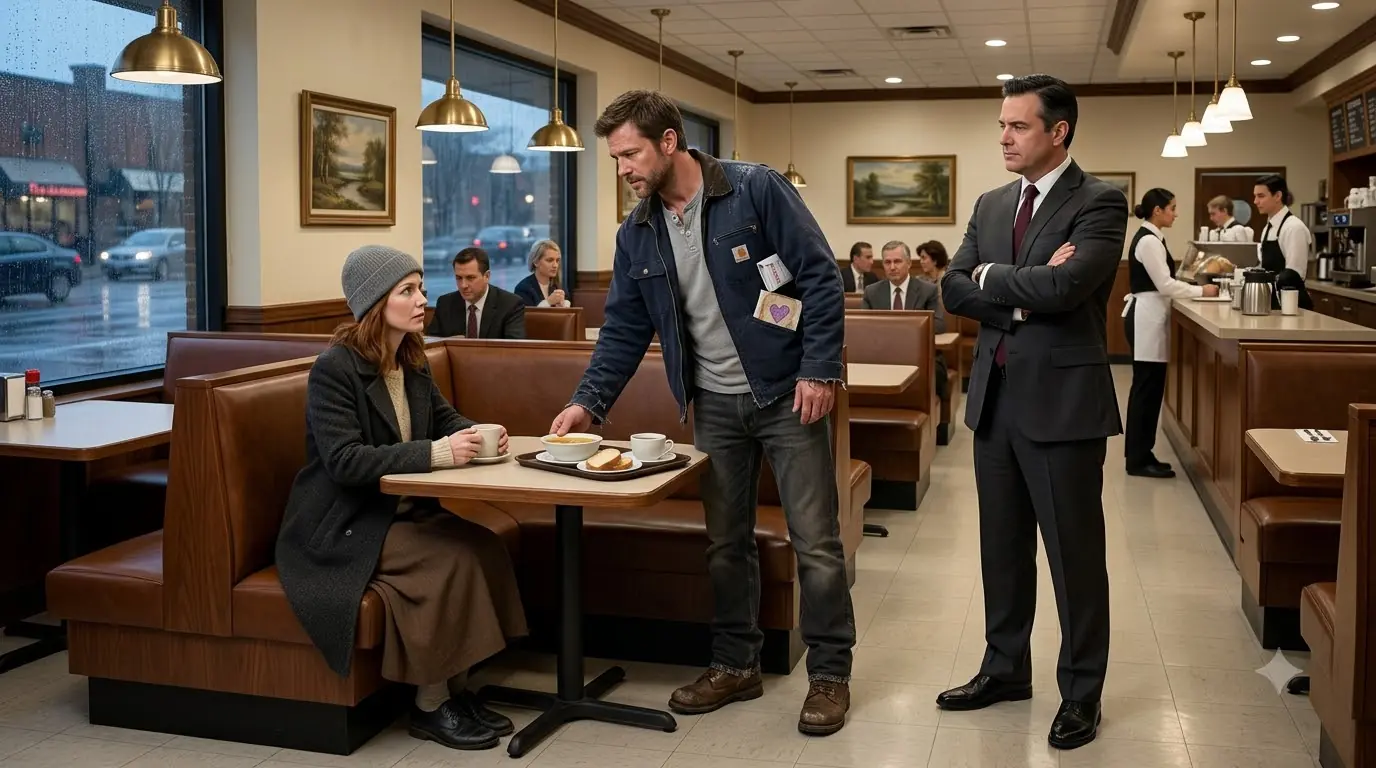
The sidewalks were slick, the gutters were full, and everyone who stepped through the front door came in with damp shoulders, red cheeks, and the relieved look of people grateful to be inside somewhere warm.
Larksburg Kitchen should have felt like shelter.
That was what it had been built to be.
The dining room had honey-colored wood floors, green booths, warm pendant lights, and the smell of soup, coffee, bread, and fried onions hanging gently in the air. Framed black-and-white photographs of old Michigan streets lined one wall. A chalkboard near the counter advertised chicken pot pie, roasted tomato soup, apple crumble, and the Friday special.
It was a place designed to make hunger feel temporary.
But in the corner booth nearest the rain-streaked window, a woman sat with an empty cup between her hands while the room decided whether she deserved to be treated like a person.
Her name, at least the name she had given the waitress, was Marion.
She looked to be in her late fifties, maybe early sixties, with damp gray hair tucked unevenly beneath a worn knit cap. Her coat was old, the cuffs frayed, the collar darkened by rain. Her shoes were thin and badly suited for November weather. The hem of her skirt was wet from the storm outside.
She had asked for something small.
Not a meal at first.
Not even soup.
Just hot water, then maybe bread if there was any left over.
“I can pay when I can,” she had said quietly.
The waitress, Jenna, had looked at Marion’s shoes first, then at the empty cup, then toward the manager’s station where Desmond Price stood watching the dining room like a man inspecting property he did not love but controlled.
Jenna was twenty-two, new, and terrified of losing her job.
So she had walked away without writing anything down.
A man at the next booth had laughed under his breath. A woman two tables over had pulled her purse closer to her body, the way people do around something they have decided is contagious. A teenager near the counter had lifted his phone, then lowered it when his mother whispered sharply at him.
Marion lowered her eyes and folded her hands tighter around the cup.
She did not argue.
She did not beg.
She simply sat there, holding the cup like it still held warmth.
Then Desmond Price arrived at her table.
He was the regional operations director for Larksburg Kitchen’s Michigan district, though the staff knew him simply as Mr. Price. He wore a charcoal coat over a fitted suit, polished shoes, and a watch expensive enough to make his handshake feel like a warning. His hair was dark, his smile smooth, and his eyes were the kind of cold that learned how to hide behind professional language.
Desmond had built a career on clean numbers.
Low waste.
Reduced losses.
Increased operational discipline.
Efficiency.
That word followed him through every meeting like a loyal dog.
But efficiency, in Desmond’s hands, usually meant the same thing.
Less mercy.
Fewer exceptions.
Faster dismissals.
At Larksburg Kitchen, he had become known for cutting anything that did not immediately produce profit, then calling the wound strategic.
Now he stood over Marion’s corner table, his voice pitched just loud enough for nearby diners to hear.
“She’s not ordering,” he said to Carrie, the senior server. “She needs to leave.”
Carrie stood beside him with a coffee pot in her hand, her face tight with discomfort.
“She asked for bread,” Carrie said softly.
“And she was told no.”
“She said she could pay later.”
Desmond turned his head slowly.
“Is this a bank?”
Carrie looked down.
“No.”
“Then we are finished here.”
Marion said nothing.
The empty cup trembled slightly between her hands, though whether from cold, hunger, or humiliation, no one seemed brave enough to decide.
No one at the counter moved to help her.
No one from the booths stood.
No one wanted to become part of the scene.
That was the hidden agreement of public cruelty. Everyone dislikes it. Everyone hopes someone else will stop it first.
The bell over the door rang.
Grady Sutton walked in with a pharmacy bag under one arm, seven dollars folded in his pocket, and the tired posture of a man who had already spent his strength for the day.
He stopped just inside the doorway.
Rain ran from his collar onto the floor.
He looked at the corner table.
Something in him decided before his mind caught up.
Grady Sutton did not look like anyone’s idea of help arriving.
His jacket was worn thin at both cuffs. His boots still carried the pale stain of last winter’s road salt, the kind that never fully washes out. His jeans were clean but faded, his face lean with the kind of tiredness that does not come from one hard day but from too many months of them stacked together.
He was thirty-seven years old, though some mornings his knees felt older. His hands were broad, cracked at the knuckles from cold air and warehouse work. His dark hair had started thinning at the temples, and his beard, which he kept trimmed with cheap clippers in the bathroom mirror, held a few silver threads he pretended not to notice.
He had not come to Larksburg Kitchen for himself.
The pharmacy bag under his arm held children’s cough syrup, a small bottle of generic fever reducer, and a prescription refill for his daughter’s inhaler. The refill had cost more than he expected, which meant dinner had become a calculation instead of a meal.
Seven dollars.
That was what remained in his pocket.
Seven dollars and a promise.
At home, above the shuttered hardware store where they rented two rooms, six-year-old Marlo was waiting. She would be sitting at the small kitchen table, coloring a house with yellow windows the way she always did when she wanted the world to feel steady under her. She would ask whether he remembered the soup. She would ask if he got bread too. She would pretend not to notice if he ate less than she did.
Children notice more than adults want them to.
Grady knew that.
So he had planned carefully.
One bowl of soup.
One side of bread.
He would tell Marlo he had eaten earlier at work. She would not fully believe him, but she was six, and six-year-olds still sometimes let love tell harmless lies when they need them to be true.
Then he saw Marion.
Desmond Price was still standing over her, his voice now lower and sharper.
“This is not a shelter,” he said. “You can sit in the bus station if you need to be somewhere warm.”
Marion lifted her eyes just once.
“I only wanted a little bread,” she said.
Desmond exhaled through his nose, almost amused.
“And I want guests who pay for what they order.”
Something moved through Grady’s face.
Not anger yet.
Recognition.
He had seen hunger before.
He had seen it in men at the warehouse who joked through twelve-hour shifts because jokes were cheaper than lunch. He had seen it in elderly neighbors who bought cat food in bulk but did not own cats. He had seen it in himself, standing at a sink after Marlo fell asleep, drinking water to quiet his stomach because there was no dignity in admitting a child’s dinner had come from your own.
Grady walked to the counter.
The cashier, a nervous teenage boy named Evan, glanced from Desmond to Grady and back again.
“What can I get you?”
“Tomato soup,” Grady said. “Bread on the side.”
“That’s seven forty-nine.”
Grady looked at the menu board.
“It says six ninety-nine.”
“With tax.”
Grady’s jaw tightened.
He unfolded the seven dollars in his pocket.
Evan swallowed.
“I can cover the tax.”
Grady looked at him.
The boy’s face flushed as if kindness embarrassed him.
Grady slid the seven dollars across the counter.
“Appreciate it.”
He waited while the soup was poured into a ceramic bowl and placed on a tray. The bread came wrapped in a paper napkin, still warm. Evan added a plastic spoon, then lowered his voice.
“Sir, Mr. Price doesn’t like people interfering.”
Grady picked up the tray.
“Then he shouldn’t give people reasons to.”
He crossed the diner floor without looking at anyone else.
Desmond saw him coming and frowned.
Grady set the tray down on Marion’s table without asking permission. He pulled out the chair across from her, only far enough to prop one boot against it, not to sit.
“Eat while it’s hot,” he said.
Marion looked at the bowl.
Then at him.
“I can’t pay you.”
“Didn’t ask.”
Her eyes filled, but she did not touch the spoon.
Grady understood that too.
Sometimes hunger is easier than accepting kindness in front of people who have already decided you deserve neither.
He reached into the pharmacy bag, drew out the slice of bread already wrapped in a paper napkin, and tucked it into his jacket pocket instead of setting it on the tray.
That piece was not for the woman across from him.
That piece had a purple heart drawn on the napkin in crayon, and it was going home.
Marlo had drawn it that morning before school and pressed it into his palm.
“For the bread,” she had said.
“Bread doesn’t need decoration,” Grady had told her.
“Yes, it does,” she replied. “Food tastes better when it knows it’s loved.”
He had folded the napkin carefully and carried it all day.
Marion watched him tuck the bread away and understood more than he wanted her to.
Desmond looked Grady over with the particular amusement of a man who had never once gone without.
“And who exactly are you?”
“Somebody sharing dinner.”
“With what money?” someone murmured from the counter.
Grady heard it.
Marion heard it.
He did not answer.
A man who has spent years counting coins learns that not every insult deserves the dignity of a response.
Grady Sutton had not planned on becoming the kind of father who counted quarters in a laundry room and called breakfast for dinner a treat.
Ten years earlier, he had worked installation for a heating and cooling company. He made steady money, drove a company van, and came home most evenings to porch lights and noise in the walls, which meant somebody was glad he had made it back.
Back then, he and May had lived in a small rental house with peeling paint and a kitchen window that stuck in summer. They had argued about money, laughed about everything else, and made big plans on small paychecks. May had wanted a garden. Grady wanted a garage someday. They both wanted children, though May had warned him she wanted “at least one who looked exactly like trouble.”
Marlo had arrived with a full head of dark hair and a cry so loud the nurse said she had strong lungs.
“She gets that from you,” May whispered from the hospital bed.
“Absolutely not,” Grady said. “I am a peaceful man.”
May laughed until she cried.
Those first years had been hard, but not hopeless. Grady worked long days. May worked part time at the library and spent evenings reading to Marlo in voices so dramatic that neighbors could probably hear them through the walls. They saved in small ways. Five dollars here. Twenty there. A jar on top of the fridge labeled garage dream, though sometimes it became grocery dream, tire repair dream, or electric bill dream.
They were not rich.
But they were alive together.
Then, two years earlier, May was killed in a highway accident outside town.
The call came at 4:18 on a wet Tuesday afternoon.
Grady remembered the exact minute because the clock above the stove had stopped at 4:18 two weeks later, and he had never replaced the batteries.
He remembered the hospital hallway.
The smell of disinfectant.
The way the doctor said his name before saying anything else.
The last thing May asked of him from a hospital bed, with her hand loose in his, was simple enough to carry and heavy enough to break a man who was not careful.
“Keep her safe,” she whispered.
“I will.”
“Keep her kind.”
His voice had cracked then.
“I will.”
“And don’t let her think love is something she has to earn with money.”
Those were the words that stayed.
Not just because they were May’s last.
Because every day after, life tried to convince him of the opposite.
Since then, every day had become a quiet negotiation with survival.
Rent first.
Heat second.
Medicine when needed.
Food stretched until it looked intentional.
At home, above the shuttered hardware store, the apartment held two rooms and a kitchen barely wide enough for one person to turn around in. But May had painted the trim yellow the year before she died, and Grady had never once considered painting over it.
The yellow trim was faded now.
Chipped near the hallway.
Smudged near the window where Marlo pressed her hands while watching for him to come home.
Still, to Grady, it was May’s handwriting on the walls.
He worked nights now at the Larksburg distribution center on the edge of town, loading trucks from eleven at night until seven in the morning. On weekends, he fixed bicycles in the alley behind his building for thirty dollars a job whenever anyone in the neighborhood needed one fixed.
Some nights, the warehouse floor manager let him clock out ten minutes early so he could catch the last bus home before the cold really settled in. Other nights, he walked the forty minutes instead, saving the fare and telling himself the walk kept him sharp.
He had stopped counting which nights were which a long time ago.
What he counted instead was smaller and steadier.
How many days were left until payday.
How many unopened bills sat on the counter.
Whether Marlo’s boots still fit, or whether that conversation would have to wait another month.
Earlier that evening, before the rain started, Marlo had stood by the window in her pajamas, holding a crayon drawing of the two of them at a long table covered in food.
“Daddy,” she had asked, “when payday comes, can we get the soup with the little noodles?”
Grady had smiled in a way that cost him more than she would ever know.
“We can do better than that,” he told her. “Maybe bread too.”
She had grinned like he had promised her a castle.
That grin was most of the reason he had stopped at the diner on his way home at all.
It was not just soup he was carrying.
It was proof he could still bring something home.
Now that proof sat in front of a woman named Marion, and Grady stood beside the table while Desmond Price looked at him like he was something dragged in by the weather.
Marion lifted the spoon.
Her hand shook, and it was not from the cold in the room.
She took one small bite.
Something crossed her face, quiet and private, the look people get when they are trying hard not to be seen feeling something.
Grady turned toward the rain-streaked window instead of watching her eat, giving her room to have the moment without an audience.
That was a kind of mercy too.
Six weeks earlier, he had filed a written complaint at the distribution center.
The complaint had been simple.
Pallets of food, still weeks from actual expiration, were being sealed and thrown into the dumpster behind the building instead of donated or sent to locations serving Open Table meals. Boxes of soup base. Bread. Frozen vegetables. Wrapped sandwiches. Food that could have fed people, marked waste because someone with a clipboard said so.
Grady had watched it happen for months.
At first, he assumed there was a reason.
Food safety.
Regulations.
Some rule he did not understand.
Then one night he saw a truck with no Larksburg logo back up to the loading bay after midnight. Two men loaded the supposedly discarded pallets into it, signed a form, and drove away.
Food that had been marked unfit was suddenly fit enough to leave in someone else’s truck.
So Grady asked questions.
The first supervisor told him to stay in his lane.
The second said surplus logistics were above his pay grade.
The third told him a man in his position should be careful about sounding difficult.
That was the sentence that made Grady write the complaint.
He wrote it by hand first, then typed it at the public library because their apartment did not have a working printer. He listed dates. Truck numbers. Pallet tags. Product codes. He added photographs he had taken discreetly on his phone.
The complaint came back three days later stamped:
Low Priority. No Further Action Required.
It was initialed by a name he had not yet understood the full weight of.
D. Price.
Now that same man stood in front of him.
Desmond folded his arms.
“This is sentimental nonsense,” he said. “I’m going to ask you one more time to leave.”
Grady turned to face him fully.
“And I’m going to ask you one more time to let her finish eating.”
His voice did not rise.
It did not need to.
There is a stillness that makes disrespect show its own face in a room, and the diner went quiet around it. Forks paused halfway. A waitress froze near the coffee station. A man in a blue shirt lowered his phone as though the joke in his hand had gone sour in his grip.
Two mornings before that Friday, on the thirty-first floor of the Larksburg Kitchen headquarters in Detroit, Josephine Winslow had sat with a spreadsheet she did not like.
The Open Table Initiative, the program her father had started in 1994, promised a free seat and a free meal at every Larksburg location for anyone who needed one, no questions asked. It was budgeted at $340,000 a year across the Midwest region.
The reported meals served had dropped ninety-two percent over eighteen months.
The money on paper was still spent down to the dollar.
“Where did it go?” she asked Desmond Price over a video call.
Her voice was even.
“We restructured,” he said, smooth and immediate, the kind of answer that had clearly been rehearsed before it was needed. “The old model wasn’t efficient. Too easy to abuse. We redirected it into something more sustainable.”
Josephine looked down at the spreadsheet.
“Restructured into what?”
Desmond changed the slide instead of answering.
He moved on to quarterly labor costs as though the question had already been settled. Two board members nodded along. An assistant kept typing as if conscience could be recorded in bullet points.
Josephine did not raise her voice.
Her father had taught her that a raised voice gives people permission to stop listening.
Holt Winslow had opened the first Larksburg Kitchen on a corner in Lansing with a loan from his own father and a rule he never once broke in thirty years of running it.
Nobody who sat down hungry left without eating, whether they could pay or not.
He used to say food was never just food.
It was welcome.
It was the first language of mercy a stranger ever spoke to another stranger.
Josephine had grown up doing homework at the counter of that first store, watching him slide a plate toward someone in a torn coat without a word about it either way. He never made a speech about it. He never called reporters. He never asked the person to explain why they were hungry.
“Questions are for banks,” he once told her. “Food is for people.”
When Holt died four years ago, the company had kept growing at a pace Josephine’s grief could not match. She inherited a chain of restaurants, a board that liked her father’s legacy but preferred her financial discipline, and a culture already beginning to confuse growth with purpose.
Men like Desmond had learned somewhere along the way how to wrap cold decisions in language warm enough that nobody in the room noticed the temperature had changed.
After the video call, Josephine sat for a long moment with a photograph on her desk.
Holt Winslow stood beside a small hand-carved wooden sign outside that first Larksburg Kitchen, back when the company was one storefront and a promise nobody had tested yet.
The sign read:
Reserved. No questions asked.
It had vanished from the corporate archives seven years earlier.
No one had ever offered an explanation, and until that morning, no one had ever made Josephine want one badly enough to ask.
So she did what she did every quarter, and what almost no one at the company knew she did.
She left her phone and her driver behind.
Pulled an old coat from the back of a closet she rarely opened.
Took eighty-one dollars in cash from a drawer.
And became, for one evening, a woman named Marion Doyle.
She rode a bus two hours west to Ann Arbor, to the one Larksburg location that had reported zero Open Table meals for six straight months running, in a city carrying more hunger than her reports admitted.
She wanted to see it with her own eyes before she let herself call it fraud out loud, even to herself.
Her chief of staff, Carol Wexler, was the only person who knew where she went on those nights. Carol had learned long ago not to ask why a woman who could buy the building instead chose to sit outside it in the rain.
That, Josephine would say much later, was the only decision she made on her own that whole night.
Everything that followed belonged to other people.
To a waitress who would not look at her.
To a man in a blue shirt who laughed.
To Desmond Price, who had forgotten that hungry people were not problems to be managed.
And to a stranger with salt-stained boots who had not asked her name before deciding she mattered.
Back in the diner, Desmond stepped closer to the table, close enough that his polished shoes nearly touched the puddle forming beneath Marion’s coat.
“You’re making everyone uncomfortable,” he said.
Grady looked around the diner at the lowered eyes, the half-finished plates, the phones angled just slightly in his direction.
“No,” he said. “Hunger makes people uncomfortable. I’m just putting a bowl in front of it.”
Desmond’s mouth thinned.
He studied Grady more carefully now, not as a stranger anymore, but as a name he was working to place.
“Sutton,” he said slowly. “You’re the one from the warehouse. The complaint about the food.”
“It wasn’t a complaint,” Grady said. “It was an accusation.”
A muscle worked in Desmond’s jaw.
“It was food,” Grady added.
Three words, plain and heavy enough to make the room shrink around them.
Outside, the storm pressed harder against the glass.
Desmond took one more step, lowering his voice just enough to sound personal while making certain the whole room could still hear it.
“You know what I think?” he said. “I think men like you love a cause because it distracts from your own failure. You can’t fix your own life, so you point at everyone else’s.”
Grady’s hands stayed loose at his sides.
He did not list the double shifts, the unpaid bills, or the nights he had gone cold so his daughter could stay warm.
A man does not always answer every insult.
Sometimes he lets it stand there naked, ashamed of itself in the silence.
“Is this how you feed your daughter?” Desmond said, tilting his head. “Giving away dinner to strangers so people can clap for you?”
The words landed hard.
Marion looked up sharply.
Grady’s jaw tightened once and went still again.
“Leave my daughter out of this,” he said.
“Why?” Desmond said. “She’s part of the story, isn’t she? Struggling father, sad little girl, a heroic bowl of soup. It’s almost touching.”
Then, with a careless sweep of his arm, he knocked the edge of the tray.
The bowl tipped.
Soup spread across the table, onto the tile, and over the toe of Grady’s boot.
No one laughed this time.
The sound was small, almost nothing.
Ceramic scraping.
Liquid spreading.
A spoon spinning once before it went still.
But it felt like the loudest thing that had happened in the room all night.
Grady looked at the mess on the floor.
He looked at Marion, whose eyes had filled with something closer to fury than sadness.
Then he knelt, picked up the spoon, and set it gently back on the table.
“You should not have done that,” he said, quiet and plain.
Desmond smirked.
“What are you going to do about it?”
Grady reached for a stack of napkins from the dispenser and began wiping the floor himself, slowly, carefully, without a word.
Not because Desmond deserved it.
Not because the diner deserved it.
Because his daughter had once asked him why anyone should clean up a mess they had not made, and he had told her.
Because the world gets better when someone chooses to.
Marion stood.
“Thank you,” she said quietly.
Grady did not look up.
“Find somewhere dry tonight.”
He finished wiping the worst of the spill, then straightened. His knees ached. His stomach twisted with hunger. His boot was soaked through with soup and rainwater.
Still, he walked Marion out under a broken awning while rain swept sideways across the sidewalk. He took off his own jacket despite the cold and set it around her shoulders while they waited for the bus together.
“You don’t have to do this,” she said.
“I know.”
“Then why?”
Grady looked down the wet street toward the distant bus lights.
“My wife used to say kindness that only happens when it’s easy isn’t kindness. It’s manners.”
Marion was quiet.
“What was her name?” she asked.
“May.”
“She sounds wise.”
“She was more than I deserved.”
The bus pulled up, brakes sighing in the rain.
He did not ask Marion her story.
She did not offer one.
When the doors opened, Grady stepped back to let her board with room to breathe, the way a man does when he wants someone to leave with their dignity still intact and unremarked on.
Before he turned to walk home, he checked the folded bread in his pocket.
Dry.
Whole.
Still shaped like a promise.
He left two quarters on the table inside, the only tip he had left to give, and walked out into the rain alone.
Someone near the door had been filming for the last two minutes of it and posted the clip before the door had fully swung shut behind him.
The video did not open on Grady offering the meal.
It did not show Desmond mentioning his daughter.
It did not show the insult, the spilled soup, or the way Grady had cleaned the floor in silence.
It opened on Grady kneeling over the mess, wet, poor, angry-looking from the wrong angle, while Desmond stood nearby in a suit.
The caption did the rest.
Angry warehouse worker causes scene at Larksburg Kitchen.
By morning, it had traveled from Ann Arbor to Detroit and well past both.
At 6:15 the next morning, Grady’s shift supervisor called.
“I have to suspend you,” he said, “pending review.”
He did not sound cruel about it.
Only tired, the way people sound when they are following a rule they do not fully believe in themselves.
“I saw the clip,” he added. “So did everyone else.”
Grady sat at his kitchen table in the blue light before sunrise, his boots drying near the radiator, the apartment smelling faintly of last night’s rain and cold coffee.
He did not argue.
There was not a version of arguing that made a suspended man employed again.
An hour later, his landlord, Mrs. Iverson, left a voicemail about the lease renewal. Her tone was careful in the way people get when they have heard half a story and are deciding how much of it to believe.
She had heard he might be out of work. They should talk before the end of the month, she said, before she could sign anything new.
Grady played the message twice, then deleted it, because there was nothing in it he could do anything about before eight in the morning.
He spent twenty minutes at the kitchen table doing the math he already knew by heart.
Two weeks of suspended pay against rent due.
Three bicycle jobs that might cover the gap if enough people in the building needed flat tires fixed before spring.
A pharmacy bill that could not be moved.
A school winter coat drive flyer that Marlo had hidden in her backpack because she knew he hated needing help from strangers.
None of the numbers changed no matter how many times he added them.
He folded the paper in half anyway and put it under the bread box, out of sight, the way a man puts away a problem he cannot solve before breakfast so it does not sit on the table where his daughter eats.
Outside, the street was still wet from the night before. A neighbor two doors down was already out scraping frost off a windshield, breath visible in the porch light.
Grady stood at the window a moment longer than he needed to, watching the ordinary business of a street waking up around a problem it knew nothing about.
He thought about calling the diner to ask whether Marion had made it somewhere dry.
Then he realized he had no way to reach her, even if he had wanted to.
No name beyond the one she had given a waitress who had not believed her anyway.
When Marlo came into the kitchen rubbing sleep from her eyes, he had already decided the morning would be an ordinary one on purpose.
“We’re drawing a house with three windows today,” he told her.
She grinned like he had promised her something enormous.
“Three?”
“Maybe four if you don’t eat all my toast.”
She looked at the plate.
There were two pieces.
One was smaller than the other.
She pushed the bigger one toward him.
“You can have the big one today.”
Grady’s throat tightened.
“No, ma’am. I’m the dad. I make the toast rules.”
“Mommy said sharing is a rule too.”
“She did.”
“So I’m sharing.”
He looked at her small serious face and saw May so clearly it hurt.
“All right,” he said. “We’ll split both pieces.”
For one hour, it worked.
They ate toast.
Marlo drew the house with three windows.
Grady packed her school bag and pretended the world outside the apartment had not turned dangerous overnight.
And that hour was enough to get them both dressed and out the door.
In Detroit, Josephine watched the edited video once, then again with the sound off, because a lie often shows itself more clearly in silence than in noise.
She called Carol Wexler before eight.
“Get me every camera at the Ann Arbor location,” Josephine said. “Every angle we have. Audio, if they kept it.”
Carol hesitated.
“Desmond’s going to ask why we’re pulling footage without looping him in.”
“Let him ask.”
“Josephine, are you sure?”
Josephine looked at the frozen image on her screen.
Grady kneeling.
Soup on the floor.
Desmond standing above him.
The wrong story, told from the wrong second.
“I was there,” she said.
Carol went quiet.
“Were you hurt?”
“No.”
“Do we need legal?”
“Yes. But not for me.”
Josephine hung up before Carol could say anything else.
Three hours later, the footage arrived in separate files, each one timestamped, each one colder than the last.
Josephine watched from the very beginning, alone in her office with the blinds drawn.
The waitress refusing the coffee.
Desmond stepping in, calm and cutting, enjoying himself in a way the audio had not captured but the posture made obvious.
Grady walking through the door, counting coins at the register before he had even glanced toward the corner table.
Grady setting down the only meal he had paid for without a flourish, without checking to see if anyone was watching him do it.
She watched Desmond needle him about the warehouse complaint.
She watched him mention Grady’s daughter.
She watched the tray go over, the soup spill, and Grady kneel to clean it without being asked twice.
Then came the parking lot camera.
Grady’s jacket around a stranger’s shoulders in the cold.
Him stepping back before she boarded the bus so she would not feel crowded into gratitude.
Him standing alone under the awning afterward, checking a folded napkin in his pocket like it still mattered whether the bread inside had survived the rain.
Josephine pressed a hand to her mouth and sat with that image longer than she had planned.
Carol entered quietly with a notepad.
“Do you want this for legal?”
“For the record to be set straight,” Josephine said. “Pull his personnel file first.”
By noon, she had it.
Grady Sutton.
Six years at the Larksburg distribution center.
Night shift loading crew.
Perfect attendance for four of those six years, until his wife died.
After that, occasional unpaid leave for child care emergencies and medical appointments, all approved.
No disciplinary history worth mentioning.
Supervisor notes described him as reliable, quiet, careful, respected by his crew, sometimes “too willing to challenge process when he sees waste.”
Josephine read that line twice.
Too willing to challenge process.
That was corporate language for someone who noticed the wrong things.
Then she saw the complaint from six weeks earlier.
Marked:
Low Priority. No Further Action Required.
Initialed by Desmond Price.
A widowed father trying to keep food on his own table had been called low priority by a company built, on paper at least, around the idea that no one should ever have to go without a seat at one.
She read the two words again.
Low priority.
She thought about the last time she had used a phrase like that herself, casually in a meeting, without once picturing a specific kitchen table it might land on.
That same afternoon, Carol laid something else on Josephine’s desk.
It was a service contract pulled from regional accounting, dated three years earlier, engaging a vendor called Birwood Sourcing Partners to handle, in the contract’s own careful language, surplus inventory no longer fit for donation.
The signature at the bottom was Desmond Price’s.
When Carol traced the business registration through the state database, the listed owner of Birwood Sourcing Partners was Colleen Price.
Desmond’s wife.
There was nothing illegal on its own about a company contracting with a vendor owned by an employee’s spouse, provided it was disclosed and priced fairly.
Neither of those things had happened.
The disclosure form in Desmond’s personnel file, the one every director signed each year listing any financial conflicts of interest, had Colleen’s name nowhere on it.
Josephine read that particular line three times before she set the page down.
“How does something like this run for three years without anyone catching it?” Carol asked, more to the room than to Josephine directly.
“Because he was the one who was supposed to catch it,” Josephine said.
They worked through the night, spreading printouts across the conference table until the room looked less like an office and more like the inside of someone’s unraveling story.
Carol cross-referenced shipping manifests against donation logs line by line, while Josephine read invoices twice each, the way her father used to read contracts before he signed anything with his name on it.
What surfaced was not carelessness.
It was a system built slowly and maintained carefully.
For three years, Desmond had been logging still-good food from the Open Table Initiative as unfit for distribution, then selling it at a fraction of its value to Birwood Sourcing Partners, which turned around and resold it at full market price to restaurants across the region.
Three hundred and forty thousand dollars a year had been redirected, most of it eventually landing in accounts that traced straight back to the Price household.
Around two in the morning, Carol found the pattern behind the pattern.
Every single location Desmond had personally visited in the last three years reported a sharp drop in Open Table meals within a month of his visit.
Ann Arbor had been the seventeenth store on the list.
Grady’s complaint from six weeks earlier had not been a nuisance to be filed and forgotten.
It had been the one loose thread that, pulled hard enough, could unravel the entire arrangement.
That explained, with an ugliness Josephine had not expected to feel in her own chest, exactly why Desmond had gone after him with such precision that Friday night.
It had not been random cruelty.
It had been a warning aimed squarely at the one person who had already come close enough to the truth to be dangerous.
Further back in the accounting archive, past the point where the trail should have gone cold, Carol found an older record.
Seven years old.
A disposal log for company property no longer in use.
One line read:
Item 1994B, hand-carved signage. Condition obsolete. Authorized by D. Price.
It was her father’s sign.
Desmond had ordered it thrown away the same year he had begun quietly starving the very program it stood for, long before Birwood Sourcing Partners had a name or a bank account, back when the damage was still small enough to hide behind a budget line.
“There’s no photograph of the sign in the disposal file,” Carol said quietly, reading over Josephine’s shoulder. “Just the line item, like it was furniture.”
Josephine did not answer right away.
She was thinking about the last time she had seen the sign in person.
She had been twelve years old, standing on a step stool so she could reach it, tracing the carved letters with one finger while her father told her a customer had once tried to pay him for the meal in the reserved seat.
Her father had told the man his money was no good there.
Not that day.
Josephine sat alone in her office long after midnight. The printouts fanned out in front of her like evidence in a trial only she had attended so far.
This had stopped being a story about one rude regional manager.
Someone had been dismantling her father’s legacy for seven years, one small decision at a time, and no one above him had ever looked closely enough to notice.
Including, for longer than she wanted to admit, herself.
Tuesday morning came gray and cold.
At nine o’clock, the thirty-first-floor boardroom at Larksburg Kitchen headquarters in Detroit filled with eleven board members, two attorneys, Carol Wexler, and Desmond Price.
Desmond arrived early with a prepared statement calling the incident unfortunate and inconsistent with company values.
His tie was centered.
His folder squared with the edge of the table.
His expression carried the calm confidence of a man who believed the room still belonged to him.
Josephine walked in last, still wearing the same coat from Friday night, the hem faintly stained where the storm had reached it.
Desmond half rose.
“Josephine, we were just reviewing the incident. We have a strategy.”
“No,” she said. “You have a cover story. Sit down.”
One of the attorneys glanced at the other, the small look of two people recalculating how long this meeting might actually take.
A regional director near the back set down her coffee without drinking it.
Josephine set a remote on the table and turned to the screen at the far wall.
The edited public clip played first, the one the whole room had already seen more than once over the weekend.
Then she played the full footage underneath it, unedited, every angle.
Desmond’s own voice came clearly over the speakers.
“She’s not ordering. She needs to leave.”
A few faces in the room changed.
Small at first.
A jaw tightening.
A chin dropping half an inch.
The particular discomfort of people recognizing a truth before they are ready to say its name out loud.
She let the footage continue.
The empty cup.
The refused bread.
Grady entering with rain running off his collar.
The meal set down quietly.
The conversation at the table.
Desmond’s voice sharpened through the room speakers.
“Is this how you feed your daughter?”
Someone at the table inhaled.
Josephine let the tray tip on screen.
She let the soup spread across the tile.
She let the whole room watch Grady Sutton kneel down and clean a mess he had not made.
“That angle doesn’t show the full context,” Desmond said.
“Then let’s keep watching,” Josephine replied.
Someone at the far end of the table murmured that this could have waited for legal to review first.
Josephine did not look toward the voice.
“It’s had a weekend,” she said. “That’s long enough.”
She played the parking lot footage next.
Grady’s jacket around a stranger’s shoulders in the cold rain.
Him waiting until the bus came.
Him stepping back before she could board so she would not have to say thank you in front of a stranger.
Then Josephine put the vendor contract for Birwood Sourcing Partners on the screen.
Desmond’s signature at the bottom.
Colleen Price’s name listed plainly as owner.
Three years of payments totaling just over one million dollars flowing quietly out of a program meant to feed families who had nowhere else to sit down.
Then the seven-year-old disposal log.
Her father’s sign marked obsolete and authorized for destruction the same year the whole pattern had begun.
The room had gone still enough that the air-handling system sounded loud overhead.
One attorney closed his folder without being asked to. A public relations officer turned her prepared statement face down on the table in front of her, as if that alone might undo it.
“This company cannot be run on sentiment,” Desmond said, standing now, his voice starting to lose its polish at the edges.
“It’s been run on your version of efficiency for three years,” Josephine said. “I’ve seen what that costs. I have the number in dollars, if the board would prefer that language.”
Desmond’s face flushed.
“You’re letting one emotional incident distort an operational model.”
“No,” Josephine said. “I’m letting an operational model reveal itself.”
He looked toward the board.
“We cut abuse. We improved margins. We protected the company from becoming a soup line.”
Josephine looked at him for a long moment before she continued.
“This company serves food,” she said. “If hunger doesn’t move us, we have no business being in this business.”
No one spoke.
She placed a single printed page on the table in front of him.
“Desmond Price, effective immediately, your employment is terminated. Every transaction connected to Birwood Sourcing Partners goes to legal and to federal investigators by end of day. The board voted nine to zero.”
Desmond opened his mouth once, and nothing came out.
For the first time in the room, the man who had always known exactly what to say had nothing left to say at all.
He gathered his folder and walked out without looking at anyone, his footsteps too loud in the quiet.
Josephine waited until the door closed.
Then she turned back to the board.
“The Open Table Initiative is fully restored effective today,” she said. “Every location will reinstate the reserved meal policy by Friday. Every manager will be retrained. Every donation log will be audited monthly by someone outside regional operations. And Grady Sutton will have a public apology before sunset.”
A board member named Elaine Pierce folded her hands.
“And Mr. Sutton’s employment?”
“Restored,” Josephine said. “With back pay.”
Another board member cleared his throat.
“And the public narrative?”
Josephine looked at him.
“The truth,” she said.
He shifted uncomfortably.
“That may expose the company to criticism.”
Josephine thought of her father’s sign being marked obsolete.
“Good,” she said. “Then maybe we’ll remember what shame is for.”
That same afternoon, Grady was on his knees in Marlo’s room, taping a sheet of plastic over a drafty window and turning a problem into a project the way he had learned to for her sake.
The apartment smelled faintly of toast, laundry soap, and the soup he had never managed to bring home.
Marlo was on the floor beside him with crayons spread around her, drawing another house with yellow windows. This one had a long table inside and three chairs instead of two.
“Who sits there?” Grady asked, pointing to the third chair.
Marlo shrugged.
“Maybe someone who needs soup.”
Grady smiled.
“Good answer.”
There was a knock at the door.
Three light taps.
Nothing official about the sound of it.
He expected Mrs. Iverson or another envelope asking him to prove once again that he was enough.
Instead, a woman stood in the hallway holding a covered box of hot food in both hands.
No coat over her shoulders this time.
No disguise.
No one standing behind her.
Recognition came slowly, then all at once.
“Marion,” he said.
She shook her head.
“Josephine Winslow.”
The name entered the room and changed the air.
Grady knew that name.
Everyone who worked for Larksburg knew that name.
It was printed on corporate letters, payroll notices, policy updates, and the annual message at the beginning of the employee handbook. Josephine Winslow, CEO of Larksburg Kitchen. Daughter of Holt Winslow. The woman whose company had suspended him before breakfast.
Marlo peeked around the kitchen doorway, small and curious.
Josephine knelt in the hallway so they were eye to eye before she said another word to either of them.
“Hello,” Josephine said. “You must be Marlo.”
Marlo studied her carefully.
“Are you the lady Daddy gave soup to?”
“Yes, sweetheart,” Josephine said. “I am.”
“Did you get dry?”
Josephine’s eyes softened.
“I did. Because your father gave me his jacket.”
Marlo looked at Grady with pride so pure it almost knocked the air out of him.
“My daddy shares things.”
“I know.”
Grady’s voice came out guarded.
“Is this pity?”
A man the world has embarrassed learns to be careful when it comes back around holding gifts.
Josephine stood slowly.
“No,” she said, her voice steady even though her eyes were not. “This is justice arriving late.”
She handed him a folder.
Inside was a written apology from the company.
Confirmation that his suspension had been lifted with full back pay.
Notice that his complaint from six weeks earlier had been formally reopened and credited as the first documented report leading to a major internal investigation.
And something beyond all of that.
An offer.
Director of Open Table Operations for the Midwest region.
Reporting directly to the board.
A salary Grady had to read three times because his mind refused to accept the number as belonging to him.
Benefits.
Travel support.
Child care stipend.
Authority over donation pipelines, store compliance, and emergency meal distribution.
No one like Desmond Price would ever again stand between him and the people the program was meant to feed.
Grady finally stepped back from the door enough to let Josephine stand fully inside the frame of it, without either of them calling it an invitation.
“The man who spilled that soup,” he said. “He still work there?”
“No,” Josephine said. “He doesn’t.”
Grady nodded once, slow, like a man setting down something heavy he had been carrying since Friday.
“I didn’t ask for this,” Grady said, reading slowly, his hands going still on the last page.
“I know,” Josephine said. “That’s why it matters.”
Marlo stepped forward then, holding half a cookie wrapped carefully in a paper napkin.
“We share things here,” she said.
Josephine took it the way a person takes something they understand is sacred.
“Thank you.”
“It has sprinkles,” Marlo said seriously. “So it’s better.”
“I believe you.”
Grady looked away, not to hide anything, but to give Josephine room to have the moment without being watched inside it.
Before she left, Josephine set one more thing on the kitchen table.
A small wooden sign, cleaned and whole.
Reserved. No questions asked.
Grady stared at it.
The wood was old, darkened by years of use, the letters carved by hand. It did not look like corporate decor. It looked like something that had been touched, carried, remembered, and saved.
“My father made this,” Josephine said. “I thought it was gone.”
“How’d you find it?”
“Carol found the disposal record. One of the warehouse supervisors remembered the sign had been taken off a truck before disposal years ago. He kept it in a storage room because he said throwing it away felt wrong.”
Grady ran one finger over the carved letters.
“Smart man.”
“Yes,” Josephine said. “He was.”
She looked at the sign.
“I think it belongs somewhere with someone who already understands what it means without being told.”
Grady looked at it for a long time and said nothing at all, because there was nothing left that needed saying out loud.
Six weeks later, federal investigators had opened formal proceedings against Desmond and Colleen Price for fraud and misappropriation of company assets.
Birwood Sourcing Partners had its accounts frozen within days of the referral.
Of the just over one million dollars diverted across three years, the company recovered $890,000, and every cent of it went directly into rebuilding the Open Table Initiative across the region. None of it was spent on advertising or press releases about the recovery itself.
Desmond never called the house.
Never sent a message.
Never showed up anywhere near Ann Arbor again.
Grady heard about the case the same way everyone else did, in a short article buried on the fourth page of the business section. Four sentences long. No photograph.
He read it once at his kitchen table, folded the paper, and did not mention it to Marlo.
Some things a father decides are his to carry alone so the house can stay light for someone smaller.
Mrs. Iverson, once she read the story in the local paper, called Grady herself and renewed his lease for two more years, lowering the rent by fifteen percent without being asked.
She said only that she would rather have good tenants than a story to explain later.
Grady accepted the Open Table job slowly.
Not because he did not need it.
He did.
But because need can make a man suspicious of blessings when life has trained him to expect a hidden cost.
Josephine understood.
She did not rush him.
She gave him the offer, then space.
During the first three weeks, he visited every Larksburg Kitchen location across the region quietly, off the clock most days, watching how staff treated the people who walked in and did not order anything.
He took notes in a spiral notebook he kept in his jacket pocket, saying little to anyone until he was ready to say something useful.
At one location outside Kalamazoo, he watched a teenage cashier turn away a man in a thin coat without looking up from the register.
Instead of writing the kid up, Grady sat down with him after close and asked what he would have wanted someone to say to him at seventeen, working his first job, unsure of the rules.
The kid stared at the table for a long time.
Then he said, “I guess I’d want someone to tell me what to do without making me feel stupid.”
So Grady did.
The next week, the kid offered a bowl of soup to a woman who had been standing outside in the cold for half an hour.
No announcement.
No shame.
Just soup.
That, Grady decided, was training that worked.
He rewrote the Open Table manual himself.
He removed the polished corporate language and replaced it with plain sentences.
Do not ask why someone is hungry.
Do not require a story.
Do not make a person perform poverty to receive food.
Feed first.
Document later.
If you are unsure, feed them anyway.
Carol cried when she read the draft.
Josephine pretended not to notice.
By spring, every Larksburg Kitchen in the Midwest had restored the reserved table. Some locations used a booth. Some used a small counter spot. Some used a corner table near the window. Every one had the same small sign above it.
Reserved. No questions asked.
The original sign, Holt Winslow’s sign, went back to Ann Arbor.
Grady hung it himself at the corner table where all of it had started.
He drilled the holes carefully and checked the level twice, not because anyone at the company had told him to, but because some things deserved to be done correctly.
Jenna, the waitress who had walked away from Marion that night, stood nearby with red eyes.
“I’m sorry,” she said.
Grady stepped down from the chair.
“You were scared.”
“That doesn’t make it right.”
“No,” he said. “It just means next time, you know what scared feels like, and you do the right thing anyway.”
She nodded.
The first person to sit under the sign that afternoon was an older man in a thin coat who kept apologizing for being wet.
Jenna brought him soup herself.
No one asked him anything.
By April, Marlo had become a familiar face at the Ann Arbor location. She came after school some afternoons, sitting near the back with crayons while Grady finished calls. Staff kept extra paper for her behind the counter. Carrie taught her how to fold napkins into little standing fans. Evan, the cashier who had helped cover the tax on Grady’s soup, became her favorite because he gave her whipped cream on hot chocolate and called it “management approval.”
Josephine came often too.
At first, always for work.
Review meetings.
Training sessions.
Store visits.
Program audits.
Then sometimes without a calendar invitation.
She would arrive in a simple coat, order coffee, sit at the counter, and watch the restaurant breathe the way her father had intended it to.
No one called her Marion.
But Grady sometimes did, quietly, when he wanted to remind her he had met her before the title.
“You staying for lunch, Marion?”
She would give him a look.
“That depends. Is the soup good today?”
“Depends who you ask.”
“I’m asking you.”
“Then yes.”
Marlo noticed everything.
Children always do.
One afternoon, she sat coloring at the corner table while Josephine reviewed program reports across from Grady. The drawing in front of Marlo showed a house with yellow windows, a long table, and three people inside.
Grady glanced at it.
“Third window again?”
Marlo nodded.
“Big houses need three windows.”
“Our apartment has two.”
“That’s why I’m drawing a bigger one.”
Josephine smiled.
“Who lives in the bigger one?”
Marlo shrugged, not looking up.
“People who need to.”
Grady and Josephine looked at each other.
Neither said anything.
Something had grown slowly between them over those months, too quiet to name at first. It was not the dramatic kind of romance people recognize immediately. It was smaller, steadier, built from shared work and careful attention.
Josephine learned that Grady drank coffee black because cream cost extra for too many years and he had lost the habit of wanting it.
Grady learned that Josephine always touched her father’s sign when she passed it, just once, like checking a pulse.
Josephine learned that Marlo hated carrots unless they were in soup, loved drawing houses, and still talked to her mother in the sky whenever the moon looked bright enough to hear.
Grady learned that Josephine had no family left close enough to call without scheduling it first, and that being a CEO meant being surrounded constantly but rarely accompanied.
They did not rush.
Both of them had grief sitting at their tables.
Both of them understood that some doors open only when pushed gently from both sides.
One evening in May, after the dinner rush, the Ann Arbor store grew quiet. Rain tapped softly against the windows, not hard like that November night, just enough to make the lights shimmer on the glass.
Marlo had fallen asleep in a booth, one cheek on her drawing paper, a purple crayon still in her hand.
Josephine sat across from Grady at Holt’s Table.
No reports between them.
No folders.
Just two cups of coffee and the wooden sign above them.
“I never thanked you properly,” Josephine said.
Grady looked at her.
“For the soup?”
“For seeing me when no one else wanted to.”
He looked down at his cup.
“You didn’t look like someone who needed seeing.”
“That was the point of the test.”
“Bad test.”
She smiled faintly.
“Yes. It was.”
Then her smile faded.
“I thought I was checking stores. I thought I was looking for numbers. But that night showed me something worse than fraud. It showed me what the company had learned to ignore.”
Grady nodded.
“Companies don’t ignore things. People do.”
“That’s fair.”
“People can also stop ignoring.”
She looked at him then.
“Is that what you did?”
“No,” he said. “I just bought soup.”
She studied him.
“Do you really believe that?”
He looked toward Marlo, asleep beneath the soft diner light.
“I believe most good things start smaller than people think.”
Josephine reached into her bag and set a small carved wooden spoon on the table between them.
No name on it.
Just one line burned along the handle.
Eat while it’s hot.
Grady turned it over in his hand, running a thumb along the letters.
“You make this yourself?”
“I tried.”
“Tried?”
“Carol says I should not quit my job to become a woodworker.”
He laughed.
It was quiet, but real.
Josephine’s eyes softened.
“I learned from someone who showed me what it looks like to share something without needing to be thanked for it.”
Marlo stirred, then lifted her head from the drawing.
Her hair stuck to one cheek.
“Are you staying for lunch?” she asked Josephine, even though it was nearly nine at night.
It was the question of a child who had decided someone belonged somewhere before the adults had caught up to the idea.
Grady did not answer for her.
He looked at Josephine instead, waiting the way a man waits when he already knows what he hopes the answer will be but is not going to say so first.
“If there’s room,” Josephine said.
Grady smiled.
“There’s always room. That’s the whole point of the sign.”
Marlo added a small figure to her drawing, standing at the third window. She did not explain who it was supposed to be, and nobody asked her to.
Outside the window, the last of the season’s rain softened the sidewalk, and somewhere down the block, a bus pulled away from a stop without either of them noticing.
Josephine had gone looking for a number missing from a spreadsheet and found a man who saved half a slice of bread for his daughter without knowing he had just saved his employer’s entire reason for existing.
Grady had walked into Larksburg Kitchen with seven dollars, a pharmacy bag, and one small promise in his pocket. He had left that night with no dinner, no jacket, and no idea that the woman he helped had the power to change the life he was barely holding together.
But that was how mercy often worked.
It arrived quietly.
It sat at a corner table.
It wore worn boots, held an empty cup, or carried bread wrapped in a napkin marked by a child’s purple heart.
And sometimes, when the world tried to decide who deserved a place at the table, one tired father stood up and reminded everyone that the answer was simple.
There was always room.
There had to be.
Because that was the whole point of the sign.