The wagon stopped in front of Jacob Whitaker’s farmhouse shortly before sunset.
Eleanor Hale remained seated for several seconds after the driver climbed down.
For three days she had imagined this moment.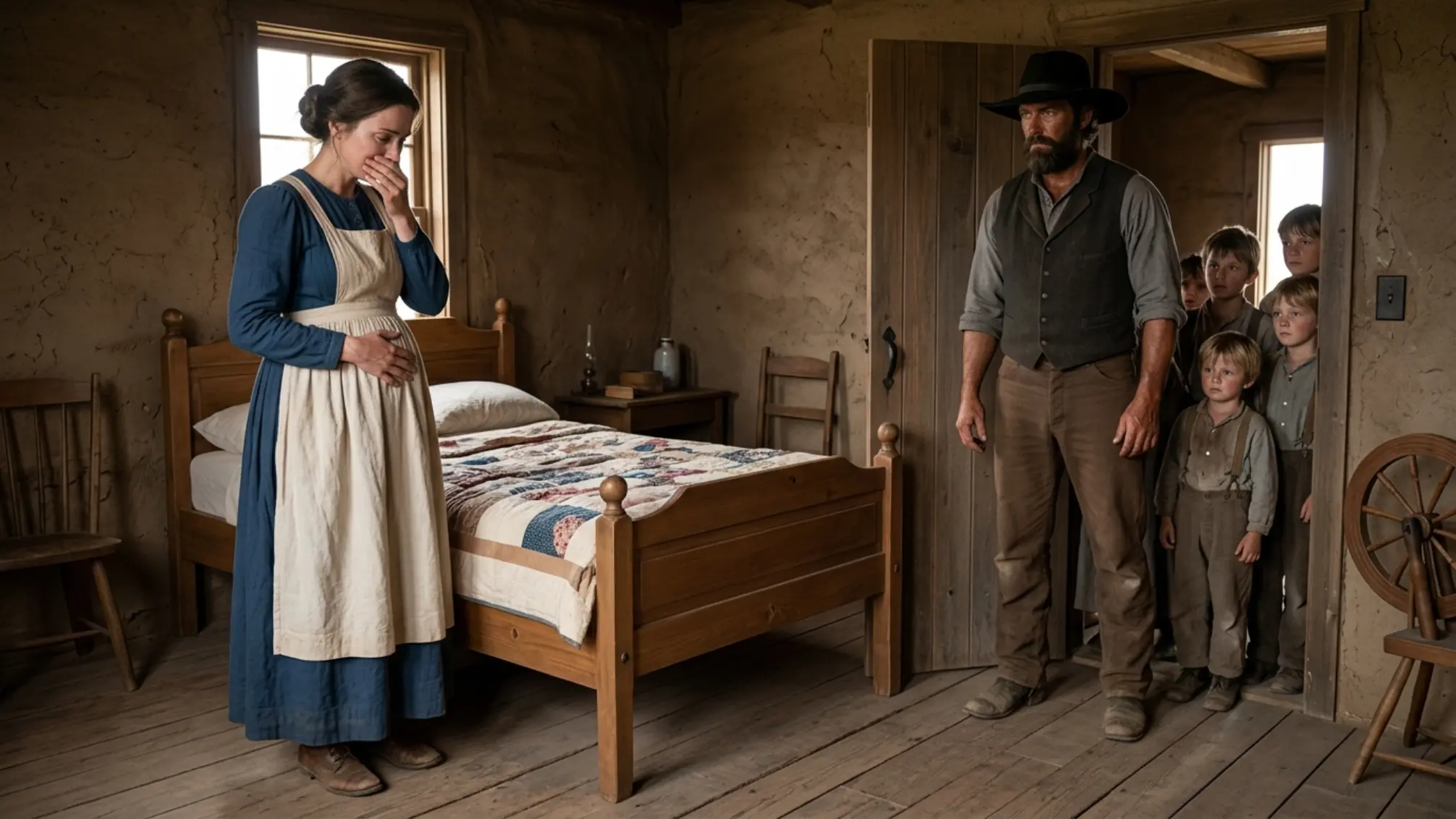
She had pictured a respectable farmhouse surrounded by wheat, perhaps a whitewashed fence, maybe flowers near the porch if the man’s daughters were old enough to care for them. She had imagined Jacob Whitaker waiting outside in a clean shirt, nervous but courteous, prepared to welcome the woman who had agreed through six carefully written letters to become his wife.
Reality was less polished.
The farmhouse sat alone beneath an enormous Kansas sky, weathered gray boards standing against miles of dry grass and late-summer fields. A barn leaned slightly toward the south. Chickens wandered beside a water pump. A broken wagon wheel rested against the porch as though someone had intended to repair it six months earlier and simply never found the time.
And five children were staring at her through the front window.
Eleanor touched one hand to the rounded curve beneath her blue traveling dress.
Her unborn baby moved faintly.
“Looks like they’re expecting you,” the driver said.
Eleanor swallowed.
“So it seems.”
Then the farmhouse door opened.
Jacob Whitaker stepped outside.
He was thirty-nine, although his letters had somehow made Eleanor imagine an older man. He was tall and broad through the shoulders, with sun-browned skin, dark hair touched slightly with gray near the temples, and a thick beard that made his serious expression look harder than it probably was.
He wore a faded gray work shirt, dark vest, brown trousers, dusty boots, and carried a black felt hat in both hands.
Jacob stopped beside the porch.
His eyes found Eleanor.
Then, despite every effort at politeness, they dropped toward her stomach.
Eleanor noticed.
Of course she did.
Jacob immediately looked embarrassed.
“Mrs. Hale.”
“Mr. Whitaker.”
The wagon driver lowered her suitcase.
Jacob stepped forward to take it.
“I hope the journey wasn’t too difficult.”
“It was long.”
“I’m sorry.”
“You didn’t build Kansas this far from Missouri.”
For the first time, something almost resembling amusement softened his face.
“No, ma’am.”
Eleanor climbed carefully down.
Jacob instinctively offered his hand.
She accepted.
His palm was rough and large, the hand of a man who had spent most of his life handling animals, timber, wire, and soil.
The moment her boots touched the ground, four children appeared on the porch.
The fifth remained half-hidden behind the doorway.
Jacob turned.
“I told you to give her room.”
“We are,” a little boy protested.
“You’re blocking the entire porch, Henry.”
The boy immediately moved six inches.
Jacob sighed.
Eleanor smiled.
That seemed to encourage them.
The oldest child was a girl of perhaps twelve, thin and serious, with brown hair braided tightly down her back. Beside her stood a boy around ten with freckles and a cautious expression. Henry appeared to be eight. A younger girl held a cloth doll against her chest.
The child hiding inside looked barely four.
Jacob cleared his throat.
“These are my children.”
He pointed gently.
“Rose is twelve. Thomas is ten. Henry is eight. Lucy is six.”
His gaze moved toward the doorway.
“And that shadow behind the door is Ben.”
“I’m not a shadow,” the small voice answered.
Eleanor crouched as much as her pregnancy allowed.
“No?”
Ben peeked around the frame.
“No.”
“What are you, then?”
He considered this very seriously.
“Ben.”
Eleanor nodded.
“That seems more useful than being a shadow.”
Lucy giggled.
Jacob looked toward Eleanor.
Something changed in his expression.
Not affection.
Not yet.
Relief, perhaps.
The children had clearly been the part of this arrangement he feared most.
Eleanor understood.
They entered the house together.
The main room was larger than she expected but painfully plain. A heavy wooden table stood beneath one window. Six mismatched chairs surrounded it. A cast-iron stove occupied the far wall, along with shelves of dishes and preserved food.
Everything was reasonably clean.
Nothing was decorative.
No flowers.
No framed pictures.
No curtains except one faded strip of cloth over the kitchen window.
It was not an unhappy house.
But it looked like a house that had forgotten how to be warm.
Jacob placed Eleanor’s suitcase beside the stairs.
“You’ll probably want to rest.”
“I’m fine.”
“You’ve been traveling.”
“I’ve been sitting.”
He frowned as though those were the same thing.
Rose came forward.
“We made your room.”
Jacob looked at her quickly.
“Rose.”
“What?”
“You don’t need to announce everything the moment she walks through the door.”
“But she should see it.”
Lucy nodded enthusiastically.
“We fixed it.”
Henry added, “I hammered something.”
Thomas muttered, “Badly.”
“I hammered it.”
“You bent three nails.”
“They still went into the wood.”
Jacob closed his eyes briefly.
Eleanor laughed.
“Then I should definitely see it.”
The children hurried toward the hallway.
Jacob remained behind.
Eleanor looked at him.
“You coming?”
He hesitated.
Then followed.
The room was small.
A handmade wooden bed stood beneath the window with a freshly washed quilt stretched carefully across it. Someone had placed wildflowers inside a chipped blue jar on the nightstand.
A narrow shelf had been installed slightly crooked beside the wall.
Henry’s contribution, Eleanor assumed.
A tiny cradle stood in one corner.
Eleanor stopped.
Her hand instinctively covered her mouth.
The children went silent.
The cradle was old but newly repaired.
Freshly sanded wood showed along one side where a crack had been mended. Inside rested a small folded blanket.
Eleanor touched her stomach.
“Where did this come from?”
Jacob looked uncomfortable.
“It was in the barn.”
Rose answered for him.
“It was ours.”
Jacob’s jaw tightened.
“Rose.”
“It was.”
She looked at Eleanor.
“Papa fixed it.”
Eleanor turned toward him.
Jacob stared at the floor.
“For the baby?”
“It needed repairing anyway.”
Thomas rolled his eyes.
“No, it didn’t.”
Jacob gave him a look.
Thomas immediately studied the ceiling.
Eleanor approached the cradle.
Her fingers moved over the smooth repaired wood.
She had spent months telling herself that she did not need anyone to care about this child before it was born.
Her first husband, Daniel Hale, had died before Eleanor even knew she was pregnant. A winter fever took him in less than five days.
Afterward, his family had offered sympathy but little else.
Daniel had left no farm, no business, no savings worth mentioning.
Only debts.
Eleanor found work sewing for a boarding house in St. Joseph, but as her pregnancy became more visible, the owner began making quiet suggestions about how difficult it might become to employ her after childbirth.
Then Eleanor had seen Jacob Whitaker’s advertisement.
Widowed Kansas farmer seeks respectable woman willing to marry and help raise five children. Stable home. No expectation of immediate affection. Honesty required.
Eleanor had laughed when she first read it.
No expectation of immediate affection sounded like the least romantic proposal ever printed.
Then she wrote to him.
She told Jacob everything.
Her widowhood.
Her pregnancy.
Her lack of money.
Jacob wrote back.
Your child did not create your hardship and should not be punished for it. If you are willing to consider five children mine, I can consider one child yours.
Eleanor had read that sentence twelve times.
Now she was standing beside the cradle he had repaired.
Tears filled her eyes.
Jacob became visibly alarmed.
“Is something wrong?”
Eleanor shook her head.
“No.”
“Did we do something?”
“No.”
“You don’t like the room?”
She laughed through tears.
“It’s beautiful.”
The five children relaxed simultaneously.
Jacob did not.
He watched her carefully.
“You can still leave.”
The room went quiet.
Eleanor looked at him.
Jacob continued.
“The driver hasn’t gone far. If this is more than you expected, I won’t blame you.”
Eleanor wiped beneath one eye.
“And leave five children wondering why nobody ever chooses them?”
Jacob’s expression changed.
The children stared at her.
His voice dropped.
“They already started calling this your room.”
Eleanor looked at the crooked shelf.
The flowers.
The quilt.
The repaired cradle.
Then she placed a hand over her heart.
“Then tell them I’m not sleeping here as a stranger tonight.”
Lucy immediately ran forward and wrapped both arms around Eleanor’s skirt.
Jacob inhaled sharply.
Rose turned away, pretending to examine the window.
Henry smiled.
Thomas said nothing, but the tension left his shoulders.
Little Ben approached Eleanor last.
He touched her stomach cautiously.
“Is there really a baby?”
“Yes.”
“When?”
“Probably before Christmas.”
He thought about this.
“Can it sleep in my room?”
Jacob finally laughed.
“No, Benjamin.”
“Why?”
“Because babies scream.”
“So does Lucy.”
“I do not!”
“You screamed when the chicken chased you.”
“That chicken was mean.”
Within seconds, all five children were arguing.
Eleanor stood in the middle of them with tears still wet on her cheeks.
Jacob watched from the doorway.
Something inside his chest tightened painfully.
For three years, he had convinced himself the house needed another woman because the work required one.
Cooking.
Laundry.
Children.
Schooling.
A farm did not care whether grief had made a man tired.
But watching Eleanor surrounded by his children, Jacob understood how badly he had lied to himself.
The house did not need a woman.
His family needed hope.
And hope had just arrived carrying one suitcase and another man’s unborn child.
Eleanor and Jacob married six days later.
There was no grand ceremony.
Reverend Samuel Pike rode out from town on a Sunday afternoon, ate dinner with them, opened his Bible near the kitchen window, and pronounced them husband and wife while five children watched with almost unbearable seriousness.
Jacob gave Eleanor a simple silver ring that had belonged to his mother.
Afterward, Lucy asked when they were supposed to kiss.
Jacob nearly dropped the Bible.
Rose whispered, “Lucy!”
“What?”
Reverend Pike developed sudden great interest in packing his satchel.
Eleanor looked toward Jacob.
Jacob looked terrified.
That amused her enough to remove some of her own nervousness.
She stepped closer.
“You heard the girl.”
Jacob lowered his voice.
“She’s six.”
“She seems very committed to proper ceremony.”
He looked at Eleanor’s lips.
“May I?”
“Yes.”
Their first kiss was brief.
Gentle.
Almost formal.
But when Jacob pulled away, Eleanor felt something she had not expected.
Not passion exactly.
Possibility.
Jacob seemed to feel it too.
He did not meet her eyes for several seconds.
Lucy clapped.
Henry complained that nothing interesting had happened.
Thomas shoved him lightly.
Ben asked whether marriage meant Eleanor could now make pie.
And just like that, life resumed.
Eleanor learned quickly that Jacob Whitaker worked from before sunrise until long after most sensible men would have stopped.
He was in the barn when she woke.
In the fields after breakfast.
Repairing fences before supper.
Checking livestock after dark.
He rarely complained.
He rarely spoke unless necessary.
And he had absolutely no understanding of how to ask anyone for help.
That irritated Eleanor immediately.
The first argument happened over laundry.
Jacob returned from the field and found Eleanor carrying a basket toward the clothesline.
He removed it from her hands.
“What are you doing?”
“Laundry.”
“You shouldn’t carry this.”
“I carried it ten feet.”
“You’re pregnant.”
“I had noticed.”
“Then sit.”
Eleanor stared.
Jacob pointed toward the porch chair.
“Please.”
“That sounded remarkably unlike a request.”
His brows knitted.
“I’m trying to help.”
“So am I.”
“You don't need to prove you can work.”
“I’m not proving anything.”
Jacob looked at the basket.
Eleanor crossed her arms.
“I am your wife, Jacob, not a porcelain doll you ordered from St. Louis.”
“I didn’t order you.”
“You placed an advertisement.”
“That sounds worse when you say it like that.”
“It should.”
Jacob almost smiled.
Eleanor caught it.
“Do not smile. We are arguing.”
“I’m sorry.”
“You’re not.”
“No.”
Now she smiled too.
The argument ended with Jacob carrying the basket and Eleanor hanging the clothes.
That became their rhythm.
Neither surrendered completely.
Both adjusted.
The children adjusted faster than Jacob expected.
Rose was the hardest.
At twelve, she had spent three years functioning as the woman of the house.
She cooked badly but persistently.
She washed her siblings’ clothes.
She helped Lucy braid her hair.
She soothed Ben after nightmares.
Eleanor never tried to replace her authority.
Instead, she asked Rose to teach her.
“Your father likes eggs how?”
“Too cooked.”
“Bread?”
“Dark.”
“Coffee?”
“Strong enough to remove paint.”
Eleanor laughed.
Within weeks, Rose stopped guarding the kitchen.
Then one evening Eleanor found her sitting alone behind the barn.
“You all right?”
Rose nodded too quickly.
Eleanor sat beside her.
For several minutes they watched the sunset.
Then Rose whispered, “I barely remember Mama’s voice.”
Eleanor said nothing.
“If you stay long enough, Ben won’t remember her at all.”
The words carried guilt.
Eleanor understood.
“I’m not here to erase her.”
Rose looked at her.
“Papa never talks about her.”
“That doesn’t mean he forgot.”
“He keeps her blue dress in a chest.”
Eleanor nodded.
“Then we leave the chest exactly where it is.”
Rose’s eyes filled.
“You don’t mind?”
“No.”
Eleanor took her hand.
“There is enough room in a family to love people who are gone and people who are still here.”
Rose began crying.
Eleanor pulled her close.
From the barn doorway, Jacob saw them.
He quietly stepped back before either noticed.
That night, after the children slept, he found Eleanor washing dishes.
“Thank you.”
She looked over.
“For?”
“Rose.”
Eleanor dried her hands.
“She misses her mother.”
“I know.”
“You should talk to her about Abigail.”
Jacob stiffened slightly.
Abigail.
His dead wife’s name still had the power to close his throat.
“I don’t know what to say.”
“Tell her something small.”
“Like what?”
“What Abigail burned when she cooked.”
Jacob looked surprised.
“She burned everything.”
“Perfect.”
“She once ruined boiled potatoes.”
Eleanor laughed.
“How?”
“I still don’t understand.”
“Tell Rose.”
Jacob looked toward the hallway.
“You make things sound easy.”
“No.”
Eleanor stepped closer.
“I just make them sound possible.”
Their eyes met.
Jacob lifted one hand.
Then stopped before touching her face.
Eleanor noticed.
“You can.”
His fingers brushed her cheek.
“You’re sure?”
“Yes.”
He kissed her.
Not like the wedding.
This one lasted.
When they separated, Eleanor rested her forehead against his chest.
Jacob's arms slowly surrounded her.
They stood beside the kitchen stove in silence.
For the first time since Daniel died, Eleanor did not feel guilty for being held by another man.
For the first time since Abigail died, Jacob did not feel that loving someone new would betray someone old.
Autumn came early.
Eleanor’s stomach grew heavier.
Jacob became increasingly impossible.
He watched her on stairs.
Watched her near the stove.
Watched her when she carried anything heavier than a spoon.
One afternoon she caught him following her toward the chicken coop.
She turned.
“Jacob.”
“Yes?”
“Why are you behind me?”
“I’m going to the barn.”
“The barn is that way.”
He looked toward it.
“I knew that.”
“You’re following me.”
“No.”
“Jacob Whitaker.”
He sighed.
“I worry.”
“You hover.”
“You could fall.”
“So could you.”
“That’s different.”
“How?”
“I’m not carrying a baby.”
Eleanor stepped close.
“You are carrying six children.”
Jacob frowned.
“Five.”
She placed his hand over her stomach.
The baby kicked.
Jacob froze.
Eleanor watched his face soften.
“Six.”
His expression became almost unbearably tender.
Then fear passed through it.
Eleanor saw.
“What?”
“Nothing.”
“Jacob.”
He pulled his hand away.
She caught it.
“What are you afraid of?”
He looked toward the field.
Eleanor waited.
Finally he whispered, “Abigail died giving birth to Ben.”
Everything became still.
Eleanor knew Abigail had died shortly after Ben’s birth.
She had never known how.
Jacob stared at the ground.
“There was bleeding.”
Eleanor tightened her grip around his hand.
“The doctor couldn't stop it.”
His voice became rough.
“I stood beside the bed holding a newborn boy while my wife died.”
Eleanor said nothing.
“I buried her three days later.”
Jacob looked at Eleanor’s stomach.
“When I see you carrying this baby, sometimes I don’t see you.”
He swallowed.
“I see that room.”
Eleanor stepped into his arms.
Jacob resisted for half a second.
Then held her fiercely.
“I’m scared too,” she whispered.
He looked down.
“You are?”
“Of course.”
“You never say it.”
“Neither do you.”
That almost made him laugh.
Eleanor continued.
“But fear doesn’t decide what happens next.”
Jacob's arms tightened around her.
“No.”
She rested her cheek against him.
“We prepare.”
So they did.
Jacob arranged for Dr. Matthew Collins to stay nearby as Eleanor’s due date approached.
Rose prepared linens.
Lucy folded baby clothes so many times they almost wore out before being used.
Henry repaired the cradle badly.
Jacob repaired Henry’s repair.
Thomas carved a tiny wooden horse.
Ben asked every morning whether the baby had arrived overnight.
The farmhouse filled with anticipation.
And fear.
The first snow arrived on December 14.
Eleanor woke before dawn with pain low across her abdomen.
She knew immediately.
Jacob was asleep beside her.
For several minutes, she watched him.
Then another contraction came.
She gripped the blanket.
Jacob woke instantly.
“What?”
Eleanor breathed.
“I think it’s time.”
The color drained from his face.
Within fifteen minutes, the entire farmhouse was awake.
Rose took charge of the younger children.
Thomas ran to saddle the horse for the doctor.
Jacob nearly forgot how boots worked.
Eleanor caught his hand.
“Look at me.”
He did.
“You’re frightening the children.”
“I’m fine.”
“You look like you’re about to face a firing squad.”
“I said I’m fine.”
Another contraction hit.
Eleanor squeezed his hand hard enough to make him wince.
“You’re not the one giving birth.”
“That is becoming very clear.”
Hours passed.
Dr. Collins arrived before noon.
By evening, the labor had become difficult.
Jacob paced outside the bedroom.
Rose sat at the kitchen table with Lucy and Ben.
Nobody spoke.
Every sound from behind the closed door tightened Jacob’s chest.
He remembered Abigail.
The blood.
The doctor’s expression.
Her hand becoming cold inside his.
Jacob stepped outside.
Snow fell steadily.
He stood on the porch without a coat.
Thomas followed.
“Papa?”
Jacob did not turn.
“What if she dies?”
Thomas had never heard his father sound like that.
“I don’t know.”
Jacob covered his face.
“I can’t do this again.”
Thomas stood beside him.
“You told us she was strong.”
“She is.”
“Then believe yourself.”
Jacob looked toward his ten-year-old son.
The boy shrugged.
“That’s what Eleanor says when I’m scared.”
Jacob laughed once.
Then cried.
Only for a moment.
He wiped his face.
They went inside.
Shortly after midnight, a cry came from the bedroom.
Not Eleanor.
A baby.
Jacob froze.
The children rose simultaneously.
Then the door opened.
Dr. Collins appeared.
He looked exhausted.
But he smiled.
“Healthy girl.”
Jacob did not move.
“And Eleanor?”
“Exhausted.”
The doctor’s smile widened.
“But perfectly alive.”
Jacob nearly collapsed.
He entered the bedroom slowly.
Eleanor lay against the pillows, pale and tired, holding a tiny wrapped child against her chest.
She looked toward him.
“You look terrible.”
Jacob laughed through tears.
“So do you.”
“That’s rude.”
“I’m sorry.”
He sat beside her.
For several seconds, he could not touch either of them.
Eleanor understood.
She took his hand and placed it against the baby's back.
Jacob began crying openly.
“She’s all right?”
“She’s perfect.”
“And you?”
“Still here.”
Jacob bowed his head against Eleanor’s hand.
“Still here,” she repeated.
The bedroom door opened slightly.
Five faces appeared.
Eleanor smiled.
“Come in.”
The children gathered around the bed.
Lucy immediately cried.
Ben stared at the infant.
“She’s small.”
“You were smaller,” Rose said.
“No.”
“Yes.”
“No.”
Eleanor laughed weakly.
Jacob looked around the room.
Six children.
His wife.
The repaired cradle.
The crooked shelf Henry had built months earlier.
He suddenly remembered the first evening.
You can still leave.
Jacob looked at Eleanor.
“You stayed.”
She met his eyes.
“You sound surprised.”
“I think I always will be.”
Eleanor smiled.
“Then get used to being surprised.”
They named the baby Grace Abigail Whitaker.
Grace for what Eleanor believed had brought them together.
Abigail because Eleanor insisted the woman who had helped create this family deserved a place inside its future.
When Jacob heard the full name, he could not speak for nearly a minute.
Rose understood before anyone else.
She hugged Eleanor carefully.
Years passed.
The farmhouse changed.
Jacob repaired the porch.
Eleanor planted flowers beneath every front window.
Rose eventually married a neighboring rancher.
Thomas took over more farm work.
Henry became far better with a hammer.
Lucy developed a talent for sewing.
Ben grew old enough to deny he had ever been frightened of chickens.
And Grace followed everyone everywhere.
Travelers passing the Whitaker farm sometimes heard the story about how Eleanor had arrived pregnant, carrying one suitcase and enough courage for an entire household.
They usually told it as though Jacob had rescued her.
Jacob always corrected them.
“No.”
Then he would look across the yard toward Eleanor.
“She rescued this place.”
Eleanor hated when he said it.
“You had a perfectly functioning farm.”
“I had buildings.”
“You had children.”
“I had people living beneath the same roof.”
He would take her hand.
“You made us a family again.”
One summer evening, nearly ten years after her arrival, Eleanor stood inside the old bedroom where she had first cried beside the handmade cradle.
The cradle now rested against the wall.
Grace had long outgrown it.
Jacob entered behind her.
“What are you doing?”
“Remembering.”
He looked around.
“The room was terrible.”
Eleanor turned.
“It was beautiful.”
“The shelf was crooked.”
“It still is.”
“I offered to fix it.”
“I wouldn’t let you.”
Jacob smiled.
He approached.
“You really thought about leaving that day?”
Eleanor considered lying.
“Yes.”
His smile disappeared.
“For how long?”
“Perhaps thirty seconds.”
“What changed your mind?”
Eleanor looked toward the cradle.
“The children.”
Jacob nodded.
Then she looked at him.
“And you.”
“Me?”
“You were terrified.”
“I wasn't.”
“You were.”
“Of what?”
Eleanor smiled.
“Of hoping.”
Jacob became quiet.
She touched his beard, now threaded with more gray.
“You looked at me like you were preparing yourself for another person to leave.”
He covered her hand with his.
“And then?”
“I decided I wanted to know what you would look like if someone stayed.”
Jacob lowered his forehead to hers.
“And?”
Eleanor kissed him gently.
“Worth the journey.”
Outside, children called across the yard.
Grace laughed somewhere near the barn.
The Kansas wind moved through the wheat.
Jacob wrapped both arms around his wife.
Years earlier, Eleanor Hale had arrived believing she needed nothing more than shelter, stability, and a father willing to accept her unborn child.
Jacob Whitaker had believed he needed someone practical enough to help raise five children.
They had both been wrong.
What Eleanor needed was somewhere she could belong without apologizing for the life she carried with her.
What Jacob needed was someone brave enough to walk into a house filled with grief and refuse to treat it as permanent.
Five children had prepared a room.
A frightened farmer had repaired a cradle.
And a pregnant widow had looked at all of them and made the decision that changed seven lives before her own baby was even born.
She stayed.
And sometimes, that was the most powerful promise a person could make.