“Sorry, I didn’t order this.”
The elderly man stared at the hot plate Hannah Cole had placed beside his steaming coffee. Rainwater dripped from the brim of his charcoal cap and gathered beneath his chair near the front window of Cole’s Family Restaurant in downtown Columbus. His hands trembled so badly that the spoon rattled against the saucer. Hannah pulled the plate closer and gave him the gentlest smile she could manage after nine hours on her feet.
“You’re soaked, freezing, and confused,” she said. “You need food more than I need permission.”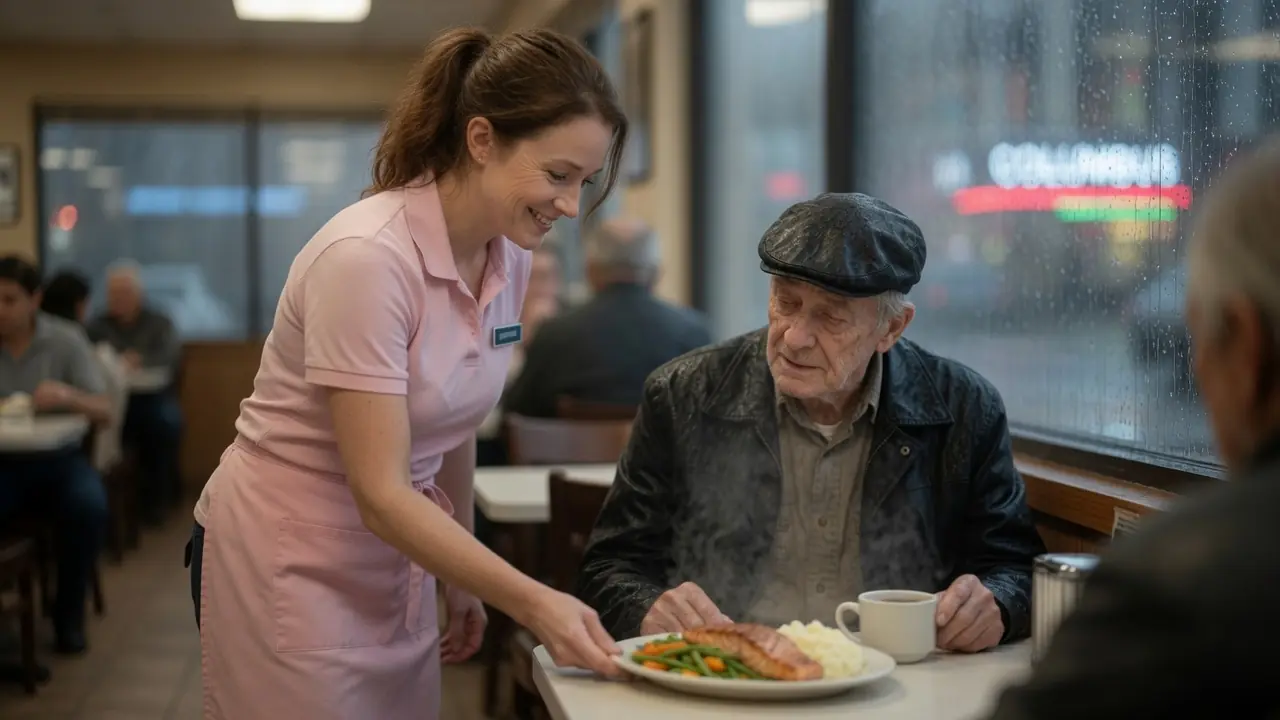
The restaurant was nearly empty because the evening storm had flooded several streets around the business district. Only two booths remained occupied, and most of the staff had begun wiping counters and preparing to close. Hannah’s manager, Tom Reed, was upstairs reviewing inventory, which gave her perhaps fifteen minutes before he noticed the unpaid meal. She knew exactly what would happen when he did.
Tom counted everything.
He counted dinner rolls, coffee refills, sugar packets, broken glasses, and the number of minutes each waitress spent speaking to customers after presenting the check. Nothing left the kitchen without appearing on a receipt, and no employee was allowed to discount food without his approval. Hannah had seen him deduct the cost of a dropped dessert from a teenage server’s paycheck. Giving away grilled salmon, mashed potatoes, and vegetables could easily cost her the job she desperately needed.
The old man looked down at the plate. “I can’t pay.”
“I know.”
“My wallet is gone.”
“That can wait.”
His watery gray eyes lifted toward her. “I don’t remember where I live.”
Hannah’s expression changed. She had assumed he was homeless when she first saw him standing beneath the restaurant awning, but his clean beige shirt, expensive watch, and well-made leather shoes suggested something else. He looked lost rather than abandoned. The rain had soaked his coat, yet he carried no bag and possessed nothing identifying him except the name Arthur, which he remembered only after Hannah asked several times.
“Do you know your last name?” she asked.
“Bennett,” he whispered. “Arthur Bennett.”
“Do you know your son’s name?”
The old man closed his eyes, searching through fog that frightened him more than the storm. “Michael. Or Matthew.” His voice broke. “He’ll be angry that I wandered off.”
“He’ll be relieved when he finds you.”
Arthur shook his head. “I don’t remember his number.”
Hannah sat in the chair opposite him, though waitresses were forbidden to sit with customers. At thirty-two, she understood the terror of being responsible for someone vulnerable while lacking every answer. Her eight-year-old daughter, Lily, suffered from severe asthma, and more than once Hannah had sat beside a hospital bed wondering whether she had missed a sign that should have warned her earlier. No frightened person deserved to be treated as an inconvenience.
“Eat,” Hannah told Arthur. “Then we’ll call every hospital and police station until someone finds your family.”
He took one careful bite of salmon.
For several seconds, he chewed without expression. Then his shoulders dropped, and something almost like relief moved across his face. Hannah pushed the coffee closer and asked another waitress to bring a dry kitchen towel. She wrapped it around Arthur’s shoulders while he ate.
The restaurant’s assistant cook, Miguel, approached cautiously. “Tom’s coming downstairs.”
Hannah glanced toward the office staircase. “Tell him table seven ordered the meal.”
“No one is assigned to table seven.”
“I am now.”
Miguel looked at Arthur and understood immediately. “I’ll say the kitchen made it by mistake.”
“No. Tom will charge you.”
“He’ll charge someone anyway.”
Hannah shook her head. “Let it be me.”
Tom Reed entered the dining room two minutes later wearing a navy suit and the irritated expression he carried whenever weather reduced profits. He stopped beside the register, scanned the nearly empty room, and immediately noticed the salmon plate near Arthur. His eyes shifted toward Hannah.
“What check is that on?”
Hannah stood. “Mine.”
Tom approached the table. “You ordered salmon during your shift?”
“No. I gave it to him.”
Arthur lowered his fork.
Tom stared at the wet elderly man as if examining trash left in the dining room. “Does he have money?”
“He’s lost and confused. I’ve contacted the police.”
“That was not my question.”
“No, he can’t pay.”
Tom’s face tightened. “Then remove the food.”
Arthur instinctively placed both hands near the plate. The movement was small, but Hannah saw the fear behind it. She stepped between Tom and the table.
“He has already started eating.”
“That meal costs twenty-eight dollars.”
“I’ll cover it.”
“With what?” Tom asked. “You begged me for extra shifts because you’re behind on rent.”
Several employees stopped working.
Hannah felt their eyes on her, but she refused to look away from Tom. He knew about the rent because she had asked to work two double shifts after Lily’s latest hospital visit consumed most of her savings. Using that information publicly was not necessary. He did it because humiliation helped him maintain control.
“I said I’ll cover it,” Hannah repeated.
Tom pointed toward the register. “Ring it under your employee meal and pay before leaving.”
Employee discounts did not apply to salmon, but Hannah knew arguing would only make Arthur more anxious. She nodded, returned to the table, and sat beside him until he finished. Tom remained nearby long enough to ensure everyone understood who had won.
Arthur ate slowly.
Between bites, fragmented memories returned. He remembered a white house, a red front door, and a woman named Eleanor who had been dead for six years. He believed he had attended a doctor’s appointment that afternoon but could not explain how he reached the restaurant. When police arrived, they checked missing-person reports but initially found no match.
Hannah refused to let Arthur leave alone.
An officer eventually contacted a nearby hospital, where a panicked family had reported a missing seventy-eight-year-old man with early-stage dementia. Arthur’s son had been searching for nearly five hours after discovering that his father left a medical building while the driver was bringing the car around. Police arranged to take Arthur to the hospital for evaluation.
Before leaving, Arthur held Hannah’s hand.
“You fed me before you knew anyone was looking,” he said.
“Anyone would have.”
The police officer glanced toward Tom. “Not everyone.”
Arthur looked at Hannah’s name badge carefully. “Hannah Cole.”
“That’s right.”
“I want to remember.”
She smiled. “You already remembered your son. That’s what matters.”
Arthur was driven away shortly after closing. Hannah paid for the meal using money she had planned to put toward Lily’s inhaler refill. Miguel offered to cover half, but she refused. She did not want Tom using another employee’s kindness as a reason to punish two people instead of one.
At home, Lily was asleep on the couch beneath a purple blanket. Hannah’s neighbor, Mrs. Alvarez, had stayed later than planned because the storm delayed buses. Hannah paid her, checked Lily’s breathing, and sat on the floor beside the couch.
Her bank account contained sixty-three dollars.
Rent was due in four days. Lily’s prescription cost forty-eight, and the restaurant would not issue another paycheck for six days. Hannah leaned her head against the couch and told herself she would find another shift, sell something, or delay one bill long enough to cover another.
She did not regret feeding Arthur.
That frightened her slightly, because regret might have made the practical consequences easier to accept. Instead, she felt only anger that kindness required financial punishment. The restaurant had discarded more food the previous night than Arthur could have eaten in a week.
At seven the next morning, Tom called.
“Come in early,” he said. “We need to discuss last night.”
Hannah arranged for Mrs. Alvarez to take Lily to school and reached the restaurant before opening. The back office smelled of old coffee, printer ink, and the grease that traveled through every wall of the building. Two waitresses stood near the storeroom doorway, pretending to organize supplies while Tom waited behind his desk.
The salmon receipt lay on top of a stack of schedules.
Tom tapped it with one finger. “Twenty-eight dollars.”
“I paid it.”
“That does not erase your violation.”
Hannah clasped her hands together. “A confused elderly man was standing outside in freezing rain.”
“You brought him inside without asking.”
“He needed help.”
“He looked like he couldn’t pay.”
“That’s why I fed him.”
Tom leaned across the desk. “You gave away my best salmon to a filthy old man who had no business being in my restaurant.”
Hannah’s fear became anger.
“He was a frightened human being calling for his son.”
“He was a liability.”
“He could have died outside.”
“And that would not have been our responsibility.”
The two waitresses in the doorway exchanged horrified looks. Tom noticed but continued because he mistook their silence for agreement.
“This restaurant is a business,” he said. “Not a shelter for every dirty stranger who appears during bad weather.”
Hannah’s voice shook, but she held her ground. “He was cold, confused, and unable to remember where he lived. I’d feed him again.”
Tom smiled without warmth. “Then do it somewhere else.”
He opened the desk drawer, removed a termination form, and pushed it toward her. Hannah stared at the paper. Her name, employee number, and final shift date had already been entered, proving he had decided to fire her before she arrived.
“You’re terminating me for one meal I paid for?”
“I’m terminating you for insubordination, unauthorized food distribution, and creating risk.”
“What risk?”
“The old man could have fallen, become sick, or accused us of something.”
“He was already sick.”
“That does not make him my problem.”
Hannah looked toward the two waitresses. Neither spoke, but tears filled one woman’s eyes. Everyone working under Tom had experienced smaller versions of the same cruelty. He reduced hours when employees refused extra unpaid duties, threatened workers who discussed wages, and mocked anyone who asked for emergency leave.
Hannah removed her name badge.
Tom pointed toward the door. “Leave your apron too.”
She untied the white apron with hands that had begun trembling. Her mind raced through rent, prescriptions, groceries, and the difficult conversation she would eventually have with Lily. Single motherhood had trained her to absorb panic privately so her daughter could continue believing the world was stable.
Then the office door opened.
A tall man in a charcoal suit entered carrying a phone and a folded missing-person flyer. He appeared to be in his mid-forties, with silver beginning at his temples and exhaustion beneath his dark eyes. Behind him stood the same police officer who had collected Arthur the night before.
The stranger looked first at Hannah, then at the termination paper.
“Before she leaves,” he said, “explain why the woman who saved my father is being punished.”
Tom straightened. “Who are you?”
“Michael Bennett.”
Hannah recognized the surname.
Michael crossed the office and offered her his hand. “Arthur Bennett is my father.”
“How is he?”
“Safe. Dehydrated, exhausted, and confused, but safe.” Emotion tightened his voice. “The doctors said the hot food and coffee likely helped stabilize him until police arrived.”
Hannah released a breath she had been holding since the previous night. “I’m glad.”
Michael turned toward Tom. “Now explain.”
Tom attempted a professional smile. “There has been a misunderstanding. Hannah violated several policies unrelated to your father.”
The police officer folded his arms.
Michael placed his phone on the desk and played security footage obtained from the restaurant’s dining room camera. The video showed Arthur soaked and trembling near the window. It showed Hannah bringing the meal, wrapping him in a towel, and remaining beside him. It also showed Tom approaching the table and demanding payment.
“My father wandered almost three miles after becoming separated from his driver,” Michael said. “He had not eaten since breakfast and could not explain who he was. Your employee recognized that he needed help.”
Tom adjusted his tie. “And I allowed him to remain.”
“You ordered her to remove his food.”
“She had already served it.”
“You called him filthy.”
Tom’s face changed. He looked toward the waitresses, wondering which of them had repeated the word. Michael answered the question before he asked.
“The office door was open when I arrived.”
Tom looked toward Hannah. “This is an internal employment issue.”
Michael nodded. “Then let us discuss the external business issue.”
He removed a card from his pocket and placed it beside the receipt. Beneath his name appeared the title President, Bennett Hospitality Group.
Tom read it twice.
Bennett Hospitality owned restaurants, hotels, and catering companies across Ohio. More importantly, it held the commercial property company that had purchased the building housing Cole’s Family Restaurant six months earlier. Tom had boasted repeatedly that the new landlord planned to renovate the block and attract wealthier customers.
Michael Bennett controlled that landlord.
Tom’s voice became cautious. “Mr. Bennett, I wasn’t aware your family had any connection to our lease.”
“That should not matter.”
“Of course not.”
“But it clearly does.” Michael looked toward Hannah. “My father deserved dignity before anyone knew my name.”
Hannah remained silent.
Michael turned back to Tom. “Your lease renewal is under review next month. Yesterday, I planned to approve a five-year extension. This morning, I watched you fire an employee for preventing an emergency inside a property my company owns.”
“You cannot threaten my business over one disciplinary decision.”
“I’m not threatening you. I’m informing you that leadership practices affect whether we consider a tenant responsible.”
Tom looked toward the police officer. “Was a crime committed?”
The officer replied calmly. “Not by Hannah.”
“This is ridiculous.”
Michael’s expression hardened. “Your restaurant uses the Bennett Foundation’s community-employment grant, correct?”
Tom stopped speaking.
The grant subsidized part of the restaurant’s payroll in exchange for maintaining fair employment standards and emergency-assistance policies. Michael had helped establish that program after his mother died. Firing someone for aiding a vulnerable adult could trigger immediate review and repayment.
“You will preserve all schedules, payroll records, disciplinary files, and security footage,” Michael said. “My compliance team will arrive this afternoon.”
Tom stood. “You are trying to destroy me.”
“No. I’m looking at what you built.”
He collected the termination form and handed it to Hannah. “Do not sign this.”
Tom reached for the paper. “That belongs to the restaurant.”
“It concerns her employment. She may retain a copy.”
Hannah looked between the two men. She appreciated Michael’s defense, but the fear inside her had not disappeared. Powerful strangers could enter dramatically and leave just as quickly, while rent and groceries remained.
“I still need work,” she said quietly.
Michael nodded. “I know.”
Tom seized the opening. “She can keep her position if this entire situation ends now.”
Hannah looked at him.
Yesterday, she might have accepted immediately. She needed the paycheck, and every practical instinct urged her to protect it. Yet returning after he humiliated her, insulted Arthur, and fired her for compassion would teach him that desperation erased boundaries.
“No,” she said.
Tom appeared shocked. “You’re refusing your job?”
“I’m refusing to keep begging you for basic decency.”
She placed the apron on his desk.
Michael did not offer her a grand reward in that moment. He asked for her contact information, promised to cover the prescription and wages she would lose during the investigation, and invited her to meet his company’s human-resources director that afternoon. Hannah accepted only after confirming that the assistance carried no hidden obligation.
By noon, Bennett Hospitality’s compliance team entered the restaurant.
They interviewed every employee separately. The complaints extended far beyond Arthur’s meal. Workers described altered timecards, unpaid closing duties, retaliatory scheduling, verbal abuse, and deductions that violated state employment rules.
Miguel produced photographs of discarded food Tom refused to donate because he believed giving meals away would attract poor people. Another waitress revealed that Tom had ordered employees not to call ambulances unless customers could prove they had insurance. A former employee submitted messages showing that Tom fired her after she missed a shift to care for a hospitalized child.
The restaurant closed temporarily three days later.
Tom accused Hannah of leading a conspiracy. The grant administrator demanded repayment, labor investigators opened a case, and the building owner declined to renew the lease under his management. Within a month, Cole’s Family Restaurant no longer belonged to Tom Reed.
Michael Bennett did not abandon the location.
He purchased the restaurant’s assets through a legal settlement and offered employment to every worker who wanted to return. Miguel became kitchen manager, the senior waitress received responsibility for training, and discarded safe food was donated nightly through a local shelter partnership.
Hannah was offered assistant general manager.
She hesitated.
“I’m a waitress,” she told Michael during the interview.
“You noticed a medical emergency before anyone else did, protected a stranger despite financial risk, coordinated with police, and stood against a manager while your own job was threatened,” he replied. “Those are leadership decisions.”
“I don’t have management training.”
“We can provide it.”
“I need hours that work with my daughter’s schedule.”
“Then we build the schedule around reality rather than pretending employees have no families.”
Hannah accepted.
The salary covered rent, Lily’s medical needs, and something Hannah had not possessed for years: the ability to plan beyond the next bill. She completed management courses through the company and helped redesign the restaurant around a simple principle.
No hungry person would be humiliated at the door.
The policy did not mean unlimited free food or unsafe situations. Employees received clear guidance for helping vulnerable customers, contacting emergency services, and using a small community-meal fund without risking their own wages. Every donated meal was documented, but the documentation existed to support kindness rather than punish it.
Arthur visited the restaurant six weeks later.
He entered holding Michael’s arm and wearing the same charcoal cap, now dry and carefully brushed. His memory remained uneven, but he recognized the window table immediately. Hannah approached in her new dark-blue manager’s uniform.
Arthur smiled.
“You fed me.”
“Yes, I did.”
“I remembered.”
Michael helped his father sit. Hannah placed coffee in front of him, followed by grilled salmon, mashed potatoes, and vegetables. This time, the receipt displayed PAID — BENNETT FAMILY TABLE.
Arthur looked toward her name badge. “Hannah Cole.”
“That’s right.”
He reached across the table and took her hand. “You stayed when I didn’t know who I was.”
Hannah’s eyes filled. “You still knew you had a son.”
“He found me because you didn’t send me away.”
Lily joined them after school. Arthur listened seriously while she described a science project involving clouds and rain. He did not remember every detail five minutes later, but he remembered that she was Hannah’s daughter and that she liked purple.
The reopened restaurant became successful for reasons Tom would never have understood.
Customers returned not because the menu became expensive or exclusive, but because the room felt human. Families brought elderly parents without fearing impatience. Hospital employees stopped after late shifts, and police officers knew confused or vulnerable people would receive water and a safe chair while help arrived.
The restaurant still made money.
It simply stopped treating compassion as a financial defect.
A year later, Hannah became general manager. She hired other single parents, created predictable schedules, and established an emergency fund employees could access without public humiliation. Miguel’s new menu increased profits, and the restaurant earned recognition from the city for community service.
Tom filed a lawsuit claiming the business had been taken from him unfairly.
Payroll records, security footage, grant violations, and employee testimony ended the case quickly. He eventually accepted a settlement requiring repayment of stolen wages and prohibiting him from managing any business receiving public employment funds.
Hannah never celebrated his failure.
She remembered too clearly how close fear had brought her to accepting his offer and returning to work. Desperation did not make people weak. It made them vulnerable to employers who understood exactly how expensive resistance could become.
On the second anniversary of the storm, rain struck the front windows almost as heavily as it had the night Arthur wandered inside. Hannah stood near the host station while Lily completed homework in a corner booth. Arthur and Michael sat at table seven, sharing dinner.
A young server approached Hannah.
“There’s a woman outside,” he said. “She’s soaked and says she lost her bus card. I don’t know if she can pay.”
Hannah looked through the window.
An exhausted woman stood beneath the awning holding a sleeping child against her shoulder.
“Bring them inside,” Hannah said.
“Should I open a community-meal receipt?”
“Yes. Two hot meals, coffee, and milk.”
The server nodded and hurried toward the door.
Michael had overheard. “You didn’t hesitate.”
Hannah watched the mother enter and look around nervously. “Someone once taught me that helping first doesn’t mean asking questions never. It just means survival comes before paperwork.”
Arthur raised his coffee cup slightly.
He might not have remembered the entire sentence, but he understood the feeling behind it.
Tom Reed had believed a plate of salmon was worth more than the frightened old man receiving it. He fired Hannah because he saw kindness as waste and poverty as contamination.
The man he dismissed as filthy had a powerful son.
But that was never why Arthur deserved to eat.
He deserved the meal when he was only a nameless, soaked stranger who could offer nothing in return.
Hannah understood that before anyone else did.
And because she did, one lost old man found his family, one frightened single mother found her own strength, and one restaurant learned that the most valuable thing placed on its tables was never the food.