Daniel Carter pulled his old tow truck into the parking lot of Miller’s Roadside Diner just as the sky turned the color of wet steel.
Rain clouds rolled low over the highway, heavy and dark, pressing down on the small town of Brookhaven like the whole evening was about to collapse.
The wind pushed loose leaves across the asphalt, and the neon sign above the diner flickered twice before glowing red again.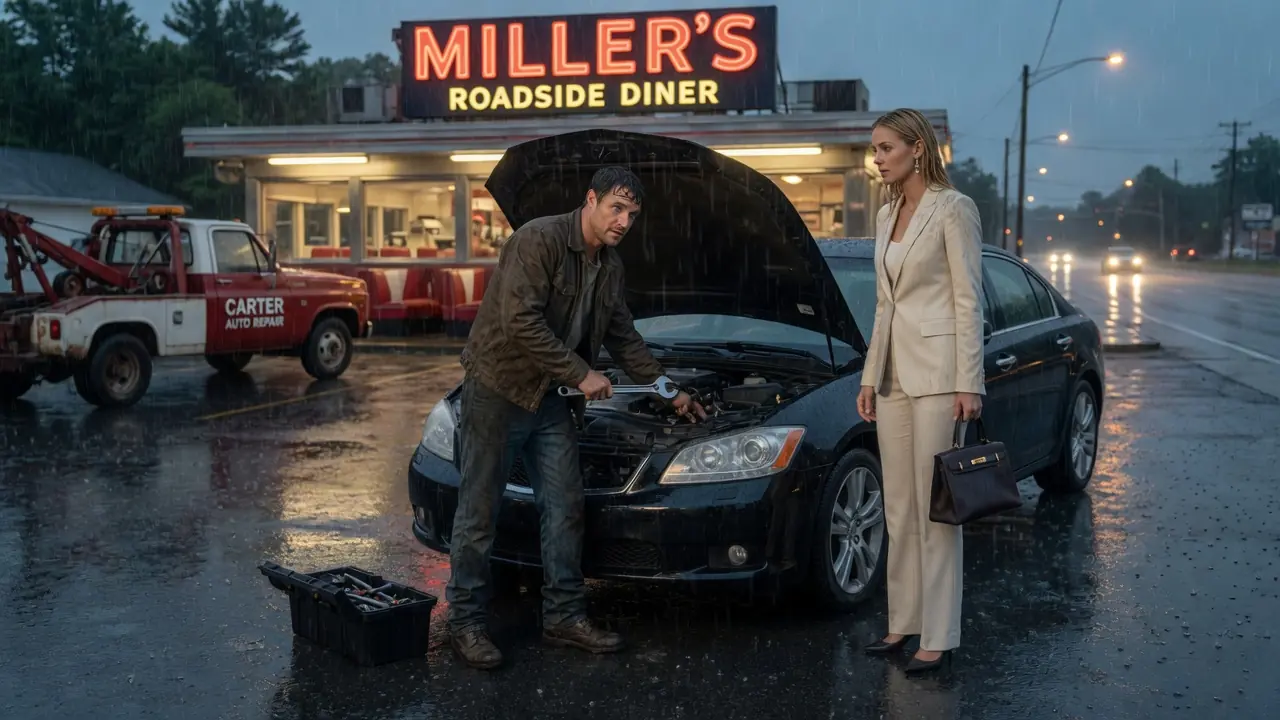
Daniel glanced at the passenger seat.
His eight-year-old daughter, Lily, had her face pressed to the window, watching the first drops of rain strike the glass.
“Looks like the sky is mad,” she said.
Daniel smiled tiredly.
“Maybe the sky skipped lunch.”
Lily turned to him, serious as a judge.
“That does make people cranky.”
Daniel laughed, and for a moment the weight in his chest lifted.
He had promised Lily pancakes for dinner, and when Daniel Carter made a promise to his little girl, he did everything in his power to keep it.
That had become one of the rules of his life after her mother died.
Promises mattered.
Not because he could keep all of them. Life had already taught him how cruel impossible promises could be. But the small ones, the reachable ones, the ones that told a child she could still trust the world in pieces, Daniel guarded those like sacred things.
Pancakes for dinner.
Bedtime stories with voices.
A note in her lunchbox every Friday.
A trip to the county fair even if he had to work until midnight afterward.
A pink umbrella when hers broke, because she had cried not about the rain, but about the fact that her mother had picked the old one.
Daniel Carter was thirty-eight years old, a mechanic, a tow truck owner, a widower, and a single father. Most days, he wore jeans stained with engine grease, steel-toed boots, and the tired expression of a man doing math in his head even when he smiled.
He owned Carter Auto Repair on the edge of town, a three-bay garage with a cracked blue sign, two aging lifts, a coffee machine that made coffee strong enough to remove paint, and more unpaid invoices than he liked to admit.
He fixed engines, changed tires, replaced batteries, rebuilt transmissions, and kept old cars alive for people who could not afford new ones. The wealthy customers usually drove forty minutes to the dealership in the city. Daniel’s customers were teachers, delivery drivers, retired couples, waitresses, construction workers, single mothers, and people who came in apologizing before they even explained what was wrong.
“I know I should have brought it in sooner.”
“I can pay half today and the rest next Friday.”
“Is it safe enough to drive just one more week?”
Daniel heard those sentences every day.
And too often, he said yes when a smarter businessman would have said no.
Yes, he could wait until payday.
Yes, he could use a cheaper part if it was safe.
Yes, he could patch the tire enough to get them to work.
Yes, he could let the invoice sit another week.
His mechanic Roy called it “charity with spark plugs.”
Daniel called it remembering what it felt like to be one bad month away from losing everything.
The garage barely broke even most months. Some weeks, the money came in just enough to go right back out: rent, parts, insurance, Lily’s school lunches, the electric bill, the medical bills still left from Anna’s final year, groceries, gas, taxes, and the hundred little costs that seemed to breed in the dark.
But every morning, Daniel opened the garage anyway.
Every evening, he came home with grease under his nails and worry behind his eyes.
And every night, if he could help it, Lily never saw the worry.
She was eight years old, with brown curls that refused to stay brushed, bright hazel eyes, and the kind of hopeful heart that made Daniel want to be better than his own exhaustion. Since Anna died three years earlier, Daniel had learned how to pack school lunches, braid hair badly, read bedtime stories with silly voices, attend parent-teacher conferences alone, and stand in the shampoo aisle for fifteen minutes wondering whether “curl hydration” and “frizz control” were the same thing.
He had learned which dresses could go in the dryer and which would shrink into doll clothes.
He had learned that glitter was not a craft supply but a long-term environmental decision.
He had learned that grief came in strange forms.
Sometimes it was a song in the grocery store.
Sometimes it was Lily asking whether heaven had pancakes.
Sometimes it was finding Anna’s handwriting on an old recipe card and needing to sit down.
But he had also learned that love could keep moving with a limp.
That was what his life had become.
Love, limping forward.
Miller’s Roadside Diner sat just off Route 19, between a gas station and an old motel with a flickering vacancy sign. It had red vinyl booths, chrome-edged tables, black-and-white floor tiles, and a pie case near the register that Lily treated like a museum exhibit.
To Daniel, it was one of the few places in town where dinner did not have to feel like another problem to solve.
The waitress, Bonnie, knew Lily’s order before they sat down.
“Chocolate chip pancakes with extra whipped cream?” Bonnie asked.
Lily gave Daniel a careful look.
Daniel sighed dramatically.
“It’s raining. We can allow emergency whipped cream.”
Lily raised both fists in silent victory.
Bonnie laughed.
“And for you, Daniel?”
“Coffee. Burger. Fries.”
“You look like you need the pie too.”
“I always look like I need pie.”
“That is true.”
They settled into a booth near the window as the rain began falling harder. Outside, headlights blurred against the wet glass. Trucks rolled along the highway, tires hissing through puddles, while the diner’s old sign glowed red across the parking lot.
Lily sat across from him, cutting her pancakes into careful squares.
“Daddy,” she said, “if pancakes are breakfast, why are we eating them for dinner?”
Daniel poured syrup onto her plate.
“Because sometimes dinner needs to be happier than dinner.”
Lily considered this seriously.
“That makes sense.”
“I was hoping it would.”
“Does that mean ice cream can be lunch if lunch is sad?”
Daniel pointed his fork at her.
“Do not use my wisdom against me.”
She grinned, and for one second, Daniel saw Anna in her face so clearly that his chest tightened.
Anna had smiled like that.
Mischief first.
Warmth second.
Anna Carter had been a second-grade teacher, the sort of woman who could quiet a room of children with one raised eyebrow and make a shy kid feel brave with one sentence. She had loved Miller’s Diner. She used to say their pancakes were “structurally questionable but emotionally important.”
When she got sick, Daniel brought her takeout pancakes in hospital containers even when she could barely eat. The smell made her smile. Near the end, when her hair was gone and her hands were thin, she had told him, “Don’t let Lily grow up thinking joy is expensive.”
He had promised.
So here they were.
Pancakes for dinner.
Emergency whipped cream.
A storm outside.
A promise kept.
By the time they finished eating, the rain had become a hard silver curtain. Water ran off the diner roof in sheets, splashing onto the sidewalk. The parking lot shone beneath the lights, dark and reflective like polished stone.
Most customers hurried to their cars with jackets over their heads.
Daniel helped Lily into her yellow raincoat and took her backpack from the booth.
“Stay close,” he said.
“I know, Daddy.”
“Parking lots get slippery.”
“I know.”
“And puddles are deeper than they look.”
“I know.”
“And if you jump in one—”
“I’ll get water in my socks, and then I’ll complain the whole way home.”
Daniel looked impressed.
“You do listen.”
“Sometimes.”
They had almost reached the tow truck when bright headlights swept across the lot.
A black luxury sedan rolled in from the highway, tires hissing through standing water. It coasted unevenly toward the far edge of the parking lot, slowed near the broken ice machine, then died completely.
The headlights flickered once.
The engine clicked.
Then everything went dark.
Lily stopped under the umbrella.
“Uh-oh.”
Daniel watched the car.
A woman stepped out into the rain.
Even in a storm, she looked like she belonged somewhere far from Miller’s Roadside Diner. She wore a cream-colored suit now darkening at the shoulders, black heels that sank into the wet pavement, and a designer handbag tucked tightly under one arm. Her dark hair clung to her face as she lifted her phone, searching for a signal.
She tried the car again.
Nothing.
Tried a second time.
Still nothing.
Her expression shifted from irritation to concern, then from concern to something closer to fear.
Daniel knew that look.
Not fear of the car.
Fear of being alone when something dependable suddenly stops working.
He looked down at Lily.
“Stay by the diner entrance, sweetheart.”
Lily followed his gaze.
“Is her car broken?”
“Looks like it.”
“Are you going to help?”
Daniel sighed softly.
“I’m going to try.”
“Because cars are your thing.”
“Because stranded people are everybody’s thing.”
He handed Lily the umbrella and walked into the rain without putting up his collar.
By the time he crossed half the lot, his hair was wet and rain had soaked into his jacket. The woman saw him approaching and immediately stepped back, one hand gripping her phone tighter.
Daniel stopped several feet away.
He knew better than to crowd a woman alone in a darkening parking lot.
“I’m not here to bother you,” he called over the rain. “Looks like your car gave out.”
She studied him quickly.
His worn jacket.
His work boots.
The grease still under his fingernails.
The tow truck behind him with CARTER AUTO REPAIR painted across the door in faded blue letters.
Some of the fear left her face.
“Yes,” she said. “It just lost power. I was supposed to be downtown twenty minutes ago, and my phone barely has service.”
Daniel glanced toward the highway.
The rain was getting worse. Water was already pooling near the underpass. A storm like this could flood the low road fast.
“You don’t want to sit out here long,” he said.
“I called roadside assistance. They said it could be two hours.”
“In this storm, more like four.”
Her shoulders sank.
Daniel pointed to the hood.
“Mind if I take a look?”
She hesitated.
“What do you charge?”
He shook his head.
“Let’s see if I can get you moving first.”
The answer seemed to confuse her.
Not because it was complicated.
Because it was simple.
“My name is Victoria Hayes,” she said.
“Daniel Carter.”
He opened the hood and leaned in as rain poured over his back. Victoria stood nearby, holding her useless phone beneath her jacket, watching him with disbelief.
Most people in her world wanted to know who she was before deciding how to treat her.
Daniel had not asked.
He did not know that Victoria Hayes was one of the youngest billionaire CEOs in America. He did not know her technology company, Hayes Dynamics, had offices in San Francisco, London, Singapore, and Berlin. He did not know her face had appeared on the covers of business magazines or that financial networks used phrases like “visionary founder” and “market disruptor” every time they said her name.
He did not know she had spent the last ten years in rooms where every smile had a motive.
To Daniel, she was simply a woman stranded in the rain.
He checked the battery terminals first.
Then the main relay.
Then the fuse box.
Victoria watched his hands move with the practiced certainty of someone who understood machines not as mysteries, but as systems with language.
Within minutes, he found the problem.
A loosened electrical connection near the fuse box had shorted under moisture.
“Found it,” he said.
Victoria stepped closer.
“You did?”
“Should be able to patch it enough to get you home. Not a permanent fix, but safe if you drive slow.”
He jogged back to his tow truck, grabbed a small tool kit and a roll of electrical tape, then returned. His hands moved quickly despite the rain. He cleaned the contact point, tightened the connection, wrapped it properly, checked the fuse, and wiped water from the area as best he could.
“Try it now.”
Victoria climbed into the driver’s seat and pressed the start button.
The engine turned over.
For one second, it struggled.
Then it roared to life.
Dashboard lights glowed.
Headlights cut through the rain.
Victoria sat there, staring at the wheel as if Daniel had performed a miracle instead of a temporary electrical repair.
She stepped back out.
“How much do I owe you?”
Daniel closed the hood.
“Nothing.”
She blinked.
“No, really.”
“Really nothing.”
“You stood in the rain fixing my car.”
“And now your car works.”
“I can pay you.”
“I’m sure you can.”
The answer was not rude.
It was simply honest.
Victoria looked at him more carefully.
Rain dripped from his hair onto his face. His jacket clung to his shoulders. Grease darkened one thumb. His eyes were tired but steady.
“My daughter’s waiting,” he said. “Just drive slow. Water’s pooling near the underpass.”
Victoria turned and saw Lily standing beneath the diner awning, holding the yellow umbrella with both hands. The little girl waved.
Victoria lifted her hand and waved back.
Something softened unexpectedly in her chest.
“Thank you, Daniel.”
He nodded.
“Get home safe, Victoria.”
Then he walked back through the rain to his daughter.
Lily looked up at him when he reached the awning.
“You’re soaked.”
“That is accurate.”
“You look like a wet raccoon.”
“Also accurate.”
“Did you fix it?”
“Enough.”
“Was she nice?”
Daniel glanced back at the black sedan.
Victoria was still watching them.
“Scared people don’t always sound nice right away.”
Lily thought about that.
“Mom used to say that.”
Daniel’s throat tightened.
“Yes,” he said softly. “She did.”
He helped Lily into the tow truck, tucked her backpack at her feet, and climbed in behind the wheel. The old engine groaned before turning over.
As he pulled out of the lot, Victoria remained in her warm sedan, watching the tow truck’s taillights glow red through the rain.
For a long moment, she did not move.
She had been helped by strangers before.
But never like that.
No recognition.
No request.
No performance.
Just kindness.
The next morning, Daniel opened Carter Auto Repair expecting an ordinary day.
Ordinary meant three oil changes, one mystery knocking sound, Mrs. Alvarez’s aging Corolla needing brakes she could not afford, and a parts supplier calling again about the overdue balance.
He arrived at seven with Lily’s lunchbox in one hand and a paper cup of gas station coffee in the other. Lily climbed down from the truck humming to herself, already talking about a spelling test she was sure she would win.
“You studied?” Daniel asked.
“Kind of.”
“That is not the answer of a future spelling champion.”
“I know most of the words.”
“Most?”
“Enough to be dangerous.”
Before Daniel could respond, three black SUVs pulled into the lot.
They were sleek, polished, and completely out of place beside the cracked pavement, rusted dumpster, and hand-painted sign that read CARTER AUTO REPAIR - HONEST WORK, FAIR PRICES.
Daniel stopped walking.
His mechanic, Roy, stepped out of the garage wiping his hands on a rag.
Roy Jenkins was fifty-nine, broad-shouldered, bald, and had worked with Daniel since the first month the garage opened. He complained about everything, cried during dog food commercials, and treated Lily like his own granddaughter.
“Boss,” Roy said slowly, “either we’re getting sued or somebody important needs an oil change.”
Men and women in dark suits stepped out of the vehicles.
A few carried tablets. One held a camera. Another opened the rear door of the middle SUV.
Victoria Hayes stepped out.
This time, she was not rain-soaked and stranded. She wore a navy suit, sleek and sharp, her dark hair perfectly styled, her posture carrying the authority of someone used to entire rooms going quiet when she entered.
Daniel stared.
Lily whispered, “Daddy, it’s the car lady.”
Victoria smiled when she saw the girl.
“Good morning, Lily.”
Lily’s mouth opened.
“You remembered my name?”
“Your dad said it last night.”
Daniel frowned slightly.
“How did you know where to find me?”
Victoria pointed toward the tow truck.
“Your business name was on the door.”
“That explains it.”
Roy leaned closer, his voice low and urgent.
“Daniel, do you know who that is?”
“She had a dead car last night.”
Roy stared at him.
“That is Victoria Hayes.”
Daniel still looked blank.
Roy lowered his voice further.
“Hayes Dynamics. Billionaire. Tech CEO. The woman on the magazine covers at the dentist office.”
Daniel glanced back at Victoria.
“Well,” he said quietly, “her car still broke like everybody else’s.”
Roy looked toward heaven as if asking for patience.
Victoria approached with two staff members behind her.
“I wanted to thank you properly,” she said.
“You already thanked me.”
“No. I said thank you while standing in a storm. That doesn’t count.”
Daniel gave a small smile.
“It counts.”
The photographer lifted a camera.
Daniel immediately stepped back.
Victoria noticed at once.
“No photos unless he agrees,” she said sharply.
The photographer lowered the camera.
Daniel looked at her.
“Appreciate that.”
She turned back to him.
“What you did last night mattered to me.”
“I fixed a wire.”
“You stopped.”
He looked at her.
Victoria’s voice softened.
“People don’t always stop.”
Daniel did not know what to say to that.
So he said the truth.
“Sometimes they do.”
She held out an envelope.
Daniel did not take it.
“What’s that?”
“A reward.”
“No, ma’am.”
“Daniel—”
“I didn’t help you for that.”
“I know. That’s why I’m offering it.”
He shook his head.
“I run a garage, not a rescue auction. If you ever need work done, I’ll charge you fair. Last night was just someone needing help.”
Victoria studied him.
Around them, passing cars slowed. A woman walking her dog paused near the sidewalk. Roy stood in the open bay, grinning like he was watching a movie and trying not to shout commentary.
Victoria lowered the envelope.
“All right,” she said. “Then I’ll bring my car here for a full inspection and pay your regular rate.”
“That I can do.”
Lily tugged on Daniel’s sleeve.
“Daddy, I’m going to be late.”
Daniel checked his watch.
“Shoot.”
Victoria smiled.
“School?”
“Third grade,” Lily said proudly.
“Very important meeting, then.”
“More important than yours,” Lily said.
Daniel closed his eyes briefly.
“Lily.”
Victoria laughed.
A real laugh, bright and surprised, nothing like the polished laugh she used at conferences and investor dinners.
“She’s right.”
Daniel drove Lily to school, and by the time he returned, Roy had already made coffee and written “BILLIONAIRE SPECIAL” on the appointment board.
Daniel erased it.
Roy wrote it again in smaller letters.
“Roy.”
“What? It’s marketing.”
“It’s nonsense.”
“Most marketing is.”
By noon, everyone in Brookhaven knew that Victoria Hayes had shown up at Carter Auto Repair because Daniel Carter fixed her car in the rain and refused a reward.
By evening, the phone rang so often Roy threatened to unplug it.
Three customers asked for inspections.
Two asked about battery problems.
One man with a perfectly functional truck said he “just wanted to support honest business.”
Mrs. Alvarez came by with her Corolla and said, “I heard you saved a billionaire.”
Daniel sighed.
“I tightened a connection.”
“That is how men describe miracles when they don’t want attention,” she said.
Roy slapped the counter.
“I keep telling him that.”
For the first time in months, the appointment board filled.
Daniel stood in the office after closing, staring at the schedule.
He should have felt relieved.
He did feel relieved.
But underneath the relief was caution.
Good fortune, in Daniel’s experience, often came with fine print.
He looked at the crayon drawing Lily had taped near his desk months ago. It showed him, Lily, Roy, and the tow truck under a bright purple sky. Anna was in the drawing too, because Lily still included her mother in every picture of family.
Daniel touched the edge of the paper gently.
“Maybe,” he whispered.
Victoria returned three days later.
This time, she came alone, driving the same black sedan.
Daniel was under a pickup replacing a starter when Roy leaned into the bay.
“Your billionaire’s here.”
Daniel rolled out from under the truck.
“She is not my billionaire.”
Roy grinned.
“She keeps coming back, she might be.”
Daniel stood and wiped his hands on a rag.
“Do not say that where Lily can hear you.”
“Lily told me to say it.”
Daniel paused.
“Of course she did.”
Victoria stood near the office door, looking slightly out of place among tires, oil cans, tool cabinets, and the old vending machine that only worked if Roy kicked the left side with just the right amount of disrespect.
“Car acting up again?” Daniel asked.
“No.”
He waited.
“I thought it should be inspected anyway.”
“You drove here for an inspection on a car that’s running fine.”
“Yes.”
“That’s very responsible.”
Her mouth curved.
“I try.”
He wrote up the ticket himself.
The car was perfect.
Of course it was.
Daniel checked it anyway. Battery. Wiring. Tires. Fluids. Brakes. Electrical system. He gave her the report in the office while Lily sat at the small desk in the corner doing homework.
“Everything looks good,” he said.
Victoria sighed dramatically.
“That’s disappointing.”
Daniel looked up.
“Most customers prefer good news.”
“I was hoping for an excuse to come back.”
Lily’s pencil stopped moving.
Daniel heard it.
So did Victoria.
Lily looked at both adults with sudden interest.
Daniel cleared his throat.
“Well, cars need regular maintenance.”
Victoria’s eyes warmed.
“How regular?”
Roy made a choking sound from the next bay.
Daniel shot him a warning look.
From that day on, Victoria found reasons to come by.
At first, the reasons were car-related.
A tire pressure check.
A brake inspection.
A question about windshield wipers.
An oil change far earlier than necessary.
Then the reasons became less convincing.
She brought coffee for the garage one morning because she claimed she had “ordered too much.” The cups came from a place where one latte cost more than Daniel’s usual lunch.
She dropped off a stack of mystery books for Lily after learning Lily loved detectives.
She brought a box of pastries because her assistant had bought them for a meeting that was canceled.
Roy accepted those without question.
“I support all canceled meetings,” he said through a mouthful of croissant.
Victoria began staying longer.
Sometimes she stood in the garage bay while Daniel explained what he was fixing. Sometimes she sat in the office while Lily did homework. Sometimes she asked Roy questions about old engines, and Roy, who had no sense of audience hierarchy, explained things to her like she was a new apprentice.
“No, don’t nod like you understand,” Roy told her once. “You absolutely do not understand fuel pumps yet.”
Victoria blinked.
Then laughed.
Daniel watched from under a hood and smiled despite himself.
At first, he kept a careful distance.
He was polite.
Friendly.
Grateful for the business.
But guarded.
Victoria noticed.
One evening, while Lily was in the office reading and Roy had gone home, Victoria stood near the open bay door as rain tapped lightly against the pavement outside.
“You don’t trust me,” she said.
Daniel looked up from an invoice.
“That’s not true.”
“It is.”
He set the paper down.
“I don’t know you.”
“That is fair.”
“And people with your kind of life don’t usually stay interested in people with mine.”
Victoria nodded slowly.
“I understand why you’d think that.”
“I don’t mean it as an insult.”
“I know.”
She looked through the office window at Lily, who was sitting cross-legged in Daniel’s old chair with a book open on her lap.
“My life looks full from the outside,” Victoria said. “But most of it is scheduled, managed, negotiated, photographed, and analyzed. People want access, investment, approval, influence, introductions. Half the time, I don’t know whether anyone likes me or just likes the door I might open for them.”
Daniel listened.
She looked back at him.
“That night in the rain, you didn’t know my name. You didn’t care what I was worth. You just helped.”
He was quiet for a moment.
“My wife used to say kindness only counts when nobody is calculating.”
Victoria’s expression softened.
“Your wife?”
“Anna,” he said. “She died three years ago.”
“I’m sorry.”
He nodded.
“Cancer. Fast and slow at the same time, if that makes sense.”
“It does,” she said quietly.
Daniel looked toward Lily.
“She was five when it happened. Some days I think I’m doing all right. Other days I realize I packed Lily’s lunch and forgot the sandwich.”
Victoria smiled gently.
“Lily seems loved.”
“That part I never forget.”
Something passed between them then.
Not romance yet.
Something simpler.
Trust beginning to test its own weight.
The friendship that followed did not announce itself.
It grew quietly in small repeated choices.
Victoria stopped by after a meeting and asked Lily about her spelling test.
Daniel remembered Victoria took her coffee with no sugar but extra cream.
Victoria learned that Roy pretended not to like expensive pastries but would eat the almond ones first.
Daniel noticed Victoria rubbed her left wrist when she was stressed.
Lily began saving drawings to show Victoria.
Victoria began keeping a pair of flat shoes in her car after ruining two pairs of heels on the garage floor.
One Saturday, Daniel invited her to Lily’s school science fair.
He regretted it immediately after asking.
“You don’t have to,” he said quickly. “I know you’re busy.”
Victoria looked at him.
“I’d like to go.”
“It’s a third-grade science fair. There will be baking soda volcanoes.”
“I’ve survived shareholder meetings. I can survive volcanoes.”
She arrived in jeans, a soft blue sweater, and flat shoes.
Lily nearly knocked over her display running to hug her.
Victoria stood there for a second, surprised, then slowly wrapped her arms around the little girl.
Daniel saw the moment land in her.
The shock of being wanted without agenda.
Lily’s project was about bridge strength using popsicle sticks and glue. She explained every part with fierce seriousness.
Victoria listened like Lily was presenting before a board of directors.
When Lily won second place, Victoria cheered louder than anyone except Daniel.
On the drive home, Lily said, “Victoria claps like she means it.”
Daniel glanced at her in the rearview mirror.
“That’s a good thing?”
“Yes. Some adults clap like they’re just being polite. She claps with her whole face.”
Daniel thought about that.
“She does.”
“Do you like her?”
He nearly coughed.
“She’s our friend.”
“That’s not what I asked.”
“You are eight.”
“I can still ask good questions.”
“You can also eat crackers without getting crumbs in the seat, but you choose not to.”
Lily grinned and dropped the subject.
For about ten minutes.
Then she said, “Mom would like her.”
Daniel’s hands tightened slightly on the steering wheel.
“What makes you say that?”
“She’s kind when nobody tells her to be.”
Daniel looked at the road ahead.
His throat tightened.
“Yeah,” he said. “Your mom liked people like that.”
Victoria had her own ghosts.
Daniel learned that slowly too.
Her father had died when she was twenty-two, leaving behind debt, lawsuits, and a half-built software idea no investor wanted. Victoria had dropped out of a doctoral program to rescue the company. She slept in offices, pitched to investors who underestimated her, and built Hayes Dynamics through sheer force of intellect and will.
Success came, then money, then more money, then the strange isolation that follows when people stop disagreeing with you honestly.
She had dated, but not seriously in years.
“Men either want to compete with me or be rescued by me,” she told Daniel once, sitting on the garage steps while Roy closed up.
“And which category am I?”
She glanced at him.
“You keep refusing rescue.”
“I have a tow truck. Professionally, I do the rescuing.”
She laughed.
But the truth remained.
Daniel was careful with her money.
Maybe too careful at first.
When she once offered to invest enough capital to expand Carter Auto Repair into three locations, Daniel’s face changed so completely that she stopped halfway through the sentence.
“I offended you,” she said.
“No.”
“I did.”
He leaned against the counter.
“You made it sound like my life is a problem to scale.”
Victoria absorbed that.
“I’m sorry.”
“I know you mean well.”
“I do.”
“But I don’t want to become one of your projects.”
That hurt her.
He saw it.
But she did not defend herself.
Instead, she said, “Then help me understand what support would look like without taking over.”
That question changed everything.
Daniel had spent years around people who offered help in ways that made them feel generous and him feel small. Victoria was the first person with power who asked how not to use it badly.
He told her the truth.
“People need someone who won’t cheat them just because they don’t understand cars.”
She listened.
He continued.
“Half my customers delay repairs until the car is dangerous because they’re afraid of the bill. They need transportation for work, school, doctors. A broken car can cost someone a job.”
Victoria was quiet.
“So the issue isn’t car repair,” she said. “It’s access.”
Daniel nodded.
“Cars are freedom in towns like this. When yours dies, your life shrinks.”
Two months later, the Carter Community Repair Fund launched quietly.
No giant banner.
No press conference.
No Victoria Hayes smiling with oversized scissors.
Just a small flyer at the front desk, designed by Lily with a drawing of a car wearing a superhero cape.
Need help with essential repairs?
Ask about the Carter Community Repair Fund.
No shame. No judgment. Safe cars matter.
Victoria funded parts through a private donation account. Daniel discounted labor. Roy volunteered extra hours twice a month and insisted he was “not being sentimental, just bored.”
The first person helped was Mrs. Alvarez.
Her Corolla needed brakes. She had been driving with a grinding sound for weeks because she was choosing between repairs and her blood pressure medication.
When Daniel handed her the keys and said the bill was covered, she cried so hard Lily brought her tissues.
Victoria stood in the doorway, watching quietly.
After Mrs. Alvarez left, Daniel found Victoria in the back lot.
“You okay?” he asked.
She wiped her face quickly.
“I’ve donated millions to organizations I’ve never seen,” she said. “I’ve funded programs with beautiful reports and metrics and impact statements. But that woman is going to drive home safely tonight because of a brake job.”
Daniel leaned beside her against the wall.
“Impact looks different up close.”
“Yes,” she whispered. “It does.”
The program changed the garage.
People came in embarrassed and left relieved. A young nurse got her car repaired in time for night shifts. A delivery driver kept his job because his transmission problem was caught early. A grandfather could take his wife to chemotherapy without borrowing his neighbor’s van.
The fund did not make Daniel rich.
It made the garage matter even more.
And Victoria kept showing up.
Not to supervise.
To help.
She sat with Lily while Daniel worked late. She learned to make coffee in the terrible machine, though Roy said her first attempt tasted like “hot regret.” She helped organize invoices when the office became chaotic. She once held a flashlight for Daniel during a late-night emergency repair, standing in the cold with her sleeves rolled up, completely focused.
At midnight, after the customer drove away, Daniel looked at her.
“You know you could have sent an assistant.”
“I know.”
“Why didn’t you?”
She looked down at the grease on her fingers.
“Because I wanted to be here.”
That sentence stayed with him all night.
Almost a year after they first met, another storm came through Brookhaven.
Not violent like the first one.
Softer.
Rain tapped against the garage roof in a steady rhythm. The pavement outside shone under the bay lights. The air smelled of oil, wet concrete, and summer grass.
Daniel was locking the tool chest.
Lily sat in the office drawing with colored pencils.
Victoria stood in the open bay, watching the rain.
“You know,” she said, “that night changed more than my car.”
Daniel turned.
“I figured it changed your electrical connection.”
She smiled.
“It did that too.”
He walked to stand beside her.
For a moment, neither spoke.
“I kept finding reasons to come back,” Victoria said.
Daniel looked at her.
“I noticed.”
“I told myself it was because you were honest. Or because Lily made me laugh. Or because the garage felt real in a way most places in my life don’t.”
“All true.”
“Yes.” She turned toward him. “But not the whole truth.”
Daniel’s chest tightened.
“What’s the whole truth?”
Her voice softened.
“I came back because I wanted to see you.”
Behind them, Lily’s colored pencil stopped moving.
Daniel glanced over his shoulder.
Lily quickly bent over her paper and pretended to draw.
Badly.
Victoria laughed softly.
“She is not subtle.”
“No,” Daniel said. “She gets that from her mother.”
Lily called without looking up, “I heard that.”
Daniel shook his head.
Victoria’s smile faded into something more vulnerable.
“I know our worlds are different.”
“They are.”
“I know people will talk.”
“They will.”
“I know I can be intimidating.”
“You can.”
She gave him a look.
“Daniel.”
He smiled faintly.
“I also know you sit on the garage floor with my daughter and help her build cardboard cities. You remember Roy’s wife’s surgery date. You ask customers about their kids. You paid for Mrs. Alvarez’s brake pads and told me not to tell anyone.”
Victoria looked away.
“You told.”
“Only to you.”
The rain fell steadily.
Daniel stepped closer.
“I’m not interested in your money.”
“I know.”
“I’m not interested in being turned into a headline.”
“I know.”
“But I am interested in you.”
Victoria’s eyes lifted.
For once, the woman who could command boardrooms looked completely uncertain.
“You are?”
“Yes.”
Lily whispered loudly from the office, “Finally.”
Daniel closed his eyes.
Victoria burst out laughing.
That laugh became one of Daniel’s favorite sounds.
Their relationship grew carefully after that.
Daniel did not introduce Victoria as his girlfriend right away. Lily, of course, introduced her that way to everyone within a week.
At school pickup, Lily told her teacher, “This is Victoria. She is Daddy’s almost-girlfriend because grown-ups are slow.”
Daniel nearly died on the sidewalk.
Victoria shook the teacher’s hand with perfect composure and said, “That is not inaccurate.”
Dating with an eight-year-old involved rules Daniel had never imagined.
No kissing in front of Lily unless she was allowed to say “ew.”
No fancy restaurants with food that looked too small.
Victoria had to learn how to play Uno properly, which meant understanding that Lily cheated with the confidence of a trial lawyer.
Movie nights required blankets, popcorn, and Duke, the old mutt Daniel had adopted after Anna died, because Lily insisted Duke was part of the family and deserved plot explanations.
Victoria entered their world gently.
She never tried to replace Anna.
That mattered more than Daniel could say.
The first time she saw Anna’s photo on the mantel in Daniel’s small house, she stopped and looked at it for a long moment.
“She was beautiful,” Victoria said.
Daniel nodded.
“She was.”
Lily appeared beside them.
“That’s my mom.”
Victoria crouched slightly.
“She looks kind.”
“She was,” Lily said. “She made better pancakes than Daddy.”
“That I believe.”
Daniel pointed from the kitchen.
“I can hear both of you.”
Lily smiled.
“Good.”
Later that night, after Lily went to bed, Daniel found Victoria standing near the mantel again.
“This doesn’t scare you?” he asked.
Victoria turned.
“What?”
“That I loved someone before you. That part of me always will.”
Her expression softened.
“Daniel, love that disappears because someone new arrives was never very strong to begin with.”
He looked down.
“I don’t want Lily to feel like moving forward means leaving her mother behind.”
“Then we won’t.”
“We?”
Victoria stepped closer.
“If I’m allowed to be part of your life, I want Anna’s memory treated with respect. Not hidden from me.”
That was the moment Daniel knew he loved her.
Not the rain.
Not the coffee.
Not the way she laughed with Lily.
That.
The fact that she made room for his past without trying to defeat it.
Their worlds collided sometimes.
Of course they did.
The first time Daniel attended a charity gala with Victoria, he wore a rented tuxedo and felt like a mechanic inside a museum display. Cameras flashed at the entrance. Reporters called Victoria’s name. Men in tailored suits looked Daniel up and down as if trying to calculate his relevance.
One asked, “And what do you do, Mr. Carter?”
Daniel said, “I fix cars.”
The man smiled politely.
“How refreshing.”
Victoria’s eyes sharpened.
Daniel touched her elbow before she could say anything.
“I’ve handled worse than condescension,” he murmured.
“Yes,” she said. “But I enjoy correcting it.”
During dinner, Daniel noticed how many people wanted Victoria’s attention. They laughed too hard at her comments. Complimented her company. Mentioned investment opportunities as if casually discussing weather.
He understood then what she meant.
So many people reached for her, but few actually saw her.
On the ride home, she removed her earrings and leaned back against the seat.
“I hated that,” she said.
“You were impressive.”
“That doesn’t mean I enjoyed it.”
He looked at her.
“Then why go?”
“Because the foundation needed donors. Because I made commitments. Because sometimes responsibility wears uncomfortable shoes.”
He smiled.
“You could put that on a mug.”
She glanced down at her heels.
“I would rather burn the shoes.”
He laughed, and she leaned her head against his shoulder.
The photograph from that gala appeared online the next morning.
Victoria Hayes Attends Children’s Hospital Benefit With Mystery Man.
By noon, reporters had identified Daniel.
Single Dad Mechanic Dating Billionaire CEO.
By evening, Carter Auto Repair had camera crews outside.
Daniel hated it.
Lily thought it was exciting for approximately six minutes, then became annoyed when a reporter blocked the snack machine.
Victoria arrived at the garage before Daniel could call her.
“I’m sorry,” she said immediately.
He was in the office, blinds half-closed.
“You warned me people would talk.”
“I did not want this.”
“I know.”
“If you want space—”
“No.”
The answer surprised both of them.
Daniel took a breath.
“I don’t like cameras. I don’t like strangers making my daughter part of a story. I don’t like people pretending my life became interesting only because you entered it.”
Victoria looked down.
“But I don’t want space from you.”
Her eyes lifted.
He continued.
“I just want us to decide what gets to be public and what stays ours.”
She nodded.
“Then we make rules.”
“Good ones?”
“Not billionaire rules,” she said. “Family rules.”
So they did.
No media at the garage.
No photographs of Lily without permission.
No interviews about their relationship.
No using Daniel’s story as inspiration branding.
Victoria’s team hated the restrictions.
Victoria did not care.
When a reporter shouted, “How does it feel to date a billionaire?” Daniel answered once, mostly because Roy dared him.
“She still can’t tell when her tire pressure is low, so I try not to let the billionaire thing go to her head.”
The clip went viral.
Victoria laughed so hard she cried.
Two years after the rainy night at Miller’s Roadside Diner, Victoria came to Carter Auto Repair after closing.
The sky was purple with evening. The garage smelled of soap because Lily had insisted the floor needed cleaning before “something important,” which made Daniel suspicious immediately.
Roy had gone home early with a grin that looked criminal.
Lily was at the office desk pretending to do homework, though her notebook was upside down.
Daniel stood near the open bay door wiping his hands on a rag.
Victoria walked toward him in a simple blue dress, no entourage, no cameras, no polished armor.
“No car trouble?” he asked.
“No.”
“That’s becoming a habit.”
She smiled nervously.
“I came to ask you something.”
Daniel looked at her carefully.
“All right.”
She took a breath.
“You and Lily changed my life. Not because you needed me. Because you let me belong somewhere without earning my place through money or power.”
Daniel’s expression softened.
“I spent years building rooms people wanted to enter,” Victoria said. “Boardrooms. Conference halls. Offices. Homes. But this garage was the first place in a long time where I felt like I could walk in without being Victoria Hayes first.”
Daniel said nothing.
His throat had tightened.
“I don’t want to keep coming back as a visitor,” she continued. “I don’t want to just stop by, or find excuses, or pretend I don’t already know where my heart is. I want to come home, Daniel. To you. To Lily. To this life, with all its oil stains and homework and Roy’s terrible coffee.”
From inside the office, Roy’s voice called, “My coffee has character.”
Daniel turned.
Roy stood in the hallway, obviously not gone.
Lily popped up beside him.
“Keep going,” she whispered loudly.
Victoria laughed through tears.
Daniel looked at Lily.
“You knew?”
“I helped.”
“Of course you did.”
Victoria reached into her pocket.
Not with a ring.
With a small brass key.
Daniel stared at it.
“What’s that?”
“A key to my house,” she said. “Not because I expect you to move. Not because I want to rush Lily. But because I want there to be no doors between us that exist only because I was afraid to open them.”
Daniel took the key slowly.
Then he reached into his own pocket and pulled out the spare key to his house.
It had a tiny purple keychain Lily had made from beads.
Victoria looked at it and laughed softly.
“Is that for me?”
“If you can handle the responsibility.”
She took it like it was worth more than any stock certificate she had ever held.
Then Daniel stepped closer and kissed her.
Inside the office, Lily cheered.
Roy blew his nose loudly and claimed allergies.
Daniel and Victoria married the following spring.
Not in a ballroom.
Not on a private island.
Not in a cathedral filled with cameras and people who wanted to be seen near power.
They married in the small garden behind Carter Auto Repair.
The customers decorated it.
Mrs. Alvarez brought flowers from her yard. The young nurse baked cupcakes. Roy built a wooden arch and complained the entire time so no one would notice how carefully he sanded it. Lily wore a pale yellow dress and insisted on walking Victoria down the aisle because, as she explained, “Daddy already knows where to stand.”
Victoria wore a simple white dress.
Daniel wore a navy suit.
Roy wore a tie with tiny wrenches on it.
During the vows, Victoria looked at Daniel and said, “You found me in a storm and gave me something I could not buy: a place to be ordinary and still be loved.”
Daniel looked back at her and said, “You came back when you didn’t have to. That’s how I knew your heart was not passing through.”
Lily cried.
Then denied it.
Then cried harder.
At the reception, which was held in the garage with the lifts cleaned and decorated with lights, Roy gave the toast.
“I’ve worked with Daniel long enough to know he’s stubborn, undercharges everybody, and once tried to fix a coffee machine with a brake tool.”
“That worked,” Daniel said.
“For three days,” Roy replied. “But I’ve also watched him raise that little girl with more love than most people know how to carry. And I’ve watched Victoria walk into this place with more money than sense about tire pressure and become part of the family anyway.”
Everyone laughed.
Roy lifted his glass.
“To Daniel and Victoria. May their marriage have fewer electrical shorts than her sedan.”
Victoria laughed so hard Daniel had to steady her.
Years later, people still told the story in Brookhaven.
They said a billionaire CEO got stranded in a roadside diner parking lot during a storm, and a poor single father fixed her car for free.
But that was only the beginning.
The real story was not about wealth meeting poverty.
It was about two lonely people recognizing honesty in each other.
It was about an eight-year-old girl waving from beneath a yellow umbrella.
It was about a man who helped without asking what it could become.
And a woman who had everything money could buy, only to discover that the thing she needed most was standing in the rain with a toolbox in his hand.
Carter Auto Repair eventually expanded.
Not into a chain.
Daniel refused that.
But the garage grew. A fourth bay. A better waiting room. A scholarship program for young mechanics. A larger repair fund that helped families across three counties keep their cars safe.
Victoria funded the expansion.
Daniel ran it.
Lily designed the logo.
Roy declared himself too old for change, then trained every new mechanic personally.
The original sign stayed above the first bay.
CARTER AUTO REPAIR
HONEST WORK, FAIR PRICES
Under it, Lily added a smaller wooden sign years later.
STRANDED PEOPLE ARE EVERYBODY’S THING.
Daniel pretended the sign embarrassed him.
It did not.
Sometimes, on rainy nights, Victoria still came to the garage after work. She would stand in the open bay beside Daniel, listening to rain strike the roof, remembering the night her car died and her life quietly began changing.
One evening, she asked him, “Do you ever think about what would have happened if you hadn’t stopped?”
Daniel looked toward the office, where Lily, now older and taller, was helping Roy argue with a computer system that neither of them understood.
“Yes,” he said.
“And?”
“I think your roadside assistance would have taken four hours.”
Victoria nudged him with her shoulder.
“Daniel.”
He smiled.
Then he grew serious.
“I think maybe some people are placed in our path at the exact moment when kindness has to make a decision.”
Victoria leaned against him.
“And you decided.”
“So did you.”
“I only came back.”
“That was the decision that mattered.”
Outside, rain fell softly over the parking lot.
Inside, the garage glowed with warm light, the smell of oil and coffee, the sound of Lily laughing, and the steady rhythm of ordinary life.
Daniel Carter had thought he was simply helping a stranded woman get home safely.
He never imagined she would become home.
And Victoria Hayes had thought she needed her car repaired.
Instead, she found a family.
Sometimes extraordinary lives do not change in grand rooms or at important tables.
Sometimes they change under diner lights in a storm.
A broken car.
A yellow umbrella.
A tired single father who stops.
A little girl who waves.
And one act of kindness that asks for nothing, yet somehow returns with everything.