The boy came into Rivers Auto Repair on a rainy Saturday with oil on his hands, panic in his eyes, and an old blue car coughing behind him like it had just survived a war.
Caleb Rivers heard the engine before he saw the driver.
It was not the normal sound of a customer pulling into the garage. 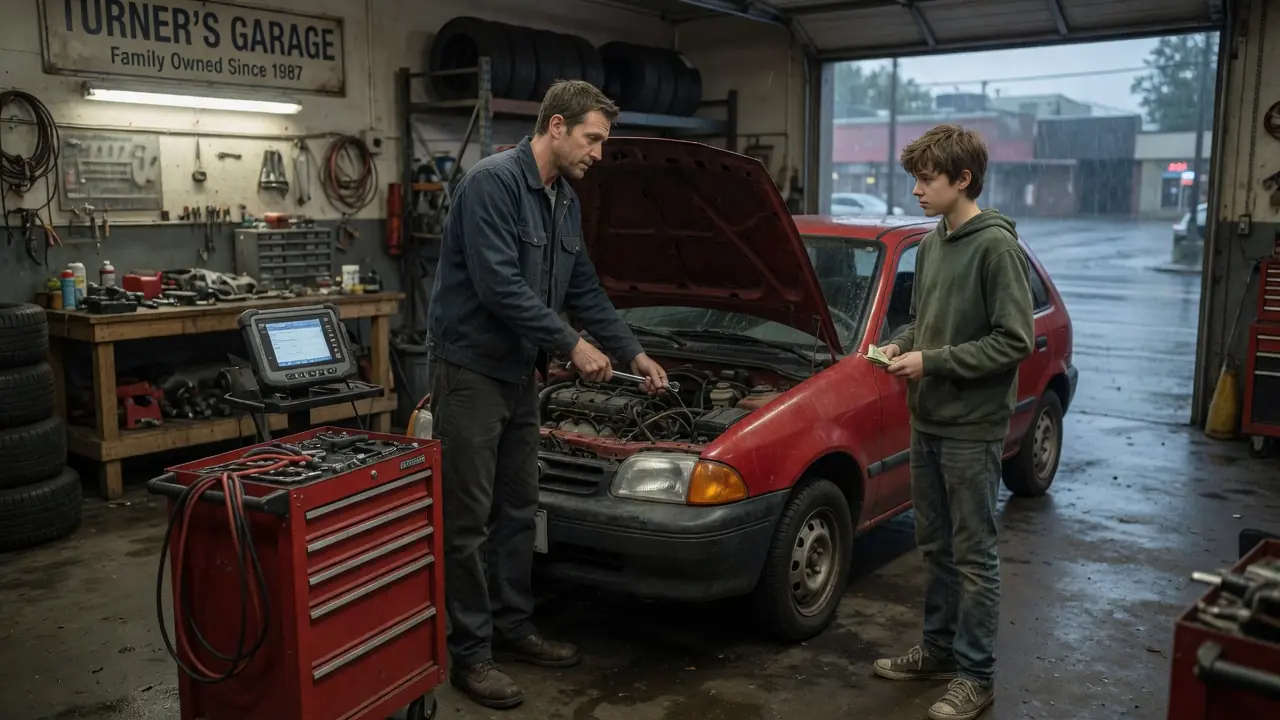
Normal customers came in with engines that knocked, rattled, hissed, or squealed. This car sounded like it was begging every part of itself not to fall apart in public.
Caleb stepped out from under the hood of a silver Subaru and wiped his hands on a rag.
Through the open bay door, he saw a faded blue 1989 Toyota Corolla rolling slowly into the lot. The car was small, boxy, and old enough to have opinions. One headlight was dim. The hood shook. The exhaust coughed gray smoke into the wet morning air.
Behind the wheel sat a boy who looked too young to be carrying that much worry.
Maybe sixteen.
Maybe seventeen.
Thin face, dark hair damp from the rain, both hands gripping the steering wheel like the car might escape if he relaxed. He guided it carefully toward the garage, tapped the brakes too hard, and the Corolla lurched to a stop just outside Bay Two.
The engine sputtered once.
Twice.
Then died.
The boy sat there for a second, eyes closed, forehead almost touching the steering wheel.
Caleb knew that posture.
That was not just frustration.
That was a kid trying very hard not to fall apart.
He walked over slowly, keeping his voice easy.
“Morning.”
The boy opened his eyes quickly.
“Sorry. I know you’re probably busy. I just need someone to look at it.”
Caleb looked at the car, then back at him.
“Is the car yours?”
The boy hesitated.
“Yes.”
That yes carried a whole story.
Caleb leaned down slightly.
“You old enough to drive it?”
“I’m seventeen. I have my license.”
“Good. That saves me one lecture.”
The boy swallowed.
“I can pay some. Not all today, but some.”
Caleb heard the shame under the words.
He had heard it from grown men, single mothers, elderly customers, college kids, and once from himself in a bank office when he was trying to save this very garage.
“How about we start with figuring out what’s wrong before we start burying you in bills?” Caleb said.
The boy blinked like he was not used to answers that did not punish him first.
“My name is Theo Grant,” he said. “The car was my dad’s. He gave it to me before he died. It’s supposed to get me to school and work, but it started shaking this morning. Then the check engine light came on. Then it smelled like burning.”
Caleb glanced toward the hood.
“Burning oil or burning rubber?”
Theo looked embarrassed.
“I don’t know.”
“That’s not a crime. Pull it into the garage slowly. Keep your foot light on the gas.”
Theo nodded and turned the key.
The Corolla protested, coughed, then came back to life with a rough idle that made Caleb wince. He guided Theo with one raised hand, backing him carefully into Bay Two. The car rolled over the concrete floor and stopped beneath the lights.
Inside the garage, the vehicle looked worse.
Rust along the bottom of the doors.
Cracked vinyl on the seats.
A steering wheel cover worn smooth at the top.
A faded parking permit hanging from the mirror.
On the dashboard was a small photo clipped near the vents: a smiling man in a work jacket standing beside the same blue Corolla, one hand on the roof, one arm around a much younger Theo.
Caleb saw Theo notice him noticing.
The boy reached up and touched the photo lightly.
“My dad,” he said.
Caleb nodded.
“What was his name?”
“Daniel Grant.”
“Did he like cars?”
Theo almost smiled.
“He loved this one. Mom always said it was ridiculous because it was older than some houses, but Dad said a good car only gets old if people stop caring for it.”
Caleb looked at the Corolla again.
A small old car.
Nothing fancy.
Nothing worth much on paper.
But suddenly, it made sense why Theo had driven in looking like the engine trouble had broken more than transportation.
“This car matters to you,” Caleb said.
“It’s mine.”
Not defensive.
Protective.
Caleb understood.
He raised his daughter Sophie alone in the apartment above the garage. She was eight now, all curls, questions, and missing front teeth. Her mother, Hannah, had died three years earlier, and Sophie still kept Hannah’s old green scarf folded beneath her pillow because it smelled faintly like lavender if you believed hard enough.
People who had not lost someone often misunderstood objects.
They thought a thing was only a thing.
A car.
A scarf.
A photograph.
A bench in the backyard.
But grief could live inside objects like heat trapped in stone.
Caleb popped the hood.
“All right, Theo. Let’s see what your dad’s Corolla is trying to tell us.”
Theo stood beside him, nervous and eager.
Caleb noticed the boy’s hands. They were not soft. There was grease under the nails, a small cut near one knuckle, and a dark smear across his sleeve.
“You been working on it yourself?”
Theo looked down.
“A little.”
“What did you do?”
“Changed the oil once. Replaced the air filter. Tried to change the spark plugs but stopped because I wasn’t sure I was doing it right.”
Caleb looked at him with approval.
“Stopping when you’re not sure is underrated.”
Theo seemed surprised.
“My mom says I shouldn’t mess with it.”
“Your mom might have a point depending on how much messing you do.”
“She wants me to sell it.”
There it was.
Caleb kept his eyes on the engine.
“Why?”
Theo’s voice lowered.
“She says it’s not reliable. Says I need something safer. Says Dad would want me in a newer car.”
“And what do you think?”
Theo looked at the photo on the dashboard.
“I think Dad wanted me in this car.”
Caleb did not answer right away.
He checked the oil level.
Low.
He checked around the valve cover.
Leak.
He examined the belts.
Cracked.
He checked the radiator hose.
Soft.
He pulled a spark plug wire and saw corrosion.
The car was not dead.
But it was tired.
Very tired.
“Theo,” Caleb said carefully, “this car can be fixed, but it needs real work. Not just one little part.”
Theo’s face tightened.
“How much?”
“I don’t know yet. I need to diagnose it properly.”
“I have two hundred and forty dollars saved.”
Caleb looked at him.
Theo lifted his chin.
“I work at Harbor Market after school. I can pay more every week.”
Caleb studied him for a moment.
There was pride in the boy.
Too much pride maybe.
But not arrogance.
This was survival pride. The kind that says, Please don’t make me feel small when I’m already scared.
Caleb nodded toward the workbench.
“Grab that stool.”
Theo frowned.
“What?”
“You want to keep this car? Then you need to understand it. Sit down. Watch. Ask questions. Don’t touch anything unless I tell you.”
Theo’s face changed.
“You’ll let me help?”
“This is your car, isn’t it?”
“Yes.”
“Then you should know what I’m doing to it.”
Theo grabbed the stool so quickly Caleb nearly smiled.
For the next hour, Caleb worked through the diagnosis slowly, explaining each step.
He showed Theo the oil leak near the valve cover gasket.
He showed him the worn belt.
He explained why the engine was idling rough.
He pulled the spark plugs and lined them up on a rag.
“See this one?” Caleb said, pointing.
Theo leaned closer.
“It’s darker.”
“Good eye. That tells us cylinder three isn’t firing cleanly. Could be plug, wire, compression, fuel issue. We test before guessing.”
Theo nodded intensely, like Caleb was teaching him state secrets.
By midmorning, Sophie came down from the apartment above the garage in pajamas, a yellow raincoat, and one pink sock.
“Dad, I can’t find my other sock.”
Caleb glanced at her.
“Did you look in your room?”
“Yes.”
“Did you look under your bed?”
“That’s part of my room, technically.”
“Sophie.”
She sighed dramatically.
“I’ll check.”
Then she noticed Theo.
“Oh. Hi.”
Theo looked suddenly awkward.
“Hi.”
Sophie pointed at the Corolla.
“Is this your car?”
Theo nodded.
“It’s old.”
“Sophie,” Caleb said.
“What? Old things are cool. Dad’s coffee maker is old and only tries to explode sometimes.”
Theo smiled despite himself.
“It was my dad’s car.”
Sophie’s expression softened in a way that made her seem older than eight.
“My mom had a scarf,” she said. “I keep it in my pillowcase. Dad says things can remember people.”
Caleb froze for half a second.
Theo looked at her.
“Yeah,” he said quietly. “I think cars can too.”
Sophie nodded like this made perfect sense.
Then she looked at Caleb.
“I’m hungry.”
“And the emotional moment is over,” Caleb muttered.
Theo laughed.
It was the first real laugh Caleb heard from him.
By noon, the rain had eased, and Caleb had a preliminary list.
Valve cover gasket.
Spark plugs and wires.
Serpentine belt.
Radiator hose.
Oil change.
Coolant flush.
Battery terminal cleaning.
Possibly a fuel filter.
Enough to make the car run better and safer, but not enough to solve everything.
Theo stared at the estimate.
His face went pale.
“I can’t pay that today.”
“I know.”
“I can do payments.”
“I know.”
“I’m not asking for charity.”
“I didn’t offer charity.”
Theo looked up.
Caleb leaned back against the workbench.
“Here’s the deal. You pay for parts at cost. I’ll reduce the labor if you help during safe parts of the repair. You sweep, organize tools, learn, and do exactly what I say. Miss a payment without talking to me, and we pause the work. Lie to your mother about where the car is, and the deal is over.”
Theo swallowed.
“You’re going to call my mom?”
“Yes.”
Panic flashed across his face.
“No, wait. Please. She’ll come here and make me sell it.”
“Theo, I’m a father. If Sophie brought her car somewhere without telling me, I’d want the adult in the room to call me.”
“She won’t understand.”
“Maybe not at first.”
“She never understands.”
“That might be true. But hiding from her won’t make her understand faster.”
Theo looked toward the Corolla.
“I just need this one thing to stay mine.”
Caleb softened.
“I know. But if you want to be treated like someone responsible enough to own this car, you have to act responsible even when it’s uncomfortable.”
Theo hated that.
Caleb could see it.
He also knew the boy heard him.
Theo gave him the number.
Caleb called.
The woman answered on the second ring.
“Hello?”
“Mrs. Grant?”
“Yes.”
“My name is Caleb Rivers. I own Rivers Auto Repair on Harbor Street. Your son Theo is here with his car. He’s safe.”
A silence.
Then a voice that had been calm became ice and fear at the same time.
“His car is where?”
Theo closed his eyes.
Caleb kept his voice steady.
“He brought it in because it was running badly. I told him I needed to speak with you before doing any repair work.”
“I’ll be there in ten minutes.”
The line went dead.
Theo dropped his head into his hands.
“She’s going to kill me.”
“She’s going to yell,” Caleb said. “There’s a difference.”
“She yells professionally.”
“Then stand steady.”
Exactly eleven minutes later, a dark green SUV pulled into the lot.
The driver’s door opened before the vehicle fully settled.
Nora Grant stepped out into the wet afternoon with the expression of a woman who had spent ten minutes imagining every terrible thing that could happen to her child.
She was thirty-eight, maybe thirty-nine, tall, with dark hair pulled back in a loose knot and worry sharpened into anger across her face. She wore a navy coat, black boots, and no makeup except whatever had survived the morning.
She walked into the garage fast.
“Theodore Daniel Grant.”
Theo winced.
Full name.
Bad sign.
Nora crossed the garage and grabbed his shoulders.
For one second, Caleb thought she might shake him.
Instead, she pulled him hard against her.
“You scared me half to death.”
Theo stood stiffly, then slowly hugged her back.
“I’m sorry.”
“No, you are not sorry enough yet.”
Her voice shook.
She let go and looked him over, checking his face, hands, clothes, as if fear needed proof he was still whole.
Then her eyes moved to the Corolla.
Her expression changed.
Pain.
Anger.
Memory.
All at once.
“You brought the car here.”
Theo straightened.
“It needed help.”
“You should have told me.”
“You would have said no.”
“That does not make lying acceptable.”
“I didn’t lie. I just didn’t say everything.”
Nora gave him a look so sharp even Caleb felt corrected.
“That is lying with better shoes.”
Theo looked down.
Caleb hid a smile and failed.
Nora saw it.
Her eyes turned toward him.
“And you are?”
“Caleb Rivers.”
“The man who called me.”
“Yes, ma’am.”
She looked him over. Grease on his hands. Worn work shirt. Calm eyes. The kind of man who did not shrink under disapproval but did not throw it back either.
“How long has he been here?”
“Since around eight-thirty.”
“And you let him stay?”
“I let him bring the car into the garage. I inspected it. I made him sit where I could see him. Then I called you before repairs began.”
Nora’s face remained hard, but something in her eyes shifted.
She had expected defensiveness.
Caleb gave her facts.
“How much damage?” she asked.
“To the car?”
“To my patience, I already know.”
Theo muttered, “A lot.”
Nora pointed at him without looking.
“Not your moment.”
Caleb looked toward the Corolla.
“The car needs work. It’s not beyond saving, but it’s not safe to keep driving as is. Oil leak. Bad belt. Rough ignition. Old hoses. Some deferred maintenance.”
Nora folded her arms.
“So it’s a money pit.”
Theo flinched.
Caleb noticed.
“It’s an old car,” he said. “Old cars require attention. That’s not the same as worthless.”
Nora’s jaw tightened.
“My husband used to say that.”
Theo looked up.
Caleb glanced between them.
Nora’s voice lowered.
“Daniel loved that ridiculous car.”
“It’s not ridiculous,” Theo said.
“It has no cup holders.”
“That’s not how value works.”
“It is when you drink coffee.”
Caleb almost smiled again.
The argument had the shape of something old and familiar. Not really about cup holders. Not even really about the car. It was about Daniel Grant sitting invisibly between them, loved by both, grieved differently by each.
Nora looked at Caleb.
“What would it cost to make it safe?”
Caleb handed her the estimate.
She read it carefully.
Theo watched her face like his future was written between each line.
Nora exhaled.
“This is a lot.”
“Yes.”
“I can pay it.”
Theo’s head snapped up.
“But I won’t pay all of it,” she continued.
Theo blinked.
“What?”
Nora looked at him.
“You want this car to be yours? Then responsibility comes with it. You will pay part. You will work. You will learn what it takes to keep it running. And you will never again bring it anywhere without telling me.”
Theo stared at her like he did not trust hope.
“You’re not making me sell it?”
Nora swallowed.
For a moment, grief softened her entire face.
“No,” she said quietly. “Not today.”
Theo’s eyes filled.
He looked away quickly.
Nora saw, but did not embarrass him.
Caleb respected that.
She turned back to him.
“Can you fix it here?”
“This is a garage,” Caleb said. “That’s generally the idea.”
Her mouth twitched.
“Fair.”
Caleb nodded toward the Corolla.
“I can start with the safety items. Theo can help with basic work under supervision.”
Nora looked doubtful.
“He has school.”
“After school. Saturdays. No late nights unless you approve.”
“And you’re comfortable teaching teenagers?”
Caleb looked toward the stairs.
“My daughter is eight and once asked if motor oil was car blood. So yes, I can handle questions.”
Sophie appeared at that exact moment from the stairs.
“It is car blood.”
Caleb closed his eyes.
“Sophie.”
Nora turned.
Sophie waved.
“Hi. I’m Sophie. Are you Theo’s mom?”
Nora’s expression softened instantly.
“Yes. I’m Nora.”
Sophie nodded toward Theo.
“He’s sad but nice.”
Theo groaned.
Caleb looked at the ceiling.
“Great. Thank you, Sophie.”
Nora smiled.
A real smile this time.
Small, tired, and beautiful.
Caleb noticed it.
Then tried very hard not to notice that he noticed it.
That was how the Corolla stayed in Bay Two.
And that was how Nora Grant began coming to Rivers Auto Repair.
At first, she only came to supervise.
That was what she called it.
Supervising.
She brought her laptop and sat in the tiny waiting room, answering emails while Theo worked beside Caleb. She ran a catering company called Grant Table, which supplied lunches for schools, small offices, and local events. Daniel had started it as a food truck. Nora had grown it into a proper business after his death, partly out of survival and partly because stopping would have felt too much like losing him twice.
She was controlled.
Efficient.
Always prepared.
She carried a planner with color-coded tabs. She answered calls in a voice that made vendors apologize even when they were right. She packed Theo’s schedule so carefully Caleb wondered if she left room for the boy to breathe.
But then he saw what was underneath.
Fear.
Nora had lost her husband suddenly, and after that, she had tried to protect her son by controlling every road around him.
Theo, meanwhile, was trying to stay close to his father by holding onto the one machine Daniel had left behind.
They were not fighting because they loved each other too little.
They were fighting because they both loved Daniel too much and did not know where to put that love now.
Caleb understood.
More than he wanted to admit.
His wife, Hannah, had died three years ago after a short illness that turned their ordinary family life into hospital rooms, medication schedules, and whispered promises. Caleb still wore his wedding ring on a chain under his shirt. Sophie still slept with Hannah’s scarf. Some days, grief was quiet. Some days, it sat at the breakfast table and asked for coffee.
So he worked.
He raised his daughter.
He kept the garage open.
He fixed cars because cars, at least, told you where they hurt if you knew how to listen.
Theo became a regular presence in the shop.
He learned to clean battery terminals.
He learned to label bolts.
He learned that dropping a socket into an engine bay was not the end of the world, though it felt like it for approximately twelve minutes.
He learned not to overtighten things.
He learned patience.
Or at least, Caleb told him he was learning patience.
Theo disagreed.
“I hate waiting.”
“Good,” Caleb said. “That gives you many opportunities to practice.”
Sophie often sat nearby with homework or drawings. She decorated a cardboard sign for the Corolla that read:
THEO’S CAR HOSPITAL.
Theo pretended to hate it.
He left it taped to the windshield.
One afternoon, Nora came in carrying a container of soup.
“For you,” she said to Caleb.
He looked at it.
“Why?”
“Because you forgot lunch yesterday.”
“How do you know?”
“Sophie told me.”
Caleb turned toward his daughter.
Sophie looked up from her coloring book.
“What? You did.”
Nora placed the container on the workbench.
“It’s chicken and rice.”
“I don’t need you feeding me.”
“I didn’t say you did.”
“Then what is this?”
“Soup.”
Theo snorted.
Caleb gave him a look.
Nora’s smile warmed the room by several degrees.
“Eat it before it gets cold.”
Caleb did.
It was excellent.
He told her so.
She looked pleased in a way she tried to hide.
After that, she brought food often enough that Caleb stopped pretending to object.
December arrived cold and bright.
The Corolla began to improve piece by piece.
The engine idled smoother. The oil leak stopped. The new belt ran clean. The radiator hose held pressure. The spark plugs fired properly. The brakes still needed work, and the suspension would need attention eventually, but the car no longer sounded like it was actively negotiating with death.
The first time Theo turned the key after the major work was finished, the Corolla started without coughing.
He froze.
Sophie screamed, “It lives!”
Caleb leaned against the workbench and smiled.
Nora covered her mouth.
Theo looked at the dashboard photo of his father.
Then he looked at Caleb.
“I did that?”
Caleb shook his head.
“We did that.”
Theo’s eyes shone.
He nodded quickly, looking down before tears could escape.
Nora stepped beside him and touched the roof of the car.
“Your dad would be proud,” she said.
Theo’s face crumpled.
For once, he did not turn away.
Nora pulled him close, and he let himself cry against her shoulder.
Caleb looked away, giving them privacy.
Sophie slipped her hand into his.
“Is this a happy sad thing?”
Caleb squeezed her hand.
“Yeah, bug.”
“I like happy sad things better than just sad things.”
“So do I.”
That evening, after Theo and Sophie went upstairs to watch a movie in the apartment, Nora stayed in the garage.
The Corolla sat in Bay Two, engine warm, hood closed.
Caleb was putting away tools when he realized she had not left.
“You okay?” he asked.
Nora leaned against the car carefully, as if still asking permission from the memories inside it.
“I hated this car,” she admitted.
Caleb set down the wrench.
Nora looked at the dashboard photo.
“Daniel spent so much time on it. Every weekend. Every spare hour. I used to joke that he loved the Corolla more than the house.”
Her voice softened.
“After he died, I couldn’t look at it without feeling abandoned. It was unfinished, and he was gone, and Theo kept asking when we’d fix it. I didn’t know how to tell him I could barely walk past it without feeling like I couldn’t breathe.”
Caleb listened.
Outside, rain tapped the garage roof.
Nora looked at him.
“Then Theo brought it here. I was furious. But really, I was afraid.”
“Of what?”
“That if the car came back to life, I’d have to admit Daniel was still gone.”
Caleb understood that sentence in his bones.
He walked closer, stopping beside her.
“When Hannah died, Sophie wanted me to keep her garden alive. I let half the flowers die because watering them felt like admitting she wasn’t coming back to do it herself.”
Nora turned to him.
“What happened?”
“Sophie watered them with a beach bucket. Too much water. Almost killed the rest.”
Nora laughed softly.
Caleb smiled.
“So I helped. Badly at first. Then better.”
Nora looked down.
“Does it get easier?”
“No.”
She looked at him.
Caleb corrected himself.
“It gets different. Some days different feels like easier.”
Nora’s eyes filled.
“That’s the most honest answer anyone has given me.”
“I’m not very good at comforting lies.”
“I’m glad.”
They stood close now.
Closer than they had before.
The garage light hummed softly overhead. The Corolla sat beside them like a patient witness. Somewhere upstairs, Sophie laughed at something Theo said.
Nora looked toward the sound.
“They’re good together,” she said.
“They are.”
“Theo smiles more here.”
“Sophie does too.”
Nora looked back at Caleb.
“And you?”
The question was quiet.
Dangerous.
Caleb could have stepped away.
Instead, he stayed.
“I think I do too.”
Nora’s breath caught.
For a moment, neither moved.
Then she reached for his hand.
Caleb let her.
Her fingers were warm.
His were rough with old grease no soap ever fully removed.
“I don’t know how to start over,” she whispered.
“Me neither.”
“I still love Daniel.”
“I still love Hannah.”
Nora nodded.
“That doesn’t scare me.”
Caleb looked at her.
“It doesn’t?”
“No. It makes me trust you more.”
That was when Caleb kissed her.
Softly.
Carefully.
Like both of them were holding something fragile between them.
It was not a kiss that erased the past.
It was a kiss that admitted the future had been standing nearby, waiting patiently for them to notice.
When they pulled apart, Nora laughed once, shaky and surprised.
“What?” Caleb asked.
She smiled through tears.
“I came here because my son lied to me about a car.”
Caleb smiled.
“I came downstairs because an engine sounded like a dying lawn mower.”
“And now?”
He looked at her hand in his.
“Now I think the car knew what it was doing.”
Christmas came two weeks later.
Rivers Auto Repair smelled like pine, coffee, oil, and cookies Sophie insisted on baking with Nora. The office windows were covered in paper snowflakes. Theo had polished the Corolla until the faded blue paint looked almost proud again.
It was not a perfect car.
It never would be.
The seats were worn. The paint still had scratches. The radio only worked when the weather was emotionally stable. But it ran.
It ran because Theo had refused to give up.
It ran because Caleb had taught him.
It ran because Nora had chosen not to sell the last thing Daniel had promised his son.
On Christmas Eve, Nora and Theo came to the garage after closing.
Theo brought a small wrapped box.
He handed it to Caleb awkwardly.
“This is from me.”
Caleb opened it.
Inside was the silver guitar keychain Theo had once offered as payment.
Caleb looked up.
Theo shrugged hard.
“You wouldn’t take it before. But I want you to have it now. Not as payment. Just… because.”
Caleb’s throat tightened.
“Theo.”
“My dad played guitar badly,” Theo said. “He kept this on the Corolla keys. I think he’d want you to have something from the car too.”
Caleb closed his hand around the keychain.
“Thank you.”
Theo nodded and looked away quickly.
Sophie ran forward with a wrapped gift of her own for Nora. It was a drawing of all four of them standing beside the Corolla. Above them, in glitter letters, she had written:
OUR GARAGE FAMILY.
Nora stared at it for a long time.
Then she knelt and hugged Sophie tightly.
“Thank you, sweetheart.”
Sophie whispered loudly, “You can cry. Adults do it here a lot.”
Theo groaned.
Caleb laughed.
Nora did cry.
Just a little.
Later that night, after the kids fell asleep upstairs during a movie, Caleb and Nora stood alone in the garage beside the Corolla.
Snow began falling outside, soft and slow.
Nora leaned into Caleb’s side.
“I used to think love after loss would feel like betrayal.”
Caleb nodded.
“So did I.”
“But it doesn’t.”
“No.”
“What does it feel like to you?” she asked.
Caleb looked at the old car, at the paper snowflakes, at the stairs leading to the apartment where their children slept under one roof for the first time.
“It feels like fixing something without pretending it was never broken.”
Nora closed her eyes.
“That’s exactly it.”
One year later, Theo drove the Corolla legally for the first time with Caleb in the passenger seat and Nora following behind in her SUV because she claimed she was calm and fooled absolutely no one.
Sophie sat beside Nora holding a handmade sign that read:
GO THEO GO, BUT NOT TOO FAST.
The Corolla rolled down Harbor Street smoothly, engine steady, brakes solid, headlights bright.
Theo’s hands were careful on the wheel.
Caleb sat beside him with one foot pressing an imaginary brake.
Theo noticed.
“You know I can drive, right?”
“I know.”
“Then why do you look like that?”
“I’m a father. We look like this around teenagers and moving vehicles.”
Theo smiled.
At the end of the road, he pulled into the overlook above the harbor. The water glittered under the afternoon sun. Fishing boats moved slowly below. Gulls called over the docks.
Theo shut off the engine.
For a moment, he sat quietly.
Then he looked at Caleb.
“I used to think if I fixed the car, I’d feel like Dad came back.”
Caleb waited.
“He didn’t.”
“No,” Caleb said gently.
“But it feels like I can take him with me.”
Caleb looked at the dashboard photo.
“Yeah,” he said. “That sounds right.”
Theo nodded.
Then, after a long silence, he said, “You’re not replacing him.”
Caleb’s chest tightened.
“I know.”
“But you’re kind of… extra.”
Caleb smiled.
“Extra?”
Theo grimaced.
“Don’t make me say emotional stuff better than that.”
“I wouldn’t dare.”
Theo looked out at the harbor.
“I’m glad Mom found you.”
Caleb’s voice roughened.
“Me too, kid.”
When they returned to the garage, Nora was waiting.
Sophie ran toward them first.
“You survived!”
Theo stepped out of the car.
“I drove perfectly.”
Caleb got out after him.
“He drove pretty well.”
Theo looked offended.
“Pretty well?”
Nora laughed and pulled her son into a hug.
Then she kissed Caleb.
Right there in front of the garage, beside the old blue Corolla, beneath the sign that read Rivers Auto Repair.
Sophie made gagging sounds.
Theo pretended to be embarrassed.
But both of them were smiling.
Years later, people in Rain Harbor still told the story of the boy who drove his father’s old car into a struggling garage and found more than a mechanic.
They said Caleb Rivers fixed the Corolla.
That was true.
He replaced parts.
Cleaned systems.
Taught Theo how to listen to an engine.
But the car was not the only thing repaired in that garage.
A boy learned that keeping his father’s memory did not mean fighting his mother.
A widow learned that letting an old car run again did not mean losing her husband again.
A single dad learned that his heart could open without betraying the woman he had loved first.
And two children learned that family could grow in strange, beautiful ways, sometimes around a rusted car, a garage full of tools, and one rainy Saturday morning when a boy drove in scared and asked for help.
That was how it began.
Not with money.
Not with a grand gesture.
Not with a perfect plan.
It began with a sick old car, a grieving boy, and a single father who looked under the hood and understood that sometimes the thing that needs fixing most is not the engine.
Sometimes it is the heart sitting behind the wheel.