The phone call came at 6:47 in the morning.
Jack Morgan had one hand inside the engine bay of a rusted Ford pickup and the other wrapped around a grease-stained rag when the old shop phone rang hard enough to startle him.
The sound echoed through Morgan’s Repairs, sharp and impatient in the quiet morning.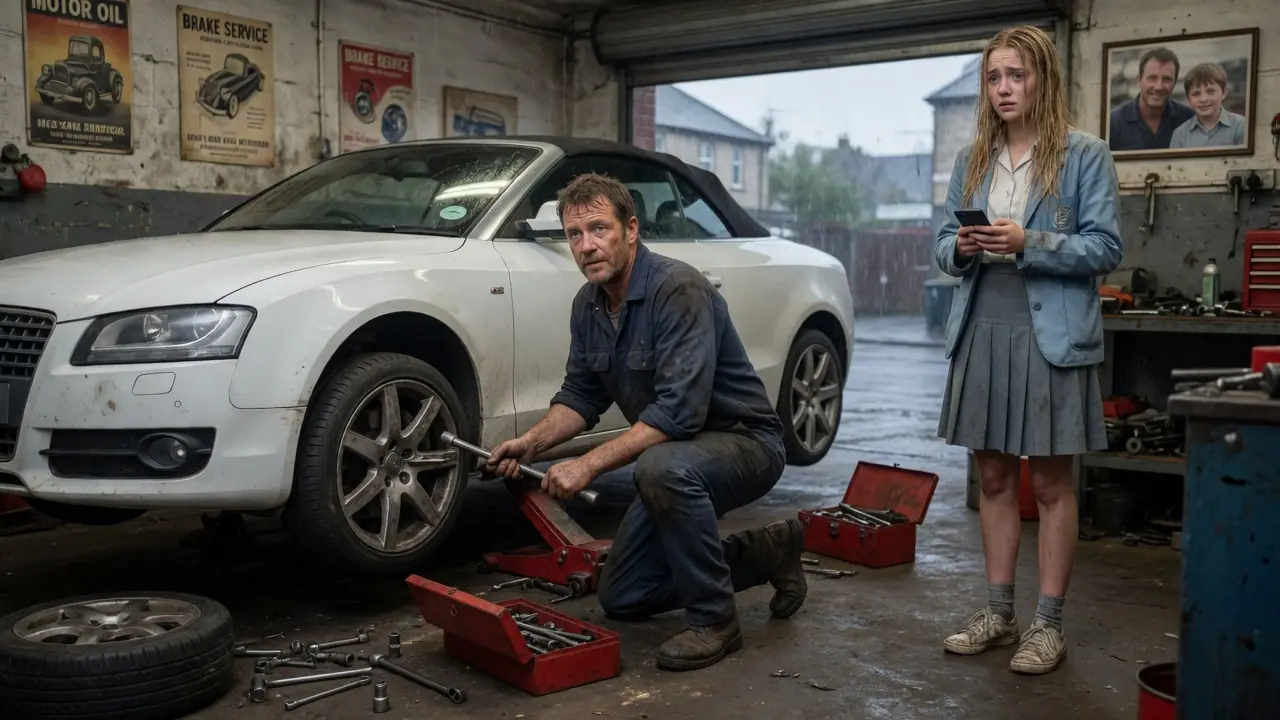
For a second, Jack thought about ignoring it.
Nobody called an auto shop before seven unless they were angry, stranded, or trying to sell something he could not afford.
He pulled his hand free from the engine, wiped black grease from his fingers, and lifted the receiver.
“Morgan’s Repairs,” he said, trying to sound more awake than he felt. “This is Jack.”
There was a brief silence on the other end.
Then a woman’s voice spoke.
Clear.
Controlled.
Refined.
“Is this the mechanic who helped my daughter yesterday?”
Jack straightened slightly.
He did not know many women who sounded like that. Her voice belonged in glass offices, boardrooms, charity galas, and places where people used cloth napkins at lunch.
Not in a struggling auto shop on the west side of Millfield at 6:47 in the morning.
“If you mean Lily,” Jack said carefully, “yes, ma’am. I helped her with a flat tire.”
“My name is Alexandra Hayes.”
Jack went still.
Even before she said anything else, the name landed with weight.
Everyone in Millfield knew the Hayes name.
Hayes Innovations employed half the county, owned the gleaming corporate campus on the hill, sponsored the children’s hospital wing, and appeared on business magazine covers whenever the press wanted a story about ambition, technology, and power.
Alexandra Hayes was not just wealthy.
She was the kind of wealthy people discussed in numbers too large to feel real.
Jack looked down at his grease-blackened hand.
On the line, Alexandra continued, “My driver will pick you up in thirty minutes.”
It was not a question.
Jack looked toward the staircase that led to the apartment above the shop.
His nine-year-old son, Ethan, was still asleep upstairs. The boy had gone to bed late after finishing extra math practice and asking three questions about fractions that Jack had answered with more confidence than accuracy.
“I’m sorry,” Jack said. “Pick me up for what?”
“To discuss what happened yesterday.”
Jack glanced at the calendar taped to the wall. He had two scheduled repairs that morning, one overdue transmission job, and only twenty-six dollars in the cash box until Mrs. Daniels paid her balance.
“If there’s a problem with the spare tire, I can send a tow—”
“This is not about the tire, Mr. Morgan.”
Her voice did not rise, but it sharpened.
“This is about my daughter.”
Jack looked toward the window.
The morning outside was pale and wet. Rain streaked the glass, turning the streetlights into blurry gold smears. His shop smelled of oil, rubber, coffee, and old metal. A normal morning in a life built from debt, work, and stubborn survival.
Nothing about it felt prepared for Alexandra Hayes.
He lowered his voice.
“Is Lily all right?”
The question produced another silence.
Not long.
But long enough.
“Yes,” Alexandra said. “Physically.”
Jack heard what she did not say.
He had been a father long enough to recognize the space between words when a parent was afraid.
“Miss Hayes,” he said slowly, “I have to get my son ready for school, and I’ve got customers coming in. I’m not sure I can just leave.”
“My assistant has already contacted Millfield Elementary to confirm your son’s start time,” Alexandra replied. “If you give permission, my driver can make sure he arrives safely. Your shop appointments can be rescheduled. You will be compensated for your time.”
Jack’s jaw tightened.
There it was.
Money as solution.
Money as command.
Money as a way to make inconvenience disappear.
“I didn’t ask for compensation,” he said.
“No,” she replied. “You didn’t ask for anything yesterday either.”
That quieted him.
Because it was true.
The night before, he had helped a drenched teenage girl in a parking space around the corner from his shop. He had changed the shredded tire on her white Audi in the rain, let her use his shop phone, told her not to drive over fifty on the spare, and refused payment when she tried to pull cash from a purse that probably cost more than his monthly electric bill.
He had thought that would be the end of it.
It never occurred to him that kindness could come back with a driver, a corporate mother, and a command disguised as logistics.
“I can be ready in forty minutes,” Jack said at last.
“Thirty,” Alexandra answered.
Then the line went dead.
Jack stood there holding the receiver for several seconds after the call ended.
Upstairs, the floor creaked.
Ethan was awake.
Jack replaced the receiver slowly and looked around the shop.
Morgan’s Repairs was not much to look at. The paint on the walls had started peeling near the ceiling. The front counter was scratched from years of keys, invoices, and elbows. The waiting area had four mismatched chairs, one coffee table missing a corner, and a stack of magazines so old that one of them still advertised a car model discontinued three years earlier.
But the tools were clean.
The floors were swept.
The work was honest.
Jack had built that shop with broken sleep, empty pockets, and hands that always seemed to ache by the end of the day.
It was not a wealthy man’s business.
But it was his.
And he had learned the hard way that sometimes dignity was the only thing a man could own free and clear.
The ceiling above him creaked again.
“Dad?” Ethan called from upstairs. “Is breakfast happening or is this a cereal emergency?”
Jack smiled despite himself.
“Depends how fast you get dressed.”
“Cereal emergency,” Ethan said.
Jack wiped his hands again and headed upstairs.
The morning sun filtered through the dusty blinds of Jack Morgan’s small apartment above the auto shop. The rooms were modest but clean, with low ceilings, secondhand furniture, and family photographs arranged carefully on the walls.
There were pictures of Emily everywhere.
Emily laughing in the kitchen of the house they used to own.
Emily holding baby Ethan near a Christmas tree.
Emily standing beside Jack at the lake, her hair blown across her face, his arm around her waist.
Emily in a hospital bed, though that photo was not on the wall. That one lived in Jack’s nightstand, tucked inside an old book because some memories were too sacred and too cruel to display.
At forty-two, Jack’s face carried the weathered lines of someone who had faced more than his share of hardship. His calloused hands were perpetually stained with engine grease despite nightly scrubbing. His shoulders were broad but tired, shaped by years of lifting heavy parts and heavier responsibilities.
He moved around the tiny kitchen preparing breakfast for Ethan.
The boy sat at the small table, hair sticking up in five directions, eyeing the plain toast and eggs with the slight frown of someone trying not to complain.
Jack noticed.
He pretended not to.
Groceries were running low again, and payday was still four days away. He would need at least two more repair jobs this week to make ends meet.
As he poured Ethan a glass of orange juice watered down to make it last longer, Jack felt the familiar weight of responsibility pressing down on his shoulders.
Five years had passed since cancer took Emily, but some mornings, the absence felt as fresh as yesterday.
Especially mornings like this.
Mornings when he wanted to ask someone whether he was doing the right thing.
Mornings when Ethan looked too thin to him, too serious, too careful with disappointment.
Mornings when Jack wished the boy’s mother were still there to soften the hard edges of their life.
Jack ruffled his son’s hair and managed a smile.
“Sorry, buddy. We’re running low on groceries this week. But hey, pancakes this weekend when Mrs. Daniels pays for her transmission work.”
Ethan looked up quickly.
“Chocolate chip?”
Jack pointed his fork at him. “Let’s not get greedy.”
“One chocolate chip per pancake?”
“That sounds like a hostage negotiation.”
“I’m very reasonable.”
“You are nine.”
“That doesn’t mean I’m wrong.”
Jack laughed, and the sound eased something inside him.
Ethan was brilliant, stubborn, and too observant for Jack’s comfort. He had Emily’s sharp mind and his father’s habit of carrying worry quietly. His math teacher had said the boy was gifted. His principal had suggested enrichment programs. His guidance counselor had mentioned summer camps Jack could not afford without pretending to consider them.
Jack had nodded through all those conversations and then gone home to calculate which bills could be paid late.
“Dad,” Ethan said suddenly, “why did the phone ring so early?”
Jack paused.
A lie would have been easier.
But he had promised Emily he would not raise their son on false comfort.
“A woman called about the girl I helped yesterday.”
“The one with the fancy car?”
“That one.”
“Is she mad?”
“I don’t think so.”
“Rich people call when they’re mad,” Ethan said seriously.
Jack raised an eyebrow. “Where did you learn that?”
“TV. Also Mr. Sweeney yelled at you because his BMW still made a noise after you fixed the other noise.”
“That was a different noise.”
“He said you should have predicted it.”
“Mr. Sweeney thinks mechanics are fortune tellers with wrenches.”
Ethan smiled, then grew thoughtful.
“So what does the lady want?”
“To talk.”
“About what?”
“I don’t know yet.”
Ethan studied him across the table.
“Are you going?”
“For a little while.”
“What about school?”
Jack hesitated. “Her driver might take you.”
Ethan’s eyes widened.
“A driver? Like a rich-person driver?”
“Exactly like that.”
“Do I need to wear my good shoes?”
“You own one pair of shoes.”
“They can be good if I wipe them.”
Jack looked at his son and felt a rush of affection so strong it hurt.
He crossed the kitchen, bent down, and pressed a kiss to the top of Ethan’s head.
“You don’t need to be anything but yourself.”
Ethan made a face. “Dad. I’m eating.”
“Tragic.”
After breakfast, Jack packed Ethan’s lunch.
Peanut butter and jelly.
An apple.
The last granola bar from the box.
Then he slipped in a note, as he did every day.
Proud of you, buddy.
Dad.
The notes had started after Emily died.
At first, they were small lifelines tucked into lunch bags because Ethan cried at school and refused to eat. Then they became tradition. Some days, when a customer complained about a bill or when rent came due without enough in the account to cover it, those small notes reminded Jack that he had not failed at everything.
A black Maybach pulled up outside the shop at exactly 7:17.
Ethan saw it from the window.
“Dad,” he whispered, pressing his face to the glass. “That car looks like it has its own bank account.”
Jack looked out and exhaled slowly.
The driver stepped out in a dark suit and opened the rear door.
Jack looked at his son.
“Remember what I said.”
“Be myself.”
“And?”
“Don’t touch rich buttons.”
“Good.”
They went downstairs together.
The driver introduced himself as Mr. Ellis and addressed Ethan with the same respect he gave Jack. That mattered. Jack noticed.
At the school, Jack watched his son step out of the car with his backpack over one shoulder and a look of barely contained excitement. A few children turned to stare. Ethan glanced back at Jack, who gave him a small nod.
Be yourself.
Ethan nodded back.
Then the driver closed the door, and Jack rode alone toward Crest Haven Estates.
As the Maybach glided through Millfield, Jack felt as if he were traveling through layers of his own life.
First came the working side of town.
Auto shops.
Laundromats.
Diners.
Dollar stores.
Houses with sagging porches and cars parked on lawns because garages were used for storage, not vehicles.
Then came the middle neighborhoods.
Tidy lawns.
Two-car garages.
School banners in windows.
Basketball hoops.
The kind of houses Jack and Emily had once imagined they would grow old in.
Then the road climbed toward Crest Haven Estates, where the homes disappeared behind gates, stone walls, and rows of manicured trees. The air seemed cleaner there, though Jack knew that was ridiculous. Money did not purify oxygen. It just made everything look less desperate.
The Hayes residence sat on a hillside overlooking the valley.
It was not a house so much as a statement made of glass, steel, and stone.
Floor-to-ceiling windows reflected the gray morning sky. Water moved silently through a narrow artificial stream beside the entrance. The driveway curved with intentional elegance, ending beneath a covered portico where another black vehicle waited.
Jack stepped out and looked down at his boots.
Clean, but old.
He had worn his least stained shirt and run a comb through his hair. Still, he felt acutely aware of every callus, every oil mark that would not scrub out, every sign that his world was built by hand instead of purchased by instruction.
The front door opened before he knocked.
Alexandra Hayes stood there herself.
She was tall, impeccably dressed in a charcoal suit, with dark hair swept into a precise twist at the back of her head. Her face was striking rather than soft, the kind of face cameras loved because it gave nothing away. Her eyes were the same blue as Lily’s, though colder at first glance.
“Mr. Morgan,” she said.
“Miss Hayes.”
“Alexandra, please.”
“Jack, then.”
Something flickered across her face.
Surprise, maybe.
Or respect.
She stepped aside.
“Come in.”
The house was beautiful in the way museums were beautiful. Light, space, expensive silence. Every surface was clean enough to feel untouched. There were sculptures instead of clutter, abstract paintings instead of family photographs, a staircase that curved upward like it had never known dust.
Jack thought of his apartment above the garage, where Ethan’s homework covered half the kitchen table and one cabinet door never closed right unless you lifted it first.
Alexandra led him into a home office overlooking the valley.
One wall was glass. The desk was black walnut. The shelves held awards, business books, framed degrees, and a single photograph turned slightly away from the room.
Jack noticed that photograph immediately because it was the only thing in the office that looked human.
Alexandra gestured to a chair.
“Coffee?”
“Black is fine.”
She made it herself at a machine that looked like laboratory equipment. Her movements were efficient and practiced. She handed him a porcelain cup and sat behind the desk.
For a moment, neither of them spoke.
Then Alexandra opened a slim folder.
“Yesterday at 3:11 p.m., my daughter’s phone went offline. At 3:16, her vehicle left its expected route. At 3:38, my security team lost all digital trace of her. At 4:22, she called from your shop.”
Jack stared at her.
“That’s a lot of numbers for a dead phone and a flat tire.”
“My daughter was almost kidnapped four years ago.”
The sentence landed quietly.
But it changed the room.
Jack’s hand tightened around the coffee cup.
Alexandra continued, her voice steady but not untouched. “She was thirteen. Her father was with her. He intervened before they could get her into the van.”
Jack said nothing.
“He survived,” Alexandra said. “Technically.”
There was the smallest break in that word.
Technically.
“He suffered traumatic brain injury during the attack. He lives now in a private care facility in Switzerland. Some days he remembers his own name. He has not recognized Lily in more than three years.”
Jack thought of Lily in the rain, standing beside her shredded tire with mascara running down her face, saying, My dad would have known what to do. But he’s…
Now the unfinished sentence had a shape.
“I’m sorry,” Jack said softly.
Alexandra’s face did not change, but her fingers moved once against the edge of the folder.
“Since then, Lily has been under extensive security protocols. Tracking, drivers, restricted routes, vetted contacts. Yesterday, she left school early without authorization to visit a former music teacher who was moving out of state. Her phone died. She got lost. Then her tire failed.”
“She wasn’t hurt,” Jack said.
“No. Because she ended up at your shop.”
The words were factual.
But beneath them was something else.
Fear.
Gratitude.
And maybe shame.
Jack set his cup down.
“Alexandra, I changed a tire. That’s all.”
“No,” she said. “You did something else. You treated her like a person.”
Jack frowned slightly.
Alexandra leaned back in her chair.
“Most people treat Lily as an extension of me. They are careful with her because of money, status, fear, reputation, or opportunity. Yesterday, she came home and told me that a man with grease on his hands told her to drive under fifty miles per hour and refused her money.”
Jack almost smiled. “That’s basic spare-tire safety.”
“To her, it was rare.”
That quieted him.
Alexandra turned a page in the folder.
“I had you researched.”
Jack’s expression hardened.
“I figured.”
“You don’t approve.”
“I don’t like being turned into paperwork.”
A faint expression, almost regret, passed across her face.
“Fair.”
She closed the folder.
“Jackson Edward Morgan. Forty-two. Widower. Former senior mechanical engineer at Westbrook Automotive Design. Opened Morgan’s Repairs after being laid off during restructuring. One son, Ethan. Age nine. Excellent academic record. Outstanding medical debt from your late wife’s cancer treatment. Business revenue unstable but reputation strong. Several documented instances of discounted or unpaid work for elderly customers, single parents, and low-income clients.”
Jack’s face went hot.
“Did the report include my favorite breakfast cereal too?”
“No.”
“Shame. It’s a real character clue.”
For the first time, Alexandra’s mouth curved slightly.
Then Jack’s voice sharpened.
“You looked into my medical debt?”
“Yes.”
“That was private.”
“You entered my daughter’s life.”
“She came to my shop in the rain.”
“And I had to know whether you were safe.”
“I am a mechanic and a father. I am not a threat because my bank account looks bad on paper.”
Alexandra went very still.
The room changed again.
Jack realized he had spoken harder than he intended.
But he did not take it back.
After a moment, Alexandra looked down at the closed folder.
“You’re right,” she said.
The admission surprised him.
She looked back up.
“I apologize. I am accustomed to solving uncertainty with information. It is not always graceful.”
“No,” Jack said. “It isn’t.”
Another silence.
This one less hostile, somehow.
Alexandra opened a second folder.
“I asked you here for two reasons. First, to thank you for helping Lily. Second, to offer you a business contract.”
Jack eyed the folder warily.
“What kind of contract?”
“Hayes Innovations maintains a corporate fleet of vehicles. Executive transport, security vehicles, employee service cars, several specialty prototypes. We currently use a dealership service center in Portland. It is expensive, slow, and impersonal.”
“Most dealership service centers are.”
“I’d like Morgan’s Repairs to handle the fleet maintenance.”
Jack stared at her.
Alexandra slid the document across the desk.
“The monthly retainer is listed on page two.”
Jack opened it.
For several seconds, he just looked at the number.
Then he looked again because his brain refused to accept it.
It was more than three times what the shop made in an average month.
Guaranteed.
For a year.
With renewal options.
The contract would pay the rent, cover parts, allow him to hire help, pay down Emily’s medical debt, replace the broken lift, and rebuild the college fund he had nearly touched twice in the last six months.
It would change everything.
That was what frightened him.
“Why?” he asked.
Alexandra’s expression remained professional. “Because your qualifications exceed our current provider’s. Because your shop is closer to our campus. Because Lily trusts you. And because, frankly, I prefer competence over polish.”
Jack looked at the contract again.
“This is a lot of money for maintenance.”
“It is standard for our needs.”
“Maybe in your world.”
“In my world,” she said, “vehicles must function safely, privacy must be respected, and trust is worth paying for.”
Jack closed the folder.
“I need time to review it.”
Alexandra studied him.
“You are refusing to sign immediately?”
“I’m saying I read things before signing them.”
“Good.”
That surprised him.
She leaned back.
“Most people see the number first and the terms second.”
“I’ve made that mistake before.”
“So have I,” she said quietly.
Jack caught the weight behind the words, but she moved on before he could study it.
“There is one more matter. Lily has asked if she may learn basic vehicle maintenance at your shop.”
Jack blinked. “She wants lessons?”
“She claims she needs to understand her own car. I suspect she simply felt safe there.”
There it was again.
That word.
Safe.
Jack thought of Lily standing in the rain. Rich, yes. Protected, yes. But lonely in a way money could not repair.
“I can teach her,” he said. “But not as a favor and not as a secret. She’ll wear old clothes, listen carefully, and she won’t be treated like royalty. If she wants to learn, she works like anyone else.”
Alexandra’s eyes narrowed slightly.
“She is not used to being spoken to that way.”
“Then it’ll be educational.”
This time, Alexandra actually smiled.
Small.
Quick.
Real.
“I think she’ll like that.”
The lessons began the following week.
At first, Lily arrived in black SUVs with security at a respectful distance, wearing expensive sweaters and shoes completely unsuited to garage floors. Jack handed her a pair of coveralls from the supply closet and pointed to a stool.
“If you don’t want grease on it, don’t wear it here.”
Lily looked at the coveralls.
Then at him.
Then smiled for the first time without trying to hide it.
“Yes, sir.”
Jack started with basics.
Oil.
Tire pressure.
Warning lights.
Brake pads.
Battery terminals.
How to listen for a sound before assuming disaster.
How to describe a problem clearly.
How not to panic when a machine misbehaved.
Lily learned quickly, asking sharper questions than most adults. She was brilliant, but more importantly, she listened. Really listened. She did not pretend to know things she did not. She did not flinch from getting her hands dirty after the first week.
Ethan met her on a Tuesday afternoon when he came downstairs after school carrying math homework and a bag of pretzels.
He stopped when he saw Lily leaning over an open hood.
“You’re the rich girl,” he said.
Jack nearly dropped a wrench.
“Ethan.”
Lily looked up.
Then she laughed.
“I guess I am.”
Ethan nodded. “Cool. I’m the shop kid.”
“Nice to meet you, shop kid.”
“You know cars?”
“Learning.”
“Dad says people who know cars should also know math.”
Lily glanced at Jack. “Does he?”
“He says that when he wants me to do homework.”
Jack pointed toward the stairs. “Homework. Now.”
Ethan saluted with a pretzel. “Yes, sir.”
From that day on, Ethan and Lily formed an unlikely friendship.
She helped him with advanced algebra.
He explained baseball statistics.
She brought books from the private school library.
He taught her how to get the snack machine in the shop waiting area to release stuck chips without shaking it violently.
Jack watched them with quiet amazement.
Lily, who had arrived brittle and guarded, softened around Ethan.
Ethan, who often seemed older than nine because life had demanded too much maturity from him, became fully a child around Lily. He showed off. He asked questions. He made terrible jokes. He laughed more.
Alexandra noticed too.
At first, she came to pick Lily up and stayed in the car.
Then she began stepping inside.
Then she began asking Jack questions about the fleet.
Then about the shop.
Then about Ethan.
Then, one Friday evening in November, she arrived without a driver, wearing dark jeans and a sweater beneath a tailored coat, looking almost ordinary except for the way everyone in the room instinctively noticed her.
Jack was under a delivery van when her shoes appeared beside the lift.
“Your left front tire is low,” he said.
She looked down.
“How could you possibly know that?”
“You pulled in heavy on that side.”
“I thought you were under a van.”
“I have ears.”
She considered this.
“Impressive.”
“Annoying, mostly.”
She surprised him by laughing.
The sound changed her face completely.
For one second, Jack saw the woman beneath the armor.
Not the CEO.
Not the billionaire.
Not the mother who ran security protocols like a military campaign.
Just a tired woman who had forgotten what it felt like to be amused without calculation.
“You should do that more,” Jack said before he could stop himself.
Her expression shifted.
“Laugh?”
“Yeah.”
“I’ll add it to my calendar.”
“Color-coded, I assume.”
“Obviously.”
He rolled out from under the van and sat up.
She looked at the grease on his cheek.
“You have something…”
He wiped the wrong side.
“No. Other side.”
He wiped again.
“Still no.”
She stepped forward, then stopped herself.
The moment was small.
Almost nothing.
But both of them felt it.
Jack cleared his throat.
“Lily’s in the office helping Ethan with fractions.”
Alexandra recovered first.
“Then I should let them finish.”
But she did not move right away.
Instead, she looked around the shop.
“Lily likes it here.”
Jack stood. “She likes being useful.”
Alexandra’s face tightened slightly.
“I have tried to give her every opportunity.”
“I didn’t say you hadn’t.”
“No. But you implied something.”
Jack leaned back against the van.
“I think Lily has had a lot of people protecting her and not many people trusting her.”
Alexandra’s eyes cooled.
“You do not know what I have had to protect her from.”
“No,” Jack said. “I don’t. But I know kids. You can keep them safe and still teach them they’re capable.”
Her jaw tightened.
For a moment, he thought she would leave.
Instead, she said quietly, “Her father told me something similar once.”
Jack said nothing.
Alexandra looked toward the office window, where Lily and Ethan sat bent over a worksheet.
“After the attack, I promised myself she would never be vulnerable again.”
“That’s a heavy promise.”
“It felt necessary.”
“I get that.”
Alexandra turned to him.
“Do you?”
Jack looked toward the stairs, toward the apartment above the shop.
“When Emily died, I wanted to keep Ethan from ever hurting again. I thought if I controlled enough, planned enough, stayed close enough, I could protect him from loss.” He shook his head slightly. “But kids don’t just need protection. They need practice living.”
Alexandra stared at him for a long moment.
Then her voice softened.
“You speak about grief like someone who has argued with it for years.”
“I have.”
“Did you win?”
“No,” Jack said. “But we’re on speaking terms now.”
That answer stayed with her.
Over the next months, the lives of the Morgans and the Hayeses became quietly entangled.
The fleet contract stabilized the shop. Jack hired Miguel full-time and added another young mechanic named Carla, a single mother with quick hands and a sharp eye for diagnostics. He paid down two overdue medical bills. He replaced the ancient coffee maker in the waiting room. He bought Ethan new winter boots without checking the clearance rack first.
But he refused to let the shop become dependent on Hayes Innovations alone.
Regular customers still came.
Mrs. Peterson still got her discount.
Mr. Gaines still paid late.
Local parents still brought in minivans with strange noises and apologetic faces.
Jack still fixed what he could and charged what was fair.
Alexandra once questioned his pricing after noticing an invoice for Mrs. Peterson that barely covered parts.
“You’re losing money on this job,” she said.
Jack signed the invoice and placed it in the drawer.
“She’s been bringing her car here since the first month I opened.”
“That does not answer my concern.”
“She’s eighty-one. Her Social Security check comes next week. Her brakes needed doing now.”
“Jack—”
“I know how business works, Alexandra.”
“Do you?”
He looked at her.
“Yes. I also know how community works. Some days one has to make room for the other.”
She did not argue.
But later, he found that Mrs. Peterson’s next three parts invoices had been quietly covered through an anonymous community repair fund created by Hayes Innovations.
When Jack confronted Alexandra, she looked entirely innocent.
“I have no idea what you mean.”
“You named it the Community Mobility Initiative.”
“A strong name increases legitimacy.”
“You’re impossible.”
“I’m efficient.”
“Rich people are weird.”
“And mechanics are sentimental.”
He laughed before he could stop himself.
She smiled as if she had won something.
By December, Ethan had been accepted into a regional math enrichment program.
Jack stared at the acceptance email with pride and dread.
The tuition was more than he could comfortably manage, even with the Hayes contract.
He did not tell Ethan immediately.
That evening, Alexandra stopped by to pick up Lily and found Jack sitting in the office, the email open on the old desktop computer.
“What is it?” she asked.
“Nothing.”
“Jack.”
He sighed.
“Ethan got into the program.”
“That is wonderful.”
“It is.”
She read his face.
“And expensive.”
“Everything wonderful seems to be.”
Alexandra looked at the screen.
“I can pay for it.”
“No.”
The answer came too fast.
Her eyebrows lifted.
“You didn’t even consider it.”
“I don’t want Ethan thinking every problem gets solved because someone rich likes us.”
“Is that what you think this is?”
“I think you’re generous. I also think generosity can feel like a cage if the person receiving it stops standing on their own feet.”
Alexandra’s expression changed.
Not anger.
Something more wounded.
“I am not trying to buy you.”
“I know.”
“Do you?”
Jack stood.
“I’m trying to protect the way my son sees himself.”
“And I am trying to help.”
“I know that too.”
They stood in the small office, surrounded by invoices, tool catalogs, Ethan’s math worksheets, and the smell of coffee that had been sitting too long.
Finally, Alexandra said, “What would preserve his dignity?”
Jack looked at her.
The question disarmed him because it was not the question wealthy people usually asked.
He sat back down slowly.
“We could make it a scholarship,” he said. “Through the community repair fund. For local kids in technical, math, or science programs. Ethan can apply like anyone else.”
Alexandra nodded.
“Done.”
“That fast?”
“Yes.”
“What if he doesn’t win?”
“He will if he earns it.”
Jack studied her.
“And you won’t interfere?”
“I will not.”
Two weeks later, Ethan won the first Hayes-Morgan Technical Scholars Award after submitting an essay about wanting to design safer vehicles for families who could not afford new cars.
Jack read the essay alone in the shop office and cried so hard he had to close the door.
On Christmas Eve, a pipe burst in Alexandra’s house.
Not a large problem by Hayes standards, but large enough to bring chaos into her carefully managed home. Water ran through a downstairs hallway before maintenance could shut it off. The staff was mostly away for the holiday. Lily called Jack, not the property manager.
He arrived with Ethan in the truck because he had been halfway through making boxed macaroni for dinner when the call came.
Alexandra opened the door barefoot, holding towels, her hair loose around her shoulders for the first time Jack had ever seen.
“I realize this is not automotive,” she said.
Jack looked past her at the water on the floor.
“Nope. But I’ve fixed worse.”
Ethan held up a toolbox. “I’m assistant plumber.”
Lily appeared behind Alexandra. “Thank God. Someone competent.”
“Hey,” Alexandra said.
“Mom, you tried to stop the leak with guest towels.”
“They were absorbent.”
Jack laughed and stepped inside.
They spent Christmas Eve stopping the leak, moving furniture, and setting up fans. Ethan and Lily ordered pizza without asking anyone. Alexandra, after three failed attempts, learned how to wring out a towel properly. Jack found her kneeling beside him in the hallway, sleeves rolled up, hands damp, expression irritated but determined.
“You know,” he said, “you don’t have to do this.”
“It is my house.”
“You have people.”
“It is still my house.”
He looked at her then.
Really looked.
For all her money, Alexandra Hayes had lived much of her life surrounded by people paid to assist her but very few people allowed to stand beside her without fear.
“You’re doing fine,” he said.
She glanced at him.
“That sounds patronizing.”
“It was meant to be encouraging.”
“Work on tone.”
“Yes, ma’am.”
Near midnight, the damage was contained, the pizza was cold, and Ethan had fallen asleep on one end of the massive living room sofa with a slice of crust still in his hand. Lily sat beside him under a cashmere blanket, reading one of his comic books with unexpected concentration.
Alexandra stood near the window, looking at the Christmas lights reflected in the glass.
Jack came to stand beside her.
“You okay?”
She took a long breath.
“I have spent years making sure nothing unexpected can enter this house.”
“Water disagreed.”
She smiled faintly.
“Yes. Water disagreed.”
Then her face softened.
“Lily laughed tonight.”
Jack looked toward the sofa.
“She does that.”
“Not like that. Not here.”
He did not know what to say.
Alexandra continued, “This house has been safe for years. But I don’t think it has been warm.”
Jack thought of his apartment above the garage, cramped and old, but full of Ethan’s notes, Emily’s photographs, and the smell of pancakes when he could afford the ingredients.
“Warm is harder than safe,” he said.
“Yes,” Alexandra whispered. “I’m learning that.”
In January, the story broke.
A business blog published a photograph of Alexandra Hayes leaving Morgan’s Repairs, followed by speculation about why one of the most powerful women in technology was repeatedly visiting a small-town mechanic. By noon, the rumor had grown. By evening, a tabloid site suggested a relationship.
Jack found out when three reporters appeared outside his shop before lunch.
Miguel locked the office door.
Carla threatened to hit someone with a torque wrench.
Jack called Alexandra.
She answered immediately.
“I know,” she said.
“Is Lily okay?”
“She’s angry.”
“Ethan?”
“I sent security to his school discreetly.”
Jack closed his eyes.
“I hate this.”
“So do I.”
“This is your world, Alexandra. Not mine.”
“I know.”
The exhaustion in her voice softened his anger.
But not enough.
That evening, she came to the shop after closing. No driver. No assistant. No armor except the expensive coat wrapped around her shoulders.
Jack was cleaning tools.
“We need to talk,” she said.
“That sounds ominous.”
“It is practical.”
“Same thing when you say it.”
She did not smile.
“Being close to me brings attention. Unwanted attention. I can manage it, but you and Ethan did not choose this.”
Jack set down the wrench.
“What are you saying?”
“I am saying perhaps distance would be wiser.”
The words landed harder than he expected.
He looked away.
“Wiser for who?”
“For your son. For Lily. For your business. For all of us.”
Jack turned back.
“No. That’s not wisdom. That’s fear wearing a nice coat.”
Her eyes flashed.
“You think I’m afraid?”
“I know you are.”
“I built a global company from nothing but code and stubbornness.”
“And you still don’t know how to sit in a room with someone you care about without planning the exit.”
The words hit too close.
Alexandra went still.
Jack regretted the force of them, but not the truth.
She looked toward the empty waiting area.
“I cannot let Lily be hurt again.”
“She already is,” Jack said quietly. “Not because of me. Because everyone keeps leaving before they can be taken.”
Alexandra’s face tightened.
“I did not leave.”
“You built walls so high she might as well have been alone inside them.”
Silence.
Outside, rain tapped against the shop windows.
Finally, Alexandra said, “And you? You are so different?”
Jack looked down.
That was fair.
He thought of Emily’s pictures, the unopened boxes in the apartment, the way he still slept on one side of the bed because the other side had once been hers. He thought of how he had avoided dating, avoided hope, avoided anything that might make Ethan believe in a second chance only to lose it.
“No,” he admitted. “I’m not.”
Alexandra’s voice softened.
“I don’t know how to do this.”
“Neither do I.”
“Helpful.”
“Honest.”
She looked at him then, and for once there was no command in her face.
Only a woman tired of being powerful because power had not made her less lonely.
Jack stepped closer.
Not too close.
Just enough.
“I’m not asking for anything from you tonight,” he said. “Not promises. Not decisions. Just don’t call fear wisdom and expect me not to recognize it.”
Her eyes filled suddenly, though no tears fell.
“I have not been spoken to like this in a long time.”
“Badly?”
“Truthfully.”
The next day, Alexandra held a press conference.
Jack did not know she was going to do it until Lily sent him a link from school.
He watched on the old computer in the shop office.
Alexandra stood behind a podium at Hayes Innovations, calm and immaculate as always, cameras flashing in front of her.
“I am aware,” she said, “that there has been public speculation regarding my family’s connection to Morgan’s Repairs.”
Jack leaned closer.
Alexandra continued, “The truth is simple. My daughter was helped by an honest man when she needed help. His business earned a fleet contract because of skill, reliability, and integrity. Any attempt to turn that into scandal says more about the hunger for gossip than about the people involved.”
A reporter shouted a question.
Alexandra’s gaze sharpened.
“My daughter is not a headline. Mr. Morgan and his son are not props. They are people. I ask that you treat them accordingly.”
Then she paused.
“And for anyone wondering whether kindness can still exist without calculation, I suggest you visit more small businesses.”
Jack stared at the screen for a long time after the clip ended.
Then Ethan came downstairs.
“Dad?”
“Yeah?”
“Miss Hayes just called you an honest man on TV.”
Jack nodded.
“She did.”
“Does that mean we’re famous?”
“No.”
“Can I still use it at school?”
“No.”
“What if someone asks?”
“Say your dad fixes cars.”
Ethan grinned.
“Famous cars.”
“Homework.”
“Yes, sir.”
Spring came slowly.
The tabloids moved on.
The shop kept growing.
Lily got accepted into three colleges and chose one with a strong mechanical engineering program, shocking Alexandra and delighting Jack. Ethan won second place in the regional math competition and insisted second place was statistically more interesting because it created motivation.
Alexandra began coming to the shop without needing a reason.
Sometimes she brought coffee.
Sometimes she brought Lily.
Sometimes she sat in the waiting area with her laptop while Jack worked, claiming the noise helped her think.
The first time she joined Jack and Ethan for dinner above the shop, Ethan made spaghetti from a box and warned her that the garlic bread was “emotionally uneven.”
Alexandra sat at their small kitchen table beneath Emily’s photographs and looked at the mismatched plates, the worn chairs, the cracked cabinet handle, and the note-covered refrigerator.
“This is lovely,” she said.
Jack looked around, almost embarrassed.
“It’s small.”
“It feels lived in.”
“That’s a polite way of saying messy.”
“No,” Alexandra said softly. “It is a way of saying loved.”
Ethan looked at her.
“Our house is pretty loved. Sometimes the sink makes a noise, though.”
“Most loved things do,” she replied.
After dinner, Ethan showed Lily an old box of Emily’s math puzzles. Jack and Alexandra washed dishes side by side because there was no dishwasher, and for some reason Alexandra insisted on helping.
She washed one plate too slowly.
“You’ve never done dishes, have you?” Jack asked.
“I have done dishes.”
“When?”
“In college.”
“So twenty-five years ago.”
“That was unnecessary.”
“You’re holding the sponge like it might file a lawsuit.”
She laughed, and the sound filled the kitchen.
Jack looked at her.
She looked back.
The moment stretched.
Then from the living room, Ethan shouted, “Dad, can rich people hear awkward silence?”
Lily burst out laughing.
Jack closed his eyes.
Alexandra smiled into the sink.
“Your son is very perceptive.”
“He is for sale.”
“No refunds,” Ethan called.
That night, after Lily and Alexandra left, Ethan stood beside Jack at the window, watching the taillights disappear.
“Dad?”
“Yeah?”
“I think Mom would like her.”
Jack’s throat tightened.
He looked down at his son.
“That’s a big thing to say.”
“I know.”
“You sure?”
Ethan nodded. “She listens when people talk. Not everybody does.”
Jack put a hand on his son’s shoulder.
“No. Not everybody does.”
On the anniversary of Emily’s death, Jack usually closed the shop.
He and Ethan visited the cemetery in the morning, brought flowers, ate lunch at the diner Emily had loved, then spent the afternoon quietly. Some years Ethan wanted to talk. Some years he did not. Jack let him decide.
That year, as they were leaving the cemetery, Alexandra and Lily were waiting near the gate.
Jack stopped.
Ethan looked up at him, then at them.
Alexandra held a small bouquet of white tulips.
“I hope this is not an intrusion,” she said.
Jack could not speak for a second.
Lily stepped forward.
“Ethan said his mom liked tulips.”
Ethan nodded. “She did.”
Together, they walked back to Emily’s grave.
Jack watched Alexandra place the flowers gently beside the stone.
No performance.
No grand gesture.
Just respect.
After a while, Alexandra stood beside Jack.
“I was afraid to come,” she said quietly.
“Why?”
“Because I did not want to stand where another woman is loved.”
Jack looked at the headstone.
“She’ll always be loved.”
“I know.”
“That doesn’t mean there’s no room in the world.”
Alexandra’s eyes shone.
“I am trying to learn that.”
He took her hand.
Not dramatically.
Not for anyone watching.
Just because in that moment, it felt true.
Alexandra looked down at their joined hands and held on.
That summer, Lily left for college.
She cried in the airport despite insisting she would not. Alexandra cried more carefully, which Lily found annoying.
Jack hugged Lily and whispered, “Check your tire pressure monthly.”
She laughed through tears.
“Yes, sir.”
Ethan handed her a notebook filled with terrible math jokes.
“For emergencies,” he said.
Lily hugged him so hard he complained about his ribs.
After she went through security, Alexandra stood very still, watching until Lily disappeared.
Jack stood beside her.
“She’ll call.”
“I know.”
“She’ll be okay.”
“I know.”
“You’re still allowed to miss her.”
That broke the last of her composure.
She turned into him, and he held her while airport crowds moved around them.
For once, Alexandra Hayes did not look powerful.
She looked human.
And Jack loved her more for it.
The proposal happened almost a year after the phone call.
Not at a gala.
Not at a restaurant.
Not on a private jet or beneath a chandelier.
It happened in Morgan’s Repairs, after closing, while rain tapped gently against the windows and the smell of oil and coffee hung in the air.
Jack had spent all day pretending nothing was unusual.
Ethan knew.
Lily knew by video call from college.
Miguel knew and had been so nervous he dropped a wrench twice.
Alexandra arrived at seven, expecting to sign updated fleet paperwork.
Instead, she found the shop lights dimmed, the waiting area cleared, and a small table set near the front window with takeout from the diner and two paper cups of coffee.
She looked around.
“Jack?”
He stepped out from the office, wiping his hands on a rag even though they were clean.
“I know this isn’t exactly your usual standard.”
Her eyes softened.
“It is becoming my favorite standard.”
He smiled nervously.
“I’ve been trying to figure out how to do this right.”
“Do what right?”
He reached into his pocket.
Alexandra went still.
Jack did not kneel immediately. He looked at her first, really looked at her.
“When we met, you tried to organize my life in thirty minutes.”
“That sounds like me.”
“And I thought you were terrifying.”
“That also sounds like me.”
He laughed softly.
“Then I got to know you. The woman who loves her daughter so fiercely she sometimes forgets love needs air. The woman who built an empire but didn’t know how to sit in a kitchen and be cared for. The woman who learned how to wash dishes badly and laugh at herself. The woman who showed up at a cemetery with tulips because my son remembered something that mattered.”
Alexandra’s eyes filled.
Jack took a breath.
“I loved Emily. I always will. She gave me Ethan. She taught me what real love looked like. For a long time, I thought loving anyone else would mean leaving her behind.”
He shook his head.
“But love doesn’t work like that. It doesn’t divide. It makes more room.”
Alexandra covered her mouth.
Jack knelt then, holding out a simple ring.
Not enormous.
Not flashy.
Beautiful in a quiet way.
“Alexandra Hayes, will you marry me? Not because either of us needs saving. Not because your world can fix mine or mine can soften yours. But because I love you, and I want to build something honest with you.”
For once, Alexandra had no polished answer ready.
She only nodded, tears falling freely now.
“Yes,” she whispered. “Yes, Jack.”
From behind a stack of tires, Ethan shouted, “She said yes!”
Lily’s voice came through a laptop on the counter. “I knew it!”
Alexandra laughed and cried at the same time as Jack stood and slipped the ring onto her finger.
Then she kissed him in the middle of the auto shop, surrounded by tools, grease, rain, and the people who had somehow become a family.
They married in the spring.
Not in a cathedral.
Not on a private island.
Not in any of the places Alexandra’s public relations team suggested before she politely told them to stop speaking.
They married behind Morgan’s Repairs, in the small lot Jack and Miguel had cleaned up, beneath strings of white lights and a handmade arch Ethan insisted was “structurally questionable but emotionally sound.”
Lily stood beside Alexandra.
Ethan stood beside Jack.
Emily’s photograph was placed on a small table near the front with white tulips beside it, because love did not need to erase anyone to make room for someone new.
Mrs. Peterson cried.
Mr. Gaines brought a cake that leaned slightly to the left.
Miguel gave a toast that made everyone laugh.
Lily said Jack was the first adult who treated her fear like something she could learn from instead of something that made her fragile.
Ethan said Alexandra made excellent coffee and terrible macaroni, but he was willing to keep her anyway.
Alexandra laughed so hard she had to wipe her eyes.
When it was Jack’s turn, he looked at his son, then at Lily, then at Alexandra.
“I used to think success meant keeping everything from falling apart,” he said. “Now I think maybe success is what happens after things fall apart and you still choose to be kind.”
Alexandra squeezed his hand.
Years later, people in Millfield still told the story differently.
Some said the billionaire CEO fell in love with the humble mechanic because he fixed her daughter’s car.
Some said Jack’s good deed saved his business.
Some said Lily was the reason two broken families found each other.
Some said Ethan had predicted the whole thing because he was the smartest person in the room and frequently said so.
Jack never corrected every version.
But when someone told the story in front of him, he usually smiled and said, “I just changed a tire.”
Alexandra would look at him then and say, “No, Jack. You opened a door.”
And maybe she was right.
Because the phone call that came at 6:47 one morning had not only brought wealth into Jack’s life.
It had brought Lily into Ethan’s.
It had brought laughter back into Alexandra’s house.
It had brought new purpose into a struggling shop.
It had brought love into places grief had once made untouchable.
Jack still opened Morgan’s Repairs every morning.
The sign was repainted now.
The lifts were new.
The waiting room had fresh coffee, better chairs, and a wall covered in thank-you notes from customers who had been helped when they could not afford help.
But some things stayed the same.
Mrs. Peterson still got her discount.
Mr. Gaines still paid late.
Ethan still found notes in his lunch, though now some were from Alexandra too.
Lily still called when her car made any suspicious sound, even if she already knew what it was.
And on rainy afternoons, when a frightened teenager or stranded parent or exhausted stranger tapped on the glass after closing, Jack still looked at the clock, sighed, and opened the door.
Because that was who he was when things fell apart.
That was who Emily had asked him to be.
That was who Alexandra had come to love.
And sometimes one simple act of kindness, done in the rain with no expectation of reward, could travel farther than any road.
Sometimes it could cross worlds.
Sometimes it could turn a struggling mechanic, a lonely boy, a guarded girl, and a powerful woman into something none of them had expected to find again.
A family.