Sophia Lauron’s pearl-white Cadillac Escalade died three miles from Pine Hollow Lodge just as the snowstorm swallowed the last visible section of road. One moment, the luxury SUV was moving steadily through the Vermont hills; the next, every warning light flashed across the dashboard before the engine shut down. Sophia guided the heavy vehicle onto the narrow shoulder and stopped beneath a green road sign half-covered in snow. The temperature outside had already fallen below twenty degrees, and her blind date was supposed to begin in eighteen minutes.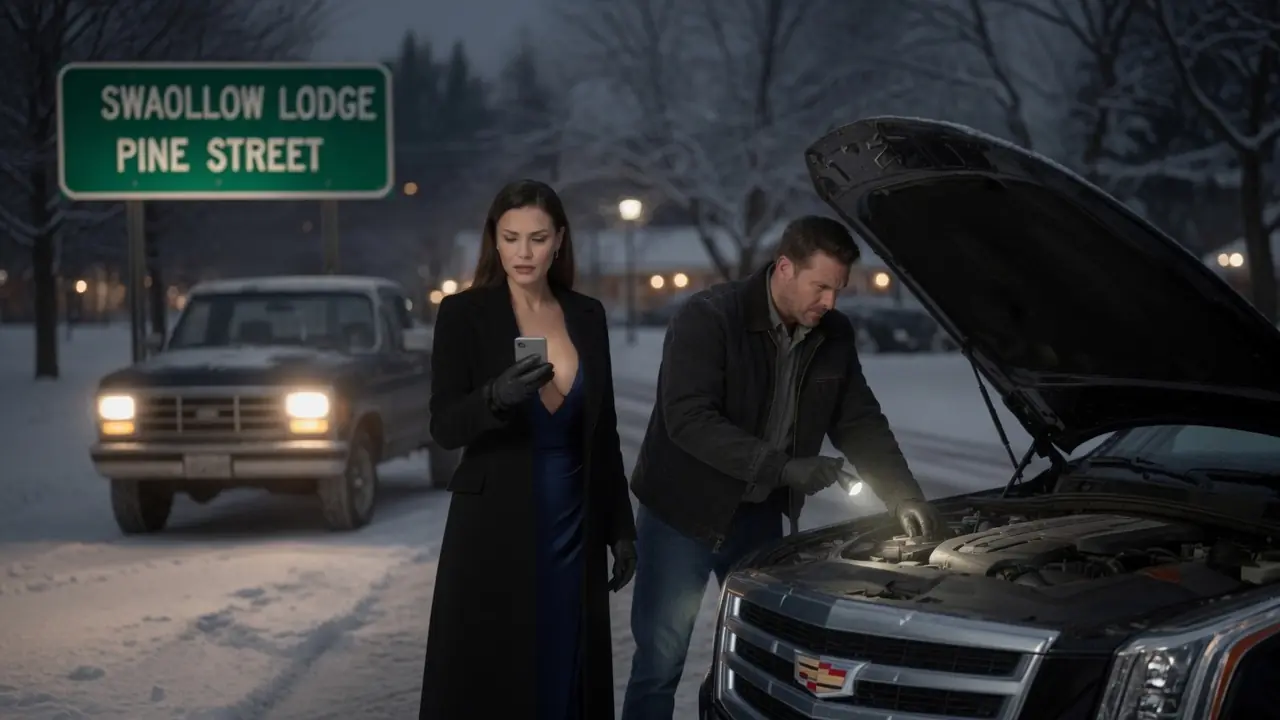
She pressed the ignition button again.
The engine clicked once and went silent.
“My Cadillac died in this snowstorm, and I’m already late for my blind date,” she muttered.
Sophia had not wanted the date in the first place. Her younger sister, Claire, had arranged it after deciding that thirty-four was too young to spend every evening reading financial reports alone. According to Claire, the man was kind, dependable, and “the only mechanic in Vermont who could repair a truck while helping his daughter finish a science project.”
Sophia had stopped listening at mechanic.
She was the chief executive of Lauron Automotive Systems, a rapidly growing company that designed electric-control units for luxury vehicles. Her days were spent with engineers, investors, lawyers, and executives whose suits cost more than most monthly rents. The thought of arriving at a secluded lodge to meet a struggling small-town father felt like something Claire had designed to prove a moral point.
Sophia hated moral points.
She checked her phone.
No service.
Snow collected along the windshield as the heater slowly weakened. Sophia pulled her black wool coat tighter around the burgundy dress she had chosen for dinner and looked toward the empty road. The lodge’s lights should have been visible beyond the next hill, but blowing snow had erased nearly everything.
Then headlights appeared behind her.
An aging dark-red pickup slowed and stopped several yards away. Its driver remained inside for a few seconds, probably deciding whether helping a stranded stranger was worth standing in the storm. Sophia watched the door open.
A tall man stepped into the snow.
He wore a worn black work jacket over a gray flannel shirt, dark jeans, gloves, and boots already dusted white. His short dark hair was damp beneath the edge of his cap, and light stubble covered a face that looked tired without appearing defeated.
He approached the Cadillac carefully.
“Are you hurt?” he called.
“No.”
“Anyone else inside?”
“No.”
“Can you unlock the hood?”
Sophia lowered the window slightly. Wind pushed snow into the vehicle.
“Roadside assistance says it may take two hours.”
The man looked up at the sky. “They won’t reach this road in two hours.”
“I’m aware.”
“Then let me take a look.”
“You’re a mechanic?”
“Usually.”
“That sounds uncertain.”
“It means I own a repair shop, but tonight I’m trying to get to dinner.”
Sophia stared at him.
He gestured toward the hood.
“Your choice. I can keep driving, or I can see whether this is something simple.”
She unlocked the hood.
The man introduced himself only as Ethan before retrieving a toolbox from his pickup. He raised the Cadillac’s hood, secured it against the wind, and shone a work light across the engine compartment.
Sophia stepped outside.
“You can wait in the car,” Ethan said.
“I would rather see what you’re doing.”
“Then hold this.”
He handed her the flashlight without asking whether she considered herself capable.
Sophia moved beside him as he examined the battery terminals, wiring harnesses, and main electrical connections. Snow clung to his shoulders while his gloved hands moved with calm precision. He did not stare at her expensive dress or ask why she was driving alone in a storm.
“The battery isn’t dead,” he said.
“What is?”
“Possibly a frozen connection in the primary control circuit.”
“This vehicle was serviced three days ago.”
“That doesn’t stop moisture from entering the wrong place.”
“It is a new Cadillac.”
“New machines break too. They just charge more for the surprise.”
Despite herself, Sophia smiled.
Ethan noticed but did not react.
He removed a protective panel near the power-distribution module. Beneath it, a small connector had loosened. Moisture had entered the housing and frozen around the contact points.
“This connection is interrupting communication between the starter system and the main controller,” he explained.
Sophia leaned closer. “That connector should be sealed.”
“It should.”
“Was it installed incorrectly?”
“Could’ve been. Could’ve been damaged during service.”
Sophia studied the component.
Her company supplied a related control system to several American manufacturers, though not this exact model. A seal failure in freezing temperatures was the kind of defect capable of triggering warranty claims, recalls, and lawsuits. She took a photograph before Ethan noticed.
“You work with cars?” he asked.
“A little.”
“That answer sounds uncertain.”
She looked at him.
He smiled faintly and returned to the repair.
Ethan cleaned the connector, dried the contacts with a small heating tool, and reinforced the seal using materials from his emergency kit. The work took nearly twenty minutes. During that time, Sophia’s fingers became numb even inside her leather gloves.
Ethan noticed.
“You should sit in my truck. The heater works.”
“I’m fine.”
“You’re shaking.”
“I said I’m fine.”
“And I said the heater works.”
His tone was neither commanding nor apologetic.
Sophia handed him the flashlight and walked toward the pickup.
The passenger door opened before she reached it. A nine-year-old girl sat in the back seat beneath a thick blue blanket, surrounded by a backpack, crayons, and a cardboard model of the solar system.
She looked at Sophia curiously.
“Are you the stranded lady?”
Sophia paused. “Apparently.”
“My dad always stops.”
“So I’ve noticed.”
The girl moved her backpack to make space. “I’m Lily.”
“Sophia.”
Lily looked toward her father beneath the Cadillac’s raised hood.
“He’s nervous.”
“About the repair?”
“About his date.”
Sophia’s attention sharpened. “He has a date tonight?”
“At Pine Hollow Lodge.”
The coincidence settled into the cab, though neither of them understood it yet.
Lily continued drawing.
“My aunt arranged it. Dad said the woman is probably too fancy for him.”
Sophia looked toward Ethan.
Snow moved around him beneath the bright work light. His pickup was old, his clothes were practical, and his daughter’s project occupied more space than anything belonging to him. He fit Claire’s description far too well.
“What is your father’s last name?” Sophia asked.
“Cole.”
Her phone suddenly gained one bar of service.
A message from Claire arrived.
Ethan Cole is already on his way. Don’t judge him before you meet him.
Sophia stared at the screen.
Outside, the Cadillac’s engine started.
Ethan lowered the hood and approached the pickup while wiping his hands on a rag. He opened the driver’s door, reached for his phone, and saw several waiting messages.
The first came from his sister.
Your date is Sophia Lauron. She drives a white Cadillac. Try not to cancel.
Ethan slowly turned toward the vehicle he had just repaired.
Sophia stepped out of the truck holding her phone.
“His name is Ethan Cole,” she said, “a single father and local mechanic.”
Ethan raised his own screen.
“Then you’re not late, Sophia. Your date has been fixing your Cadillac.”
For several seconds, only the wind spoke.
Lily leaned between the front seats.
“I knew it.”
Neither adult looked at her.
Sophia crossed her arms. “Did your sister mention what I do?”
“She said you run a company.”
“She did not give you the name?”
“She said I’d search you online and invent reasons not to come.”
“That sounds perceptive.”
“She also said you would probably hate my truck.”
Sophia glanced at it.
“I’ve seen worse.”
Ethan laughed once.
The tension weakened enough for both of them to breathe.
Pine Hollow Lodge stood only a few miles away, but the storm had worsened. Ethan checked the Cadillac again and warned Sophia that the repaired seal should hold, though he preferred following her in case the connection failed.
“You can ride with us,” he offered. “Leave the Cadillac here and retrieve it tomorrow.”
“I am not abandoning a vehicle beside the highway.”
“It’s insured.”
“It also contains confidential files.”
“Then I’ll follow.”
Sophia hesitated.
She had built her career by avoiding dependence. Yet the man she had already decided would be unsuitable had repaired her car without knowing her name, protected his daughter in the warmth of the truck, and offered help without turning kindness into leverage.
“Fine,” she said. “But stay close.”
“I was planning to.”
They reached Pine Hollow Lodge thirty minutes late.
The building stood beside a frozen lake, with smoke rising from stone chimneys and lanterns glowing along the entrance. The storm had forced most guests to remain indoors, and the dining room was quieter than usual.
Claire had reserved a table near the fireplace.
Lily joined them because the sitter at the lodge had canceled due to the weather. Ethan apologized, but Sophia surprised both of them by saying she did not mind.
“I’ve attended worse business dinners,” she said.
Lily looked impressed. “With children?”
“With investors.”
Dinner began awkwardly.
Ethan ordered the least expensive meal and refused when Sophia suggested sharing a bottle of wine. He needed to drive Lily home. Sophia noticed his attention move automatically toward his daughter whenever the child coughed, shifted, or became too quiet.
It reminded her of something she had forgotten.
Care could be constant without being loud.
“So,” Ethan said, “what does your company actually do?”
“We design electronic systems used in high-end vehicles.”
“Control modules?”
“Among other things.”
He leaned back. “Then you knew more about that connector than you admitted.”
“I wanted to see whether you did.”
“Was this a test?”
“Not intentionally.”
“That’s what people say when they enjoy testing people.”
Sophia narrowed her eyes.
Lily covered a smile with her napkin.
Ethan continued, “Did I pass?”
“You repaired the Cadillac.”
“That’s not an answer.”
Sophia looked toward the fireplace.
“You passed the repair.”
“And the date?”
“It has barely started.”
“Fair.”
She asked about his shop.
Cole Auto & Marine occupied a converted service station outside the small town of Maple Ridge. Ethan had inherited it from his father and nearly lost it after his wife, Anna, died from cancer three years earlier. Medical bills consumed their savings, and Ethan reduced his hours to care for Lily.
Now he worked long days while raising his daughter above the garage.
Sophia listened without interrupting.
She had expected self-pity.
Ethan offered none.
“We manage,” he said.
“Is that true?”
“Most days.”
“What happens on the others?”
“We manage badly.”
Sophia smiled again.
He was not impressed by her title, wealth, or company. He also did not punish her for having them. His honesty felt unfamiliar enough to be dangerous.
“What about you?” Ethan asked. “Why did your sister arrange a date?”
“She believes I work too much.”
“Does she?”
“Yes.”
“Is she wrong?”
“No.”
Sophia explained that Lauron Automotive Systems had grown quickly after she took control from her father. The company’s newest project was a cold-weather vehicle-control platform intended to prevent electrical failures in extreme climates.
The system was supposed to become their largest contract.
Instead, field tests had begun failing.
Connectors froze.
Control units lost communication.
Vehicles shut down without warning.
Ethan stopped eating.
“Like your Cadillac.”
“That vehicle does not use our system.”
“But the failure pattern is similar.”
Sophia nodded.
Investors had given her six weeks to solve the problem. If the next demonstration failed, a larger competitor would purchase the company’s debt and force a sale.
Ethan considered this.
“What do your engineers think?”
“That the software needs another update.”
“What do you think?”
“That they are wrong.”
“Why?”
“Because software cannot seal water out of a connector.”
Ethan placed his fork down.
“Then why are they treating it like software?”
“Because the hardware team says the seals meet specification.”
“Specifications are written indoors.”
Sophia stared at him.
Ethan continued. “Cold doesn’t care what passed inspection. Water enters through movement, pressure, road salt, bad installation, tiny changes in materials. You test connections after months of vibration?”
“Yes.”
“In real vehicles or laboratory fixtures?”
“Both.”
“On country roads?”
“I don’t know.”
“That means no.”
The conversation changed.
Dinner became an engineering discussion conducted between a billionaire CEO, a small-town mechanic, and a nine-year-old child drawing snowflakes on the table paper. Ethan described common failures he saw in modern vehicles—plastic housings becoming brittle, connectors loosening under repeated temperature shifts, drainage paths freezing because designers assumed water would flow normally.
Sophia took notes.
Lily ate dessert.
By the time the lodge announced that the road home had closed, Sophia had filled six pages.
The storm forced them to remain overnight.
Only one guest suite and one smaller room remained. Sophia took the suite, while Ethan and Lily accepted the smaller room across the hall. She offered to pay for both.
Ethan refused.
“I can afford one night.”
“I know.”
“Then stop trying to solve everything with money.”
Sophia’s expression cooled.
“I was being considerate.”
“You were being efficient.”
“What is wrong with efficiency?”
“Nothing, until it replaces asking what people want.”
The comment stayed with her after they separated.
At two in the morning, Sophia could not sleep.
She stood beside the suite window watching snow cover the parked Cadillac. The repaired vehicle represented more than an inconvenient breakdown. It mirrored the problem threatening her company.
A component had passed inspection.
Real conditions exposed the flaw.
She opened her laptop and reviewed test reports until someone knocked.
Ethan stood outside wearing jeans and a thermal shirt.
“Lily is asleep,” he said. “Your light was on.”
“I’m reviewing failure data.”
“At two?”
“I told you I work too much.”
He stepped inside only after she invited him.
Sophia displayed photographs from several failed prototypes. Ethan examined them slowly, enlarging images of seals, housings, mounting positions, and wiring routes.
Then he noticed a pattern.
Every failed unit had been installed near a section where snow and road spray collected before freezing. The housing itself remained sealed during laboratory tests, but the mounting bracket forced the cable downward at an angle. Repeated vibration pulled the connector slightly sideways, creating an opening too small to detect during inspection.
“You don’t have a seal problem,” Ethan said.
“What do we have?”
“A mounting problem that becomes a seal problem.”
Sophia leaned closer.
He sketched a revised bracket on lodge stationery.
The design redirected pressure away from the connector and created a drainage channel below it. It was simple enough that Sophia initially doubted it.
Then she compared the sketch to the failure photographs.
It fit every case.
“You solved this during a blind date,” she whispered.
“I noticed it during a storm.”
“My engineers have spent nine months on this.”
“They understand the system. Mechanics understand what vehicles do after systems leave clean rooms.”
Sophia looked at him.
“Come work for me.”
Ethan laughed.
“I’m serious.”
“I own a shop.”
“You could consult.”
“I have a daughter, customers, and a life in Maple Ridge.”
“I’m not asking you to abandon them.”
“You asked without discussing any details.”
Sophia caught herself.
Efficiency again.
“What would you want?” she asked.
Ethan’s expression softened.
“A chance to test the redesign in real conditions. Credit for the work. And no corporate agreement that lets your company take the idea while pretending it came from a committee.”
“Reasonable.”
“Also, my daughter gets to finish her solar-system project before I become unavailable.”
Lily’s voice came from the hallway.
“I already finished it.”
She stood wrapped in a blanket, listening.
Sophia laughed so suddenly that it surprised her.
By sunrise, the roads reopened.
They left Pine Hollow Lodge after breakfast. Ethan followed Sophia’s Cadillac all the way to Maple Ridge, though the repair held perfectly.
Their second date occurred inside his garage.
Sophia arrived wearing jeans, boots, and a coat that cost more than Ethan’s first car. Lily helped them build a rough prototype of the revised bracket using cardboard, wire, and parts from a damaged control unit.
The first field test worked.
So did the second.
Sophia arranged a formal consulting contract through independent lawyers. Ethan received ownership credit for the bracket concept, fair payment, and the right to remain in Vermont.
The company’s engineers initially resisted him.
One asked whether automotive design should really depend on “garage intuition.”
Ethan placed three failed modules on the conference table.
“Call it whatever helps you listen.”
Sophia hid a smile.
Over the next five weeks, the redesigned mounting system survived freezing rain, vibration testing, road salt, and repeated cold starts. The final demonstration took place on the coldest morning of the year.
Investors gathered beside a row of test vehicles.
The system activated perfectly.
No connectors froze.
No engines shut down.
Lauron Automotive secured the contract.
The agreement saved more than four hundred jobs and prevented the forced sale of the company. Sophia’s board praised her leadership, though she corrected anyone who described the solution as hers alone.
“The design came from Ethan Cole,” she said publicly. “A mechanic who understood the environment our laboratory failed to respect.”
Ethan attended the announcement in a borrowed suit.
Lily wore a blue dress and carried the solar-system model everyone had once delayed.
Afterward, Sophia offered to purchase his garage and transform it into a regional testing center.
Ethan refused.
Then he proposed something else.
Lauron Automotive could build the test facility beside the existing shop while allowing Cole Auto & Marine to remain independent. Local mechanics would be hired as field consultants, connecting engineers directly with real repair experience.
Sophia accepted.
Not immediately.
She asked questions first.
Ethan noticed.
Their relationship grew outside the company.
Sophia learned to eat dinner above the garage while Lily explained school dramas in painful detail. Ethan attended formal events where people assumed he was an employee until Sophia introduced him as the man who saved the company.
He disliked the phrase.
“You saved it,” he told her.
“You identified the failure.”
“You listened.”
That distinction mattered.
Six months after the snowstorm, Sophia stood beneath the same road sign where her Cadillac had failed. Spring had replaced snow with wet grass and early wildflowers.
Ethan parked behind her.
“Car trouble?” he asked.
“No.”
“Then why are we here?”
Sophia held up the original damaged connector inside a small clear box.
“I kept it.”
“That seems unhealthy.”
“It changed my life.”
“The connector?”
“The man who repaired it.”
Ethan stepped closer.
Sophia’s confidence disappeared briefly, revealing the woman who once believed dependence was weakness.
“I spent years choosing people who fit my schedule, my company, and the image everyone expected,” she said. “Then my Cadillac died, and the man I feared would never understand my life understood the one problem nobody else could solve.”
Ethan took her hand.
“I thought you’d look at my shop, my truck, and my daughter and decide we were too small for your world.”
“You are my world now.”
He kissed her beside the road where they had first met.
A year later, Ethan proposed at Pine Hollow Lodge.
Lily carried the ring inside a model Cadillac she built from cardboard. Sophia laughed so hard that the guests near the fireplace turned to watch.
She said yes before Ethan completed his speech.
They married during the following winter.
Snow covered the lodge grounds, but the Cadillac reached the entrance without failing. Sophia wore a simple ivory dress, while Lily stood beside Ethan as both daughter and best person.
During the reception, Claire raised her glass.
“To the blind date neither of them wanted.”
Ethan looked at Sophia.
“You were late.”
“My Cadillac broke down.”
“Excuses.”
She kissed him before he could continue.
Years later, Lauron Automotive became known not only for advanced control systems but for a testing program built around mechanics, drivers, and real-world environments. Ethan remained independent, dividing his time between the garage, the test facility, and home.
Sophia never stopped working hard.
She simply stopped working alone.
The official company history credited the breakthrough to a revised mounting system developed during extreme-weather field analysis. Investors preferred language like that.
Lily preferred the truth.
Her version appeared in a school essay years later:
My dad met Sophia because her Cadillac died in the snow. He fixed her car, she helped save his garage, and together they saved a company. They were supposed to meet at a lodge, but sometimes the right person finds you before you reach the place you planned.
Sophia framed the essay inside her office.
Beside it sat the failed connector from that first night.
The tiny component had nearly ruined two futures.
Instead, it brought them together on a frozen Vermont road—three miles from a blind date they had already begun without realizing it.