“You repaired my motorbike for free, so don’t insult me by refusing the return.”
Emma Carter dropped a thick investment contract onto the scarred workbench, rattling the loose sockets beside it. She stood beneath the leaking roof of David Miller’s failing motorcycle garage in an elegant camel trench coat, her hazel-green eyes fixed on the widowed single father who had helped her when he believed she was a stranded traveler without enough money to pay. David wiped the grease from his hands, read the eight-figure investment figure on the first page, and pushed the contract back toward her.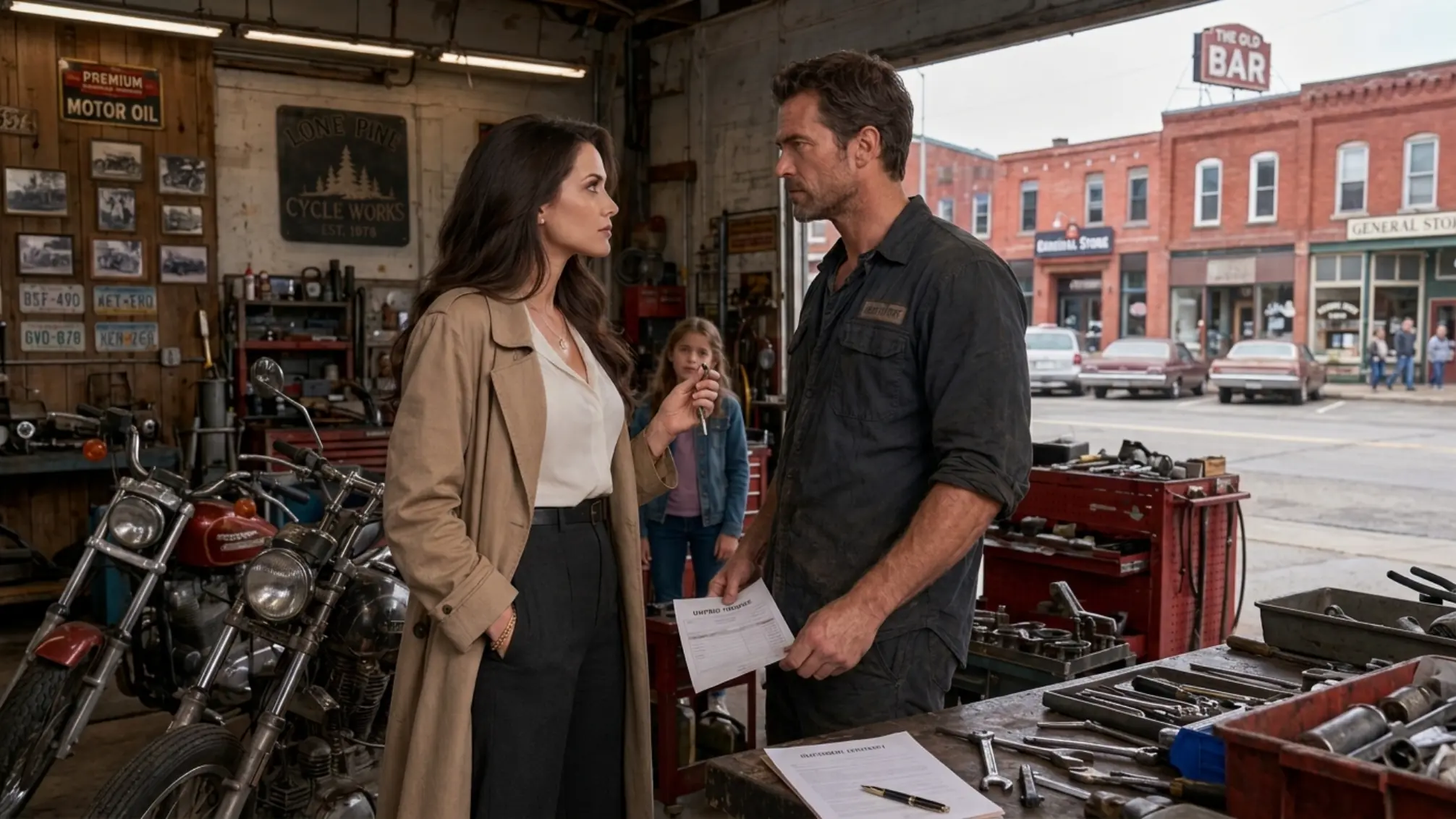
“A billionaire’s charity costs more than an unpaid repair,” he said.
Emma stepped closer. “Refuse me, and this garage dies with your pride.”
David picked up a pen and placed it across the contract. “Then write ‘equal partner’—and watch what we build from nothing.”
The garage fell silent.
Near the office doorway, eight-year-old Lily Miller clutched a small red toolbox against her chest. She had watched Emma arrive in a black luxury SUV surrounded by legal advisers, assistants, and security personnel, then dismiss every one of them before entering the shop alone. The woman standing before her father no longer looked like the rain-soaked stranger who had pushed a dusty motorbike through the garage doors three months earlier.
She looked powerful enough to purchase the entire street.
David was thirty-eight and had spent most of his life repairing machines other people had already given up on. His garage stood on the edge of a small Ohio town where the factories had slowly disappeared and empty storefronts outnumbered growing businesses. The hand-painted sign above his entrance had faded until only half the original lettering remained visible.
The shop had belonged to his father.
David inherited it together with unpaid taxes, worn tools, an unstable hydraulic lift, and a reputation for honest work that did not always translate into enough income. Some weeks, he earned enough to cover every bill. Other weeks, he stood at the kitchen table after Lily went to bed, shifting money between electricity, groceries, insurance, and the garage mortgage.
Four years earlier, his wife, Rachel, had died after a sudden illness.
The diagnosis arrived in spring. By winter, David was standing beside a hospital bed holding her hand while every future they planned disappeared in a quiet room. Lily was only four and understood death through questions David could barely answer.
“Is Mommy coming home?”
“No.”
“Can we visit her?”
“Not where she went.”
“Will she know I miss her?”
David told Lily yes because he needed to believe it too.
After Rachel’s death, every responsibility rested on him. He packed lunches before sunrise, tied ponytails badly until online tutorials taught him better, opened the garage at eight, closed early for school meetings, cooked dinner, checked homework, washed uniforms, and read stories until Lily fell asleep.
The work exhausted him.
Her smile kept him moving.
David’s father once told him that hardship revealed character only when nobody was watching. It was easy to be generous when generosity earned admiration. The real test came when helping someone cost time or money you could not spare.
That lesson returned on a rainy Tuesday evening.
David had already worked ten hours. Two motorcycles remained unfinished, a supplier was threatening to suspend his account, and Lily sat inside the office drawing pictures while waiting for him to close. The rain had begun leaking through a new crack near Bay Two, filling a bucket with an irritating metallic rhythm.
Then footsteps sounded outside.
A beautiful dark-haired woman appeared beyond the open garage door, pushing a dusty motorbike through the rain. Her clothes were simple, her hair clung to her face, and exhaustion showed behind the determination in her eyes.
“Excuse me,” she said. “My bike stopped a few miles back. Could you look at it?”
David glanced toward the clock.
He needed to finish the waiting repairs, buy groceries, and get Lily home before bedtime. He also noticed the woman’s wet hands trembling around the handlebars.
“Bring it inside.”
She introduced herself only as Emma.
David inspected the motorbike beneath the brightest light available. A damaged fuel line had starved the engine, and a loose ignition connection created an intermittent electrical failure. Neither problem was complicated, but both required replacement parts and nearly an hour of labor.
Emma stood beside the workbench watching him.
“How bad is it?”
“Repairable.”
“How expensive?”
“Not terrible.”
Her expression changed.
David had seen that look before. Customers often tried to hide financial fear behind technical questions, as though understanding the repair could somehow create money.
Emma opened a small canvas bag and searched through it. She counted several bills, then looked toward the floor.
“I’m embarrassed to admit this,” she said, “but I don’t have enough.”
“How much do you have?”
“Forty-three dollars.”
“The parts cost more than that.”
“I can leave the bike and return tomorrow.”
“You’re traveling alone?”
“Yes.”
“Where are you staying?”
“I haven’t decided.”
David studied her for a moment.
She carried herself differently from someone accustomed to uncertainty. Her speech was precise, her watch was simple but unusually refined, and her hands showed none of the marks produced by constant manual work. Yet none of those observations changed the immediate problem.
She needed to leave safely.
“Keep your money,” David said. “I’ll fix it.”
Emma looked at him. “Why?”
“Because getting stranded again after dark would be worse than losing an hour.”
“You don’t know me.”
“I don’t need your biography to replace a fuel line.”
Lily emerged from the office holding a plastic cup. “Do you want tea?”
Emma looked down at her. “You have tea here?”
“It tastes bad, but it’s warm.”
David turned. “Excellent salesmanship.”
Lily shrugged. “Honesty matters.”
Emma accepted the tea.
While David repaired the bike, Lily showed her drawings of the garage. One page depicted David lifting an enormous motorcycle with one hand while Lily held an oversized wrench. Another showed a leaking roof above a boat because, according to Lily, the garage would eventually flood enough to require one.
Emma laughed for the first time that evening.
The sound surprised even her.
For years, people had responded to Emma Carter’s identity before responding to her. She was thirty-six, founder and CEO of Carter Quantum Systems, and one of the youngest self-made billionaires in American technology. Her company created logistics software, advanced vehicle sensors, and energy-management systems used across global industries.
Business magazines placed her face on covers.
Investors changed travel plans when she requested meetings.
Politicians returned her calls.
But success carried a hidden cost. The moment strangers learned her name, conversations became performances. People searched for opportunities, investments, jobs, introductions, or photographs. Some pretended to share her interests. Others treated her kindness like a door into her accounts.
Emma occasionally escaped by traveling without assistants, security, or visible luxury. She dressed simply, rented ordinary vehicles, and explored unfamiliar roads because anonymity allowed her to discover how people behaved when they believed she could offer nothing.
Most ignored her.
Some judged her clothing or motorbike.
David simply repaired what was broken.
When the engine finally started, Emma reached for her remaining cash.
David shook his head. “Buy fuel.”
“I need to repay you.”
“Then help someone else when you get the chance.”
“That is not payment.”
“It is tonight.”
Emma looked toward Lily, who had fallen asleep inside the office with crayons scattered around her arms.
“Your daughter stays here while you work?”
“When the babysitter cancels.”
“You do all this alone?”
David followed her gaze. “We manage.”
Emma placed the money back into her bag. “I won’t forget this.”
David smiled tiredly. “People say that right before forgetting.”
She rode away through the rain.
By the next morning, David had nearly dismissed the entire encounter. Life did not leave him enough time to imagine whether mysterious strangers might return. A delivery worker needed a transmission repaired, an elderly customer could not afford new brakes, and the leaking roof had expanded its attack on Bay Two.
One week later, the same motorbike stopped outside.
Emma entered carrying a paper bag filled with pastries.
“I owed you a proper thank-you.”
“You already said thank you.”
“Now I brought cinnamon rolls.”
David looked inside the bag. “This changes the situation.”
Lily ran from the office and hugged Emma before remembering they barely knew each other. Emma froze for half a second, then returned the embrace gently.
She stayed for an hour.
The following week, she returned with coffee. After that, she visited without bringing anything. She sat on an overturned crate while David worked and asked questions about engines, childhood memories, books, and raising Lily.
Their conversations never felt forced.
David appreciated that Emma listened rather than waiting for an opening to speak. Emma admired that he disagreed with her without becoming defensive or trying to impress her. Lily decided Emma was trustworthy after discovering she could draw motorcycles almost as badly as David.
Weeks passed.
Emma began joining them for dinner at inexpensive neighborhood restaurants. David assumed she worked remotely for a technology firm. She never directly lied, but she described her life using careful fragments.
“I manage people.”
“How many?”
“A lot.”
“What kind of company?”
“Transportation technology.”
“You enjoy it?”
“Sometimes I enjoy solving the problems. I rarely enjoy the people creating them.”
David understood that answer without needing additional details.
One evening, they sat inside a small café after Lily went to a friend’s house. Emma had been unusually quiet throughout dinner, turning her glass slowly between her hands.
“There’s something important I haven’t told you.”
David waited.
“My life is different from what you think.”
“Married?”
“No.”
“Fugitive?”
She almost smiled. “No.”
“Then we’re doing well.”
Emma took a breath. “I own Carter Quantum Systems.”
David stared at her.
“The Carter Quantum Systems?”
“Yes.”
He leaned back. “The company that builds navigation software for commercial fleets?”
“And several other things.”
“The company worth—”
“Please don’t say the number.”
David remained silent for several moments.
Emma watched for the change she had seen countless times: widened eyes, sudden nervousness, exaggerated politeness, or carefully hidden calculation.
Instead, David asked, “Would you like tea?”
She blinked. “What?”
“The coffee here is terrible. You look like you need tea.”
“You just learned I’m a billionaire.”
“You’re still the woman whose motorbike broke down.”
Emma felt something inside her loosen.
“You’re not angry?”
“You didn’t owe me financial disclosure.”
“I let you believe I couldn’t pay.”
“You didn’t have enough money with you.”
“I could have transferred a thousand times the repair cost in seconds.”
“But you didn’t.”
“That bothers you?”
David considered the question. “A little.”
She looked down.
“Not because you’re wealthy,” he continued. “Because you were testing me.”
Emma’s eyes lifted.
“I needed to know whether your kindness was real.”
“That means you arrived assuming it might not be.”
“My experience taught me to.”
“Experience can explain distrust. It doesn’t make distrust harmless.”
Emma accepted the criticism without defending herself.
“I’m sorry.”
David nodded. “Good.”
“You forgive me?”
“I’m deciding.”
That answer made her smile because it was the first honest reaction anyone had given her all week.
Their friendship continued, but David established a boundary. He refused gifts for Lily, rejected expensive dinners, and insisted Emma never use her influence to resolve problems he had not asked her to touch.
Emma respected the boundary.
Until she saw the foreclosure warning.
She found it beneath invoices one afternoon while helping Lily search for drawing paper. The notice gave David sixty days to clear overdue payments or lose the garage.
Emma said nothing in front of Lily.
After the child left for a school activity, she confronted David beside the workbench.
“You’re losing the building.”
“I’m handling it.”
“How?”
“More work.”
“You’re already working fourteen-hour days.”
“I’ll sell the tow trailer.”
“That buys one month.”
“Then I’ll find the next month.”
Emma looked around at the leaking roof, aging equipment, and crowded service bays. Customers waited days because David lacked enough lifts and tools to accept more work.
“You don’t have a labor problem,” she said. “You have a capacity problem.”
“I have a money problem.”
“They’re connected.”
“I know.”
“What if we expand?”
“No.”
“You didn’t hear the proposal.”
“I heard the billionaire say ‘we’ while looking at my failing business.”
Emma’s jaw tightened. “You think I’m offering charity.”
“Aren’t you?”
“No. I’m offering an investment.”
“You fixed a stranger’s motorbike, so she buys your garage?”
“I spent three weeks reviewing your accounts.”
David stared at her. “You did what?”
“With public records and information you previously showed me.”
“You investigated my business.”
“I evaluated it.”
“Without asking.”
“Because you would have refused.”
“I’m refusing now.”
Emma’s frustration sharpened. “This garage has strong customer retention, high-quality work, almost no advertising costs, and demand you cannot satisfy. The building is failing, not the business.”
“It belongs to my family.”
“I’m not asking you to sell it.”
“What are you asking?”
“Let me build around what already works.”
That conversation led to the contract she slammed onto his workbench two days later.
Her legal team proposed paying every existing debt, purchasing the neighboring property, rebuilding the garage, installing modern equipment, and funding expansion into a regional motorcycle-service network. Emma’s company would receive seventy percent ownership.
David would remain manager.
He read that section twice.
“Manager?”
“You would operate the business.”
“While you own it.”
“My capital carries the risk.”
“My name, reputation, labor, and customers created the value.”
“The company needs professional systems.”
“So build systems. Don’t purchase my life and call me an employee.”
Emma stepped closer. “Refuse me, and this leaking garage dies with your pride.”
David placed a pen across the document.
“Then write ‘equal partner.’”
Emma stared at him.
“Fifty percent?” she asked.
“Fifty percent.”
“You’re contributing a business worth less than the first construction phase.”
“I’m contributing the reason customers will walk through the new doors.”
“You expect equal control after I supply all capital?”
“I expect equal control because you’re investing in my judgment.”
Her expression became cold. “That is not how serious business works.”
“Then take your serious business somewhere else.”
David turned toward an unfinished motorcycle.
Emma remained beside the bench for several seconds before collecting the contract and leaving without another word.
Lily watched the black SUV disappear.
“Did you make her mad?”
“Yes.”
“Are you mad?”
“Yes.”
“Are you still friends?”
David looked toward the empty driveway. “I don’t know.”
Emma did not return for two weeks.
During that time, David received an offer from another company interested in purchasing the property. The amount would clear his debts but eliminate the garage. He could accept the money, find employment elsewhere, and finally stop wondering whether every month would end in disaster.
Lily found him reading the offer at home.
“Are we moving?”
“Maybe.”
“What happens to Grandpa’s garage?”
“Someone builds something else there.”
Her eyes filled with tears. “But that’s where you fix people’s bikes.”
“I can fix them somewhere else.”
“It won’t be ours.”
David folded the paper.
“No,” he admitted. “It won’t.”
The following morning, Emma walked into the garage carrying a revised contract.
No assistants.
No lawyers.
No security.
She placed it before David.
The first page read:
Carter-Miller Motorcycle Works — Equal Partnership Agreement.
David looked up.
“Fifty-fifty,” Emma said. “Equal voting rights, shared control, no transfer of your family property without mutual approval, and no outside sale unless both partners agree.”
He continued reading.
The agreement guaranteed jobs for existing employees, established paid apprenticeships for young mechanics, and created a repair fund for delivery workers facing financial hardship. David retained authority over service standards, hiring, and customer policies.
Emma controlled expansion finance and technology integration.
Neither could overrule the other in protected areas.
“What changed?” he asked.
“You were right.”
“That happens occasionally.”
She ignored the remark. “I thought money entitled me to control because money was the easiest contribution to measure. But your trust, reputation, and knowledge are the foundation. Without them, I’m investing in an empty building.”
David turned another page.
“You added a clause banning personal gifts through company accounts.”
“You’re impossible to buy for.”
“Good clause.”
“Are we partners?”
He picked up the pen.
“Equal partners.”
Construction began one month later.
The original garage remained standing while workers built a larger service center on the neighboring lot. David refused to replace the faded family sign, so Emma had it restored and mounted above the new entrance.
Modern lifts, diagnostic computers, fabrication equipment, and secure storage transformed the business. Yet David insisted that every mechanic still greet customers personally and explain repairs without hiding behind technical language.
They hired six apprentices during the first year.
Two came from families unable to afford trade school. One was a former delivery rider who had lost work after his motorcycle failed. David trained them with the same patience his father once gave him.
Emma introduced scheduling software and mobile-service vehicles. She used her company’s logistics network to reduce parts costs while David ensured those savings reached customers rather than disappearing entirely into profit.
They argued constantly.
Emma wanted faster expansion.
David wanted stronger training.
She demanded consistent branding.
He rejected uniforms that made mechanics look like luxury salespeople.
He objected when she used the phrase “customer-value optimization,” and she banned him from writing advertisements after he proposed the slogan:
WE FIX BIKES. MOSTLY CORRECTLY.
Lily loved every disagreement.
“You fight like family,” she told them.
Neither answered.
The business became profitable within eighteen months. A second location opened in another Ohio town, followed by a third. Each center included apprentice positions and a repair fund for workers who depended on motorcycles or scooters to earn income.
David continued working inside the original garage several days each week.
Wealth did not interest him, although his ownership stake eventually made him financially secure. He paid off his home, created a college account for Lily, and replaced his aging pickup only after the transmission failed beyond reasonable repair.
Emma’s life changed differently.
The garage became the one place where nobody cared about her market value. Mechanics teased her when she wore expensive shoes near engine oil. Lily corrected her whenever she missed school events, and David challenged decisions that entire corporate boards accepted without question.
Their friendship deepened slowly.
Neither rushed to name it.
David remained loyal to Rachel’s memory without treating his grief as a locked door. Emma never attempted to replace Lily’s mother. She simply arrived, listened, and became someone Lily trusted.
One evening, after the second service center opened, Emma stood beside the same dusty motorbike David repaired during the rainstorm. She had preserved it rather than replacing it with something newer.
“You can afford any motorcycle in the world,” David said.
“This one led me here.”
“It nearly left you beside the highway.”
“That was the useful part.”
Lily entered carrying a framed copy of the original unpaid invoice. Beneath it, she had written:
Amount owed: $86.
Amount eventually returned: One company, six apprentices, three garages, and Emma.
David read the final word twice.
Emma looked away to hide her reaction.
Lily smiled. “The math is accurate.”
At the company’s fifth anniversary, employees gathered inside the original service center. The faded sign hung above a wall displaying photographs from the earliest days: David and his father beside the old garage, Lily coloring inside the office, Emma pushing the broken motorbike through the rain, and the first group of apprentices standing beneath the restored entrance.
Emma addressed the room briefly.
“I once believed I found this company because I invested in a skilled mechanic,” she said. “The truth is that it began when a man who could not afford to lose eighty-six dollars decided a stranger’s safety mattered more than payment.”
David stood beside Lily near the workbench.
Emma looked directly at him.
“He taught me that kindness without conditions is not weakness. It is the rarest form of value because it cannot be purchased after the moment has passed.”
She raised the original invoice.
“This company exists because he refused my money twice.”
David leaned toward Lily. “She’s leaving out how stubborn she was.”
“She included that in the employee handbook,” Lily whispered.
Years earlier, Emma rode alone because wealth made genuine connection almost impossible to recognize. David helped her without knowing her name, company, or bank balance. He did not offer kindness because he expected a return.
That was why she trusted him with an investment.
It was also why he refused to become someone she merely rescued.
The partnership succeeded because both learned the same lesson from opposite sides of power. Emma discovered that money could expand something valuable without owning the person who created it. David learned that accepting support did not erase dignity when the agreement respected what he brought to the table.
Their story did not begin inside a boardroom.
It began beneath a leaking garage roof, with a damaged fuel line, forty-three dollars, bad tea, and a little girl offering warmth to a stranger.
Emma arrived believing she had found a rare kind man.
David believed he had simply repaired a motorbike.
Neither understood that the smallest unpaid invoice of his career was about to become the most important partnership of both their lives.