“The clicking started after I drove here from Seattle. Can you fix it before it gets worse?”
Daniel Carter’s wrench stopped against the engine.
For several seconds, the only sounds inside the open garage were the soft ticking of hot metal, children riding bicycles along the Oak Haven sidewalk, and the quiet scratch of his ten-year-old daughter’s pencil across a math worksheet. Daniel had been examining a loose exhaust bracket beneath the hood of the silver sedan. Until the woman mentioned Seattle, she had been nothing more than a new neighbor who needed help.
Now one word had opened a door he had spent seven years trying to seal.
Daniel slowly raised his head.
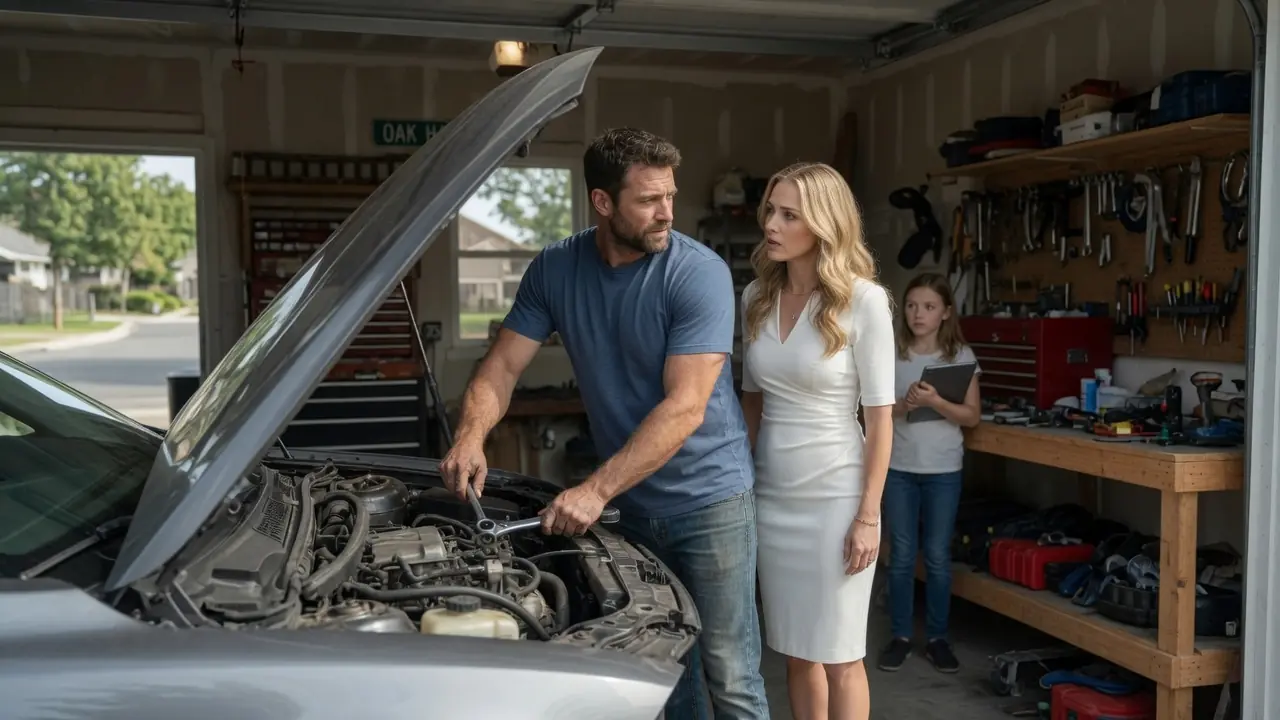
The woman standing beside the car was elegant in a way that seemed almost foreign to the modest suburban street. Long blonde hair fell in carefully styled waves around her shoulders. A fitted white dress, delicate necklace, and polished heels suggested a life lived in corporate buildings rather than backyard garages. Time had added faint lines around her hazel eyes, but it had not changed the face Daniel once knew better than his own.
“Seattle?” he asked.
“Yes.” She glanced down the quiet street. “I lived there for years before deciding I needed something slower.”
Daniel lowered the wrench.
“Did you leave a husband and a little girl there seven years ago?”
The woman’s expression emptied.
Behind them, Emily stopped writing.
Daniel watched recognition move across the stranger’s face in stages—confusion, disbelief, fear, and finally a grief so immediate that she gripped the edge of the car to steady herself.
“Daniel?”
He stood upright, wiping grease from one hand with a dark rag.
“Yes.” His voice remained controlled, though every muscle in his body had tightened. “And before you disappear again, look at the daughter who grew up without you.”
Laura Bennett turned toward the back of the garage.
Emily sat on a wooden stool beneath a shelf lined with oil filters and repair manuals. Her light-brown hair was tied into a simple ponytail, and she held her tablet against her chest as if it could protect her. She had Daniel’s serious expression, but the shape of her eyes belonged unmistakably to Laura.
For one painful moment, mother and daughter stared at each other without speaking.
Laura’s hand rose to her mouth.
“She’s so big.”
“She’s ten.”
“I know how old she is.”
“Knowing a number isn’t the same as being there.”
Daniel’s words struck hard enough to make Laura look down. He had imagined this confrontation many times during the first years after she left. In some versions, he shouted until she cried. In others, he refused to let her speak. Eventually, the fantasy faded because anger became too heavy to carry while raising a child alone.
Yet now that she stood in his garage, the old wound felt newly opened.
Emily climbed down from the stool.
“Dad, who is she?”
Daniel looked at his daughter.
For years, he had softened the truth. He told Emily that her mother had moved away to build a different life and was not ready to return. He never said Laura abandoned them during the hardest year of his life. He never described the empty closet or the note on the kitchen table.
He had wanted Emily to grow up believing no adult’s failure meant she was unworthy of love.
“This is Laura,” Daniel said carefully.
Emily’s eyes remained on the woman. “The new lady in the blue house?”
“Yes.”
Laura’s voice trembled. “Emily, I’m—”
“Don’t,” Daniel interrupted.
Laura closed her mouth.
He returned his attention to the engine because machinery made more sense than memory. The clicking noise came from a loose bracket near the exhaust manifold, a ten-minute repair that required no new parts. Daniel tightened the connection, started the engine, and listened until the sound disappeared.
Laura remained motionless beside the sedan.
“The car is fixed,” he said. “You don’t owe me anything.”
“Daniel, please let me explain.”
“There is nothing you can say in front of her today.”
“I didn’t know you lived here.”
“I believe you.”
Laura blinked, surprised.
“I moved into the blue house through a relocation agency,” she said quickly. “I wanted to leave Seattle. I didn’t choose this neighborhood because of you.”
“I said I believe you.”
“Then let me talk to you.”
Daniel lowered the hood with a firm metallic thud. “Emily and I have a life. A good one. You do not get to arrive with a broken car and turn our home into another emergency.”
Laura’s eyes filled.
“I didn’t come here to hurt you.”
“You came seven years too late to control that.”
Emily moved closer to Daniel and took his hand.
Laura noticed the instinctive gesture—the child seeking safety from the father who had always been there. Her composure fractured. She looked at Emily as though every missed birthday, fever, school play, and bedtime had suddenly taken physical form.
“I’m glad you’re okay,” she whispered.
Emily studied her. “Do you know me?”
The question wounded Laura more deeply than any accusation Daniel could have made.
“I knew you when you were very small.”
“That isn’t what I asked.”
Laura had no answer.
Daniel opened the driver’s door and placed the keys on the seat. “Welcome to Oak Haven. Please give us space.”
Laura nodded because refusing would have made the moment uglier.
She climbed into the sedan, closed the door, and sat behind the wheel without starting the engine. Daniel turned away before she finally pulled from the driveway. He listened as the repaired car traveled smoothly toward the blue house at the end of the block.
Emily did not release his hand.
“Was she my mother?”
Daniel closed his eyes.
“Yes.”
That evening, he activated what Emily called the pancake protocol. Whenever life became too difficult for a normal dinner, Daniel made breakfast instead. Pancakes required simple steps, and the smell of butter and syrup made their kitchen feel protected from anything beyond its walls.
Emily sat at the table tracing a fork through the syrup on her plate.
Daniel knew she was thinking because she had eaten only one bite.
“You told me Mom had to leave for work,” she said.
“I told you a version of the truth that I thought would hurt less.”
“So she didn’t leave because of work?”
Daniel sat across from her.
“When you were three, my business in Seattle failed. We lost most of our savings, and I was struggling to find another job. Your grandfather became sick, and the medical bills kept growing. Your mother and I were afraid all the time.”
“Then she left.”
“Yes.”
“Without me?”
Daniel forced himself not to look away. “Yes.”
Emily’s lower lip trembled, but she did not cry.
“Why?”
“I cannot answer for her.”
“Did I do something?”
“No.” Daniel reached across the table and covered her hand. “You were the best thing in both our lives. Her leaving was about her fear and her choices. It was never because you were not enough.”
“Did she say goodbye?”
Daniel remembered the note.
I can’t do this anymore. I need to find myself. I’m sorry.
“Not properly.”
Emily looked toward the dark window above the sink. Somewhere beyond the glass, Laura sat less than a block away. The distance between them was small enough to walk, yet it contained seven years of absence.
“Are you still angry?” Emily asked.
“I was angry for a long time.”
“And now?”
Daniel considered the question.
“I don’t know what I am now.”
At the blue house, Laura sat among half-open moving boxes with an old photograph in her hands. It showed Daniel holding baby Emily in a Seattle hospital. Laura stood beside him, exhausted and smiling, one hand resting on her daughter’s tiny blanket.
It was the only family photograph she had taken when she left.
For seven years, she carried it from apartment to apartment, hiding it in drawers whenever shame became unbearable. She told herself she would contact them once she became stable, then once she received a promotion, then once she became someone successful enough to return without looking like a failure.
Each achievement made the silence harder to break.
Laura eventually became a senior marketing executive, bought an expensive apartment, and traveled across the country. Colleagues admired her. Clients requested her personally. She possessed everything she once believed would make her life meaningful.
Still, she ate most dinners alone.
Three months before moving to Oak Haven, Laura stood before a wall of windows in her Seattle office and realized she had spent seven years proving she could survive without the two people whose absence made every victory feel hollow. She requested remote work, sold the apartment, and chose a quiet Midwestern suburb from a relocation listing.
Finding Daniel had not been her plan.
But perhaps life had placed her there because she had postponed responsibility long enough.
The following morning, Daniel walked Emily toward the school bus stop. They saw Laura in the yard of the blue house struggling to lift a large box of books from the driveway.
She noticed them but did not call out.
Daniel intended to continue walking.
Emily slowed. “She’s lifting it wrong.”
Daniel glanced at his daughter.
“You always say heavy things need two people.”
“That is a box, not a family lesson.”
“It can be both.”
He almost smiled despite himself.
Daniel asked Emily to wait near the sidewalk and walked toward Laura. She froze when he approached, uncertain whether to apologize or retreat. He bent, lifted the other side of the box, and nodded toward her knees.
“Use your legs. Not your back.”
Laura obeyed.
Together, they carried the box onto the porch.
“Thank you,” she said.
“It doesn’t mean anything.”
“I know.”
Daniel turned to leave.
“Was she all right last night?”
He stopped but did not face her. “No.”
Laura pressed her lips together.
“But she will be,” Daniel continued. “Because I will not let your return convince her she was ever unwanted.”
“I never stopped wanting her.”
“Wanting someone privately is not the same as loving them publicly.”
Laura accepted the blow.
“What can I do?”
“Nothing yet.”
He walked back to Emily.
Over the next two weeks, Laura kept her promise to give them space. She did not appear at the garage with unnecessary questions or leave gifts at their door. She focused on unpacking, joined the neighborhood association, and volunteered at the local library’s youth art program.
Emily noticed everything.
“She works with kids on Thursdays,” she told Daniel one evening.
“How do you know?”
“Mrs. Alvarez’s son goes to the program.”
Daniel looked up from an invoice. “You have become very informed about the blue house.”
“I’m curious.”
“Curiosity doesn’t require action.”
Emily folded her arms. “You always say questions are how people learn.”
“Machines are easier.”
“That is not an answer.”
Daniel sighed.
He could forbid contact, but he knew that would transform Laura into a mystery larger than reality. Emily deserved the ability to understand her mother with Daniel’s protection, not through secret conversations or neighborhood gossip.
Three weeks after Laura arrived, Daniel invited her to meet them at a public park.
She arrived early and wore jeans, a plain sweater, and no expensive jewelry. Daniel suspected she had deliberately tried not to appear like the polished stranger from the driveway. Emily sat beside him at a picnic table, holding a written list of questions.
Laura stopped several feet away. “May I sit?”
Emily nodded.
The first question was immediate.
“Why did you leave me?”
Laura’s face tightened.
“I was afraid.”
“Of me?”
“No. Never of you.”
“Of Dad?”
“No. I was afraid of failing, of being poor, and of losing the life I thought I deserved. Your father was grieving, his business had collapsed, and I felt like the walls were closing around me. Instead of helping him rebuild, I ran.”
Emily looked down at her list. “Why didn’t you come back?”
“Shame.”
“That sounds like another word for fear.”
“It was.”
“Did you know where we lived?”
“For the first year, yes. Then your father moved, and I convinced myself you were better without me.”
Daniel’s jaw tightened. “You could have found us.”
“I know.”
“You had lawyers, investigators, and enough money to locate anyone.”
“I know.”
“Then do not pretend distance made the decision.”
Laura met his eyes. “It didn’t. I made the decision every day I stayed silent.”
Emily asked whether Laura remembered her birthday.
Laura gave the correct date.
She remembered Emily’s first word, the stuffed rabbit she carried as a toddler, and how she refused to sleep unless someone sang the same song three times. The details did not erase the absence, but they proved Laura had not forgotten entirely.
When the questions ended, Emily folded the paper.
“I don’t want to call you Mom.”
Laura’s eyes glistened. “You don’t have to.”
“I might call you Laura.”
“I would be grateful.”
“And you cannot promise things you won’t do.”
“I won’t.”
Emily looked at Daniel. “Can she come to my violin recital next month?”
The request surprised both adults.
Daniel did not answer immediately. He wanted to protect Emily from another disappointment, but protection could not mean deciding every emotion for her.
“If Laura commits to coming,” he said, “she must be there.”
“I’ll be there,” Laura replied.
Daniel’s voice hardened. “Do not say it unless nothing except an actual emergency will stop you.”
Laura looked directly at Emily. “I will be there.”
The recital began at six on a Thursday evening.
Daniel and Emily arrived early. At five forty-five, Laura had not appeared. At five fifty, her seat remained empty. Daniel felt old anger returning, and he prepared to distract Emily before she looked toward the audience.
At five fifty-seven, Laura hurried through the auditorium doors carrying no flowers and offering no dramatic excuse. Her hair was damp from rain, and she had abandoned her car several blocks away because an accident blocked the road.
She took the reserved seat beside Daniel.
“I said I would come,” she whispered.
Emily saw her from the stage.
The child’s shoulders relaxed.
She played beautifully.
Afterward, Laura did not force a hug. She simply told Emily which section of the music she loved most, proving she had listened rather than merely attended. Emily smiled and handed her the program to keep.
Small moments followed.
Laura helped Emily choose drawing pencils for a school project. She attended soccer practice but sat apart unless invited closer. She learned not to ask Daniel for forgiveness each time they spoke, because repeated apologies could become another demand placed upon the wounded person.
Daniel watched carefully.
He expected Laura’s effort to fade once guilt became inconvenient. Instead, she remained steady. Weeks turned into months, and her actions slowly became less about repairing her image and more about understanding the child she had missed.
One afternoon, Emily’s school called Daniel while he was replacing a transmission. She had fallen during gym class and injured her wrist. Daniel closed the garage immediately, but Laura reached the school first because she had been volunteering at the nearby library.
When Daniel entered the nurse’s office, he found Laura sitting several feet from Emily, respecting the child’s space while distracting her with a drawing game. She had not signed any medical documents or pretended to possess parental authority. She simply remained until Daniel arrived.
Emily’s wrist was sprained, not broken.
On the drive home, she said, “Laura was scared.”
“She should have been.”
“No, I mean she looked like you do when I get hurt.”
Daniel gripped the steering wheel.
That night, he stood alone in the garage listening to the cooling engine of a repaired truck. Laura appeared at the open door but did not enter.
“I wanted to make sure she was comfortable.”
“She’s sleeping.”
Laura nodded.
“Thank you for staying with her,” Daniel said.
It was the first gratitude he had offered her.
“I would have stayed as long as she needed.”
Daniel wiped his hands with a rag. “Seven years ago, that sentence would have changed everything.”
“I know.”
“Part of me hates that you have become the person we needed only after we learned to live without you.”
Laura’s voice softened. “I hate that too.”
He studied her.
“Why did you really leave Seattle?”
“Because I finally admitted success had become a hiding place. Every promotion gave me another reason not to face what I did. Then one night, I received an award and returned to an empty apartment. I looked at our old photograph and realized I had built an impressive life around a missing center.”
“You could leave Oak Haven when this becomes painful.”
“I could.”
“Will you?”
“No.”
Daniel wanted to believe her.
That frightened him more than anger ever had.
Three months after the broken car brought them together, the blue house no longer looked temporary. Books filled the shelves, plants appeared on the porch, and drawings from the library program covered the kitchen wall. Emily began visiting for one supervised hour each Saturday.
Laura did not attempt to replace Daniel’s routines. She created new ones carefully. She and Emily sketched buildings, baked uneven cookies, and talked about Seattle without pretending the city had been responsible for Laura’s choices.
Daniel sometimes joined them for dinner.
The meals were awkward at first. Every comfortable laugh felt disloyal to the pain he had carried, while every silence reminded them how much remained unresolved. Yet healing did not arrive as one dramatic decision. It appeared through consistency.
Laura returned when she said she would.
She listened when Emily was angry.
She accepted boundaries without punishing anyone for setting them.
One Saturday, Emily asked Laura whether she still loved Daniel.
The question stopped the room.
Laura looked at him before answering. “I never stopped loving the person he was. But love without courage is not enough, and I lost the right to ask him for anything.”
Emily considered this. “Dad fixes things.”
Daniel nearly protested.
Laura shook her head. “Some things should not be fixed back into what they were. Sometimes people build something new.”
Later, Daniel stood in the garage turning that sentence over in his mind.
For years, he believed forgiveness meant pretending the damage had not happened. Laura’s words offered another possibility. Forgiveness could acknowledge the broken part while refusing to let it control every future movement.
Months later, Laura came to the garage wearing a simple sweater and jeans.
Daniel was restoring an old engine while Emily attended a sleepover. The evening air was cool, and the street had settled into the comfortable quiet he once feared Laura would disturb.
“Is the lead mechanic free for a walk?” she asked.
“No car trouble?”
“Not today.”
He set down the wrench.
They walked toward the park without discussing Seattle, debt, or the note. They spoke about Emily’s upcoming science project, the neighborhood bake sale, and Laura’s plan to expand the library art program.
At the corner, Daniel stopped.
“I don’t know whether I can trust you the way I once did.”
Laura nodded. “I don’t expect you to.”
“I cannot promise this becomes a marriage again.”
“I’m not asking for that.”
“And Emily comes first.”
“She always should have.”
Daniel looked toward the blue house, then back toward the home and garage he had built through years of work. He no longer saw Laura as someone powerful enough to destroy his peace. He saw a flawed woman accepting the consequences of what she had done and choosing to remain without guarantees.
“I can offer a walk,” he said.
Laura smiled softly. “Then I’ll walk.”
They continued beneath the streetlights.
Their story did not end with sudden reconciliation or a promise that love erased abandonment. Daniel did not forget the years he raised Emily alone, and Laura did not receive instant forgiveness because regret had finally caught up with her.
Instead, they built something honest.
Laura became part of Emily’s life through presence rather than title. Daniel gradually released the anger that once defined his identity as a single father. Emily learned that forgiveness did not mean surrendering boundaries and that a person could love someone while still requiring them to prove they would stay.
The silver sedan remained parked at the end of the block.
Occasionally, it needed another repair. When it did, Laura paid the same rate as every other customer and waited her turn. Daniel never joked that the first breakdown brought them together, because the truth was more complicated.
The car had not repaired their family.
It had merely stopped long enough for three people to face one another.
Seven years earlier, Laura believed leaving would save her from a life falling apart. Daniel believed he had failed because he could not persuade her to stay. Emily grew up wondering whether a mother’s absence meant something inside her was missing.
The reunion changed none of the past.
It changed what they allowed the past to decide.
Daniel’s life was no longer the story of the woman who abandoned him. It was the story of the father who stayed, the daughter who demanded the truth, and the woman who finally learned that returning meant more than appearing at the door.
One evening, the three of them sat on Daniel’s driveway while Emily practiced violin beneath the open garage lights. Laura listened from one chair, and Daniel cleaned tools beside her.
The music was imperfect.
A few notes arrived too early, while others trembled before becoming clear. Emily stopped halfway through and frowned.
“I ruined it.”
Daniel shook his head. “You lost the rhythm. Start again from where it changed.”
Laura looked at him.
The lesson belonged to more than music.
Emily raised the violin and began again.
This time, both parents stayed until the final note.