She stood in the middle of the street, shivering, her eyes darting left and right as though the world had suddenly turned into an endless wall closing in on her.
Cars rushed past, their headlights cutting through the cold evening air, blinding her for a second at a time.
Every sound made her flinch.
Every engine felt too close.
Every shadow on the sidewalk looked like it might turn into someone reaching for her.
Her hand trembled as she clutched a small torn backpack to her chest.
Inside that backpack was everything she owned.
A sweater.
A folder of old documents.
A cracked phone with no service.
A photograph she had almost thrown away three times but could never quite let go of.
Her lips moved, whispering something so faint the city swallowed it before anyone could hear.
“I can’t go back.”
On the other side of the street, a man carrying a grocery bag slowed his steps.
He had almost passed by.
Almost.
He had a carton of milk under one arm, a loaf of bread in the bag, and a small box of cereal his daughter had begged for that morning before school. He was tired from a long shift at the auto repair shop, and his shoulders ached from spending most of the day bent over engines that seemed to break for no reason except to test his patience.
His name was Michael Turner.
He was thirty-seven years old, a single father, and the kind of man who had learned to keep his head down because life had already taken enough from him.
But when he saw the young woman standing alone in the street, something in him stopped.
Not just his feet.
His whole body.
She was too still. Too frightened. Too lost in a way that had nothing to do with directions.
A car horn blared, and she jerked backward, almost stumbling.
Michael’s grip tightened around the grocery bag.
He looked toward the small two-bedroom house waiting for him four blocks away. His daughter, Grace, was probably curled up on the couch by now with her favorite blanket, watching cartoons too close to the television, pretending she had not noticed how late he was.
Grace was six years old.
She was the center of his world.
Every decision Michael made began and ended with her.
He should have kept walking.
That was the careful thing.
The safe thing.
A single father did not invite trouble into his life. He did not stop for strangers in the middle of a dark street. He did not risk bringing someone else’s storm home to the only child who depended on him.
But the woman looked up then.
For one second, her eyes met his across the street.
And Michael saw something he recognized.
Not because he had lived her exact pain.
But because grief, fear, and loneliness had a language of their own.
He had seen that look in his own mirror after his wife died, when people told him to be strong, when the house was quiet except for Grace crying herself to sleep, when he had stood in the kitchen at midnight wondering how one man was supposed to become two parents overnight.
The woman’s lips parted as though she might ask for help.
But no sound came out.
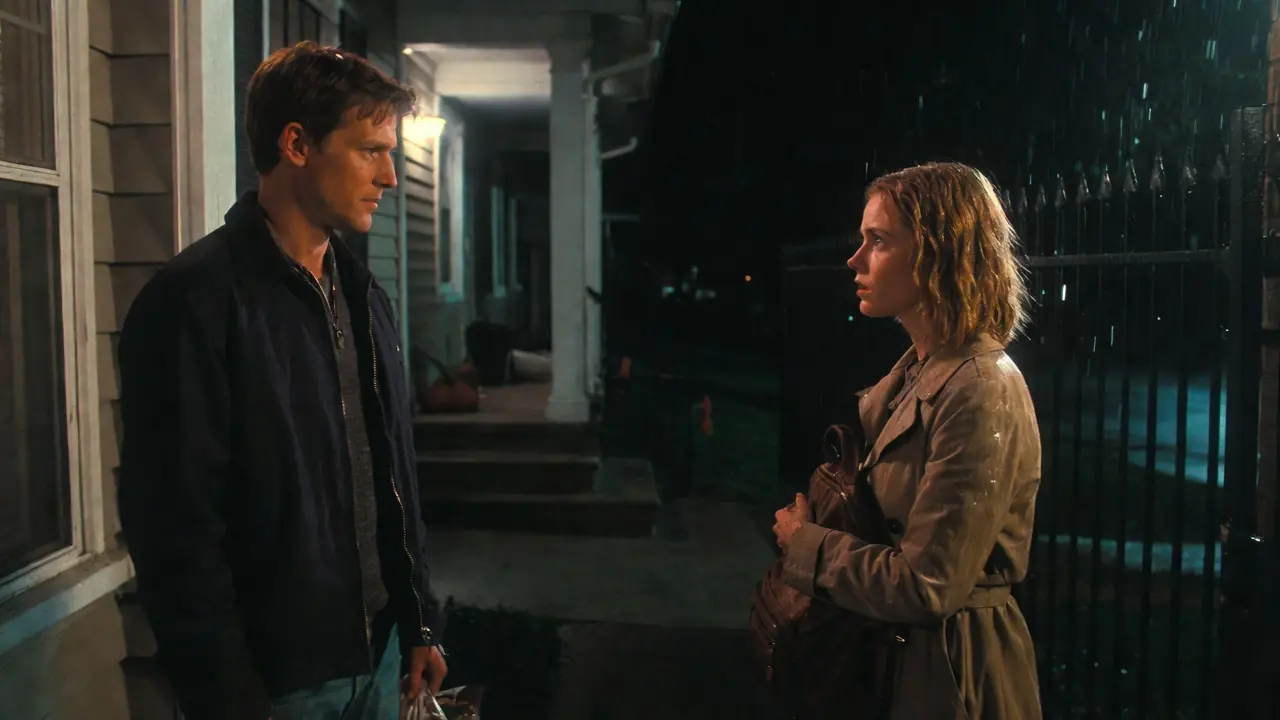
Michael stepped off the curb and crossed the street carefully.
The woman saw him coming and stiffened. Her hands tightened around the backpack until her knuckles turned pale.
Michael stopped several feet away, leaving enough space between them that she could run if she needed to.
“Ma’am,” he said gently, keeping his voice low beneath the noise of passing cars. “Are you all right?”
She nodded quickly.
Then shook her head.
The contradiction was written all over her trembling body.
Michael did not move closer.
He did not reach for her.
He did not ask too many questions.
Instead, he stood still, holding the grocery bag at his side, offering her the one thing she seemed to need most in that moment.
A choice.
“You don’t have to talk to me,” he said. “But you shouldn’t be standing in the street. It’s not safe.”
She looked past him, then over her shoulder, then toward the end of the block.
As if expecting someone to appear.
Michael noticed her shoes first. Thin canvas sneakers, soaked from the earlier rain, dark at the toes and splitting along the side. Then her jacket, far too light for the cold November wind cutting through the city. Her hair was damp, tucked behind one ear unevenly, and her face was pale with exhaustion.
She looked young.
Maybe twenty-eight.
Old enough to have learned the world was dangerous.
Young enough that it still seemed unfair she had learned it this hard.
“What’s your name?” Michael asked softly.
She swallowed.
For a moment, he thought she would not answer.
Then she whispered, “Sarah.”
The name seemed to hurt coming out.
“I’m Michael,” he said. “I live a few blocks from here.”
That made her step back.
Fear flashed in her eyes.
Michael immediately lifted one hand, palm open.
“I’m not asking you to come anywhere with me. I just...” He exhaled slowly. “There’s a diner on the corner. It’s open late. Let me buy you something warm to eat. No questions.”
Sarah stared at him.
Suspicion fought with hunger.
He could see both clearly.
“I don’t have money,” she said.
“I didn’t ask if you did.”
Her lips trembled.
“I can’t pay you back.”
“You don’t have to.”
“Why?”
That one word held more than doubt.
It held all the doors that had been closed in her face, all the people who had looked away, all the times help had come with conditions sharper than the danger she was running from.
Michael looked toward the diner window glowing at the end of the block.
Then back at her.
“Because you look cold,” he said. “And hungry. And I’d want someone to stop if my daughter ever needed help.”
Something changed in Sarah’s face at the word daughter.
Not yet.
But something close to it.
A crack in the wall.
After a long pause, she nodded once.
Just once.
Michael did not smile too widely. He did not act relieved. He simply turned slightly and began walking toward the diner at a slow pace, making sure she could follow without feeling chased.
Sarah walked two steps behind him.
Then one.
Then beside him.
But she kept the backpack clutched against her chest the entire way.
The diner was small and nearly empty, its windows fogged from the warmth inside. A tired waitress behind the counter looked up when the bell rang above the door.
Michael chose a booth near the back, where Sarah could sit with her back to the wall and see the entrance.
He did not ask why she chose that side.
He understood.
Some fears explained themselves.
Sarah slid into the booth, still holding the backpack on her lap. Her eyes moved constantly, to the door, the windows, the kitchen, the waitress, the man near the register paying for coffee.
Michael sat across from her.
“Order anything you want,” he said.
She looked down at the menu.
Her fingers shook so badly the laminated page rattled faintly.
“I’m not that hungry,” she said.
Her stomach answered with a quiet, painful sound.
Michael pretended not to hear it.
When the waitress came over, he ordered soup, grilled cheese, fries, and hot tea.
Sarah looked up quickly.
“That’s too much.”
“It’s not,” Michael said simply.
When the food came, Sarah stared at it as if it might vanish.
Steam rose from the soup.
Her eyes filled with tears.
She tried to blink them away, but one escaped and rolled down her cheek.
Michael looked down at his own hands to give her privacy.
“Eat,” he said quietly. “You’re safe for the next few minutes. Just eat.”
She picked up the spoon.
At first, she ate slowly, carefully, like someone trying to remain polite even while starving.
Then hunger took over.
She finished the soup, half the sandwich, most of the fries, and drank the tea with both hands wrapped around the mug.
Michael did not ask questions.
He only pushed a napkin closer when she needed one.
After several minutes, Sarah’s breathing steadied.
Color returned faintly to her face.
“I’m sorry,” she whispered.
“For what?”
“Eating like that.”
“You were hungry.”
She looked at him then, really looked at him, as if trying to understand what kind of person answered that simply.
Michael leaned back slightly.
“You don’t owe me your story,” he said. “But I need to ask one thing. Are you in trouble with the law?”
Her eyes widened.
“No,” she said quickly. “No. Nothing like that.”
“All right.”
“That’s it?”
“That’s it.”
Sarah looked down at the backpack.
“I just couldn’t stay where I was anymore.”
Michael heard the weight inside those words.
He felt anger rise in him, but he kept it still and quiet.
Anger would not help her right now.
“What about family?” he asked carefully.
Sarah’s fingers curled around the strap of her backpack.
“No one I can call.”
The waitress refilled Michael’s coffee.
Outside, the streets had grown darker.
The dinner crowd had passed, and the diner settled into that late-night quiet where every sound felt amplified: forks against plates, coffee pouring, the hum of the refrigerator behind the counter.
Michael checked the time.
Grace would be waiting.
His neighbor Mrs. Alvarez had agreed to stay with her for an hour after school, but that hour had turned into much longer. He would need to call and apologize.
He looked at Sarah.
She had finished eating and now sat with both hands around the mug, not drinking, just holding it for warmth.
“Where will you go tonight?” Michael asked.
Sarah did not answer.
She did not need to.
Michael looked out the window.
The wind pushed rainwater along the curb in thin silver lines.
He thought of Grace asleep on the couch.
He thought of the empty room at the back of his house, the room that had once been meant for guests, then storage, then nothing at all.
He thought of every warning people would give him if they knew what he was considering.
Then he thought of his late wife.
Anna had always said kindness was not kindness if it only appeared when convenient.
Michael took a slow breath.
“Look,” he said gently. “I don’t know what you’re running from, and you don’t owe me an explanation tonight. But you shouldn’t be out there alone. I have a spare room. You can stay for one night. Just tonight. Door locks from the inside. I’ll give you space.”
Sarah stared at him.
Fear returned at once.
She pushed herself slightly back against the booth.
Michael nodded, understanding.
“You can say no.”
“Why would you do that?” she asked.
“Because I can.”
“That’s not a reason.”
“It is to me.”
Her eyes searched his face.
“You have a daughter.”
“Yes.”
“And you’d bring a stranger into your house?”
“I’d bring someone cold and scared into my house for one night so she doesn’t sleep on the street.” He paused. “But if you’re uncomfortable, I can pay for a motel.”
Sarah gave a small, broken laugh.
“A motel needs ID.”
Michael understood then that whatever had happened to her was complicated.
Not just one bad night.
Not just a lost wallet.
A whole life had collapsed behind her.
“I won’t force you,” he said. “But the offer is real.”
Sarah looked toward the window.
Then down at the backpack.
Then back at Michael.
Her voice was barely audible.
“Just tonight?”
“Just tonight,” he said.
She nodded.
The drive to Michael’s house was quiet.
Sarah sat in the passenger seat with the backpack on her lap, her knees drawn slightly inward, her whole body angled toward the door as though she still expected to need an escape.
Michael kept both hands on the wheel and did not try to fill the silence.
The neighborhood was modest and quiet, with small houses, narrow driveways, and porch lights glowing through the mist. Michael parked in front of a blue one-story house with a small front yard and a bicycle lying on its side near the steps.
Sarah stared at the bicycle.
“Your daughter’s?”
“Grace,” Michael said. “She’s six.”
Sarah’s expression softened for half a second.
Then fear closed over it again.
Michael opened the front door quietly.
The living room was warm. A cartoon played softly on the television. Grace was asleep under a yellow blanket on the couch, one hand tucked beneath her cheek.
Mrs. Alvarez, a woman in her late sixties with silver hair and kind eyes, rose from the armchair.
“You’re late,” she whispered.
“I know. I’m sorry.”
Her gaze moved past him to Sarah.
Questions filled her face, but she did not ask them.
Michael said softly, “She needed help.”
Mrs. Alvarez looked at Sarah for a long moment.
Then she nodded once.
“I left soup in the fridge,” she said. “Grace ate. Homework is in her backpack. She brushed her teeth after much negotiation.”
Despite everything, Michael smiled.
“Thank you.”
Mrs. Alvarez touched his arm as she passed.
“Be careful,” she murmured.
“I will.”
After she left, Michael turned to Sarah.
“That’s Mrs. Alvarez. She lives next door. She helped a lot after my wife passed.”
Sarah looked at Grace asleep on the couch.
“I can leave,” she whispered. “I don’t want to scare her.”
“She’ll ask questions in the morning,” Michael said. “But she won’t be scared unless I am.”
Sarah looked at him.
“Are you?”
Michael answered honestly.
“A little.”
She lowered her eyes.
“But not enough to turn you away,” he added.
He showed her the guest room. It was small, with a narrow bed, a dresser, and a window facing the backyard. A stack of folded blankets sat at the foot of the bed.
“The door locks,” he said, pointing. “Bathroom is across the hall. There are clean towels in the cabinet. I can get you something dry to sleep in if you want.”
Sarah stood just inside the room, gripping her backpack.
“This is too much.”
“It’s a room.”
“No.” Her voice trembled. “It’s safety.”
Michael did not know what to say to that.
So he only nodded.
“I’ll leave you alone. If you need anything, I’ll be in the living room.”
“You’re not sleeping in your room?”
“My daughter is on the couch. I’ll carry her to bed, then I’ll stay where I can hear if either of you need anything.”
Sarah’s eyes filled.
“Thank you.”
Michael stepped back.
“Good night, Sarah.”
He closed the door softly.
Inside the room, Sarah sat on the edge of the bed and did not move for several minutes.
The house was quiet.
Not silent in the way dangerous places were silent.
Quiet in a lived-in way.
The hum of the heater.
The creak of old pipes.
The faint sound of Michael lifting Grace from the couch and carrying her down the hall.
A child murmuring in sleep.
A father whispering, “I’ve got you, baby.”
Sarah pressed both hands over her mouth to keep from sobbing too loudly.
For months, she had been surviving.
Not living.
Surviving.
Every decision had been about staying ahead of fear. Every breath had been measured against danger. Every door had looked like either a trap or a test.
But this door had closed gently.
This room was warm.
And no one had asked her to prove she deserved it.
That was what finally broke her.
She cried quietly into the borrowed pillow until exhaustion pulled her under.
The next morning began with pancakes.
Michael always made pancakes on Saturdays because Grace believed pancakes tasted better when shaped like uneven circles and slightly burned on one side. He had tried to improve his technique over the years, but Grace insisted they were perfect because they looked “like real life.”
Sarah woke to the smell of butter and coffee.
For a few seconds, she panicked.
She did not know where she was.
Then memory returned.
The diner.
The car.
The warm room.
Michael.
She sat up quickly, reaching for her backpack.
It was still beside the bed.
Untouched.
That alone made her breathe easier.
She changed back into her clothes, folded the blankets carefully, and stepped into the hallway.
Grace was sitting at the kitchen table wearing pajamas with stars on them, her curls messy from sleep, her feet swinging above the floor.
She looked up and froze.
Sarah froze too.
Michael turned from the stove.
“Morning,” he said gently. “Grace, this is Sarah. She needed a safe place to stay last night. Sarah, this is Grace.”
Grace studied her.
Sarah braced herself.
For fear.
For questions.
For the innocent cruelty children sometimes spoke without meaning to.
Instead, Grace smiled.
“Hi.”
One word.
Simple.
Warm.
Unguarded.
Sarah’s throat tightened.
“Hi,” she whispered.
Grace tilted her head.
“Do you like pancakes?”
Sarah blinked.
“I... yes.”
“Good. Daddy made too many. He always makes too many.”
“I make the exact right amount,” Michael said.
Grace leaned toward Sarah and whispered loudly, “He does not.”
Sarah laughed.
It was small and rusty from disuse, but it was real.
Michael heard it and turned back to the stove before she could see the emotion on his face.
That morning, Sarah ate two pancakes, drank coffee, and answered Grace’s questions with cautious smiles.
Her favorite color was blue.
She liked books.
She had once worked with children.
No, she did not have pets.
Yes, she knew how to braid hair.
That last answer changed everything.
Grace immediately dragged a brush from her room and asked Sarah to braid her hair “like a princess but not too fancy because I still need to run.”
Sarah’s hands were gentle as she worked.
Michael stood in the kitchen doorway watching them.
Grace sat on the floor between Sarah’s knees, talking nonstop about school, cartoons, dinosaurs, and a boy named Ethan who always stole the purple crayon.
Sarah listened as if every word mattered.
Something in Michael’s chest softened.
The house had not felt like this in years.
After breakfast, Sarah offered to leave.
She stood near the front door with her backpack over one shoulder.
“Thank you for everything,” she said. “I mean it. I’ll figure something out.”
Michael looked at her thin jacket.
Then at the cold morning beyond the window.
Grace appeared beside him, holding the braid carefully over one shoulder.
“Where is she going?”
Sarah opened her mouth.
No answer came.
Michael crouched down to Grace’s level.
“Sarah has some things she needs to figure out.”
Grace frowned.
“But she can figure them out here.”
Sarah looked away.
Michael stood slowly.
“You can stay a few more days,” he said. “No pressure. No questions. Just until you have a plan.”
Sarah shook her head.
“I can’t do that.”
“Why not?”
“Because people always want something back.”
Michael’s face changed.
Not with offense.
With sadness.
“I don’t,” he said.
Sarah looked at him for a long moment.
Grace reached out and took two fingers of Sarah’s hand.
“You can stay,” Grace said. “We have pancakes.”
That was not a logical argument.
But somehow, it was the one that worked.
Sarah stayed.
At first, only for two days.
Then through the week.
Then one week became two.
Michael set boundaries clearly. The guest room was hers. No one entered without knocking. She did not have to explain anything until she was ready. She could help around the house if she wanted, but she did not have to earn food or shelter like payment.
Sarah struggled with that most.
On the third morning, Michael found her washing dishes that were already clean.
On the fourth, she folded Grace’s laundry and apologized for not doing it better.
On the fifth, she scrubbed the kitchen floor so hard her hands reddened.
Michael finally sat across from her at the table and said, “You don’t have to prove you deserve to be here.”
Sarah stared down at her hands.
“Yes, I do.”
“No,” he said gently. “You don’t.”
Her mouth tightened.
“You don’t understand.”
“You’re right,” he said. “I don’t fully understand. But I know what it looks like when someone believes kindness is a bill that will come due later.”
Sarah’s eyes lifted.
Michael’s voice softened.
“That’s not what this is.”
She wanted to believe him.
He could see that.
But belief did not come easily to someone who had survived by expecting disappointment.
So Michael did not demand trust.
He let time do what words could not.
Days found a rhythm.
Michael worked at the auto repair shop from eight to six. Grace went to school. Sarah, once she began to feel steady enough, started applying for jobs online using Michael’s old laptop.
She searched for daycare positions first.
Then assistant teacher roles.
Then anything that involved children.
“I used to be good with kids,” she said one evening, almost to herself.
Grace looked up from coloring.
“You still are.”
Sarah smiled faintly.
Michael watched from the sink, rinsing plates.
Grace had a way of saying simple truths like they were obvious facts everyone else had been slow to notice.
Sarah began walking Grace to school in the mornings when Michael had early shifts. The first time, she was nervous, checking over her shoulder every few steps. By the fifth time, she and Grace were laughing about which houses had the best Halloween decorations even though Halloween had already passed.
At night, Sarah read bedtime stories.
Grace loved the voices Sarah made for different characters. Michael would stand outside the bedroom door listening to his daughter laugh harder than he had heard in months.
Those laughs did something to him.
They healed places he had not admitted were wounded.
After his wife died, Michael had become careful with joy.
He allowed Grace to have it.
He encouraged it.
But for himself, joy felt dangerous.
Like a door that, once opened, might lead to grief again.
Sarah’s presence complicated that.
She brought warmth into the house without trying.
Not loud warmth.
Not dramatic.
The quiet kind.
A folded blanket waiting on the couch after his late shift.
Grace’s lunch packed with a napkin drawing tucked inside.
A pot of soup on the stove because Sarah noticed Michael often forgot to eat dinner until it was too late.
A small plant on the kitchen windowsill because, she said, “Every house should have something growing.”
Michael began to smile more.
Grace noticed first.
Children always did.
One night, after Sarah had gone to bed, Grace climbed onto the couch beside him and leaned her head against his arm.
“Daddy?”
“Yeah, bug?”
“Miss Sarah makes the house less sad.”
Michael stared at the television, though he was no longer watching it.
After a long moment, he kissed the top of Grace’s head.
“Yeah,” he said softly. “She does.”
But healing was not a straight road.
Some nights, Sarah woke gasping.
Michael heard her through the wall more than once. Quick breaths. A muffled sob. The creak of the bed as she sat up suddenly.
He never entered.
He only sat in the hallway once, back against the wall, close enough that if she opened the door, she would know someone was there.
After twenty minutes, the door opened a crack.
Sarah looked down and saw him sitting on the floor.
“You don’t have to do that,” she whispered.
“I know.”
“I’m fine.”
“I know.”
She almost smiled.
“You’re a terrible liar.”
“So are you.”
For the first time, she sat beside him in the hallway.
Neither spoke for a while.
The house was dark except for the small nightlight Grace insisted stay plugged into the hallway wall.
Finally, Sarah said, “I hate sleeping.”
Michael looked at her.
“Because of dreams?”
She nodded.
“Because when I sleep, I forget I left. Then I wake up thinking I’m still there.”
Michael’s hands curled together.
He wanted to ask where.
He did not.
Sarah leaned her head back against the wall.
“My stepfather was charming,” she said quietly. “That was the worst part. Everyone liked him. He knew how to speak in public. He knew how to smile at neighbors. He knew how to make my mother believe every word he said.”
Michael stayed still.
Sarah stared at the floor.
“When I tried to tell her he was cruel when no one else was around, she said I was grieving wrong. She said I was angry because my real father left when I was little. She said I needed to stop making stories.”
Her voice did not rise.
That made it hurt more.
“I tried for years to be good enough that maybe he’d stop. Quiet enough. Helpful enough. Invisible enough. But people like that don’t stop because you behave. They just find new ways to remind you they can still reach you.”
Michael’s throat tightened.
“I’m sorry,” he said.
Sarah closed her eyes.
“I don’t even need people to be sorry anymore. I just need someone to believe me.”
“I believe you.”
Her face crumpled.
Three words.
That was all it took.
She covered her mouth, trying to hold herself together, but the tears came anyway.
Michael did not touch her until she reached for his hand.
Then he held it.
Nothing more.
No promise he could not keep.
No speech about everything being okay.
Just his hand around hers in the quiet hallway while the night slowly softened around them.
From that night on, something changed.
Sarah did not tell everything at once. She told pieces.
A childhood spent trying to read the mood of a house before opening the door.
A mother who looked away because facing the truth would have shattered the life she had chosen.
A stepfather who used money, reputation, and fear like tools.
A final argument.
A threat.
A backpack packed in six minutes.
A bus station.
Two nights without real sleep.
And then the street where Michael found her.
Michael listened.
Sometimes he asked careful questions.
Sometimes he said nothing.
Grace did not know the full story. She only knew that Sarah had been hurt by people who should have protected her, and that now she was safe with them.
That was enough for Grace.
One afternoon, Grace came home from school with a drawing.
It showed three people in front of a blue house: a tall man, a small girl, and a woman with long brown hair. Above them, in uneven letters, Grace had written: My family.
Sarah saw it on the fridge and went very quiet.
Grace looked suddenly worried.
“Is it okay?”
Sarah knelt and pulled her into a hug.
“It’s more than okay,” she whispered.
That night, Sarah left her backpack in the closet for the first time.
Michael noticed.
He did not say anything.
But when he passed the closet and saw it sitting there, no longer clutched like a lifeline, he stood still for a moment with his hand on the hallway wall.
Then he went into the kitchen and quietly cried where Grace and Sarah could not see.
Two months after the night Michael found her, Sarah got a job.
It was part-time at a small daycare fifteen minutes from Grace’s school. The pay was not much, but the director liked her immediately. Sarah had a calmness with children who were upset, a patience that seemed to come from understanding fear too intimately.
On her first morning, she stood in front of the mirror wearing a simple blue sweater and black pants Michael had helped her pick out from a thrift store.
Her hands trembled as she smoothed the sweater.
“I look ridiculous,” she said.
Grace sat on the bed behind her.
“You look like a teacher.”
Sarah looked at Michael in the doorway.
“What if I mess up?”
“You will,” he said.
Her eyes widened.
He smiled.
“Everyone messes up. Then you go back the next day.”
Sarah let out a shaky breath.
“That’s supposed to be comforting?”
“It’s the best I’ve got.”
Grace jumped off the bed and hugged Sarah around the waist.
“You’re going to be great.”
Sarah rested a hand on Grace’s hair.
For a moment, she closed her eyes.
“I’m going to try.”
Trying became living.
Slowly, Sarah built a life from small pieces.
A bus pass.
A paycheck.
A savings envelope tucked into the back of a drawer.
A library card.
A community college brochure.
A phone plan in her own name.
She began attending evening classes twice a week, studying early childhood education. Michael drove her when his schedule allowed. When he could not, Mrs. Alvarez watched Grace until Sarah got home.
The house became a network of care.
Not perfect.
Not easy.
But real.
Some nights, everyone was tired.
Michael would come home with grease on his sleeves and exhaustion in his eyes. Sarah would be worn out from work and classes. Grace would be cranky over homework or missing her mother or simply being six years old and overwhelmed by feelings too big for her body.
They had hard evenings.
Burned dinners.
Misunderstandings.
Quiet apologies.
But through it all, Sarah stayed.
And Michael found that he wanted her to.
That realization frightened him.
He had loved Anna deeply.
Her absence still lived in the house. In the framed photo by the stairs. In Grace’s smile. In the recipes tucked into a kitchen drawer. In the way Michael still reached for two mugs some mornings before remembering.
He had not expected to feel anything like love again.
And he did not call it love at first.
He called it gratitude.
Then friendship.
Then concern.
Then habit.
He noticed how Sarah laughed now, fuller than before.
He noticed how she looked at Grace with fierce tenderness.
He noticed how she remembered he hated onions but pretended not to.
He noticed how she still flinched less and less.
He noticed the morning she walked outside alone to bring in the mail without checking over her shoulder.
He noticed the afternoon she sang while washing dishes.
And one evening in early spring, when Grace had fallen asleep on the couch between them during a movie, Michael looked over at Sarah and found her already looking at him.
Neither spoke.
Something passed between them.
Soft.
Uncertain.
Dangerous in the way hope was dangerous.
Sarah looked away first.
Michael did not push.
Whatever was growing between them, he knew it had to grow slowly.
Sarah did not need someone claiming her life.
She needed space to choose it.
So he gave her that.
Spring came to Chicago carefully.
Snow melted from curbs. Trees grew small green buds. The wind remained sharp, but sunlight lingered longer in the evenings.
One Saturday, Michael took Grace and Sarah to the park where he had first seen Sarah standing in the street.
Not the exact spot.
Sarah was not ready for that.
But nearby.
They brought sandwiches, apples, and a thermos of hot chocolate because Grace insisted picnics required hot chocolate regardless of weather.
Sarah sat on a bench beneath a leafless tree, watching children play on the swings.
“I used to think I’d never feel normal again,” she said quietly.
Michael sat beside her.
“Do you?”
“Sometimes.” She smiled faintly. “Then Grace asks me whether worms have feelings, and I realize normal is maybe overrated.”
Michael laughed.
From the grass, Grace shouted, “They probably do!”
Sarah laughed too.
The sound was easy now.
Not free of pain.
But free enough.
Michael looked at her.
“You’re different than the night I found you.”
Sarah’s smile faded into something thoughtful.
“I’m still her,” she said.
“I know.”
“I don’t want to pretend she never existed.”
“You don’t have to.”
Sarah looked down at her hands.
“She survived. I think I owe her that. Not shame. Not forgetting. Gratitude.”
Michael nodded slowly.
“That makes sense.”
“She got me to you,” Sarah said.
The words settled between them.
Michael’s throat tightened.
Grace ran back then, saving him from needing to answer.
She threw herself onto the blanket dramatically.
“I’m starving.”
“You ate ten minutes ago,” Michael said.
“That was past starving. This is new starving.”
Sarah handed her half a sandwich.
Grace accepted it with great seriousness.
“Thank you.”
Sarah brushed hair from Grace’s face.
“You’re welcome.”
And Michael knew, watching them, that his heart was already involved.
By summer, Sarah had saved enough for a small apartment deposit.
She told Michael on a Thursday night after Grace went to bed.
“I found a place,” she said.
Michael was drying dishes.
His hands stilled.
“Oh.”
“It’s not far. Just a studio above a bakery near the daycare.”
“That’s good,” he said.
His voice sounded normal.
He was proud of that.
Sarah watched him carefully.
“I think I need to try living on my own.”
“Of course.”
“I don’t want you to think I’m ungrateful.”
Michael turned from the sink.
“Sarah, no. Don’t say that.”
“This house saved me.”
“You saved yourself. We just gave you a place to do it.”
Her eyes filled.
“I don’t know how to leave Grace.”
Michael’s chest ached.
“She’ll still see you.”
“And you?”
He looked at her.
“I’ll still see you too.”
The words were simple.
But both heard what lived beneath them.
Sarah moved into the studio two weeks later.
Grace cried for an entire afternoon, then helped decorate Sarah’s new place with drawings and paper flowers.
Michael carried boxes upstairs and fixed a loose cabinet door before Sarah could ask.
The apartment was tiny, but bright. It had one large window overlooking the bakery sign and enough room for a bed, a small table, and two chairs.
Sarah stood in the middle of it, looking around.
“My own key,” she whispered.
Michael smiled.
“That’s a good feeling.”
She nodded, tears shining in her eyes.
“The best.”
For a while, they adjusted.
Sarah came over for dinner twice a week.
Grace stayed with her some Saturday afternoons while Michael picked up extra work.
Michael walked Sarah home sometimes, though she insisted she could do it alone.
“I know you can,” he said.
“Then why come?”
“Because I want to.”
That answer always made her quiet.
One evening in September, nearly ten months after the night they met, Sarah invited Michael and Grace to a small event at her daycare.
The children had made art projects, and Sarah had helped organize the display. Parents filled the room, admiring finger paintings, paper suns, crooked houses, and portraits with too many arms.
Michael watched Sarah move among them with calm confidence, kneeling to speak to children, laughing with coworkers, guiding shy parents toward their children’s drawings.
She belonged there.
Not because someone had given her permission.
Because she had built her way there.
Grace tugged Michael’s sleeve.
“Daddy.”
“Yeah?”
“Miss Sarah looks happy.”
Michael smiled.
“She does.”
“Are you happy?”
The question surprised him.
He looked at Sarah again.
She caught his gaze across the room and smiled.
Michael felt something warm and terrifying open in his chest.
“Yes,” he said softly. “I think I am.”
Grace leaned closer.
“Good. You were sad for a long time.”
He looked down at his daughter.
Children saw too much.
“I know, bug.”
“It’s okay if you love her,” Grace said.
Michael froze.
Grace looked at him with her mother’s serious eyes.
“Mommy would want us to have people.”
Michael crouched slowly in front of her.
“Where did you hear that?”
Grace shrugged.
“I just know.”
Michael pulled her into his arms.
For a moment, he could not speak.
Across the room, Sarah saw them and her smile softened, though she did not know what had been said.
That night, after Grace fell asleep in the back seat during the drive home, Michael parked outside Sarah’s building and walked her to the door.
The bakery below was closed. The street smelled faintly of bread and rain.
Sarah stood on the bottom step, keys in hand.
“Thank you for coming tonight,” she said.
“You were amazing.”
She looked down, smiling.
“I was nervous.”
“Didn’t look like it.”
“I’m getting better at doing things scared.”
Michael nodded.
“That’s bravery, I think.”
Sarah looked at him for a long moment.
“Michael.”
“Yeah?”
“I need to say something, and I don’t want it to ruin what we have.”
His heart began to pound.
“Okay.”
“You gave me safety when I had none,” she said. “Then you gave me space when I needed to stand on my own. And somewhere in all of that, I...” Her voice trembled. “I started loving you.”
Michael could not move.
Sarah rushed on.
“I don’t mean I need anything from you. I don’t mean you have to answer right now. I just needed to say it because for so long I was afraid of my own feelings, and I don’t want fear making my choices anymore.”
Michael looked at this woman who had once stood shivering in the middle of a street, clutching a broken backpack like it was the last piece of herself.
Now she stood in front of him with her own key, her own life, her own voice.
He stepped closer, slowly enough that she could step away if she wanted.
She did not.
“I love you too,” he said.
Sarah closed her eyes.
A tear slipped down her cheek.
Michael reached up and wiped it gently away.
“I’ve been afraid to say it,” he admitted.
“Because of Anna?”
“Because of Anna. Because of Grace. Because of you. Because I didn’t want love to feel like another thing you had to survive.”
Sarah gave a small, broken laugh.
“It doesn’t.”
“No?”
She shook her head.
“With you, it feels like something I get to choose.”
Michael smiled, his own eyes burning.
“Then choose slowly.”
“I can do slowly.”
“Good,” he whispered. “So can I.”
Their first kiss was soft.
Careful.
Not a rescue.
Not a promise that pain would never return.
Only a beginning.
The kind built not from desperation, but trust.
One year after the night Michael found Sarah in the street, the three of them returned to the same corner.
It had been Sarah’s idea.
The weather was cold again, though not as bitter as that first night. Grace wore a purple coat and held a small paper bag from the bakery below Sarah’s apartment. Inside were three cupcakes, one chocolate, one vanilla, and one strawberry because Grace insisted every important event required options.
Sarah stood on the sidewalk, looking at the place where she had once been too afraid to move.
Michael stayed beside her, not touching her yet.
Grace looked around.
“This is where Daddy found you?”
Sarah nodded.
“This is where I thought my life was over.”
Grace frowned.
“But it wasn’t.”
“No,” Sarah said. She looked at Michael. “It was where it started again.”
Michael took her hand.
This time, she did not tremble.
They sat on a nearby bench and shared cupcakes in the cold.
Grace got frosting on her nose. Michael pretended not to notice. Sarah wiped it away with a napkin, laughing when Grace protested that frosting was “face decoration.”
Afterward, Grace pulled a folded paper from her pocket.
“I made something.”
She handed it to Sarah.
It was a drawing of three people standing in front of a blue house.
A man.
A little girl.
A woman.
Above them, Grace had written carefully: The family we found.
Sarah pressed the drawing to her chest.
Michael looked away for a moment, blinking hard.
Grace climbed into Sarah’s lap without asking.
Sarah held her close.
For a long time, the three of them sat there as the city moved around them.
Cars passed.
People hurried by.
The world remained loud, busy, imperfect.
But for Sarah, the street no longer felt like a wall closing in.
It felt like proof.
Proof that one person stopping could change everything.
Proof that kindness, when given without demand, could become a doorway.
Proof that being seen at the lowest point of your life could be the first step toward standing again.
Months later, Sarah completed her first year of community college.
Michael and Grace sat in the front row of the small auditorium, clapping louder than anyone when her name was called for an early childhood education certificate.
Sarah walked across the stage with steady steps.
No torn backpack.
No fear in her eyes.
Just a woman who had fought her way back to herself.
After the ceremony, Grace ran into her arms.
“You did it!”
Sarah laughed, holding her tightly.
“We did it.”
Michael approached more slowly, carrying flowers.
“Proud of you,” he said.
Sarah looked at the flowers.
Then at him.
“You brought me flowers?”
“Seemed like the right occasion.”
Grace grinned.
“He practiced what to say in the car.”
“Grace,” Michael warned.
Sarah laughed.
Michael shook his head, but he was smiling.
Their life did not become perfect.
No real life does.
There were hard days.
Sarah still had moments when old fear returned without warning. Michael still carried grief for Anna, though it had become gentler with time. Grace still missed her mother in sudden waves that made her quiet at bedtime.
But now, none of them carried their pain alone.
That was the difference.
Sarah kept working at the daycare while continuing classes. Michael opened his own small repair garage two years later, with Sarah helping manage the office and Grace drawing the first sign for the waiting room.
It was crooked.
They framed it anyway.
On the wall of their home, next to family photos and Grace’s school art, Sarah kept one item in a simple wooden frame.
It was a strap from her old torn backpack.
The backpack itself was gone.
But she kept the strap as a reminder.
Not of fear.
Of survival.
Of the night she stood in the street believing she had nothing left.
Of the man who crossed the road.
Of the child who said hi.
Of the home that began as a place to stay for one night and became the life she had never thought she would be allowed to have.
Years later, when people asked Sarah how she and Michael met, she did not tell the story like a fairy tale.
She told the truth.
“I was lost,” she would say. “And he stopped.”
Michael would always shake his head.
“She saved us too.”
And he meant it.
Because before Sarah came, his house had been warm but lonely. Grace had been loved but missing something neither of them knew how to name. Michael had been surviving, working, parenting, breathing, but not fully living.
Sarah brought laughter back.
She brought color back.
She brought the reminder that love could come again, not to replace what had been lost, but to sit beside it gently.
And Grace, who had always understood more than adults gave her credit for, said it best one evening when she was older, sitting between them on the porch as rain tapped softly on the roof.
“Some people think family is only who you start with,” she said.
Sarah looked at her.
Michael smiled.
Grace leaned against Sarah’s shoulder.
“But sometimes family is who finds you when you’re scared and says, ‘You can stay.’”
Sarah reached for Michael’s hand.
He held it.
The rain continued falling, soft and steady.
And inside their small house on the outskirts of Chicago, the lights stayed on.
Not because life had become easy.
But because one night, when everything could have gone differently, a tired single father saw a frightened woman in the street and chose not to look away.
That choice became a meal.
Then a room.
Then trust.
Then healing.
Then love.
And in the end, it became a family.
A family built not by blood alone, but by courage, patience, kindness, and the rare, powerful grace of being seen exactly when the world has made you feel invisible.
Sarah had come to Michael and Grace needing a hand.
What she found was a home.
And what she gave them in return was something just as precious.
She taught them that broken lives can bloom again.
That love can return quietly.
That safety can be rebuilt one ordinary day at a time.
And that sometimes, the smallest act of kindness is not small at all.
Sometimes, it is the beginning of everything.