The lawyers slid the folder across the mahogany table, and Elias Warren’s hands trembled as he read the number.
Enough money to change everything.
“She remembered you,” they said. “The woman from the diner.”
But Elias barely remembered giving away that breakfast three weeks ago. He’d been starving himself for months. How could one soggy sandwich to a stranger rewrite his entire future?
The answer lay in who that stranger really was, and why she’d been running for her life that morning.
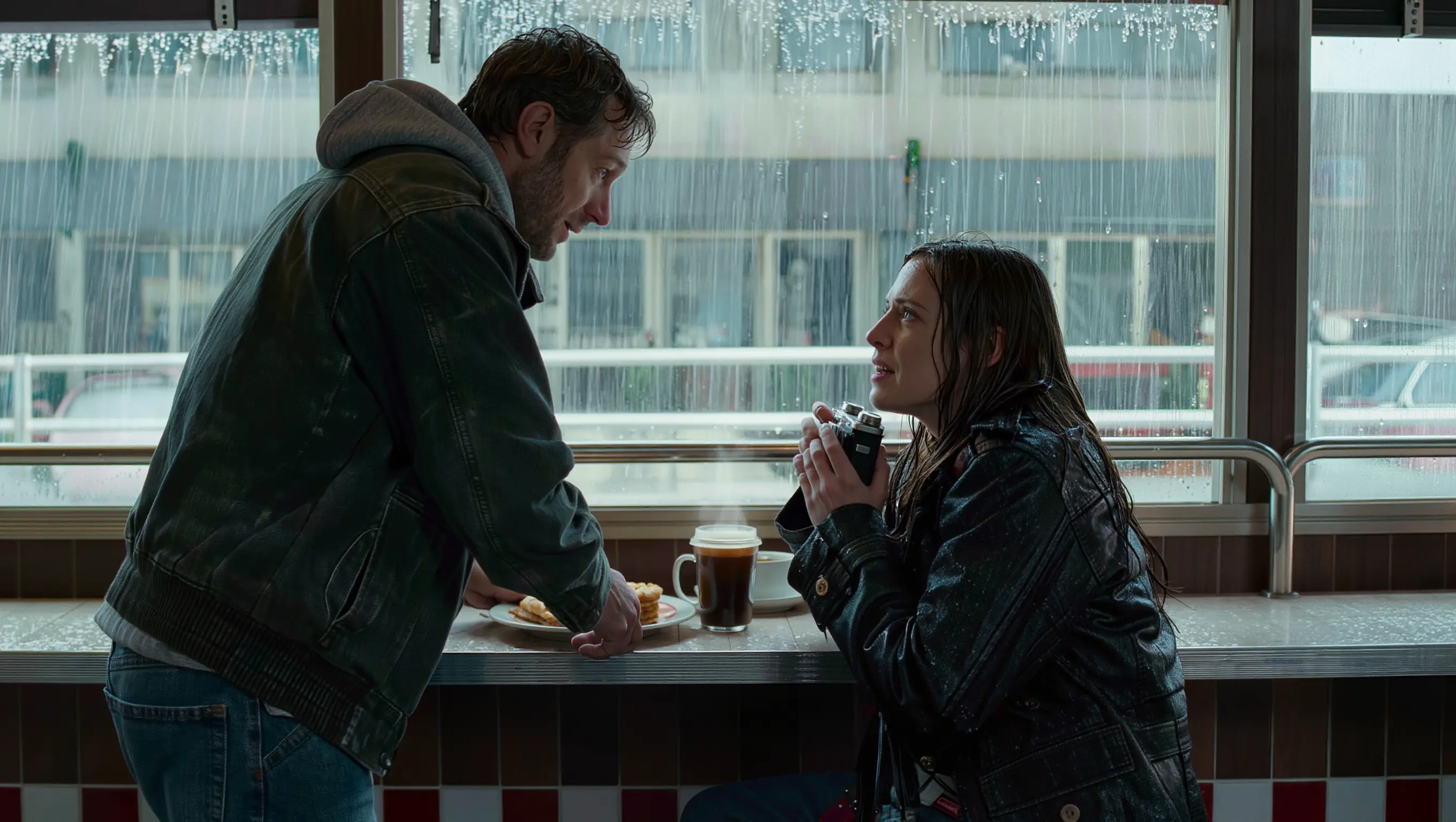
The rain came down like nails that November morning, hammering the cracked sidewalk outside Murphy’s Diner with the kind of relentless fury that felt personal.
Elias Warren stood under the rusted awning, water dripping from his secondhand jacket, counting the damp bills in his palm for the third time.
$11.47.
It was all he had until Friday’s paycheck, still three days away, and he’d already done the math in his head a dozen times during his shift at the warehouse. He could buy breakfast, an actual breakfast, not the stale crackers he’d been eating for two weeks. Or he could stretch the money across those three days with another round of instant ramen and black coffee.
His daughter Lara had eaten the last decent meal yesterday before school, mac and cheese from a box, and she’d smiled at him like he’d given her something special.
That smile was worth every hunger pang.
The diner’s warmth pulled at him through the fogged windows. The smell of bacon and fresh coffee was a kind of torture.
Elias closed his eyes and made a decision that felt both reckless and necessary. He would eat breakfast just this once, just enough to remember what it felt like to be human instead of a machine running on fumes and willpower.
The bell above the door chimed as he pushed inside, and the immediate wall of heat and greasy comfort nearly made him weep.
Martha, the day-shift waitress who’d worked at Murphy’s longer than Elias had been alive, looked up from behind the counter and gave him that knowing smile that held equal parts sympathy and respect.
“Elias Warren,” she said, her voice warm as the coffee pot she was already reaching for. “Don’t usually see you in here on a Wednesday morning. You celebrating something?”
“Just treating myself,” he said, sliding onto a stool at the counter that had duct tape holding the vinyl together. “Been a while.”
“Too long, sweetheart. Too long.”
Martha poured the coffee without asking. Steam rose from the chipped mug like a prayer answered.
“What will it be?”
He opened his mouth to order the cheapest thing on the menu. Scrambled eggs and toast. Maybe $2.50 if he skipped the hash browns. But something in him rebelled against the constant calculus of poverty. Just once, he wanted to order like a regular person, like someone who had the luxury of hunger instead of the grinding necessity of it.
“The breakfast sandwich,” he heard himself say. “With bacon and the hash browns.”
Martha’s smile widened.
“Coming right up, honey. And don’t you worry about a thing.”
He knew what that smile meant. Martha had been slipping him extra portions for months, pretending the kitchen had made too much or that an order had been canceled.
He tried to refuse at first, pride making him stupid, but Lara needed those calories more than he needed his dignity. He’d learned to accept charity with grace, even when it burned.
The coffee was perfect, hot and bitter, and strong enough to make his empty stomach clench with anticipation. Elias wrapped both hands around the mug and let himself have this moment.
The diner hummed with late-morning energy. A trucker in the corner booth working through a stack of pancakes. An elderly couple sharing the newspaper. A construction crew taking their break with enough noise and laughter to fill the whole space.
Normal people. Regular people. People who could afford Wednesday breakfast without calculating the cost against their daughter’s winter coat fund.
The front door opened behind him, bringing in a gust of wind and rain so violent that everyone turned to look.
At first, Elias thought it was just the storm. The door had blown open on its own, maybe, or someone had lost their grip on the handle.
But then he saw her.
She stood in the doorway like something that had crawled out of a nightmare, drenched to the bone. Her dark hair was plastered to her face in twisted ropes. Her clothes, once maybe expensive, now just soaked fabric clinging to a frame that seemed held together by pure will, dripped onto Murphy’s worn linoleum.
But it was her eyes that stopped Elias’s breath in his chest.
They were the eyes of someone drowning on dry land.
“Help,” she whispered, the word so quiet it almost didn’t make it across the threshold. “Please.”
Nobody moved.
The construction crew stared. The elderly couple exchanged concerned looks. Even Martha, who’d seen everything in 30 years behind that counter, froze with the coffee pot suspended in midair.
The woman took one unsteady step forward, then another, moving like her bones had forgotten how to hold her upright. She was shaking, not the normal shiver of someone cold and wet, but the violent trembling of shock, trauma, terror.
Her hands clutched something against her chest, a battered camera with a cracked lens that she protected like it contained her last breath.
“I’m sorry,” she said, louder now, but breaking on every syllable. “I’m so sorry. I just… I need…”
She swayed, catching herself on the back of a chair.
Someone should help her, Elias thought. Someone should do something.
And then he realized, with a sick lurch, that he was already standing, already moving toward her without deciding to, his body responding to distress with an instinct he didn’t know he still possessed.
“Hey,” he said gently, keeping his voice low and calm like he did when Lara woke from nightmares. “Hey, it’s okay. You’re safe here.”
Up close, she looked worse. There was a bruise blooming along her jawline, half hidden by her wet hair, scratches on her hands. Her clothes, expensive beneath the grime and water, were torn at the shoulder.
And those eyes, God, those eyes held so much fear that Elias felt it transfer into his own chest like a contagion.
“I don’t…”
She stopped, swallowed hard.
“I haven’t eaten since yesterday. Maybe before. I don’t… I don’t remember.”
Behind them, Martha had found her voice.
“Honey, sit down. Let me call someone.”
“No.”
The woman’s terror spiked, her grip on the camera tightening until her knuckles went white.
“No police. No calls. Please, I just need…”
Her gaze landed on the counter, on the steam rising from someone’s breakfast, and something in her face crumpled.
“Food. Just food.”
Elias turned and saw his sandwich sitting there, exactly where Martha had just placed it. The bacon glistened with grease. The eggs were perfectly scrambled. The hash browns were golden and crispy at the edges, just the way he liked them.
His $11.47 transformed into this one small miracle of normalcy.
He looked at the woman, at the way she was trying not to stare at the food, at how her whole body seemed to lean toward it like a plant toward sunlight.
He thought about Lara, about what it would take to reduce his bright, laughing daughter to this state of desperate animal hunger. He thought about the last three weeks of his own gnawing emptiness, and how this sandwich represented a victory over that emptiness that he’d been anticipating all morning.
And then he thought about how none of that mattered at all.
“Come on,” he said, gesturing to the stool next to his. “Sit down. That breakfast is yours.”
She stared at him like he’d spoken a foreign language.
“What?”
“It’s yours. I just ordered it, so it’s hot. Sit down and eat before it gets cold.”
“I don’t… I can’t.”
Tears were sliding down her face now, mixing with the rainwater.
“I don’t have any money. I don’t have anything.”
“Didn’t ask if you did.”
Elias pulled out the stool, steady and patient.
“Come on now. Before Martha comes over here and tries to feed us both.”
She moved like someone in a dream, or maybe a nightmare she couldn’t wake from. Her body folded onto the stool with a carefulness that spoke of recent injury.
And when he pushed the plate toward her, she looked at it like it might disappear if she blinked.
“Go ahead,” Elias said softly. “It’s real. I promise.”
She picked up the sandwich with shaking hands and bit into it.
The sound she made, half sob, half groan, was so raw and vulnerable that Elias had to look away.
She ate like someone who’d forgotten food could taste like anything, tears streaming down her face the whole time, not bothering to wipe them away.
Martha appeared with another mug of coffee, setting it down in front of the woman without comment.
The diner had gone quiet. Everyone pretending not to watch while watching anyway, the way people do when witnessing something private that’s happening in public.
“Thank you,” the woman whispered between bites. “Thank you. I’m sorry. Thank you.”
“Nothing to be sorry for,” Elias said.
He flagged Martha down, making a decision that he knew Lara would understand, even if it meant crackers for dinner again.
“Can you bring another sandwich and some water?”
“Elias.” Martha’s voice held a warning, a reminder of what she already knew about his situation.
“Please, Martha.”
She studied his face for a long moment, then nodded.
“On the house, honey. Both of them.”
“No, I can…”
The woman ate through both sandwiches and all the hash browns with a focus that was almost frightening. When she finally slowed down, finally looked up from the empty plates, her eyes were clearer, but somehow more broken.
“I’m Seren,” she said, her voice unsteady. “Or I was. I think I still am. I don’t…”
She stopped, shook her head.
“I’m sorry. I’m not making sense.”
“You’re making enough sense,” Elias said. “I’m Elias, and you don’t owe me your story if you’re not ready to tell it.”
She laughed, but it was a bitter sound.
“I don’t even know where the story starts anymore. Everything got tangled up. Everything went wrong so fast.”
The camera was still clutched against her chest. And now that she’d eaten, now that some color had returned to her face, Elias could see that she was younger than he’d first thought, maybe early 30s, with fine features that would have been striking if they weren’t swollen with crying and exhaustion.
“Are you in danger?” he asked quietly. “Right now, I mean. Is someone looking for you?”
Her whole body tensed.
“I don’t… I think so. Maybe. I’ve been running for two days. I don’t know if I lost them or if they’re still…”
She cut herself off, glancing toward the windows where rain continued to assault the glass.
“I can’t stay anywhere. Can’t stop moving. But I was so hungry I couldn’t walk anymore. And I saw the lights and I just…”
“It’s okay,” Elias interrupted gently. “You don’t have to explain. Do you have somewhere to go, someone to call?”
“No.”
The word was flat, final.
“Everyone I thought I could trust… they’re part of why I’m running.”
Martha was back, sliding a to-go container across the counter.
“Extra food, honey. In case you need it later. And there’s a women’s shelter on Fifth Street, just four blocks north.”
“No shelters,” Seren said quickly. “They’ll look there. They’ll find me.”
“Who’s they?” Elias asked, though part of him didn’t want to know.
He didn’t want to get involved in something that had this woman running scared through a storm. She met his eyes, and in hers he saw a calculation warring with desperation.
“People who want something from me, something I won’t give them. Something worth more than my life, apparently.”
“The camera.”
Elias understood without her saying it. Whatever she was protecting, whatever had put her in this state, it was connected to that battered piece of equipment she guarded like a talisman.
“Listen,” he said, pulling out his wallet and removing the remaining cash, five dollars and change. Not enough to save anyone. Barely enough to matter, but it was what he had.
“Take this. It’s not much, but maybe it gets you a bus ticket or a meal or something.”
Seren stared at the crumpled bills like they were a foreign concept.
“I can’t take your money.”
“You can, and you will,” Elias said, pressing it into her hand before she could refuse. “And take this, too.”
He shrugged out of his jacket, the one with the broken zipper and the stain on the sleeve that wouldn’t come out, and draped it around her shoulders. It swallowed her frame, but it was dry and warm, and that was what mattered.
“You’ll freeze,” she protested, but she was already pulling it tighter.
“I’ll survive. I’ve got a car and a place to sleep tonight. You need it more than I do.”
She looked at him for a long moment. Really looked at him, and he wondered what she saw. Probably just another struggling guy in a cheap diner. Nothing special, nothing remarkable.
He couldn’t know that she was cataloging every detail of his face, trying to memorize the kindness she saw there, because she’d spent two days surrounded by cruelty and had almost forgotten what the alternative looked like.
“Why?” she whispered. “You don’t know me. I could be anyone. I could be lying about everything.”
Elias thought about that.
“Could be,” he admitted. “But I don’t think you are. And even if you were, you needed food and you needed help. And I had food to give. That’s all that matters.”
Tears welled up in her eyes again.
“I was someone before this. Someone who mattered. And now I’m just…”
Her voice cracked.
“Now I’m just this.”
“You’re someone who matters right now,” Elias said firmly. “Whatever happened before, whatever’s chasing you, you matter. You hear me?”
She nodded, not trusting her voice, clutching his jacket and the to-go container and the five dollars like they were lifelines thrown to a drowning woman, which Elias supposed they were.
“I need to go,” she said, standing up with visible effort. “I’ve stayed too long already. They might… I can’t lead them here to you, to these good people.”
“Where will you go?”
She attempted a smile, but it fell apart halfway through.
“I don’t know. Somewhere else, anywhere else, just moving until I figure out what to do next.”
Elias wanted to stop her, wanted to offer more help, wanted to solve this problem that clearly needed more than a sandwich and five dollars. But he could see in her eyes that she was already halfway out the door, already back in survival mode, calculating her next move.
“Be careful,” he said, inadequate words for an impossible situation.
“Thank you,” she said again, and this time the words carried weight, like a vow or a promise. “You gave me something today. More than food, more than money. You gave me…”
She stopped, searching for words.
“You saw me when I felt invisible. When I felt like a ghost, you saw me.”
Then she was moving quick despite her obvious pain, clutching the camera and the food and his jacket. The door opened. The storm reached in, and she was gone, swallowed by rain and wind and whatever darkness was chasing her.
Elias stood there for a moment, staring at the space she’d occupied, feeling the absence of his jacket and his money and his breakfast like phantom limbs.
Martha was beside him, one hand on his shoulder.
“That was a good thing you did,” she said quietly.
“Was it?” He turned to look at her. “She’s still out there, still running, still scared. What good did a sandwich really do?”
“More than you know, honey. More than you know.”
The diner slowly returned to its normal rhythm. The construction crew finished their break. The elderly couple left arm in arm, their newspaper tucked under an umbrella. The trucker paid his bill and rumbled back out into the rain.
Life continued, indifferent to the small drama that had unfolded.
Elias sat back down at the counter, staring at his empty plate, his empty mug, his empty wallet.
He’d come here to treat himself, to remember what it felt like to be human, and instead he’d given that humanity to someone who needed it more.
His stomach growled, already regretting the decision. But something else in him, something deeper than hunger, felt oddly satisfied.
“Let me make you something,” Martha said. “On the house for real this time. No arguments.”
“You don’t have to.”
“I know I don’t have to. I want to. Someone does something good in my diner, I reward that. It’s my policy. Now hush up and drink your coffee.”
She disappeared into the kitchen, and Elias sat there in the warm diner, rain hammering against the windows, and thought about the terrified woman in his jacket.
He wondered where she was now. He wondered if she’d find somewhere safe. He wondered what kind of trouble could turn a person into that level of desperate flight. Most of all, he wondered if he’d done enough, if his small gesture would matter in any real way, or if it was just a Band-Aid on a bullet wound, too little, too late, and ultimately pointless against whatever forces were hunting her.
He didn’t know, couldn’t know, that in three weeks his entire life would change. That the woman named Seren would prove to be someone else entirely. Someone whose gratitude would reach across impossible distances to find him.
That his moment of kindness, his choice to give away his one luxury, would become the catalyst for everything that came after.
Right now, all he knew was that he’d done what felt right in the moment, and whether that mattered or not was out of his hands.
Martha returned with eggs and toast, extra bacon piled high.
“Eat up, Elias. You did good today. Let someone take care of you for once.”
He ate slowly, savoring each bite, but his mind kept returning to those haunted eyes and that whispered thank you, and the way she’d held his jacket like it was made of gold instead of threadbare polyester.
The rain continued, the day wore on, and somewhere in the storm, a woman named Seren ran for her life, carrying his kindness with her like a light in the darkness.
The days after Seren disappeared back into the storm moved with the grinding slowness of a clock with dying batteries.
Elias went through the motions of his life. The warehouse shifts that started at 5:00 in the morning. The careful rationing of groceries. The evenings with Lara where he pretended everything was fine even as the bills piled higher on the kitchen counter.
But something had shifted inside him. Some calibration had been thrown off, and he couldn’t shake the image of those terrified eyes, or the way she’d clutched his jacket like it was the only solid thing in a dissolving world.
He found himself looking for her everywhere, on the street corners during his drive to work, in the shadows between buildings, among the faces of the homeless who huddled under highway overpasses.
Every woman with dark hair made his heart jump. Every hunched figure in the rain made him slow down, squinting through his fogged windshield.
But Seren was gone, vanished as completely as if she’d never existed, and the rational part of his brain kept insisting that was probably for the best. Her problems were bigger than his capacity to solve them. His interference might have even made things worse.
Still, he couldn’t let it go.
“Dad, you’re doing it again,” Lara said one evening, her voice pulling him back from wherever his mind had wandered.
They were sitting at their cramped kitchen table, and she was supposed to be working on her math homework while he sorted through the mail. Most of it was red-stamped warnings, second notice, final notice, account past due.
“Doing what, sweetheart?”
He forced his attention back to her, to the numbers she’d written in her careful handwriting, to the here and now of their small life together.
“That thing where you go somewhere else.”
She tapped her pencil against her textbook, studying him with those too-perceptive eyes that saw more than any 11-year-old should have to see.
“You’ve been doing it a lot lately. Since last week. Last Wednesday.”
The diner. The woman who’d looked at him like he’d given her more than breakfast, like he’d given her proof that humanity still existed somewhere in whatever nightmare she was living through.
“Just thinking about work stuff,” he lied, and hated himself for it.
He’d always tried to be honest with Lara, even when the truth was hard, even when it meant admitting that money was tight or that he didn’t have all the answers. But this felt different, too complicated to explain, too heavy to put on her young shoulders.
“Is it about that lady?” Lara asked, and Elias’s head snapped up.
“What lady?”
“The one at the diner. Martha told Mrs. Chen about it when she came in to pick up her order. And Mrs. Chen told me when I was waiting for you after school.”
She said it matter-of-factly, the way children do when they don’t realize they’re revealing that adults have no secrets in small communities where everyone knows everyone else’s business.
“She said you gave away your breakfast to someone who needed it. That was nice, Dad.”
Elias felt something tight in his chest loosen slightly.
“Yeah, well, she was in trouble. Seemed like the right thing to do.”
“Do you think she’s okay?” Lara’s voice went softer, worried in that empathetic way she had that reminded him painfully of her mother. “Mrs. Chen said she looked really scared.”
“I don’t know, baby. I hope so.”
Lara nodded slowly, then went back to her math problems, but Elias could see the wheels turning behind her eyes. His daughter had inherited his inability to let things go, his tendency to worry about people he couldn’t help, and he both loved and hated that about her.
The next morning at the warehouse, Miguel caught him staring off into space while they were supposed to be loading pallets onto a delivery truck.
Miguel had worked there longer than anyone, had seen generations of desperate men cycle through looking for steady work and a paycheck that didn’t bounce. And he had the kind of street wisdom that came from surviving 47 years in a world that didn’t cut anyone any breaks.
“You good, hermano?” Miguel asked, hefting a box with practiced ease. “You’ve been somewhere else all week.”
Elias blinked, refocusing.
“Yeah, I’m good. Just tired.”
“Tired is you moving slow. This is you not moving at all. What’s going on?”
There was something about Miguel’s directness, his refusal to accept surface answers, that made Elias want to talk. So he did, keeping his voice low so the other workers wouldn’t overhear, telling the story of the woman in the diner, the fear in her eyes, the way she’d disappeared back into the storm, carrying his jacket and his five dollars like talismans against whatever darkness was chasing her.
Miguel listened without interrupting, his expression growing more serious as the story unfolded.
When Elias finished, Miguel was quiet for a long moment, thinking.
“That’s heavy, man,” he finally said. “You did what you could. Sometimes that’s all we got.”
“But what if it wasn’t enough? What if she’s still out there, still running, still…”
Elias stopped, frustrated by his own inability to articulate the gnawing feeling in his gut.
“Listen to me,” Miguel said, his tone firm. “You can’t save everybody. You can barely save yourself right now. No offense. You gave her food. You gave her money. You gave her kindness when she needed it most. That matters. Even if you never know what happened after, even if it didn’t fix everything, it matters.”
“Does it though? Really?”
“My tia used to say something when I was a kid back in Guadalajara. She’d say, ‘Una vela no pierde nada encendiendo otra.’ You know what that means?”
Elias shook his head.
“A candle loses nothing by lighting another candle. You gave away your breakfast, your jacket, your money, but you didn’t lose anything real. You just shared your light. What she does with it, where she goes, whether it saves her or not, that’s not on you, hermano. You did your part.”
The words settled into Elias like stones finding the bottom of a deep well. Miguel was right. He knew Miguel was right.
But it didn’t make the not knowing any easier to bear.
The weekend brought a new crisis that temporarily pushed thoughts of Seren into the background.
The landlord, Mr. Kozlov, knocked on their apartment door Saturday morning with an expression that Elias had learned to dread. Apologetic but firm, the look of a man who had his own bills to pay and couldn’t afford sentimentality.
“Elias,” he said, not quite meeting his eyes. “We need to talk about the rent.”
They were two months behind.
Elias knew he’d been stretching every dollar, playing a desperate game of which bill to pay and which to let slide. Always keeping the rent as the priority because losing their apartment would mean losing everything.
But the warehouse had cut hours last month, and Lara had needed new shoes because her old ones had fallen apart, and the car had needed a repair that couldn’t wait. And suddenly he was drowning in the arithmetic of poverty where nothing ever quite added up.
“I know,” Elias said quietly, aware that Lara was in the next room and could probably hear every word. “I’m going to have it. I just need a little more time.”
“I gave you time last month and the month before.” Kozlov’s accent thickened when he was uncomfortable, his Russian roots showing through. “I have mortgage to pay, property taxes. I’m not rich man, Elias. I can’t keep carrying people.”
“I understand. I do, but I’ve got a full paycheck coming Friday, and I can get you half then, and the rest by the end of next week. I promise.”
Kozlov studied him, and Elias could see the calculation happening behind his eyes, the risk of eviction paperwork versus the certainty of Elias as a tenant who, despite everything, had always eventually paid what he owed.
Finally, the landlord sighed.
“Friday half, and the rest in one week. Not two. Or I have to start the process. You understand? I can’t help it.”
“I understand. Thank you. I won’t let you down.”
After Kozlov left, Elias stood in the middle of their small living room and did the math in his head for the hundredth time.
Even with the full paycheck on Friday, even if he picked up every possible overtime hour between now and then, the numbers didn’t work. He’d come up short again. Always short.
He thought about the five dollars he’d given to Seren, the breakfast that had cost Martha probably eight dollars, even though she’d claimed it was on the house. He didn’t regret it. He couldn’t regret it, not when he remembered the desperate gratitude in her eyes. But the practical part of his brain couldn’t help calculating what that money might have meant now, in this moment, with Kozlov’s deadline hanging over him like a sword.
“Dad.”
Lara appeared in the doorway, still in her pajamas, her hair a mess from sleep.
“Are we going to have to move again?”
The question hit him like a punch to the gut.
They’d moved three times in the past two years, each apartment a little smaller, a little cheaper, a little further from anything resembling stability.
Lara had learned not to unpack completely, to keep her most important things in a backpack just in case. And that broke something in Elias every time he saw it.
“No, baby,” he said, pulling her into a hug and hoping desperately that he wasn’t lying. “We’re going to be fine. I promise.”
She hugged him back fiercely, and he felt her small body trembling slightly.
“I hate this,” she whispered into his chest. “I hate being poor. I hate worrying all the time. I hate that you have to work so hard and we still don’t have enough.”
“I know. I hate it, too.”
There was no point in platitudes. No point in pretending it would all work out when they both knew how precarious everything was.
“But we have each other, right? And that’s something.”
“Mom used to say that,” Lara’s voice was muffled against his shirt. “Before she left, she’d say, ‘We have each other,’ and that was enough. But it wasn’t enough for her, was it?”
Elias closed his eyes against the familiar pain of that abandonment.
Rachel had left two years ago, walked out one morning with two suitcases and a note that said she couldn’t do it anymore. Couldn’t keep fighting against the grinding poverty and the constant stress and the slow suffocation of dreams deferred indefinitely.
He didn’t blame her. Not really. Some people weren’t built for this kind of endurance.
But Lara blamed her.
And that was a wound that hadn’t healed. Might never heal.
“Your mom had her own struggles,” he said carefully. “That wasn’t about you. That was never about you.”
“I know.”
But she didn’t sound convinced.
They spent the rest of the weekend in careful economy mode. Free activities only. Meals stretched from whatever was left in the pantry, no unnecessary electricity or water usage.
On Sunday, Elias dropped Lara at the library where she could do her homework and read for free while he picked up an extra shift at the warehouse.
Miguel was there, too, working overtime to pay for his daughter’s quinceañera in three months, and they moved through the familiar motions in companionable silence.
During their break, sitting on the loading dock with convenience store coffee that tasted like hot cardboard, Miguel asked, “You figure out your rent situation?”
“Working on it,” Elias said, which was code for no, and I’m terrified.
“How much you short?”
Elias told him, and Miguel let out a low whistle.
“That’s rough, man. I’d help if I could, but…”
“I know. You’ve got your own stuff.”
“Everyone does.”
Elias stared out at the industrial park, at the other warehouses and factories that formed the economic engine of people trying to survive.
“Sometimes I think about what my life would look like if I’d made different choices. If I’d gone to college, if I’d learned a trade, if I’d done something, anything other than this.”
“We all think that,” Miguel said. “But you can’t live in the if-only. You’re here now. You’re doing the best you can. That counts for something.”
“Does it? Because from where I’m sitting, my best isn’t good enough. My kid deserves better than this. She deserves stability and security and a father who can afford to buy her breakfast without having to calculate the cost against the electric bill.”
Miguel was quiet for a moment, then said, “You know what your kid has that a lot of kids don’t? A father who gives a damn. A father who shows up every day. A father who gives away his own breakfast to help a stranger because that’s the kind of man he is. That’s worth more than money, hermano.”
“Try telling that to my landlord.”
“I’m serious. Lara knows she’s loved. She knows you’re fighting for her. When she grows up, that’s what she’s going to remember. Not the apartments you lived in or the meals you couldn’t afford, but the father who never gave up on her.”
Elias wanted to believe that. He wanted to believe that love and effort would somehow be enough to compensate for all the material things he couldn’t provide. But the world ran on money, not love, and right now he was running out of both.
Monday brought no relief.
He went back to Murphy’s Diner on his break, partly because he was hungry, and partly because he couldn’t shake the hope that maybe Seren would reappear, would walk through that door and reveal that everything had worked out, that his small gesture had mattered in some tangible way.
But she wasn’t there, only Martha, wiping down the counter with the same methodical movements she’d probably been making for three decades.
“Any sign of her?” Martha asked, reading his mind the way she always did.
“Who?”
“Don’t play dumb with me, Elias Warren. That girl from last week. The one you’ve been looking for in every face that walks through that door.”
He sighed, caught.
“No, nothing. She’s just gone.”
Martha poured him coffee without asking. The same chipped mug as always.
“Maybe that’s good. Maybe she found what she needed and moved on.”
“Or maybe whatever was chasing her caught up.”
“Don’t think like that. You helped her. You gave her a chance. What she did with it is her story, not yours.”
It was almost the exact same thing Miguel had said, and Elias wondered if there was some universal wisdom about letting go that everyone understood except him.
But he couldn’t let go. The not knowing gnawed at him like a physical thing, a hunger that food couldn’t satisfy.
“I keep thinking,” he said slowly, “about what she said, that she used to be someone who mattered. Like she’d lost herself completely. Like whatever happened had erased who she used to be.”
“People can come back from that,” Martha said. “I’ve seen it. Takes time, takes help, takes belief that there’s something worth coming back to. Maybe you gave her that belief.”
“Or maybe I just gave her a sandwich and false hope.”
“There’s no such thing as false hope, honey. There’s just hope. And sometimes that’s the only thing that keeps people breathing.”
The week crawled forward. Wednesday came and went, one week exactly since Seren had disappeared into the storm, and Elias marked it mentally without knowing why.
Friday brought his paycheck, and he cashed it immediately, counting out the bills with shaking hands. Even with the overtime, even with the extra shift, he was still $300 short of what he owed Kozlov. $300 that might as well have been three million dollars for all his ability to conjure it out of thin air.
He paid what he had, watching Kozlov’s face carefully for any sign of leniency.
The landlord counted the money twice, his expression grave.
“This is half like you promised,” Kozlov said. “But I need the rest by end of week or I have to file papers. I’m sorry, Elias. I have no choice.”
“I understand. I’ll get it. I will.”
But he had no idea how.
He’d already picked up every available hour at the warehouse. He’d already sold everything they owned that had any value. There was nothing left to squeeze, no stone left to extract blood from.
He was at the end of his resources, the end of his options, the end of his ability to keep the spinning plates from crashing down.
That night, he lay awake in bed, listening to Lara’s soft breathing from the next room, and thought about failure, about what it meant to be unable to provide for your child despite working yourself to exhaustion.
About the millions of people who fought this same battle every day, invisible warriors in an endless war against poverty that nobody wanted to acknowledge.
About the cruel mathematics that meant one unexpected expense, one medical bill, one missed paycheck could unravel years of careful survival.
He thought about Seren, too. Wondered where she was sleeping tonight. Wondered if she was still running, or if she’d found some measure of safety.
He hoped she had. He hoped his small act of kindness had mattered in ways he couldn’t see.
Because right now it felt like nothing mattered. Like all the effort and sacrifice and determination in the world couldn’t change the fundamental fact that some people got to live with security while others spent their entire lives one disaster away from losing everything.
The weekend was a blur of job searching. Applications sent into the void. Phone calls that went nowhere.
Sunday evening found him back at the kitchen table staring at the pile of bills and doing the same impossible math for the thousandth time.
Lara was in her room, supposedly doing homework, but probably worrying about the same things he was worrying about because children always knew. Always felt the stress even when you tried to hide it.
His phone rang, a number he didn’t recognize.
He almost didn’t answer, assuming it was another creditor or collection agency, but something made him pick up.
“Is this Elias Warren?”
A woman’s voice, professional and crisp.
“Yes. Who’s this?”
“My name is Katherine DeLuca. I’m calling from Hoffman and Associates, a legal firm in the city. Do you have a moment to speak?”
His stomach dropped.
Legal firm meant trouble. Meant something he’d missed or forgotten or failed to pay had finally caught up with him.
“What’s this about?”
“Mr. Warren, I need to verify some information first. Did you recently have an encounter at Murphy’s Diner with a woman named Seren Vale?”
The world seemed to tilt sideways.
Seren.
Her lawyers were calling him, which meant either she was in serious trouble and he’d somehow been implicated or something worse. Something he couldn’t even imagine.
“Yes,” he said. “Last Wednesday. Is she okay? Did something happen to her?”
“Miss Vale is safe, Mr. Warren. In fact, she asked me to contact you specifically. Would it be possible for you to come to our offices tomorrow morning? Say 10:00? There’s a matter Miss Vale would like to discuss with you in person.”
“I work tomorrow morning. I can’t just…”
“I understand this is short notice, but I assure you this is quite important. We would, of course, compensate you for any lost wages from missing work.”
Elias’s mind raced.
Lawyers. Compensation. Seren was safe but wanted to see him. None of it made any sense.
“I don’t understand. What’s this about?”
“I’m not at liberty to discuss the details over the phone, Mr. Warren, but I promise you this is a matter worth your time. Can we expect you tomorrow at 10:00?”
What choice did he have?
“Yes, I’ll be there. Where’s your office?”
She gave him an address in the financial district, the kind of neighborhood where Elias never had reason to go, where the buildings were all glass and steel and the people wore suits that cost more than his monthly rent.
He wrote it down with shaking hands, his mind spinning through possibilities, each one more unlikely than the last.
After he hung up, he sat there in stunned silence until Lara appeared in the doorway.
“Dad, who was that?”
“I’m not sure, baby, but I think…”
He stopped, not wanting to say it out loud, not wanting to hope.
“I think maybe the woman from the diner wants to thank me or something.”
“That’s good, right?”
“I don’t know. Maybe.”
But as he lay in bed that night, unable to sleep, his mind kept circling back to Katherine DeLuca’s professional tone, to the expensive-sounding law firm, to the fact that Seren apparently had lawyers, plural, which suggested she was someone very different from the terrified woman who’d stumbled into Murphy’s Diner looking like death warmed over.
He thought about her camera, the way she’d protected it like it contained her last breath. He thought about how she’d said she used to be someone who mattered, past tense, like that person had been erased.
What if she hadn’t been erased? What if she’d just been hidden, running from something, and his act of kindness had somehow mattered more than he could have imagined?
It seemed impossible. It seemed like the kind of thing that happened in movies, not in real life, not to people like him who couldn’t even make rent.
But Katherine DeLuca had been real. The phone call had been real. And tomorrow morning he would walk into that glass tower and find out what it all meant.
He finally fell asleep sometime after two, his dreams full of rain and broken cameras and women’s voices saying thank you over and over like a prayer or a promise.
And he had no way of knowing that his entire life was about to change in ways he couldn’t begin to comprehend.
The morning arrived with a gray sky that threatened rain, and Elias stood in front of his bathroom mirror trying to make himself presentable for a meeting he still didn’t understand.
His best shirt, the one he saved for job interviews and parent-teacher conferences, had a small stain near the collar that wouldn’t come out no matter how many times he’d scrubbed it. His pants were clean but worn thin at the knees. His shoes were the same ones he wore to the warehouse, scuffed leather that had seen better days.
He looked exactly like what he was, a man hanging on by his fingernails, trying to appear respectable in a world that measured worth by the price of your clothes.
Lara knocked on the bathroom door, already dressed for school in clothes they’d bought from the clearance rack at Target.
“You look nice, Dad.”
“I look like I’m pretending,” he said, then immediately regretted it. “Sorry, I’m just nervous.”
“It’s going to be okay.”
She said it with the confidence of someone who still believed adults had control over their lives, who hadn’t yet learned that sometimes trying your hardest still wasn’t enough.
“That lady probably just wants to say thank you properly.”
“Probably,” he agreed, though his gut told him it was more complicated than that.
Lawyers didn’t call people in for simple thank yous. Lawyers meant something bigger, something he couldn’t predict. And the uncertainty made his stomach churn with equal parts hope and dread.
He dropped Lara at school, watching her disappear through the doors with her backpack that was almost as big as she was, then pointed his car toward the financial district.
The drive took him through neighborhoods that felt like different countries, from his worn-down part of town, where every building needed paint and every corner had someone asking for spare change, through the gradual gentrification of the Midtown area, and finally into the gleaming corporate heart of the city, where glass towers reflected clouds and wealth whispered from every polished surface.
Hoffman and Associates occupied the 23rd floor of a building so sleek and modern it looked like it had been designed by someone who’d never experienced a single moment of financial hardship.
Elias parked in the visitor garage, wincing at the 20-dollar fee, and took the elevator up with a group of people in expensive suits who didn’t even glance at him.
He was invisible here, a ghost from another economic reality, and he felt it in his bones.
The reception area was all marble and leather with abstract art on the walls that probably cost more than his car. A young woman behind a desk that looked like it belonged in a spaceship smiled at him with professional warmth.
“Elias Warren,” he said, his voice coming out rougher than he intended. “I have a 10:00 with Katherine DeLuca.”
“Of course, Mr. Warren. Ms. DeLuca is expecting you. Please have a seat, and someone will be with you shortly.”
He sat on a leather couch that was almost offensively comfortable and tried not to think about how out of place he was.
The magazines on the coffee table were all financial journals and luxury lifestyle publications showing homes and cars and watches that existed in a universe completely separate from his own.
He picked up one just to have something to do with his hands, flipping through pages of excess while his mind raced with possibilities.
What if this was about pressing charges against whoever had been chasing Seren? What if they needed him to testify? What if he’d somehow become involved in something dangerous just by giving away his breakfast?
The scenarios spiraled in his head, each one more anxiety-inducing than the last, until a woman’s voice cut through his spiraling thoughts.
“Mr. Warren.”
He looked up to see a woman in her 40s, impeccably dressed in a charcoal suit with gray-streaked hair pulled back in a neat bun and eyes that assessed him with sharp intelligence.
She extended her hand, and he stood, shaking it, noting that her grip was firm and professional.
“I’m Katherine DeLuca. Thank you for coming on such short notice. Please follow me.”
She led him down a hallway lined with offices where serious people had serious conversations about serious amounts of money. And Elias felt increasingly like he’d stumbled into the wrong movie.
They passed a conference room where a dozen lawyers were gathered around a table covered in documents, and he caught fragments of conversation about mergers and acquisitions and fiduciary responsibility. Words from a language he’d never learned to speak.
Katherine’s office was positioned in the corner with floor-to-ceiling windows that offered a view of the entire city sprawling below like a map of inequality.
She gestured for him to sit in one of the chairs facing her massive desk. And he did, feeling like a child called to the principal’s office.
“I’m sure you’re wondering why you’re here,” Katherine said, settling into her own chair with the ease of someone completely comfortable in her domain.
“The thought crossed my mind,” Elias said, trying for humor, but landing somewhere near nervous deflection.
“Let me start by assuring you that you’re not in any trouble, Mr. Warren. Quite the opposite, in fact.”
She opened a leather folder on her desk, glancing at whatever was inside before meeting his eyes again.
“What I’m about to tell you is confidential, and I need your agreement to keep this information private before we proceed. Are you comfortable with that?”
“Yes. Of course.”
“Good.”
She leaned back slightly, her expression softening into something almost resembling warmth.
“The woman you met at Murphy’s Diner last Wednesday, the woman you gave your breakfast to, her name is Seren Vale. Does that name mean anything to you?”
Elias shook his head.
“Should it?”
“Perhaps not. Seren is an internationally acclaimed photographer. Her work has been featured in galleries across Europe and North America. She’s won multiple awards, including the Prix de la Photographie Paris and the World Press Photo Award. Her images have been on the cover of National Geographic, Time magazine, and dozens of other major publications. She’s considered one of the most talented visual artists of her generation.”
The words landed like stones in still water, rippling outward into implications Elias couldn’t fully process.
The terrified woman in his jacket, the one who’d looked like she’d been running for her life, was famous, was important, was someone whose name should have meant something.
“I had no idea,” he said quietly. “She just looked like someone who needed help.”
“Yes,” Katherine said, and there was something in her tone. Approval, maybe, or respect. “That’s precisely why we’re here, Mr. Warren.”
Seren didn’t just stumble into that diner by accident. She was running from a very serious situation. Without going into details that aren’t mine to share, I can tell you that she’d recently escaped from people who were attempting to exploit her, to take advantage of her talent and her trust fund for their own gain. She’d been held against her will for nearly three days, enduring psychological and physical abuse before she managed to get away.”
Elias felt his stomach drop.
“Jesus.”
“She ran with nothing but her camera, the one item she managed to protect throughout her ordeal because it contained evidence she’d been gathering. She had no phone, no wallet, no way to contact anyone she could trust because she discovered that some of the people she thought were friends were actually part of the scheme. She spent two days in complete survival mode, not knowing who she could turn to before exhaustion and hunger brought her to Murphy’s Diner.”
The pieces were falling into place now, the terror in her eyes taking on new dimensions.
She hadn’t just been scared. She’d been traumatized, betrayed by people close to her, unsure who was safe and who was complicit.
“And then you gave her your breakfast,” Katherine continued. “Not because you knew who she was, not because you expected anything in return. You did it because she was a human being in desperate need and you had something to give. Do you understand how rare that is, Mr. Warren? How precious?”
“I just… Anyone would have done the same.”
“But they didn’t.” Katherine’s voice was firm. “Seren told me there were at least a dozen other people in that diner. No one else moved. No one else offered help. Only you. And more than the food, more than the money or the jacket, you gave her something she desperately needed in that moment. You saw her as a person, not as a problem to avoid or a potential danger. As a human being worthy of kindness.”
Elias didn’t know what to say to that.
The silence stretched between them, filled only by the muted sounds of the city 23 floors below.
“Seren managed to reach safety that afternoon,” Katherine said. “She called me from a church shelter, and I arranged for secure transportation to get her somewhere safe. She’s been recovering since then, both physically and emotionally, but she’s been very clear about one thing. She wants to do something for the man who helped her when she needed it most.”
“She doesn’t owe me anything,” Elias said quickly. “I’m glad she’s safe. That’s enough.”
“Mr. Warren, I’m going to be very direct with you because time is valuable, and I suspect you’re a man who appreciates honesty.”
Katherine pulled several documents from the folder and spread them on the desk between them.
“Seren comes from significant family wealth. Her parents passed away when she was young, leaving her a substantial trust fund that she gained full access to when she turned 30. Between that trust, her own successful career, and various investments, she has considerable resources at her disposal.”
Elias stared at the documents without really seeing them, his mind trying to catch up with where this was going.
“She’s established a charitable grant in your name,” Katherine continued. “The terms are quite specific. For the next three years, you and your daughter will receive monthly payments covering your basic living expenses, rent, utilities, groceries, necessary clothing.
Additionally, there’s an education fund for your daughter that will cover her schooling expenses through university should she choose to attend. There’s also a professional development allocation for you, funding for training, certification programs, or education that would allow you to pursue a career path beyond your current employment.”
The words were coming at him too fast.
Monthly payments. Education fund. Three years.
It didn’t make sense. People didn’t just do this. Didn’t just hand out life-changing amounts of money because someone gave them a sandwich.
“I don’t understand,” he said, his voice barely above a whisper. “Why would she? How could she?”
“Because you fed her when she felt like a ghost,” Katherine said simply. “Her words, not mine. She said you gave her back her humanity when she’d lost sight of it. She wants to give you back your future.”
Elias looked down at the documents, at the numbers printed there in black and white. The monthly amount was more than he made in two weeks at the warehouse. The education fund had more zeros than he could process. The total value of the grant was enough to change every aspect of his and Lara’s lives fundamentally.
“This can’t be real,” he said. “People don’t just… this doesn’t happen.”
“It’s very real, Mr. Warren. These documents are legally binding. All they require is your signature accepting the terms of the grant.”
Katherine pushed a pen toward him.
“I should mention that Seren has one request. She’d like to meet with you when you’re ready. No pressure, no timeline, just when and if you feel comfortable. She wants to thank you herself.”
His hands were shaking as he picked up the pen.
He read through the documents with eyes that kept blurring with tears he was trying desperately not to shed.
Every paragraph reinforced what Katherine had said. This was real. This was happening. His daughter would be able to go to college. He could finally get training for a better job. They could move to a decent apartment. They could stop living on the knife’s edge of one disaster away from complete collapse.
“Why me?” he asked, looking up at Katherine with tears now streaming freely down his face. “There are so many people struggling, so many people who need help. Why am I the one getting this?”
“Because you were there,” Katherine said gently. “Because when Seren needed someone, you stepped up. That’s all. Sometimes life isn’t fair in terrible ways, Mr. Warren. Sometimes it’s not fair in wonderful ways. This is one of the wonderful ways.”
He signed the documents with hands that could barely hold the pen steady. Each signature felt like signing a treaty with a kinder universe, one where good things could happen to good people, where small acts of kindness could echo back in impossible ways.
When he finished, Katherine collected the documents with a smile that seemed genuinely pleased.
“There’s one more thing,” she said, pulling out a bank card and a letter. “This card is connected to an account that’s been set up in your name. The first month’s payment has already been deposited, along with an additional amount to help you catch up on any immediate expenses. The letter is from Seren. She asked that I give it to you personally.”
Elias took both items with hands that felt disconnected from his body.
The letter was in a cream-colored envelope with his name written in flowing script on the front. He stared at it, not sure he could handle any more emotion than he was already drowning in.
“Take your time,” Katherine said. “There’s a small conference room down the hall where you can have privacy if you’d like to read it now, or you can take it home. Whatever feels right.”
“I think I need to read it now,” Elias said, “before any of this feels real.”
Katherine led him to a small room with a table and chairs and closed the door quietly behind her, leaving him alone with the letter.
He sat down heavily, staring at the envelope for a long moment before carefully opening it.
The letter inside was handwritten on heavy paper, the kind that spoke of care and intention. The words swam on the page at first, but he forced himself to focus, to read what Seren had written in her careful script.
Dear Elias,
I don’t know if I have the words to adequately express what your kindness meant to me that morning. I’ve been trying to write this letter for days, starting over again and again, because nothing feels sufficient.
When I walked into that diner, I was at the lowest point of my life. I’d spent three days being systematically broken down by people I’d trusted. People who saw me only as a resource to be exploited.
I’d escaped, but I’d left behind everything. My sense of safety, my ability to trust, my belief that I mattered as a human being beyond what I could provide for others.
I was starving, exhausted, terrified, and so completely alone that I felt like I was fading out of existence, like I was becoming invisible even to myself.
And then you saw me.
Not just looked at me, but really saw me. You didn’t ask questions I couldn’t answer. You didn’t demand explanations or make judgments. You just recognized that I was a person in need. And you gave me what you had.
Even though I could see, I could absolutely see, that you didn’t have much to give.
That breakfast wasn’t just food, Elias. It was proof that kindness still existed. That humanity still existed. That I still existed. Not as a famous photographer or an heiress or any of the other labels people use to define me, but as a person worthy of basic human decency.
You gave me your jacket, your money, your time, and your dignity. You treated me like I mattered when I felt like I didn’t, and that saved me in ways that have nothing to do with the calories in that sandwich.
I know the grant Katherine has set up probably seems overwhelming or even uncomfortable. I know your instinct is probably to refuse it, to say it’s too much, to insist you don’t deserve it, but please understand this isn’t charity. This is reciprocity.
You gave me what you had when you had almost nothing. This is me giving you what I have, which happens to be financial resources I barely notice spending.
You showed me that one person’s kindness can matter. Let me show you the same thing.
I hope we can meet someday when you’re ready. I’d like to know you beyond that one moment in the diner. I’d like to know the man who taught me that humanity still exists in dark places.
But there’s no pressure, no obligation. You’ve already given me more than you know.
Thank you for seeing me.
Thank you for feeding me.
Thank you for reminding me that I’m human.
With more gratitude than words can express,
Seren
Elias read the letter three times, tears streaming down his face, his chest tight with emotions he didn’t have names for. Joy and grief and relief and disbelief all tangled together into something that felt like being unmade and remade simultaneously.
He thought about that morning in the diner, about how close he’d come to not going in at all, to just driving past and saving his money for another day.
He thought about how random it all was, the timing, the weather, the moment when Seren had stumbled through that door. Five minutes earlier or later, and they never would have crossed paths. He would have continued his grinding existence, and she would have continued running, and neither of their lives would have intersected in a way that mattered.
But they had intersected, and somehow, impossibly, miraculously, that intersection had created this moment where everything changed.
He sat in that conference room for almost 20 minutes, letting himself feel the full weight of what had just happened.
When he finally emerged, Katherine was waiting in the hallway with that same gentle smile.
“You okay, Mr. Warren?”
“I don’t know,” he said honestly. “I don’t think I’ve processed any of this yet.”
“That’s perfectly normal. This is life-changing news. Take all the time you need.”
She handed him a business card.
“My direct number is on there. If you have any questions about the grant, about the accounts, about anything at all, call me day or night. I’m here to help facilitate this process.”
“When…” Elias cleared his throat. “When does Seren want to meet?”
“She left that entirely up to you. Today, next week, next month, whenever you feel ready. There’s no rush and no pressure.”
He thought about it, about meeting the woman behind the letter, about seeing her in a context that wasn’t pure survival and terror.
Part of him wanted to immediately, wanted to thank her in person, wanted to understand how someone could be so generous. But another part of him needed time to adjust to this new reality before adding another overwhelming emotional experience.
“Can you tell her…” He paused, choosing his words carefully. “Can you tell her thank you, and that I’d like to meet her, but I need a little time to get my head around all this first?”
“Of course. She’ll understand completely.”
Elias left the building in a daze, walking back to his car without really seeing the city around him.
He sat in the driver’s seat for a long time, staring at the bank card in his hand, at the letter he’d carefully folded and put in his pocket, at the documents that proved this wasn’t a dream or a hallucination.
His first call was to the warehouse.
“Miguel, it’s Elias. I need you to tell the supervisor I won’t be coming back.”
“What? Man, you can’t just quit without notice. They’ll…”
“I know, I know, but something happened. Something big. I’ll explain later, but I can’t… I can’t go back to that job. Not after this.”
Miguel was quiet for a moment.
“You okay, hermano? You sound weird.”
“I’m better than okay. I think… I think my life just changed.”
His second call was to Kozlov.
“Mr. Kozlov, it’s Elias Warren. I’m going to have your rent. All of it today, plus next month in advance. I’ll bring it by this afternoon.”
Kozlov sputtered in confusion.
“You won lottery or something?”
“Or something,” Elias said and laughed, a real, genuine laugh that felt like it came from somewhere deep that hadn’t laughed in years.
His third call was to the school.
“This is Elias Warren, Lara’s father. I need to pull her out early today. Family emergency, the good kind. I’ll be there in 20 minutes.”
When Lara came out of the building looking worried, Elias was waiting by his car with a smile so wide it hurt his face.
She ran to him, confused and concerned.
“Dad, what’s wrong? What happened?”
He picked her up and spun her around, something he hadn’t done since she was six years old, and she squealed in surprised delight.
“Nothing’s wrong, baby. Everything’s right. Everything’s finally, impossibly right.”
They got ice cream in the middle of the day on a Monday, sitting in a booth at the cheap chain restaurant, and Elias told her everything.
He watched her face cycle through disbelief to shock to joy to tears. Watched her process what this meant for their lives. Watched her realize that she could dream again about things like college and new clothes and not being hungry, and maybe, just maybe, being a regular kid who didn’t have to worry about whether they’d have a home next month.
“You gave her your breakfast,” Lara said, wonder in her voice. “Just your breakfast? And she’s doing all this?”
“Not just the breakfast,” Elias corrected gently. “The kindness, the seeing her as a person, that’s what mattered.”
“So being good to people actually works.”
There was something heartbreaking in how surprised she sounded. How much her young life had taught her that the world didn’t reward goodness.
“Sometimes,” Elias said. “Sometimes it does. We got lucky, baby. We got so impossibly lucky.”
They spent the afternoon doing things they’d only dreamed about. Going to the bank and depositing enough money to cover all their debts. Driving to Kozlov’s and paying the rent in full with cash that made the old man’s eyes go wide. Stopping at a grocery store and filling a cart without calculating every penny. Buying Lara new shoes that actually fit and a winter coat that wasn’t from a thrift store.
With each small purchase, each small freedom, Elias felt something tight in his chest slowly loosening. The constant calculation, the endless anxiety, the grinding weight of poverty.
It wasn’t gone entirely, might never be fully gone, because that kind of survival instinct went bone deep. But it was lifting, becoming lighter, making space for something he’d almost forgotten.
Hope.
That evening, sitting in their apartment that suddenly felt less like a temporary shelter and more like an actual home, Lara looked at him with serious eyes.
“Dad, do you think you’ll go back to school like Seren’s letter said you could?”
He thought about it, about the dreams he’d had once before life got hard, before Rachel left, before survival became the only goal.
“Maybe. There’s a technical drafting program at the community college. I always thought I’d be good at that, creating things, designing things. I like working with my hands, but using my brain, too.”
“You should do it,” Lara said firmly. “You should do all the things you couldn’t do before.”
“We both should,” he said. “This isn’t just my second chance, baby. It’s ours.”
Later, after Lara was asleep, Elias sat at the kitchen table and read Seren’s letter again.
He thought about her words, about being seen, about mattering as a human being. He thought about how easily he could have walked past that diner, how close he’d come to not having enough money for breakfast that day, how the entire trajectory of his life had pivoted on a moment of choosing kindness over self-preservation.
He pulled out his phone and typed a text to the number Katherine had given him.
This is Elias Warren. Please tell Seren I’d like to meet her whenever she’s ready. I have some things I’d like to say, too.
The response came within minutes.
She’ll be glad to hear that. I’ll arrange something soon. And Mr. Warren, she’s not the only life you changed. You changed your own, too. Don’t forget that.
The weeks that followed felt like living in someone else’s life. A life Elias kept expecting to dissolve, like morning fog the moment he looked away.
But it didn’t dissolve.
Every morning, he woke up and checked the bank account on his phone, half convinced the numbers would have vanished overnight, replaced by the familiar terror of insufficient funds.
But the numbers stayed.
They were real.
This was real.
The first major change was the apartment.
Katherine had mentioned that the grant included housing assistance, and when Elias asked what that meant, she’d explained that Seren had arranged for him to look at several properties in safer neighborhoods with better schools.
No pressure to move, she’d emphasized, but the option was there if he wanted it.
He and Lara spent a Saturday touring three different apartments, each one incrementally better than the last, until they walked into a two-bedroom unit in a building that had actual security, working appliances, and windows that didn’t rattle when the wind blew.
Lara had stood in the middle of what would be her bedroom, a real bedroom with a closet and enough space for a desk, and started crying.
“It’s too much,” she’d whispered. “Dad, this is too nice. Are we allowed to have something this nice?”
The question had broken something in Elias’s chest. The casual way she’d internalized the belief that they didn’t deserve good things.
He’d knelt down to her level, taking her hands in his.
“Yes, baby. We’re allowed. We’re absolutely allowed.”
They’d moved in two weeks later, and Miguel had shown up with his truck and three of his cousins to help haul their meager possessions.
It had taken exactly one trip, their entire life fitting easily into the bed of a pickup truck, and that reality had hit Elias hard. How little they’d accumulated, how much they’d lost or left behind or never had in the first place.
Martha from the diner had come by with a housewarming gift, a casserole dish, and a set of kitchen towels, her eyes suspiciously wet as she hugged him tight.
“You deserve this,” she’d said fiercely. “Don’t you dare feel guilty about deserving this.”
But guilt was there anyway, threading through the joy like a dark current.
Guilt that he was one of the lucky ones while Miguel and Martha and millions of others continued fighting the same battles he’d just been released from. Guilt that his daughter had spent years believing nice things weren’t for people like them. Guilt that it had taken a stranger’s trauma to lift them out of poverty when his own years of backbreaking work hadn’t been enough.
He’d mentioned this to Katherine during one of their check-in calls, and her response had been characteristically direct.
“Mr. Warren, guilt over receiving help is just pride wearing a different mask. You think you have to earn every good thing through suffering? That’s poverty mindset talking, and it’s exactly what keeps people trapped. Accept the gift. Use it well. That’s how you honor it.”
So he tried.
He enrolled in the technical drafting program at the community college, attending evening classes twice a week while Lara did her homework at the kitchen table in their new apartment.
The coursework came easier than he’d expected, his hands and mind finding satisfaction in the precision of design, in the translation of ideas into blueprints and specifications.
His instructor, a retired architect named Paulson, had pulled him aside after the third class.
“You’ve got an eye for this, Warren. Where have you been hiding?”
“Warehouse,” Elias had said. “For the last eight years.”
Paulson had shaken his head.
“Waste of talent. But you’re here now. That’s what matters.”
Lara was thriving in ways that made Elias’s heart hurt with joy and retroactive grief for all the years she hadn’t been able to thrive.
She’d joined the school’s art club, something she’d always wanted to do but couldn’t because the club met after school and there had been no way for her to get home.
Now she stayed for the meetings, and Elias picked her up afterward, listening to her excited chatter about projects and friendships and the normal concerns of an 11-year-old girl whose biggest worry was whether her charcoal drawing was good enough for the spring exhibition.
She’d made a friend named Zoe, a girl with braces and an infectious laugh, who came over for playdates where they built elaborate structures out of cardboard boxes and watched movies without having to worry about running up the electricity bill.
The first time Zoe’s mother had come to pick her up, she’d looked around the apartment with friendly interest.
“You just move in? Everything looks so new.”
“Yeah,” Elias had said. “Fresh start.”
“Well, it’s lovely, and Lara is such a sweet girl. Zoe just adores her.”
After they’d left, Lara had looked at him with shining eyes.
“She has playdates at her house, too, Dad. Normal playdates. Like normal kids.”
Normal.
It was a word she used a lot now, testing it out, trying it on, seeing if it fit.
For years, she’d known she wasn’t normal, that their life existed in the margins of what other kids experienced. Now she was discovering what it felt like to not stand out for all the wrong reasons, to have a winter coat that fit and shoes that didn’t have holes and a backpack that wasn’t held together with duct tape.
Three weeks after the meeting at Hoffman and Associates, Katherine called to say that Seren was ready to meet if Elias was.
They arranged it for a Saturday afternoon at a small gallery downtown, neutral territory where they could talk without the weight of too much formality or the chaos of too much publicity.
Elias spent the morning nervous, trying on different shirts and asking Lara’s opinion until she’d laughed and told him to just pick one already.
“She’s not going to care what you’re wearing, Dad. She just wants to meet you.”
But he cared. He wanted to make a good impression. Wanted to be worthy of the gift she’d given them. Wanted to be someone she could feel good about helping.
Miguel had offered to watch Lara for the afternoon, sensing that this was something Elias needed to do alone. And he dropped her off before heading downtown with sweating palms and a racing heart.
The gallery was small and elegant, showing black-and-white photography that captured moments of startling intimacy. A child’s hand in an adult’s palm, an elderly couple dancing in their kitchen, a street musician playing to an empty subway platform.
Elias was studying a photo of a woman laughing in the rain when he heard a voice behind him.
“That’s one of my favorites from that series.”
He turned, and there she was.
Seren Vale looked nothing like the terrified woman who’d stumbled into Murphy’s Diner and everything like her simultaneously.
Her dark hair was clean and styled, falling past her shoulders in waves. She wore simple clothes, jeans and a soft sweater, but they fit properly, moved with her naturally. Her face had filled out slightly, the gauntness replaced by healthy color, and the bruise on her jaw had faded to nothing.
But her eyes were the same, deep and dark and carrying weight that didn’t show anywhere else. They were the eyes of someone who’d seen things they couldn’t unsee, who’d survived things that left marks on the soul rather than the skin.
“Hi,” Elias said, inadequate but genuine. “You look good, healthy. I’m glad.”
“Thanks to you,” she said, and there was emotion thickening her voice. “Can we sit? I’m a little nervous, actually.”
They settled on a bench in front of the photograph, sitting with careful space between them, two people connected by a moment they were both still trying to understand.
“I don’t even know where to start,” Seren said, her hands clasped tightly in her lap. “I’ve rehearsed this conversation a hundred times, and now everything I planned to say feels wrong.”
“You don’t owe me speeches,” Elias said gently. “The letter was enough. More than enough.”
“It wasn’t, though. Words on paper can’t capture what…”
She stopped, took a breath.
“That morning at the diner, I was so far gone. Do you understand what I mean? I wasn’t just scared or hurt. I was disappearing. The person I’d been, the person I thought I was. She was just gone, erased by three days of being treated like an object instead of a human. And I started to believe it. Started to think maybe that’s all I’d ever been.”
Elias watched her face as she spoke, saw the effort it took to revisit that place.
“I walked into that diner because I literally couldn’t take another step,” she continued. “I was hallucinating from exhaustion and hunger. I knew I looked crazy, knew people were staring, knew I should probably feel ashamed, but I was too empty to feel anything. And then you just… you saw me. Not the mess I looked like, not the potential problem I represented, me, the person underneath all the trauma.”
“You made it easy,” Elias said. “You asked for help. That takes courage.”
“I begged a room full of strangers for food. That’s not courage. That’s desperation.”
“It’s both.”
He turned slightly to face her more fully.
“Listen, I need to tell you something, too. That morning, I’d been going hungry for two weeks. That breakfast was the first real meal I was letting myself have in forever. And I’d spent the whole drive to the diner talking myself into it, justifying it, trying to convince myself I deserved to eat something besides crackers and ramen. So when I gave it to you, it wasn’t some grand selfless gesture. It was just… it was the only thing that made sense in that moment. You needed it more than I did.”
Seren’s eyes were glistening.
“You were starving, and you gave me your food.”
“I was struggling. You were drowning. There’s a difference.”
“Is there?”
She wiped at her eyes with the back of her hand.
“God, I promised myself I wasn’t going to cry. Katherine said I should keep it together. Be professional.”
“Katherine isn’t here, and I don’t care about professional. Cry if you need to.”
She laughed, a watery sound that held more relief than humor.
“You’re exactly like I remembered, exactly like I hoped you’d be. Kind without being condescending, present without being invasive. Do you have any idea how rare that is?”
“I’m just a guy who gave you a sandwich.”
“Stop,” she said, firm now. “Stop diminishing what you did. You gave me proof that I mattered when I felt like I didn’t. That’s not small. That’s everything.”
They sat in silence for a moment, watching other gallery visitors drift past the photographs, each person absorbed in their own interpretation of captured moments.
“Can I ask what happened?” Elias said carefully. “You don’t have to tell me, but I’ve wondered about what you were running from.”
Seren took a long breath, considering.
“The short version is that I was betrayed by people I thought were helping me. My agent, my business manager, a few others. They’d been systematically isolating me, controlling my access to information and money, positioning themselves to take over my trust fund through some legal manipulation I still don’t fully understand. When I started asking questions, when I tried to take back control, they…”
She paused, her jaw tightening.
“They made it very clear that I wasn’t free to leave, that I’d created value for them, and they weren’t letting me go.”
“Jesus, Seren.”
“I’d been documenting everything with my camera without them knowing. Little things at first, then bigger ones. Conversations I shouldn’t have overheard. Documents left carelessly on tables. I was building a case, but I wasn’t fast enough. They figured out what I was doing and things escalated quickly. I was essentially held prisoner in my own apartment for three days while they tried to…”
Her voice cracked.
“While they tried to break me down enough that I’d sign whatever they wanted.”
Elias felt anger rising in his chest, hot and protective.
“Did they hurt you?”
“Not physically. Well, not much, but psychologically, they were very effective. They knew exactly which buttons to push, which fears to exploit. By the time I managed to escape, I genuinely wasn’t sure if I could trust my own judgment anymore. They’d convinced me that everyone I knew was part of it, that no one would believe me, that I was alone.”
“You’re not alone now,” Elias said.
“No,” she agreed softly. “I’m not. Katherine helped me file charges. The investigation is ongoing, but my lawyers are confident we have enough evidence for criminal prosecution. More importantly, I’ve got my assets locked down and my independence back. I’m safe. Finally.”
“I’m glad. I’ve been… I didn’t know if you were okay. I kept hoping you’d made it somewhere safe.”
“I did. Partly because that food kept me going long enough to make the call that got me help. Partly because your kindness reminded me I was worth saving.”
She turned to look at him directly.
“Elias, I need you to understand something. The grant I set up, the money, the resources, that’s not charity and it’s not guilt. It’s recognition. You gave me what you had when you had almost nothing. I’m giving you what I have because I have abundance. It’s reciprocity, not obligation.”
“It still feels like too much,” he admitted. “Like I didn’t do enough to deserve this level of…”
“That word, deserve. I hate that word.”
Seren’s voice was passionate now, animated in a way she hadn’t been before.
“Nobody deserves poverty, Elias. Nobody deserves to starve while working full-time. Nobody deserves to watch their child go without because the system is rigged against them. You didn’t do anything to deserve struggling, and you didn’t do anything special to deserve help. You’re a human being who needed support, and I have the resources to provide it. It’s that simple.”
“It doesn’t feel simple.”
“I know, because we live in a world that tells us we have to earn every scrap of help through suffering and proof of worthiness. It’s nonsense. If I’d met you in that diner and you’d refused to help me, would I deserve to starve?”
“Of course not.”
“Well, the reverse is also true. You deserve support regardless of whether you helped me or not. The fact that you did help me just means I’m the one privileged to provide it.”
Elias absorbed this, turning it over in his mind. It went against everything he’d internalized about accepting help, about pride, about independence, but there was something clarifying about hearing it stated so plainly.
“How’s your daughter?” Seren asked, shifting gears. “Lara, right?”
“She’s good. Really good. Thriving, actually. She joined the art club at school. Made a good friend. She’s doing things normal kids do.”
He smiled.
“That’s her favorite word lately, normal. Like she’s discovering what it means for the first time.”
“What about you? Katherine mentioned you enrolled in school.”
“Technical drafting. It’s… yeah, it’s good. Better than good. I forgot what it felt like to use my brain for something other than survival calculations. Forgot I was actually kind of smart before life beat that out of me.”
“Life doesn’t beat intelligence out of people. It just buries it under necessary things.” Seren’s expression was thoughtful. “I’d like to see your work sometime, if you’re comfortable showing it.”
“Really?”
“I’m a visual artist. Design, precision, the translation of concept to reality. That’s all connected. I’d be genuinely interested.”
They talked for another hour, the conversation flowing more naturally as the initial nervousness faded.
Seren told him about her photography, about the project she was working on documenting survivors of various traumas, about her plans to create a foundation supporting artists from disadvantaged backgrounds.
Elias told her about Lara’s obsession with drawing anything and everything, about Miguel and Martha and the community of people who’d helped him survive when survival felt impossible.
“You should bring Lara to meet me,” Seren said as they prepared to leave. “If she’s interested in art, I’d love to show her my studio. No pressure, just an offer.”
“She’d probably die of excitement,” Elias said. “Honestly, she’s already impressed that I know someone who’s been in National Geographic.”
“Tell her I’m more impressed by her father, who fed a stranger when he was hungry himself. That’s worth more than any magazine cover.”
They exchanged phone numbers, real personal numbers, not mediated through Katherine’s office.
As they stood to leave, Seren reached out and hugged him quickly, fiercely.
“Thank you,” she whispered against his shoulder, “for seeing me when I was invisible. For reminding me I’m human.”
“Thank you,” he replied, his voice rough with emotion. “For giving me back my future. For letting me believe good things can happen.”
The drive home felt different somehow, like the city itself had shifted into a warmer frequency.
Elias called Lara from the car, putting her on speaker so he could hear her voice while he navigated traffic.
“How’d it go, Dad?”
“Really good, baby. She’s nice, real. She wants to meet you, actually. Show you her photography studio if you’re interested.”
The squeal that came through the speaker made him laugh.
“Are you serious, Dad? That’s amazing. When? Can we go soon? I need to bring my sketchbook. Do you think she’d look at my drawings?”
“Probably, if you want her to, but there’s no rush. We’ve got time now. That’s the whole point.”
When he got home, Lara launched into his arms with the full force of 11-year-old enthusiasm. And Miguel stood in the doorway of their new apartment, grinning.
“She’s been bouncing off the walls for an hour,” Miguel said, “talking about meeting a real photographer and visiting a studio and possibly never being calm again.”
“Come in,” Elias said. “Let me tell you both about it.”
They sat in the living room, a real living room with furniture that matched and windows that faced the street, and Elias recounted the meeting. Lara asked a hundred questions, and Miguel listened with the quiet satisfaction of someone watching a friend finally catch a break.
“You know what this is?” Miguel said when Elias finished. “This is proof that the candle thing works. You lit her candle, she lit yours back. Light multiplying.”
“Your tia was a smart woman,” Elias said.
“Damn right she was. She’d be proud of you, hermano. Hell, I’m proud of you.”
After Miguel left and Lara was in bed, Elias stood at the window of their new apartment, looking out at the city lights.
He thought about the version of himself from a month ago, standing in the rain outside Murphy’s Diner, counting damp bills and trying to decide if he could afford breakfast.
That man had felt like a failure, like someone who was letting his daughter down, like someone barely holding on to the edges of a life that kept trying to shake him loose.
That man had given away his breakfast to a stranger and changed everything. Not because he’d been noble or selfless or special, just because he’d been present in the moment when someone needed help and he’d had something to give.
The profound simplicity of it still took his breath away. How small acts could ripple outward in ways impossible to predict. How kindness could echo back in forms unrecognizable from their origin.
His phone buzzed with a text from Seren.
Thank you again for today, for letting me say what I needed to say and for not making it weird.
He smiled and typed back.
Thank you for changing my life and for not making that weird.
Her response came immediately.
Deal. Let’s just be friends who happen to save each other. Sound good?
Sounds perfect.
He set the phone down and returned to the window, to the view of a city full of people fighting battles no one else could see.
Struggling against systems designed to keep them struggling, surviving on grit and hope and occasional kindness from strangers. Somewhere out there, another Elias was counting bills and trying to decide if he could afford breakfast. Another Seren was running from something terrible, looking for proof that humanity still existed.
The world kept spinning its mix of cruelty and grace, and all anyone could do was show up in their moments and choose which side to feed.
Elias had chosen kindness when he could barely afford to, and kindness had chosen him back in ways that defied logic or fairness or reasonable expectation.
He didn’t know if he deserved it. Maybe nobody really deserved anything, good or bad. Maybe it was all just chaos with occasional patterns.
But he knew what he was going to do with it.
He was going to live, really live. He was going to give Lara the childhood she deserved. He was going to finish his training and build a career that engaged his mind. He was going to be the kind of person who lit candles for others because he remembered what darkness felt like.
And maybe, just maybe, he was going to stop feeling guilty for being one of the lucky ones and start feeling grateful instead.
The gratitude settled into routine more slowly than Elias expected, the way profound changes always take time to become real rather than surreal.
Three months after that first meeting at the gallery, he found himself living a life he still had to consciously remind himself was his.
Waking up in an apartment where the heat worked consistently, driving Lara to school in a car that didn’t threaten to die at every stoplight, attending classes where he was learning skills that might actually lead somewhere beyond exhaustion and desperation.
But it was the small moments that hit hardest, the ones that reminded him how fundamentally everything had shifted.
The day Lara casually asked if they could order pizza for dinner without first calculating whether they could afford it. The morning he bought coffee without checking his bank balance first. The afternoon he replaced his worn-out work boots with new ones simply because the old ones had holes, not because they’d completely fallen apart.
Each tiny freedom felt like a miracle he didn’t quite trust yet.
Seren had become a steady presence in their lives, though not in the overwhelming way Elias had worried about.
She’d text occasionally, sharing photos from her current project or asking how his drafting classes were going. She’d invited them to her studio twice now, and both times Lara had been so excited she’d barely slept the night before.
The studio was in a converted warehouse space downtown, all exposed brick and enormous windows that let in perfect northern light, and it was filled with equipment and prints and the organized chaos of creative work.
During their second visit, Seren had walked Lara through her process, explaining composition and light and the stories she tried to tell through images. Lara had listened with the intense focus she reserved for things she truly cared about, asking smart questions that made Seren’s face light up with genuine interest.
“She’s got a good eye,” Seren had told Elias while Lara was examining a series of portraits on the far wall. “The way she talks about negative space, about emotion in images, that’s not something you can really teach. Either you see it or you don’t.”
“She gets that from her mother,” Elias had said automatically, then felt the familiar pang of complicated grief that came with any mention of Rachel. “She was creative. Is creative, I guess, wherever she is.”
Seren had studied him thoughtfully.
“You don’t hear from her.”
“Not in almost two years. She sends Lara a birthday card sometimes, always late, always with some excuse about being busy or traveling or finding herself.”
He tried to keep the bitterness out of his voice and mostly failed.
“I don’t blame her for leaving. The life we had was hard. But I’ll never forgive her for abandoning Lara. That kid deserved better.”
“She had better,” Seren had said quietly. “She had you. You stayed. That counts for everything.”
The conversation had stayed with him, tumbling around his head during his evening classes and his weekend study sessions.
He’d stayed because leaving had never been an option, because Lara was his daughter, and you didn’t abandon your kids no matter how hard things got. But he’d never thought of it as heroic or even particularly notable. It was just what parents did.
Except some parents didn’t.
Rachel hadn’t.
And the math of that failure still didn’t quite add up in his head.
His drafting instructor, Paulson, had pulled him aside after class one evening in late spring.
“I’ve got something I want to run by you,” he’d said, his tone suggesting it was more than just another assignment critique. “There’s a firm downtown, Bergman Associates. Mid-sized architecture and engineering outfit. They’re looking for a junior draftsman, someone they can train up. I recommended you.”
Elias had stared at him, certain he’d misheard.
“You what?”
“I sent them your portfolio from the class projects. They were impressed. They want to interview you next week.”
Paulson had handed him a business card with contact information.
“Now, it’s entry level, so the pay isn’t spectacular, but it’s a good firm with room for advancement, and it’s actual career-track work, not just a job. Thought you might be interested.”
Interested?
Elias had felt something enormous swelling in his chest. Something that felt dangerously close to hope.
“Yes. God, yes. Thank you. I don’t know how to thank you.”
“Do good work. That’s all the thanks I need. And Warren…”
Paulson had gripped his shoulder firmly.
“You’ve got talent. Don’t waste it by thinking you don’t deserve opportunities. Take them when they come.”
The interview had been terrifying and exhilarating in equal measure.
Elias had worn his best clothes, actually best now, not just least worn, and sat across from two partners at Bergman Associates who’d asked him about his designs, his process, his vision for what he wanted to create.
They’d looked at his portfolio with genuine interest, asked follow-up questions that suggested they actually cared about his answers, and at the end of it all, they’d offered him the position starting in two weeks.
The salary was more than he’d made at the warehouse, with benefits and vacation time and a clear path for advancement. It wasn’t wealthy by any means, but it was stable. It was dignified. It was work that would engage his mind instead of slowly grinding down his body.
He’d called Miguel from the parking lot, barely able to get the words out through the emotion clogging his throat.
“Hermano, that’s amazing,” Miguel had said, his voice warm with genuine happiness. “See, I told you. You light your candle, good things happen.”
“I keep waiting for someone to take it all back,” Elias had admitted. “For someone to realize there’s been a mistake, and I’m not supposed to have any of this.”
“Nobody’s taking anything back. This is your life now. You get to keep it.”
He told Lara that evening over dinner, actual dinner, not reheated leftovers or cereal masquerading as a meal. And she’d cried happy tears into her spaghetti before launching into excited planning about how they should celebrate.
“Can we invite Seren?” she’d asked. “And Miguel and Martha. Everyone who helped us should know about this.”
So they’d organized a small gathering at their apartment the following weekend.
Martha had brought her famous apple pie. Miguel had shown up with his wife Rosa and their daughter Maria, who’d recently had her quinceañera thanks to all those overtime hours. Seren had arrived with flowers and a bottle of wine and a gift bag for Lara that turned out to contain professional-grade art supplies.
“Every artist needs quality tools,” Seren had said when Lara had gasped at the expensive sketchbooks and pencils. “Plus, I’m being selfish. I want to see what you create with these.”
They’d eaten and laughed and told stories.
And at one point, Elias had looked around his living room at these people who’d shown up for him in different ways. Miguel with his steady friendship and wisdom. Martha with her quiet generosity. Seren with her transformative gratitude. And Lara at the center of it all, glowing with the kind of happiness that came from feeling secure enough to relax.
And he’d felt something shift fundamentally in his understanding of his own life.
This wasn’t temporary. This wasn’t luck that would run out. This was real, earned not through any single act, but through years of showing up and trying and refusing to become bitter, even when bitterness would have been justified.
The breakfast he’d given Seren had been the catalyst, but the foundation had always been there.
His capacity for kindness, his commitment to his daughter, his determination to remain human in circumstances designed to strip humanity away.
Later, after most people had left and it was just him and Seren cleaning up while Lara showed Maria her new art supplies in her bedroom, Seren had said something that crystallized it all.
“You know what I’ve been thinking about?”
She’d been drying dishes while he washed, a comfortable domestic rhythm that felt natural despite how unlikely their friendship was.
“That morning in the diner, I told you I used to be someone who mattered. Like I’d lost that completely. I remember I was wrong. I hadn’t stopped mattering. I just surrounded myself with people who didn’t value me for the right reasons. They valued my name, my money, my connections, not me as a person. But you valued me as a person without knowing anything about the rest. That’s what I’d lost sight of. The difference between being valued and being seen.”
Elias thought about this while scrubbing a particularly stubborn pot.
“I think I was dealing with something similar. Not the same circumstances, obviously, but that feeling of disappearing. When you’re poor, people look through you. You’re invisible in this specific way. Visible enough to judge, not visible enough to matter. I felt like I was vanishing into that invisibility, becoming nothing but my circumstances.”
“But you weren’t nothing. You were still kind, still generous, still capable of seeing other people even when you felt invisible yourself.”
“So were you. You didn’t have to set up that grant. You could have just moved on with your life.”
“No,” Seren said firmly. “I couldn’t, because you reminded me what kind of person I want to be, and I couldn’t go back to my comfortable life pretending that moment didn’t matter. We saved each other, Elias. That’s the truth of it.”
The dishes were done, the kitchen was clean, and they stood there in his modest apartment with its secondhand furniture and its windows that faced other buildings.
And Elias felt something he’d spent years believing was impossible.
Contentment.
Not happiness exactly, not the wild joy of winning the lottery or escaping danger, but the deep, quiet satisfaction of being okay, of being safe, of being enough.
The months continued their forward march.
Elias started his job at Bergman Associates and discovered he was good at it, that his eye for design and his attention to detail translated into work that earned respect from colleagues and praise from clients.
He was assigned to real projects, a community center renovation, a small office building, a residential development, and his contributions mattered in tangible ways.
His supervisor, a woman named Chen, who’d been in architecture for 20 years, had called him into her office after his first major project wrapped.
“You’ve got something, Warren,” she’d said, leaning back in her chair with an appraising look. “Raw talent that’s been dormant too long. If you’re serious about this, about really building a career, I can help guide you toward licensing. You could be a full architect eventually, not just a draftsman.”
The possibility had stunned him.
Architect. A profession that required years of education and training and money he’d never had. But Chen was talking about a pathway, about mentorship and the company helping with educational costs for promising employees.
And suddenly it wasn’t impossible anymore.
It was difficult, sure, but difficult was different from impossible.
“I’m serious,” he’d said. “I want this.”
“Then we’ll make it happen slowly, sustainably. You’ve got time now. That’s the luxury people don’t talk about. Time to build something real instead of just surviving day to day.”
Lara was thriving in ways that continued to amaze him.
Her art teacher had entered one of her drawings in a regional student competition, and she’d won second place, coming home with a ribbon and a check for $50 that she’d immediately wanted to frame instead of cash.
Her friendship with Zoe had deepened, and she’d made other friends, too, building a social circle that looked like the normal childhood Elias had desperately wanted for her.
One evening, she’d come to him with her math homework, which was getting harder as she advanced, and they’d worked through problems together at the kitchen table.
Halfway through, she’d looked up at him with those serious eyes that were so much like her mother’s.
“Dad, do you think Mom knows about what happened to us? About Seren and everything?”
The question landed like a stone in still water.
They didn’t talk about Rachel often. It hurt too much, raised too many complicated feelings neither of them had fully processed.
“I don’t know, baby. Maybe. The internet exists, so if she’s looked for us, she might have found out about the move, about the changes.”
“Do you think she’d come back? If she knew we were doing better?”
Elias set down his pencil carefully, choosing his words with the weight they deserved.
“I don’t know if she’ll ever come back, and I know that’s hard to hear. But I need you to understand something. Her leaving wasn’t about you. It wasn’t because you weren’t enough or because she didn’t love you. It was about her own stuff. Her own struggles that had nothing to do with how amazing you are.”
“Then why does it still hurt?”
“Because love doesn’t stop just because someone leaves. You’re allowed to love her and miss her and be angry at her all at the same time. Those feelings don’t cancel each other out. They just exist together, and that’s okay.”
Lara had nodded slowly, processing this with the emotional intelligence of a kid who’d been forced to grow up too fast.
“I don’t think I want her to come back anymore,” she’d said quietly. “Not because I don’t love her, but because we’re okay now. We’re good, and I don’t want anything to mess that up.”
“We are good,” Elias had agreed, pulling her into a hug. “We’re so good, baby. And nothing’s going to mess that up. I promise.”
Six months after that morning in Murphy’s Diner, Seren invited them to an exhibition opening at a major gallery downtown.
It was her first public show since the incident, a series called Aftermath that documented survivors of various traumas in the months and years following their experiences.
The images were stunning and difficult. Raw emotion captured in black and white. Faces that showed both devastation and resilience. Moments of vulnerability that somehow transformed into power.
Near the center of the exhibition was a photograph that made Elias stop breathing.
It was Murphy’s Diner, the booth where he’d sat that morning, shot from an angle that captured the rain-streaked windows and the worn vinyl seats and the coffee mug on the table.
The placard next to it read, The place where I remembered I was human.
Seren appeared beside him, elegant in a black dress, her hair pulled back to reveal the confidence of someone who’d reclaimed herself.
“You took this?” Elias asked, though he knew the answer.
“I went back about a month after everything, sat in that same booth, ordered coffee from Martha, who was very surprised to see me looking so different, and took that shot. That’s where my recovery started, Elias. In that moment when you saw me, I needed to document it.”
“I don’t know what to say.”
“You don’t have to say anything. I just wanted you to know that what you did mattered in ways that extended far beyond the immediate moment. This entire exhibition exists because you reminded me I was worth saving. Every person documented here, every story told, it all traces back to that choice you made to be kind when you had every reason not to be.”
Lara was standing in front of another photograph, studying it with the intense focus she brought to art.
Other gallery visitors moved through the space, examining the images, reading the stories, confronting the reality of survival and recovery.
There was something sacred about the space Seren had created, something that honored both suffering and resilience without romanticizing either.
Martha had come to the opening, too, dressed up in a way Elias had never seen, and she’d grabbed his arm with tears streaming down her face.
“I had no idea who she was,” Martha had whispered. “That morning, I thought I was just helping a girl in trouble. I didn’t know she was famous or that any of this would happen.”
“Does it matter?” Elias had asked gently.
“No,” Martha had admitted. “I guess it doesn’t. We helped because helping is what you do. The rest is just…”
She gestured at the elegant gallery with its champagne and its well-dressed patrons.
“All this extra stuff that comes after.”
Miguel had shown up, too, having taken the evening off specifically to support Elias. And he’d wandered through the exhibition with Rosa, both of them moved by the powerful images.
“Your friend has a gift,” Miguel had said. “She takes pain and turns it into something that matters. That’s alchemy, hermano.”
At the end of the evening, after most of the crowd had dispersed and the gallery was preparing to close, the four of them, Elias, Lara, Seren, and Martha, stood together near the photograph of the diner.
“I’ve been thinking,” Seren said, her voice contemplative, “about starting a foundation. Not just for artists, though that’s part of it, but specifically for people in situations like yours was, Elias. People who are struggling, not because they’re not trying hard enough, but because the system is rigged against them. I want to create grants, support systems, pathways out of poverty that don’t require perfect circumstances or lucky breaks.”
“That’s ambitious,” Elias said.
“It’s necessary. You shouldn’t have had to be lucky. You shouldn’t have had to meet me in exactly the right moment for your life to change. The support should just exist systematically for everyone who needs it.”
She looked at him seriously.
“I’d like your help with it. You understand the reality of poverty in ways I never will. You know what actually helps versus what sounds good but doesn’t work. Would you consider consulting on the project?”
The request surprised him, but it felt right in a way he couldn’t fully articulate.
“Yes, absolutely. Yes. If I can help make sure others get the support I got, I want to be part of that.”
“We all do,” Martha added. “Count me in for whatever you need.”
They made plans, talked about possibilities, sketched out ideas that ranged from practical to ambitious.
Lara contributed, too, her young perspective offering insights about what kids needed when their families were struggling. It felt like something was being built, something that would outlast the specific moment that had brought them together.
As they were leaving, Elias pulled Seren aside for a moment.
“Thank you,” he said. “For everything. For the grant, for the friendship, for making me feel like I matter beyond just surviving. I don’t think I’ll ever be able to fully express what this has meant.”
“You already have,” Seren said. “Every time you show up for Lara, every time you work hard in your classes, every time you choose kindness, even when it’s difficult, that’s you expressing gratitude by living well. That’s all I wanted, for you to have the chance to live instead of just survive.”
The drive home was quiet, Lara dozing in the passenger seat, exhausted from the excitement of the evening.
Elias drove through the city streets, past the warehouse where he used to work, past the old apartment building where they’d barely made rent, past Murphy’s Diner where everything had changed on a rain-soaked morning that felt simultaneously like yesterday and a lifetime ago.
He thought about the version of himself who’d stood outside that diner counting damp bills, trying to decide if he could afford breakfast.
That man had been at the end of his rope, holding on through sheer stubbornness and love for his daughter. That man had been invisible, exhausted, defeated in ways that didn’t show on the surface.
That man had chosen kindness anyway, had given away his one luxury because someone needed it more. Had seen a stranger’s humanity when it would have been easier to look away.
And somehow, impossibly, that choice had rippled outward into this new life where he had stability and purpose and hope. Where his daughter could be a normal kid with normal concerns, where he could build a career instead of just collecting paychecks, where kindness had echoed back in forms he never could have imagined.
The profundity of it still took his breath away.
How interconnected lives were. How small acts could cascade into transformative changes. How seeing each other as human beings instead of obstacles or opportunities could fundamentally alter the trajectory of existence.
He pulled into the parking lot of their apartment building, gently waking Lara so they could walk up together.
She was sleepy and happy, leaning against him as they rode the elevator, talking drowsily about the photographs she’d seen and the stories Seren had told.
Inside their apartment, with its comfortable furniture and its functioning appliances and its overwhelming sense of safety, Elias tucked Lara into bed and stood in her doorway watching her fall asleep.
She looked peaceful in a way she never had in their old apartment, where she’d always slept with a tension that came from subconscious awareness of instability.
His phone buzzed with a text from Seren.
Thank you for coming tonight. Having you there mattered more than you know. You’re the heart of that whole exhibition. The proof that humanity survives in the darkest places.
He typed back carefully.
You’re the heart of my new life. The proof that kindness echoes back. We saved each other. I’ll never forget that.
Her response came immediately.
Neither will I. Sleep well, friend.
Elias stood at the window of his daughter’s bedroom, looking out at the city lights that sparkled against the dark sky.
Somewhere out there, someone was struggling the way he’d struggled. Someone was making the same calculations about whether they could afford to eat. Someone was choosing between medicine and rent, between their child’s needs and their own survival, between hope and despair.
He couldn’t save them all. He couldn’t fix the systemic problems that created poverty in a wealthy society. But he could contribute to Seren’s foundation. He could be the kind of person who lit candles for others. He could remember what darkness felt like and work to create more light.
The morning in Murphy’s Diner had taught him something profound.
That kindness wasn’t a luxury reserved for people with resources. It was a choice available to everyone, regardless of circumstances.
He’d been starving, and he’d given away his breakfast. That moment of choosing connection over self-preservation had changed everything, but not because it was extraordinary.
Because it was human.
Simply, profoundly human.
He thought about Miguel’s aunt and her wisdom about candles.
A candle loses nothing by lighting another candle.
You could share light without diminishing your own. You could give without depleting yourself. You could see others without becoming invisible yourself.
These truths felt revolutionary in a world that constantly insisted on scarcity, on competition, on the zero-sum game of winners and losers. But they weren’t revolutionary. They were ancient, fundamental, the bedrock of what made communities and civilizations possible.
People taking care of each other.
People showing up.
People choosing kindness even when it was difficult.
Especially when it was difficult.
Elias returned to his own bedroom, crawling under covers that were warm and clean, in an apartment that was secure and paid for, with a daughter sleeping safely down the hall and a career building toward something meaningful.
He’d been given an extraordinary gift, but the seed of that gift had been his own capacity for compassion. Seren had watered it, nurtured it, transformed it into something larger than either of them alone.
But the seed had always been there in him, in everyone.
The ability to see each other, to care for each other, to choose connection in moments of isolation and fear.
That was the real story.
Not that he’d been lucky enough to help someone wealthy who could help him back, but that he’d retained his humanity in circumstances designed to strip it away, and that humanity had become the foundation for everything that followed.
As he drifted toward sleep, Elias felt something he’d spent years believing was impossible.
Peace.
Not the temporary relief of a crisis averted, but the deep, bone-level certainty that he and Lara were going to be okay. That they’d not just survived, but were actually building a life worth living.
The woman he’d fed on a rain-soaked morning had given him back his future. But he’d given her something, too. Proof that she mattered, that humanity persisted, that kindness could exist even in the hardest places.
They’d saved each other.
And in doing so, they’d created ripples that would extend far beyond their own lives, touching people they’d never meet, creating possibilities they couldn’t predict.
That was the gift.
Not the money or the opportunities or the transformed circumstances, though those mattered enormously. The real gift was the reminder that connection was possible. That we could choose to see each other. That small acts of kindness could echo into futures we’d never imagined.
Elias Warren fell asleep in his safe, warm apartment, his daughter safe and warm down the hall, his future opening before him like a door he’d thought was permanently locked.
He fell asleep knowing that tomorrow he’d wake up and go to a job he loved. That Lara would go to school with friends who cared about her, that they were building something sustainable and real.
He fell asleep knowing that the morning he’d given away his breakfast had been the morning everything changed. Not because he’d been extraordinary, but because he’d been present. Because he’d chosen kindness when he had every reason not to. Because he’d seen a stranger’s humanity and responded to it with his own.
That was enough.
That would always be enough.
And whatever came next, whatever challenges or joys or ordinary moments filled the years ahead, he would carry that truth forward.
That kindness matters.
That we save each other.
That light multiplies when we’re brave enough to share it.
In the darkness of his bedroom, in the quiet of his new life, Elias smiled.
And somewhere across the city, in her own space of hard-won peace, Seren Vale smiled, too.
Two people connected by a moment that had transformed them both, carrying forward the lesson that would shape the rest of their lives.
We save each other, always in ways we can’t predict and wouldn’t dare to hope for. We save each other by showing up, by seeing each other, by choosing connection over isolation and kindness over indifference.
That was the story.
Not of poverty and wealth, not of luck and circumstance, but of human beings recognizing each other’s humanity and responding with grace.
And that story, like all true stories of connection and compassion, had no ending. It just continued forward, rippling outward, touching lives and patterns too complex to trace, creating light in darkness, hope in despair, and proof, always proof, that we matter to each other in ways that transcend any individual moment.
The rain that had fallen that November morning had long since dried.
But what it had nourished continued to grow.