A single father lost his job on the coldest day of October with only forty-two dollars left in his pocket and a young daughter waiting at home.
Yet he still gave his last real money to a stranger huddled at a bus stop.
Twenty-four hours later, four black SUVs pulled up in front of his house.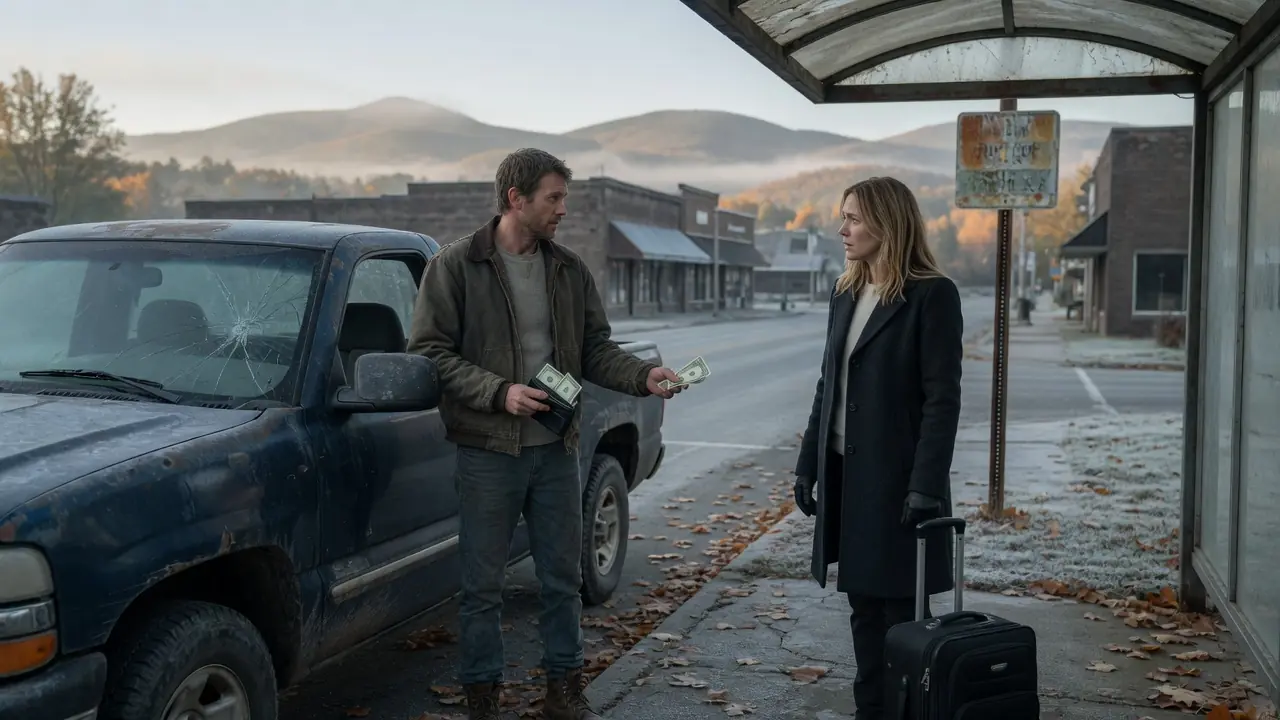
The heater in the break room had been broken for three weeks, and Ryan Hale could see his own breath curling in front of him as he signed out of his shift at 6:47 in the morning.
The clipboard was cold against his fingers. The pen did not work at first, and he had to scribble hard circles in the corner of the page before the ink came through.
“Hale.”
The voice came from behind him.
He did not turn around right away. He recognized it the way a man recognizes the sound of a dog that has bitten him before.
“Hale? I need you in Mr. Delaney’s office.”
Ryan turned.
Carl Voss stood in the doorway of the break room with his arms crossed over his chest, wearing the same navy polo he had worn yesterday and probably the day before that. Carl was forty-six years old, with thinning hair combed forward to hide a receding hairline that had already given up on being hidden.
He had a way of standing that made every room feel smaller than it was.
“It’s the end of my shift,” Ryan said.
“I know when your shift ends. I’m telling you, Delaney’s office. Now.”
Ryan set the pen down on the clipboard. His hands had that specific ache that came from twelve hours of lifting, the kind where the joints did not hurt so much as the spaces between them. He was thirty-two years old, and most mornings he felt forty-five.
“What’s this about, Carl?”
“He’ll explain.”
Ryan looked at him for a second.
He had been working under Carl Voss for two years and seven months. In that time, he had noticed that Carl never said anyone’s first name. He had also noticed that Carl kept a spare key to the temperature-controlled unit on a lanyard under his shirt, where nobody could see it, even though company protocol said the key was supposed to stay in the supervisor’s lockbox.
Ryan had never mentioned it to anyone.
It was not his business.
He started thinking maybe it should have been.
The walk from the break room to Martin Delaney’s office was about four hundred feet past the loading dock, where two guys from the night crew were still finishing up a shipment, past the row of forklifts lined up like sleeping cows, past the bulletin board where someone had pinned up a birthday card for a woman named Brenda, who Ryan did not think worked there anymore.
The fluorescent lights buzzed overhead. Everything smelled like cardboard and diesel and the faint chemical sweetness of the floor wax they used.
Delaney’s door was open.
That was never a good sign.
When Martin Delaney closed his door, it meant he was on the phone with his wife or eating a sandwich. When his door was open, it meant he wanted people to see who was going in.
“Ryan, come in. Shut the door behind you.”
Ryan did. He sat down in the chair across from Martin’s desk without being asked.
Carl came in behind him and stood against the wall, arms still crossed.
Martin Delaney was a big man, maybe six-foot-three, with the kind of belly that had been a beer belly in his twenties and had slowly become just a belly in his fifties. He had a photograph of his grandson on his desk and a coffee mug that said World’s Okayest Boss, which his daughter had given him as a joke and which he had taken slightly too seriously.
Ryan had always liked him.
Not the way you like a friend.
The way you like a man who remembers your name and asks how your kid is doing.
“Ryan,” Martin said.
He was looking at the desk, not at Ryan.
That was the first bad sign.
“Martin.”
“There’s been a situation with the Regis Hollister shipment that went out Tuesday.”
Ryan nodded. He remembered the shipment. It had been a big one. Forty-two pallets of medical-grade equipment, insulin pumps and surgical tools, and a couple of crates of something Ryan had not been cleared to know about.
He had helped load six of the pallets himself.
“What about it?”
“Eleven of the crates didn’t arrive.”
Ryan waited.
Martin was still looking at the desk.
“Didn’t arrive where?”
“Anywhere. They signed in here. They signed out of the dispatch log. The truck made it to the distribution center in Albany, but eleven crates weren’t on the truck when it got there.”
“Okay,” Ryan said slowly. “That’s a lot of weight to lose between the loading dock and Albany.”
“That’s what the insurance company is saying.”
Ryan was starting to understand what kind of conversation this was. He could feel it in the way Martin would not look at him, in the way Carl stood against the wall like he was enjoying a movie he had already seen.
“Martin.”
“Ryan.”
“Are you firing me?”
Martin finally looked up.
He had the eyes of a man who had been up all night arguing with himself.
“There’s footage,” Martin said. “From the dock camera. Tuesday night at 11:47. You were on that dock alone for about six minutes.”
“I was closing up. I close up every Tuesday.”
“I know.”
“I was doing my job.”
“I know, Ryan.”
“Then what’s the problem?”
“The problem,” Carl said from against the wall, “is that the paperwork shows you signed the last four crates onto the truck at 11:51. Four minutes after the camera picked up what it picked up.”
Ryan turned in his chair to look at him.
“And what did the camera pick up?”
“You,” Carl said. “Moving crates around. Off camera some of the time.”
Ryan stared at him.
Carl had the kind of face that could be very expressive when it wanted to be, and right now it was not expressing anything. That was the most expressive thing about it.
“Carl.”
“What?”
“You were here Tuesday night.”
“I left at ten.”
“No, you didn’t.”
“I did.”
“Carl, I saw your truck in the lot when I—”
“You’re mistaken.”
The word mistaken landed in the room like a thrown rock.
Ryan felt his face go hot.
Not from anger exactly.
From something colder than anger.
From the recognition of a thing being done to him.
He turned back to Martin.
“Martin, I didn’t take those crates.”
“I know you didn’t, Ryan.”
“Then why are we having this conversation?”
“Because it’s not up to me.”
Martin finally pushed a piece of paper across the desk.
It was a termination notice, already signed by someone in HR whose signature Ryan did not recognize. The reason for termination was listed as pending investigation, loss of corporate property, probable cause.
“The insurance company is driving this,” Martin said. “And corporate. They want somebody off the payroll while the investigation runs. If it clears, you might be able to come back.”
“If?”
“Ryan—”
“Martin, I have a kid.”
“I know.”
“I have a seven-year-old daughter. Her mother has been gone for four years. I have rent due on the fifteenth.”
“Ryan, I know. I know all of it. I’m sorry.”
“You’re sorry.”
“I’m sorry.”
Ryan looked at the termination notice.
His name was spelled correctly. His employee ID was correct. The date was correct. Everything about it was correct except for the part where it said he had done something he had not done.
He thought about his daughter, Emma.
He thought about the fact that he had promised her a new pair of boots that weekend because her old ones had a hole in the toe and she was too proud to say anything about it. He had noticed her stuffing a folded-up napkin into the toe last Thursday morning before school.
He thought about the forty-two dollars in his wallet.
He picked up the pen off Martin’s desk and signed the notice.
“Ryan—”
“What, Martin?”
“I really am sorry.”
“Yeah.”
He stood up.
Carl was still against the wall.
Ryan walked past him close enough that their shoulders almost touched.
Carl did not move.
Ryan did not look at him.
At the door, Ryan stopped.
“Carl?”
“Yeah?”
“Your lanyard’s showing.”
Carl’s hand went to his collar before he could stop it. He felt the lanyard under his shirt, the key tucked against his chest.
He looked at Ryan.
Ryan looked at him.
Neither of them said anything.
Then Ryan walked out.
The parking lot was the kind of cold that went through cloth. Ryan stood next to his truck for a minute without opening the door.
His truck was a 2003 Ford Ranger with 214,000 miles on it, and the driver’s side door did not latch right anymore. There was a crack in the windshield that ran from the bottom right corner up to about the middle, where it stopped for now.
He had bought it off a guy in Rutland for twelve hundred dollars three years ago, and it was the second most expensive thing he owned.
The first was Emma’s mattress.
He got in.
He sat.
He did not turn the key.
The sun was just starting to come up over the Green Mountains, which meant the whole sky had that specific October color, the color of an old bruise.
The mountains looked farther away than they were.
Everything did that morning.
He thought about calling his sister. She lived in Phoenix, and they talked once every three or four months. The last time they had talked, she had said, “If you ever need anything, Ry,” and he had said, “I know, I know.”
She had meant it.
He had meant it.
And he was not going to call her.
He thought about calling Emma’s grandmother, his mother-in-law Rosa, who lived on the other side of town in a small house that smelled like cinnamon and laundry soap. Rosa loved Emma more than she had ever loved anyone in her life. She had offered more than once to help.
He had never taken her up on it because Rosa lived on a fixed income, and he was not going to be the man who took money from his dead wife’s mother.
He thought about his wife.
About Marlene.
About the fact that she had been gone four years and three months, and he still sometimes reached for the other side of the bed.
He turned the key.
The truck coughed. He let it warm up for a minute before he put it in gear.
Then he drove home the long way through downtown because he was not ready yet to tell Emma.
It was a quarter past seven when he saw the woman at the bus stop.
The bus stop on Chestnut and Vine was not a real bus stop anymore. The route had been cut in 2019 when the town council redid the budget. There was still a sign and a bench and a little plastic roof over it, but no bus came there now.
Ryan sometimes forgot that, then remembered, and thought it was sad the way a thing could stay in place long after it had stopped meaning anything.
The woman was sitting on the bench.
She had a small suitcase beside her, black, the expensive kind with recessed wheels. She was wearing a wool coat that looked warm but not warm enough, a pair of leather gloves, and her hair was pulled back in a way that had started out neat and gotten messier through the night.
She was maybe thirty.
She was looking at her phone.
Ryan drove past her.
Then he slowed down.
Then, about a block later, he pulled over.
He sat in his truck for a second.
“Come on, Ryan,” he said to himself out loud. “Just go home.”
He did not go home.
He made a U-turn at the next light, came back, pulled up in front of the bus stop, and rolled down the passenger window.
“Ma’am.”
She looked up.
She had gray eyes.
They were very tired.
“Yes?”
“You all right?”
“I’m fine. Thank you.”
“That bus doesn’t run anymore.”
She blinked.
“I’m sorry?”
“The bus. This stop. They cut the route a few years back. Whatever you’re waiting for, it isn’t coming.”
She looked down the street, then back at him.
She had the face of a person who had been holding something together for a while and was starting to notice the seams.
“I wasn’t waiting for a bus,” she said. “I was waiting for an Uber. It canceled twice.”
“Out here, you’ll be waiting a while. Not a lot of drivers in this part of town this early.”
“I’m figuring that out.”
“Where are you trying to go?”
She hesitated.
It was a small hesitation, but Ryan caught it.
“Burlington,” she said eventually.
“Eventually is a funny word for a Tuesday morning.”
She almost smiled. It did not quite make it to her mouth, but it made it to her eyes.
“My car broke down last night,” she said. “On the interstate. I got a tow as far as the next exit and walked the rest of the way into town. Every motel said they were full, and I ended up here. Just to sit. I’m not usually like this. I’m usually quite organized.”
“Everybody’s quite organized until they aren’t.”
That did make her smile, barely.
“You look cold,” Ryan said.
“I am cold.”
“There’s a diner on Main, three blocks that way. They open at six. It’s warm. I can drop you off.”
She looked at him.
She looked at his truck.
She looked at his face.
Ryan could see her weighing it.
He did not blame her.
He was a thirty-two-year-old man in a dirty Carhartt jacket offering a woman alone at a bus stop a ride in a truck with a cracked windshield at seven in the morning. He could see exactly how that looked from the outside.
“I can call you a cab instead,” he said. “From my phone. I’ll pay for it. That might be better.”
She tilted her head.
“Why would you do that?”
“Do what?”
“Pay for a cab for a stranger.”
Ryan thought about it.
“My wife used to say that the world runs on people doing small dumb things for each other,” he said. “I don’t know if she was right, but I figure I’m not going to find out by not doing them.”
The woman was quiet for a second.
“Your wife sounds like a thoughtful person.”
“She was.”
She caught the tense.
She did not say anything about it.
Ryan appreciated that.
“I’ll take the diner,” she said. “If you don’t mind.”
“I don’t mind.”
She stood up and picked up her suitcase. It was heavier than it looked, and she had to set it down again for a second before she lifted it into the bed of the truck.
Ryan got out to help her.
She waved him off.
“I’ve got it. Thank you.”
She climbed into the passenger seat. She smelled faintly like expensive perfume that had been worn for too long without being refreshed.
The truck cab felt smaller with another person in it.
Ryan could not remember the last time anyone besides Emma had sat in the passenger seat.
He pulled out onto the road.
They drove in silence for about half a block.
“What’s your name?” she asked.
“Ryan. Ryan Hale.”
“I’m Celeste.”
“Just Celeste?”
“Just Celeste for now.”
He glanced at her.
She was looking out the window.
“Okay,” he said. “Just Celeste.”
They drove another block.
“Can I ask you something, Ryan?”
“Sure.”
“You look like a man who’s had a bad morning.”
He laughed.
It came out shorter and harder than he meant it to.
“That obvious?”
“Your knuckles are white on the wheel.”
He looked down.
They were.
He made himself loosen his grip.
“I got fired,” he said. “About forty-five minutes ago.”
“I’m sorry.”
“Yeah.”
“Can I ask why?”
“They think I stole something I didn’t steal.”
She looked at him for a long moment.
“Why didn’t you steal it?” she asked.
He glanced at her, surprised.
“What?”
“Why didn’t you steal it? If you had the chance, and you look like a man who needs money, why didn’t you?”
He thought about it.
Not because he had to, but because he wanted to give her a real answer.
“Because my daughter’s seven,” he said. “And someday she’s going to do something hard, and I want her to be able to do it because I did hard things first.”
Celeste did not say anything.
She looked out the window again.
They pulled into the parking lot of the diner. The sign said Helen’s in red neon, but the E was missing, so in the morning dim it said H LENS.
Ryan put the truck in park.
“Here you go.”
“Thank you, Ryan.”
She opened the door, then paused.
“Would you think I was strange if I asked you for another favor?”
“I’m past being surprised today.”
“My wallet was in the car, in the tow truck. I don’t have any cash, just cards, and the diner’s sign in the window says cash only before nine a.m. Would you—”
He was already reaching for his wallet.
He opened it.
He had two twenties and two ones.
Forty-two dollars.
It was the last money he had until unemployment kicked in, which would be at least two weeks and probably three.
He took out the two twenties. He folded them once. He held them out to her.
She stared at them.
“No. Ryan, I can’t take that. I meant like ten dollars. I’ll pay you back. I can’t take it.”
“Take it. Get yourself breakfast. Get yourself coffee. Get yourself a car back to wherever you need to go.”
“This is forty dollars.”
“I can count.”
“You just told me you lost your job.”
“I did.”
“And you have a seven-year-old daughter.”
“I do.”
She looked at the money.
Her eyes were doing something complicated that he could not quite read.
“Why?” she said quietly.
He shrugged.
“Because you need it more than I do right now. I’m going home to a kid who loves me. You’re going to a diner alone in a town you don’t know. Forty bucks isn’t going to save my life. It might make yours a little less terrible for an hour. That’s a deal I can live with.”
She took the money.
She took it slowly, the way you take a thing you do not want to take but do not know how to refuse.
“I will pay you back,” she said. “I promise.”
“Don’t worry about it.”
“I’m going to.”
“Okay.”
She got out.
She pulled her suitcase out of the truck bed. She stood in the parking lot for a second, holding the suitcase and the folded bills, looking at him through the open passenger window.
“Ryan Hale.”
“Yeah?”
“You have a good face.”
“I don’t know what that means.”
“Neither do I. But you do.”
She closed the door.
He waited until she was inside the diner before he pulled out of the parking lot.
He drove home the rest of the way with two dollars in his wallet.
The apartment was on the second floor of a three-story walk-up on Birch Street, above a laundromat that made the whole building smell faintly of dryer sheets. The stairs were narrow, and the banister was loose, and Ryan had been meaning to fix it for a year.
Emma was already up. She sat at the kitchen table in her pajamas, eating cereal straight out of the box because they were out of milk and she was not going to say anything about it. Her hair was a nest. She had a library book open in front of her.
She was seven years old.
She read at a fifth-grade level.
Sometimes Ryan caught himself being almost afraid of her.
“Daddy?”
“Hey, kiddo.”
“You’re home early.”
“Yeah.”
“Did something happen?”
Ryan set his keys on the counter. He took off his jacket, hung it on the back of the chair, and sat down across from her.
“A couple of things, actually.”
“Bad things?”
“Some bad.”
“Okay.”
She waited.
She was good at waiting.
She had always been good at waiting. When her mother had been sick at the end, Emma had been three years old, and she had sat in the hospital room for hours without complaining, drawing pictures on the back of intake forms.
Ryan had thought at the time that it was just a phase and she would grow out of it.
She had not grown out of it.
He was not sure she ever would.
“I lost my job this morning,” he said.
“Oh.”
“It’s going to be okay. I’m going to find another one, but for a little while things might be kind of tight.”
“Tighter than now?”
“A little.”
She nodded while chewing a dry Cheerio.
“Can we still get the boots?”
He almost told her yes.
He almost lied.
“Maybe not this weekend, kiddo.”
“Okay.”
“But soon.”
“Okay, Daddy.”
She closed the library book. She reached across the table and put her small hand on top of his big one.
Her hand was sticky.
He did not know what from.
“Daddy?”
“Yeah?”
“Did you do anything bad?”
“No.”
“Okay.”
“I promise, Emma. I didn’t do anything.”
“I know. I know you didn’t.”
She said it so simply that it almost knocked him backward. She did not say it like a question she hoped would be answered the right way. She said it like a fact she had already checked.
He did not know what to say.
He just squeezed her hand.
“Daddy?”
“Yeah, kiddo?”
“Are we going to be okay?”
He looked at her.
At her nest of hair.
At her library book.
At the cereal box with the cartoon bee on it, almost empty.
“Yeah, Emma. We’re going to be okay.”
He did not know if he was telling the truth.
He hoped he was.
He was so tired.
The rest of the day went the way days like that go.
He made phone calls. He filled out an online application for unemployment that kept timing out. He drove to the gas station on the corner and put four dollars of gas in the truck with money from the change jar.
He made Emma a grilled cheese for lunch and ate the crusts himself and called it his lunch.
At 3:30, he walked Emma to school for her afternoon program, which was free.
Thank God for the free afternoon program.
On the way back, he stopped at the corner, looked up at the sky, and said, mostly to himself, “All right. All right, I just need a break.”
He did not know who he was talking to.
He had stopped believing in the kind of listener who answered back a long time ago.
He walked home.
He sat on his couch.
He stared at the wall.
At 4:47 in the afternoon, his phone rang.
It was a number he did not recognize.
He let it go to voicemail.
Nobody called him with good news.
At 4:52, it rang again.
Same number.
He let it go to voicemail.
At 4:58, it rang a third time.
He picked it up.
“Hello?”
There was a pause.
Then a woman’s voice.
Familiar.
“Ryan Hale?”
“Speaking.”
“This is Celeste. From this morning.”
He sat up.
“Oh. Hey.”
“I wanted to thank you again.”
“You don’t have to. It’s fine.”
“I’d like to pay you back.”
“Really, it’s—”
“Ryan.”
“Yeah?”
“Will you be home tomorrow morning?”
“I’ll be home every morning for a while.”
“Can I come by? Around nine?”
He hesitated.
He did not know what to make of this woman. He did not know how she had gotten his number. He had not given it to her.
“How’d you get this number?”
“I have my ways.”
“That’s not an answer.”
“I know. I’ll explain tomorrow. Nine?”
He thought about it.
He thought about Emma at school.
He thought about his two dollars.
He thought about the look on her face in the parking lot when she had said, You have a good face.
“Nine,” he said.
“Thank you, Ryan.”
“Celeste?”
“Yes?”
“Who are you?”
There was a pause.
A long one.
“Someone who owes you a debt,” she said. “I’ll see you in the morning.”
She hung up.
Ryan held the phone against his ear for another few seconds after the line went dead, listening to the silence on the other end like he might be able to hear something in it.
He set the phone down on the coffee table.
He got up and went to the window.
He looked down at Birch Street, at the laundromat sign, at an old man walking a small brown dog, at the gray October sky pressing down on the rooftops like a hand on a shoulder.
Somewhere, very faintly, he could hear a siren.
It was not coming for him.
Not yet.
He stood at the window for a long time. The light outside began to change the way it does in the late afternoon in Vermont in October, going from gray to a deeper gray to a kind of bronze that settles over everything before the dark comes on.
Ryan watched it change.
He did not move.
He was thinking about Carl Voss’s lanyard.
He was thinking about the way Martin Delaney had not been able to look at him.
He was thinking about Emma’s hand on top of his at the kitchen table, sticky with something he could not identify, and about how he had told her they were going to be okay.
He did not know yet that four black SUVs were already being scheduled to drive up his street in the morning.
He did not know yet that the woman he had given his last forty dollars to owned a company with eighteen thousand employees on three continents.
He did not know yet that the man who had framed him was, at that very moment, sitting at his kitchen table across town, pouring himself a third glass of whiskey, believing he had gotten away with it.
Ryan stood at the window as the bronze faded out of the sky.
Down on the street, the old man with the brown dog turned the corner and disappeared.
A car passed.
Then another.
Then nothing for a long time.
Ryan Hale stood at the window in a second-floor apartment above a laundromat in a small town in Vermont with two dollars in his wallet and a seven-year-old daughter who believed him when he said things were going to be okay.
And he waited for morning to come.
He did not sleep well.
That was not unusual.
Ryan had not really slept well since Marlene died, not the way other people talked about sleeping, where you closed your eyes and woke up and the time between had felt like a gift.
For him, sleep was more like an intermission.
You sat in the dark for a while and waited for the rest of the show to start again.
But this time was worse than usual.
He lay on his back in the bedroom that was really just a closet with a mattress in it because he had given Emma the bigger room two years ago when she started asking for a space for her books.
He stared at the water stain on the ceiling that looked like the state of Michigan.
He stared at it for so long that, at some point around three in the morning, Michigan became a horse, then a dog, then the face of Carl Voss grinning with his thinning hair combed forward.
He got up.
The kitchen floor was cold through his socks.
He filled the kettle and stood at the counter waiting for the water to boil. Out the kitchen window, the sky was still full dark. Across the alley, the windows of the building opposite were mostly dark too, except one on the third floor where a woman Ryan had never met stood at her own kitchen counter doing what he was doing, her face lit blue by the glow of a phone screen.
They did not wave at each other.
They had never acknowledged each other.
But Ryan found himself oddly grateful she was there.
The kettle clicked.
He poured the water over a tea bag that had already been used once. He had started doing that last month.
One tea bag, two cups.
Marlene would have laughed at him.
She had been the kind of person who bought fresh flowers every Saturday. Not because they were rich. They were not. But because she said it kept the house from knowing they were broke.
He still thought about that.
The idea that a house could know things.
He carried the tea into the living room, sat on the couch with the cup on his knee, and watched the window for a while. He watched the dark go a little less dark, then a little less dark, until it became the color of wet cement, then the color of dust, and finally morning.
He looked at the clock.
7:14.
He had an hour and forty-six minutes before Celeste knocked on his door or did not.
It occurred to him that she might not come.
That this whole thing might be the kind of odd little episode a man has when he has had a very bad day, where a stranger says something kind to him in a parking lot and, for a few hours, he convinces himself the world has noticed him.
He half expected nine o’clock to pass without anything happening.
He woke Emma at 7:30.
He made her toast with the last of the peanut butter. He brushed the back of her hair while she brushed the front, because she could not see the back in the mirror and did not trust him to do the front. She put on her boots with the hole in the toe.
He walked her to the corner where Rosa, her grandmother, met her on school days.
Rosa was a small woman in her early sixties with a face that had been beautiful once and was still interesting now. She wore a red coat that was too thin for the weather and a scarf that Marlene had knitted her the winter before she got sick.
Rosa saw Emma from half a block away and opened her arms without saying anything.
Emma ran the last twenty feet into them.
“Ryan,” Rosa said over Emma’s head.
“Rosa.”
“You look terrible.”
“Thanks.”
“Are you eating?”
“I’m fine, Rosa.”
“That’s not what I asked.”
Ryan did not answer.
Rosa studied him for a second, the way she studied everything, then nodded once, a small concession, and let it go.
“You’ll pick her up at five.”
“I’ll pick her up at five.”
“Emma, you have your lunch?”
“Yes, Abuelita.”
“Good girl. Kiss your father.”
Emma turned, ran back to Ryan, and hugged him around the waist, hard and fast, the way she always did, like she was making sure the hug got all the way through.
Then she ran back to Rosa and took her hand.
Ryan watched them walk down the block until they turned the corner.
Rosa did not look back.
Rosa never looked back.
Emma looked back once, waved, and was gone.
Ryan walked home slowly.
The sidewalks were slick with the kind of frost that was not really frost yet, more like the memory of frost. A man across the street was trying to start a snowblower that probably had not been started since last March.
The snowblower coughed and gave up.
The man swore at it in Russian.
Ryan did not know it was Russian, just that it was not English.
He got back to the apartment at 8:22.
He made his bed. He had not made his bed in a month. He did not know why he was making it now. He wiped down the kitchen counter. He put away the two clean dishes from the drying rack.
He stood in the middle of his living room and looked at it like a stranger would. He saw the sag in the couch, the two-dollar lamp from the thrift store, and the bookshelf he had built himself out of boards from a pallet.
For a second, he felt something that was not quite shame, but close to it.
Then he let it go.
Because there was no version of the next hour in which his apartment became a different apartment, and there was no point pretending there was.
At 8:56, he heard the engines.
He was in the kitchen rinsing out his teacup. He turned off the water. He listened.
He walked to the front window of the living room and pulled back the curtain.
Four black SUVs were parked on Birch Street.
They had come down the block without him hearing them arrive. They were parked in a kind of loose staggered line, the way military vehicles parked in the movies, though Ryan had never been in the military and could not have said if he was right.
They were big and clean and looked like they had never driven on a dirt road in their lives.
Men in dark suits were getting out of three of them.
Two men from the first.
One from the second.
Two from the third.
The fourth SUV still had its driver inside and its passenger door closed.
Ryan counted the men.
Then he counted them again.
He was not someone who was used to counting men in suits in front of his building.
He let the curtain fall.
He stood in the middle of his living room and noticed, with the small part of his brain that was still noticing things, that he was holding a dish towel.
He set the dish towel on the arm of the couch.
A car door opened downstairs. He heard it from the sidewalk, through the thin glass of his window.
Footsteps.
The outer door of the building opening.
The mailboxes clanging shut because the outer door always banged them when it swung too hard.
Footsteps on the stairs.
Three knocks.
Ryan walked to the door.
He stopped with his hand on the knob.
He had the strangest feeling that if he did not open the door in the next five seconds, his life would go on being his life.
And if he opened the door, it would not.
He opened the door.
The man on the other side was in his fifties, tall, clean-shaven, with the kind of build that suggested he had once played a sport nobody remembered him for. He had a Bluetooth device in his ear. He was not smiling.
“Mr. Hale?”
“Yes.”
“My name is Marcus Pell. I work for Ms. Arden. She is in the vehicle. She asked if you’d be willing to come down and speak with her.”
“Down to the street?”
“Yes, sir.”
“She doesn’t want to come up?”
“She didn’t say, sir. She said to ask.”
Ryan looked past him. The hallway was empty. Through the stairwell window, he could see the top of one of the SUVs.
“Ms. Arden,” Ryan said slowly.
“Yes, sir.”
“That’s her last name?”
“Yes, sir. Celeste Arden.”
Ryan had heard the name before. He could not place it exactly. He had the feeling of trying to remember a song lyric by its second word.
“Give me one minute,” Ryan said.
“Yes, sir.”
“Don’t say sir.”
“Yes—”
The man stopped. A small smile tugged at the corner of his mouth and gave up.
“All right.”
Ryan closed the door. He leaned his forehead against it for a second. Then he walked back into the bedroom and put on a clean shirt, a blue flannel that had been Marlene’s father’s and was a size too big for him.
He looked at himself in the mirror over the dresser.
He ran a hand through his hair.
He needed a haircut.
He had needed a haircut for two months.
He went downstairs.
Marcus Pell was waiting on the landing. He walked down behind Ryan, not beside him, the way a person walks when he is used to walking behind someone.
Out on the sidewalk, the other men in suits were standing in positions that were not random.
Ryan noticed that.
One of them was at each end of the block. One was watching the alley. The other two were near the vehicles.
Nobody was looking at Ryan directly.
They were all looking at everything except Ryan.
The fourth SUV, the one that had not let anyone out, was the one Marcus walked him to.
Marcus opened the back door.
Celeste Arden was sitting inside.
She was wearing a different coat than yesterday, charcoal, longer, and a cream-colored turtleneck under it. Her hair was no longer pulled back messily. It was down and brushed, resting on her shoulders like a thing that had been attended to.
Her eyes were the same.
Gray.
Tired in the specific way they had been tired at the bus stop, like tired was something she wore more than something she felt.
“Ryan, please. Get in.”
He got in.
Marcus closed the door behind him.
The door was very heavy. It closed with a sound like a bank vault.
Inside the SUV, it was warm.
There was a faint smell of leather and coffee. A small console sat between the two back seats, and on the console was a steel thermos and two paper cups.
She was pouring coffee into one of them as he sat down.
“I hope you take it black.”
“I take it however it comes.”
She handed him the cup.
Her fingers were cold.
“You lied to me yesterday,” Ryan said.
“I did not lie.”
“You told me your name was just Celeste.”
“I told you that was my name for now. That was true. I did not give you my full name. That is not the same as lying.”
“Most people would call that the same.”
“Most people are imprecise.”
He looked at her.
She looked at him.
She had a small private smile at the corner of her mouth that was not quite amused and not quite apologetic.
“I’m sorry, Ryan. That was a lawyer’s answer. I apologize.”
“It’s okay.”
“It’s not.”
“Okay.”
She took a sip of her own coffee.
The SUV was not moving. The driver sat in front with the engine off, looking straight ahead through the windshield like he was made of wax.
“Who are you?” Ryan asked.
“My name is Celeste Arden. I run a company called Arden Logistics International. We move freight. Medical supplies, electronics, agricultural equipment, some high-value industrial materials. We have operations in forty-one countries. We employ about eighteen thousand people.”
Ryan looked at her over the rim of his coffee cup.
“Okay,” he said.
“Okay?”
“I heard you.”
“You’re not surprised.”
“I’m very surprised. I’m just not going to show it in front of you.”
She laughed.
It was a real laugh, short, almost startled.
“That’s fair.”
“Your company,” he said carefully. “Arden Logistics.”
“Yes.”
“That’s a holding parent, isn’t it?”
“Yes.”
“It owns subsidiaries.”
“Yes.”
“One of those subsidiaries is called Regis Hollister.”
Her smile faded.
“Yes.”
Ryan set his coffee down on the console.
He looked at the dashboard of the SUV and then back at her.
“You own the company that fired me.”
“My company owns the company that fired you.”
“That’s splitting hairs.”
“Maybe.”
“Did you know that when you let me drive you to the diner?”
“I knew you were a warehouse employee at one of my subsidiaries. I knew there had been a disciplinary event concerning you. I did not know the specifics. I was not working off a list with your name on it, Ryan. I was sitting at a bus stop in the cold, and you were the person who stopped.”
“You were at the bus stop on purpose.”
“Yes.”
“You weren’t stranded.”
“I was not stranded.”
“There was no broken-down car.”
“There was no broken-down car.”
Ryan leaned back in the seat.
He could feel the leather through his shirt.
He was trying not to let his face do anything.
“So yesterday,” he said, “was a test?”
“Yesterday was a coincidence that I took advantage of.”
“That’s a nicer way of saying yes.”
“I suppose it is.”
“I gave you my last forty dollars.”
“Yes.”
“Because I thought you were stuck.”
“Yes.”
“And you weren’t.”
“I wasn’t.”
“Ryan—”
“Hold on. Let me think for a second.”
She held on.
She let him think.
The silence inside the SUV was a very expensive silence.
Out the tinted window, he could see the second-floor curtains of his own apartment, and for a second, he felt like he was seeing them from very far away, from someone else’s life.
“Why were you there?” he finally asked.
“At the bus stop?”
“Yeah.”
“I was observing.”
“Observing what?”
“People.”
“Come on.”
“I am not being cute, Ryan. I was observing people. For the last five months, I have been doing things like this. I dress down. I go to towns where my company operates. I sit where people can see me. I stand in line at gas stations. I walk through parking lots at the end of shifts. I’m trying to understand who the people who work for me actually are because something is wrong inside my company, and I do not trust the reports I am getting from the top down. So I am trying to see it from the bottom up.”
“Something is wrong.”
“Yes.”
“Like the shipments going missing.”
“That’s one of the things. Yes.”
“And you picked the bus stop at Chestnut and Vine because…”
“Because that stop is half a mile from the rear gate of the Regis Hollister distribution facility. I’ve been watching that facility for six weeks. I thought I might see something useful. I did not expect to see you.”
“You didn’t expect anything?”
“I expected a lot of things. I did not expect a man who had just been fired from my company to pull over in a truck with a cracked windshield and give me his last forty dollars.”
Ryan was quiet.
“You didn’t know I’d just been fired.”
“Not at that exact moment. I knew there had been a termination that morning. I did not know yet that the termination was you. I put it together late last night after I went back to the hotel.”
“After you called me.”
“Before I called you. The call was after.”
“So when you called me…”
“I already knew.”
“And you came here this morning.”
“Yes.”
“With four SUVs.”
She smiled, a little tired.
“I apologize for the SUVs. My security team is somewhat aggressive about these visits. It is a compromise I make with them so they will let me do the rest of what I do.”
“Your security team?”
“Yes.”
“You have a security team?”
“I have a team, yes. Marcus is the lead. He has been with me for nine years. He does not like me very much this morning because I did not let him drive me yesterday, which was, in his view, a professional betrayal of the highest order. He has been making me pay for it all night.”
“He’s the one who knocked on my door.”
“Yes.”
“He knocked three times.”
“He always knocks three times. I don’t know why. It is one of his mysteries.”
Ryan looked at her.
There was something in her voice when she talked about Marcus that was almost warm. It was the first time she had sounded warm since she had gotten into his truck the morning before.
“Celeste.”
“Yes.”
“Why are you here?”
She set her coffee down.
She clasped her hands in her lap and looked at them for a second, as if reading something off the backs of them, then looked up at him.
“I need your help, Ryan.”
“With what?”
“With the thing that got you fired.”
“The theft?”
“Yes.”
“I didn’t do it.”
“I know you didn’t.”
“How do you know?”
She looked at him for a long second.
“Because of yesterday,” she said. “Because a man who would give away his last forty dollars on the worst day of his life does not move eleven crates of insulin pumps off a truck at midnight on a Tuesday. I am not sentimental, Ryan. I am making an operational assessment. The math does not work.”
“The math?”
“Yes. The math of human beings. I have been in this business for a long time. I know what thieves look like. Thieves do not give away forty dollars to strangers. Thieves do not tell their daughters they want them to do hard things. Thieves have certain tells. You do not have any of them. The man who framed you, Ryan, has all of them.”
“Carl?”
“I did not say Carl.”
“Carl Voss?”
“I did not say Carl Voss.”
“But it’s Carl Voss.”
“Ryan, I’m going to say something to you, and I need you to listen carefully.”
“Okay.”
“I cannot tell you what I know.”
“Why not?”
“Because if I tell you what I know, and you act on it, and you are wrong, then we both have a problem. And because if I tell you what I know, and you tell the wrong person, then I have a bigger problem than you do. I am not willing to make that trade yet because I do not know you well enough yet. Do you understand?”
“Yeah, I do. But…”
“But I can give you a question to answer, and I can give you the resources to answer it. And I can tell you that if you answer it correctly, you will find what I have already found, and you will do it in such a way that you will not just clear your name, but end a man’s career and possibly put him in a federal courtroom.”
Ryan was quiet.
“Carl.”
“I did not say Carl.”
“What’s the question?”
She opened a folder on the seat next to her.
He had not noticed the folder before.
She took out a single sheet of paper and handed it to him.
The sheet had a table of numbers on it. Dates, times, shipment IDs, and a column of what looked like weight variances in pounds.
“Those are the dispatch logs for the Regis Hollister facility over the last fourteen months,” she said. “Every shipment that left that dock. The weight on the loading manifest, the weight at the first weigh station on I-89, and the variance between them.”
Ryan looked at it.
He started reading.
He could not help himself.
He felt his brain doing the thing it did when it saw a pattern before he consciously recognized it, like the feeling of almost sneezing.
“These variances are tiny,” he said. “Most of them are under thirty pounds. That’s within normal packing variance.”
“Yes.”
“But some of them aren’t.”
“No.”
“And the ones that aren’t…”
“Look at the dates.”
He looked at the dates.
He saw it after about four seconds.
“They’re all Tuesdays.”
“Yes.”
“Tuesday nights.”
“Yes.”
“Between ten p.m. and midnight.”
“Yes.”
“When Carl Voss closes out the dock.”
“I did not say Carl Voss.”
“Jesus, Celeste.”
She smiled.
Small.
“Well, now you’re just confirming what I already won’t confirm.”
He handed the sheet back to her.
His hands were shaking slightly.
Not a lot.
Just a little.
“You want me to prove it?”
“No. I can prove it. I have already mostly proven it. My compliance team has been building a case on this for three months.”
“Then what do you want from me?”
“I want you to help me finish it.”
“Why me?”
“Because the legal case requires testimony from a line employee who can speak to the physical operations of that dock. Because my compliance people are excellent at data and mediocre at physical plant. Because you worked that dock for two years and seven months, and you know which loading bay doors close quietly and which ones don’t. You know how long it takes a forklift to cross the floor. You know where the blind spots are in the camera coverage. You know things that are not in any report. And because you were the man who was supposed to take the fall, Ryan. The cleanest way to end this properly is for the man they tried to destroy to be the man who puts the evidence on the table.”
Ryan was quiet for a long time.
“I have a daughter.”
“I know.”
“I can’t do something dangerous.”
“I am not asking you to do something dangerous. I am asking you to work inside a legal process with my legal team, with my security team, and with pay.”
“Pay?”
“Yes.”
“How much?”
“Your base would be the salary of an internal compliance associate. That is eighty-four thousand dollars annualized. I am offering you a six-month contract to start, with the option to extend, and a signing bonus to compensate for the wrongful termination, which we will characterize as a settlement. The settlement is sixty thousand dollars. It would be paid out this week.”
Ryan stared at her.
“Sixty thousand dollars?”
“Yes.”
“This week?”
“Yes.”
“You’re offering me sixty thousand dollars?”
“I am offering you what my legal team estimated a wrongful termination suit against Regis Hollister would cost me to settle out of court, minus the legal fees on both sides. It is not generosity, Ryan. It is arithmetic.”
“Is everything arithmetic with you?”
She thought about it.
“Most things,” she said. “Some things aren’t.”
“Which things aren’t?”
She looked at him for a second.
Then she looked away, out the window at the laundromat.
“I will have to get back to you on that one.”
He sat with the coffee in his hand and the sheet of numbers between them. He thought about Emma and the boots and the two dollars in his wallet and Carl Voss’s lanyard and Martin Delaney not being able to look at him.
“If I say yes,” he said.
“Yes.”
“I’m not doing this for the money.”
“I don’t believe you, but go on.”
“I’m doing it because that man tried to put this on me. He tried to put it on me because he thought I’d take it. He thought I was the kind of person nobody would miss, and I want him to look at me when it comes apart.”
“That is a perfectly acceptable reason.”
“Okay.”
“Okay?”
“I’ll do it.”
She did not smile.
She nodded once, sharply, like a business transaction had been concluded.
“Thank you, Ryan.”
“When do we start?”
“Now, if you can. I would like you to come with me to my team’s operation site. It is about forty minutes from here. You will sign a contract. You will sign a non-disclosure agreement. Then we will start work. I will have you home by five. You can pick up your daughter.”
“You know about the five o’clock pickup?”
“I know a number of things about you, Ryan. I had a briefing last night.”
“That’s unsettling.”
“I imagine it is. I’m sorry.”
“No, you’re not.”
She almost smiled.
“I am a little sorry. Not enough to have done it differently.”
“Fair.”
She knocked once on the partition between the back seat and the front.
The driver turned the key.
The SUV’s engine came to life very quietly, almost smoothly, the way a thing comes to life that has been well made by people who were paid well to make it.
“Ryan.”
“Yeah?”
“One more thing before we drive.”
“Okay.”
“When you see Carl Voss next, and you will see him again, you will not say anything to him. You will not look at him with anything on your face. You will not threaten him. You will not warn him. You will let him believe he has won for as long as I ask you to. Can you do that?”
He thought about the lanyard. He thought about you’re mistaken. He thought about Martin Delaney’s eyes when he said, It’s not up to me.
“Yeah,” he said. “I can do that.”
“Good. Because I’m going to ask you to do it for several weeks.”
“Okay.”
“And Ryan?”
“Yeah?”
“I will pay you back the forty dollars.”
“Don’t worry about it.”
“I am going to.”
“Okay.”
She took a single crisp bill out of a small wallet in her coat pocket and handed it to him.
It was a hundred.
“I said forty.”
“I know. The rest is interest.”
“Celeste—”
“Take it, Ryan, or I will be annoyed.”
He took it. He folded it and put it in his wallet next to the two dollars that were still there.
He could feel the weight of it, which was ridiculous, because a hundred-dollar bill weighed the same as a one-dollar bill.
But he could feel it.
The SUV pulled away from the curb.
The other three SUVs pulled out behind it in formation.
They moved down Birch Street in a slow black line, and the old man with the small brown dog, out for his morning walk, stopped on the sidewalk and watched them go by with his mouth slightly open.
Ryan sat in the back and watched his own street slide past the tinted window.
He saw the laundromat. He saw the corner where Rosa had met Emma an hour ago. He saw the little handwritten sign on the door of the pharmacy that said Back in 15 Minutes and had said Back in 15 Minutes for as long as Ryan had lived in that neighborhood.
“Where are we going, exactly?” he asked.
“A building my company owns outside Montpelier. It is off the books. Very few people at Regis Hollister know it exists.”
“Off the books?”
“Not illegally. Just not advertised.”
“Got it.”
She was watching him. He could feel it.
“Ryan.”
“Yeah?”
“You’re not afraid.”
“I’m a little afraid.”
“You don’t look afraid.”
“I’ve been very afraid for about twenty-four hours straight. I think I ran out this morning.”
“That happens.”
“Does it happen to you?”
“Not for a long time. When I was younger. Not for a long time now.”
He looked at her then, and he saw something pass across her face that was not the face of a billionaire or a CEO or a woman in a charcoal coat in the back of an armored SUV.
It was the face of a person.
Briefly.
Then it was gone.
The face of the woman who ran the eighteen-thousand-employee company was back.
And she was looking out the window at the hills.
“Can I ask you something?” he said.
“Yes.”
“Why the bus stop?”
“I told you. It was half a mile from the facility.”
“No, I mean you have four SUVs. You have a security team. You could have surveilled the facility from anywhere. Why did you sit at the bus stop in the cold alone at seven in the morning?”
She was quiet.
“Celeste.”
“I don’t know.”
“You don’t know?”
“I do not give you an answer when I do not know. I am telling you I do not know. Sometimes in this job, I do not know why I do the things I do. I just do them. Afterwards, when they work, I write them up as strategy. And when they don’t work, I write them up as lessons.”
“That’s not an answer.”
“It is the best I have today, Ryan.”
He leaned back in the seat.
The SUV had gotten onto the highway. The hills were rolling past the window, brown and gray, with the last of the October leaves clinging to the trees like people who had not been told the party was over.
The sky was the color of a pigeon’s back.
“I hope you find it,” he said quietly.
“Find what?”
“Whatever you were looking for at the bus stop.”
She did not answer.
She looked out her window, not at him, but he saw in the reflection on the glass that she was almost smiling in a way that was not about anything good exactly.
It was the smile of a person who had just recognized something in herself she had been trying not to recognize.
They drove the rest of the way in silence.
The building outside Montpelier did not have a sign.
It was a long, low brick structure set back from the road behind a line of pine trees, with a gravel drive and a small guard hut at the entrance.
The guard waved them through without looking.
Inside, the lot was full of unmarked cars.
Not SUVs.
Regular cars.
Hondas and Subarus and an old Volvo with a dented fender.
Ryan had expected it to look like a spy movie.
It looked like a dental office that had seen better years.
“What is this place?” he asked as Marcus opened the door for him.
“It used to be a printing plant,” Celeste said. “My grandfather owned it. We refitted it about twenty years ago. It is where I send projects I do not want discussed at the main office.”
“You own your grandfather’s printing plant?”
“I own everything of my grandfather’s. He was not a very generous man in life. It turned out he was very generous after.”
Inside, the building was bright, clean, and quiet. There were maybe thirty people in the main open space sitting at desks, looking at monitors, talking in low voices.
They did not look up when Celeste walked in.
They were not pretending not to look up.
They simply did not look up.
Ryan got the impression that they had long ago established that when she came in, nobody stopped working. Because if they stopped working, she would find them something to do, and it would be harder than what they had been doing.
A woman came toward them.
She was tall, Black, mid-forties, wearing a gray suit and reading glasses on a chain around her neck. She had the kind of presence that took up more room than her body did.
“Celeste.”
“Delia, this is Ryan Hale. Ryan, this is Delia Whitmer. She runs my internal compliance team. She is the person you will report to.”
“Mr. Hale?”
“Mr. Hale is my father,” Ryan said. “Ryan’s fine.”
“Ryan, welcome aboard. I understand we have you on a rather short fuse, so let’s get you sorted.”
She turned on her heel.
Ryan followed.
He glanced back at Celeste, who was already three feet away from him and moving in a different direction. Her head turned toward a man who had materialized from somewhere with a tablet in his hand and was talking to her in a low, urgent tone.
“She won’t be at your orientation,” Delia said without looking back. “She has twenty-one things to do today before eleven. You will mostly work with me. Is that going to be a problem?”
“No, ma’am.”
“Don’t call me ma’am. I’m not your mother.”
“Yes, ma—”
“Stop talking.”
“Yes.”
“Better.”
She led him into a conference room.
On the table was a thick folder, a pen, and a laptop.
“You will sign the paperwork first, then you will read it.”
“Don’t you usually do that the other way?”
“Usually people do. You’re on a clock. You can read after. If there is something in there you object to after you read it, you can come to me and we will discuss it and I will probably tell you no. Sit down.”
He sat.
He signed the paperwork where she pointed. He signed an NDA that was fourteen pages long. He signed a contract. He signed a settlement agreement that had a check attached to it with a paperclip, a real physical check, already printed for sixty thousand dollars, made out to Ryan Hale.
He stared at it for a second.
“It’ll clear by Friday,” Delia said. “Deposit it today. Don’t carry it around.”
“Right.”
“Now, come here.”
She walked him to another room, a smaller one, windowless, with three monitors on a desk and a whiteboard on one wall.
On the whiteboard was a chart in blue marker with dates and times and names and arrows.
Ryan saw his own name on it in the bottom corner with an arrow pointing to it that said: Framed — October 14.
“This is where you will work for the next six weeks,” Delia said. “This is the room where we pull it apart. You will sit at that desk. You will have a bad chair. I apologize for the chair. We have had trouble getting a new one through procurement.”
“Okay.”
“We know most of what happened. We do not yet know all of it. We know it is not one man. We believe it is three. We believe one of them is above Carl Voss in the org chart, which is the part we have not yet nailed down. Your job is going to be to help us nail it down, because you know that org chart, and you know those people, and some of them you have been inside a break room with for two years.”
“Who do you think it is? The one above Carl?”
Delia looked at him for a long second.
“Ryan.”
“Yeah.”
“I’m going to tell you a true thing about this work, and it is the only speech I will give you, so listen.”
“Okay.”
“The people who do this kind of theft do not think they are thieves. They think they are underpaid. They think the company owes them. They think they are clever. They are not clever. They are greedy and lazy, and they leave tracks they do not see because they do not think anyone is looking. Your warehouse supervisor does not believe he did anything wrong. He believes he took what was his. This is important for you to understand because when we eventually put him in a room with a lawyer, he will not cry, and he will not apologize, and he will not ask for your forgiveness. He will look at you and tell you it was not personal. Do you understand?”
“Yeah.”
“Good. Now sit down and let me show you what we have.”
She opened a file on the monitor.
Ryan sat in the bad chair, which was in fact very bad. He pulled himself up to the desk and looked at what was on the screen.
It was the dock camera footage from the Regis Hollister warehouse.
Tuesday night.
11:47 p.m.
Ryan saw himself on the screen moving crates, living a life he did not yet know was being taken from him.
And in the corner of the frame, for just three seconds at 11:49:06, he saw a second shadow move behind a forklift.
A shadow that should not have been there.
He leaned forward.
“Play that again,” he said.
Delia played it again.
“You see him?” she asked.
“Yeah.”
“Recognize him?”
“Not from that.”
“From anything?”
Ryan watched the clip a third time.
The shadow moved behind the forklift, paused, then slipped out of frame. As it slipped out, something on the shadow’s chest caught the light for just a fraction of a second.
A thin line.
A lanyard.
“Yeah,” Ryan said. “I recognize him.”
Delia watched his face.
“Good,” she said. “Let’s get to work.”
Ryan sat forward in the bad chair.
He did not feel afraid anymore.
He did not feel tired anymore.
He felt, for the first time in a very long time, like a man with a door to walk through and a reason to walk through it.
He reached for the mouse.
Outside the windowless room, somewhere in the building, a phone rang and rang and was not answered. A coffee machine hissed. A keyboard clattered.
Somewhere in another part of the state, Carl Voss was waking up in his recliner where he had fallen asleep with the television on. He was stretching, yawning, and pouring himself the first cup of coffee of a morning he believed would be like every other morning.
He was wrong about that.
He just did not know it yet.
The first week was numbers.
Ryan had not expected that.
He had expected the kind of thing you saw in movies, men in suits standing in rooms full of whiteboards, drawing lines between photographs.
What he got was a chair that made his lower back ache by eleven in the morning, three monitors that were always on, and numbers.
Weight variances.
Timestamp logs.
Badge swipe records.
GPS pings from the tractor-trailer fleet.
Thermostat data from the temperature-controlled units.
He had not known until that first week that a warehouse generated that much data. You could have printed a book about a single Tuesday night and still not said everything there was to say about it.
Delia worked him hard.
She was not unkind about it, but she was not warm either. She would bring him a file, set it on the desk, and say, “Before lunch.”
She would come back at 11:50 and hold out her hand for it.
If it was not ready, she would not scold him.
She would just look at him for three seconds and walk away.
Then, the next day, he would find that the file she had given him that morning was a little bigger.
He understood her after the first three days.
She was not testing whether he could do the work.
She was testing whether he could do it faster than he thought he could.
The answer, it turned out, was yes.
He got home at five every night. Celeste had been good on that. A car came for him at 4:30 every afternoon, and the driver, a heavy man named Theo with a beard like a Civil War general, did not make small talk and did not ask how his day was.
Theo drove with both hands on the wheel and the radio off.
Ryan came to appreciate this enormously.
Emma did not ask him about the new job, not the first week. She knew he had a job again because he had told her so the night he signed the paperwork, sitting on the edge of her bed while she brushed her teeth in the little bathroom across the hall.
He had said, “I got a new job, kiddo. It’s temporary, but it’s a real one.”
She had said, with toothpaste around her mouth, “Do you like it?”
He had thought about it for a second and said, “I think I’m going to.”
She had nodded and spat into the sink.
She did notice the new boots, though.
He had stopped at the mall on his way home that Friday, the day the check cleared, and bought her the boots. Brown, lined with something soft. Two sizes too big so she could grow into them.
He had also, without quite meaning to, bought her a winter coat she did not need and a pair of gloves she did.
He put the bag on the kitchen table.
She came out of her room, saw the bag, and walked over very carefully, the way she walked when she was afraid a thing might not be real. She opened the bag, looked inside, then looked up at him.
“Daddy?”
“Yeah?”
“This is a lot.”
“I had a good week at work.”
“Okay.”
She pulled out the boots.
She held them up.
She looked at them the way a person looks at a thing they had not believed they were going to have.
She did not squeal.
Emma was not a squealer.
She just held the boots for a long time.
Then she said very quietly, “Can I put them on now?”
“Even though we’re inside?”
And Ryan said, “You can put them on now, kiddo.”
She sat down on the linoleum, unlaced them with her small, serious hands, and put them on.
She walked around the kitchen in her new boots for about ten minutes, not saying anything, just walking.
Ryan stood at the sink and pretended to wash a dish that was already clean.
That was the first week.
The second week was when he started to notice he was being watched.
It was not dramatic.
It was not a man following him in a trench coat down an alley.
It was smaller than that.
It was the same car behind him in the rearview mirror two mornings in a row, a gray Toyota Camry with a small dent in the front bumper. He had seen the same car parked across from the apartment the night before, both nights.
He told himself he was being paranoid.
On the Thursday of that second week, he told Delia about it anyway.
Delia did not laugh.
Delia did not say he was being paranoid.
Delia picked up her phone, dialed an extension, and said, “Get me the plate of a gray Camry that followed Hale in this morning.”
Then she hung up.
She looked at Ryan and said, “You should have told me on Monday.”
“I thought I was being paranoid.”
“Ryan.”
“Yeah?”
“You are not a paranoid man. Your problem is the opposite. Your problem is that you give people the benefit of the doubt longer than is wise for you. When you notice something, tell me about it. Even when you think it is nothing. Especially when you think it is nothing. Okay?”
“Okay.”
Her phone rang ninety seconds later. She picked it up, listened, nodded once, and hung up.
“The Camry is registered to a leasing company in Burlington. The leasing company rents to small businesses. One of the small businesses is a private investigator named Dale Rochford. He is not a very good private investigator. He is the kind you hire when you are not very sophisticated and want to know if your wife is cheating. Someone paid him to put eyes on you.”
“Someone like Carl?”
“I did not say Carl.”
“Is it Carl?”
Delia smiled very slightly.
“It is Carl.”
“So Carl thinks I’m a threat.”
“Carl thinks you are a loose end.”
“What do we do?”
“We let him watch. We let him see you take your daughter to school. We let him see you come home. We let him see a man who is trying to pull himself together after losing his job. That is what he wants to see. That is what you are going to show him. In the meantime, I am going to have someone put eyes on Dale Rochford and on everyone Dale Rochford reports to, and we are going to follow the money from the other end. Okay?”
“Okay.”
“Ryan?”
“Yeah?”
“You look a little pale.”
“I’m fine.”
“Are you armed?”
“I’m sorry?”
“Do you own a firearm?”
“No.”
“Do you want one?”
“No.”
“Good.”
“I was going to say no anyway.”
“Okay, then. Do you have anyone who stays with your daughter at night?”
“Her grandmother is on the block, three buildings down.”
“Good. Keep it that way. We will put a man on your street at night for a while. You won’t see him. He won’t knock on your door. He will be there. Is that all right with you?”
Ryan thought about it.
“Yeah,” he said. “That’s all right with me.”
He went back into the windowless room. He sat down in the bad chair and looked at the whiteboard, which had grown a lot of new things in ten days.
There were photographs now.
Carl Voss in a grainy security still, walking to his car in the parking lot.
A man named Everett Sharp, the regional operations director above Carl, whom Ryan had met exactly twice in two years and who had both times struck him as the kind of man who shook your hand with one hand while checking his watch with the other.
And a third photograph, a woman in her mid-forties named Linda Marrow, who worked in corporate accounts at headquarters in Burlington.
Ryan had never met her.
Until that morning, he had not known she existed.
Linda Marrow was the one who signed off on the paperwork that moved the missing crates onto a ghost shipping manifest, routed through a shell company in Montreal that did not exist, then through another shell company in the Netherlands that technically existed but had never done any other business, and finally to a private warehouse outside Worcester, Massachusetts, where the crates were broken down and the contents sold through three different unauthorized medical supply channels.
The whole ring had generated, in the fourteen months Delia’s team had been tracking it, something in the neighborhood of eleven million dollars.
Linda Marrow, as best anyone could tell, had received a little under four hundred thousand of it.
Carl Voss had received about eight hundred thousand.
The man who had received the rest was Everett Sharp.
Everett Sharp, Ryan learned that second week, had recently bought a vacation home on Lake Champlain. He had also quietly paid off his ex-wife’s lawyers in a settlement that had otherwise been about to go very badly for him. He had a son at a private college in Rhode Island.
The son did not know his tuition had been paid for the last two semesters with money stolen one insulin pump at a time from the company his father worked for.
Ryan stared at the whiteboard for a long time that Thursday afternoon.
Delia came in around three.
“You look upset.”
“I’m fine.”
“You don’t look fine.”
“I’m thinking about the kid.”
“What kid?”
“Sharp’s son. At the college.”
“What about him?”
“He’s going to find out.”
“Yes.”
“That’s not going to be a good day for him.”
“No, it is not.”
“He didn’t do anything wrong.”
“No.”
“And he’s going to lose his dad, and he’s going to lose his tuition, and he’s going to find out his whole life for the last two years was a lie.”
“Yes.”
“That’s the part of this I don’t like.”
Delia sat down on the edge of the desk. She took her reading glasses off their chain and held them, not putting them on, just holding them.
“Ryan?”
“Yeah?”
“That is going to happen whether you help us or not. The only thing your work changes is how soon it happens and how cleanly. If it happens in two months instead of six, the ring unwinds with about half as many other lives broken in the process. If it happens through a careful legal process instead of a messy federal indictment, the kid will have a chance to keep his education because Sharp’s ex-wife has a settlement that our lawyers can structure to include his remaining tuition. If you walk away, none of that happens. The kid still loses his dad. He just loses him louder. Okay?”
Ryan was quiet.
“I’m not telling you to feel good about it,” Delia said. “I’m telling you to keep working.”
“Okay.”
She stood up and started to leave.
Then she paused at the door.
“For what it’s worth,” she said, “the fact that it bothers you is why she picked you.”
“Who?”
“You know who.”
She left.
Ryan sat at his desk. He looked at the photograph of Linda Marrow, the photograph of Everett Sharp, and the photograph of Carl Voss.
He looked at them for a long time.
Then he picked up the mouse and went back to work.
He did not see Celeste again for ten days.
The first few days, he had thought she might come into the building, that he might turn a corner and see her. She did not.
Delia mentioned her twice, both times in passing.
“Ms. Arden wants the midweek update by Wednesday.”
“Ms. Arden asked if you were settling in. I said you were.”
That was it.
He did not ask about her.
He told himself he did not need to. He was being paid to do a job. The job was the job. He was not being paid to think about the woman who had hired him.
He thought about her anyway.
Not in any way that meant anything, he told himself. Just in the way a man thinks about a person who has done something unexpected for him.
He thought about the way she had said most things are arithmetic and then, when he had asked which things were not, had said, I will have to get back to you on that one.
He thought about her gray eyes in the SUV.
He thought about the moment at the bus stop when she had said, You have a good face, and how she had said it not like a compliment, but like a diagnosis.
On the Monday of the third week, she came to see him.
He was alone in the windowless room. It was just past four in the afternoon. The office outside had the quiet hum it had when people were finishing their days, typing a little slower, stretching their shoulders, getting ready to go home.
Ryan had been staring at a spreadsheet for maybe forty minutes, looking at it without reading it, and was about to close the file and call it.
The door opened behind him.
He did not turn around.
He assumed it was Delia.
“I’ll have the Marrow summary for you in the morning.”
“That is good to hear.”
He turned in the chair.
Celeste was in the doorway.
She had on a black sweater, black jeans, and boots. Not the boots of a person who spent her day in an office, but the boots of a person who had been walking outside. Her hair was pulled back. Her face was a little red from the cold.
“Ms. Arden?”
“Celeste, please.”
“Okay.”
“Are you almost done?”
“I can be.”
“Then finish. I’ll wait.”
She came into the room and stood behind him, looking at the whiteboard while he saved the file, closed the spreadsheet, and shut down the monitors.
Nobody had ever stood behind him while he worked before.
He was aware of her silence in a way that made him work more slowly than usual because he kept thinking he was about to make a small mistake.
“You’ve added a lot to that board,” she said, still looking at it.
“Delia did most of it.”
“I doubt that. Delia’s handwriting is worse than that. Half of that is yours.”
“I guess.”
“You have tidy handwriting, Ryan.”
“My mother was a schoolteacher.”
“That tracks.”
He stood up and turned off the desk lamp. The room was lit now only by the overhead fluorescents and the small glow of the monitors going to sleep.
“Walk with me,” she said.
“Out of the building?”
“Yes.”
“It’s cold.”
“I know. Put your jacket on.”
He put his jacket on and followed her out of the windowless room, through the main floor where people were getting up and going home. Nobody made a point of looking at them, and nobody made a point of not looking at them.
Then they went out the front door.
It was dark already.
5:15 in late October, and the sky was a kind of navy blue that felt almost purple, with one star already hanging over the pines.
The parking lot lights were the orange sodium kind that made everyone look a little yellow.
There was a gravel path that went around the side of the building. She walked on it, and he walked beside her.
“How’s your daughter?” she asked.
“She’s good. She’s got new boots.”
“That’s good.”
“Yeah.”
They walked maybe thirty feet without saying anything.
“Celeste?”
“Yes?”
“You didn’t come out here to ask me about my daughter.”
“I did, actually. But I also did not.”
“Okay.”
“I want to ask you something, Ryan, and I want you to answer me honestly.”
“Okay.”
She stopped walking.
He stopped too.
They were maybe halfway down the gravel path, at a bend where you could see out across the pines to the hills beyond. The wind was picking up. She had her hands in her jacket pockets, and her shoulders were up a little against the cold.
“Do you trust me?” she asked.
He thought about it.
He thought about it longer than she probably expected him to.
“I don’t know yet,” he said.
She nodded.
“That’s a good answer. It’s an honest one.”
“Why do you ask?”
She looked out at the hills.
“Because I’m about to ask you to do something that I cannot do through Delia. I need you to do it for me personally, and I need you to know that if you say no, I will not hold it against you. And if you say yes, I am going to put you in a room with a man, and I am going to ask you to lie to him.”
Ryan was quiet.
“Lie to who?”
“Everett Sharp.”
“What?”
“I want you to go see him.”
“What?”
“I want you to tell him that you have information that could clear your name, but that you are willing to make it disappear for a price. I want you to tell him that you know something the company does not know, and that you will stay quiet about it for money.”
“I want you to tell him you need sixty thousand dollars.”
“He’ll know I already got sixty thousand.”
“He will not.”
“Your settlement was handled through a shell. His visibility into the lower part of the organization is less than he thinks it is. He will not know what you were paid or by whom. He will not be able to verify it quickly, which is part of why he will bite.”
“Celeste.”
“I know.”
“That’s entrapment.”
“It is not. Entrapment is when the government induces someone to commit a crime they would not have otherwise committed. I am not the government. And Everett Sharp has already committed the crime. We are simply creating an opportunity for him to confirm on audio that he has committed it.”
“On audio?”
“Yes.”
“You want me to wear a wire?”
“I want you to wear a wire.”
Ryan turned and looked at her.
She was still looking out at the hills.
“You understand,” he said slowly, “that I’m a warehouse guy.”
“I understand that you are an extremely observant man who has been working in a warehouse. There is a difference.”
“Celeste.”
“I know.”
“I’ve never done anything like this in my life.”
“I know.”
“I don’t know what to say to a man like that.”
“You don’t have to say anything fancy. You have to go in nervous. You have to go in like a man who has been pushed into doing something he does not want to do. That is not a hard performance for you, Ryan, because it is the truth. You’re going to be nervous. You’re going to have been pushed into doing something you don’t want to do. All you have to do is let him see it. Then you have to ask for the money. Then you have to let him talk.”
“Why me?”
“Because he will believe it of you.”
“Why?”
“Because he already thinks you are the kind of man who takes what he is offered. He thinks that because he is the kind of man who takes what he is offered, and he cannot imagine a man who isn’t. That is going to be the thing that ruins him, but it is also what makes this possible.”
Ryan shook his head.
“Can’t Delia get him some other way?”
“She can. She will, eventually. But it will take months. It will take careful subpoenas and federal cooperation and a sit-down with the district attorney. It will take a very long time and a lot of very expensive lawyers. In that time, two more shipments are going to get moved, and two more men are going to get framed for moving them. One of those men might be fired. One of those men might be arrested. I am not willing to wait that long. I have waited long enough.”
“Then do it legally. Do it the slow way.”
“Ryan.”
“Yeah?”
“I am asking you. I am asking you because I think you can do it, because I think you will do it well, and because I trust you to do it without getting yourself hurt. But I am asking you. If you say no, we will do it the slow way. I will not punish you.”
He turned and looked at her.
She was facing him now. The light from the sodium lamp at the end of the path barely reached them. Her face was half in shadow. Her eyes were steady on his.
“What happens to me if this goes wrong?” he asked.
“If it goes wrong, nothing happens to you legally because you will not have committed a crime. You will have taken a meeting with a senior executive of the company that fired you, and you will have floated a suggestion. You did not execute anything. You did not take money. The only thing that will happen if this goes wrong is that he will not say what we need him to say, and we will walk out, and we will try again through the courts.”
“What if he does more than refuse to say it?”
“Meaning what?”
“Meaning what if he decides I’m a threat and calls someone?”
“He will call someone. He will call Carl. Carl is already watching you. Carl will be in the meeting listening on a phone from the parking lot, almost certainly. That is fine. In fact, that is better, because if Sharp implicates Carl in the conversation, we catch both of them at once.”
“So you’re putting me in a room with two men who have already spent months trying to destroy me.”
“Yes.”
“With a wire.”
“With a wire.”
“In a building I don’t control.”
“You will not be alone in the building. Marcus will be outside. My team will be in position. You will have a panic word. If you say the word, we come through the doors.”
“What’s the word?”
“You pick it.”
“I don’t know.”
“Pick something unusual. Something you would not say in normal conversation in that room.”
Ryan thought about it.
“Burlington,” he said.
“Why Burlington?”
“Because I’ve never had any reason to say Burlington in a sentence with those men. And because that’s where she lives.”
“Who?”
“Emma’s grandmother, Rosa. She was born in Burlington.”
“All right. If you say Burlington, we come in.”
“Okay.”
“You’re agreeing? Or okay, you’ve heard me?”
“I’m agreeing.”
She breathed out.
It was the first sign that she had been holding her breath.
He noticed it.
He noticed himself noticing it.
“Thank you, Ryan.”
“Don’t thank me yet.”
“I’m thanking you for being willing. Whatever happens.”
“Okay.”
They stood there on the gravel path for another second without saying anything.
The wind moved through the pines. Somewhere far off, a dog barked. Somewhere a little less far off, a train went by. The long, low horn carried across the hills.
“Celeste.”
“Yes?”
“Why do you do this?”
“Do what?”
“This. Any of it. The bus stop, the four SUVs, the windowless room. You could hand this off. You could let Delia run the whole thing. You could sit in a boardroom. You don’t.”
She was quiet for a long time.
“My father owned this company before me,” she said finally.
“Okay.”
“He was, I think you would say, a corner-cutting man. Not evil, but not honorable either. He built things quickly, and he did not ask too many questions about how the people under him built things. When he died, I inherited a company that had a reputation for results and a reputation for being a little dirty. I spent the first five years of my time here trying to clean it. I thought, because I am stubborn, that by the time I was thirty, I would have made it a clean company.”
“How old are you?”
“Thirty.”
“Ah.”
“Yes. Ah. I am thirty, and my company is not clean. I realized two years ago that part of the reason it is not clean is because every generation of executives under me has learned to tell me what I want to hear, the way they learned to tell my father what he wanted to hear. I cannot trust the reports. I cannot trust the briefings. I cannot trust the dashboards. The only thing I can trust is what I see with my own eyes in places where they do not know I am looking. So I go to bus stops, Ryan. I go to bus stops and I watch. Sometimes I am wrong. Sometimes I am right. And sometimes a man pulls over and gives me forty dollars, and I find out something about my company I could not have found any other way.”
“What did you find out?”
“I found out there are still honest men in the field. And I found out I had stopped believing there were.”
Ryan did not know what to say.
He looked at her, and he saw her, the whole of her, for a second. Not as a billionaire in a charcoal coat. Not as the woman who ran his life for the moment. But as a person who was tired in a particular way and had been carrying a particular thing alone for a long time.
He wanted to say something that would help her.
He did not know what it would be.
“Celeste.”
“Yes?”
“If I do this, the wire, the meeting…”
“Yes?”
“After, when it’s all over, the whole thing…”
“Yes?”
“Will you stop sitting at bus stops for a while?”
She looked at him.
She almost smiled.
“For a while,” she said. “Yes. I think I could stop for a while.”
“Good.”
“Ryan.”
“Yeah?”
“It’s cold out here.”
“Yeah, it is.”
“We should go inside.”
“Okay.”
They walked back down the gravel path toward the building. The windows of the main floor were lit from inside in a warm yellow that spilled out onto the lot.
Marcus Pell was standing in the parking lot, as Marcus Pell tended to do, watching the road.
He nodded at them as they approached.
He did not ask where they had been.
He never asked where they had been.
At the door, Celeste stopped.
“It will be Thursday.”
“This Thursday?”
“Yes.”
“That’s three days.”
“Yes.”
“Okay.”
“Delia will brief you tomorrow and Wednesday. On Thursday morning, you will meet Sharp at his office in Burlington. He thinks you are coming to ask about appealing your termination. He has agreed to see you because he thinks he is being generous. You will know what to do when you get there.”
“Okay.”
“Ryan.”
“Yeah?”
“Don’t tell your daughter where you are going on Thursday.”
“I wouldn’t.”
“I know, but—”
“Yeah.”
“Be careful.”
“I will be.”
She held out her hand.
He took it.
She did not shake it.
She just held it for a second, very briefly, then let go.
Thursday morning was cold and very clear.
The kind of cold that made the inside of your nose sting when you breathed. The kind of clear that made every distant thing look a little closer than it was.
Ryan drove himself.
That had been his request, and Delia had grudgingly agreed. He drove his own truck, the 2003 Ford Ranger with the driver’s side door that did not latch right, up the highway toward Burlington.
Marcus and two of his people were in a car somewhere behind him. Theo was in another car somewhere ahead of him. A technician named Owen, a very thin young man with red hair who had fitted him with the wire that morning, was in a van two blocks from Sharp’s office, listening on headphones.
The wire was taped to his chest under his shirt.
He had not expected it to itch.
It itched.
He parked in the visitor lot at the Regis Hollister corporate office.
Inside the building, it smelled like a dentist’s office. Bright, clean air with a faint chemical sweetness under it.
There was a woman at the front desk. She was young, and she was on the phone. She looked up at Ryan.
“Ryan Hale for Everett Sharp.”
She nodded, held up a finger, then said into the phone, “I’m going to have to call you back.”
She hung up and pressed a button on her console.
“Mr. Sharp, your ten o’clock is here.”
A voice came back through the little speaker, muffled but cheerful.
“Send him up.”
The woman smiled at Ryan.
It was not a real smile.
“Third floor. He’ll meet you at the elevator.”
“Thanks.”
In the elevator, Ryan watched the floor numbers tick up.
He told himself to breathe. He told himself to let his hands sweat if they wanted to sweat. He told himself, as Delia had told him seven times in the last three days, that the goal of this conversation was to say very little, let Sharp talk, and ask for money.
The elevator opened on three.
Everett Sharp was waiting for him.
He was fifty-four, not tall, with the kind of body that had been in decent shape in his twenties and had spent the thirty years since negotiating with gravity. He had a navy blazer over a white shirt and no tie. He had the smile of a man who was good at smiling without meaning it.
He stuck out a hand.
“Ryan. Good to see you. Come on back to my office.”
“Thanks for seeing me.”
“Of course. Of course. We have to take care of each other, right?”
Ryan shook his hand.
The hand was soft.
It did not belong to anyone who had ever lifted a crate.
They walked down a hallway with framed photographs on the walls. Trucks. Distribution centers. A group photograph of the board.
Sharp was in the group photograph.
So was a woman Ryan did not recognize.
And a man he did.
A man who had once visited the warehouse in Rutland and had been introduced to Ryan as Mr. Arden, the founder.
Celeste’s father.
He was dead now, from what she had said.
He did not look like his daughter.
His eyes were different.
Harder.
Sharp’s office was a corner one with two walls of windows. The windows looked out over the parking lot and beyond it to the distant ridge of the Green Mountains. There was a large desk. There were two chairs in front of it.
Sharp gestured Ryan to one of them and sat down in his own chair behind the desk.
“So, Ryan, how are you holding up?”
“Honestly, Mr. Sharp?”
“Everett.”
“Everett. I’ve had a rough month.”
“I bet you have. I bet you have. You got a tough break there.”
“Tough break. Yes, sir.”
“I want you to know, Ryan, that from my side of the building, I was not comfortable with how that was handled.”
“Okay.”
“Not comfortable at all. You’re a good worker. Martin Delaney has been with us a long time, and he has never said a bad word about you. You understand?”
“I appreciate that.”
“But you have to understand, the investigation is not in my lane. The insurance people, the corporate compliance people, they drive that process. I can’t override them, even if I wanted to. My hands are somewhat tied.”
“I understand.”
“So you wanted to talk about an appeal, I think my assistant said.”
“Sort of.”
“Sort of?”
Ryan took a breath.
He made himself look down at his hands. He let them shake a little. He did not have to fake it. They were shaking on their own.
“Mr. Sharp.”
“Everett, please.”
“Everett, I’ve been going over everything in my head for three weeks, every night. I’ve been looking at things. Old paperwork. Schedules. I have a good memory for numbers.”
“Okay.”
“I know some things.”
Sharp’s face did not change, but something in his eyes did.
Ryan saw it.
It was like watching a door close very quietly, far away.
“What kind of things?”
“I know when the variances started. I know which Tuesdays they happened. I know which loads were light by how much. I’ve been keeping records. I have them written down at home.”
“Ryan.”
“And I have a friend at the weigh station. Used to be a friend. He sent me some weigh tickets without telling his boss.”
“Ryan.”
“And I started looking at those tickets, Everett, and I noticed something. I noticed that the dates line up with when a specific person has a specific route open. I noticed something else too. I noticed that the paperwork at our end has been signed off by somebody at corporate every time. Same person, same initials.”
Sharp was very still.
“Ryan.”
“Yes, sir?”
“I want you to think carefully about what you’re saying to me.”
“I have been. I’ve been thinking about it for three weeks.”
“Ryan.”
“Everett, I’m not here to start anything. I’m here because I’ve got a kid. I’ve got a seven-year-old. Her mother died four years ago. I had a job I was good at, and it’s gone, and I can’t get another one in this industry because when somebody calls for a reference, they’re going to hear about a missing insulin shipment. Nobody is going to hire me in logistics. Not in this state. Maybe not in any state. I’ve been looking.”
“Ryan—”
“I need to take care of her. I need to get out of Vermont. I’ve got my mother-in-law in Burlington, but I can’t stay near this place. I need a fresh start.”
“Ryan?”
“I need sixty thousand dollars, Everett, to start over. And if I had that, I’d lose my paperwork. All of it. I’d sign a letter saying I was retracting every accusation I’ve made internally on my way out.”
Sharp did not answer for a long time.
Ryan made himself look up at him.
He made himself look right at him.
He kept his face the face of a man who was ashamed of what he was saying and doing it anyway.
“Sixty thousand dollars,” Sharp said slowly.
“Yes, sir.”
“You understand that if I wrote you a check for sixty thousand dollars out of this company, it would be in every audit report we have from three different departments by the end of the month.”
“I wasn’t asking for a check.”
“What were you asking for?”
“I was asking for a man like you to figure out how to get sixty thousand dollars to a man like me in a way that nobody sees.”
“And you think I know how to do that?”
“I think you’ve figured out how to do something like that before.”
Sharp’s face changed.
It was not a big change.
It was the smallest change.
His mouth tightened at the corner. A single muscle along his jaw moved.
“Ryan?”
“Yes, sir?”
“What exactly do you think you know?”
“I think I know what Tuesday nights look like at that dock. And I think I know whose initials are on the paperwork at your end. And I think if I ever said those things in a federal courtroom, they would be very interesting to a federal judge. And I think, Everett, that I don’t want to say them anywhere. I want to disappear. I want sixty thousand dollars, a clean reference letter, and a train ticket out of the state. Then I don’t know you, and you don’t know me, and Carl Voss never heard my name.”
Sharp looked at him.
Ryan looked back.
It was a long moment.
Much longer than Ryan had been prepared for.
He could hear a clock ticking somewhere in the office. He could hear, very faintly, the hum of the heater.
“Let me ask you something, Ryan.”
“Yes, sir.”
“Who sent you?”
“Nobody sent me.”
“Somebody sent you. You’re a warehouse guy. You don’t walk into my office on a Thursday morning with this kind of number in your mouth. Somebody put you up to this. Was it a lawyer?”
“No, sir.”
“Was it somebody inside this company?”
“No, sir.”
“Was it a reporter?”
“No, sir. Everett, I’ve got a kid and no job. I don’t need a reporter. I need money.”
Sharp watched him.
Sharp was not a dumb man. Ryan could see it on his face. He was calculating. He was running math. He was considering whether Ryan was a man on his own or a man with handlers.
Then slowly, Ryan saw the math tip.
Sharp smiled.
Not a big smile.
A small one.
The smile of a man who had decided, for reasons of his own greed and arrogance, that he was looking at a fly he could swat.
“Ryan?”
“Yes, sir?”
“Sixty thousand is a lot of money.”
“Yes, sir.”
“I don’t have sixty thousand dollars of my own money to give you this afternoon.”
“I understand.”
“What I could do, hypothetically, is put you in touch with someone who does.”
“Okay.”
“This person would not be the company. This person would be a private individual.”
“Okay.”
“The money would come to you in a way that could never be traced to this company or to me. Are you following?”
“Yes, sir.”
“And in exchange, Ryan.”
“Yes, sir?”
“In exchange, you would never speak about Tuesday nights again to anyone, ever. Are we clear?”
“Yes, sir.”
“Because if you ever did, Ryan…”
“Yes?”
“There are two or three people who would be very unhappy with you, and they would not be unhappy in a way that you would find survivable. Do you understand?”
“I understand.”
“Good.”
Sharp leaned back in his chair.
He exhaled.
For a second, he looked almost relaxed, like a man who had just finished solving a small household problem.
“Give me a number I can reach you at.”
“It’s in the file.”
“Give it to me again.”
Ryan gave it to him.
Sharp wrote it down.
“Somebody will call you in the next seventy-two hours. You will meet them in a place they pick. You will bring the records, all of them. Not copies. Originals. They will bring an envelope. That will be the end of it. Are we clear?”
“Yes, sir.”
“Ryan.”
“Yes?”
“One more thing. I want to make sure we understand each other. You’re a father. I’m a father. I have a son in college. Rhode Island. Good school. Good kid. I understand what it is to want to take care of them. I’m not angry at you for coming in here. I’m glad you came to me instead of anyone else. I think you made a smart decision today. I just need you to stay smart. Are you going to stay smart?”
“Yes, sir.”
“All right, then.”
He stood up.
Ryan stood up.
Sharp walked him to the door of the office.
At the door, he put a hand on Ryan’s shoulder.
Not in a friendly way.
In the way a man puts a hand on something to see how heavy it is.
“Ryan.”
“Yes?”
“Take care of yourself now.”
“Yes, sir.”
Ryan walked to the elevator.
He pushed the button.
He waited.
The elevator took forever.
He did not let himself look back at Sharp’s office.
He did not let himself breathe.
He kept his face, the face of a man who had just made a bad deal out of desperation.
The elevator came.
He got in.
The doors closed.
He rode down three floors without moving.
When the doors opened on the lobby, he walked out past the woman at the front desk. She was back on the phone. She did not look up.
He walked out through the glass doors into the cold, clear October morning. He crossed the parking lot past the gray Camry, which he did not look at, to his truck.
He unlocked it.
He got in.
He closed the door.
He put his hands on the steering wheel.
He sat there for a second.
Then, very quietly, he said one word for the benefit of the technician two blocks away with the headphones on.
“Burlington.”
There was no response in his ear because he was not wearing an earpiece.
But he did not need one.
He knew that on the other end of the wire, people were moving.
He started the engine. He put the truck in gear. He drove out of the parking lot, down the road, and onto the highway.
When he hit the on-ramp, he realized his hands were still shaking and had been shaking the whole time.
He drove south toward Montpelier with the heater running and the radio off, and one phrase repeating in his head over and over in Sharp’s voice.
I’m glad you came to me instead of anyone else.
He had him.
He had him on tape.
He drove for a long time without speaking, and somewhere around the second rest stop, he started to laugh quietly. Not because anything was funny, but because his body had to do something with what it was carrying.
When the laugh finished, he was crying a little.
He let himself cry for about thirty seconds.
Then he wiped his face on his sleeve and kept driving.
When he got back to the building outside Montpelier, Delia was waiting for him at the door. Marcus was behind her, and a young man with a tablet was behind Marcus.
They walked him down the hallway three abreast without saying a word.
In the conference room at the end of the hallway, Celeste was already sitting at the table with a pair of headphones pushed down around her neck and a face he could not quite read.
She looked up when he came in.
She stood.
She did not smile.
Her eyes were very bright.
“Ryan?”
“Yeah?”
“Sit down.”
He sat.
She sat down across from him.
She folded her hands on the table and looked at him for a long moment.
“You did it,” she said.
“I did it.”
“You did it very well.”
“It didn’t feel very well. It felt like I was going to throw up.”
“That is what doing it well feels like.”
He almost laughed.
She reached across the table and put her hand on top of his briefly, the way Emma had done at the kitchen table three weeks earlier.
Her hand was not sticky.
Her hand was very cold.
She left it there for maybe four seconds, then took it back.
“Now we finish,” she said.
The call came on Saturday afternoon.
Ryan was on the couch in the apartment on Birch Street with Emma sitting cross-legged on the floor in front of him, braiding yarn into a bracelet she was making for her teacher. The television was on, but nobody was watching it. Something about a cooking competition.
The apartment smelled like leftover tomato soup he had heated up for lunch.
His phone buzzed on the arm of the couch.
Unknown number.
Vermont area code.
He looked at Emma.
She was concentrated on the yarn, the tip of her tongue between her teeth.
He got up quietly and walked into the bedroom. He closed the door behind him.
“Hello.”
“Ryan Hale.”
It was a woman’s voice.
Not one he recognized.
“Speaking.”
“I’m calling for a mutual friend. He told me you’d be expecting a call.”
“Okay.”
“Tomorrow, four p.m. There’s an unpaved turnoff on Route 12A, about three miles north of Northfield. Old logging road. You’ll see it. Drive in exactly a quarter mile and stop. Don’t get out of your vehicle. Bring the records.”
“Okay.”
“Don’t bring anyone. Don’t tell anyone. If we see another car on that road inside ninety minutes of your arrival, the meeting is off, and our mutual friend is going to be unhappy with you.”
“I understand.”
“Four p.m. Don’t be early. Don’t be late.”
She hung up.
Ryan stood in the bedroom with the phone in his hand for a long time.
The bedroom had one window, a small one, looking into the air shaft between buildings. The window had a crack in the bottom right corner.
He stared at the crack.
Then he went back out into the living room.
Emma looked up from the yarn.
“Who was that?”
“Work.”
“On a Saturday?”
“Sometimes on a Saturday, kiddo.”
“Okay.”
She went back to her bracelet.
He sat down on the couch.
His hands were steadier than they had been in Sharp’s office, but only a little.
He called Delia.
Delia picked up on the second ring.
“Tell me.”
“A woman. Four p.m. tomorrow. Old logging road off 12A, north of Northfield. Quarter mile in.”
“Hold.”
She was gone for maybe a minute. He could hear her typing, and he could hear voices in the background. Once he heard Marcus Pell say something short with the cadence of a curse word.
She came back on.
“All right. We’re going to need the next several hours, Ryan. Can you come in tonight?”
“Emma.”
“Bring her to Rosa.”
“Delia—”
“I know. I know it’s Saturday. I need you tonight. I need to walk you through the meet. I need to put you in the vest. I need Marcus’s team to do the approach survey before dark, because that road is going to be very different in the dark than it is in the light, and we are not going to have time to do it tomorrow.”
“The vest?”
“The vest.”
“A bulletproof vest?”
“A Kevlar vest. Yes.”
“Delia.”
“Ryan. Did you think these people were going to hand you an envelope and shake your hand?”
“I thought they might hand me an envelope and shake my hand.”
“I know you did. That is why I am telling you to come in tonight.”
He looked at Emma through the open door of the bedroom.
She was holding the bracelet up to the light, checking the pattern.
“I’ll come in,” he said. “Give me an hour.”
“One hour.”
She hung up.
He sat on the bed for a second with his hands on his knees, then got up and went out into the living room.
“Em.”
“Yeah?”
“Abuelita is going to watch you tonight.”
She looked up.
“Why?”
“Work thing. I have to go in.”
“On a Saturday night?”
“Yeah.”
“Daddy?”
“Yeah?”
“What do you do at your job?”
He had known this question was coming. He had been waiting for it for almost a month.
He sat down on the floor next to her.
He picked up a piece of yarn.
“I help them figure out who’s been stealing things from the company.”
She looked at him.
“Okay.”
“It’s not dangerous, kiddo. I sit at a desk. I look at papers.”
“Then why are you going in on a Saturday night?”
“Because we almost figured it out. And when you almost figure it out, sometimes you have to work fast.”
“Okay.”
She took the piece of yarn back from him.
“Daddy?”
“Yeah?”
“You’re not in trouble.”
“No, Em. I’m not.”
“Pinky promise.”
She held out her little finger.
He hooked his around it.
She squeezed hard, the way she always did, like she was trying to make sure the promise could not come undone.
“Pinky promise,” he said.
He dropped her at Rosa’s at 6:18.
Rosa met him at the door in her slippers.
She did not ask why.
She had stopped asking why a long time ago.
She kissed Emma on the top of the head and put a hand on Ryan’s arm for one second, which was as close as Rosa came to saying anything tender.
Then she waved him off.
He drove out to the building outside Montpelier and got there at 7:02.
The parking lot was fuller than it had been on any other Saturday, and there were two cars he did not recognize.
Marcus was at the front door.
“Late,” Marcus said.
“Traffic.”
“No traffic on a Saturday.”
“Inner traffic.”
Marcus almost smiled.
They went inside.
The conference room had been rearranged. The big table was still in the middle, but it now had maps on it. Topographic maps. Satellite images printed off that morning.
There were four people in the room Ryan had not seen before, two women and two men. All of them wore the casual clothes of people called in on a weekend, and all of them looked at Ryan with the mild curiosity of people trying to figure out whether he was going to be a liability.
Delia was at the head of the table.
Celeste sat two seats down from her in a black sweater with her hair tied back.
She looked up when Ryan came in.
“Ryan.”
“Celeste.”
“Sit.”
He sat across from her.
She slid a mug of coffee over to him without asking.
He took it.
He was starting to get used to coffee just appearing in his hand when she was in a room.
“Let’s walk it,” Delia said.
They walked it.
The logging road ran east off 12A into mixed pine and hardwood forest. It had been used years ago for pulling timber out to trucks parked on the shoulder of the highway. Now it was half overgrown and unmaintained.
A quarter mile in, the road opened into a small clearing where loggers had once staged equipment. The clearing was maybe sixty feet across. There was one way in by vehicle and one small footpath out the other side, which went up a ridge and came out on a fire road a mile to the east.
Marcus’s team had walked it that afternoon.
They had photographs.
“This is a bad location for them,” Marcus said. “Good for us.”
“How?”
“If they wanted to make you disappear, they would pick a different kind of road. Something with standing water, or something with a drop-off where they could push a vehicle. They picked this because it’s private and close to the highway, but it’s too close to the highway. They are not professional killers, Ryan. They’re thieves. They are going to try to scare you. They’re going to show you that they know where you live. They are going to take the records. They are going to give you the envelope if you seem cooperative. They are going to tell you to leave the state. If you do not seem cooperative, they’re going to try to frighten you more. What they are not going to do is shoot you in that clearing. They don’t know how, and they don’t want to.”
“Comforting,” Ryan said.
“It is not comforting. It is an operational assessment. The vest is a backstop, not a plan.”
“Right.”
“The plan is this. You arrive at four p.m. You stop at the coordinates I give you, not in the clearing itself. You stop about twenty feet before the clearing, and you wait. If they come to the truck, fine. If they want you to get out and walk the last twenty feet, you do, because that is a reasonable ask. You do not go beyond the clearing. You do not get in a vehicle with them. You do not follow them anywhere. If they try to move you, you say Burlington.”
“Got it.”
“They will not be expecting you to have a wire because they saw you come out of Sharp’s office on Thursday, and Sharp does not sweep his office. So they will have no reason to think you are recording. This is our advantage. We keep it. You do not touch the wire. You do not adjust your shirt. You do not reach into your pocket for anything that is not your phone. Your phone stays visible to them throughout.”
“Right.”
“Your goal in the clearing is simple. Get them to say, on record, the names of the men above them. Not Sharp. We have Sharp. We need to know if there is anybody above Sharp who signed off on this operation. Celeste thinks there might be. I am not convinced. It would be nice to know.”
Ryan glanced at Celeste.
She was looking at the map.
She did not look up.
“How do I get them to say that?”
“You ask, gently. You play nervous. You tell them you want to know how high this goes because you want to know how scared you should be. That is a plausible thing for a frightened man to ask. They will not tell you. Do not push. The tape is gravy. The envelope and their willingness to hand it to you is the main dish.”
“Okay.”
“One more thing.”
“What?”
“There is a chance Carl Voss is in the woods.”
Ryan looked at her.
“A chance?”
“He is the muscle of this operation. If they have put anyone in the woods to watch you, it would be him. He is too invested to stay home. Marcus’s team will be placed so that if anyone is in the woods, we will see them before they see us. But you should be prepared for the possibility that Carl is within fifty feet of you during that conversation.”
“Jesus.”
“I know.”
“If he is, what then?”
“Then you finish the conversation. You take the envelope. You drive out. Once you are on the highway, my team sweeps the woods. If he is there, we will see him leave, and we will follow him, and we will pick him up before sundown. But you do not acknowledge him. Do you understand?”
“Yes.”
“Ryan.”
“Yes?”
“You did a very hard thing on Thursday. You are about to do a harder thing tomorrow. I’m telling you this now while you’re sitting in a warm room because tomorrow, when you’re in a cold truck twenty feet from strangers who want to hurt you, it will be useful to remember it. You are not doing this alone. There are eight people in this room and six more outside who are going to be thinking about you all at the same time for the entire two hours between four and six p.m. tomorrow. You are not the only one carrying it. Do you understand me?”
He did.
He nodded.
“Good. Now stand up. Owen is going to fit you for a new vest.”
The vest was thinner than he had expected. It went on under a flannel shirt, and Owen, the thin young man with red hair, smoothed it against his chest with the small, tired patience of a man who had fitted a lot of nervous civilians into armor.
“How does it feel?”
“Like I’m wearing a wetsuit that hates me.”
“Yeah, sorry. Don’t stretch your arms above your head a lot. It pulls weird. You can put a winter coat on over it, and nobody’s going to notice.”
“Owen?”
“Yeah?”
“Has anyone you fitted for one of these ever gotten shot?”
Owen paused.
He looked at Ryan.
He had a kind face under the red hair.
“Twice,” he said. “In both cases, they walked away.”
“Okay.”
“You’re going to walk away too, Mr. Hale.”
“Ryan.”
“Ryan. Yeah. You’re going to walk away.”
“Okay.”
Owen finished the fit, pulled Ryan’s flannel back down over the vest, and stepped back.
“You’d never know.”
“I know.”
“Yeah.”
Ryan put his coat on.
He looked in the small mirror Owen had on the inside of the fitting room door.
He looked like a man in a flannel and a coat.
Which was what he was.
Mostly.
He went back out to the conference room.
Delia and Marcus were still at the map. Most of the other people had gone. Celeste stood at the window with her back to the room, looking out at the parking lot.
Delia looked up.
“You’re set. Home, sleep, be at your apartment at one p.m. tomorrow. Your car will leave from there. It will be your truck with a GPS on it and a second driver following two miles back. We do not want you alone on the road.”
“Okay.”
“Eat a real breakfast.”
“Okay.”
“Ryan?”
“Yeah?”
“I know you didn’t ask for this life.”
“No, I didn’t.”
“You are doing it well.”
“Thanks.”
She turned back to the map.
That was the end of the conversation.
Delia did not do long conversations.
He started to leave.
“Ryan?”
It was Celeste.
She had not turned around.
“Yeah?”
“A minute.”
He stopped.
Marcus looked at him, looked at her back, and quietly left the room. Delia gathered up a stack of papers, did not make a show of it, and left too.
The door closed.
Celeste was still at the window.
He walked over and stood next to her.
He looked out at the parking lot with her. The sodium lights were on. Theo’s car was parked at the end of the row with Theo in the driver’s seat reading a book that looked small in his big hands.
“You should go home,” she said.
“I’m going.”
“I mean it.”
“I’m going.”
She did not say anything for a minute.
“Celeste?”
“Yes?”
“You all right?”
“No. Not especially.”
“Okay.”
“I do not like tomorrow. I do not like any part of tomorrow.”
“It was your idea.”
“It was my idea. Which is why I don’t like it. Most of the time when I’m nervous about something, it is because I think other people have not thought it through. This time, I thought it through. That is worse.”
“You could call it off.”
She looked at him.
“Can I?”
“Yeah, you can.”
“I would back out tomorrow if you told me to. I wouldn’t think less of you.”
“Would you think less of yourself?”
He thought about it.
“Probably. Yeah.”
“Then I’m not going to call it off.”
“Okay.”
She looked at him for a long moment.
Her face, under the bad lighting of the conference room, was very tired.
“Ryan?”
“Yeah?”
“May I ask you a personal question?”
“You can ask.”
“What was your wife like?”
He was quiet.
He had not expected that one.
“Marlene.”
“Marlene.”
“She was sort of a small person with a big voice. She laughed loud. She cried loud. She sang in the car whether she knew the song or not. She was a veterinary technician. She worked at a clinic in Rutland. She loved old dogs. She liked old dogs better than puppies. She said puppies were a lot of potential and old dogs were a lot of follow-through.”
Celeste smiled small.
“I think I would have liked her.”
“Most people liked her.”
“How did she die?”
“Cancer. It was fast.”
“I’m sorry.”
“Thank you.”
“How old was Emma?”
“Three.”
“That’s young.”
“It is.”
“Does she remember her?”
“Pieces. Mostly from what I’ve told her. There are videos. Marlene’s mother has them. Emma watches them sometimes.”
“Does she look like her?”
“Yes. She has her laugh, the loud one.”
Celeste was quiet.
“Ryan.”
“Yeah?”
“I have not talked about this with anyone. Not for a long time. But my fiancé died six years ago.”
He looked at her.
“Celeste.”
“Plane crash. A small plane, not mine. He was with his brother. They were flying back from a property he was looking at for me. They went down in Colorado. He was thirty-one. I was twenty-four.”
“I’m sorry.”
“It was… it was a bad year.”
“Yeah.”
“I mention it only because when you told me yesterday that you hoped I would stop sitting at bus stops…”
“Yeah.”
“It was the first time in a long time that someone said something to me that suggested they had noticed I was a little bit alone. People notice I am the CEO. People notice I am wealthy. People notice I am busy. Nobody has noticed in a long time that I am a little bit alone. I noticed that you noticed. That is all I wanted to say.”
Ryan did not know what to say.
He had the feeling again that she was a person, not a billionaire. That the suits and the SUVs and the reading glasses on chains were things, only things, and that underneath them was just a woman in a room at night saying the things she had not said in a long time.
“You’re not as alone as you think you are, Celeste.”
“Maybe not.”
“For what it’s worth.”
“It’s worth something.”
He looked out the window.
Theo was still reading his book.
“Go home, Ryan.”
“Okay.”
“Sleep.”
“Okay.”
He walked to the door.
At the door, he stopped.
“Celeste?”
“Yes?”
“I’ll come back tomorrow.”
“I know you will.”
“I’m telling you anyway.”
She smiled.
It was a small, real smile.
She nodded twice.
He left.
He did not sleep much.
He slept in pieces, the way he had slept three weeks ago, with the water stain on the ceiling doing its parade of shapes. At one point, around four in the morning, he got up and sat on the edge of Emma’s empty bed because Emma was at Rosa’s.
He stared at her bookshelf in the dark for a while. She had a worn copy of Charlotte’s Web face down on the top of the bookshelf, open to the page where she had stopped.
He did not look to see which page.
He just sat and looked at the book, and he thought about the fact that a seven-year-old was reading a book that had been on a bookshelf for forty years and had made a dozen other kids cry before her.
There was something comforting about that, although he could not have said what.
He got up.
He made coffee.
He ate eggs.
At 12:55 p.m., there was a knock on the door.
It was Theo.
“Ready?”
“Ready.”
Theo looked him up and down.
“Vest?”
“Vest.”
“Good.”
Theo walked him downstairs to the truck, which had been staged in the lot that morning by someone Ryan had never seen. Theo got out. Ryan got in the driver’s seat.
Theo leaned in the window.
“I’m two miles behind you the whole way. I am not visible. I am not going to ride your bumper, but I am there.”
“Okay.”
“You take 89 to the 12A exit. You turn right. Three miles north on your right, there’s an old wooden post that used to have a sign on it and doesn’t anymore. The turnoff is ten feet past that. You go in at a walking pace. You count exactly four hundred forty yards on your odometer. That’s the quarter mile. You stop. You leave the engine running.”
“Leave it running.”
“Yes. You do not kill the engine. If you kill the engine and something happens, you want the engine already running so you can put it in gear. The keys stay in the ignition. You do not put the keys in your pocket. Do you understand?”
“Yes.”
“Phone in the cup holder, visible. Ringer on. We will not call, but they will see it and they will not wonder if you’ve hidden it.”
“Okay.”
“Vest is snug?”
“Yes.”
“Good. Drive.”
Ryan drove.
He drove with the radio off. He drove with both hands on the wheel at ten and two, which he had not done since he was sixteen.
He drove with the heater at a setting he kept adjusting.
Too hot.
Too cold.
Too hot.
Too cold.
He thought about Emma and then made himself stop thinking about Emma because thinking about Emma was going to make his face do things he did not want his face to do.
He took the exit.
He took the turn.
He passed the old wooden post. It really did not have a sign on it anymore. There was just a rusted bracket.
He pulled onto the logging road.
The road was narrower than he expected, with overgrown grass running down the middle and ruts on either side from tires that had been there years ago.
The pines closed in overhead.
The light went green and low.
He counted the odometer.
At exactly four hundred forty yards, he saw the clearing open up ahead of him.
He saw two vehicles in it.
A dark green Chevy pickup.
A smaller black sedan.
Three men stood in the clearing.
None of them was Carl Voss.
None of them was Everett Sharp.
He stopped the truck and left the engine running.
He waited.
One of the men detached himself from the group and walked toward him. He was tall and broad, wearing a brown canvas jacket and a wool cap pulled down low. He wore sunglasses even in the low forest light.
He came up to the driver’s side window.
Ryan rolled it down halfway.
“Afternoon,” the man said.
His voice was calm, almost friendly.
“Afternoon.”
“Mr. Hale.”
“Yes.”
“You’re on time.”
“I was told to be.”
“You were. Step out of the vehicle, please.”
Ryan took a breath.
Delia had told him this was all right. Getting out of the truck was within the boundary of the plan.
“Engine stays on,” Ryan said.
“Engine stays on. Keys stay in. We don’t want your truck. Come on out.”
Ryan got out.
He left the door open and stood beside the truck.
“Walk with me. Not far. Ten steps.”
Ryan walked with him.
Ten steps.
The other two men were still by the green pickup. One leaned against the hood smoking. The other sat in the driver’s seat of the pickup with the door open, watching.
The man in the brown jacket stopped.
“Records?”
“In the truck. Passenger seat. Manila envelope.”
“Stay here.”
The man walked past Ryan to the truck. He leaned in through the open passenger door. He picked up the envelope and flipped through it quickly, the way a man flips through a stack of bills to make sure they are all bills.
Then he walked back to Ryan.
“This is everything?”
“That’s everything.”
“No copies?”
“No copies.”
“You’re sure?”
“I’m sure.”
“Mr. Hale.”
“Yes.”
“If you’re lying to me about copies, I’m going to know about it within forty-eight hours, and I’m going to come to your apartment on Birch Street. I’m going to come in through the door, whether it is locked or not. Are we clear?”
“We’re clear.”
“Good.”
The man nodded once, walked back to the green pickup, and said something to the man leaning on the hood.
The man on the hood straightened. He took a thick white envelope out of his jacket pocket and walked over to Ryan.
“Count it if you want.”
“I trust you.”
“You shouldn’t. Count it.”
Ryan took the envelope.
It was heavier than he would have thought a stack of paper would be.
He opened it and flipped through hundred-dollar bills.
Bank banded.
Six bands.
Sixty thousand dollars.
He had never held sixty thousand dollars at one time in his life.
His hands were very steady, which surprised him.
He nodded and put the envelope inside his coat.
“That’s it, then,” the man said.
“That’s it.”
“You leave the state by the end of next week. We check. If you haven’t left, we check harder.”
“Okay.”
The man started to turn.
Ryan heard himself speak.
“Can I ask you something?”
The man turned back.
He did not look surprised. He looked only mildly annoyed, like a clerk who had almost finished a transaction and now was being asked about the return policy.
“What?”
Ryan made his face do what it had done in Sharp’s office.
A little ashamed.
A little frightened.
A man trying to understand how scared he should be.
“How high does this thing go? I’m asking for me. I’m asking because I want to know how far I need to go to feel safe.”
The man looked at him.
“Mr. Hale.”
“Yes.”
“That is not information you need.”
“Further than you know? Less far than you think?”
“You have an envelope. You have a head start. Use both of them.”
“Does it go past Sharp?”
The man laughed once.
A short, humorless laugh.
“Mr. Hale.”
“Yes?”
“You think Sharp is the top of this?”
“I don’t know.”
“Sharp is middle management. Sharp is the guy who takes a number that has already been agreed to and makes sure it gets paid. Sharp is not the man who decides how many crates leave a dock in a given month. That number comes from somewhere else.”
“From where?”
The man looked at him for a long second.
Then he shrugged.
He shrugged in the way a man shrugs when he has been paid, has given the envelope, and feels, for a moment, magnanimous.
“That number comes from a woman named Linda who works out of the corporate office in Burlington, who has been taking orders for a long time from a man at the company who is higher than Sharp. That man’s name is Douglas Reinick. He’s the chief operating officer. He’s the one who set this up three years ago. He is the one who will clean it up eventually because Sharp is getting sloppy. Now, Mr. Hale, are we done?”
“We’re done.”
“Get in your truck.”
Ryan got in his truck.
He put it in reverse. He backed slowly out of the logging road, watching the three men in the rearview, seeing them not move until he was out of sight around the first bend.
He backed all the way out to the highway. He swung the wheel and pulled onto 12A going south.
He drove for exactly one mile.
Then he said quietly, almost to himself, “Douglas Reinick.”
In the van two miles behind him, Owen leaned forward over the console and said very calmly, “We got it.”
Ryan kept driving.
He did not let himself shake until he got off the highway.
Then he pulled into the parking lot of a gas station, put the truck in park, and sat there with his hands on the wheel.
He shook for about forty-five seconds.
Hard.
The way a man shakes when he has been holding it in.
Then he stopped shaking.
He drove back to Montpelier.
He did it too.
The conference room was already full when he walked in.
Delia was at the head of the table. Marcus stood against the wall with his arms crossed, looking at a tablet. Celeste sat in the same chair she had been in Friday night, but she was leaning forward now, both hands flat on the table, watching the door.
When Ryan came in, she stood.
“Reinick,” she said.
“Douglas Reinick. The chief operating officer. That’s what the man said.”
She sat back down slowly.
She put both hands on her face for a second, covering her eyes.
Not dramatically.
Just a small private gesture.
Then she took them away.
“Delia?”
“Yes.”
“Get legal. Get the federal people. We’re going to court on Tuesday.”
“Tuesday?”
“Tuesday.”
“That’s two days.”
“Two days.”
“Celeste, we have been building to Wednesday next week.”
“We are moving it up. He is going to know by Monday morning that this meeting happened. He is going to know by Monday afternoon that the records he bought are not the only copies. He’s going to start shredding. If we do not move by Tuesday, we will lose the internal evidence sitting in his office right now. Get legal. Get everyone in tonight.”
Delia did not argue.
Delia stood up and walked out.
Celeste looked at Ryan.
“You did it again.”
“I did it again.”
“Sit down.”
He sat.
Someone had put a mug of coffee on his side of the table.
He did not remember who or when.
“How are you?”
“Tired.”
“Okay.”
“The envelope is in my coat pocket. There’s sixty thousand dollars in it.”
“Give it to Marcus. It’s evidence. You will not get to keep it.”
“I didn’t think I would.”
Marcus came over.
Ryan handed him the envelope.
Marcus nodded, put it in a sealed plastic sleeve he had ready, and walked away with it.
“Celeste.”
“Yes?”
“Reinick. You know him.”
“I’ve met him maybe fifteen times. He was one of my father’s hires. He stayed on because he was useful and because he knew where a lot of bodies were buried. Not literally, but in a reputational sense. He is fifty-eight years old. He is married. He has four grandchildren. He gave me a fountain pen for my thirtieth birthday that I keep in my desk and use, and now I will never use it again.”
“I’m sorry.”
“Don’t be.”
She stood and walked over to the window. She looked out at the parking lot.
“I thought I knew who the men in my company were, Ryan. Sharp, Carl, Linda. I thought I had taken the measure of them. I did not expect Reinick. Reinick is the one who writes the honest company memos. Reinick is the one I had on the internal culture committee. Reinick is the one who told me two years ago that we needed to be tougher on shipping losses because the margins were getting thin and people would start to feel it was all right to pilfer.”
“So he set up a protection racket against his own crime.”
“Yes. And he made the policy so tight that anyone who tried to report theft from the bottom up would get crushed by the reporting process. Which is what happened to you. You were not framed by Carl in a vacuum. You were framed by Carl because Reinick built the kind of system in which a man framed by Carl would fall through every safety net in the company before landing on the pavement.”
“Jesus.”
“Yes.”
She turned around.
Her face, Ryan saw, was very pale.
Her eyes were hard.
“I’m going to fire him personally, Ryan. On Tuesday. In his own office. Before the federal people arrive.”
“Celeste?”
“Yes?”
“I want to be there.”
She looked at him.
“You want to be where?”
“When you fire him.”
“Why?”
“Because I want him to see me. I want him to see the man he let Carl Voss destroy standing behind the woman who pays his salary on the day he loses everything. I want him to know he lost to a warehouse guy and a seven-year-old’s father and a woman who sat at a bus stop.”
She looked at him for a long time.
“Ryan.”
“Yes?”
“That is a somewhat dramatic request.”
“I know.”
“It is also exactly the right request. You may be there.”
“Thank you.”
“Ryan?”
“Yes?”
“I want you to do one more thing for me.”
“Okay.”
“I want you to be in that room as a member of my team. Not as a contractor. Not as a compliance associate. I want you there as a representative of the office of the CEO. I am creating a role. It is an internal position: deputy to the CEO for field operations. The salary is one hundred forty thousand dollars. You will report only to me. You will work out of this building. It is a permanent position.”
He stared at her.
“Celeste.”
“Before you say anything.”
“Celeste.”
“Before you say anything, Ryan. I am not offering this because of what you did today. I am offering it because I have watched you for almost a month, and I do not have a man or woman on my executive team who sees operations the way you do. Delia is brilliant. Marcus is brilliant. They are both trained to see systems. You see people. I am short on people who see people. I need one. I want you.”
“I have a seventh-grade education in logistics.”
“You have two years and seven months of working the floor at the company I am trying to fix. You have a lifetime of working jobs where, if you made a mistake, you lost the job. That is an education. Nobody on my executive team has that education. I want you.”
“Celeste?”
“Yes?”
“Can I think about it?”
“Yes.”
“For how long?”
“Until Tuesday.”
“Okay.”
“Okay.”
She sat back down. She pulled a file toward her, opened it, and started reading.
She was back in the mode of the CEO.
But for just a second, before she looked down at the file, she looked up at him, and her face did something small and private.
Ryan saw it.
He saw that she had been afraid.
He saw that she had been afraid for him all afternoon and had not let anyone in the room see it until he walked back through the door. Even then, she had kept it off her face while she listened to him talk. The cost of keeping it off her face was what had shown up just now in that small private look.
He did not say anything about it.
He stood up.
He picked up his coffee.
He walked to the door.
“Ryan.”
“Yeah?”
“Go home. Hug your daughter.”
“I was going to.”
“I know.”
Tuesday morning, Ryan stood in the hallway on the ninth floor of the Regis Hollister corporate office, two floors above Sharp’s office, in a suit Celeste’s assistant had sent over to his apartment on Sunday night with a note that said: Don’t ask, just wear it.
The suit fit.
It fit a little too well for something that had been guessed at. He suspected, without being able to prove it, that someone had taken his measurements off his coat during the long afternoon at Montpelier.
Celeste stood beside him. She wore a charcoal suit and low heels. Her hair was pinned up.
Marcus was behind them with two men Ryan did not know. Delia was two steps behind Marcus with a leather folio under her arm and a face that was carefully blank.
At the end of the hallway was a glass door that said D. Reinick, Chief Operating Officer.
Behind the glass door was an empty reception area. Reinick’s assistant had been relieved of duty for the morning on a pretext. Beyond the assistant’s desk was the door to Reinick’s office.
It was closed.
Celeste walked up to it.
She did not knock.
She opened the door.
Douglas Reinick was at his desk, on the phone.
He was fifty-eight years old, with silver hair cut short, a square face, and a build that had been athletic once and was still dignified. He had on a white shirt and a tie with a small embroidered sailboat on it.
He looked up as the door opened.
His face did the smallest thing.
He said into the phone, “I’ll call you back.”
Then he hung up.
“Celeste?”
“Douglas.”
“I wasn’t expecting you today.”
“I know you weren’t.”
Celeste walked into the room.
Ryan walked in behind her.
Marcus stopped at the door, and the two men with him stopped behind him. Delia came in last and closed the door.
Reinick looked at Ryan.
“Who is this?”
“This is Ryan Hale. He is my deputy for field operations. You haven’t met.”
“Deputy for field operations?”
“That is a new role.”
“Since when?”
“Since about four minutes ago, formally. In practice, since three weeks ago.”
Reinick looked at Ryan.
Ryan looked back at him.
“Mr. Reinick,” Ryan said.
“Mr. Hale.”
“I used to work for you, indirectly.”
“Did you?”
“At the distribution center in Rutland. On the warehouse floor.”
Reinick’s face was very still.
“I don’t recall meeting you.”
“You didn’t meet me. But I worked for you. Until about a month ago, when Carl Voss framed me for moving eleven crates of insulin pumps off a loading dock on a Tuesday night.”
Reinick did not say anything.
“I didn’t move the crates, Mr. Reinick. Carl did. You know that. You also know who ordered them moved, and why, and where the money went.”
Reinick looked at Celeste.
“Celeste, whatever this is—”
“Douglas.”
“Whatever this is, I think it would be better for us to sit down privately.”
“It is not going to be private, Douglas.”
“Celeste—”
“You were given a company I trusted you with. You were given a rank I trusted you with. You were given access to my name and my reputation, and you turned all of it into a machine for stealing from the people in the hospitals we supply. You built the internal reporting structure in such a way that any honest person who noticed what you were doing would be ground up by the process before they could get to anyone who would listen. You framed Ryan Hale for a theft you engineered, and you did it because he was the first person in eighteen months who might have started asking questions you did not want answered.”
“Celeste, I think—”
“Be quiet, Douglas.”
He was quiet.
“There is a federal team in the lobby of this building. They arrived six minutes ago. They are not coming up yet. They will come up at my signal. You have until my signal to do exactly one thing. You are going to stand up from that desk. You are going to walk out from behind it. You are going to hand me the fountain pen I gave you three years ago, which is in the top drawer on the left. You are going to walk out of this office, into that hallway, and stand there while Ryan Hale closes the door behind you. Then you will sit in the reception area and wait for the federal team to come up. You will not take anything off your desk. You will not touch your computer. You will not use your phone. Are we clear?”
“Celeste—”
“Are we clear, Douglas?”
He did not answer for a long time.
Finally, slowly, he stood up.
He walked out from behind his desk.
He paused.
Then he pulled open the top left drawer and took out the fountain pen.
It was a handsome pen, black with a gold nib.
He looked at it for a second.
Then he held it out to her.
She took it.
“Thank you,” she said.
He walked to the door.
At the door, he turned.
He looked at Ryan.
“Mr. Reinick?” Ryan said.
“Yes?”
“You understand this was not personal.”
Ryan looked at him.
He thought about Delia, three weeks ago, saying, He will tell you it was not personal.
“Do you understand?” Reinick asked.
“Mr. Reinick?”
“Yes?”
“That’s the thing. It was personal. It was personal to me. It was personal to my daughter. It was personal to my wife’s mother. It was personal to everybody who was going to hire me and now isn’t. It was personal to the kids in the hospitals who didn’t get their insulin pumps. You just didn’t have to make it personal because you weren’t the one who was going to pay for it. That’s what you thought, anyway. You were wrong about that part.”
Reinick looked at him.
He did not answer.
He walked out into the reception area.
Ryan closed the door behind him.
He stood there for a second with his hand on the doorknob.
Through the frosted glass, he could see the blurred shape of Reinick sitting down in one of the reception chairs. His head was down. His hands were in his lap.
Ryan turned around.
Celeste was looking at him.
“You did that well,” she said.
“I’ve had practice lately.”
She nodded.
Delia opened her folio and took out a phone.
She made a call.
“Send them up,” she said.
She hung up.
Somewhere below them in the lobby, six federal agents began walking toward the elevators.
Ryan stood in the middle of Douglas Reinick’s office, in a suit that fit him a little too well, on a Tuesday morning in the middle of November. And he understood, in a way too big to speak, that the month of his life that had started with a termination notice in Martin Delaney’s office had just ended.
Celeste walked over to him.
She did not hug him.
She did not touch him.
She just stood next to him, looking at the empty desk.
“Ryan.”
“Yeah?”
“You said you wanted to think about the job.”
“Yeah.”
“Have you?”
“Yeah.”
“And?”
He looked at the chair Reinick had just stood up from. He looked at the window behind the desk, which had the same view of the mountains Sharp’s office had two floors down, only a little higher up.
He looked at Celeste, standing beside him with her hands at her sides and the fountain pen held between two fingers.
“Yeah,” he said. “I’ll take it.”
“Good.”
“On one condition.”
“What?”
“I want to be able to bring Emma here sometimes, on days when school is out. I don’t want her to think my job is a secret. I want her to see where I work.”
Celeste looked at him.
Her face did the small private thing again.
The thing she did not let other people see.
“Yes, Ryan,” she said. “Yes. Of course. Bring her whenever you want. We will make her a badge. Delia will pretend to hate it. She will love it.”
Ryan laughed softly.
Outside in the reception area, Douglas Reinick sat with his head in his hands.
Down on the ground floor, six agents were stepping into an elevator.
Somewhere across town, a seven-year-old girl in brown boots was sitting in a classroom with a yarn bracelet around her wrist, drawing a picture of her father.
She did not know yet where he was standing.
She did not know yet that he had, in the space of four weeks, walked through a door he was never coming back out of.
She was just drawing him.
She drew him tall.
The federal agents took Douglas Reinick out through the lobby, not the garage.
That had been Celeste’s request.
She wanted it seen.
She wanted the people in the building, the accountants on four and the schedulers on five and the young analysts on six who had gotten jobs at Regis Hollister because it was a good name on a résumé, to see their COO walk out between two men in dark jackets with federal IDs on lanyards.
She wanted them to know with their own eyes, without a press release and without a rumor chain, that the man who signed their performance reviews had been arrested in his office on a Tuesday at 11:42 a.m.
Ryan stood at the window of Reinick’s office and watched them lead him out to the curb.
Reinick was not in cuffs.
In exchange for not being cuffed in his own building, Reinick had agreed through his lawyer to full and voluntary cooperation with the federal team.
He got into the back of a black Crown Victoria. The agent closed the door. The car pulled away.
A few people on the sidewalk turned their heads.
Nobody knew who he was.
To everyone on the street, he was just a silver-haired man getting into a car.
Ryan turned from the window.
Delia was at the desk. She had her folio open and was making small ticks next to items on a checklist. Marcus and the two men with him had already left the room. They were down the hall standing outside Linda Marrow’s cubicle, waiting for her to finish the call she was on because she did not know yet that her life had ended at 11:42.
She thought she was going to lunch at 12:30.
Celeste was sitting in Reinick’s chair.
She had not chosen to.
She had sat down because she needed to sit down.
Her hands were on the arms of the chair.
She was looking at nothing.
“Celeste?”
“Yes?”
“You all right?”
“I am very tired.”
“Yeah.”
“I do not think I have felt this tired in six years.”
“Okay.”
He came around the desk and stood next to her, not too close, the way a person stands near another person when they do not want to impose but do not want to leave.
“What do you need?” he asked.
“A sandwich.”
“Okay.”
“A bad one. A deli sandwich. Roast beef. Too much mustard. White bread.”
“Okay.”
“And a small bag of chips.”
“I can do that.”
“Ryan?”
“Yeah?”
“Will you sit with me while I eat it?”
“Yes.”
He went down to the deli on the corner of Cherry and St. Paul, the one with the handwritten specials board where somebody had misspelled coleslaw for at least three years.
He bought two sandwiches, two small bags of chips, and two cans of a local soda Marlene used to drink. Not because he was thinking about Marlene, but because it was the one that was cold.
He carried the paper bag back through the cold noon air, past the black Crown Victoria that had already come back for another passenger, past the news van that had started to set up on the other side of the street because something in the building had started to leak before the press release had gone out.
He rode the elevator back up to nine and walked into Reinick’s office.
Celeste was still in the chair, eyes closed now.
He set the bag on the desk.
She opened her eyes.
“You got me the soda I like.”
“That was a guess.”
“It was a good guess.”
“Yeah.”
She unwrapped the sandwich.
They ate in silence for a while.
She was right.
It was a bad sandwich.
The bread was too soft. The mustard was the cheap yellow kind. She ate it like it was the first meal she had had in days, which, from what Ryan could tell, might have been close to true.
When she had finished about two-thirds of it, she put it down.
“Ryan.”
“Yeah?”
“I want to tell you something about my father.”
“Okay.”
“When I was eleven, I caught him cheating at a board game. It was Monopoly. It was my birthday. He had been moving money from the bank to his own pile when I wasn’t looking. I saw him do it. I called him on it. He laughed. He told me that in business, everyone cheats, and the only question is whether you get caught. I did not argue with him, but I remember thinking very clearly that I did not want to become a person who believed that.”
“Okay.”
“I became that person anyway, Ryan. For a while. In my twenties, after he died. There was a year where I was signing things I had not read and hiring people I did not know and giving my lieutenants authority I should not have given them because I did not know how to run the company and I was ashamed to ask. I gave Reinick a lot of rope in that year. He learned in that year that I would sign what he put in front of me. He made decisions in that year that shaped what he could do for the next six.”
“You were in your twenties.”
“I was in my twenties. I know. It does not excuse it. It explains it. That’s different.”
“Yes, it is different.”
She picked up the sandwich again. Took a bite. Set it down.
“I want you to understand,” she said, “that what happened to you was partly my fault. Not just Carl’s fault. Not just Reinick’s fault. Mine. If I had been a better CEO at twenty-four, Reinick would not have had the room to build what he built, and you would not have been standing on that dock at 11:47 on a Tuesday.”
“Celeste.”
“Yes?”
“You don’t owe me that.”
“I do.”
“No, you really don’t. I was at that dock because of Carl. I was out of a job because of Reinick. But I was in that conversation with Everett Sharp because of you. And I was in this office this morning because of you. I have sixty thousand dollars in my bank account because of you. My daughter has new boots because of you. Whatever math you’re doing, it already balanced out months ago.”
She looked at him.
“You have a way of making a person feel absolved,” she said.
“I’m not absolving you. I’m just telling you to stop accounting for a debt you already paid.”
She was quiet.
“All right,” she said. “All right.”
“Finish your sandwich.”
“I’m finishing it.”
The cleanup took the rest of November and most of December.
The federal case against Douglas Reinick, Everett Sharp, Linda Marrow, and Carl Voss moved as federal cases move, which is not fast in any sense a normal person would recognize, but faster than those cases usually moved because Celeste’s legal team had, in cooperation with the U.S. Attorney’s Office, handed over a case file that was essentially pre-built.
Delia had done that.
She had been building the file for three months before Ryan ever showed up. The work Ryan had done in the windowless room filled in the last operational pieces.
Carl Voss was arrested at his house in Rutland at 6:30 on a Wednesday morning. He had been sitting in his recliner again, watching the news. He did not resist.
The arresting officer said later that he looked, in the moment the agents came through the door, less like a frightened man and more like a man who had been waiting a long time for something to happen and was mostly just grateful to know, finally, which thing it was.
Everett Sharp was arrested in his office.
His son, at the college in Rhode Island, found out from the news before anyone could call him. Celeste had quietly, through Delia, arranged a trust that would cover the boy’s remaining tuition. The boy would not know for another two years where the money came from.
When he eventually figured it out, he would write Celeste a letter.
She would keep the letter in her desk drawer behind the fountain pen.
Linda Marrow pleaded out in the first week of December. She gave the government three other names, two of them inside companies that were not Celeste’s. Those companies had their own months to come.
Douglas Reinick did not plead out.
He went to trial the following June. He was convicted on eleven counts, including wire fraud, theft of interstate commerce, and conspiracy. He was sentenced to nine years.
In his sentencing hearing, the judge noted for the record that the defendant had abused a position of significant trust and had constructed internal company processes specifically to harm any employee who might have detected his scheme.
The judge read, briefly, from a victim impact statement submitted by a man named Ryan Hale.
Reinick did not look up during the reading.
Ryan did not attend the hearing.
Celeste did.
She sat in the back row, alone, in a black coat with her hands folded in her lap.
When the verdict came back, she did not cry.
She nodded once, the way she nodded at board meetings, and she got up and left.
That night, she drove back to Burlington and had dinner with Ryan and Emma at a Thai restaurant two blocks from the apartment on Birch Street. She did not mention the verdict at all, and Ryan did not ask.
Emma, who was eight by then, told Celeste a long and slightly garbled story about a substitute teacher who had, she claimed, eaten a worm on a dare.
Celeste laughed.
It was a real laugh.
The kind of laugh that came out of her when she had been holding something up all day and could finally put it down for an hour.
That was June.
A lot had happened between November and June.
Ryan and Emma did not move out of the apartment on Birch Street right away.
They could have. Ryan’s salary was one hundred forty thousand dollars a year now, and there was no financial reason to stay above a laundromat.
But Emma had said, when Ryan brought it up tentatively over cereal one morning, that she liked her room, and she liked that the bus stop for school was on their corner, and she liked the smell of dryer sheets, and she did not want to move.
Ryan had said, “Okay.”
He had added, because he could not help himself, that maybe next year they would look.
Emma had shrugged.
“Maybe,” she said. “Next year.”
So they stayed.
Ryan fixed the banister. He replaced the cracked kitchen window. He had the building’s landlord, who liked him, repaint the front door. He bought a new couch. The old couch went out onto the sidewalk on a Thursday morning and was gone by Thursday afternoon, which was how things left Birch Street.
He bought Emma a desk for her room.
He bought himself a coat that did not have paint stains on it because now he sometimes had to go to meetings in Burlington, where he met with lawyers and auditors and other people whose time cost money. He had learned from Celeste’s assistant that a coat with paint stains on it was a small thing that could cause you an argument you had already won.
Work was good.
Work was, in fact, the best thing he had ever done.
He spent the first three months on something he called privately the road tour.
He visited every Regis Hollister distribution center in the Northeast. He did not come in as an executive from corporate. He came in as what Celeste called in his official bio on the company website: deputy to the CEO for field operations.
That did not actually mean anything to anyone in the field.
What it meant in practice was that Ryan showed up at four in the morning at a loading dock in Albany, or at five a.m. at a distribution hub in Syracuse, or at 6:30 at the Rutland facility where he had worked for two years and seven months.
He stood with the men and women unloading trucks. He drank bad coffee with them in break rooms with broken heaters. He asked them questions.
He asked them how the schedules worked.
He asked them who they reported to.
He asked what frustrated them.
He asked what they would fix.
He asked who they would tell if they had been worried about something unusual in the last year.
The answers he got were, at first, very careful.
People did not know what to make of him.
He was a guy in a nice but not too nice coat with a company badge who sat in their break room and asked questions like a friend.
After a few weeks, the stories started.
Quiet ones at first, then louder ones.
He came back to Montpelier every Friday with a notebook full of things Celeste’s company had not known about itself.
Half of them were small.
A scheduling software that people hated. A bathroom that had been broken for three months in one facility. A shift manager in Scranton who was, according to seven different people, a good man. A shift manager in Albany who was, according to sixteen different people, not.
Two instances of theft that were nothing like the Reinick operation and were just opportunistic.
A forklift driver in Poughkeepsie taking home tools.
A night-shift supervisor in Binghamton stealing small quantities of cold medicine.
Those were cleaner to handle.
Those were, as Delia said one afternoon, a relief.
Celeste read his notebook every Friday afternoon. They would sit in her office, which was on the top floor of the building in Burlington with a view of the lake, and she would read while he drank coffee that she had learned by then to have ready for him when he came in.
She read fast.
She underlined.
She asked questions in the margins in a neat small hand.
Sometimes she looked up at him and said something like, “This man in Scranton, the one you say is good. Did he get promoted this year?”
And Ryan would say, “No.”
And she would say, “Why not?”
And they would have a conversation about that for an hour, the way two people have a conversation when they are thinking about the same problem from different angles, and they do not want to leave any of it uncovered.
He got home to Birch Street by seven on Fridays.
He would pick up Emma from Rosa’s on the way. Emma had dinner ready for him some Fridays, something simple that Rosa had taught her, rice with beans or pasta with butter and cheese. She set the table for two with a little too much ceremony. She would sit across from him and tell him about her week.
He listened.
He listened in a way he had not listened even a year earlier.
He had been tired then in a way that made everything quieter than it should have been.
He was less tired now.
Not because his job was easy.
His job was not easy.
He was less tired because he had stopped carrying the thing he had carried for four years, which was the belief, half-buried, that he was going to fail Emma.
He had not failed her.
He had been given a second chance on a morning he had not expected by a stranger who had seen him, and he had taken it. Now he was doing work that mattered, and his daughter was doing her homework at a desk he had bought her.
It was winter.
It was a real Vermont winter, the kind that made the inside of your car windshield fog up the second you got in.
Emma had a cold in January that lasted three weeks. Ryan sat with her on the new couch one Saturday afternoon while she dozed under a blanket and watched a cooking competition not unlike the one that had been on the television the day the call came from the woman with the unknown number.
Ryan watched her sleep for a while.
He thought about the fact that, in an alternate version of the autumn, he had almost been in a federal courtroom as a defendant instead of a witness.
He thought about the forty dollars.
He thought about the small hesitation a man makes in the moment between the thing he knows he should do and the thing he tells himself is wiser.
He thought about how thin the line was between the life he was in and the life he almost had.
He put his hand on Emma’s forehead.
She was warm, but not too warm.
She stirred in her sleep, turned her face toward his hand, and said without waking, “Daddy?”
He said quietly, “I’m here, kid.”
She slept.
Celeste came to Birch Street for the first time in February.
It was not a date.
That was important to both of them, although neither said so out loud.
It was a Sunday. It was snowing lightly, and she had a binder she needed to go through with him before a Tuesday board meeting. She had called Saturday night and asked if he would mind her coming by Sunday afternoon.
He had hesitated for only a moment before saying, “No, come over.”
Emma was at Rosa’s for the afternoon. Rosa had a quilting group. She had been quilting, against everyone’s expectation, since she was sixty. Emma had started a quilt with her. They had made two lopsided potholders that Ryan used every day.
Celeste arrived at 1:10 in the afternoon.
She came up the stairs alone. Marcus, Ryan noticed from the window, was in a car on the corner doing what Marcus did.
Celeste had a canvas bag over her shoulder. She wore jeans and a sweater, and her hair was in a braid. She looked, for the first time since Ryan had known her, almost the age she actually was.
“I brought the binder.”
“Come in.”
She came in.
She looked around the apartment.
She did not do the thing Ryan had been half afraid she would do, which was to look at the apartment the way a rich person looks at a small space, as a space to be escaped.
She looked at it like she was visiting a person’s home.
She took off her boots at the door, unprompted. She saw the little rug in the hallway that Marlene had bought at a yard sale years ago and stepped carefully around it.
“This is nice,” she said.
“It’s okay.”
“No. It’s nice. It feels like somebody lives here.”
He did not know what to say to that.
He made tea.
She sat at the kitchen table.
She opened the binder.
They went through it.
It took about two hours.
Around three, they took a break. She got up to stretch her shoulders and walked around the living room.
She stopped at the shelf by the window where Ryan had a framed photograph of Marlene from a camping trip they had taken the summer before Emma was born.
Marlene was laughing in the photograph.
Her hair was in her face.
Celeste looked at the photograph for a long time.
“Ryan?”
“Yeah?”
“Tell me about the photograph.”
“Nickel Lake. A weekend. It was about a hundred degrees. We forgot the tent poles. We slept in the car.”
Celeste smiled.
“She laughed in the picture because she thought it was funny?”
“It was funny.”
“Even though you had to sleep in the car?”
“Marlene thought everything was funny. It was one of her best qualities. It was also sometimes annoying.”
“I can imagine.”
She looked at the photograph a while longer.
“Ryan?”
“Yeah?”
“I want to say something, and I don’t want it to be strange, and I don’t know how to do it without it being strange.”
“Say it.”
“You have been, for me these last few months, I don’t know quite how to put this…”
“Okay.”
“The first person in a long time who I don’t have to be the boss with.”
“Okay.”
“I don’t mean at work. I mean the rest of it. I mean the parts that aren’t work. I don’t talk to anyone about things that aren’t work, Ryan. I haven’t since I was twenty-four. I talk to you about things that aren’t work, and I notice I’m doing it, and I don’t mind.”
“Celeste.”
“Let me finish.”
“Okay.”
“I am not going to do anything about that. I am your boss. That matters. And your wife is in that photograph, and she has a right to be in that photograph for as long as you need her to be. I am not asking you for anything. I just wanted you to know.”
He stood up and walked over to her, not close, but close enough. He looked at the photograph. He looked at Marlene’s face.
“Celeste.”
“Yes?”
“She would have liked you.”
“You think so?”
“Yeah. She would have teased you, but she would have liked you.”
“What would she have teased me about?”
“The reading glasses on the chains.”
“I don’t wear them on chains. Delia does.”
“She would have teased Delia too.”
“Poor Delia.”
“Yeah.”
Celeste smiled.
It was a small smile.
She looked back at the photograph.
“Thank you,” she said.
“For what?”
“For not making me feel weird for saying that.”
“Celeste.”
“Yes?”
“I’m not going to do anything about it either. Yet.”
“Yet.”
“Yeah.”
“Okay.”
“Okay.”
That was the whole conversation.
They went back to the binder.
She left at 4:30. She did not hug him at the door. She put her hand on his forearm for a second, then left.
He closed the door behind her and stood there in the apartment in his socks. He thought about a woman in a charcoal coat sitting alone at a bus stop, and a woman in a braid sitting at his kitchen table, and a woman in a photograph with her hair in her face.
He thought about how a person’s heart could make room for things it had not expected to make room for, and how it did not, in the making of that room, have to throw anything out.
Spring came.
The snow went.
Emma turned eight at the end of March.
Ryan threw her a small birthday party at the apartment. Rosa came. Two of Emma’s friends from school came with their parents. Celeste came.
She had never been to a kid’s birthday party before, she told Ryan quietly in the kitchen.
He asked what she wanted to do.
She said, “I want to be useful.”
So he gave her a bowl and a spatula and let her frost the cake.
She frosted it badly.
It came out looking like a cake that had been frosted by a person who had never frosted a cake.
Emma loved it.
Emma said it was the best cake she had ever seen.
Celeste, who had been a CEO at twenty-four and had negotiated acquisitions worth more than most countries’ GDPs, sat at Ryan’s kitchen table and watched an eight-year-old blow out candles on a crooked cake.
Her face did, briefly, a thing Ryan had never seen it do before.
It was something close to wonder.
The federal case wrapped up by July.
Sharp pleaded out and got four years.
Voss pleaded out and got three.
Marrow got probation because she had cooperated and because the judge considered her role the smallest.
Reinick, as already mentioned, went to trial and got nine.
His wife divorced him in August.
His fountain pen stayed in Celeste’s desk drawer, now moved to a small wooden box that had been her grandmother’s.
In August, Celeste took Emma and Ryan on a weekend trip to the coast of Maine.
It was not a romantic trip.
It was a weekend.
Marcus drove them in a car that was not an SUV, which he did not like, but Celeste had insisted. They stayed in a rented house overlooking a harbor in a small town Ryan had never heard of.
Emma collected sea glass on the beach for three hours on Saturday morning. Ryan sat with Celeste on the porch. They drank coffee. She read a novel. He read the newspaper.
Toward the end of the second day, she told him this was the most rested she had been in eight years.
On Sunday evening, driving back, Emma fell asleep in the back seat.
Celeste, in the passenger seat, turned to Ryan, who was driving, and said quietly, “Ryan?”
“Yeah?”
“Do you think about it?”
“About what?”
“Us.”
He did not pretend to misunderstand.
He had stopped pretending to misunderstand her a while ago. It was one of the things that had gotten easier between them.
“Yeah,” he said. “I do.”
“Okay.”
“Do you?”
“Yes.”
“How often?”
“Often.”
He drove for a minute without saying anything.
“Celeste?”
“Yes?”
“I don’t want to do it wrong.”
“I know.”
“Marlene’s been gone almost five years, and I know that’s a long time, and I know most people would say it’s past time. But I don’t want to do it wrong. I don’t want to do it wrong for Emma. I don’t want to do it wrong for you. I don’t want—”
“Okay.”
“Does that make sense?”
“It makes sense.”
“Are you okay with it?”
“I am okay with it. I’m not in a hurry, Ryan. I have waited six years. I can wait another year.”
“Another year?”
“Give or take.”
He laughed quietly.
“That’s very arithmetical of you.”
“I told you. Most things are arithmetic.”
“Some things aren’t.”
“Yes.”
“Which things aren’t?”
She looked out at the road.
The headlights of the truck threw long yellow cones into the dark. In the back seat, Emma’s breathing was deep and even.
Celeste reached across the console and put her hand lightly on top of Ryan’s hand on the gearshift.
She did not hold it.
She did not grip it.
She just laid her hand there for a second, the way she had done in a conference room in Montpelier nine months earlier.
“This isn’t,” she said.
They did not get married the following autumn the way you might expect in a story, because they were not ready.
They were ready the autumn after that.
It was October again.
Two years to the week since the morning Ryan had lost his job in Martin Delaney’s office.
The leaves were turning. The air had that specific cold only Vermont has, the cold that has wet pine in it.
Emma was nine.
She had grown four inches in a year. She was taller than the yarn bracelets and the tear-stained copy of Charlotte’s Web, although she still had both, and she was starting to be a person with opinions about things.
She had strong opinions about who Ryan was going to marry.
She had, she told him solemnly in the kitchen one morning, three conditions.
One, that Celeste was going to be called Celeste, not anything else, because that was her name, and Emma was not going to change it.
Two, that Celeste was going to teach her to drive when she was old enough because Celeste had, Emma discovered, learned to drive at twelve on a farm in the Adirondacks, and Emma wanted that.
Three, that Ryan was not going to stop being her father for any part of any day, for any reason, and that was not up for discussion. If it was up for discussion, Emma was going to have an opinion about that too.
Ryan said okay to all three.
He also said the third one was not something he was willing to agree to because it was not something he was willing to do. Therefore, it was not an agreement. It was a fact, and facts did not need agreements.
Emma thought about that for a second.
Then she said she supposed that was all right.
They held the wedding at the bus stop.
That had been Celeste’s idea, and Ryan had laughed when she said it. Then he looked at her face and realized she was serious, and he stopped laughing.
The bus stop at Chestnut and Vine had not become famous or anything. It had stayed what it was, a little shelter with a bench and a plastic roof on a corner in a small town in Vermont, forgotten by the bus company.
But the town council, in an act of small local pride that Ryan had read about in the local paper a month after the federal case wrapped up, had put a small plaque on the side of the shelter.
The plaque said simply:
Kindness has been known to stop here.
No names.
No dates.
The town had not told Ryan or Celeste they were doing it.
Ryan had walked past the shelter one afternoon in April, seen the plaque, and stood there for ten minutes with his hand on his mouth. Then he walked home and called Celeste.
Celeste went very quiet on the phone.
Then, in the voice she used when she was about to cry, she said she thought that was the most Vermont thing she had ever heard.
So they held the wedding there.
It was a small wedding.
Not in the way weddings say they are small.
Actually small.
There were twenty-three people.
Rosa was there in a new dress she had made herself.
Delia was there with her reading glasses on their chain, crying quietly, which surprised everyone, including Delia.
Marcus was there wearing a tie that did not match anything, guarding the sidewalk out of professional habit, although there was nothing to guard.
Theo was there with his wife, a short woman who called Theo my bear.
Owen, the red-haired technician, was there with a date.
Martin Delaney was there in a jacket that did not fit him, looking at the ground most of the time because he had asked to come and had been told yes, and he did not quite know what to do with his hands.
Ryan had forgiven him a long time ago.
Martin had not quite forgiven himself.
That was something Martin was going to work on for the rest of his life.
Ryan hoped he would get there.
Emma was the flower girl.
Rosa had made her a dress that was a soft gold color. Emma had picked the color herself. She walked down the sidewalk toward the bus stop with a small basket of mums because there were no rose petals available in Vermont in late October, and Emma had solemnly explained to everyone that mums were practically the same thing.
The officiant was a woman named Iris who ran the hardware store on Main. She had also been, in an earlier life, a justice of the peace.
She was seventy-two. She wore overalls under a wool coat.
She was the only officiant Ryan and Celeste had ever wanted.
The ceremony was short.
Iris kept it short.
She said a few things about how the two people in front of her had walked into a hard autumn, one of them carrying nothing and one of them carrying too much, and had recognized each other somehow in the middle of it. She said they had agreed, without using the word, to help each other finish carrying what they had been carrying alone.
She said she did not know much about love, although she had been married herself for forty-one years. But she knew a little about stubbornness, and she thought a good marriage was mostly stubbornness about each other.
She said she thought the two people in front of her had the right kind of stubbornness.
She said a few other things.
They were short, and they were good.
Ryan and Celeste said their own vows.
They had agreed the night before to keep them short.
Ryan said, “Celeste, I didn’t know on the worst day of my life that I was going to look back on that day as one of the best ones. I didn’t know the worst day and the best day could be the same day. I know it now. I’m going to try every day to be the man you have decided to marry. I’m going to fail some days. I’m going to apologize on the days I fail. I’m going to do my best every other day. I love you.”
Celeste said, “Ryan, I sat at this bus stop two years ago because I had stopped believing there were honest men in my company. You pulled over. You didn’t know me. You gave me the last money you had. I have been rich my whole life. I have never been as surprised by anything as I was by that. I am marrying you because I have been surprised by you every week since. I hope I surprise you too sometimes. I love you.”
Emma watched from Rosa’s side.
She was not crying.
Emma rarely cried.
But her small hand was in Rosa’s, and Rosa’s fingers were tight around Emma’s, and Rosa was crying enough for both of them.
They exchanged rings.
They kissed.
It was not a long kiss.
It was a small, correct kiss in a town full of small, correct things.
The twenty-three people applauded. A few cars honked as they drove by, although none of the drivers had any idea what had happened on the sidewalk.
That was all right.
Vermont drivers honk at things they do not understand.
It is a local tradition.
Afterward, they walked two blocks to a small restaurant with a back room. They ate for a long time. They told stories.
Delia told one about Celeste from five years earlier that had everyone laughing. Marcus told one about Ryan from a morning eleven months earlier on a logging road off Route 12A that had everyone very quiet and then laughing hard.
Martin Delaney did not tell a story.
He came up to Ryan at some point in the evening with a glass of cider in his hand and said simply, “I’m glad you made it, Ryan.”
And Ryan said, “Me too, Martin.”
They shook hands.
Emma danced with her father once, standing on his shoes. She danced with Celeste once, not standing on her shoes because Emma had recently decided she was too old to stand on anybody’s shoes.
Celeste was not offended.
Celeste had, she told Ryan quietly later, expected this day would come.
At some point in the evening, Ryan stepped outside to get air.
The restaurant had a back patio with one string of lights over it. The air was cold.
He stood with his hands in his pockets and looked at the sky, which was clear and full of the kind of stars only rural Vermont had.
He thought about a lot of things standing there.
He thought about Marlene.
He let himself think about Marlene.
He thought that if she could see him, she would probably have something smart to say about the fact that he had married a billionaire. The remark would be affectionate, and it would also, in some way, be the kind of thing only she could have said.
He thought that he was allowed to think about her and be happy at the same time.
He had not been sure for a long time that he was allowed.
He was sure of it now.
He thought about Carl Voss, who was in a federal prison camp in New Hampshire and who, according to some report someone had mentioned in passing a month ago, was working in the kitchen.
He did not feel sorry for Carl.
He did not feel satisfaction either.
He mostly did not think about Carl.
That had been the hardest thing to learn: that the people who had tried to destroy him had to be allowed eventually to become people he did not think about, because thinking about them was a form of letting them still own a small part of his life.
He had been working on giving them back that part for a year.
He had mostly done it.
He thought about Reinick, about a fountain pen in a small wooden box in Celeste’s office, about a trust for a boy at a college in Rhode Island who had written a letter, about how the worst people in a person’s life did not always get what they deserved in a way that was satisfying.
Sometimes they got what they deserved in a way that was only quiet, and you had to be at peace with it because you could not demand more than the world was going to give you.
He thought about the forty dollars.
He thought about how a person could do one small thing on a morning when everything else had gone wrong, and that thing could turn out to be the thing that opened every door for the rest of his life.
He thought about how that should not be the lesson exactly, because if you made it the lesson, it was too neat.
Most people who gave away their last forty dollars did not have a billionaire return to their door the next day.
Most people who gave away their last forty dollars got nothing back for it.
Ever.
That was the truth.
He had been lucky.
He had also been a certain kind of person on a certain kind of morning, and those two things together had made a door open that might not have opened otherwise.
But he thought, standing there under a single string of lights on a back patio in Vermont, that there was still a lesson in it.
It was just not a neat one.
It was that you had to be the kind of person who would do the thing even when the door did not open.
Because most of the time, it did not.
Most of the time, the forty dollars was just gone.
And you did it anyway because there was some part of you that was not for sale, some small part that was yours and yours alone. Every time you gave it away for something that could not pay you back, that part got a little bigger.
Then, one Tuesday morning at a bus stop in the cold, a stranger sat down in your passenger seat, and she noticed the size of that part, and your life began.
That was the lesson, if you wanted one.
He did not know if he was right.
He was thirty-four years old. He was now married to a woman who ran a company with eighteen thousand employees. He had a daughter who could read chapter books and quilt, and who was telling everyone at the party inside that her father was a manager of an important thing, which was as close as Emma had gotten to describing what he did.
It was, he thought, better than most descriptions he had heard from grown-ups.
He did not have everything figured out.
He did not think anybody did.
He thought that was probably all right.
The door opened behind him.
Celeste came out. She had a small glass of something in her hand.
She came over, stood next to him, and looked up at the stars.
“You’re missing the party.”
“I’m coming back in.”
“Ryan.”
“Yeah?”
“Thank you.”
“For what?”
“For pulling over.”
He laughed quietly.
“You’re welcome.”
“I mean it.”
“I know.”
She took his hand.
She held it properly this time, all the way, fingers through fingers.
They stood there under the string of lights and the cold stars, two people who had been two different kinds of alone and were now something else.
Inside the restaurant, Emma was telling Marcus Pell, who was listening with enormous seriousness, about a worm that a substitute teacher had once eaten on a dare.
Outside, a car honked somewhere far off at nothing in particular.
Ryan Hale stood on a back patio in a small Vermont town in the middle of an October that was cold but not unkind, and he let himself, for the first time in his adult life, believe that the story he was in was going to end well.
It did.
What began with a man giving away his last forty dollars ended with a wedding at a bus stop and a plaque that said kindness had been known to stop there.
Everything that was broken had been put back together, not perfectly because nothing is ever put back perfectly, but fully enough that a girl could blow out candles on a crooked cake, and a woman who had been alone could sit on a back patio holding a hand, and a man who had thought he had lost everything could look up at the stars and mean it when he said he was home.
Maybe the point is not that kindness always comes back.
Most of the time, it does not.
The point is that you become the kind of person who does it anyway.
Then, on the day you do not expect it, something the size of your whole life walks up to you at a bus stop and asks you for forty dollars, and you say yes, and a door opens that you did not know was there.
That is the whole story.