A Single Dad Helped A Crying Woman At The Bus Stop — She Owned The Company That Rejected Him
A cold rain swept through downtown Chicago on a Tuesday afternoon in late November. A single father carrying a worn toolbox and his seven-year-old daughter walked away from a failed job interview when he spotted a woman in an expensive coat sitting alone at a bus stop, crying into her hands.
Nobody stopped. Nobody asked. He quietly handed her his only umbrella, then sat down beside her and talked to her like she was just another person having a hard day.
He had no idea she was the CEO of the company that had just rejected him hours before. And she had no idea she had just met the one man who could keep her entire company from falling apart.
Wyatt Bennett was thirty-two years old, and he had learned long ago not to let the world see him flinch. He grew up on Chicago’s South Side, the kind of neighborhood where you either found a trade or found trouble.
Wyatt found a trade.
By his mid-twenties, he had built a solid career as an operations engineer in logistics, the kind of man companies called when their supply chains were bleeding money and nobody could figure out why. He had a knack for it. Not the spreadsheet kind of knack, but the floor-level kind, the kind where he could walk through a distribution center for forty minutes and come back with three reasons why everything was running wrong.
He had also, briefly, had everything else a man could want. A wife named Claire, a small apartment in Wicker Park with a second-hand couch and a view of the alley they both somehow loved. And then Sophia, born on a March morning, seven and a half pounds, with her mother’s eyes and her father’s stubbornness.
Claire died four years ago. A car accident on the interstate, a November evening, ice on the road, and a truck driver who fell asleep at the wheel.
The world kept turning. Wyatt learned how to cook breakfast, how to braid hair, how to say everything was fine when everything was not fine at all.
The company where he had worked shuttered eighteen months after the pandemic. He had warned management twice about the structural inefficiencies bleeding their margins. Both times, they had smiled and changed the subject.
After the company folded, he had worked delivery routes, then HVAC repair, then overnight shifts at a regional warehouse. He paid his rent. He kept Sophia fed. He kept moving, which was how he came to be sitting in the lobby of Whitmore Logistics Group that Tuesday morning, wearing his best jacket, which was not a very good jacket, with a manila envelope on his knee and Sophia beside him in her school coat, reading a paperback she had already read twice.
The position was senior operations manager. Wyatt had applied on a long shot, but his work history was legitimate. He had turned around logistics systems that had been hemorrhaging losses for years. He knew routing software, warehouse flow, last-mile inefficiencies, and the kind of data manipulation that companies used to hide poor performance from investors. He had lived through all of it firsthand.
The HR coordinator who greeted him gave his jacket a single glance and then smiled the kind of smile that meant nothing.
The interview panel was led by a man named Jason Cole. He was in his early forties, trimmed and polished, the kind of manager who had an opinion about everything and experience with very little.
He arranged the questions to make Wyatt feel small from the first minute, asking about graduate credentials Wyatt did not have, referencing industry conferences Wyatt had not attended, treating every real-world answer Wyatt gave as somehow insufficient.
When Wyatt described rerouting an entire warehouse operation during a system failure without losing a single shipment, Jason nodded slowly and said, “Impressive anecdote,” in a tone that made it sound like a liability.
Sophia waited outside the glass door the entire time, sitting straight, not making a sound because she was seven years old and already understood that her father needed things to go right today.
They did not go right.
When they walked Wyatt back through the lobby, Jason said it plainly, without even the decency of professional softness.
“We’re looking for someone who fits the culture here. I think you can understand.”
He gestured vaguely at Wyatt’s jacket, at the child waiting by the door, at the manila envelope, at something unspoken that translated clearly to, “You are not one of us.”
Wyatt thanked him. He shook hands. He picked up his toolbox from the floor beside the reception desk, walked to his daughter, took her hand, and they walked out into the rain together.
“Daddy,” Sophia said quietly, pulling her hood up. “They didn’t like you.”
“Did they?”
It was not really a question.
“There’ll be somewhere else,” Wyatt said. “Something better.”
He believed it, or he told himself he did, because she was seven years old and she needed him to believe it. And so he would.
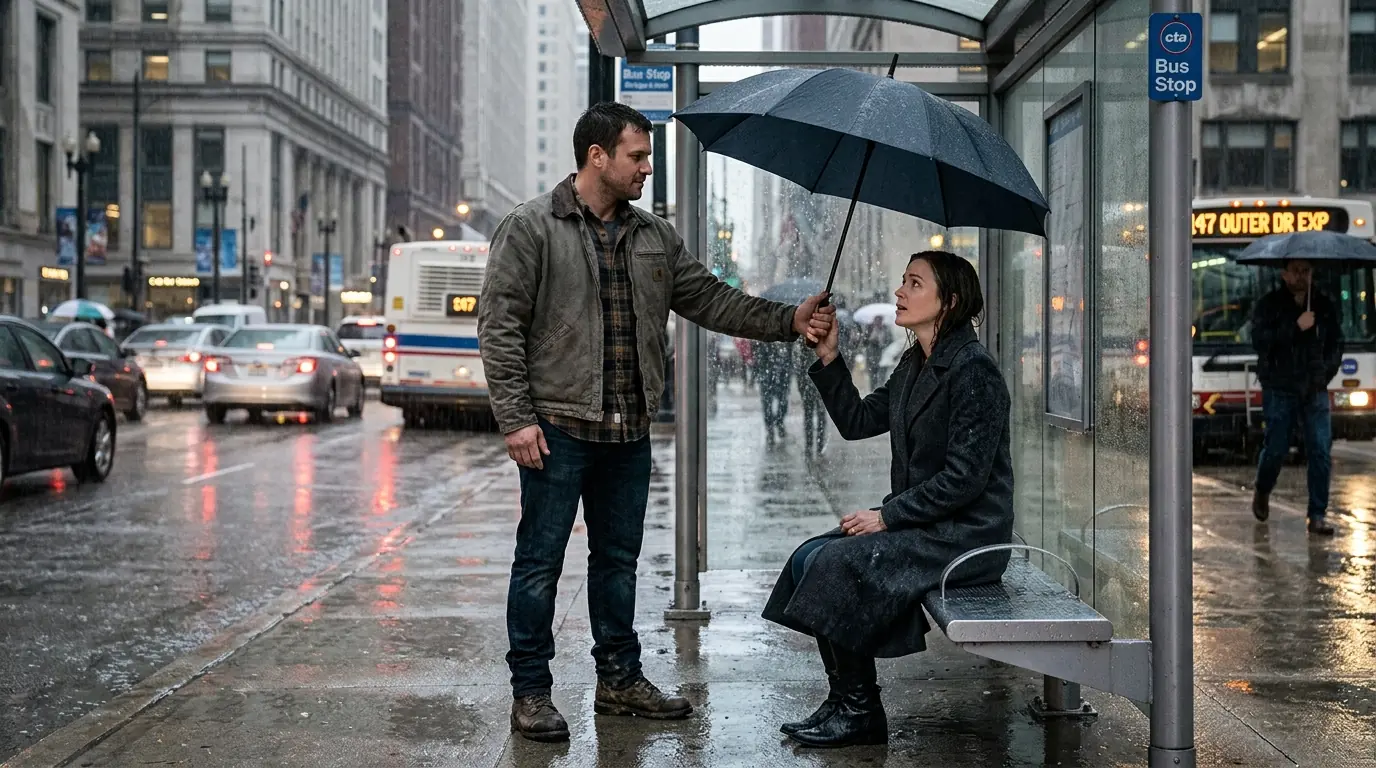
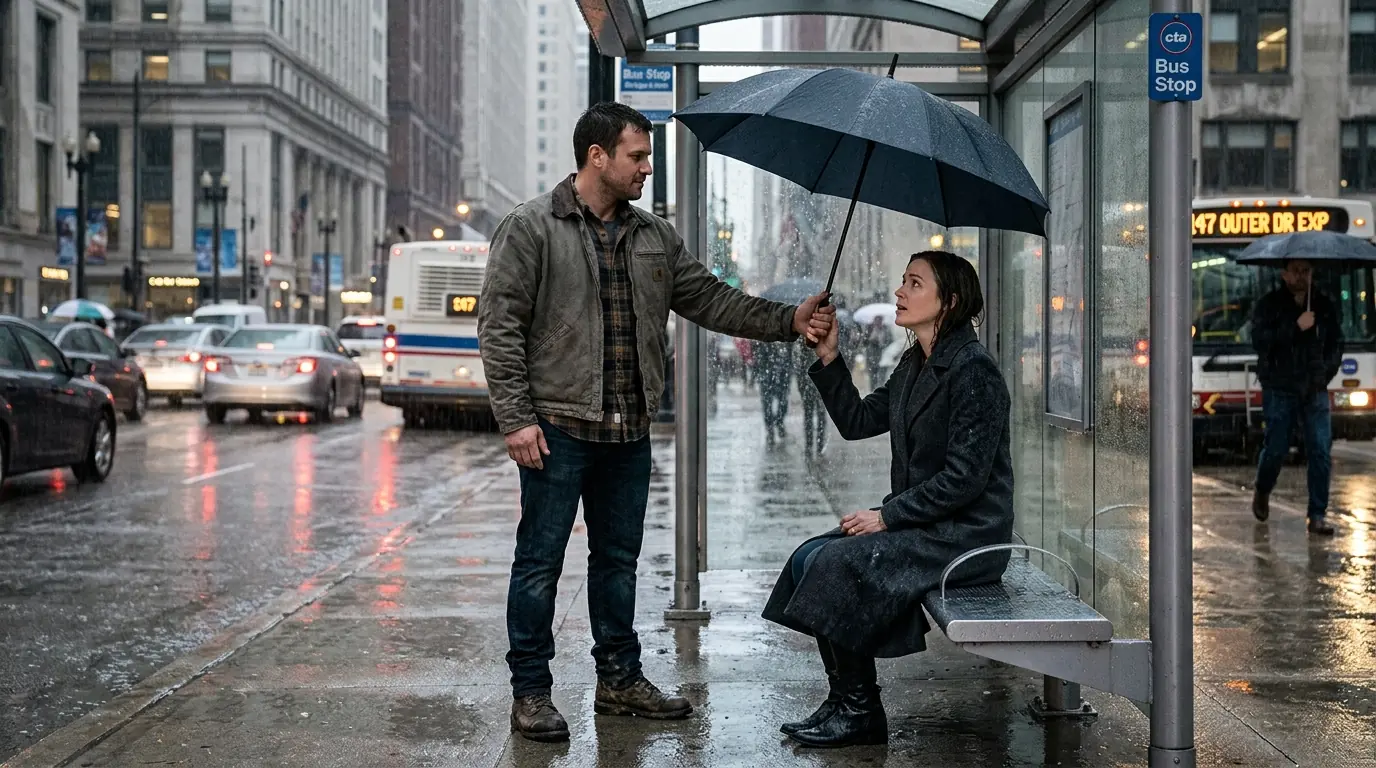
The bus stop was three blocks from the Whitmore Tower, a concrete shelter with a cracked plastic roof that did almost nothing against the November rain. Wyatt had exactly $4.70 in his wallet, enough for two bus fares and a small snack from the corner store if he timed it right.
He stood at the edge of the shelter, letting Sophia have the dry center, and checked his phone out of habit, even though there was nothing to check. That was when he noticed the woman at the far end of the bench.
She was sitting very still, one hand pressed flat against her knee, crying not loudly, not dramatically, but the way people cry when they have been holding it in for a long time and simply have no more holding left.
Nobody was paying attention. Two men in hard hats walked past without turning. A teenager glanced over and looked away. One woman stopped for half a second, decided this was not her business, and kept moving.
Wyatt watched for a moment. He recognized something in the way she was sitting, that particular stillness of a person who has stopped expecting anything to come.
He opened his umbrella and walked to the end of the bench. He held it out to her without a word.
She looked up, startled, and he saw that her mascara had run, and she had made no move to wipe it, which told him she was past caring what she looked like to strangers.
“I’m not going anywhere for a few minutes,” he said simply. “You might as well use it.”
She stared at the umbrella for a long moment, as if she was looking for the trick in it. Then she took it.
Sophia had already pulled a small travel pack of tissues from the front pocket of her school bag. She kept them there because her father sometimes got sawdust in his eyes at work, and she held it out toward the woman with both hands, the way children offer things, completely without calculation.
The woman looked at Sophia, and something shifted in her face. She took the tissues and whispered, “Thank you,” in a voice that barely made it out.
Wyatt sat down on the bench, leaving a respectful distance. He did not ask what was wrong. He did not introduce himself. He looked out at the street and said, “Bad days always feel longer than they are.”
The woman wiped her face slowly.
“I don’t usually,” she started, then stopped. “I just needed to sit somewhere that wasn’t my office.”
“Makes sense,” Wyatt said.
She was quiet for a moment. Sophia had gone back to reading, which was exactly the right thing to do.
“What do you do?” the woman asked. “When everything you’ve spent years building is about to fall apart and there’s nothing you can do to stop it?”
Wyatt thought about it the way he always thought about real questions, not quickly, but honestly.
“You figure out which part of it actually matters,” he said. “Then you go save that part first. The rest you deal with after.”
She turned and looked at him fully for the first time. Her eyes were dark and red from crying. They were sharp, the kind of eyes that were used to reading rooms and reading people.
“You make it sound simple,” she said.
“It’s not,” he said. “But complicated problems usually have one real root. You find the root. You start there.”
She let out a breath that was almost a laugh, tired, but genuine.
“You sound like you’ve done this before.”
“A few times.”
They sat in silence for a while after that, the rain coming down steadily, Sophia turning a page, the city moving past the shelter the way cities do, indifferent and endless.
When the bus arrived, Wyatt stood and collected Sophia. The woman was still seated, the umbrella over her, and she looked up at him.
“Thank you,” she said, “for treating me like an ordinary person.”
Wyatt picked up his toolbox.
“You looked like you needed that more than anything else.”
He and Sophia stepped onto the bus. The doors closed. The bus pulled away into the gray afternoon.
Behind them, at the curb, a black Mercedes pulled up fast. A driver in a dark jacket jumped out and jogged to the shelter, his voice urgent.
“Miss Whitmore, the board has been trying to reach you for the last two hours.”
The woman stood slowly, straightening her coat. Her name was Grace Whitmore. She was thirty-eight years old. She was the founder and chief executive officer of Whitmore Logistics Group, the same company whose lobby Wyatt Bennett had walked out of, rejected, less than an hour before.
Grace Whitmore did not cry often. She had not built a nine-figure logistics company from a rented office and a second-hand server rack by being the kind of person who cried. She had grown up in a family that considered emotional restraint a form of respect. She had survived a hostile merger attempt at thirty-one, a class action lawsuit at thirty-four, and a board restructuring at thirty-five that nearly cost her the company she had founded with her own savings.
She had gotten through all of it by being harder, and faster, and sharper than whoever was in the room with her.
She was not entirely sure what had happened at the bus stop. The Mercedes moved through downtown traffic, her driver silent behind the partition, and Grace sat in the back seat with a stranger’s cheap umbrella across her lap and thought about a man she did not know the name of.
He had not recognized her. She was almost certain of that. The way he had spoken to her, not carefully, not with that particular calibrated friendliness that people used around her, told her he had no idea who she was.
He had just sat down beside a woman who was having a bad day and treated it like the obvious thing to do.
When she reached the office, her assistant was already waiting at the elevator with a tablet full of damage reports. Grace took off her wet coat without looking and moved toward her desk.
And as she crossed the conference room threshold, she saw, on the corner of the low table near the door, a manila folder with a yellow rejection slip clipped to the front.
She almost walked past it. Then the name on the label caught her eye.
Wyatt Bennett.
She stopped. She picked up the folder.
Inside was a resume and a set of performance evaluations from three previous employers. The rejection note in Jason Cole’s handwriting said simply, “Not a cultural fit. Appearance and background inconsistent with company image.”
Grace read the evaluations slowly. Wyatt Bennett had managed a warehouse expansion during a supply chain crisis and reduced delivery failures by thirty-one percent. He had identified a data falsification scheme at a mid-sized freight company and documented it before the board had any idea it existed. He had been separated from that company not for poor performance, but because he refused to sign off on altered inventory reports.
Every supervisor who had written about him said the same thing in different words: “Hardest worker in the room. Fastest problem solver. Refuses to cut corners.”
She read the rejection note again.
“Not a cultural fit.”
Grace called Jason Cole into her office. He arrived smoothly, as he always did, composed, slightly too confident, his tie straight.
She asked him to walk her through the afternoon’s candidate decisions. He spoke at length about qualifications and team dynamics and brand alignment.
When she asked specifically about Wyatt Bennett, Jason’s eyes moved briefly to the folder and then back to her face.
“He had some gaps,” Jason said. “A history of friction at previous positions, not the kind of person who works well within established structures.”
“He reported data fraud at his last company,” Grace said. “That is not friction. That is integrity.”
Jason kept his expression pleasant.
“There are other candidates who meet the same technical criteria without the complications.”
She held his gaze for two seconds longer than was comfortable, then dismissed him.
She sat at her desk for a long time after that. Then she opened her laptop and pulled up the company’s internal operations logs.
What she found made her stop breathing for a moment.
Delivery routing anomalies going back eight months. Warehouse inventory adjustments that did not match physical audits. KPI numbers that had been cleaned before reaching her reporting dashboard.
The problems were subtle, the kind of thing that would not be visible without knowing exactly what to look for, but someone had clearly known what to look for. And someone had been very careful.
Grace Whitmore was not easily frightened, but sitting in her office that evening, with the rain still falling outside and the folder of a rejected stranger on her desk, she felt a cold and quiet clarity move through her.
Something was wrong inside her own company. And it had been wrong for a long time.
Wyatt’s apartment was on the third floor of a building on the North Side that had good bones and poor maintenance. The radiator clicked at night. The hallway light had been out for three weeks. And the super had a theory about the elevator that nobody fully understood.
Wyatt paid $640 a month for two bedrooms and considered himself fortunate.
The weekday routine was fixed and efficient. He was up at 5:45. By 6:15, Sophia had been through the bathroom and was eating the breakfast he had already made, usually eggs and toast, sometimes oatmeal with the good syrup she liked. He dropped her at school by 7:50. He was at his current job by 8:30.
Most evenings, he picked her up from the after-school program, made dinner, helped with homework, and got her to bed by 9:00. Then he either took his overnight shift at the regional warehouse on Kedzie or worked through the certification exam he had been slowly completing for the past six months.
He did not complain about any of this. He had made a decision four years ago at Claire’s funeral, standing outside in the cold because the church was too warm and he needed air, that he was going to be the kind of father she would have been proud of.
He kept that decision the way he kept his tools maintained, ready, not left where they could rust.
But there were things he could not fix with attention and routine. He noticed one Saturday morning that the sole of Sophia’s left sneaker had separated at the toe. She had said nothing. He found it when she set them by the door after coming in from the rain, and he could tell from the neat way she placed them that she had been trying to keep him from seeing it for days.
He sat at the kitchen table that night with the shoe and a tube of adhesive and repaired it properly. And when she came out in her pajamas to see what he was doing, she said, “You don’t have to do that.”
“I know,” he said.
She watched him work for a minute, then went back to bed.
At school, the other kids noticed things. Sophia had told him once, without self-pity, just as fact, that a boy in her class had asked why her dad always wore the same jacket. She had told the boy it was because it was a good jacket.
Wyatt had heard this from the other room and held very still. And when she came back, he had asked if it bothered her. And she had looked at him as though the question were strange.
“Why would it bother me?” she said.
He did not have an answer for that.
At the warehouse, the men on his shift trusted him the way workers trust people who know what they are doing and do not make it about themselves. He could look at a loading pattern and tell you in four minutes why it was creating downstream delays. He could hear a conveyor and know from the pitch whether the belt was about to slip.
The floor supervisor had asked him twice if he wanted to move up to lead. He had declined both times because the lead position paid the same with more headaches, and he was already carrying enough.
The email arrived on a Tuesday evening just after 10:00. It was from the recruitment system at Whitmore Logistics Group, automated and bloodless.
Thank you for your interest in the operations manager position. After careful review, we regret to inform you that we will not be moving forward with your application at this time.
Wyatt read it once, then deleted it. He closed the laptop and sat in the quiet kitchen. The radiator clicked. From the hallway, no light came under Sophia’s door.
Then she appeared in the doorway in her socks, half awake.
“Was that them?” she asked.
“Go to sleep,” he said.
“They were wrong,” she said, with the complete certainty of a seven-year-old who had decided this was fact and would not be revisiting it.
“Maybe,” he said. “Go to sleep.”
She went. He sat a little longer in the quiet, then turned off the light.
Grace had not become a CEO by ignoring her instincts. She had built Whitmore Logistics Group from the ground up over eleven years, starting with three trucks, one dispatch coordinator, and a business plan written on graph paper.
She knew what a healthy operation looked like from the inside out, and she knew what sickness looked like, too. The particular texture of a system that is functioning on the surface while quietly failing below it.
What she found in the internal logs over the following two days went beyond an anomaly. It was a pattern, and patterns told stories.
Delivery routes had been altered in ways that added mileage without adding value. The additions were small, fifteen to twenty minutes per run, but across hundreds of daily routes, they generated billing overages absorbed into the fuel and labor accounts and then quietly redirected.
Warehouse receiving logs had been adjusted to record quantities that did not match the physical counts she pulled herself walking the floor at 6:00 in the morning before the day shift arrived. The delta between what was logged and what was physically present amounted to several million dollars over eight months, possibly more.
The KPI dashboard she reviewed every Monday had been filtered. Someone with administrator access had been shaving numbers before they reached her view.
The manipulation was sophisticated, but not invisible. Not to someone who had run the full operation herself for the first five years and knew every data point by its source.
Someone had been very careful, but careful was not perfect.
The name that kept appearing in the access logs, the route modification timestamps, and the administrator override records was Jason Cole.
Grace sat with this for twenty-four hours before moving on it. Not because she doubted the data, but because she understood that moving prematurely without airtight documentation would allow Jason to claim error, to build a competing narrative before she could build her case.
She needed the full picture. And as she assembled that picture, one detail kept surfacing.
In Wyatt Bennett’s resume, which she had now read three times, there was a paragraph about his previous employer, a mid-sized freight company out of Indianapolis. He had identified a data falsification scheme. He had documented it carefully. He had been pushed out for refusing to stay quiet.
The pattern he had caught there was nearly identical to what she was looking at now.
She called his number on a Wednesday morning. No answer. She tried again in the afternoon. Nothing.
On Thursday, she asked her assistant for the residential address on file from his application. The neighborhood surprised her, though she recognized it should not have. The street was quiet and working class. The building solid and slightly worn.
She pressed the button for unit 314 and waited. When the door at the top of the stairs opened and Wyatt appeared in a T-shirt and work jeans, grease on his forearms, he looked at her with the careful neutrality of a man identifying someone out of context.
“Ms. Whitmore,” he said.
“You recognize me,” she said.
“I looked you up after the interview. Seemed like the right thing to do.”
Grace looked past him into the hallway. At the far end, under a wall light burning at half strength, a small girl sat on the floor beside a bicycle, watching with the quiet attention of a child who had learned not to interrupt adult conversations.
Something moved through Grace’s chest that she did not immediately name.
“I’d like your opinion on something,” she said to Wyatt, “about the company’s operations. I believe there is a serious problem inside the system.”
He looked at her for a long moment, deciding.
“Why come to me?” he said.
“Because you’ve seen this before,” she said. “And because whoever is running this problem inside my company is very good at making it look like nothing. I need someone who won’t be fooled by clean surfaces.”
“I wasn’t hired,” he said.
“I know,” she said. “I’m asking anyway.”
He was quiet for a moment.
“No,” he said. “I appreciate you coming, but I won’t go back to a place that made clear I wasn’t wanted. That’s not pride. It’s just not a position I’m willing to take.”
Grace nodded. She had anticipated this, and she respected it.
She left her card on the stair rail on her way out, because she believed in leaving doors open, and because what she had seen in that hallway, a man repairing a child’s bicycle under a dim light at the end of a long day, told her that some people were worth asking twice.
The crisis arrived the way crises always do, not suddenly, but all at once.
On a Monday morning in early December, the Whitmore Regional Distribution Center in Joliet went dark. The routing system, the inventory sync, and the outbound manifest interface failed simultaneously in a cascading sequence that the IT team spent most of the morning chasing through error logs without resolution.
By noon, over four thousand shipments were stalled. Retailers were calling. Medical supply contracts, the most time-sensitive and publicly visible part of the company’s portfolio, were at risk.
The regional director, Marcus Webb, had been on the phone with Grace since 8:00 that morning and was running out of phrases, for he did not know what had happened.
The board convened an emergency call at 2:00 in the afternoon. Grace sat at the head of the conference table and listened to twelve men in expensive chairs discuss what they called a governance failure.
Several members spoke about the need for executive accountability. One used the phrase “confidence in current leadership” in a way that was not meant as a compliment.
Grace kept her face still and her voice level and let them finish.
What she did not tell them was what she already knew. This was not a system failure. This was a deliberate act.
The cascading shutdown had been triggered by a sequence of commands entered through an administrator account the previous Sunday evening. The account belonged to Jason Cole. His badge scan showed him in the building until 10:45 that night.
What she needed was someone who could walk into the broken system and prove not just the entry point, but the full architecture of what had been built and how it had been hidden. Someone who had done exactly this before.
She drove to the warehouse on Kedzie at 9:00 that evening. She found Wyatt in the receiving bay working the tail end of a shift.
He saw her before she reached him and set down his clipboard and walked toward her with an expression that was somewhere between tired and unsurprised.
She told him everything. Not the edited version she had given the board, the whole thing. The data manipulation, the rerouting scheme, the phantom inventory, the Sunday shutdown, Jason Cole’s access logs. She told him how long it had been running and how much she estimated had been taken.
He listened without interrupting. When she finished, he said, “Why didn’t you see it earlier?”
It was a fair question, and it landed with the weight of one.
“Because the reports I was receiving had already been cleaned,” she said. “And because I trusted the wrong person to manage the systems I built.”
Wyatt nodded slowly.
From behind Grace came a small voice. She turned. Sophia was sitting on a metal bench near the bay door, bundled in her coat, a book open on her lap. Wyatt had brought her to the overnight shift because the sitter had canceled.
She looked up at Grace with her father’s same direct, unhurried way of taking in a person.
“She’s really scared,” Sophia said to her father.
Not unkindly. Just as information.
Wyatt looked at his daughter for a moment, then back at Grace. He took a slow breath.
“I’ll look at it,” he said. “Just the system. I’m not taking a position. I’m not signing anything. I look at it, I tell you what I find, and I walk away.”
“That’s enough,” Grace said.
“And I’m not doing it in the building while Jason Cole still has access to it.”
“That can be arranged.”
He finished noting the inventory batch he had been working on because he was the kind of man who completed what he started before he started something new. Then he gathered his daughter and walked with Grace out into the December cold.
The next morning, Wyatt Bennett walked into the offices of Whitmore Logistics Group for the second time. The same security desk, the same gleaming lobby. He was wearing the same jacket.
Two analysts near the elevator recognized him from the application process. One leaned toward the other and said something quiet. Wyatt kept walking.
“Who is he?” someone asked. Not quietly enough.
Grace did not answer. She kept walking.
Wyatt did not ask for a conference room. He did not ask for a presentation deck or a briefing from the IT director. He asked for a pass to the warehouse floor, a login to the route management system, and half an hour to walk around without anyone following him.
Grace gave him all three.
He started in the receiving dock at the Joliet distribution center. He moved slowly, the way he always moved through a new operation, watching, listening, talking to the people who were actually there.
He crouched beside a pallet scanner and spoke to the woman operating it for six minutes. He stood at the outbound sorting line and watched the flow without saying anything. He found the shift supervisor in the break room and asked him, casually, how long the rerouting delays had been happening.
“Eight, nine months, maybe,” the supervisor said. “We flagged it to management. We were told it was a software optimization.”
Wyatt nodded and said nothing else.
He spent forty minutes in the route management system, pulling data that had not been cleaned, the raw feeds, not the filtered views. He pulled dispatch logs and cross-referenced vehicle IDs against fuel consumption records. He looked at a class of deliveries marked completed that showed GPS trails inconsistently short for the mileage billed.
Then he pulled the records of a fleet of vans that appeared in the routing system but had no corresponding maintenance logs, no insurance filings, and no physical presence in any of the company’s facility parking records.
They were ghost vehicles. They existed only as billing entries.
Each ghost van was assigned daily routes. Each route generated a cost-per-mile reimbursement. The reimbursements moved through a third-party logistics vendor called Prism Courier Solutions, contracted through an approval process Grace had signed off on eighteen months ago without reason to question it.
Prism Courier Solutions was a shell. Its registered address was a mailbox in a suburb of Indianapolis. The controlling LLC, traced through two intermediate entities, was a holding company with Jason Cole’s personal attorney listed as registered agent.
Wyatt took a single legal pad from the supply cart and wrote down twelve line items in a dense, precise column. Then he went to find Grace.
She was waiting in her office with Marcus Webb and two people from finance. He set the legal pad on the table and talked through it for nine minutes.
Nobody interrupted.
Ghost fleet. Shell vendor. Eight months of fraudulent billing. Cross-referenced against the inventory shortfalls and route overages, the conservative estimate was forty-three million dollars. The aggressive estimate was higher.
“He was positioning for a takeover,” Wyatt said without heat, just as fact. “The operational failures were staged. When the system collapsed publicly, he would have proposed a restructuring that placed him in control of the replacement infrastructure. He already had the vendor relationships. He already had the architecture in place. He was going to offer to fix exactly what he broke.”
Grace sat very still.
“You did this in three hours,” Marcus Webb said. Not accusatory, but with the tone of a man in the presence of something he had no category for.
“I’ve seen it before,” Wyatt said. “Different company, smaller scale, same structure.”
Jason Cole was in the building when Grace’s assistant knocked on his meeting room door and asked him to come to the executive suite. He arrived with the practiced composure of a man who expected to control whatever came next.
He was not in control of what came next.
Grace laid the evidence in front of him in the order Wyatt had presented it. She did not raise her voice. She walked through twelve items on a legal pad, each one with a specific date, a specific access log, a specific dollar figure.
When she placed the registered agent documentation for the holding company on the table, a very particular stillness crossed Jason’s face.
He said he wanted to speak to legal counsel.
“That’s your right,” Grace said. “Security is outside the door.”
Jason looked at Wyatt. Really looked at him, and something moved across his face. It might have been the recognition of a specific cruelty, that the man he had dismissed as not fitting the culture had been the one to find the threat he had spent eight months concealing.
He left the room without another word.
The board meeting that afternoon was unusual from the start. Jason Cole’s allies arrived with a prepared position. Wyatt Bennett was not a company employee. His findings were unofficial. He had a documented history of conflict with former employers. The appropriate conclusion would come through appropriate channels.
Several independent board members listened to this without expression, and then asked to see the documentation.
Wyatt had not printed anything from the company’s systems, but the night before he had pulled the original routing logs from a third-party compliance archive that Whitmore used for regulatory backup, a system Jason had apparently not known about or had not believed would be used this way.
He had unfiltered data, time-stamped and provably unaltered.
Marcus Webb had also pulled camera footage from two warehouse facilities showing physical inventory moved to outbound bays corresponding to no logged shipment.
And there was the email thread, thirty-one messages between Jason Cole’s personal account and the contact address for Prism Courier Solutions going back sixteen months, discussing billing structure adjustments, route padding parameters, and a timeline for what one message called the operational transition.
Wyatt laid everything on the conference table. In sequence. Without drama.
He did not raise his voice. He did not name motives or predict outcomes. He simply presented the mechanism in the order it had occurred and let the board members read what they were reading.
By the forty-minute mark, four of the six independent board members had stopped taking notes and were staring at the table.
Jason’s primary ally on the board, a member named Graham, who had brought Jason into the company in the first place, sat through the full presentation without speaking. When it was done, he said one sentence.
“I’ll be recusing myself from the vote.”
The vote was to authorize an independent forensic audit and place Jason Cole on administrative suspension pending investigation. It passed without dissent.
As the board members filed out in the particular silence of people processing something they did not know how to categorize, one of the newer members stopped and looked at Wyatt.
“Are you on staff here?” he asked.
“No,” Wyatt said.
The man nodded slowly, as if this explained something while raising several other questions, and then he left.
Grace crossed the room and stood beside Wyatt.
“I owe you an apology,” she said. “On behalf of this company, what happened to you in that interview room was wrong.”
“Jason managed the process,” Wyatt said.
“I know,” she said. “I still signed off on the structure that let him. That’s mine.”
He accepted this the way he accepted most things, without exaggeration in either direction.
“What are you going to do now?” she asked.
“Go pick up my daughter,” he said. “She has a book report due Friday.”
He picked up his coat. He had left his legal pad on the table. The twelve items were still visible in the small, precise handwriting of a man who had learned to make limited space work.
As he reached the door, a young analyst who had made the quiet remark that morning looked up and then away with a slightly different expression of someone who now understood they had made a mistake.
Wyatt kept walking.
The weeks that followed were not dramatic. That was the thing about real change in real companies. It happened in meetings and revised processes and quiet decisions that most people would never witness, but it happened.
Grace was a different presence in the building after that December. Not softer. Exactly the edge that had brought her this far did not disappear, but the defensive layer, the watchfulness she carried into every room with every person, had begun to loosen.
She started holding floor meetings instead of only executive briefings. She walked the operations areas twice a week herself. She had a long private conversation with Marcus Webb about what he had flagged eight months ago and why it had never reached her, and what they were going to build differently so it would.
On a Thursday afternoon in late December, she brought lunch to a small apartment on the North Side.
Sophia answered the door. She looked at Grace, looked at the bag in her hand, and said, “Dad, someone’s here,” in the tone of a child who already knew exactly who it was.
They ate at the kitchen table, Wyatt, Sophia, and Grace, and talked about nothing important. Sophia explained at considerable length the plot of the book she was writing a report on. Grace listened as though it were the most natural conversation she had had in months, which, she realized somewhere in the middle of it, it was.
After Sophia had been excused to do homework, Grace sat with Wyatt over cooling coffee and said what she had not yet said directly.
“I grew up being told that the best thing you can do for yourself is never need anything from anyone,” she said. “I built a company out of that belief. It worked, mostly, until I realized I had surrounded myself with people who were exactly the same, and none of us could tell when something was wrong because none of us would admit we needed help seeing it.”
Wyatt listened. He did not offer reassurance because she was not asking for it. He asked one question.
“Do you still believe that?”
Grace considered it honestly.
“Not entirely,” she said. “Not anymore.”
They sat in the quiet for a while.
“At the bus stop,” Grace said eventually, “did you know who I was?”
“No,” Wyatt said.
“I believe you,” she said. “That’s the thing. I believe you, and I’ve spent eleven years not being able to say that about many people.”
Wyatt was quiet in the way some people are quiet, not because they have nothing to say, but because they understand a moment does not always need filling.
From the hallway came the sound of Sophia’s pencil moving against paper. The radiator clicked.
“I told Sophia once that her mother was the kind of person who always knew what mattered,” Wyatt said. “That I try to be that kind of person for Sophia because it’s the best way I know to keep her close.”
Grace looked at him.
“She would have liked you,” he said quietly. “You figured out what mattered.”
It was a simple sentence, and it cost him something to say it. And it landed with the weight of something true.
Later, when Sophia came back for a glass of water, she leaned against the counter and studied Grace with the assessing calm of a child who had already formed a verdict.
“You’re different from how Dad described you,” Sophia said.
Grace raised an eyebrow.
“He described me?”
“He said you were sad,” Sophia said. “But you don’t look as sad anymore.”
Grace laughed. Not a polished laugh. A real one, sudden and unguarded. The kind she had not produced in longer than she could clearly recall.
Wyatt looked at his daughter with the particular expression of a parent pretending to be exasperated and failing at it completely.
Spring came the way it always comes to Chicago, tentatively, then all at once. February was still brutal. March was ambiguous, but by April, something had shifted in the light, and the trees along the side streets were doing the thing they do every year that never gets ordinary. The slow green opening that happens between one morning and the next, reliable and completely impossible every single time.
By April, Whitmore Logistics Group had completed its forensic audit. The findings were extensive. Jason Cole had been removed and referred for criminal prosecution. The fraudulent vendor contracts had been unwound. The ghost fleet billing had been fully traced and documented. The final figure was just over fifty-one million dollars.
Grace had presented the full audit results to the board and the company’s major investors personally, without softening. She described not only what had happened, but how it had been allowed to happen, the gaps in oversight, the deference to a single point of operational control, the interview process that had filtered out the one person in their pipeline who might have caught it earlier.
She proposed, and the board approved, a complete restructuring of the operations oversight function.
The head of that restructured function had been offered to Wyatt Bennett.
He declined.
This surprised everyone except Grace, who had half expected it. He told her, clearly and without apology, that the role she was describing would require sixty-hour weeks and regular evening availability that he was not in a position to give.
He had a seven-year-old. He had book reports to help with on Fridays. He had a daughter who had spent four years watching her father hold things together, and he was not going to hold a company together at the cost of her knowing what he looked like in the morning.
Grace listened and then proposed instead a consulting arrangement, defined hours, project-based, rate at his discretion. Work he could do without the overhead of internal politics.
He thought about it for two days and then said yes.
The company began to recover. Not only financially, though financially it recovered. The culture began to change in the slower, less measurable way that cultures change when the person at the top changes how they move through a room.
Grace started asking different questions in every setting. She started listening for what people were not saying. She revised the hiring criteria herself, removing the filters that had been added for image over ability, replacing them with assessments built around demonstrated judgment and practical problem-solving.
The day those new criteria went into effect, she thought about Wyatt’s jacket. The manila folder. Not a cultural fit.
She kept the umbrella. She had not meant to, initially. It had ended up in the back seat of her car the night of the bus stop, and she had kept meaning to return it. And then she had not returned it. And eventually, she understood she was not going to.
It stood in the corner of her office behind the door, a second-hand blue umbrella with a slightly bent spoke, and she was aware that it was exactly the kind of object a person keeps when they are not quite ready to put a name to what it means.
On a Wednesday morning in April, Wyatt and Sophia were at their usual bus stop waiting for the Crosstown route. Sophia had a new backpack, small and red, bought on sale, and she was explaining something about magnets to Wyatt that she had learned the day before and considered urgently important.
A car pulled up to the curb. Grace got out. She was in a lighter coat. The heavy winter one was gone. She looked, Sophia thought, like someone who had recently decided to stop being quite so careful about everything. And it suited her.
Sophia grinned.
“You’re not crying this time,” she said.
Grace looked down at her.
“No,” she said. “I’m not.”
She looked at Wyatt, and he looked at her, and the language they had built over months of honesty, quiet, economical, and real, passed between them in half a second.
The three of them walked down the block together, and the morning light on the city was the particular gold that comes after a long Chicago winter, and the trees were doing their annual impossible thing, and it was enough. It was, in fact, exactly enough.
There is a kind of person who, when they find someone broken down at the side of the road, simply stops. Not because they expect anything back. Not because anyone is watching, but because that is simply who they are.
Wyatt Bennett was that kind of person. He had been that kind of person on the worst professional day of his adult life, carrying a toolbox and his daughter, and a rejection that should have broken him, and he had sat down beside a stranger at a bus stop in the rain and offered what little he had.
The world does not always reward that. But sometimes, not always, and not automatically, but sometimes, the stranger at the bus stop turns out to be the one person who can give back more than was ever given. Not because the universe keeps a ledger, but because kindness, when it is genuine, has a way of finding the people who know exactly what to do with it.