She was still wearing the dress when they found her.
White silk soaked through at the hem, a veil tangled in the wind, sitting alone in a wheelchair in the middle of a park that everyone else had abandoned to the cold.
She was not crying.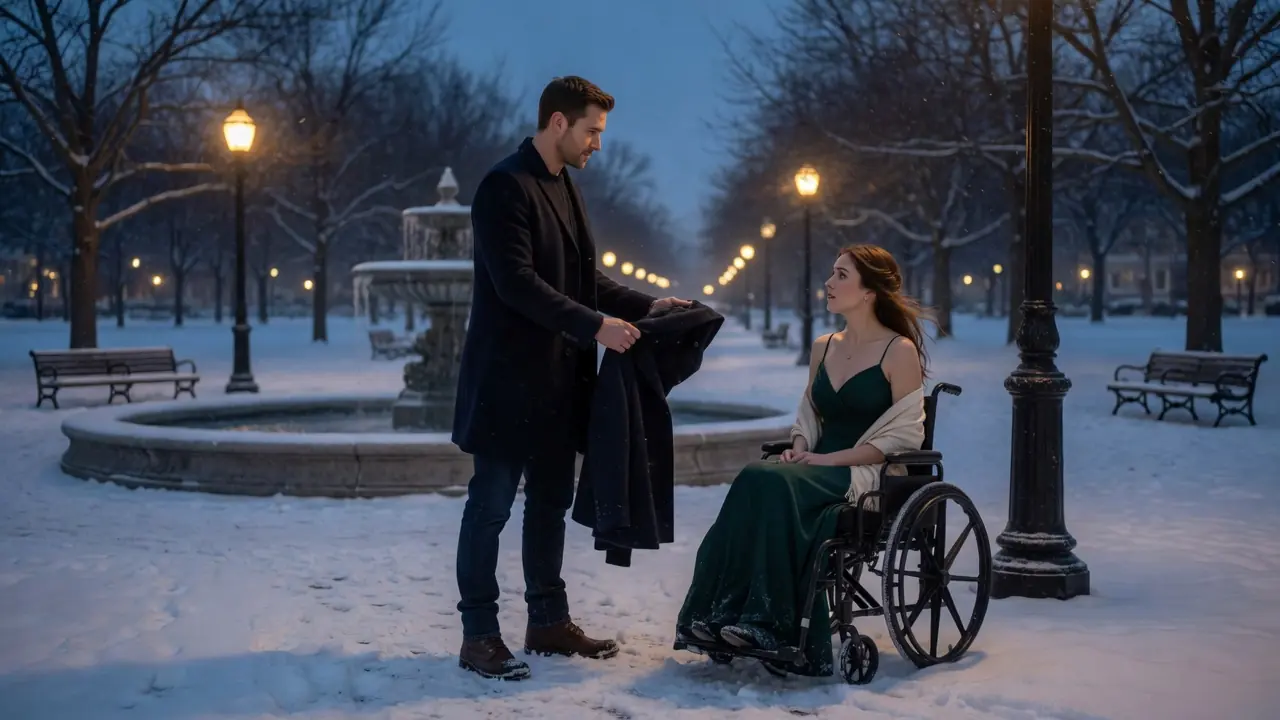
That was the thing that stopped Nolan Pierce in his tracks.
She was not crying at all. She just sat there looking at nothing, like a woman who had already used up every tear she had left and was now simply waiting for the world to decide what came next.
His daughter, Emma, tugged his sleeve and said, “Daddy, she forgot to go inside.”
The park had no business being beautiful in weather like that.
It was the kind of cold that did not announce itself. It just arrived, settled into your collar and your cuffs and the space between your shoulder blades, and stayed there until you stopped fighting it.
The snow had been falling since mid-afternoon, soft and indifferent, covering the benches, the walking paths, and the iron lamppost at the center of the park in a thin white sheet that muffled everything.
Sounds.
Footsteps.
Voices.
The whole neighborhood felt like it had been wrapped in gauze.
Nolan Pierce had not planned to cut through Callaway Park that evening. He had planned to take the long way home, the one that ran along Birch Street, because Emma liked to look at the string lights in the cafe windows, and he liked the extra four minutes it gave him to decompress before dinner.
It had been a long Thursday.
It had been a long year, really, though he had stopped keeping count somewhere around month nine. And the idea of four extra minutes with nothing to do but watch his daughter press her nose against bakery glass and name the pastries felt like something close to luxury.
But Emma had spotted a cat near the park entrance, and that had been the end of the Birch Street plan.
She was seven years old, and she had strong opinions about cats. Once she made up her mind to follow one, Nolan had learned there was very little point in arguing.
So he followed her through the iron gate, past the empty fountain, down the main path that curved through the center of the park toward the far exit.
And that was when he saw her.
He almost did not register it at first. His brain sorted the image into the wrong category.
Park bench.
Snow.
Shape.
Then something deeper and more instinctual caught up and told him to stop walking.
She was sitting in a wheelchair at the far end of the path, maybe sixty feet ahead, positioned slightly off center beneath the lamppost.
The chair was a sleek, modern one, the kind that did not look medical so much as deliberate. Matte black frame. Precision wheels.
It sat at a mild angle on the path, as if someone had rolled it to that exact spot and then walked away.
She was not moving.
She had a white blanket across her lap, though whether it was an actual blanket or just the fall of the dress, Nolan could not tell at first.
The veil had mostly come loose from wherever it had been pinned and was drifting in a slow, ghostly arc behind her left shoulder.
He stopped walking.
Emma, three feet ahead of him, also stopped. She had lost the cat.
She looked back at him, then forward again, then tugged her wool hat down over her ears the way she did when she was thinking hard about something.
“Daddy,” she said, “I see her. She’s wearing a wedding dress.”
“Yeah,” he exhaled slowly. “She is.”
Emma looked up at him with that particular expression she had developed over the last year, the one that was too old for her face, too steady, the one that showed up when she was deciding whether or not the adults around her were going to handle a situation correctly.
She had been doing it since her mother died.
Nolan had not figured out yet if it broke his heart or made him proud.
“Is she okay?” Emma asked.
He looked at the woman in the wheelchair.
The snow was gathering on the armrests. It had started to collect on the shoulders of the dress. She had not moved.
“I don’t know,” he said. “Let’s go find out.”
He approached slowly and at an angle, keeping himself visible, not wanting to startle her.
Up close, the dress was extraordinary, or it had been once. Fitted silk bodice, long sleeves with tiny buttons at the wrists, a full skirt that pulled around the footrests of the chair in elaborate folds.
It was the kind of dress that cost more than his truck.
The hem was dark with wet and cold and whatever the park path was made of under the snow.
The veil was ivory, not white, and it had a delicate scalloped edge that was now frayed on one side.
She was staring at the fountain, the empty one, the one the city drained every November, with an expression that was not quite blank and not quite grief.
It was something in between.
Suspended.
Like she was watching something happening in a place only she could see.
She was younger than he had expected. Maybe late twenties, early thirties.
Dark hair piled up in an arrangement that had mostly come undone, pins scattered, a few loose strands crossing her face. She was pale, though that might have been the cold.
She had the kind of face that was striking without being immediately readable. Strong jaw. High cheekbones. Dark eyes that were currently aimed at a distance of approximately fifteen feet and a thousand miles.
She heard him coming.
He could tell because her jaw tightened almost imperceptibly, and her right hand adjusted its grip on the wheel’s push rim.
Not fear exactly.
More like bracing.
“Hey,” Nolan said.
He stopped about eight feet away, close enough to be heard without crowding her.
“Sorry to interrupt whatever’s happening. I just… we noticed you from the path and wanted to make sure you were all right.”
She turned her head.
Her eyes moved from him to Emma, who was standing half behind his left side and peering around his arm with open, uncomplicated curiosity.
“I’m fine,” the woman said.
Her voice was even, controlled, the kind of voice that was used to giving that answer quickly and without elaboration.
“Okay,” Nolan said.
He did not move.
She looked at him for a moment, something shifting slightly in her expression.
“You don’t believe me.”
“You’ve got snow on your shoulders,” he said. “And I don’t think that fountain’s been running since October.”
She glanced down at herself, at the white dusting on the silk, with something that might have been the beginning of dark amusement.
“I didn’t notice,” she said.
“How long have you been out here?”
She thought about it.
Actually had to think about it.
“I’m not sure.”
Emma chose that moment to duck under Nolan’s arm and step forward. He caught her shoulder out of instinct, but she was already speaking.
“Your dress is really pretty,” Emma said with complete sincerity. “Even with the snow on it.”
Something happened in the woman’s face.
It was not a smile, not quite, but it was the motion a smile makes before it decides whether to actually arrive.
She looked at Emma with a focus that was different from the way she had looked at Nolan.
Less guarded.
Less managed.
“Thank you,” she said.
“I’m Emma. I’m seven. This is my dad.”
“I know you’re his daughter,” the woman said. “You have the same eyes.”
Emma considered this.
“His or sadder?”
Nolan closed his eyes briefly.
Emma had no malicious instinct in her body. She simply said what she saw. It had been three years of that, and he still did not always know how to prepare for it.
When he opened his eyes, the woman in the wheelchair was looking at him with an expression that was, for the first time, genuinely curious.
“Nolan,” he said. “Nolan Pierce.”
“Celeste Vaughn.”
“Celeste,” he repeated, because she looked like she needed to hear her own name said by someone who was not judging it. “Can I ask what happened? You don’t have to answer. I just… it’s getting colder.”
She turned her face back toward the fountain.
“I was supposed to get married today,” she said with a flatness that was too deliberate to be real. “And then I didn’t.”
“Did something go wrong with—”
“I left,” she said. “I was about to walk down the aisle, and I left. I had my father wheel me to the car, and then I had the driver drop me here.”
A pause.
“I don’t entirely know why I chose here. I used to run in this park.”
She stopped and seemed to register what she had said.
Something closed down behind her eyes.
Before.
The silence that followed was not uncomfortable exactly.
It was heavy, full of things that were not going to be explained tonight.
Nolan took off his coat. It was dark wool, nothing special, but warm.
He held it out to her.
“You’ll freeze,” she said.
“I’ve got a sweater underneath, and she generates her own heat.” He tilted his head toward Emma.
Celeste looked at the coat, then at him.
He could see her running some internal calculation. Threat assessment probably. Or maybe just the exhausted decision of whether she had any resistance left.
She must have decided she did not, because she let him drape it over her shoulders.
She reached up and pulled it closed at the front, and for a moment, she just held it there, both hands gripping the lapels.
Something in her face changed in a way Nolan could not name but recognized.
It was the expression of someone who had not been taken care of in a long time and had forgotten what it felt like.
He knew it because he had seen it in mirrors for the better part of three years.
“You should go home,” she said. “Both of you. It’s cold.”
“We’re going to,” he said. “But you should come, too.”
She looked up sharply.
“Not—”
He caught himself and made sure his voice stayed easy.
“There’s a diner about four blocks from here. Morrow’s. They do good soup, and the heat actually works. I was going to take Emma for dinner. You’re welcome to join us.”
Emma confirmed this with a solemn nod.
“The tomato soup is very good,” she said. “But the grilled cheese is better.”
Celeste looked at Emma for a long moment, then back at Nolan.
He could see her deciding something, or trying to.
The lamppost above them flickered once in the wind. Snow fell between them in the thin, patient way it does when it is settling in for the night.
“I don’t have any money on me,” she said finally. “I left my bag at the venue.”
“I didn’t ask,” he said.
Morrow’s Diner was exactly the way Nolan had described it.
Warm to the point of being slightly too warm, with ancient red vinyl booths and the kind of lighting that made everyone look a little better than they probably did.
The hostess, a woman in her fifties named Deb, had worked the Thursday dinner shift for as long as Nolan had been coming there. She looked at Celeste’s wedding dress with exactly zero visible reaction and led them to the corner booth without a word.
Nolan watched Celeste maneuver the wheelchair up to the table, pushing back the extra chair without being asked.
The movement was practiced and automatic.
She had clearly been navigating spaces like this for years, the small recalibrations, the adjustments to angles and clearances that people in chairs learn by doing because the world largely does not think about it for them.
She did not ask for help.
Nolan did not offer any.
Emma, who had clearly decided that Celeste was the most interesting thing that had happened to her in months, planted her chin in her hands and watched Celeste examine the menu with the focused attention of a researcher.
“Do you know what you want?” Emma asked.
“Not yet. What do you recommend?”
Emma took this seriously.
She went through the relevant sections of the menu with the gravity of a sommelier, explaining the hierarchy of soups, why the grilled cheese was superior to the club sandwich, and her nuanced thoughts on the pie situation at Morrow’s.
Cherry was reliable.
Apple was inconsistent.
Never order the blueberry on a weeknight.
Celeste listened to all of this without interrupting, which Nolan noted. A lot of adults listened to Emma the way people listened to hold music, technically present, waiting for it to stop.
Celeste listened like she was actually interested in the cherry versus apple debate.
Or maybe she needed something uncomplicated to anchor herself to.
Either way, she listened.
“She talks a lot,” Nolan said when Emma excused herself to use the bathroom.
“She’s articulate,” Celeste said. “There’s a difference.”
He looked at her.
“You have kids?”
The question landed wrong.
He could see it in the way her hands stilled on the menu. Not anger. Something older than that.
She set the menu down and smoothed the silk over her lap, which was probably not conscious, but was a gesture that had grief in it.
“No,” she said. “Not anymore.”
Then, before he could follow that in any direction, she asked, “What happened to her mother?”
“Cancer,” he said. “Three and a half years ago. Emma was three.”
He let that settle.
“It was fast, which I guess is one of the things people say to make themselves feel better. That it was fast.”
“It isn’t better,” Celeste said.
“No,” he agreed. “It isn’t.”
Their food came.
Emma returned and applied herself to the grilled cheese with focused energy. Celeste ate the soup slowly, like someone remembering that eating was a thing she was supposed to do.
Nolan ate without tasting much and watched the snow hit the window. He thought about how strange it was, the way terrible things sometimes produced unexpected hours like this one.
A diner booth.
A little girl explaining pie.
A stranger in a wedding dress holding a spoon like it was the first solid thing she had touched all day.
By the time the check came, Emma had fallen asleep against his shoulder, and Celeste was holding a cup of coffee with both hands, looking out at the street with an expression that was still heavy but had lost some of its suspension.
She looked more present.
More tired, maybe.
That was different.
“Where were you going to go tonight?” he asked.
She turned away from the window.
“I have a hotel. My assistant handles things like that. She probably already made a reservation somewhere.”
“Okay,” he said. “Do you want to call her?”
Celeste looked at her hands.
She was still wearing the engagement ring. He had not noticed it before. Now he saw her look at it, too, with the detached air of someone who had forgotten a thing was there and then rediscovered it and was not sure how to feel.
“In a minute,” she said.
He nodded.
She did not call for another twenty minutes.
During that time, she and Nolan talked about very little. He told her about the neighborhood. She told him a carefully neutral story about a business trip to Portland.
Emma snored softly against his arm, and somehow the twenty minutes passed without either of them noticing how many there had been.
When she finally did call, her assistant answered on the first ring, and Nolan could hear the suppressed alarm in the woman’s voice even from across the table.
He could not make out the words, but he got the shape of the conversation.
The assistant had been coordinating a minor disaster on multiple fronts. There was no clear hotel reservation because Celeste had gone dark for three hours, and the options were limited because there was apparently a medical conference in town and half the decent hotels were full.
Celeste listened to all of it with the stillness of someone who ran a company and was used to receiving bad news without visible reaction.
She said a few quiet things.
Then she hung up.
“No hotel,” she said.
Her voice was even.
Her jaw was tighter.
“There’s a guest room,” Nolan said. “At my house. It’s not— It’s basic. Emma painted the walls in there last summer and chose a color she described as ocean blue, which is really more of a teal. But the bed’s good, and I have extra blankets.”
Celeste stared at him.
“You don’t know me.”
“I know you’ve been outside in a wedding dress for three hours and you don’t have anywhere to go,” he said. “And I know Emma would never forgive me if I left you to figure it out on your own.”
She opened her mouth, closed it, then looked at Emma, who was still asleep, one small hand curled under her chin.
“That’s an unfair argument,” Celeste said.
“Yes,” he said. “But it’s a true one.”
The house on Mercer Lane was a 1940s craftsman that Nolan had bought with his wife, Karen, six years ago, when they were convinced that two people, and eventually a family, needed more space than their apartment could offer.
They had been right about that.
They had been less right about how much work an old house needed.
The gutters.
The porch steps.
The perpetually cold second bathroom.
But in the years since Karen died, Nolan had found something like purpose in the slow, ongoing maintenance of it.
It gave his Saturdays structure. It gave him something to fix when he could not fix the things that actually needed fixing.
He got Emma inside first, asleep and boneless, and put her to bed with her shoes still on because she was out completely, and he had learned not to fight that battle after nine at night.
Then he came back downstairs to help Celeste navigate the porch ramp he had built two years ago for his elderly neighbor, who had since moved to assisted living, but whose ramp now turned out to have another purpose.
She noticed the ramp.
He could tell by the slight pause at the bottom of the porch steps, the brief recalibration.
“My neighbor,” he said. “He doesn’t need it anymore. Lucky coincidence.”
Celeste said nothing.
She rolled herself up the ramp and waited while he unlocked the door.
Inside, she stopped in the small entryway and looked at the house the way people look at houses that are lived in.
Not decorated.
Not staged.
Actually occupied.
There were Emma’s drawings pinned to the wall above the radiator. A pair of work boots by the door and small sneakers beside them. A library book on the hall table, three days overdue. A coffee mug that had not made it back to the kitchen.
A home.
“It’s a good house,” Celeste said.
“It needs work,” he said, because that was always the first thing he said about it.
“Most things do.”
He showed her the guest room.
Teal walls, as advertised. A bed with a white comforter, a nightstand with a lamp and a coaster, and a small dresser Emma had stuck a sticker of a horse on the side of.
The bathroom was across the hall, fully accessible, he noted without elaborating, because his neighbor had needed that, too.
He left a set of his clothes, the softest, most washed things he owned, on the dresser for her to change into if she wanted, because she could not spend the night in a wet wedding dress.
“If you need anything,” he said from the doorway.
“I won’t,” she said automatically.
Then she caught herself and looked at him across the small room.
“Thank you,” she said. “I mean that.”
“I know you do,” he said.
He pulled the door closed behind him.
He did not go to sleep right away.
He sat at the kitchen table with a cup of tea he did not drink and looked at the window over the sink, where the snow was still coming down.
He thought about Karen because he thought about Karen every night, and because tonight felt like a night that needed acknowledging.
He was not sure what he was thinking exactly. He was not building anything in his head or arriving at conclusions. He was just noticing that something had shifted in the air of the house, the way it does when a space that holds only two people suddenly holds three.
The house was quiet.
Emma was asleep.
The stranger in the guest room was presumably beginning to understand that she had survived the day.
He was forty minutes into sitting there when he heard it.
A sound from the guest room, muffled by the walls and the closed door and the general insulation of the old house, but still audible in the kitchen quiet.
He did not move.
He did not go to the door.
He just listened and understood from the sound that Celeste Vaughn, CEO, runaway bride, woman who had been sitting in a frozen park for three hours without crying, was finally allowing herself to cry now that she was alone and the door was closed and nobody was watching.
He stayed where he was.
That was all she needed right now.
Not company.
Not comfort.
Not from him.
Just a house that held the sound without echoing it back.
He drank the tea.
It was cold.
He drank it anyway.
Emma found Celeste in the morning.
This was perhaps inevitable. Emma’s internal alarm clock had never respected weekends or circumstances, and by 7:15, she was already awake and curious and following the sound of someone moving around in the kitchen.
Nolan heard her footsteps on the stairs and thought briefly about intercepting her, then decided against it because Emma was going to do what Emma was going to do, and also because he was curious about what would happen.
What happened was this.
Emma walked into the kitchen and found Celeste sitting at the table in Nolan’s oversized gray sweatshirt and a pair of his sweatpants with the legs rolled up, her dark hair loose and still slightly damp, holding a mug of coffee with both hands and looking out the kitchen window at the backyard, which was now fully white and still.
Emma stopped in the doorway and assessed the situation.
Then she went to the refrigerator, took out the orange juice, poured herself a glass with the careful concentration of someone still getting the hang of not spilling, and climbed up onto the chair across from Celeste.
“You stayed,” Emma said.
“I stayed,” Celeste agreed.
Emma drank her juice and looked at Celeste with the particular brand of unvarnished attention that children apply to things they find genuinely interesting.
“Is your wheelchair always with you?” she asked.
“Yes,” Celeste said. “It’s been with me for about four years now.”
Emma nodded.
“My friend Marcus has a hearing aid that’s always with him. He says it’s just part of him.”
“That’s a good way to think about it,” Celeste said.
“Is that how you think about your chair?”
A pause.
“I’m still working on that.”
Emma considered this with the seriousness it deserved.
“That’s okay,” she said. “Some things take a long time to figure out. My dad’s still figuring out how to make pancakes without burning one.”
From the hallway, where he had been standing and listening, Nolan pressed his back against the wall, looked at the ceiling, and thought, not for the first time, that his daughter was going to be something extraordinary when she grew up.
He made pancakes.
He burned one, as was essentially tradition.
The three of them sat around the small kitchen table on a Friday morning, with snow still packed against the windows, and Celeste Vaughn ate a pancake that was slightly overdone on one side, drank her second cup of coffee, and listened to Emma explain a school project about weather systems.
The morning had a rhythm to it that felt almost ordinary.
Almost.
At one point, Nolan refilled Celeste’s coffee without being asked.
She noticed.
Her hand moved toward the mug in a small, involuntary gesture of surprise, as if she had expected to have to ask, and the not having to ask had caught her off guard.
Such a small thing.
He filed it away somewhere without quite meaning to.
The plan, such as it was, had been one night.
That was what he had offered. A place to land, a safe stop on the way to whatever came next.
But when she called her assistant after breakfast to work out logistics, the conversation was longer and quieter than expected. When she set her phone down, she was looking at it with the expression of someone who had just realized that the path they thought was there had closed over.
“What’s wrong?” he asked.
“My condo is being painted this month,” she said. “I forgot. I moved out for the week, and I was supposed to go back after the honeymoon.”
She said the word honeymoon with the flat precision of someone defusing something.
“The painting isn’t finished. There are fumes.”
Emma looked at her father.
Nolan looked at Celeste.
Something unspoken happened between the adults.
A negotiation conducted entirely in eye contact and small shifts in expression.
“The room’s still there,” Nolan said.
Celeste looked at him.
“Teal walls and everything,” he said.
The expression on her face was complicated. There was resistance in it, and a kind of uncomfortable gratitude, and something else he could not quite read.
Some internal argument she was having with herself that he was not going to try to settle for her.
“A few days,” she said finally. “Just until the painting is done.”
“Sure,” he said, as if it was nothing.
As if his house did not already feel different.
“A few days.”
Emma went very quiet and then covered it up by focusing very hard on her remaining pancake, but Nolan could see the small private lift at the corners of her mouth.
His daughter was subtle as a freight train.
That afternoon, while Emma did homework at the coffee table and the snow outside finally began to let up, Nolan sat across from Celeste in the living room.
She had a laptop open and was working. He could see the speed and focus with which she moved through documents and emails, the different person she became when she was in that mode.
Sharp.
Decisive.
The kind of person who ran a room.
He wondered which version of her was the true one. Then he figured that was probably a stupid question, because the answer was clearly both.
He was refinishing a cabinet door. It was something he had been putting off for four months, and today felt like a day to do something with his hands.
They worked in an easy parallel, not speaking until she said, without looking up from her screen, “She was going to be a girl.”
He set down the sandpaper.
“The baby,” she said.
Her voice was steady, practiced.
“We found out at sixteen weeks. A girl.”
A pause.
“Her name was going to be Iris.”
He did not say anything.
He had learned in the years since losing Karen that the worst thing you can do when someone hands you something like that is rush to say something that makes it better.
There is nothing that makes it better.
You just hold what they have given you and do not drop it.
“Damian never said her name,” Celeste said after a while. “He said it made things harder, so we just stopped saying it.”
Her jaw shifted.
“I let that happen. I let him convince me that not saying her name was the healthy thing to do. That moving forward meant moving away from—”
She stopped.
Her hand had curled into a fist on the table beside the laptop.
“Anyway.”
“Iris is a beautiful name,” Nolan said.
She looked up.
Something moved through her face.
Surprise.
Pain.
The particular relief of being heard.
“Yeah,” she said, her voice slightly unsteady for the first time. “It is.”
Emma wandered in from the living room to ask about the spelling of a word, and the moment quietly folded itself back into the afternoon.
Outside, the snow finally stopped, and the sky above Mercer Lane began, very gradually, to clear.
Celeste stayed.
Not just for a few days, as it turned out, but that, as Nolan would later understand, was how it always starts.
With one small thing you do not say no to.
One cup of coffee that goes cold because the conversation outlasted it.
One morning that feels ordinary until you realize somewhere around the second pancake that ordinary was the thing you had both stopped believing you could have.
The painting at Celeste’s condo was finished in four days. She knew this because her assistant, Priya, confirmed it on a Tuesday morning with a text that included the building manager’s signoff and a note that the air quality was clear.
Celeste read the message sitting at Nolan’s kitchen table, her second cup of coffee going cold beside her laptop.
She did not respond to it for two hours.
She told herself she was finishing a report.
She was not finishing a report.
What she was actually doing, and she knew this even if she was not ready to say it out loud, was sitting in a kitchen that smelled like coffee and old wood and whatever Nolan had burned slightly on the stovetop the night before, listening to Emma upstairs argue with her backpack about where her library book had gone, and not being ready to go back to a condo that smelled like fresh paint and had no one in it.
She finally texted Priya back.
Handle the utility setup. I’ll confirm return date by end of week.
She closed the message thread and went back to the report she had not been writing.
It was strange the way the house had gotten under her skin so quickly.
Celeste had spent years first building her company, then recovering from the accident, then building the company again with different hands and a different body, becoming the kind of person who did not need spaces to feel like anything.
Her condo was expensive and well-designed and almost completely impersonal because she had learned that personal things got in the way.
Personal things had edges. They caught the light wrong. They reminded you of other things.
The house on Mercer Lane was entirely personal.
Every room had something in it that someone had left there intentionally. Emma’s drawings. A half-finished woodworking project in the back corner of the living room. A mug that said “World’s Okayest Dad” that Emma had clearly chosen and which Nolan used every single morning without irony.
There was a photograph on the shelf above the fireplace of a woman with warm eyes and Emma’s exact nose, laughing at something outside the camera’s frame.
Nolan never pointed to it and explained it.
He did not need to.
Celeste understood who she was.
Karen Pierce had loved this house. That was legible in every room.
Nolan had kept it that way, not as a shrine exactly, but as the kind of honest acknowledgement that the person who used to live here mattered and still did.
It was the first home Celeste had been inside in years that felt like it was telling the truth.
On Wednesday, she had a board call at nine in the morning that ran until almost noon, and she ran it from the guest room with the door closed, her laptop propped on the small desk she had moved to face the window.
She could hear, distantly, Emma getting ready for school. The thump of footsteps. The particular negotiation of a seven-year-old who had opinions about which jacket she was going to wear. Then the front door. Then Nolan’s truck backing out of the driveway.
The call was with seven board members across four time zones, and it concerned the company’s expansion into three new markets and a licensing dispute that had been grinding through legal review for six weeks.
Celeste handled it the way she handled everything professionally.
With precision.
With the kind of authority that did not ask for permission.
She cut off tangents and redirected the conversation back to the decisions that actually needed to be made.
Twice, she caught board members trying to run out the clock on items they had already agreed to in previous calls. Both times, she named what they were doing without making it personal and moved on.
When the call ended, she sat quietly for a moment in the chair by the window and felt the particular exhaustion of being the smartest person in a room where that still was not enough.
Then she opened the door and went downstairs.
Nolan was in the kitchen making a sandwich.
“How’d it go?” he asked, with the low-key curiosity of someone who genuinely wanted to know but was not going to push.
“Fine,” she said.
Then, because fine was what she said when she did not want to talk and this was slightly different, she added, “One of my board members spent forty minutes trying to table a vote he already agreed to last month because he doesn’t like the direction we’re taking the Asia expansion.”
Nolan added mustard to his sandwich.
“Did you let him?”
“No.”
“Good.”
He gestured at the counter.
“There’s bread. Cold cuts. The mustard’s good.”
It took her a beat to realize he was inviting her to make her own lunch.
Not offering to make it for her.
Not asking if she needed help.
Just pointing at the bread and assuming she would figure it out.
She made herself a sandwich.
It was not a complicated event, but it was the kind of not complicated that meant something, and she was not entirely sure what.
That afternoon, Emma got home from school and dropped her backpack by the door with a declaration that third grade was a lot.
Celeste was at the kitchen table with two contracts open in front of her, a highlighter in one hand, and the particular expression she wore when she was reading something she did not trust yet.
Emma climbed onto the chair across from her and looked at the contracts with interest.
“What are those?”
“Partnership agreements,” Celeste said, not looking up. “Two companies want to work with my company. These are the documents that say how.”
“Do you trust them?”
Celeste did look up then.
“I don’t know yet. That’s what I’m figuring out.”
Emma considered this. She pulled her own backpack toward her and took out a folder.
“I have homework, too,” she said in the tone of someone offering solidarity.
“What subject?”
“Reading comprehension. It’s boring. You have to read a thing about beavers and answer questions.”
“Beavers are actually interesting,” Celeste said.
Emma looked skeptical.
“Mrs. Harmon made them boring.”
They sat across from each other and worked, the kitchen quiet except for the scratch of pencil on paper and the occasional click of Celeste’s highlighter.
Once, Emma spelled a word wrong on her worksheet and erased so hard she tore a small hole in the paper and made a sound of profound frustration.
Celeste looked over.
“Sound it out,” Celeste said. “What does it start with?”
“C,” Emma said. “But it sounds like it should be K.”
“A lot of words are like that. The C just decided to act like a K. English is full of letters making other letters’ choices.”
Emma laughed at this unexpectedly.
A real laugh.
“That’s weird.”
“It is weird,” Celeste agreed, and went back to her contract.
It was such a small thing.
That was the part Celeste could not stop turning over later, when Emma had gone to set the table and the house had expanded back into its usual evening rhythm.
It was such a small and unremarkable thing.
Two people doing their work at the same table, one of them seven years old, in a kitchen in a neighborhood that Celeste’s company valuation could have bought and sold many times over.
And yet, she had not felt that quietly, stubbornly okay in longer than she could accurately remember.
She did not say this to anyone.
She barely let herself think it directly.
But she noticed it, the way you notice a change in weather before you can name what is different.
A shift in pressure.
Something settling.
The nights were where it got harder.
Not in any visible, dramatic way. Celeste was good at invisible. She had been invisible for years.
Grief hidden behind quarterly earnings calls, behind the controlled neutrality of her public face, behind Damian’s insistence that moving on was the same thing as moving through.
She had gotten very skilled at the kind of sadness that did not show unless you knew exactly where to look.
But there were things about this house at night that made the invisible harder to maintain.
The quiet, partly.
Her condo had the particular silence of a building that was just expensive walls around air, and she had gotten used to it, to the nothing of it.
Nolan’s house had a different kind of quiet, one that had sounds inside it.
The heat clicking on. The creak of a floorboard when someone turned over in bed upstairs. Once, a car alarm on the street that went off for twenty seconds and then stopped.
And there was the backyard.
She had noticed it the first morning.
From the guest room window, she could see the backyard through the bare winter trees, a modest rectangle of frozen ground, a small shed in the back corner, and a garden bed along the south fence that had clearly been neglected for at least one growing season, maybe two.
The frames of old tomato cages still stood there. A hose was coiled under the eave of the shed. The ghost of something that had once been tended remained.
She did not ask about it directly.
Instead, on Thursday evening, while Nolan was washing up after dinner and Emma was in the bath, Celeste rolled herself to the back door and looked out at it through the glass.
“It used to be Karen’s,” he said.
She had not heard him come up behind her.
She did not turn around.
“She had tomatoes,” he said. “And herbs. She was ambitious with the herbs. Basil, rosemary, a whole section of mint that got out of hand the second summer. Emma used to sit in the middle of it.”
He paused.
“After she died, I just didn’t. I kept meaning to do something with it, and then I didn’t. Then it had been two years, and it was just easier to not.”
“I understand that,” Celeste said.
“I know you do.”
He was quiet for a moment.
“You want some more coffee? I made a second pot.”
He did not wait for the answer.
He went back to the kitchen. She heard him pour it. Heard him set the mug on the counter where she could reach it when she turned around.
Not handed to her.
Just placed where it would be available.
She stayed at the window a little longer, looking at the frozen garden, at the bare cages and the packed earth and the small signs of what it had been.
Then she turned herself around and went back to the table.
On Friday, Nolan came home from work to find Celeste and Emma on the living room floor.
This required a moment of adjustment.
He stood in the doorway with his keys in his hand and processed the scene.
Emma was cross-legged on the rug, Celeste beside her in the chair but leaned down at Emma’s level. Both of them were bent over a large piece of paper that Emma had covered in what appeared to be a hand-drawn map.
“What is this?” he asked.
“We’re planting the garden,” Emma announced without looking up.
He looked at Celeste.
She looked back at him with an expression that had something slightly defensive in it, as if she had been caught at something and was not sure whether to apologize for it.
“She mentioned the backyard,” Celeste said. “I have a landscape architect in my network. We were just—”
She paused.
“It was just a conversation. Emma had ideas.”
“I have a lot of ideas,” Emma confirmed.
He looked at the map.
Emma had drawn it with serious intent. The garden bed along the south fence. The shed in the corner. Something that might have been a raised planter near the back.
In one section, in her blocky seven-year-old print, she had written:
Flowers for Mom.
In another section, in slightly different handwriting that was clearly not Emma’s, someone had written:
Raised bed, accessible height.
He stood there with his keys still in his hand for a moment that went on a beat longer than it should have.
“Dinner’s going to be late,” he said finally, and went to hang up his coat.
He was in the kitchen for about four minutes before he heard the chair on the hardwood behind him.
He did not turn around. He was filling a pot with water, and his hands were doing something with the faucet that did not strictly require his full attention.
“I should have asked,” Celeste said. “About the garden. It wasn’t my place.”
“It’s fine,” he said.
“Nolan.”
He turned.
She was just inside the kitchen doorway, and she was looking at him the way she had looked at the board member on that call.
Not aggressive.
Not soft.
Just clear.
“If it’s not fine, say so,” she said. “I can take it.”
He thought about it.
The honest answer was that it was complicated. Seeing that map with “Flowers for Mom” written on it in Emma’s handwriting had hit him somewhere he had not expected. And the second line, the one about the raised bed, had hit him somewhere else entirely, somewhere warmer, which was also complicated.
“It’s not not fine,” he said, which was probably not great English but was accurate.
She seemed to accept this. The tension in her shoulders dropped about a quarter of an inch.
“Emma told me about the mint getting out of hand. She said it was aggressive.”
“It took over half the bed the second summer. Karen was unreasonably proud of it.”
Something in Celeste’s face softened.
“She sounds like someone who committed to things.”
“Yeah,” he said. “She really did.”
The water was boiling.
He turned back to the stove and added pasta.
Behind him, he heard Celeste roll back toward the living room. Emma’s voice started up again, something about whether sunflowers or lavender were better along the south fence.
The kitchen filled up with steam and the particular comfortable noise of an evening that was, against most reasonable expectations, going okay.
Saturday brought snow again, lighter this time, more suggestion than weather event, and Nolan had the day off.
He spent the morning fixing the porch railing, which had been loose for a month. When he came back inside, Celeste was on the phone in the guest room.
He could hear the tone of the conversation, not heated, but weighted.
By the time she emerged, her face had the closed quality it got when she had been dealing with something she did not want to explain yet.
He did not ask.
He made sandwiches.
He put one at her end of the table and sat down with his own.
They were halfway through lunch when she said, “Damian called.”
He set down his sandwich.
“He heard I was staying somewhere. Priya told his assistant, which means he asked specifically, and she didn’t know not to say anything.”
A pause.
“He wants to talk.”
“What did you tell him?”
“I told him I’d think about it.”
She looked at the sandwich.
“I shouldn’t have said that. I know I shouldn’t have, but four years is a long time. Even when it’s wrong, it’s a long time.”
“It is,” he said.
She looked up.
“You’re not going to tell me what to do.”
“No.”
“Most people would have an opinion.”
“Most people aren’t in your situation.”
He said, “I was with Karen for eight years. I know what it’s like when something big and long has a specific person’s name on it, and how strange it is when that’s not how it ends.”
She was quiet for a moment.
Outside, the light snow tapped the kitchen window in a way that was almost inaudible.
“He never said her name,” Celeste said.
It was not the first time she had said it, but it came out differently now. Not as information, but as a verdict.
“Not once after the accident. After we lost her. I kept waiting for him to say it just once, just to acknowledge that she had been real, and he never did.”
Nolan said, “What was her name?”
She looked at him.
“You told me,” he said. “I remember. But I want you to say it.”
A long pause.
Something worked its way through her expression.
Resistance, then something breaking open under it.
“Iris,” she said.
“Iris,” he repeated. “That’s a good name.”
She pressed her lips together and looked at the table.
Her hand was flat on the surface beside her plate, and he could see the slight tremor in it that she was controlling by pressure, by sheer force of will, the way she controlled most things.
“Yeah,” she said, her voice rough. “It was a really good name.”
He did not reach for her hand.
She had not asked for that.
He just stayed where he was, across the table, present and not going anywhere, and let the name sit in the air between them where it belonged.
Emma came downstairs twenty minutes later, unaware that anything had shifted, and informed them both that she had finished her homework and required suggestions for the afternoon.
Celeste, whose eyes were completely dry and whose face had resettled into something steady, told her she had heard good things about a nature documentary series about birds, which Emma found unexpectedly acceptable.
They spent the afternoon on the couch.
Emma tucked against Nolan’s side, Celeste at the end nearest the window, the television on, the snow outside thickening and then thinning again while a narrator explained the migration patterns of Arctic terns with more enthusiasm than the subject probably required.
At one point, Emma fell asleep.
Nolan looked across at Celeste.
She was watching the screen, but not really seeing it. He could tell by the set of her jaw that she was still somewhere else.
Somewhere with a name she had not been allowed to say for almost four years.
“You don’t have to call him back,” Nolan said quietly enough not to wake Emma.
“I know,” Celeste said.
“But whatever you decide…” He stopped and started again. “Just decide it because it’s what you actually want, not because it’s easier.”
She turned her head and looked at him across the length of the couch and the sleeping child between them, with an expression that was harder to read than usual.
Layered.
Complicated.
A mixture of things he could not fully identify.
“Is that what you did?” she asked. “After Karen?”
He thought about it honestly.
“Not always,” he said. “I made a lot of decisions that were easier. Still do.”
He looked at Emma.
“But I’m working on it.”
She turned back to the television.
“Okay,” she said.
It was not agreement or disagreement.
It was just acknowledgment of him, of what he had said, and of the fact that he had said it without expectation.
Outside, the snow stopped.
The last of the afternoon light came through the window in a slant that crossed the floor and reached the edge of the couch and stopped just short of where she was sitting, the way light often does.
Finding the room, but not quite everything in it.
Not yet.
The week Celeste had planned to stay turned into something else, something without a clear end date, and none of the three people in that house named it directly.
They just kept making coffee in the morning and setting the table for three, moving through the days together imperfectly, with all the friction and exhaustion and small unannounced moments of grace that came with being people who had been broken in different ways and were slowly, cautiously learning to share the same space without pretending they were not.
She did not call Damian back.
Not that day.
Not the next.
The message sat in her phone like something that had expired. Still technically there. Still requiring a response. But increasingly irrelevant to the shape her days had taken.
She was aware this was not a mature long-term strategy.
She was also aware that she was sleeping better than she had in two years, and that Emma had started saving her the seat closest to the window at breakfast without being asked, and that these two facts were not unrelated to her willingness to keep not calling.
What she did instead was work, which was what she always did when she was avoiding something.
She worked hard and she worked well.
Three major decisions pushed through in a single week. Two contract disputes resolved. A personnel issue in the Singapore office handled with the kind of surgical precision her executive team had learned over the years meant she was either at her sharpest or under pressure, and usually both at once.
Priya, who had been her assistant for six years and knew her patterns the way a ship’s pilot knows a river, sent her a message on Tuesday that said only:
You’re working at your crisis pace. Are you okay?
Celeste typed back:
I’m fine.
Deleted it.
Typed:
Working through some things.
Deleted that, too.
Then sent:
Call me at four.
At four, she told Priya she needed another week at the current address and to handle her mail accordingly.
Priya said, “Of course,” in a tone that contained a complete separate conversation’s worth of subtext.
Celeste ended the call before they could have that conversation out loud.
She was on the back porch when she hung up, the small covered section that stayed dry even in snow, where she had started taking her afternoon coffee because the light came in right at 3:30 and stayed until almost five.
She sat there with her phone in her lap and looked at the dead garden.
She thought about Damian for the first time without also thinking about everything that went wrong in sequence.
She just thought about him directly.
The way he had looked at her across operating tables, across boardroom tables, across their own dining table in the apartment they had shared for the last eighteen months of their relationship.
The particular expression he had developed after the accident, careful, watchful, the face of a man managing a situation rather than loving a person.
She had told herself for a long time that it was grief. That he grieved differently. That the way he refused to say Iris’s name was about his own pain and not about dismissing hers.
Sitting on someone else’s back porch in the February light, she understood with a clarity that was new and slightly cold that she had been telling herself a version of events that was easier than the true one.
Damian had not grieved differently.
Damian had not grieved at all.
He had managed.
Managed her.
Managed the optics of their relationship.
Managed the way their shared loss appeared to the world they both moved in.
She had let him because she had been too broken in those first months to tell the difference between being cared for and being handled.
The difference had become apparent only very slowly, and by the time it was clear, they were engaged, and there was a wedding date, and stopping had started to feel like destroying something rather than just acknowledging it had already broken.
She sat with all of that in the thin February light until the cold got into her hands and she needed to go back inside.
She did not tell Nolan any of this directly.
What she told him was smaller things, offered in pieces over the course of the days.
Details from the accident, from the recovery, from the long year of rehabilitation during which she had rebuilt herself from a completely different foundation than the one she had started with.
She told him about learning to drive an adapted car and how humiliating she had found the learning, and how she had pushed her instructor to the edge of his professional patience trying to master it in half the recommended time.
She told him about the first board meeting after she came back in the chair and how two of her VPs had adjusted their behavior in a way they thought was subtle.
Talking slightly slower.
Repeating themselves.
Looking at Damian instead of her when asking questions.
She told him how she had fired one of them on the spot and put the other on a performance plan, and how the rest of the board had recalibrated immediately and completely.
Nolan listened to all of it without offering opinions she had not asked for.
He laughed at the right moments, not out of politeness, but because some of it was genuinely funny, especially her impression of the rehabilitation instructor who had told her to have patience with herself, which she delivered with a flatness that made it clear she had not taken that advice.
And he was quiet at the right moments, too.
He did not fill silences the way a lot of people did, the way Damian had, covering the difficult seconds with noise and momentum because stillness made him uncomfortable.
In return, he talked about Karen.
Not at Celeste’s prompting and not with the heavy intentionality of someone who had decided to share, just naturally in the context of things.
Karen had been an elementary school teacher. She had been terrible at driving in reverse. She had believed firmly that a home should have plants in it, which was why there were still four slightly struggling houseplants on the windowsill above the kitchen sink that Nolan kept alive through what appeared to be stubbornness rather than any genuine horticultural knowledge.
She had laughed at her own jokes before the punchline.
Every single time.
“Every time?” Celeste asked.
“Every time. She would start laughing in the middle of the setup, then she’d have to stop and recover and then finish the joke. By the end, Emma and I were laughing at her laughing more than whatever the actual joke was.”
He shook his head.
“She knew it was a problem. She tried to stop. She couldn’t.”
Celeste thought about this.
“That’s not a problem,” she said. “That’s a quality.”
He looked at her.
Something in his face shifted in a way she was getting familiar with. The small adjustment that happened when she said something that landed somewhere real.
“Yeah,” he said. “That’s what she used to say, too.”
The problem with Damian materialized on a Thursday.
Not the problem itself.
The man.
He arrived at 11:15 in the morning in a car that cost three times what Nolan’s truck cost, and he stood at the front door in a charcoal overcoat and an expression of controlled concern that Celeste recognized immediately because she had once believed it was love.
She heard the knock from the kitchen.
She heard Nolan’s footsteps on the stairs. He had been fixing something in the upstairs bathroom, a perpetually leaking faucet.
Then the front door.
Then a voice she knew as well as her own.
Carefully modulated.
Reasonable.
“My name is Damian Cross. I’m looking for Celeste Vaughn. I believe she’s been staying here.”
A pause.
Nolan’s voice.
“Can I ask how you know that?”
“She mentioned the neighborhood to a mutual contact.”
A slight smooth adjustment.
“I’m her fiancé. I’ve been worried about her.”
“Former fiancé,” Celeste said.
She had rolled herself from the kitchen to the hallway without fully deciding to. She stopped behind Nolan, who was filling the doorway in a way that was not technically blocking it, but was not exactly not blocking it either.
Damian looked at her past Nolan’s shoulder.
His expression shifted through several things in quick succession.
Relief, which was real.
Assessment, which was always real.
And something else that she might once have read as love, but now read more accurately as the expression of someone recalculating.
“Celeste,” he said, his voice warm.
Practiced warm.
“I’ve been trying to reach you.”
“I know,” she said. “I’ve been thinking about whether to respond.”
“Can we—” He glanced at Nolan. “Can we talk privately?”
Nolan did not move.
Not aggressively. He was not blocking the door on purpose, technically, but his presence was a question he did not put into words.
He looked at Celeste.
“It’s all right,” she said.
He stepped back and let Damian in.
Then, without making a production of it, he said, “I’ll be in the kitchen,” and went there, leaving the front hallway to them.
Damian looked around the house with an expression he was trying to keep neutral, but which had a layer of something underneath it.
Evaluation.
He was looking at the drawings on the wall, the overdue library book that had finally been returned and replaced by a different overdue library book, the small shoes by the door beside the work boots.
Reading the house.
Reading what it said about her being in it.
“This is where you’ve been,” he said.
“Yes.”
“Whose house is this?”
“Someone who offered me a place to stay.”
“A man.”
It was not a question.
“A man with a child. A man who found me sitting alone in a park at nine at night in a wet wedding dress, in case the sequence of events matters.”
He had the grace to absorb that without flinching, which was one of his skills.
He was very good at absorbing things without flinching.
It had taken her a long time to understand that this was not the same as being strong.
“I’m not here to fight,” he said.
He turned back to her, his voice dropping into the register he used for important conversations.
Sincere.
Measured.
“I’m worried about you, Celeste. You walked out of the wedding without talking to anyone. You disappeared for three days before Priya confirmed you were safe. You’re not answering my calls. I’m allowed to be worried.”
“You’re allowed to be worried,” she said. “But I’m not having a breakdown, Damian. I made a decision.”
“A decision?” he said carefully, like he was handling something fragile. “Leaving your own wedding without a word is a decision?”
“It was. And so was agreeing to the wedding in the first place. I made some decisions that weren’t right for me, and I made one that was.”
He moved closer.
Not crowding. He was too controlled for that. But closing the distance in a way that was deliberate.
“You haven’t been yourself since the accident. I know that. I’ve tried to—”
“Since the accident?” she said. “Or since we lost Iris?”
He stopped.
She watched his face.
Watched the specific thing that happened there.
Not pain.
Not quite.
The thing that happened was more like a door swinging shut.
A closing.
The same closing she had watched happen every single time she said that name in the last three years, which was why she had eventually stopped saying it, because watching that door swing shut had been more than she could afford.
She was watching it now, and she was not going to look away from it.
“You don’t—” he started.
“Don’t what?”
“You use her as— You make everything about—”
He stopped, controlled himself, then started again with the careful voice.
“Dwelling on it isn’t healthy, Celeste. We’ve been over this.”
“The therapist we saw, both of us,” she said, “said we each needed to grieve in our own way. She did not say one of us should pretend it didn’t happen.”
“That’s not what I did.”
“You never said her name.”
She said it simply, not as an accusation, but as a fact that had its own weight and was going to have it regardless of how he received it.
“Not once after we lost her. You talked about the accident, about my recovery, about our plans, about the future. You talked about everything around it, and you never said her name.”
“Because every time I got close to it, you fell apart.”
“I was supposed to fall apart.”
Her voice came out harder than she had intended.
“She was my daughter. She was real. She had a name, and she was real, and she died. I was supposed to fall apart. That’s not instability. That’s grief. Those are different things. And you treated them like they were the same.”
The hallway was very quiet.
From the kitchen, nothing.
Nolan was either very still or had gone somewhere out of earshot. Emma was at school. The house held only the two of them and what had finally been said out loud between them.
Damian’s expression moved through several configurations and settled on something that looked like hurt but had control underneath it.
He was a person who never fully stopped managing, even when he was being genuine.
She understood suddenly and completely that this was not going to change. This was not a thing she could ask him to put down. It was how he was built, the same way she was built for forward motion, and he had loved that about her and struggled with everything the accident had interrupted.
They had each, in their own way, been asking the other to be someone they fundamentally were not.
“I did love you,” he said.
And it was true.
She could hear the truth of it.
“I still do.”
“I know,” she said. “But you loved the version of me that didn’t need you to stay in hard places. And that version is gone, Damian. She’s been gone for four years.”
She looked at him steadily.
“And I’m not sorry about that.”
He looked at her for a long time. At the wheelchair. Then back at her face. Then somewhere in the middle distance of his own recalculation.
Then he said, “He’s not right for you either. Whatever you think is happening here, you don’t know what’s happening here. A widower with a kid in a house that needs work.”
He said it without malice, which somehow made it worse.
“That’s a lot of someone else’s grief to take on.”
“Unlike what you were offering,” she said.
He had no answer for that.
Or he had one and knew better than to say it.
He put his hands in his pockets and looked at the floor, and for a moment he was just a man in an expensive coat standing in someone else’s hallway.
She felt the full weight of four years, and what they had been to each other, and what they could not fix. It sat heavily in her chest, and she let it.
“I hope you find what you’re looking for,” he said finally.
“I’ll tell you when I find it,” she said. “That way you’ll know I did.”
He left.
The door closed.
The house absorbed the silence.
Celeste sat in the hallway for a moment without moving.
Her hands were gripping the push rims of her chair, and she made herself release them deliberately, finger by finger, until her hands were flat on her thighs.
Her breathing was not entirely steady.
That was all right.
She let it be unsteady for a minute in the empty hallway where no one was watching.
Then Nolan came out of the kitchen.
He did not say anything.
He did not ask how she was or what had happened or offer commentary on the man who had just left.
He just came and stood a few feet from her with a mug of coffee. Her coffee, the one she had left on the kitchen counter.
He held it out.
She took it.
“Emma’s back at 3:15,” he said. “She’s got a reading test today. She’s been nervous about it.”
“She’ll do fine,” Celeste said. “She’s been practicing.”
“I know, but she’ll want to tell someone about it when she gets home.”
Celeste looked at him.
He was looking at the door, the one Damian had just walked out of, with an expression that was carefully not an opinion.
“You heard?” she asked.
“The walls are thin,” he said. “Old house.”
“All of it?”
“Most of it.”
He finally looked at her.
“For what it’s worth, you didn’t need me to come in there. You handled it.”
“I didn’t feel like I was handling it.”
“You were.”
He paused.
“That’s usually how it works. You don’t feel like you’re standing until you look down and realize your feet are on the floor.”
She looked down at herself.
At the chair.
At her hands around the mug.
At the hallway floor beneath her.
She was not standing, but she understood what he meant, and it landed somewhere she did not have a word for yet.
“The garden,” she said.
He blinked.
“What about it?”
“I want to actually plan it. Not just the drawing on paper. I want to call the landscape architect I mentioned and get real measurements and figure out what’s actually possible.”
He looked at her for a moment.
“Okay,” he said.
“The raised beds need to be at a height I can work from, and I want to put something in the corner near the shed. Something that comes back every year, not just annuals.”
“Perennials?”
“Yes.”
She turned the mug in her hands.
“Karen had tomatoes. I was thinking we could keep that on the south bed like she had.”
She looked up at him.
“If that’s all right.”
He was quiet for long enough that she started to wonder if she had miscalculated, if she had stepped into something she did not have a right to step into.
She opened her mouth to take it back.
“Rosemary comes back every year,” he said. “She grew rosemary. I don’t know why I never replanted it.”
“We can replant it,” Celeste said.
He nodded slowly, not at her exactly, more at the idea of it, at something he was working out internally.
Some door that had been closed for two years was opening.
Not all at once.
Not without difficulty.
But opening.
“Yeah,” he said. “Let’s do that.”
Emma’s reading test had gone well.
She announced this at the front door at 3:16 in the specific triumphant tone of a child who had prepared for something and had been vindicated.
She dropped her backpack in its usual spot and looked between Nolan and Celeste with the particular alertness that seven-year-olds have for household atmospheres.
“Did something happen?” she asked.
“Someone came by,” Celeste said. “And then left.”
Emma studied her face.
“Are you okay?”
“Getting there,” Celeste said.
Emma seemed to accept this as a complete answer. She climbed onto her chair at the kitchen table and pulled out her homework folder.
Then she looked up.
“Celeste,” she said.
“Yeah?”
“When you’re all the way okay, will you still be here?”
The question hit the room and stayed there.
Nolan, at the counter, became very interested in the cabinet door he was ostensibly checking.
Celeste sat with the question and all its honest weight, this seven-year-old’s uncalculated version of something the adults in the house had been carefully not asking in words.
“I’m going to be here for a while,” Celeste said.
Emma nodded, satisfied, and opened her homework folder.
The afternoon moved around them in its ordinary way.
Homework.
A debate about what to have for dinner.
Nolan burning something that was not supposed to be burned.
Emma setting the table with the focused ceremony she brought to tasks she had decided were important.
The kitchen was warm.
The light through the window was the thin, clear light of a February evening, pulling itself slowly toward something longer.
Outside, the garden sat frozen and still, waiting, the way things that have been neglected for long enough will wait.
Without urgency.
Without reproach.
Just waiting to be returned to.
The landscape architect’s name was Roy Seldon, and he arrived on a Saturday morning in early March with mud on his boots, a measuring tape, and the particular easy competence of someone who had been doing a thing for thirty years and no longer needed to perform it.
He was in his late fifties, broad-shouldered, with reading glasses he kept pushing up his nose and then forgetting about.
Celeste had worked with him twice before, once on the rooftop garden at her company’s headquarters and once on an accessible courtyard project she had funded for a rehabilitation center in the city.
She trusted his judgment in the specific way you trust someone who never oversells and never misses a measurement.
Roy walked the backyard with Celeste while Nolan stood on the porch and watched, his coffee going cold in his hand, the way it usually did when he was thinking about something else.
Emma had stationed herself at the back fence with the hand-drawn map she had made weeks ago, offering commentary that Roy received with complete seriousness.
“She wants sunflowers along the south fence,” Celeste told him.
Roy looked at the fence.
“South exposure is good for sunflowers. We put them behind the lower bed so they don’t shade what’s in front.”
He made a note.
“What are we working with on clearance?”
“Chair width plus turning radius. Standard thirty-six-inch path minimum, but I prefer forty-two where we have room.”
“We have room.”
He paced the width of the garden, counting steps under his breath.
“Raised beds. What height are you comfortable with?”
“Twenty-eight to thirty inches. Enough depth for tomatoes.”
Roy wrote it down without commentary, which was one of the reasons she liked working with him.
He did not remark on the wheelchair. He did not make adaptations feel like accommodations. He just integrated the requirements into the design the way any other constraint got integrated, as facts about the space, not facts about her.
He took his measurements, and they talked through the layout for an hour.
The raised beds along the south and west fences. An accessible gravel path forming a wide loop through the center. The corner near the shed where they would put the perennials.
Rosemary, as Nolan had suggested.
Lavender, too, because Emma was still lobbying for it and the south-facing corner would suit it.
A small Japanese maple for structure, something that would change with the seasons, that would look like something different in every month of the year.
“There’s one more thing,” Celeste said when Roy had most of what he needed.
She had thought about how to say this for a few days. There was not a graceful way, so she just said it directly.
“I want to put something in the center. Not a plant. A marker. Two names.”
Roy looked at her over the reading glasses.
“A memorial stone?”
“Something simple. Not elaborate. Just the names.”
He nodded.
“I know someone who does stonework. Good work. Doesn’t overcharge.”
He closed his notebook.
“I’ll get you a full plan by Thursday.”
She thanked him and walked him out through the side gate.
When she came back around to the porch, Nolan was still standing there. He had been there the whole time, she realized.
Not supervising.
Not hovering.
Just present in the way he was present for things, like a person who had decided to stay and meant it.
“Two names,” he said.
“If that’s all right.”
He looked at the backyard, at the empty beds, the shed, the corner where the rosemary would go.
His jaw worked through something he was not putting into words yet, and she let him have the time.
“Karen would have had an opinion about the layout,” he said finally. “She always thought the tomatoes should be closer to the house. Said it was too far to walk when you were in the middle of cooking.”
“We can move the south bed closer to the house.”
“It’s fine where it is.”
But the corner of his mouth had something in it.
“She was wrong about that. Actually, they need the full sun. She just didn’t like the walk.”
Celeste looked at him.
“Tell Roy when he sends the plan. He’ll adjust.”
Nolan shook his head slightly, something loosening in his shoulders.
“Yeah,” he said. “Okay.”
Spring came the way it always does in that part of the country.
Not cleanly.
Not all at once.
But in fits and arguments.
A warm week in early March followed by a late snow that surprised everyone and irritated Nolan, who had already moved the snow shovel to the back of the garage.
Then came genuine warmth in the third week, the kind that had real staying power, that got into the ground and started doing things.
Roy’s crew broke ground on the garden on a Tuesday when Emma was at school.
Celeste worked from the porch that day, her laptop open, half her attention on a product roadmap and the other half on the controlled demolition of the old garden beds, the leveling of the ground, the delivery of materials that turned the backyard into temporary chaos.
She had run construction projects for her company that cost forty times this amount and involved fifty times the complication, and she found herself tracking this one with a personal investment that surprised her.
Nolan took a half day off work to be there.
He did not do much. Answered questions when Roy’s crew had them. Moved a few things when asked.
But he was there, and he watched it happen with the particular expression of a person witnessing something he did not quite know how to feel about.
Not bad feeling.
Just complex feeling.
The garden being rebuilt was not only a garden being rebuilt, and everyone on the property understood this without it needing to be said.
By the time Emma got home from school, the framework was mostly in.
The raised beds were framed. The path was laid out in gravel that was still loose and needed settling. The corner near the shed was prepped for the perennials.
Emma walked through the side gate, stopped, and looked at it with her hands on her hips in an unconscious imitation of her father.
“It’s different,” she said.
“It’s new,” Nolan said. “But it’s the same yard.”
She walked the path carefully, testing the gravel with her feet, looking at the bed frames.
She stopped at the corner where the rosemary would go.
She had been told about the rosemary, about Karen’s rosemary specifically, that it was being replanted.
“Will it grow back?” she asked.
“That’s what rosemary does,” Celeste said. “It comes back every year.”
Emma was quiet for a moment, processing this with the seriousness she brought to information about plants, which had become a genuine interest over the past several weeks.
She had been researching sunflowers with focused intensity and had presented both Celeste and Nolan with handwritten fact sheets that they had both kept.
“Okay,” she said finally, with the tone of someone approving a plan.
Then she looked at the center of the garden where the ground was still bare.
“What goes there?”
“A stone,” Celeste said. “With two names on it.”
Emma looked at her, then at her father.
Something moved through her small face, the particular comprehension of a child who has grown up close to loss and knows more about it than children should have to know.
“Mom,” she said.
“And someone else,” Celeste said. “Someone I lost.”
Emma looked at the bare center of the garden.
“What was her name?”
“Iris.”
Emma said the name quietly, testing it, the way children will sometimes say a word to understand what it feels like in their mouth.
Then she nodded.
“That’s a flower, too,” she said.
“It is,” Celeste said. “I didn’t know that when we chose it. But it is.”
Emma seemed to find something right about this. Some alignment that satisfied her.
She went back to studying the rest of the garden with proprietary attention, and the afternoon settled around them, the three of them in the new unfinished space that smelled like dirt and gravel and the faint green possibility of things that had not grown yet.
There were hard weeks in there.
It was not all garden plans and settled evenings.
There was the Tuesday in March when Celeste got a call from her lead investor, a man named Franklin, who had been with the company since the beginning and who was, on that particular day, in an aggressively bad mood about the Asia expansion timeline and the Q1 numbers, which were not where anyone wanted them to be.
The call lasted two hours, and she spent most of it standing her ground on decisions she had made deliberately and believed in.
When it was over, she was still right and still exhausted. She sat at the kitchen table with her phone face down and her jaw tight and did not speak for twenty minutes.
Nolan came in from the backyard, saw her, and went to make coffee without asking what was wrong.
She did not tell him until the coffee was in front of her and she had had a few minutes to let the tension drop from her shoulders by a few degrees.
“Investor issue,” she said. “Bad. Manageable. He’s wrong, and eventually he’ll understand he’s wrong, but the process of getting there is…”
She pressed her fingers to her forehead.
“Expensive in terms of time and patience.”
“You trust the decision you made?”
“Yes.”
“Then it’ll hold.”
He sat down across from her.
“Is there anything you need to actually do tonight, or is this the kind of thing that just needs to settle?”
She thought about it.
“The second one.”
“Okay.”
He turned his mug in his hands.
“Emma’s school did this thing last week where they asked all the kids to draw their family. She brought it home today.”
Celeste looked at him.
“And there were four people in it.”
The kitchen went quiet.
“She gave me a hat,” he said. “I don’t wear hats, but okay. She gave herself pigtails even though she cut her hair short in January. And she drew you with—”
He paused.
“She gave your wheelchair wheels that looked like fireworks.”
Celeste looked at her coffee mug.
Something was happening in her chest that she was not going to name out loud right now. A tightening and releasing that she recognized as the thing that came just before she let herself feel something fully.
“She didn’t show me.”
“She said she was going to. She was building up to it.”
He was watching her carefully.
“I wanted you to know first in case you needed a minute before she showed you.”
She sat with that.
With the fact that he had thought to do that, had thought ahead to what she might need before she knew it herself.
“Thank you,” she said.
“Sure.”
He drank his coffee.
“It’s a really good drawing. The firework wheels were an inspired choice.”
She laughed.
It came out shorter and rougher than she intended, more of a release than amusement, but it was real.
Emma appeared in the doorway ten minutes later with the drawing folded under her arm, trying to look casual about it.
She placed it on the table in front of Celeste with the solemnity of someone presenting an official document.
Celeste looked at it for a long time.
Four people, as Nolan had described. A house with a garden starting in the background. The wheels that looked like fireworks.
“I made yours gold,” Emma said. “Because gold is the best color.”
“It is,” Celeste said. “Thank you, Emma.”
Emma nodded with the dignity of an artist receiving well-deserved recognition and went to get a snack.
Celeste folded the drawing along its original lines and slid it into the front pocket of the bag she kept hooked on the back of her chair, the place where she put things she was going to keep.
The condo issue came to a head in April.
It had been approaching for a while. Celeste had known it would. The painting had been done since February. The air quality had been clear since February. She had been here for two and a half months on an explanation that had stopped being accurate after the first two weeks, and the honest accounting of that had been sitting at the back of her mind with the patient persistence of things that need to be addressed.
It was Nolan who brought it up, which she had not expected.
She had expected to do it herself, to reach some internal threshold and announce that she would be leaving by a certain date, framing it cleanly, making it easy.
That was how she handled complicated things.
She framed them and made them easy.
He brought it up on a Sunday evening in mid-April while they were in the garden, the real garden now, with its raised beds and gravel path and the rosemary that had been planted three weeks ago and was already doing something, putting out new growth in small, hopeful increments.
They had developed a Sunday habit of being out here in the late afternoon when the light was good.
Emma had a dedicated corner of the west bed where she was attempting cherry tomatoes under Celeste’s guidance, with the mixed results that beginning gardeners always have and the dogged optimism of someone who takes failure as feedback.
Emma had gone inside to get water.
They were alone, and Nolan said without particular preamble, “Your condo’s been ready since February.”
“I know,” she said.
“You haven’t mentioned leaving.”
“No.”
He was quiet for a moment.
He had a trowel in his hand that he was using to edge the bed nearest him, and he kept doing it while he talked, which was a Nolan Pierce characteristic.
He did the physical thing so the emotional thing had somewhere to rest.
“I’m not asking you to leave,” he said. “I want to be clear about that.”
“Okay.”
“But I also don’t want you staying because it’s easier than having a conversation.”
She looked at him.
He was still working the edge of the bed, not looking at her, giving her the space to figure out what she wanted to say without the pressure of his direct attention.
“I don’t know what this is,” she said finally.
“Neither do I.”
“That doesn’t bother you?”
He set the trowel down and looked at the garden, at the rosemary, at Emma’s tomato corner, at the center where the stone would be placed next week.
“I spent two years after Karen died being very clear about what things were or not having them be anything,” he said. “I got very good at making sure nothing was undefined. It felt safer.”
“It usually does,” she said.
“Yeah.”
He picked the trowel back up.
“It also meant I didn’t have anything.”
She looked at the rosemary, at the new growth on it, the soft gray-green of the new leaves against the woody older stems.
“Emma drew me in her family,” she said.
It was not a question.
“She did.”
“She didn’t ask you first.”
“Emma doesn’t usually ask first,” he said with dry affection. “She decides and then informs.”
Celeste was quiet for a moment.
“I’ve been running a company for six years. I make decisions every day that affect hundreds of people, and I don’t hesitate.”
She looked at her hands on the push rims of her chair.
“And I am genuinely uncertain about this in a way I don’t have a professional framework for because it’s not professional.”
“No,” he said.
“For what it’s worth,” he said, “I’m uncertain, too. I haven’t—”
He stopped, then started again more carefully.
“There hasn’t been anyone since Karen. Not because I decided there wouldn’t be. It’s just how it went.”
He kept his eyes on the bed he was edging.
“This is the first time in three years that I’ve had to think about it.”
Celeste sat with this, with the full weight of what he was telling her, which was not a declaration so much as an honest accounting, which was actually more valuable.
“I’m not easy,” she said. “In case that’s not clear. I’m difficult to work with, and I’m demanding, and I have opinions about everything, and I have grief that’s…”
She paused.
“Not small.”
“I know,” he said. “I’ve been here for two and a half months.”
“So have you.”
“Not easy, I mean.”
He looked at her then.
“No. You communicate in partial sentences and significant pauses. You handle emotional conversations by fixing household objects. You burned the same section of the same pan three Tuesdays in a row and refused to acknowledge it was the pan’s fault.”
“It wasn’t the pan’s fault.”
“Nolan. It was absolutely the pan’s fault.”
The corner of his mouth moved.
She watched it.
She had cataloged all the small movements of his expressions over the past weeks. The way the right side of his mouth did something slightly ahead of the left when he was actually amused. The way his eyes went somewhere interior before he said something he was not sure about.
The way he watched Emma when he thought no one was watching him, with a love so complete and unguarded that it was almost difficult to look at directly.
She had not let herself think too specifically about any of this.
But she had cataloged it.
“The pan’s been replaced,” he said.
“I know. I ordered a new one.”
He blinked.
“You ordered it?”
“Three weeks ago. It’s in the cabinet to the left of the stove.”
He looked at her with an expression she had not seen before.
Something uncomplicated.
Something that did not have management or strategy in it.
Something that was just a person surprised by being known.
Emma came back through the porch door with three bottles of water, distributed them with the efficiency of someone who had taken on a task seriously, and dropped into a crouch beside her tomato corner to check on what she called her best candidate, a plant that had been outpacing the others since week two.
“It’s doing good,” she announced. “I think it’s going to survive.”
“I think so, too,” Celeste said.
The afternoon was warm.
Genuinely warm.
The real warmth of a spring that had finally committed.
The garden smelled like earth and the faint herbal edge of the rosemary, and the light was the long, gold, horizontal light of April evenings that make everything look like it is being remembered even while it is happening.
Celeste did not go back to her condo that week or the week after.
She did not formally announce she was staying.
She simply continued to be there at the kitchen table in the mornings, on the porch in the afternoons, in the garden on Sundays, managing her company from the guest room with the teal walls and the horse sticker on the dresser, making herself useful in the specific ways she was good at and being honestly incompetent in the ways she was not.
She burned exactly one dinner that month, a fact Emma recorded in a notebook she was apparently keeping for reasons of personal documentation, and Nolan did not let her forget it even slightly.
She found she did not want him to.
The memorial stone arrived on a Thursday in late April.
Roy’s stoneworker had done it simply.
Gray granite, oval, smooth edges, two names, one above the other, in plain clean letters.
No dates.
No other text.
Just the names, which were enough.
Nolan carried it to the center of the garden and set it in the ground while Celeste watched.
Emma stood beside her.
The late afternoon was quiet, only birdsong and the distant sound of someone mowing a yard two streets over.
They stood there together for a while without saying much.
What needed to be said had been said over months of mornings and evenings and Sunday afternoons.
The stone said the rest.
Emma reached down and pulled a small weed that had appeared near the edge of the stone with the automatic reflex of someone who had learned to take care of things.
She threw it aside, straightened up, and took Celeste’s hand the way she did sometimes now.
Naturally.
Without announcement.
Just as a fact.
Celeste closed her hand around Emma’s small one and looked at the two names in the gray granite, in the ground that had belonged to Karen Pierce and now belonged to all of them.
She felt not the absence of grief, because the grief was still there, would always be there, but the strange, specific truth that grief and love occupy the same space.
That you cannot have the depth of one without the permanence of the other.
The rosemary was getting its legs.
The tomatoes were climbing in the corner where Karen’s mint had once gotten uncontrollably out of hand.
Something green and low was coming up through the soil.
Volunteer growth, Roy had said, from the original root system that had never fully died, just been dormant, waiting for the right conditions.
The garden was not finished.
Gardens never are.
But it was alive, and it was theirs, and the evening light crossed it in long, warm angles while the three people who tended it stood in it together and let the day end.
The mint came back in May.
Not a little.
Aggressively.
The way Karen’s mint had apparently always done, with the single-minded territorial ambition of a plant that had been waiting out a long winter and had opinions about it.
Roy had warned them this might happen when he saw the volunteer growth in April, but none of them had quite anticipated the speed of it.
By the second week of May, it had claimed eighteen inches of the corner bed and was making credible advances on the rosemary’s territory.
Emma found it on a Saturday morning and came back through the porch door at a near run.
“The mint is taking over,” she announced.
Nolan was at the stove. He turned around with a spatula in his hand.
“How bad?”
“Really bad. Like, ambitious bad.”
He looked at Celeste, who was at the kitchen table with her laptop open in front of her first cup of coffee, and Celeste looked back at him.
They had one of those brief, wordless exchanges that had become increasingly common between them over the past months.
A full conversation conducted in raised eyebrows and small expressions.
“Karen would be smug about this,” he said.
“She’d be completely smug,” Celeste agreed.
Emma looked between them.
“Was Mom’s mint always like that?”
“Your mother’s mint was a menace,” Nolan said. “From day one.”
He turned back to the stove, but his voice had something warm in it now. The ease of a man who could say that without it costing him as much as it used to.
“She said it was character. I said it was a hostile takeover.”
Emma considered this.
“I think it’s character,” she said, and went back outside.
Nolan watched her go through the window above the sink. He was still for a moment, the spatula in his hand, looking at the garden where Emma was crouching beside the mint with the focused attention she gave to things she had decided mattered.
“She’s going to be fine,” Celeste said, not looking up from her laptop. “She’s going to be more than fine.”
“I know,” he said.
But he kept watching her for another few seconds before he went back to the eggs.
Celeste’s company had its best quarter in three years that spring.
The Asia expansion that Franklin had spent two months arguing against delivered results in the first month that made his objection seem, in retrospect, like the complaints of a man who did not trust what he could not personally predict, which was what they had always been.
Franklin called to acknowledge this in the way powerful men acknowledge being wrong.
Briefly.
In passing.
With the implication that the success validated a collaborative process in which his doubts had been a useful check, which was a creative version of events but not worth correcting.
Celeste accepted the call in the garden, which had become her preferred place for calls she did not want to give full rooms to.
She walked the gravel path between the raised beds with the phone to her ear, listening to Franklin reconstruct the narrative with one hand and checking on her tomato plants with the other.
They were ahead of Emma’s by two weeks, which Emma had noted with competitive attention, and which Celeste had not pretended was not satisfying.
When the call ended, Celeste sat by the memorial stone for a moment, the way she sometimes did.
Not every day.
Not as ritual, exactly.
More as a natural pause, the way you might stop at a specific corner of a room that held something true about a place.
The stone was weathering slightly already, the gray granite collecting a faint patina from the spring rains. This made it look less like a thing that had been placed and more like a thing that belonged, which was what she had hoped for.
Karen Pierce.
Iris Cross.
She had kept her own last name for the stone, for Iris, the name that had been on all the hospital forms, on all the documents she had signed in those terrible early weeks after the accident.
It was the wrong last name now in the sense that Damian was gone and what they had was over.
But it was the name that had existed when Iris had existed briefly in the space between possibility and loss.
And it seemed important to keep that accuracy.
She stayed with it for a few minutes, as she did.
Then she went back to work.
In June, Emma finished second grade.
The ceremony, if you could call it that, was more of an end-of-year program involving a recorder ensemble that was ambitious in spirit and mixed in execution.
It was on a Thursday afternoon.
Nolan took a half day from work.
Celeste cleared her afternoon calendar two weeks in advance and did not tell anyone at the company why, which was unusual for her. She generally overexplained her scheduling decisions as a matter of professional transparency.
This time, she simply blocked the time and guarded it.
She sat in the second row of the gymnasium next to Nolan, with a folding chair pulled back to make room for her wheelchair, and watched twenty-two second graders perform a recorder version of a song she did not recognize.
Emma delivered three lines of spoken narration with the composed authority of someone who had rehearsed but was also genuinely comfortable in front of an audience.
“She has Karen’s poise,” Nolan had once said, which was the kind of thing a person said when they needed the two things they loved to be connected.
After the program, there was punch and cookies in the common room, and Emma found them immediately and attached herself to Celeste’s right side with the proprietary ease of a child who had stopped thinking about whether it was appropriate and was simply expressing what was true.
Emma’s teacher, Mrs. Harlow, not Mrs. Harmon, as Emma had corrected the distinction multiple times, came over to speak to Nolan. After a few minutes, she turned to Celeste with the measured friendliness of a person meeting someone for the first time who has heard their name many times.
“Emma talks about you a lot,” Mrs. Harlow said.
She glanced at Emma, who was eating a cookie with focused energy and pretending not to listen.
“She told the class you run a technology company.”
“I do,” Celeste said.
“She also said you’re teaching her about gardening.”
“She has strong instincts for it. Better than mine were at her age.”
Mrs. Harlow smiled.
“She told us your tomatoes are competing.”
“They are,” Emma said without looking up from the cookie. “Mine are catching up.”
“They are catching up,” Celeste confirmed. “Barely.”
Emma looked up with a very specific expression.
“I’m going to win.”
“We’ll see,” Celeste said.
Emma went back to the cookie, satisfied, and Mrs. Harlow looked between the two of them with the comfortable smile of someone who had been teaching long enough to recognize when children were telling the truth about the shape of their homes.
On the way back to the car, Emma slipped her hand into Celeste’s without looking at her.
She just reached out and took it the way she had been doing for months now.
Naturally.
Without marking it as significant.
Celeste held it.
Nolan walked slightly ahead, unlocking the truck, and she watched him, the width of his shoulders, the particular set of his posture on a good afternoon, the way he held the truck door open and waited without making anything of the waiting.
She thought about a park in February, a frozen fountain, a man with sad eyes and a daughter who said what she saw without apology.
She thought about the coat that had been draped over her shoulders without being asked, and the soup at Morrow’s that had gone slightly cold, and the teal-walled guest room with the horse sticker, and the morning she had eaten a slightly burned pancake at a kitchen table and understood with a clarity she had not been prepared for that this was what she had been missing.
Not success.
Not a wedding.
Not a future planned in broad, comfortable strokes by someone who loved her achievements more than her actual self.
This.
Exactly this.
She had not been looking for it.
She would not have described herself as looking for anything at the time. She had been, if she was honest, in the process of ending.
Not dramatically.
Not in any way that would have been visible from the outside.
But inside, slowly and steadily, running down like something that had been going on reserves for too long.
The company was healthy. The company had always been the thing she could hold on to.
But underneath the meetings and the quarterly numbers and the controlled neutrality of her public face, she had been deeply and genuinely worn out by the effort of maintaining a life that did not leave room for the parts of herself she had been told to outgrow.
She had not expected a park in February to turn into this.
She was not sure you could expect this exactly.
You could only, she thought, try to be honest enough with yourself to recognize it when it arrived.
The summer was not uncomplicated.
Nothing real is.
There was a week in July when the Asia expansion hit a regulatory snag that required Celeste to work eighteen-hour days for six days straight.
During that stretch, she was short-tempered and distracted and once snapped at Nolan over something so trivial she could not remember what it was twenty minutes later.
He let it land without escalating it, which was its own kind of skill.
She apologized that evening directly, without excessive explanation, which was how she had learned to do it.
“I know,” he said. “It was a rough week.”
“It was, but that wasn’t about you.”
“I know that, too.”
He poured her a glass of water and set it in front of her.
“How’s the regulatory thing?”
She told him.
He listened with genuine attention, asking questions that were better than the questions her board asked because they were not filtered through self-interest.
He was not a technology executive.
He was a man who worked with his hands and fixed things and understood systems. He had a practical, unadorned intelligence that she had come to value in a way she had not anticipated, because in her professional world almost everyone had the same kind of intelligence, and it had stopped registering as remarkable.
She also knew he had hard weeks.
In July, he lost a job bid he had been preparing for for six weeks. A commercial renovation contract, significant, the kind of job that would have meant two months of solid work.
He heard back on a Wednesday and came home quiet, then went directly to the garage and spent two hours doing something with the truck that did not need doing.
She did not go out to the garage.
She made dinner, actual dinner, which she had gotten better at over the months, or at least more reliable.
She kept Emma occupied.
When he came in, she put the food on the table and did not ask.
He sat down and ate.
After a while, he told her about the bid.
She listened.
She did not tell him it would work out because she was not in the habit of saying things she could not guarantee.
She said the proposal had been solid, that the contractor who won it was known to underbid and underdeliver, and that the next bid would be better.
Practical things.
True things.
“You did research on the contractor,” he said.
“I looked him up.”
He stared at her.
“When?”
“After you submitted the bid. I was curious.”
She picked up her fork.
“His reviews are not encouraging.”
He looked at her for a long moment, and the expression on his face was the one she had cataloged months ago and never fully knew what to do with.
The unguarded, uncomplicated one.
The one without management in it.
“You’re something else,” he said.
“I prefer to be prepared,” she said.
He laughed.
The first real one since he had come home.
Emma, who had been monitoring the dinner table atmosphere with the vigilance of a child who loved the people at it, visibly relaxed and went back to her food.
These were the weeks.
The actual texture of it.
Not the good parts in relief against a neutral background, but the whole weave, difficult and ordinary and funny and exhausting and occasionally transcendent in the way that only things you have actually worked for can be.
Nolan proposed in late August.
Not because it was planned. Not because he had decided on a date and arranged circumstances and constructed a moment.
He would have said, if asked, that he was not a person who was good at constructed moments, and Celeste would have agreed and told him that was one of the things she appreciated about him.
They would have been right.
It happened on a Sunday evening.
Emma had gone to spend the night at her school friend Nadia’s house, the first sleepover she had done in several months, and the house was quiet in the way it got without her.
Not empty, because the house had never felt empty since February.
Just a different order of quiet.
Slower.
More space between sounds.
They had eaten dinner and cleaned up, then gone out to the garden, as they often did in the evenings when the summer light lasted long enough to make it worth it.
The garden was fully itself now.
The raised beds were dense with tomatoes and basil and the herbs that had come in strong in the late spring. The sunflowers along the south fence, which Emma’s research had made possible, stood tall and solid and exactly where she had planned them.
The Japanese maple in the corner had leafed out fully and was doing what Roy had said it would do.
Being different in every month.
Being beautiful in a way that changed, which was better than being beautiful in only one way.
The memorial stone was in the center.
The light was warm on it.
They sat out there without needing to fill it, the way they had learned to do over the months.
Celeste had brought her coffee. Nolan had his.
He was looking at the garden with an expression she knew, the one where he was taking stock of something, measuring it internally.
“The tomatoes,” he said.
“I’m aware of the tomatoes,” she said.
Her yield was, at this point, substantially higher than Emma’s. This had become a point of significant household tension.
“Emma’s going to accuse you of sabotage again.”
“Emma needs to accept that she planted too close together and didn’t thin early enough.”
“She’s eight.”
“Eight-year-olds can learn plant spacing.”
He smiled at the garden.
The light was going amber now, the late August kind that made everything look like it was in the last frame of something.
The rosemary was full and settled.
The volunteer mint had been negotiated into a reasonable section of the corner bed through sustained intervention that had taken most of April.
The memorial stone was half in shadow and half in the last of the sun.
“This is good,” he said.
“The garden?”
“This.”
He gestured broadly, meaning the garden, but also not only the garden. Meaning the evening, the quiet, the two of them out here in the August light with coffee and tomatoes and the smell of basil.
Meaning the whole arc of it, as well as he could gesture toward an arc.
She looked at him.
He was looking at the stone.
“I talk to her out here sometimes,” he said. “Karen, not— I mean, not like I think she can hear it. Just out loud, because it helps to say things out loud.”
“What do you say?”
He thought about it honestly, which was what he did.
“I tell her about Emma. What Emma’s doing, what she’s getting better at, what’s still hard.”
He paused.
“I’ve been telling her about you since February.”
Celeste looked at the stone, at Karen’s name and Iris’s name, and the way the late light lay across both of them.
“What do you tell her?”
“That I was in the park with Emma because Emma followed a cat,” he said. “That there was a woman in a wedding dress in the snow. That I didn’t know what I was doing, but it seemed like the right call.”
He turned his coffee mug in his hands.
“That it was the right call.”
She did not say anything.
The light shifted by a degree.
“I’m not good at this,” he said. “Saying things directly. You know that.”
“I know that.”
“I’m going to say it anyway.”
He set his coffee mug on the arm of the porch chair and turned to look at her directly with the particular expression she had only seen a few times. The one where he had decided to put something down that he had been carrying and just say the actual thing.
“I love you. Not the version of you that runs a company or the version that has everything figured out. Just you. The whole difficult, demanding, opinion-about-everything version of you that orders replacement pans and grows better tomatoes than a child and says exactly what she thinks even when it’s uncomfortable.”
He paused.
“Especially that.”
She looked at him.
“I’m not asking you to be something you’re not,” he said. “I’m not asking you to slow down or simplify or be easier to be around. I’m asking you to be exactly what you are, here with me and Emma.”
He stopped.
“I want to marry you, if you want that.”
The garden was very quiet.
A bird somewhere in the maple.
The distant sound of a sprinkler two yards over.
Celeste sat with it, not because she was uncertain.
She understood in this moment that she had not been uncertain for quite some time.
She sat with it because it deserved to be sat with, because some things are so true and so long-awaited and so different from what you had talked yourself into expecting that they require a moment of just being held before you do anything with them.
She thought about Damian briefly and without bitterness.
About the four years she had spent trying to reshape herself into something manageable, something that did not require hard places, something that could move forward by pretending the hard places were not there.
She had loved him in the way you love someone when you are a specific version of yourself, when you have agreed, consciously or not, to leave certain rooms locked.
She had spent those years quietly suffocating in her own locked rooms without knowing exactly what was happening.
She thought about February, about a park and a frozen fountain and a man who had given her his coat and not made anything of it.
About teal walls and burned pancakes and a seven-year-old who had sat across from her at a diner and said her wheelchair was just part of her, the way Marcus’s hearing aid was part of him, with the casual grace of someone who had not learned yet to see those things as problems.
She thought about Iris and about the stone in the center of the garden that said her name where it could be seen, where it was real, where it had always deserved to be.
“Yes,” she said.
It came out simply, without ceremony, which was right.
Nolan exhaled, not dramatically, just the quiet release of someone who had been bracing for something and could now stop.
He reached into the pocket of his jacket. She had not noticed him reaching into it, or maybe she had and had not let herself land on what it meant.
He took out a ring.
It was not elaborate.
A simple gold band with a small oval stone the color of deep water.
“It was my grandmother’s,” he said. “I’ve had it for years. I wasn’t— I didn’t have a plan. I’ve been carrying it for three weeks because every time I thought about giving it to you, I talked myself out of the moment.”
“You’ve been carrying it for three weeks?”
“In my jacket pocket.”
She looked at the ring, at his hand holding it, at the garden around them, at the light that was almost gone now, the sky above the fence going the particular shade of blue that exists only in the ten minutes between sunset and dark.
“You burned three dinners while you were carrying that ring,” she said.
“In my defense, two of those were the pan.”
“We got a new pan.”
“The third one was… I was distracted.”
She held out her hand.
He put the ring on her finger, which required a small adjustment because his hands were slightly unsteady, which she noted and would tell no one.
She looked at it on her hand.
Then she looked at him.
“I’m still difficult,” she said.
“I know.”
“And I have strong opinions about the garden layout.”
“We all do. Emma filed a formal objection last week about the sunflower placement.”
“The sunflower placement is correct.”
“I’m not telling her that.”
She laughed.
He laughed.
The garden held them both in its August quiet, and the light finished going, and they stayed out there until it was fully dark and the air had cooled to the specific pleasantness of a late summer night, and neither of them had any reason to go in.
Emma found out the next morning.
She came back from Nadia’s house at ten in the morning, buzzing with the particular compressed energy of a child who had not slept enough, had eaten cereal for breakfast at a friend’s house, and was running entirely on excitement.
She dropped her overnight bag at the door and registered immediately, with the antenna she had always had for the atmosphere of a room, that something was different.
She looked at Celeste.
At her hands.
“Is that a ring?” she said.
Celeste held out her left hand.
Emma stepped forward and looked at it with the focused attention she gave to things that required evaluation.
“It’s pretty,” Emma said.
She looked at her father, then back at Celeste. The calculation on her face was visible. The working out of what this meant, what it changed, whether it matched the thing she had been hoping for without quite naming it.
“We’re getting married,” Nolan said simply, without overexplaining it.
Emma stood there for a moment.
Something moved through her face.
Not surprise exactly.
More like the satisfaction of a person who has been patient about something for a long time and has now been proven right.
“I know,” she said.
Nolan looked at her.
“You know?”
“I drew it in February,” she said. “The family picture. There were four of us. I just waited for you to catch up.”
The kitchen was quiet for a beat.
Then Celeste pressed her lips together and looked at the table because she was not going to cry in front of Emma.
She was absolutely not.
She almost managed it.
“Emma,” Nolan said.
“Yeah?”
“Come here.”
She went to him without question, and he hugged her.
The kind of hug that did not have any performance in it, just a father and his daughter in a kitchen on a Sunday morning.
Over Emma’s head, he looked at Celeste with an expression she did not have a word for and had stopped needing one.
Emma extracted herself from the hug with the dignity of someone who had allowed sufficient sentiment and was now ready to move on.
She looked at Celeste.
“You’re going to be my mom,” she said.
Not a question.
A statement of fact.
Celeste met her eyes.
“If you want that.”
Emma thought about it with her characteristic seriousness.
“I’ve had practice being your friend,” she said. “Being your daughter is probably not that different.”
“It’s probably not,” Celeste agreed.
“Okay.”
Emma pulled out her chair at the kitchen table and sat down.
“What’s for breakfast?”
This is what Celeste would understand later.
Not immediately, because real things do not resolve immediately.
They settle slowly, the way soil settles after planting, after all the work has been done and you step back and let the conditions do what they do.
She would understand that the thing she had been most afraid of was not the wheelchair, not the grief, not the career or the complications or the terrible months after the accident.
The thing she had been most afraid of was being known completely.
Being seen without the competence and the forward motion and the professional clarity.
Being seen in the locked rooms, the ones where Iris lived and the accident lived and the parts of herself she had agreed to keep quiet.
Damian had stood outside those rooms.
He had not asked to go in.
And she had, on some level she had not been fully conscious of, been grateful for that. The not asking. Because being seen in those rooms would have required being vulnerable.
Being vulnerable would have required trusting that what was in there would not be too much.
Too broken.
Too much work for someone to love.
Nolan Pierce had not asked to see those rooms.
He had simply been present in a frozen park, at a diner table, in a kitchen with burned pancakes and a daughter who said what she saw.
The rooms had opened on their own, one at a time, because being near someone who was not going to flinch at what was inside them was apparently what those rooms had been waiting for.
She could not tell you exactly when it had shifted.
She did not think there had been a moment.
She thought it had been accumulation.
Coffee cups and garden plans and a drawing with firework wheels and a seven-year-old who kept a notebook and said, “I know,” when her father told her they were getting married, because she had drawn it already in February when she decided how the story went.
This was what she would carry forward.
That grief is not the opposite of love.
That you do not recover from loss by putting it behind you, by agreeing to speak around it, by filling the space where it used to be with enough forward motion that you cannot hear it anymore.
You recover, if that is even the right word, which she was not sure it was, by finding people who are willing to say the name.
People who will sit with you in the thing without trying to manage you out of it.
People who understand that the capacity to still hurt from a thing is also the capacity to still love it, and that these are the same quality, and that it is one of the best qualities a person can have.
Karen Pierce had laughed at her own jokes before the punchline every time.
Her mint had been aggressively territorial.
She had thought the tomatoes should be closer to the house, even though she was wrong about that.
She had loved a man who built things with his hands, and a daughter who decided how stories went before they finished, and a house that needed work, always needed work.
She had left them all her warmth and all her mint, and the shape of herself in every room.
Iris Cross had existed for sixteen weeks in a world that had not finished preparing for her.
She had a name that was also a flower, and her mother had not been allowed to say that name out loud for three years, and had finally said it in a kitchen on Mercer Lane to a man who had asked her to say it and then said it back.
That was the beginning of something she had not been able to name for months, but now could.
Home.
It was home.
The garden was still going in September.
The tomatoes, all of them, Celeste’s and Emma’s both, had run their course and been productive and were beginning to wind down, which was what tomatoes did at the end of summer.
Emma had accepted this philosophically.
The sunflowers along the south fence were still standing, but had gone to seed at the heads, which Roy had told Emma she could collect.
She had collected them carefully into a paper bag she labeled “Next Year” in marker and kept on her dresser.
Next year.
Emma had written it with complete confidence.
Next year, the sunflowers would come back.
Next year, the rosemary would be bigger.
Next year, the mint would probably try to take over again, and someone would have to manage it, and they would.
Next year, the house on Mercer Lane would have one more person in it formally, officially, on all the relevant documents.
Not that the documents were what made it real.
Emma had drawn it real in February.
The rest was catching up.
Nolan and Celeste had not set a date yet. There was no rush. There had never been a rush.
That had been one of the quiet lessons of the months since February, that the forward motion she had built her life on was a useful quality in certain contexts and an obstacle in others.
Some things needed to be moved through at the speed they happened rather than the speed she preferred.
The wedding would be when it was right.
Small, probably.
The backyard, possibly, once they talked to Roy about whether the layout could accommodate it and Emma had weighed in, which she would, because Emma had opinions and a notebook.
For now, there was a Sunday in September with the light going golden over the garden and Emma at the west bed doing something with the tomato cages she was deconstructing for storage.
Nolan was on the porch with coffee and the week’s planning.
Celeste was at the center of the garden beside the memorial stone, with her hands in the last of the basil, cutting what was left before the first frost came.
She was not thinking about anything particularly significant.
She was thinking about whether there was enough basil to make one more batch of the sauce Emma had recently decided was her favorite food on earth and therefore needed to exist in large quantities.
She was thinking about a call she had at eight tomorrow and whether it needed prep or just presence.
She was thinking about the ring on her left hand catching the light when she moved.
She was thinking about Iris a little.
She always thought about Iris a little every day, the way you keep something in your peripheral vision, not always directly, but always present, always there.
This was not sad the way it used to be sad.
Or it was still sad, but the sadness had a different character now.
It was the sadness that belongs to love, which is a kind of fullness, not a kind of emptiness.
The two things had traded places over the months without her noticing the exact moment of exchange.
She looked at the stone, at both names in the weathered granite.
“The basil’s good this year,” she said quietly to the stone, to no one, to both of them. “Emma likes the sauce. I’ll make a lot of it.”
The maple moved in the small afternoon wind.
The sunflowers were bowed at their seeds.
The mint, relentless, territorial, unbothered by consequence, held its corner of the garden with complete confidence.
Behind her, Emma said, “How much is enough basil for the sauce?”
“Bring me the bag from the kitchen.”
Footsteps.
The porch door.
Nolan saying something she could not hear from here.
Emma saying something back.
The light in the garden was the September kind, warm but not pretending to be summer anymore. Honest about what was coming, which was the cold and the bare canes and the long wait that preceded everything coming back.
This was not sad.
This was the deal.
The whole deal.
The frost and the dormancy and the volunteer growth in spring and the mint that came back unbothered, and the perennials that returned exactly where you had planted them precisely because you had planted them in the right place, in soil you had prepared, in ground that was ready.
You plant things in the right ground and you tend them, and they come back.
You say the names out loud, and they stay real.
You let the right people into your locked rooms and you find out the rooms were not as dangerous as you had thought.
That what was in there was grief, which is also love, and that love does not run out no matter how many people carry it.
Emma came back through the porch door with the bag.
She handed it to Celeste, then crouched down beside the memorial stone the way she sometimes did, natural and unsentimental, and looked at the names.
“Hi, Karen,” she said. “Hi, Iris.”
She touched the top of the stone briefly with two fingers.
“The sunflower seeds are saved. I’m planting them again next year.”
Then she stood up and handed Celeste the bag and went back to the tomato cages.
Celeste sat in the September light with basil and a ring and a full, complicated, imperfect life built in the ground of something real.
And the garden grew around her, alive and ordinary and entirely, completely hers.