Gray light over Silver Creek.
Frost on the gravel.
Twenty matte black Range Rovers idled in a half circle around the small clapboard house, their engines low and steady in the cold morning air.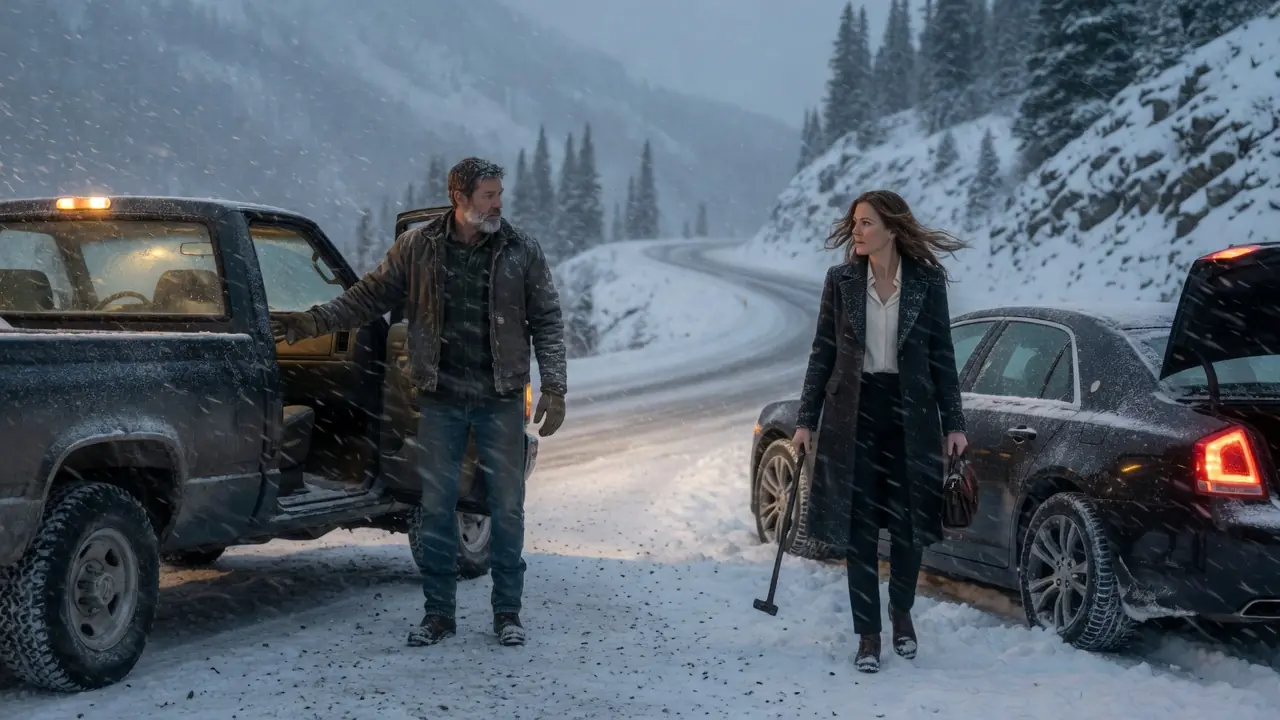
No one stepped out.
The house was not built for that kind of arrival. It was a narrow, weathered place at the edge of town, with white paint peeling from the porch rails, smoke curling from the chimney, and a stack of split firewood leaning against the side wall. Beyond it, the trees climbed toward the ridge, dark pines standing silent beneath a thin cover of early snow.
Holden Carver stood on the porch with a chipped mug of coffee in his right hand.
He wore old jeans, worn boots, and a red flannel shirt beneath a faded canvas jacket. His dark hair was touched with gray at the temples, and his face had the calm, unreadable stillness of a man who had learned long ago that panic rarely improved anything.
He did not call the sheriff.
He did not reach for the rifle locked inside the mudroom cabinet.
He did not step back into the house.
He simply stood there, watching the black vehicles breathe vapor into the cold.
The front door opened behind him.
The woman stepped out and stood beside him.
She wore the same wool coat she had worn the night before, now dry but still creased from sleep. Her hair was pulled back loosely from her face. She had not put on makeup. She looked pale, exhausted, and far more human than she had looked when he first found her stranded on Silver Creek Pass.
She said nothing.
The lead vehicle’s door opened.
A man in a dark suit stepped out onto the gravel. He was in his early fifties, broad but not bulky, his hair clipped short, his face hard in the way men become hard when their work has trained softness out of them. He paused beside the open door and scanned the porch, the tree line, the windows, the roofline, the road behind him, and then Holden.
Only then did he walk forward.
His boots crunched over the frost.
He stopped ten feet from the porch steps.
“It’s been a long time,” he said.
None of them knew how the morning would end.
Some mornings rewrite a life.
This was one of them.
What those Range Rovers came for was not what anyone in Silver Creek would have guessed.
It was not money.
It was not revenge.
It was not an arrest.
It was the past, arriving in black vehicles before sunrise, carrying secrets that had waited twelve years for the right door to open.
The night before, it began the way most days in Silver Creek did for Holden Carver, with a drive he had taken so many times he could feel the curves of the road before they came.
He had been in Boulder since dawn, delivering a rebuilt transmission to a client who paid in cash and asked no questions. The job had started as a favor for a rancher, then become a referral, then become one of those complicated repair deals where a man ended up spending fourteen hours on a concrete floor because an old truck had more history than sense.
By the time Holden finished, his shoulders ached, grease had worked itself under his nails, and he had two hundred miles of winter road between him and home.
Wren had stayed at her Aunt Lala’s since morning.
That was the usual arrangement when Holden had a long job. Wren would help Lala at the diner, wipe menus, refill sugar jars, eat too much pie, and go to bed in the back room that still smelled of cedar shavings because Lala’s late husband had once used it for storage. Wren liked the room because it had a tiny window facing the alley, and because Lala let her keep a bird notebook under the pillow.
Holden had planned to drive home that evening, sleep hard, and pick Wren up the next day.
He had not planned for the storm.
The clouds came in low over the Front Range by 3:00 in the afternoon. By 4:00, the National Weather Service had moved the warning forward by six hours. By 5:00, the snow had begun to slant sideways across the windshield of his old pickup.
Holden had spent enough of his life reading weather, terrain, and road behavior to know when the mountains had decided to stop cooperating.
He gripped the wheel a little tighter and chose the shorter way home, Silver Creek Pass, knowing the gate at the summit would close before 9:00. It was not the safest choice, but it was still passable if he kept moving and reached the downward slope before the plows pulled back.
The old pickup groaned as it climbed.
Wind pushed snow across the road in fast white sheets. The headlights caught flakes so thick the world ahead looked like static. The tires hummed over patches of packed ice, then bit into gravel where the county had salted earlier in the day.
Holden drove with both hands on the wheel and his eyes moving constantly.
Road edge.
Ditch.
Rock face.
Tree line.
Mirror.
Again.
Old habits.
He had spent the last twelve years trying to become a small-town mechanic and father. Most days, he succeeded. But the body remembered what the mind tried to retire. His hands still knew how to check exits without thinking. His eyes still mapped sightlines. His breathing still changed when a road narrowed between rock and drop-off.
He almost did not see the sedan.
It sat at an angle on the shoulder near the second switchback, hazard lights pulsing weakly against the snow. A black late-model sedan, expensive and low to the ground, the kind of car that belonged under hotel awnings and private airport canopies, not halfway up a mountain pass in a storm.
The driver was outside.
She stood with her back to the wind, one hand braced on the open trunk, the other holding a tire iron like she had seen one used in movies and disliked finding out real life required more.
Her coat was tailored. Her boots were not made for snow. Snow had begun to settle on her shoulders and in her dark hair.
Holden slowed, pulled in twenty feet ahead, and stepped out.
The wind hit him hard.
He zipped his jacket higher and walked toward her.
The woman turned before he spoke. She did not startle. She simply looked at him as if she had already calculated three possible risks and found all of them irritating.
She had the posture of someone more accustomed to giving instructions than receiving them.
Her first words confirmed it.
“I have called for assistance,” she said. “It is on the way.”
“No, it isn’t.”
Her eyes narrowed.
“Excuse me?”
“The pass closes in twenty minutes. You won’t reach anyone for sixty miles once the signal drops.”
“I reached someone.”
“Maybe down below. Not up here.”
She glanced down the road, then back at him.
“Then I’ll wait for the road crew.”
“Road crew won’t come up tonight.”
The wind shoved snow between them.
She measured him for a long moment.
Holden let her.
She was in her late thirties, maybe early forties, with a face that would have looked controlled even in a courtroom, a boardroom, or a disaster. Her dark hair was tied low at the back of her neck, though the storm had pulled strands loose. Her skin was fair, her jaw tight, and her eyes a clear gray-green that gave away almost nothing.
Almost.
There was pain in the way she stood.
Not fear.
Not yet.
Pain.
“My name is Holden Carver,” he said. “I live four miles down. You can sit in my truck while I bring you down the mountain. After that, the choice is yours.”
“I don’t get into strangers’ vehicles.”
“Good rule.”
She blinked once.
He pointed toward her sedan.
“Your front tire is done. You do not have a spare mounted, and even if you did, this shoulder is too icy to change it safely. Your car sits too low for the drift building behind your rear axle. In ten minutes, the road will look flat. In twenty, the plow gate closes. In thirty, this becomes a recovery job, not a roadside delay.”
She stared at him.
Holden continued.
“You can stay in your locked car and hope the storm cares about your schedule, or you can get in my truck for four miles. I won’t touch your bag. I won’t ask your name. You can sit in the back if it makes you feel better.”
Something in her expression shifted at that.
Not trust.
Assessment.
She looked at his truck. An old blue Ford with rust around the wheel wells, a cracked dashboard, and a toolbox mounted behind the cab. It did not look impressive. It looked maintained. That mattered more on this road.
She walked to her car, took a small leather bag from the passenger seat, locked the sedan behind her, and followed him without giving her name.
The drive down the mountain was silent.
The signal on her phone died inside the first mile.
She looked at the screen once, then put the phone in her bag.
Holden noticed that she did not panic.
People who depended on phones panicked when they stopped working. This woman only became quieter.
Snow came hard through the wipers. The road dropped in slow switchbacks, the guardrails half hidden under blown powder. Twice, Holden eased the truck around fallen branches. Once, he slowed near a place where the ditch had filled with old plow slush and ice.
The woman watched the road.
Not him.
Not the truck.
The road.
“Do many people take this pass at night?” she asked finally.
“Locals who know better and strangers who don’t.”
“Which am I?”
“That depends.”
“On what?”
“Whether you do it again.”
She looked at him for the first time since getting into the truck.
A tired shadow of amusement crossed her face and disappeared.
At the house, the old retriever lifted her head from the rug, sniffed once, and went back to sleep.
“Dog’s name is June,” Holden said.
The woman looked at the dog.
June sighed deeply, deciding the stranger was not worth leaving the warm place beside the stove.
The house was small but solid.
A woodstove warmed the front room. Boots lined the mudroom wall. A row of hooks held jackets in descending sizes, the smallest one bright yellow and covered with embroidered birds. A bookshelf leaned slightly beneath the weight of paperbacks, field guides, repair manuals, and a few children’s books. The kitchen opened off the front room, narrow and old, with a scarred table, a deep sink, and a window facing the dark pines.
Holden did not apologize for the house.
People with money often expected apology from people without it.
He had never learned the habit.
He put water on for coffee, then heated leftover bean soup on the stove.
The woman stood near the kitchen doorway, holding her leather bag as if it might need defending.
“You can sit,” he said.
She did.
They ate at the small kitchen table and spoke perhaps eight sentences between them.
About the storm.
About the road.
About the way the pipes behaved when the temperature dropped below zero.
She used a spoon the way someone uses a fountain pen.
Holden noticed and said nothing.
She noticed him noticing and said nothing too.
That became the rhythm.
Two people trained in different kinds of silence, sitting across from each other while snow turned the windows white.
He made up the bed in his daughter’s room and laid out two clean towels.
“She’s not home tonight,” he said. “Staying with her aunt.”
The woman looked toward the small hallway.
“You have a daughter?”
“Wren. Eight.”
Her face changed so slightly most people would have missed it.
Holden did not.
He had seen grief move through faces before. It had many disguises. Sometimes it looked like anger. Sometimes arrogance. Sometimes nothing at all.
He took the sofa himself.
The pistol stayed in the locked drawer in the kitchen.
And he listened to the wind until he fell asleep just past midnight.
The woman woke before dawn.
The house was warm from a stove she had not heard him feed.
Somewhere outside, an owl was calling its last call of the night. The storm had softened, but the world beyond the window still looked buried in blue-gray quiet.
She lay still for a moment, taking in the room.
Children’s books on a low shelf.
A stuffed fox missing one eye.
A small lamp shaped like a crescent moon.
A jar of colored pencils.
A notebook on the desk labeled Wren’s Birds — Volume Two in careful handwriting.
The room did not feel decorated.
It felt lived in.
That unsettled her more than wealth ever had.
Maren Halberstam had slept in hotels where sheets cost more than most people’s monthly groceries. She had stayed in government guest houses, penthouse suites, private residences, and aircraft cabins designed to make time zones feel optional. She had woken in rooms with views of London, Dubai, Singapore, and Washington, D.C.
None of those rooms had ever made her feel as if she were intruding on someone’s heartbeat.
This one did.
She rose quietly and walked into the front room.
There were no military photographs on the walls. No medals in shadow boxes. No folded flag. No framed articles. No old uniforms. Nothing that announced what Holden Carver had once been.
The mantel held only a framed picture of a woman in her thirties, laughing at something off camera.
Maren stopped in front of it.
The woman in the photo had sun-brown hair, a square jaw, bright eyes, and the kind of open laughter that made the person behind the camera visible too. Someone had loved her when the picture was taken. Loved her enough to keep that laugh in the center of the room.
The bookshelves held novels, field guides, repair manuals, and old maps. On the lowest shelf, a thick spiral-bound ledger had been read so many times the cover was beginning to come apart at the spine.
Maren noticed other things too.
The sightlines through every window were clean.
The door to the kitchen could be closed from where he had slept on the sofa.
The pistol drawer, when she passed the kitchen, had a small lock she had not seen on a kitchen drawer before.
The mirror near the front door reflected the road.
The porch light switch could be reached from behind the open front door without exposing the person standing there.
The man who lived here had built a quiet house with the habits of someone who had once needed to know which door he could see from which chair.
She did not draw a conclusion.
She simply noted it.
That was how she had survived boardrooms, defense contracts, and men who smiled while stealing from companies. She noticed. She waited. She filed things away.
Holden came in from outside with snow on his shoulders and set a mug of black coffee on the counter in front of her without a word.
He smelled faintly of cold air, woodsmoke, and motor oil.
“Thank you,” she said.
He nodded once.
Her phone lit up on the table between them.
She had two bars again.
The screen showed forty-seven missed calls.
Maren looked at the number of missed calls and felt the first true flicker of danger.
Not concern.
Danger.
There were too many calls from security.
Too many from Renata.
Too few from the person who should have been panicking first.
She picked up the first call that came in live.
“Ms. Halberstam, oh, thank God,” Renata said before Maren could speak. Her executive assistant’s voice was tight with exhaustion. “Ms. Halberstam, we’ve been searching all night. Camera at the truck stop in Lyons caught your car at 6:42, and the GPS pinged once after the slide. The team is thirty minutes out.”
Maren looked at Holden across the rim of the coffee mug.
He was standing still, one hand resting on the edge of the counter, expression unreadable.
“Thank you, Renata,” she said into the phone. “I’m safe. Tell Decker to come in slow.”
She ended the call and placed the phone on the table.
The house was very quiet.
Even June had lifted her head now.
Holden was still standing where he had been, watching her.
“My name is Maren Halberstam,” she said. “I am the chief executive of Halberstam Aero Logistics. The man bringing my security team is named Decker. I owe you an explanation I do not yet know how to give.”
Holden nodded once.
Just once.
He did not ask a question.
He did not move.
The first engine reached the top of the road sixteen minutes later.
Then another.
Then ten more.
Then ten after that.
Holden walked out onto the porch with the coffee still in his hand.
He did not flinch when the half circle closed around the house.
Maren stood at the kitchen window and listened.
The lead door opened.
Boots on gravel.
A voice she did not recognize, lower and softer than she had expected, came in through the gap of the front door.
Five words, spoken to the man on the porch.
“It’s been a long time.”
She walked out.
The man in the suit had not yet looked at her.
He was looking at Holden.
And Holden was looking back at him with the expression of a man who had been waiting twelve years to see this face again.
For the first time in her adult life, Maren Halberstam did not know whose house she was standing in.
Decker turned to her then.
“Ma’am, we need to get you inside.”
She looked at Holden.
He gave the smallest nod she had ever seen a man give.
She went in.
The question she had not asked went in with her.
The answer waited only a few minutes.
Decker stood at Holden’s kitchen counter with a leather folder open in front of him. He had removed his gloves, but not his coat. His men had spread across the property with the quiet efficiency of people who did not need to discuss positions in front of civilians.
Three men outside.
Two at the road.
Two sweeping the tree line.
The rest pulled back to the perimeter road.
The half circle was no longer a threat.
It was a wall.
“Forensics on the sedan came back twenty minutes ago,” Decker said. “Brake line was cut clean. Three-quarter slice designed to fail under load, not at idle. Steering linkage tampered with at the column.”
Maren sat at the kitchen table.
She was wearing the same wool coat from the night before because she had nothing else with her.
“Same vehicle?” she asked. “Two failures?”
“One event.”
Holden stood at the far end of the kitchen with his arms crossed. He had not sat down. He had not been asked to leave. No one seemed willing to tell him where to stand.
Maren noticed that too.
“Route?” she said.
“Changed at 15:30 yesterday,” Decker replied. “The original driver was reassigned at 15:35. The replacement called in sick at 16:10. By the time you got in the car, you were on a road no one in our system was tracking and behind a wheel that was going to come apart.”
“Who approved the change?”
“Garrett Vance.”
Maren closed her eyes for a moment.
When she opened them, she was looking at Holden.
His face was very still.
Too still.
“Decker,” she said, “how do you know him?”
Decker glanced at Holden.
Holden gave him nothing.
Decker spoke carefully.
“I served under Mr. Carver in a unit that doesn’t appear on any organizational chart you’d have clearance to read, ma’am. He left the work twelve years ago. I am answering your question only because he has not told me to stop.”
Maren let the answer settle.
She did not press.
There was a longer conversation here, and it would happen on a different day, in a different room, when she had the right to ask.
She turned back to Decker.
“The pattern. The brake line cut. The route swap. The driver swap. Have you seen it before?”
Holden took half a breath and looked at the floor.
It lasted less than a second.
Maren saw it.
Decker saw it.
Neither of them said anything.
“Once,” Decker said. “Twelve years ago. A different name on the file.”
He did not say whose.
Maren did not ask.
She was beginning to understand, slowly, that there were several conversations going on around her that she was not yet a party to.
She set her hands flat on the table.
“Decker, I run a defense logistics company with eleven thousand employees and a chief operating officer who arranged my death. I do not know who in my organization is clean. If I return to Denver, I return to a building I cannot trust.”
“Recommend you stay here, ma’am. Seven days. We map the threat. We isolate the cells inside the company. We move when we know the ground.”
“And Mr. Carver?”
“He has not been asked, ma’am.”
Maren looked at Holden.
Holden looked back at her.
He did not say yes.
He did not say no.
He simply did not move toward the door.
“Seven days,” she said.
Late in the afternoon, the snow finally stopped.
The sky remained low and colorless, but the wind had eased, leaving Silver Creek wrapped in a silence that felt almost suspicious after the storm.
A red truck came up the road and parked behind one of the Range Rovers.
A small woman in a flannel coat got out, holding the hand of a child of perhaps eight, whose hair was the same dark brown as Holden’s.
The child carried a small canvas bag and a brown stone the size of a robin’s egg.
The woman was Lala Carver, Holden’s late wife’s older sister, though most of Silver Creek called her Aunt Lala whether they had permission or not. She owned the diner, wore men’s boots under her aprons, and had once broken a customer’s finger for grabbing a waitress. The story had been exaggerated over the years. The finger had only been sprained, but Lala never corrected anyone.
Wren stopped on the porch and looked up at the woman she did not know.
She was eight years old, narrow-faced, serious-eyed, and wearing a yellow coat with stitched birds on the pockets. Her gaze moved over Maren’s expensive coat, her city boots, her tired eyes, and the way she stood beside the porch post as if unsure whether she belonged inside or outside.
Then Wren held out the stone.
“This is for you,” she said.
Maren looked at it.
“For me?”
Wren nodded.
“It’s smooth. I found it by the creek. Smooth rocks are for people who had bad days.”
Maren took it.
She did not know why.
The stone was cold in her palm, worn round by water and time.
“Thank you,” she said carefully.
Wren nodded once, apparently satisfied, then walked into the house as if twenty black Range Rovers in the driveway were less interesting than whether Holden had made soup.
Maren turned the stone once in her hand.
Then she put it in her pocket.
She kept it there for the rest of the day.
Three days passed.
The convoy did not stay in formation.
By the second morning, the Range Rovers had broken into smaller cells.
Two at the diner.
Two at the fire road junction.
One at the trailhead where the pass met Forest Service Road 17.
The rest tucked behind a screen of pines on a parcel of land Decker had quietly leased from a rancher by Thursday afternoon.
The town noticed, but did not ask.
Silver Creek was the kind of place where strangers were observed and then allowed to be strange until they became dangerous or interesting enough to discuss at breakfast.
Decker took the corner booth at Lala’s Diner and made it his command post.
He drank coffee black, ate pancakes once a day, and ran his radio from a small earpiece that no one in the diner pretended to see.
Lala refilled his cup without comment.
When one of Decker’s men tried to pay for coffee with a hundred-dollar bill, Lala looked at him over her glasses and said, “This is a diner, not a hostage exchange.”
He found smaller bills.
Holden ran his own perimeter separately.
He went to the garage at 6:00 every morning and was not back until 11:00.
Maren understood by the second day that he was not actually working on engines.
She had seen him walk past the kitchen window with a notebook in his hand, then drive to the gas station at the edge of town, then drive back twenty minutes later. She had seen him stop at the sheriff’s house. Burl Tannehill, sixty years old and silver-haired, had grown up two ranches over. Holden stayed there for forty minutes.
She did not ask.
He did not explain.
They had reached, by some unspoken protocol, an arrangement in which she understood the shape of what he was doing, and he understood that she understood.
That, Maren thought, was rarer than honesty.
It was trust without decoration.
She worked from his kitchen table.
She negotiated an aerospace logistics contract worth $1.3 billion while wearing a borrowed cardigan Lala had brought over on the second morning with the words, “Cold up here. Don’t ask me where it came from. It fits.”
Maren had thanked her and put it on.
The cardigan smelled faintly of cedar.
On video calls, her executives saw only her face, a blank wall, and the edge of a window. They did not see the woodstove, the dog asleep by the rug, the child’s bird drawings stacked near the salt shaker, or Holden moving silently through the kitchen behind the laptop with a mug in one hand and a wrench in the other.
She watched people on the calls more carefully than she ever had.
Who seemed worried?
Who seemed curious?
Who seemed relieved?
Who asked where she was without asking why she was alive?
Garrett Vance did not attend the first two calls.
His assistant said he was coordinating crisis continuity.
Maren made a note.
Vance had been her chief operating officer for four years. Before that, he had overseen auxiliary contracts, special logistics channels, and classified support lines inherited from older company structures. He was polished, efficient, and too useful to be liked. Her father had trusted him. The board respected him. Employees feared him in the quiet way employees fear people who can end careers with phrases like “not aligned with future needs.”
Maren had never liked him.
But she had trusted his competence.
That now seemed like the more dangerous error.
On the third afternoon, Wren came home from the diner with a small spiral notebook.
She climbed onto the bench at the kitchen table next to Maren and opened it without asking, the way a child opens a book in front of a person she has decided to trust.
“This is a junco,” Wren said. “This one is a chickadee. This one is a mountain bluebird. But I only saw it once.”
Maren turned the pages slowly.
The drawings were careful, not particularly good, and entirely hers.
There was no refrigerator art here.
The child kept her drawings in books.
“What is this one?” Maren asked, pointing.
“A nuthatch. They walk upside down. Upside down on the tree, headfirst going down. They are the only ones.”
Maren nodded gravely.
“That seems useful.”
“For bugs,” Wren said. “Not for people.”
“Good to know.”
Wren leaned her arm against Maren’s arm and stayed there for the next twelve pages.
Maren did not move.
There had been children in Maren’s life, technically.
Board members’ children at charity galas.
Politicians’ grandchildren in photographs.
Executives’ infants displayed briefly on video calls before nannies removed them from professional view.
But no child had leaned against her simply because she had decided Maren was safe enough to be furniture.
It did something strange to her chest.
That evening in the kitchen, Maren was pouring a second cup of coffee when Holden came in from the cold.
He reached for the pot at the same moment she did.
The backs of their hands touched against the handle.
Neither of them moved.
Neither of them pulled away.
The pot finished its pour.
He stepped back.
She set her cup down on the counter and lifted it to her mouth.
Across the street in the diner window, Lala lowered her dish towel slowly, turned to the row of clean glasses, and began polishing the one that did not need polishing.
She did not look up again for a long time.
He came in three black SUVs on the fifth morning.
Garrett Vance had pulled the location data from Maren’s company phone, a privilege of his office that he had been quietly using for thirty-six hours before he committed to the drive.
He brought two attorneys, one board member named Howell with a long history of doing whatever Vance told him to do, and a private psychiatrist who had been compensated handsomely never to read a chart out loud.
Holden’s address was not in any of their files.
Vance went to the diner instead.
Silver Creek had only one.
He sat down in a booth, ordered nothing, and waited.
The diner grew quiet around him in the specific way rural diners do when a man enters wearing too much money for the floor he is standing on.
Lala stood behind the counter, one hand resting near the coffee pot.
“You eating?” she asked.
“No.”
“Then you’re waiting?”
“Yes.”
“For who?”
“Maren Halberstam.”
Lala looked at him.
Then at the three SUVs outside.
Then back at him.
“You one of hers?”
Vance smiled.
“I’m here on behalf of her company.”
Lala’s mouth tightened.
“In Silver Creek, that means no.”
Maren arrived twenty minutes later in the borrowed cardigan, with Decker behind her and two of his men outside the door.
She sat across from Vance and folded her hands on the table.
“Garrett.”
“Maren. Thank God. I’ve been worried sick.”
“Have you?”
“You’ve been off-grid for five days. There are rumors. The board is concerned. Howell came up at my request. I brought Dr. Mills because I wanted to be sure you were…”
He let the sentence hang.
Maren did not.
“Do you have a court order?”
Vance’s smile faltered for half a second.
He recovered.
“Maren, this is not—”
“Do you have a court order, Garrett? Yes or no?”
“No.”
“Then I am not required to speak with Dr. Mills, with Howell, or with you. I am the chief executive officer of this company, in full possession of my faculties, and on personal leave by my own arrangement. You have driven a long way to find that out.”
Vance leaned forward.
His voice dropped half an octave.
“There is a provision in the bylaws, Maren. Emergency conduct. If three board members sign…”
The bell over the diner door rang.
Sheriff Burl Tannehill stepped inside, tipped his hat at Lala, and walked to the booth without raising his voice.
“Mr. Vance, your three vehicles are blocking the entrance to my diner. I’d ask you to move them or take this conversation back to wherever you came from.”
Vance looked up at him.
“I’m conducting corporate business.”
“In a diner whose parking lot you’re blocking.”
“This is a private matter.”
“It became public when your driver parked across the handicapped ramp.”
Vance opened his mouth.
Burl held his gaze.
“I won’t say it twice, sir.”
Vance stood.
The attorney stood.
Howell stood.
The psychiatrist gathered his coat and did not meet anyone’s eyes.
They filed out into the morning light.
Holden was sitting at the counter on the third stool from the door.
He had been there since before Vance arrived.
He had not turned his head once during the conversation.
He did not turn it as the door closed behind them.
The convoy left town inside the hour.
But it did not leave clean.
By that evening, two listening devices had been found.
One in the eaves of the diner.
One in the public phone box outside the hardware store.
A man named Kurt Dolan, who had done eighteen months for assault and held a grudge against Holden from before the conviction, was paid in cash to keep eyes on the garage.
And by midnight, three financial newspapers were running variations of the same headline.
CEO Off-Grid in Mountain Town: Sources Inside Halberstam Aero Cite Concern Over Influence of Local Stranger.
The story moved fast.
By noon the next day, it had been picked up by four cable outlets.
Maren watched one segment in silence from Holden’s kitchen table while Wren drew warblers beside her and Holden made sandwiches at the counter.
A panelist with perfect hair spoke gravely about “executive vulnerability,” “possible mental strain,” and “questions around rural isolation.”
Another suggested that defense logistics leadership required stability.
A third wondered aloud whether Maren Halberstam’s absence could affect national supply chains.
No one mentioned the brake line.
No one mentioned the route swap.
No one asked why Garrett Vance had found her before law enforcement made a statement.
Maren turned the volume off.
Wren looked up.
“Are they talking about you?”
“Yes.”
“Are they wrong?”
“Yes.”
Wren considered that.
“Then why do they sound so sure?”
Holden set down a plate in front of her.
“That’s how people sound when they need other people to be unsure.”
Maren looked at him.
He did not look back.
In the back kitchen of the diner that night, Lala was wiping down the counter when her cell phone rang.
The number was unlisted.
She did not give the number to anyone.
She answered on the third ring.
“Lala, it’s Dorothy Ann. I just saw Garrett Vance’s name on the news.”
Lala set the rag down.
Across the diner, Decker looked up from his corner booth. He did not hear the call, but he saw Lala’s face change.
“Ann left something with me,” Dorothy said. “Told me to tell you when the time came. The time has come.”
Lala did not answer for a long moment.
Then she walked into the storeroom, closed the door behind her, knelt by the bottom shelf, and pulled out a sealed manila envelope that had not been touched in twelve years.
It had been hidden behind old tax records, a broken pie safe hinge, and three tins of coffee no one would ever drink.
Lala held it in both hands.
For a moment, she was no longer the woman who ran Silver Creek’s only diner.
She was Ann’s sister again.
The sister who had buried her.
The sister who had promised.
Lala drove out to the house just after 7:00 the next morning.
Holden was already at the garage.
Decker’s truck was at the diner.
Wren was eating cereal in front of the small television in the den.
Lala parked, climbed the porch steps, and knocked once.
Maren opened the door.
“Walk with me,” Lala said.
They went along the cleared path to the woodshed and stopped where the trees thickened. The snow had a hard crust on it now, bright beneath the morning light. Their boots sank only slightly.
Lala held the manila envelope against her chest with both hands.
“Ann left this with me twelve years ago,” she said. “She told me to keep it dark until one of two things happened. Either the man who did it came back, or someone else turned up at the right door asking the right kind of questions.”
“She…”
“You,” Lala said. “I would know who. She told me the name of the company. The name was Halberstam Aero Logistics. She said someone would come who’d been put on the same road she was put on. She said when that happened, what was hers became theirs. She said I was the keeper, not the owner. Twelve years I have kept it for her. You are the owner now.”
Lala held out the envelope.
Maren took it with both hands.
It felt light.
Too light for what it was doing to the air between them.
“Holden doesn’t know,” Lala said. “She made me promise. She said he would carry it as guilt and never be free. She said someday she would give it to someone who could finish what she started. And that person would be the one to choose whether he ever heard about it.”
“Lala…”
“I’m not asking you to choose now. I’m asking you to watch what’s in there.”
Lala walked back to her truck without another word and drove away.
Inside the envelope was a small black thumb drive and a single sheet of folded paper.
The paper said:
Whoever you are, please.
A.
Maren sat alone in the front room with Holden’s laptop on her knees.
Her hands were steady as she inserted the drive.
They did not remain steady.
A single video file opened.
A woman in her thirties sat in a kitchen.
Maren recognized this kitchen, twelve years younger.
The paint had been brighter then. The curtains different. The table in the same place, but less scarred. The woman’s hair was tied back. Reading glasses were pushed up on her forehead. She looked tired, alert, and alive.
“My name is Ann Carver,” she said, looking directly at the camera. “I am a forensic accountant under contract with the Office of the Inspector General. I am recording this because I do not believe I will finish the work I have started. And I want what I know to outlive me.”
She spoke for forty minutes.
She named seventeen shell companies.
She gave bank routing numbers.
She gave dates.
She described auxiliary contracts buried inside defense logistics frameworks, payment flows split across vendors, and subcontractor chains designed to disappear under classified procurement language.
She said the name Garrett Vance only once near the end, and only as an associate who appeared repeatedly in the auxiliary chain.
She named his predecessor, a man whose name Maren had heard her father say at a board meeting when she was twenty-three years old.
She read three account numbers and the institution they were held in.
She named a pattern of vehicle interference used to remove inconvenient witnesses.
Brake line.
Steering linkage.
Route swap.
Driver swap.
Maren felt the room narrow.
Ann said she had been followed home twice in the last month.
She said her husband knew she was worried, but not why. She said he had already left work that asked too much of his soul, and she refused to pull him back into a world he was trying to survive leaving.
Near the end, Ann looked directly into the camera.
“If you are watching this, it means I did not make it. This network does not die with one person. It looks for a successor. My husband has no proof. I hid it to protect him, but if you are standing where I once stood, then this is yours.”
She paused.
“Tell Lala she was a good sister. Tell Holden I loved him. Tell whoever you are to be careful.”
The video ended.
Maren’s hand was very still on the trackpad.
Then it began to shake.
Then her shoulders began to shake.
She did not make a sound.
She had not cried in ten years.
Not when her father died.
Not when federal contracts nearly destroyed her first year as CEO.
Not when she sat alone in her office after laying off eight hundred people to save the company from collapse.
She did not cry loudly now.
She wept the way some people pray.
Outside on the porch, Lala had not driven away.
She had pulled the truck around the back of the property, walked up to the steps, and sat down on them.
She was waiting in the cold without going in.
Maren showed Holden the drive that evening.
She had thought for an hour about not showing him at all.
Lala had said the choice was hers.
Ann had said the choice belonged to whoever came after.
But Maren Halberstam had not built a billion-dollar company by lying to the people she had begun to need.
He sat at the kitchen table while she queued the file.
He did not ask what it was.
He looked at her face and understood that whatever it was, it would not be small.
He watched the entire forty minutes without moving.
At first, his face did not change. Then, slowly, something behind his eyes retreated to a place Maren could not follow. He watched Ann speak in the kitchen where he was now sitting. He heard the voice he had buried beneath twelve years of silence, work, fatherhood, and unresolved questions.
When the video ended, Holden sat with his hands flat on the table and his eyes on the wall behind Maren’s shoulder.
He did not speak for what felt like a very long time.
Five minutes, maybe more.
Wren was at Lala’s for the night. Decker was outside. The house was quiet except for the wind pressing softly against the windows.
Then Holden said very softly, “I always thought she had something. I never had the proof.”
He paused.
“You just brought her back to me.”
He did not thank Maren for the company.
He did not thank her for the warning.
He thanked her for finishing something his wife had begun.
Maren nodded once.
She did not say what she was feeling.
She did not have a word for what she was feeling.
She closed the laptop.
Then she opened it again.
She set it between them.
“Then we finish it.”
They sat at the kitchen table until well past midnight.
Decker came in at 10:00 and stayed.
Maren used her authority to issue a subpoena from the office of the chief executive for a forensic audit of Halberstam Aero’s auxiliary contracts.
She authorized Decker to share the substance of Ann’s drive with three named federal investigators by name and clearance level.
She drafted a private letter to two members of the board she had reason to believe were clean, instructing them not to act on anything until she returned.
Holden made one call.
He picked up his old phone, scrolled to a name he had not dialed in eleven years, and pressed the green key.
He spoke for nine minutes in a voice Maren had not heard him use.
Not the mechanic.
Not the father.
Not the quiet man who made coffee without asking.
The voice was flat, controlled, and stripped of every unnecessary word.
When he hung up, he looked at her and said, “He knew Ann. He retired four years ago. He’s coming out of retirement for this. He’ll meet us in Denver.”
Vance moved at the same time.
By 2:00 in the morning, his lawyers had filed an emergency motion with the Halberstam board, requesting an immediate competency hearing and a 72-hour temporary removal of Maren from her position pending evaluation.
The filing cited her extended absence in an unknown rural location, her altered communication patterns, and concerning third-party influence.
Maren read the motion as it came across her screen at 2:11.
She did not blink.
“He’s playing his hand,” she said.
Holden looked at the file.
“He’s going to lose it.”
Wren came down the hall in her pajamas at quarter past 2:00, woken by the lamps.
She did not understand the words on the table.
She understood the faces.
She walked over to Maren without saying anything, put her arms around her neck, and laid her head against Maren’s shoulder for ten seconds.
Then she walked back down the hall to bed.
Maren sat very still for a long time after the door closed.
Just before 3:00, Holden stood up to look at a line of bank routing numbers on her screen.
He came around the table and leaned over her shoulder.
His hand braced on the back of her chair. His face was close to her ear.
He pointed.
“That one. That’s the same account she named.”
She turned to look up at him.
Their faces were perhaps eight inches apart.
Neither of them moved.
Neither of them spoke.
Decker knocked once on the kitchen door, hard, with a folded printout in his hand.
They straightened at the same instant.
Holden took the printout.
Maren opened a new spreadsheet.
Neither of them said anything about it.
Both of them knew it had happened.
The board meeting was set for 10:00 the next morning in Denver.
Maren drove herself in her own car with Wren asleep in the back and Holden in the passenger seat, a soft case across his lap containing a copy of Ann’s drive and one hundred forty pages of cross-referenced audit material.
Decker followed in a separate vehicle with two of his men.
The rest of the convoy stayed in Silver Creek.
The Halberstam Aero Tower in downtown Denver was forty-seven stories of dark glass. It rose from the financial district like a blade, reflecting cold morning sun and the kind of power people mistake for permanence.
Maren had not slept since the night before.
She did not look at the building for long.
They left Wren on a long upholstered bench in the executive reception area with a coloring book. The receptionist promised to keep an eye on her, and Holden sat beside her in a dark jacket and the only button-down shirt he owned.
He had no intention of going into the room unless asked.
Maren went in alone.
Vance was already at the table.
Howell was there.
Eleven other board members. The company’s general counsel. A court reporter at the corner who had been retained by the company some hours earlier on Vance’s instruction.
Maren set her materials down at her place at the head of the table and did not bother to sit.
“We have a number of items on the docket this morning,” she said. “Mr. Vance’s motion of yesterday at 2:11 a.m. is one of them. Mine is the other.”
She began with the audit data.
She moved through Ann Carver’s drive without naming Holden by anything other than the source.
She presented the brake line pattern, the route swap, the driver swap, and the seven independent forensic reports Decker had pulled together overnight.
She presented the bank routing numbers and the seventeen shell companies.
She named the predecessor.
Forty minutes in, Vance interrupted.
“Madam Chairman, I have a document I would like entered into the record.”
He slid it across the table.
Howell picked it up.
The general counsel read it.
It was an affidavit, four pages signed and notarized.
It alleged a long-running confidence scheme by one Holden Carver to attach himself romantically and financially to female executives of major defense firms. It contained dates, locations, and the names of two previous victims.
Maren took it without expression.
“May I have four minutes to review?”
She handed it to a forensic analyst Decker had quietly placed in the room.
The analyst opened a laptop, ran two checks, and looked up.
“The document’s metadata shows a creation time of 03:15 this morning. The notarial seal is from a Nevada notary whose license was revoked in 2023. The signer of record does not exist in any Halberstam Aero personnel file under any spelling. This document was generated by Mr. Vance’s office between 3:00 and 4:00 a.m.”
Maren slid the affidavit back across the table.
“Next item.”
Vance did not look at her again.
Holden was called in only once for technical confirmation of the vehicle pattern.
He was vouched for by Decker and by a partial declassification request that the federal investigator on Holden’s call had filed the previous afternoon.
He stood at the foot of the table.
“The interference pattern is known to my office as Pattern Tanner Three. I observed it for the first time in 2013. The victim was Ann Carver.”
That was all he said.
He sat down.
No one asked him to elaborate.
Perhaps because no one wanted to hear what his face said he could tell them.
The board voted.
Vance was removed by twelve to zero with one abstention.
The matter was referred immediately to federal prosecutors.
Maren gathered her materials and walked out.
Wren was asleep with her cheek on the coloring book.
Holden picked her up without a word.
Maren walked beside him to the elevator.
In the parking garage, Decker pulled a second sealed envelope from his inside pocket.
“Ma’am, Ann left a second one. Not for you. For whoever came after the one she expected. I don’t know that name either. You can open it when you’re ready.”
Maren took the envelope.
She did not open it.
She held it against the same coat she had been wearing for six days.
She put it in her bag and got in the car.
Four days later, the temperature climbed above freezing for the first time in eleven days, and the snow on the roof began to drop in soft wet thuds along the porch line.
Maren had not driven back to Denver.
She was running the company from Holden’s kitchen table because the kitchen table was where the work had become possible.
The federal investigators arrived in town on Tuesday.
By Wednesday afternoon, three additional Halberstam Aero employees had been placed on administrative leave.
Two had retained counsel.
One had agreed to cooperate.
The story moved off the financial papers and onto the federal docket.
Maren took afternoons off.
She walked into the woods with Holden on Wednesday and again on Thursday.
They did not talk much.
The trail was narrow, and the silence was an honest silence.
On Thursday, where the trail dipped and a thin layer of ice still held under the snow, she lost her footing for half a second.
Holden caught her by the hand to steady her.
He did not let go when she was steady.
She did not pull away.
They walked the next quarter mile that way, neither of them looking at the other.
On Friday, Wren asked Maren to come sled with her on the slope behind the house.
The sled was a battered red plastic thing with a frayed nylon rope.
Maren sat on it with Wren in her lap and pushed off the top of the hill.
They went down twice.
The second time, Wren laughed a high, surprised laugh that broke into the cold air like something living.
Maren laughed too.
She had not laughed that way in three years, since her father, very quietly and very privately, had failed to wake up one morning in his apartment in Boston.
She did not know she still had that laugh.
She had it now.
She laughed twice, and then she laughed once more, and Wren said, “Again.”
They went down again.
That night at the diner, Maren sat at the counter and ate a slice of cherry pie she had not ordered.
Lala had simply set it in front of her with a fork and walked away.
Toward closing, when the diner had emptied, Lala came back to the counter and stopped across from Maren.
She set down the dish towel she had been carrying for an hour.
“Ann would have liked you.”
That was all she said.
Maren felt the water rise in her eyes.
She did not cry.
She nodded once, very slowly, and looked down at the pie.
When she looked up again, Lala had moved on to wipe down the booths.
On Sunday morning, Maren drove back to Denver in her own car.
She did not say when she would return.
Holden did not ask.
Wren stood on the porch with a stone in her hand, a different stone, a small black one shaped like an arrowhead, and gave it to Maren through the rolled-down window before she pulled away.
Maren put it in her pocket next to the first one.
She kept both there all the way to the city.
Spring came late to Silver Creek that year, the way spring always did at altitude.
But by the second week of April, the snow had retreated to the shaded hollows, and the creek had begun to run high under the bridge by the diner.
Maren had not restructured the company.
She had not moved corporate headquarters to a mountain town the way the trade press had briefly speculated she might.
She had stayed CEO.
She had stayed in Denver during the week.
What she had done was buy a small four-wheel drive she could drive herself, and on Friday afternoons, she got in it without a security detail and drove the ninety minutes up the pass to Silver Creek, where she stayed until Sunday night and worked remotely the rest of the time.
Holden had not reopened any old office.
He was still a mechanic.
He had taken one consulting call in February and one in March, both from people he had once worked with, both on terms he had set, both done from his garage with the door closed.
He had not gone back to Denver.
Wren had begun, sometime in the second week, to call Maren “March.”
She did it without thinking.
The first time it happened, Holden was bent under the open hood of a customer’s truck with a wrench in his hand.
“March said nuthatches are still weird even if they’re smart,” Wren announced from the doorway.
Holden paused for half a second.
Then he kept turning the bolt.
He did not say anything.
On a Sunday in mid-April, the last of the porch snow was sliding off the roof in slow, uneven drops.
The sound it made on the railing was a quiet, almost musical thing.
Holden carried two cups of coffee out from the kitchen and handed one to Maren, who was sitting on the top step in a flannel of his she had stopped giving back.
Their fingers touched against the handle.
This time, neither of them pulled away.
She did not look up.
He did not look down.
They sat with the coffee between them and watched the slow, steady drip of melt from the eaves onto the railing.
Drop after drop, like something patient that had taken its time getting here.
Inside the house, through the open door, the small scratching sound of a colored pencil on paper meant Wren was drawing.
She had moved on from sparrows.
She was working her way through the warblers now, and she had told Maren on Friday night that she was going to draw every one of them by the end of summer.
Maren had agreed to help name them.
Holden set his coffee down on the step beside him.
“Stay through dinner,” he said.
It was not quite a question.
“I will.”
That was the whole conversation.
The sun moved an inch lower in the sky.
A truck passed on the road below the house.
Somewhere in the trees, a chickadee began to call.
Maren reached into her coat pocket and felt the two stones there.
The brown one and the black one.
Both still where she kept them.
Neither of them had been looking when it happened.
Neither of them had asked for any of this.
A sabotaged car on a mountain road.
Twenty black Range Rovers at dawn.
A dead wife’s hidden message.
A CEO with enemies inside her own tower.
A mechanic who had spent twelve years trying to live quietly.
A child who gave stones to people who had bad days.
But life did not always ask permission before changing direction.
Sometimes it came in snow.
Sometimes in silence.
Sometimes in a voice on a porch saying, “It’s been a long time.”
And sometimes, after years of surviving what could not be fixed, two people found themselves sitting side by side, listening to meltwater fall from the roof, realizing neither of them wanted to let go of what had found them.
Not yet.
Maybe not ever.