Gray light over Silver Creek.
Frost on the gravel.
Twenty matte black Range Rovers idled in a half circle around the small clapboard house.
No one stepped out.
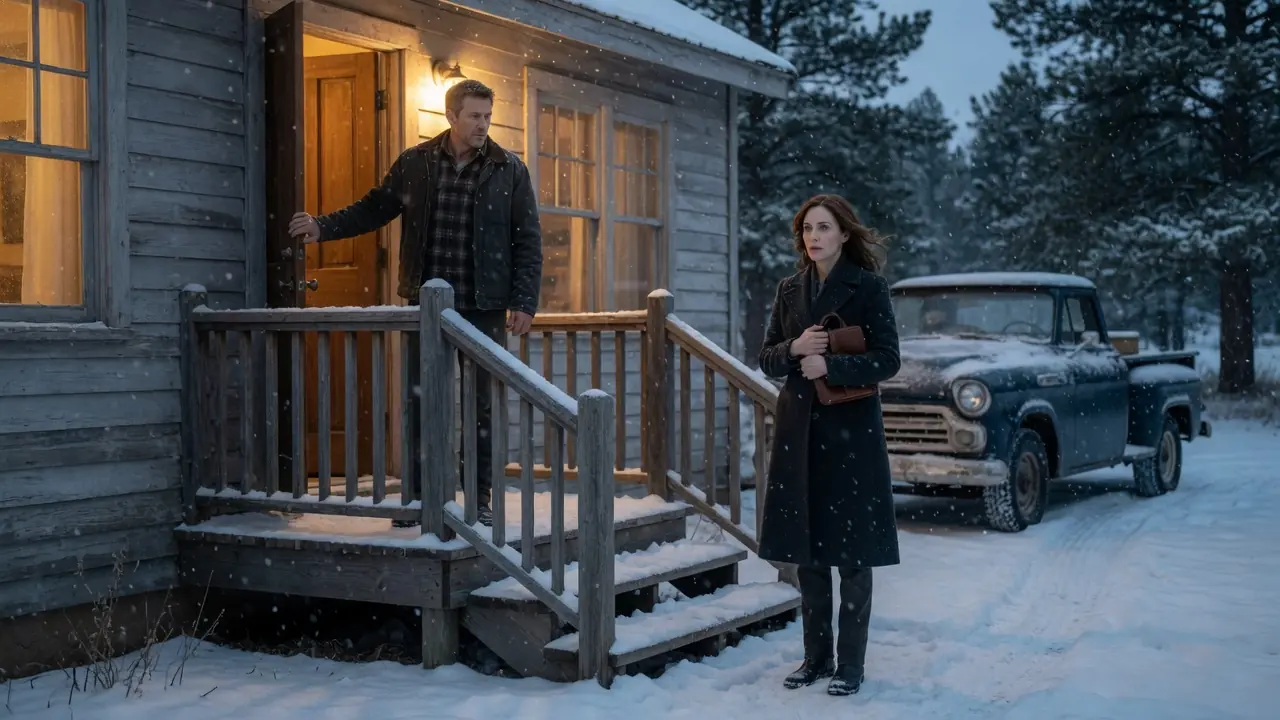
Holden stood on the porch, coffee in hand, old flannel against the cold. He did not move. He did not call the sheriff. He did not step inside.
The front door opened behind him. The woman walked out and stood beside him.
She said nothing.
The lead vehicle’s door opened.
A man in a dark suit crossed the gravel and stopped.
“It’s been a long time.”
None of them knew how the morning would end.
Some mornings rewrite a life.
This was one of them.
What those Range Rovers came for was not what you think.
The night before, it began the way most days in Silver Creek did, with a drive Holden had taken so many times he could feel the curves of the road before they came.
He had been in Boulder since dawn, delivering a rebuilt transmission to a client who paid in cash and asked no questions.
Wren had stayed at her Aunt Lala’s since morning. That was the usual arrangement when Holden had a long job. Wren would help Lala at the diner, eat too much pie, and go to bed in the back room that still smelled of cedar shavings.
Holden had planned to drive home that evening and pick her up the next day.
He had not planned for the storm.
The clouds came in low over the Front Range by 3:00 in the afternoon. By 4:00, the National Weather Service had moved the warning forward by six hours. By 5:00, the snow had begun to slant sideways across the windshield of his old pickup.
He gripped the wheel a little tighter and chose the shorter way home, the Silver Creek Pass, knowing the gate at the summit would close before 9:00.
He almost did not see the sedan.
It was parked at an angle on the shoulder near the second switchback. Hazard lights pulsed weakly against the snow.
A black late-model sedan, expensive, the kind that did not belong on this road.
The driver was outside, standing with her back to the wind, a tire iron in her hand, and an empty trunk behind her.
Holden slowed, pulled in 20 feet ahead, and stepped out.
The woman stood straight. She watched him approach without moving.
She had the posture of someone more accustomed to giving instructions than receiving them.
And her first words confirmed it.
“I have called for assistance,” she said. “It is on the way.”
“No, it isn’t.”
“Excuse me?”
“The pass closes in 20 minutes. You won’t reach anyone for 60 miles.”
She glanced down the road, then back at him.
“Then I’ll wait for the road crew.”
“Road crew won’t come up tonight.”
She measured him for a long moment.
The snow had begun to settle on her shoulders. The temperature was dropping fast. Holden could feel it through his jacket.
“My name is Holden Carver,” he said. “I live four miles down. You can sit in my truck while I bring you down the mountain. After that, the choice is yours.”
She did not give her name.
She nodded once, walked to her car for a small leather bag, and locked the sedan behind her.
The drive home was silent.
The signal on her phone died inside the first mile.
Holden did not ask her name, and she did not offer one.
They watched the snow come down through the wipers.
At the house, the old retriever lifted her head from the rug, sniffed once, and went back to sleep.
Holden heated leftover bean soup on the stove.
They ate at the small kitchen table and spoke perhaps eight sentences between them about the storm, about the road, and about the way the pipes behaved when the temperature dropped below zero.
She used a spoon the way someone uses a fountain pen.
He noticed and said nothing.
He made up the bed in his daughter’s room and laid out two clean towels.
He took the sofa himself.
The pistol stayed in the locked drawer in the kitchen.
And he listened to the wind until he fell asleep just past midnight.
The house was warm from a stove she had not heard him feed.
Somewhere outside, an owl was calling its last call of the night.
She lay still for a moment, taking the room in.
Children’s books on a low shelf.
A stuffed fox missing one eye.
A small lamp shaped like a crescent moon.
Then she rose and walked out into the front room.
There were no military photographs on the walls. No medals in shadow boxes. No flag folded into a triangle.
The mantel held only a framed picture of a woman in her 30s, laughing at something off camera.
The bookshelves held novels and field guides.
On the lowest shelf, a thick spiral-bound ledger had been read so many times the cover was beginning to come apart at the spine.
But the woman who had not given her name noticed other things.
The sightlines through every window were clean.
The door to the kitchen could be closed from where he had slept on the sofa.
The pistol drawer, when she passed the kitchen, had a small lock she had not seen on a kitchen drawer before.
The man who lived here had built a quiet house with the habits of someone who had once needed to know which door he could see from which chair.
She did not draw a conclusion.
She simply noted it.
Holden came in from outside with snow on his shoulders and set a mug of black coffee on the counter in front of her without a word.
“Thank you,” she said.
He nodded once.
Her phone lit up on the table between them.
She had two bars again.
The screen showed 47 missed calls.
She picked up the first one that came in live.
“Ms. Halberstam, oh, thank God. Ms. Halberstam, we’ve been searching all night. Camera at the truck stop in Lyons caught your car at 6:42, and the GPS pinged once after the slide. The team is 30 minutes out.”
She looked at Holden across the rim of the coffee mug.
“Thank you, Renata,” she said into the phone. “I’m safe. Tell Decker to come in slow.”
She set the phone down.
Holden was still standing where he had been, watching her, expression unreadable.
“My name is Maren Halberstam,” she said. “I am the chief executive of Halberstam Aero Logistics. The man bringing my security team is named Decker. I owe you an explanation I do not yet know how to give.”
He nodded once.
Just once.
He did not ask a question.
He did not move.
The first engine reached the top of the road 16 minutes later.
Then another.
Then 10 more, and 10 after that.
Holden walked out onto the porch with the coffee still in his hand.
He did not flinch when the half circle closed around the house.
Maren stood at the kitchen window and listened.
The lead door opened.
Boots on gravel.
A voice she did not recognize, lower and softer than she had expected, came in through the gap of the front door.
Five words, spoken to the man on the porch.
“It’s been a long time.”
She walked out.
The man in the suit had not yet looked at her.
He was looking at Holden.
And Holden was looking back at him with the expression of a man who had been waiting 12 years to see this face again.
For the first time in her adult life, Maren Halberstam did not know whose house she was standing in.
Decker turned to her then.
“Ma’am, we need to get you inside.”
She looked at Holden.
He gave the smallest nod she had ever seen a man give.
She went in.
The question she had not asked went in with her.
Decker stood at the kitchen counter with a leather folder open in front of him.
Three of his men had spread across the property, and the rest had pulled back to the perimeter road.
The half circle was no longer a threat.
It was a wall.
“Forensics on the sedan came back 20 minutes ago,” he said. “Brake line was cut clean. Three-quarter slice designed to fail under load, not at idle. Steering linkage tampered with at the column.”
“Same vehicle?” Maren said. “Two failures?”
“One event.”
Maren sat at the table. She was wearing the same wool coat from the night before because she had nothing else with her.
“Route?” she said.
“Changed at 15:30 yesterday. The original driver was reassigned at 15:35. The replacement called in sick at 16:10. By the time you got in the car, you were on a road no one in our system was tracking and behind a wheel that was going to come apart.”
“Who approved the change?”
“Garrett Vance.”
She closed her eyes for a moment.
When she opened them, she was looking at Holden, who had been standing at the far end of the kitchen, with his arms crossed and his face very still.
“Decker,” she said, “how do you know him?”
Decker glanced at Holden.
Holden gave him nothing.
Decker spoke carefully.
“I served under Mr. Carver in a unit that doesn’t appear on any organizational chart you’d have clearance to read, ma’am. He left the work 12 years ago. I am answering your question only because he has not told me to stop.”
Maren let the answer settle.
She did not press.
There was a longer conversation here, and it would happen on a different day, in a different room, when she had the right to ask.
She turned back to Decker.
“The pattern. The brake line cut. The route swap. The driver swap. Have you seen it before?”
Holden took half a breath and looked at the floor.
It lasted less than a second.
Maren saw it.
Decker saw it.
Neither of them said anything.
“Once,” Decker said. “Twelve years ago. A different name on the file.”
He did not say whose.
Maren did not ask.
She was beginning to understand, slowly, that there were several conversations going on around her that she was not yet a party to.
She set her hands flat on the table.
“Decker, I run a defense logistics company with 11,000 employees and a chief operating officer who arranged my death. I do not know who in my organization is clean. If I return to Denver, I return to a building I cannot trust.”
“Recommend you stay here, ma’am. Seven days. We map the threat. We isolate the cells inside the company. We move when we know the ground.”
“And Mr. Carver?”
“He has not been asked, ma’am.”
Maren looked at Holden.
Holden looked back at her.
He did not say yes.
He did not say no.
He simply did not move toward the door.
“Seven days,” she said.
Late in the afternoon, the snow finally stopped.
A red truck came up the road and parked behind one of the Range Rovers.
A small woman in a flannel coat got out, holding the hand of a child of perhaps eight, whose hair was the same color as Holden’s.
The child carried a small canvas bag and a brown stone the size of a robin’s egg.
Wren stopped on the porch and looked up at the woman she did not know.
“This is for you,” she said, and held out the stone.
Maren took it.
She did not know why.
She turned it once in her hand, then put it in her pocket, and kept it there for the rest of the day.
Three days passed.
The convoy did not stay in formation.
By the second morning, the Range Rovers had broken into smaller cells.
Two at the diner.
Two at the fire road junction.
One at the trailhead where the pass met Forest Service Road 17.
The rest tucked behind a screen of pines on a parcel of land Decker had quietly leased from a rancher by Thursday afternoon.
The town noticed, but did not ask.
Silver Creek was the kind of place where strangers were observed and then allowed to be strange.
Decker took the corner booth at Lala’s Diner and made it his command post.
He drank coffee black, ate pancakes once a day, and ran his radio from a small earpiece that no one in the diner pretended to see.
Lala refilled his cup without comment.
Holden ran his own perimeter separately.
He went to the garage at 6:00 every morning and was not back until 11:00.
Maren understood by the second day that he was not actually working on engines.
She had seen him walk past the kitchen window with a notebook in his hand, then drive to the gas station at the edge of town, then drive back 20 minutes later.
She had seen him stop at the sheriff’s house.
Burl Tannehill, 60 years old and silver-haired, had grown up two ranches over. Holden stayed there for 40 minutes.
She did not ask.
He did not explain.
They had reached, by some unspoken protocol, an arrangement in which she understood the shape of what he was doing, and he understood that she understood.
She worked from his kitchen table.
She negotiated an aerospace logistics contract worth $1.3 billion while wearing a borrowed cardigan Lala had brought over on the second morning with the words, “Cold up here. Don’t ask me where it came from. It fits.”
Maren had thanked her and put it on.
Lala had not stayed for coffee.
The cardigan smelled faintly of cedar.
On the third afternoon, Wren came home from the diner with a small spiral notebook.
She climbed onto the bench at the kitchen table next to Maren and opened it without asking, the way a child opens a book in front of a person they have decided to trust.
“This is a junco,” she said. “This one is a chickadee. This one is a mountain bluebird. But I only saw it once.”
Maren turned the pages slowly.
The drawings were careful, not particularly good, and entirely hers.
There was no refrigerator art here.
The child kept her drawings in books.
“What is this one?” Maren asked, pointing.
“A nuthatch. They walk upside down. Upside down on the tree, headfirst going down. They are the only ones.”
Maren nodded gravely.
Wren leaned her arm against Maren’s arm and stayed there for the next 12 pages.
That evening in the kitchen, Maren was pouring a second cup of coffee when Holden came in from the cold.
He reached for the pot at the same moment she did.
The backs of their hands touched against the handle.
Neither of them moved.
Neither of them pulled away.
The pot finished its pour.
He stepped back.
She set her cup down on the counter and lifted it to her mouth.
Across the street in the diner window, Lala lowered her dish towel slowly, turned to the row of clean glasses, and began polishing the one that did not need polishing.
She did not look up again for a long time.
He came in three black SUVs on the fifth morning.
Garrett Vance had pulled the location data from Maren’s company phone, a privilege of his office that he had been quietly using for 36 hours before he committed to the drive.
He brought two attorneys, one board member named Howell with a long history of doing whatever Vance told him to do, and a private psychiatrist who had been compensated handsomely never to read a chart out loud.
Holden’s address was not in any of their files.
Vance went to the diner instead.
Silver Creek had only one.
He sat down in a booth, ordered nothing, and waited.
Maren arrived 20 minutes later in the borrowed cardigan, with Decker behind her and two of his men outside the door.
She sat across from Vance and folded her hands on the table.
“Garrett.”
“Maren. Thank God. I’ve been worried sick.”
“Have you?”
“You’ve been off-grid for five days. There are rumors. The board is concerned. Howell came up at my request. I brought Dr. Mills because I wanted to be sure you were…”
“Do you have a court order?”
Vance’s smile faltered for half a second.
He recovered.
“Maren, this is not…”
“Do you have a court order, Garrett? Yes or no?”
“No.”
“Then I am not required to speak with Dr. Mills, with Howell, or with you. I am the chief executive officer of this company, in full possession of my faculties, and on personal leave by my own arrangement. You have driven a long way to find that out.”
Vance leaned forward.
His voice dropped half an octave.
“There is a provision in the bylaws, Maren. Emergency conduct. If three board members sign…”
The bell over the diner door rang.
Sheriff Burl Tannehill stepped inside, tipped his hat at Lala, and walked to the booth without raising his voice.
“Mr. Vance, your three vehicles are blocking the entrance to my diner. I’d ask you to move them or take this conversation back to wherever you came from.”
Vance opened his mouth.
“I won’t say it twice, sir.”
Vance stood.
The attorney stood.
Howell stood.
The psychiatrist gathered his coat and did not meet anyone’s eyes.
They filed out into the morning light.
Holden was sitting at the counter on the third stool from the door.
He had been there since before Vance arrived.
He had not turned his head once during the conversation.
He did not turn it as the door closed behind them.
The convoy left town inside the hour.
But it did not leave clean.
By that evening, two listening devices had been planted.
One in the eaves of the diner.
One in the public phone box outside the hardware store.
A man named Kurt Dolan, who had done 18 months for assault and held a grudge against Holden from before the conviction, was paid in cash to keep eyes on the garage.
And by midnight, three financial newspapers were running variations of the same headline.
CEO Off-Grid in Mountain Town: Sources Inside Halberstam Aero Cite Concern Over Influence of Local Stranger.
The story moved fast.
By noon the next day, it had been picked up by four cable outlets.
In the back kitchen of the diner that night, Lala was wiping down the counter when her cell phone rang.
The number was unlisted.
She did not give the number to anyone.
She answered on the third ring.
“Lala, it’s Dorothy Ann. I just saw Garrett Vance’s name on the news.”
Lala set the rag down.
“Ann left something with me,” Dorothy said, “to tell you when the time came. The time has come.”
Lala did not answer for a long moment.
Then she walked into the storeroom, knelt by the bottom shelf, and pulled out a sealed manila envelope that had not been touched in 12 years.
Lala drove out to the house just after 7:00 the next morning.
Holden was already at the garage.
Decker’s truck was at the diner.
Wren was eating cereal in front of the small television in the den.
Lala parked, climbed the porch steps, and knocked once.
Maren opened the door.
“Walk with me,” Lala said.
They went along the cleared path to the woodshed and stopped where the trees thickened.
The snow had a hard crust on it now.
Lala held the manila envelope against her chest with both hands.
“Ann left this with me 12 years ago,” she said. “She told me to keep it dark until one of two things happened. Either the man who did it came back, or someone else turned up at the right door asking the right kind of questions.”
“She…”
“You,” Lala said. “I would know who. She told me the name of the company. The name was Halberstam Aero Logistics. She said someone would come who’d been put on the same road she was put on. She said when that happened, what was hers became theirs. She said I was the keeper, not the owner. Twelve years I have kept it for her. You are the owner now.”
Lala held out the envelope.
Maren took it with both hands.
“Holden doesn’t know,” Lala said. “She made me promise. She said he would carry it as guilt and never be free. She said someday she would give it to someone who could finish what she started. And that person would be the one to choose whether he ever heard about it.”
“Lala…”
“I’m not asking you to choose now. I’m asking you to watch what’s in there.”
She walked back to her truck without another word and drove away.
Inside the envelope was a small black thumb drive and a single sheet of folded paper.
The paper said:
Whoever you are, please.
A.
Maren sat alone in the front room with Holden’s laptop on her knees.
She inserted the drive.
A single video file opened.
A woman in her 30s sat in a kitchen.
Maren recognized this kitchen, 12 years younger.
Her hair was tied back. She had reading glasses pushed up on her forehead. She was looking directly at the camera.
“My name is Ann Carver. I am a forensic accountant under contract with the Office of the Inspector General. I am recording this because I do not believe I will finish the work I have started. And I want what I know to outlive me.”
She spoke for 40 minutes.
She named 17 shell companies. She gave bank routing numbers. She gave dates.
She said the name Garrett Vance only once near the end, and only as an associate who appeared repeatedly in the auxiliary chain.
She named his predecessor, a man whose name Maren had heard her father say at a board meeting when she was 23 years old.
She read three account numbers and the institution they were held in.
She named a pattern of vehicle interference used to remove inconvenient witnesses.
Brake line.
Steering linkage.
Route swap.
Driver swap.
She said she had been followed home twice in the last month.
Near the end, she looked at the camera and said, “If you are watching this, it means I did not make it. This network does not die with one person. It looks for a successor. My husband has no proof. I hid it to protect him, but if you are standing where I once stood, then this is yours.”
She paused.
“Tell Lala she was a good sister. Tell Holden I loved him. Tell whoever you are to be careful.”
The video ended.
Maren’s hand was very still on the trackpad.
Then it began to shake.
Then her shoulders began to shake.
She did not make a sound.
She had not cried in 10 years.
And she did not cry loudly now.
She wept the way some people pray.
Outside on the porch, Lala had not driven away.
She had pulled the truck around the back of the property, walked up to the steps, and sat down on them.
She was waiting in the cold without going in.
Maren showed him the drive that evening.
She had thought for an hour about not showing him at all.
Lala had said the choice was hers.
But Maren Halberstam had not built a billion-dollar company by lying to the people she had begun to need.
He sat at the kitchen table while she queued the file.
He did not ask what it was.
He looked at her face and understood that whatever it was, it would not be small.
He watched the entire 40 minutes without moving.
When the video ended, he sat with his hands flat on the table and his eyes on the wall behind her shoulder and did not speak for what felt like a very long time.
Five minutes, maybe more.
Then he said very softly, “I always thought she had something. I never had the proof.”
He paused.
“You just brought her back to me.”
He did not thank her for the company.
He did not thank her for the warning.
He thanked her for finishing something his wife had begun.
Maren nodded once.
She did not say what she was feeling.
She did not have a word for what she was feeling.
She closed the laptop.
She opened it again.
She set it between them.
“Then we finish it.”
They sat at the kitchen table until well past midnight.
Decker came in at 10:00 and stayed.
Maren used her authority to issue a subpoena from the office of the chief executive for a forensic audit of Halberstam Aero’s auxiliary contracts.
She authorized Decker to share the substance of Ann’s drive with three named federal investigators by name and by clearance level.
She drafted a private letter to two members of the board she had reason to believe were clean, instructing them not to act on anything until she returned.
Holden made one call.
He picked up his old phone, scrolled to a name he had not dialed in 11 years, and pressed the green key.
He spoke for nine minutes in a voice Maren had not heard him use.
When he hung up, he looked at her and said, “He knew Ann. He retired four years ago. He’s coming out of retirement for this. He’ll meet us in Denver.”
Vance moved at the same time.
By 2:00 in the morning, his lawyers had filed an emergency motion with the Halberstam board, requesting an immediate competency hearing and a 72-hour temporary removal of Maren from her position pending evaluation.
The filing cited her extended absence in an unknown rural location, her altered communication patterns, and concerning third-party influence.
Maren read the motion as it came across her screen at 2:11.
She did not blink.
“He’s playing his hand,” she said.
“He’s going to lose it.”
Wren came down the hall in her pajamas at quarter past 2:00, woken by the lamps.
She did not understand the words on the table.
She understood the faces.
She walked over to Maren without saying anything, put her arms around her neck, and laid her head against Maren’s shoulder for 10 seconds.
Then she walked back down the hall to bed.
Maren sat very still for a long time after the door closed.
Just before 3:00, Holden stood up to look at a line of bank routing numbers on her screen.
He came around the table and leaned over her shoulder.
His hand braced on the back of her chair. His face was close to her ear.
He pointed.
“That one. That’s the same account she named.”
She turned to look up at him.
Their faces were perhaps eight inches apart.
Neither of them moved.
Neither of them spoke.
Decker knocked once on the kitchen door, hard, with a folded printout in his hand.
They straightened at the same instant.
Holden took the printout.
Maren opened a new spreadsheet.
Neither of them said anything about it.
Both of them knew it had happened.
The board meeting was set for 10:00 the next morning in Denver.
Maren drove herself in her own car with Wren asleep in the back and Holden in the passenger seat, a soft case across his lap containing a copy of Ann’s drive and 140 pages of cross-referenced audit material.
Decker followed in a separate vehicle with two of his men.
The rest of the convoy stayed in Silver Creek.
The Halberstam Aero Tower in downtown Denver was 47 stories of dark glass.
Maren had not slept since the night before.
She did not look at it.
They left Wren on a long upholstered bench in the executive reception area with a coloring book.
The receptionist promised to keep an eye on her, and Holden sat beside her in a dark jacket and the only button-down shirt he owned.
He had no intention of going into the room.
Maren went in alone.
Vance was already at the table.
Howell was there.
Eleven other board members. The company’s general counsel. A court reporter at the corner who had been retained by the company some hours earlier on Vance’s instruction.
Maren set her materials down at her place at the head of the table and did not bother to sit.
“We have a number of items on the docket this morning,” she said. “Mr. Vance’s motion of yesterday at 2:11 a.m. is one of them. Mine is the other.”
She began with the audit data.
She moved through Ann Carver’s drive without naming Holden by anything other than the source.
She presented the brake line pattern, the route swap, the driver swap, and the seven independent forensic reports Decker had pulled together overnight.
She presented the bank routing numbers and the 17 shell companies.
She named the predecessor.
Forty minutes in, Vance interrupted.
“Madam Chairman, I have a document I would like entered into the record.”
He slid it across the table.
Howell picked it up.
The general counsel read it.
It was an affidavit, four pages signed and notarized.
It alleged a long-running confidence scheme by one Holden Carver to attach himself romantically and financially to female executives of major defense firms.
It contained dates, locations, and the names of two previous victims.
Maren took it without expression.
“May I have four minutes to review?”
She handed it to a forensic analyst Decker had quietly placed in the room.
The analyst opened a laptop, ran two checks, and looked up.
“The document’s metadata shows a creation time of 03:15 this morning. The notarial seal is from a Nevada notary whose license was revoked in 2023. The signer of record does not exist in any Halberstam Aero personnel file under any spelling. This document was generated by Mr. Vance’s office between 3:00 and 4:00 a.m.”
Maren slid the affidavit back across the table.
“Next item.”
Vance did not look at her again.
Holden was called in only once for technical confirmation of the vehicle pattern.
He was vouched for by Decker and by a partial declassification request that the federal investigator on Holden’s call had filed the previous afternoon.
He stood at the foot of the table.
“The interference pattern is known to my office as Pattern Tanner Three. I observed it for the first time in 2013. The victim was Ann Carver.”
That was all he said.
He sat down.
The board voted.
Vance was removed by 12 to 0 with one abstention.
The matter was referred immediately to federal prosecutors.
Maren gathered her materials and walked out.
Wren was asleep with her cheek on the coloring book.
Holden picked her up without a word.
Maren walked beside him to the elevator.
In the parking garage, Decker pulled a second sealed envelope from his inside pocket.
“Ma’am, Ann left a second one. Not for you. For whoever came after the one she expected. I don’t know that name either. You can open it when you’re ready.”
Maren took the envelope.
She did not open it.
She held it against the same coat she had been wearing for six days.
She put it in her bag and got in the car.
Four days later, the temperature climbed above freezing for the first time in 11 days, and the snow on the roof began to drop in soft wet thuds along the porch line.
Maren had not driven back to Denver.
She was running the company from Holden’s kitchen table because the kitchen table was where the work had become possible.
The federal investigators arrived in town on Tuesday.
By Wednesday afternoon, three additional Halberstam Aero employees had been placed on administrative leave.
Two had retained counsel.
One had agreed to cooperate.
The story moved off the financial papers and onto the federal docket.
Maren took afternoons off.
She walked into the woods with Holden on Wednesday and again on Thursday.
They did not talk much.
The trail was narrow, and the silence was an honest silence.
On Thursday, where the trail dipped and a thin layer of ice still held under the snow, she lost her footing for half a second.
Holden caught her by the hand to steady her.
He did not let go when she was steady.
She did not pull away.
They walked the next quarter mile that way, neither of them looking at the other.
On Friday, Wren asked Maren to come sled with her on the slope behind the house.
The sled was a battered red plastic thing with a frayed nylon rope.
Maren sat on it with Wren in her lap and pushed off the top of the hill.
They went down twice.
The second time, Wren laughed a high, surprised laugh that broke into the cold air like something living.
Maren laughed, too.
She had not laughed that way in three years, since her father, very quietly and very privately, had failed to wake up one morning in his apartment in Boston.
She did not know she still had that laugh.
She had it now.
She laughed twice, and then she laughed once more, and Wren said, “Again.”
They went down again.
That night at the diner, Maren sat at the counter and ate a slice of cherry pie she had not ordered.
Lala had simply set it in front of her with a fork and walked away.
Toward closing, when the diner had emptied, Lala came back to the counter and stopped across from Maren.
She set down the dish towel she had been carrying for an hour.
“Ann would have liked you.”
That was all she said.
Maren felt the water rise in her eyes.
She did not cry.
She nodded once, very slowly, and looked down at the pie.
When she looked up again, Lala had moved on to wipe down the booths.
On Sunday morning, Maren drove back to Denver in her own car.
She did not say when she would return.
Holden did not ask.
Wren stood on the porch with a stone in her hand, a different stone, a small black one shaped like an arrowhead, and gave it to Maren through the rolled-down window before she pulled away.
Maren put it in her pocket next to the first one.
She kept both there all the way to the city.
Spring came late to Silver Creek that year, the way spring always did at altitude.
But by the second week of April, the snow had retreated to the shaded hollows, and the creek had begun to run high under the bridge by the diner.
Maren had not restructured the company.
She had not moved corporate to a mountain town the way the trade press had briefly speculated she might.
She had stayed CEO.
She had stayed in Denver during the week.
What she had done was buy a small four-wheel drive she could drive herself, and on Friday afternoons, she got in it without a security detail and drove the 90 minutes up the pass to Silver Creek, where she stayed until Sunday night and worked remotely the rest of the time.
Holden had not reopened any old office.
He was still a mechanic.
He had taken one consulting call in February and one in March, both from people he had once worked with, both on terms he had set, both done from his garage with the door closed.
He had not gone back to Denver.
Wren had begun, sometime in the second week, to call Maren “March.”
She did it without thinking.
The first time it happened, Holden was bent under the open hood of a customer’s truck with a wrench in his hand.
He paused for half a second.
Then he kept turning the bolt.
He did not say anything.
On a Sunday in mid-April, the last of the porch snow was sliding off the roof in slow, uneven drops.
The sound it made on the railing was a quiet, almost musical thing.
Holden carried two cups of coffee out from the kitchen and handed one to Maren, who was sitting on the top step in a flannel of his she had stopped giving back.
Their fingers touched against the handle.
This time, neither of them pulled away.
She did not look up.
He did not look down.
They sat with the coffee between them and watched the slow, steady drip of melt from the eaves onto the railing.
Drop after drop, like something patient that had taken its time getting here.
Inside the house, through the open door, the small scratching sound of a colored pencil on paper meant Wren was drawing.
She had moved on from sparrows.
She was working her way through the warblers now, and she had told Maren on Friday night that she was going to draw every one of them by the end of summer.
Maren had agreed to help name them.
Holden set his coffee down on the step beside him.
“Stay through dinner,” he said.
It was not quite a question.
“I will.”
That was the whole conversation.
The sun moved an inch lower in the sky.
A truck passed on the road below the house.
Somewhere in the trees, a chickadee began to call.
Maren reached into her coat pocket and felt the two stones there.
The brown one and the black one.
Both still where she kept them.
Neither of them had been looking when it happened.
Neither of them had asked for any of this.
But neither of them would let it go now.