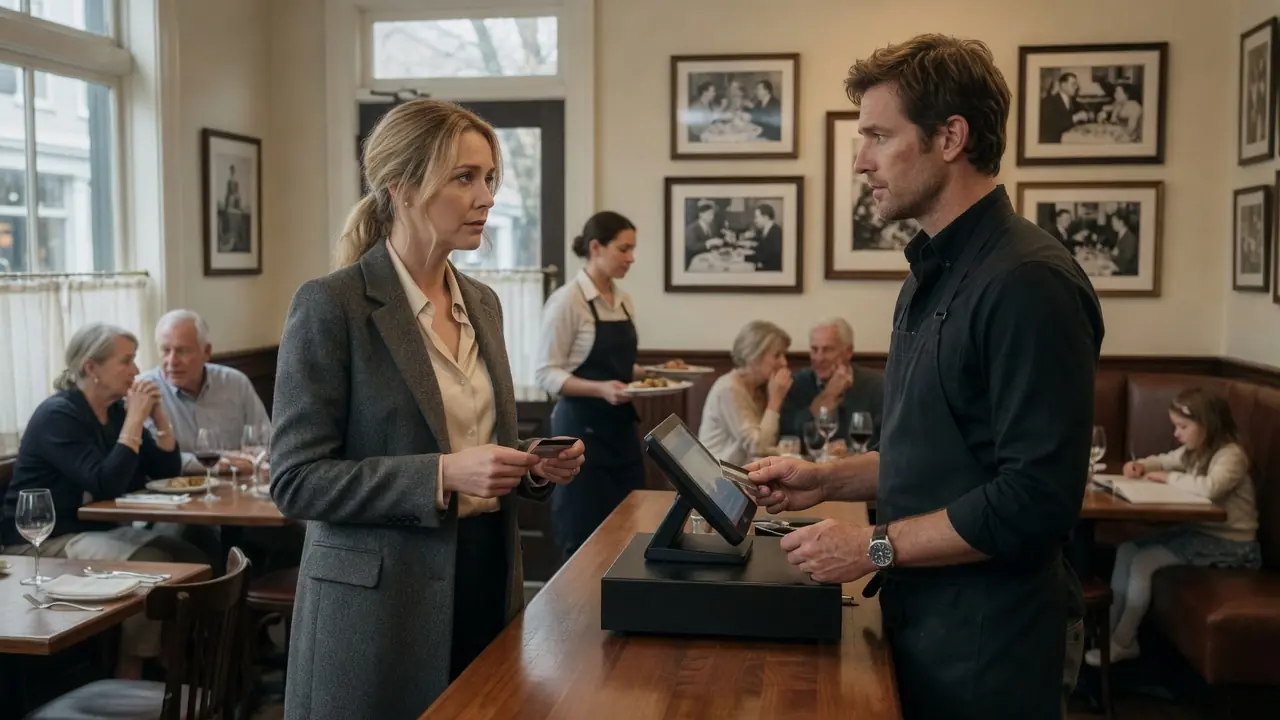
The card reader beeped twice.
Red light.
The manager at Marlowe’s Table frowned and slid the black card back across the counter.
Margot Sterling stared at it for a long second. The couple at the next table turned their heads. 7:42 on a Tuesday. The room too quiet.
“I can’t afford this,” she whispered.
Four words, broken at the edges.
Hayes Marlowe stepped out from behind the counter, tapped his own card on the reader, and said to the manager, “It’s covered. Don’t make a thing of it.”
He didn’t look back at her.
She looked up.
Something broke.
Margot moved to the corner table without looking at anyone. She sat down slowly, the way people sit when they’ve already decided not to cry, and pressed her palms flat against the wood until the trembling stopped.
The bistro went back to its own quiet rhythm. Forks against plates, low conversation, the hum of an old refrigerator behind the bar. Whatever moment had broken the room a minute ago had already been folded away by the regulars who understood that some things were not to be discussed.
Hayes came over without a word. He set down a small white cup of coffee and a glass of water with no ice. He did not ask if she needed anything else. He did not look at her face. He turned and went back behind the counter and began wiping down the espresso machine with a folded cloth.
Margot watched the steam rise off the cup.
Thirty-six hours since she had slept.
She had flown out of Teterboro at 4:00 that morning under her mother’s maiden name, paid cash for a small rental car at the Charleston Airport, and driven straight into the city with no plan except an appointment at 9:00 the next morning with a private attorney on East Bay Street.
At 4:00 in the afternoon, somewhere over the Carolinas, every credit card in her name had been frozen.
No notice. No call. Just the cold confirmation when she tried to pay for gas outside Columbia.
She had walked into Marlowe’s because the sign looked warm and she had not eaten in a day.
A small voice broke the silence at her elbow.
“Daddy says don’t bother the lady.”
Margot turned her head.
A girl of seven stood there in a green sweater with a workbook pressed against her chest and a pencil behind her ear, the way an adult might wear one. Brown hair, serious eyes.
“You’re not bothering me,” Margot said.
“Okay,” the girl said gravely.
Then she walked over to the next table down, sat in the booth, and opened the workbook. She did not look up again.
Margot smiled for the first time in three days.
It surprised her. She felt the smile travel up into her eyes, and then leave just as quickly, the way a window opens and closes.
Behind the counter, Hayes was working through a routine that had clearly been built over years. He counted the till, refilled the napkin holder at the bar, and joked quietly with an older man at the end of the counter who was finishing a glass of red wine.
The older man, whom Hayes called Mr. Devereaux, said something about a high school football game, and Hayes laughed once, short and real.
Margot watched him pull the tip jar toward him and divide the bills into three small stacks, not two.
She did not know what the third stack was for. She noticed the watch on his wrist was old and steel and not expensive. She noticed his hands were a cook’s hands, scarred along the knuckles. She noticed the way the waitress thanked him with her eyes when he handed her one of the stacks.
There was nothing wrong with any of it.
There was simply too much care in the room for a small bistro on Queen Street at 9:00.
She stood up and left a folded twenty under the saucer that she had no way of paying back yet.
She walked past the counter toward the door. She did not say thank you. She could not find the word.
Hayes nodded at her as she passed. He did not watch her go.
She was back at 6:45 the next morning.
The door was unlocked, but the open sign had not been turned around yet. Hayes was at the espresso machine, his back to the room, in a clean black apron. The smell of butter and yeast filled the front of the shop.
Margot placed a thick envelope on the counter.
“I’d like to settle last night and tip whoever was working the floor.”
“I’d have done it for anyone. Keep it for the lawyer.”
“It isn’t charity if I pay it back.”
“It isn’t a debt if I didn’t lend it.”
He turned the espresso machine off, dried his hands on the side of the apron.
“Sit. I’ll bring you something.”
She sat at the same corner table.
He brought her black coffee, a slice of brown toast, and a single soft egg in a small white cup. He sat down briefly across from her, which surprised her, and then stood again as if he had thought better of it.
“Weather’s supposed to turn,” he said. “Rain by Friday.”
“I might be gone by Friday.”
“Might.”
She drank the coffee. He stayed long enough to make sure she actually ate, then went back to the kitchen.
She listened to him moving around behind the swinging door the way she used to listen to her father moving around the kitchen on weekend mornings when she was small.
“Six years,” he said when he came back with the pot. “I’ve been here six years this summer.”
“From where?”
“Up north,” Hayes said, and that was all he said.
She finished, paid in cash from a small fold in her coat, and stood. She walked toward the door slowly, her eyes drifting across the framed photographs on the back wall.
Old Charleston, a football team from 1978, a black-and-white shot of three men in chef’s jackets behind a long table.
She stopped.
The man on the left was Hayes, ten years younger, hair darker, eyes the same.
Above the photograph, set into the wood of the frame, was a small brass plaque that read:
Brier and Stone Hospitality Group, Founders Dinner, 2015.
Margot did not move for a long moment.
Brier and Stone.
Her father had spent three years trying to get a meeting with Brier and Stone. Her father had kept a copy of their employee charter in his desk drawer. Her father had said the name Hayes Marlowe at a dinner once, in passing, the way other men spoke about senators.
Hayes Marlowe had sold his entire stake in 2020 and walked away.
The financial press had called it the cleanest exit in modern hospitality.
No one had seen him since.
She did not turn around. She did not say anything. She set the breakfast menu, which she had been holding without realizing it, gently down on the next table.
Then she walked out.
On the sidewalk, she stopped, looked up at the wrought iron balcony across the street, and thought one sentence very clearly.
My father talked about this man.
Inside the bistro, Hayes stood at the front window and watched her cross Queen Street, turn the corner at Broad, and disappear.
He stood there a full minute after she was gone.
Then he walked back to the wall, lifted the founder’s photograph off its hook, wrapped it carefully in a sheet of yesterday’s newspaper, and slid it into the bottom drawer of his office desk.
He closed the drawer slowly.
He locked it.
He had been recognized once in six years. He had hoped it would not happen this way.
The lawyer’s office on East Bay Street smelled of old paper and pencil shavings.
Margot sat in a leather chair across from a woman in her fifties named Eleanor Pace, and listened as Pace explained that the emergency motion Spencer had filed in New York had been continued five days. The board would not meet until the following week.
Five days.
Margot had brought two.
She found a small studio for rent three blocks from Marlowe’s, paid the deposit in cash from a wire Theo Bishop had routed through his personal account, and moved in with a single overnight bag.
There was a coffee maker she did not trust, and a window that looked out on a side garden full of wisteria.
She went back to the bistro the next morning, and the morning after, and the morning after that.
By the third morning, when she pushed open the door at 6:45, the coffee was already poured, the brown toast was already on the plate, and a soft egg was already in the small white cup on the corner table.
Hayes did not say anything about it. He nodded once and went back to the kitchen.
She did not say anything either.
She sat. She ate. She read the local paper.
She did not tell him she was staying.
He knew.
She could tell he knew. Not the details, the shape of it. A woman who showed up at the same table at the same time with the same order was a woman who had nowhere else to be.
On the fourth morning, between her second cup of coffee and his rounds of the floor, Hayes paused at her table.
“There’s a man named Harold Sims. Runs a small practice on East Bay. Real estate. Tenant rights. He’s a friend.”
Hayes set a folded napkin on the table. A phone number was written on it in pencil.
“If you need any long-term lease advice while you’re in town, he’s discreet.”
Margot looked at the napkin. She understood immediately what it actually was.
Not real estate. A safe contact. A number she could call if something went wrong.
“Thank you,” she said quietly.
He had already moved on.
Harold Sims turned out to be a former federal prosecutor who had left Washington fifteen years earlier and now worked quietly out of a brownstone two doors down from Pace’s office.
By the end of the meeting, he had agreed to coordinate with Pace, run interference on any out-of-state subpoenas Spencer might try to issue in South Carolina, and serve as a buffer between Margot and the press if her location leaked.
It was the first piece of leverage she had assembled against Spencer in eight days.
That night, she walked back to Marlowe’s at 7:00.
The bistro was busy. She waited at the counter until Hayes came back from the kitchen.
She set a bottle of wine on the counter. Twenty-two dollars, the best a small market three blocks over had carried. She had spent ten minutes choosing it.
“You don’t have to drink it,” she said. “Just thank you.”
Hayes picked up the bottle. He read the label, turned it over once in his hand, and set it carefully behind the bar next to the register.
“I’ll save it,” he said, “for something worth opening it for.”
She did not know what he meant.
She thought she might know later.
She walked out into the warm Charleston evening and felt, for the first time since her credit cards had died over the Carolinas, that she was not entirely alone.
In New York, Spencer Halloran was running out of patience.
The bank freeze had failed to flush his sister into the open the way he had expected. She had not called him. She had not called the legal team. She had not surfaced at any of the usual addresses.
He hired a man named Carl Rennick.
Rennick had spent twelve years with a federal agency and four more in the private sector and was very good at finding women who did not want to be found.
Rennick landed in Charleston on a Wednesday morning and started with the airports, the rental car agencies, and the hotels.
By noon on Thursday, he was working the restaurants in the historic district.
He walked into Marlowe’s Table at 12:15 on a Thursday in a gray suit that did not quite fit the city. He sat at the bar. He ordered a club soda. He showed the bartender a photograph on his phone and asked, in the friendly voice of a man who had practiced sounding harmless, whether anyone had seen a blond woman, late thirties, who might have eaten there in the past week.
Hayes was at the other end of the bar drying glasses.
He did not look up.
He listened to every word.
The bartender, a young woman named Carla who had worked there two years, hesitated.
Hayes set down the glass he was drying and walked over.
“We get a lot of people through here,” he said pleasantly. “I’m sorry. I couldn’t tell you.”
Rennick studied him.
“You the owner?”
“I am.”
“You don’t recognize her?”
“I don’t recognize her.”
Rennick held the phone there a moment longer, then put it away, left a five on the bar for the club soda, and walked out into the noon heat.
Hayes finished drying the glass.
Then he went into his office, closed the door, and stood at the window for two minutes without moving.
At 4:30, Margot came in the front.
Hayes met her at the door and turned her gently back toward the side alley.
“Use the back entrance for the next few days,” he said.
He led her down a narrow brick passage between two buildings that came out on Cumberland Street.
“There was a man asking about you at lunch.”
Margot stopped walking.
The blood left her face.
“How did you know he was asking about me?”
Hayes looked out toward Cumberland, where a delivery truck was backing into a loading bay. He did not look at her.
“I’ve seen that kind of man before,” he said. “Predators always carry it the same way.”
She stood there in the narrow passage with the smell of old brick and trash bins around her, and she understood for the first time that Hayes had not given her his protection out of casual decency.
He had given it out of recognition.
“Use the back door for the rest of the week.”
That night in her studio, she opened her laptop and typed three words into the search bar.
Brier Stone hostile.
The first article was from a financial journal dated June of 2019.
Hayes Marlowe, then forty-two and chief executive of Brier and Stone Hospitality, had defeated a sixteen-month hostile takeover by a Singapore-based investment fund in the last week of his wife’s chemotherapy.
He had personally flown to three boardrooms in seventeen days.
He had won by a margin of two votes.
Sarah Marlowe had died eleven months later.
Margot closed the laptop, sat in the dark studio, and understood that the man who had told her to use the back door had once stood exactly where she was standing now.
And he had survived it.
Saturday afternoon at Marlowe’s had its own slower light.
The lunch crowd had thinned. Sun came through the front window at an angle that turned the wood floor honey-colored. A jazz record played at low volume from the speaker above the bar.
Poppy sat at a table near the back with her workbook open, and a small mess of colored pencils scattered across the place setting.
Her forehead was creased. She was trying to draw something and erasing it, trying again, erasing it again. Her bottom lip had crept out the way it did when she was about to give up.
Margot had come in around 2:00 for a late lunch and had taken the next table.
She had not planned to interrupt.
She watched the child struggle for perhaps three minutes before she leaned over.
“What’s it supposed to be?”
“The water cycle,” Poppy said, miserable. “Mrs. Halpern said it has to be neat.”
Margot looked at the workbook, a diagram half erased, arrows that didn’t connect, a cloud that had become a smudge.
“May I?”
Poppy slid the workbook across the table.
Margot took a clean paper napkin from the dispenser, smoothed it flat, and picked up the blue pencil.
She had no expertise in elementary science. She had ten years of building presentations for boards of directors who did not want to read more than one slide.
She drew a long line down the middle of the napkin. A river. Above it, a small mountain. Above the mountain, a single cloud. From the cloud, three short arrows down. From the river, three short arrows up.
Evaporation.
Condensation.
Precipitation.
Each word in small clear letters next to its arrow.
The whole diagram took her ninety seconds.
Poppy stared at it.
“That’s it,” she said. “That’s exactly it.”
“It’s the same as yours. You just need to draw the parts one at a time.”
Poppy took the napkin carefully in both hands.
“Can I keep this?”
“Yes.”
The girl bent over her own workbook and began to copy. Slower now, more deliberate. The lip had gone back where it belonged.
Behind the counter, Hayes had stopped drying the glass in his hand.
He stood there for perhaps forty seconds and watched the two of them at the table. He did not smile. He did not move closer.
After forty seconds, he turned away and let out a breath so quiet that no one heard it but him.
Margot did not look up.
But she felt the moment land somewhere inside her she had not visited in years.
She had been told, in different ways by different people, that running Sterling Hospitality had cost her something. She had not known what until she sat at a small table in a small bistro and watched a seven-year-old child copy a diagram off a paper napkin.
She had built four hundred hotels.
She had not built one of these.
Later, after the dinner rush, after Poppy had been put to bed on the long couch in the back office under a wool blanket the color of oatmeal, Hayes came and sat down at the corner table across from Margot.
“You in trouble with someone bigger than you?” he asked quietly.
Margot turned her coffee cup a quarter turn on its saucer.
“Family.”
Hayes nodded once.
“Worst kind.”
He did not ask anything else.
He sat with her for another ten minutes while the dishwasher ran in the kitchen. She understood, without him saying so, that he would only know more when she was ready to tell him.
Theo Bishop flew into Charleston on a Monday morning under a false name and met Margot in the back room of a coffee shop on Wentworth Street that he had vetted twice.
He was sixty-two, gray at the temples, and had served her father for thirty-one years. He set a leather portfolio on the table between them.
He did not open it immediately.
“I have to give you something, Margot, and I need you to listen before you ask questions.”
She sat very still.
Theo opened the portfolio. Inside were three sealed envelopes and one slim folder.
“Your father left this in a safe deposit box in Geneva. The instructions were that it be opened on your thirty-eighth birthday or in the event of any hostile movement against you. I opened the box four days ago. Your birthday is in two months. The hostile movement has already begun.”
He slid the first envelope across the table. The wax seal had been broken neatly.
“It’s a letter. Read it when you’re alone. The relevant page for today is page three.”
She lifted the letter out.
Her father’s handwriting was small and slanted and unmistakable.
She turned to page three.
It was a list.
Ten names.
Beside each name, a short notation in her father’s shorthand.
Hayes Marlowe’s name was third.
Hayes Marlowe, Brier and Stone.
Integrity untouched by money.
If he answers, listen.
Margot read the line three times. She did not move.
Theo waited until she looked up.
“Your father served with Hayes Marlowe on the International Hospitality Ethics Council from 2017 to 2019. They were not personal friends. They were not even close colleagues, but they voted together on three matters that mattered. And your father trusted the way Marlowe voted when he had nothing to gain by it.”
“He never told me.”
“He was going to. In the summer of 2019, he asked me to set up a private dinner in Manhattan to introduce the two of you. Then Sarah Marlowe was diagnosed. Marlowe withdrew from public life within ninety days. Your father set the introduction aside. He intended to revisit it the following year. He died in March.”
Margot set the letter down carefully, the way one sets down a glass that might break.
“Charleston was on your father’s list of cities he wanted you to consider when you eventually stepped down. He used to say it was a quiet place where careful people went.”
“He said that to me,” she said slowly. “Once. I was twenty-six. I’d forgotten.”
“You hadn’t forgotten. You came here.”
She did not answer.
Theo closed the portfolio. He laid his hand briefly on top of it.
“The folder contains everything else you’ll need from me for the next ten days. I have to be back in New York tonight. Spencer has Wendell Croft’s old office under surveillance, so I can’t approach him myself. If you want Marlowe’s help, you’ll have to ask him. I cannot make that approach for you. Your father wouldn’t have either.”
“Why not?”
“Because Marlowe made it clear when he left the industry that he was done answering for other people’s problems. The only thing that will move him is the truth from you in person.”
Theo left at four.
Margot walked back to her studio with the letter inside her coat. She did not open it again that day. She sat by the window through dusk, watched the wisteria move in the breeze, and slowly understood that her arrival at Marlowe’s Table had not been chance and had not been fate.
It had been a quiet line drawn by a father she had not finished mourning.
She would have to talk to Hayes that night, if possible.
She knocked at the back door of Marlowe’s at 10:30.
The kitchen light was still on. Hayes opened the door in his apron with a dish towel over his shoulder. He looked at her face for one full second.
“Come in,” he said.
He did not look surprised.
She stepped into the small back hallway. He locked the door behind her.
The bistro was empty. The chairs had been turned up on the tables. Poppy was asleep in the office, the door pulled half shut so the light from the hallway would not wake her.
“I know who you were,” Margot said. Her voice was steady. “And I think you know I’m not who I said I was either.”
Hayes did not answer right away. He turned, picked up the dish towel from his shoulder, folded it once, and set it on the counter.
“Come in the kitchen,” he said. “I’ll cook.”
He cooked spaghetti, olive oil, three cloves of garlic sliced thin, a lemon zested and squeezed, cracked pepper, salt.
He did not measure anything.
The whole meal took eleven minutes.
He set two plates on the small steel prep table in the back of the kitchen, poured the remainder of a bottle of white wine into two short tumblers, and pulled out a stool for her opposite him.
The yellow overhead bulb was low enough that the rest of the kitchen receded into shadow.
They ate for a long time without speaking.
“My wife’s name was Sarah,” he said eventually.
He was looking at his plate.
“She was forty-one. She was sick for fourteen months. I sat in a boardroom on the second of June, 2019, finishing a vote that was going to save Brier and Stone from a hostile fund out of Singapore. The doctor called my cell during the vote. I let it go to voicemail. I won the vote by two, and I walked out into the hallway and listened to the message, and she had eleven months left.”
Margot did not move.
“I sold my stake three weeks after her funeral. Took Poppy, came south. I picked Charleston because Sarah and I came here on our honeymoon, and she said it was the only city in America she could imagine retiring in. I bought this building because the kitchen reminded me of the first restaurant where I ever worked. I bought it cash. I have not been in a boardroom since.”
He set down his fork.
“What you build doesn’t matter if there’s no one to come home to.”
Margot looked at him across the small table. She did not say anything for almost a minute.
“My brother, my half brother, is trying to take the company. He’s manufactured a federal inquiry against me. The bank freeze on Tuesday was him. The man at the bar on Thursday was his. The emergency board vote is on Friday in Manhattan. If I don’t show up with evidence that the inquiry is fraudulent, the board will suspend me, and Spencer will run Sterling by Monday.”
“How long has he been doing this?”
“Three years. I didn’t see it. I thought he was harmless.”
“He isn’t harmless.”
“None of them are.”
She nodded. She took a slow breath.
“I have spent ten years thinking I was Sterling Hospitality. I have spent four days here, and I am not sure that’s true anymore. I don’t know yet what’s left of me if I take that off.”
Hayes looked at her across the table. He did not reach out. He did not say it would be all right.
He picked up the wine bottle, found a small amount still in the bottom, and poured it carefully into her glass.
She realized she was crying.
She did not wipe her face.
It was the first time in four years she had cried in front of anyone without trying to hide it.
Theo called at 7:00 in the morning.
The emergency board meeting had been moved up. Margot had seventy-two hours to be in Manhattan with documented evidence of Spencer’s manufactured inquiry.
If she came in empty-handed, three swing votes on the board would defect, and the suspension motion would pass nine to three.
She walked to Marlowe’s at 8:00.
Hayes was already at the espresso machine. He read her face and pulled two coffees instead of one.
“How long?” he asked.
“Seventy-two hours. I fly out tomorrow afternoon.”
He nodded. He set the coffees down at the corner table and sat across from her.
“You need a forensic accountant who can move on twelve hours’ notice. Independent. Not connected to any of the Big Four. Not someone any of Spencer’s people would be watching.”
“I don’t have one.”
“I do.”
He told her about Wendell Croft, former chief financial officer of Brier and Stone, who had left the industry six months after Hayes did and built a small forensic accounting practice in Atlanta that took only cases the big firms refused to touch.
Croft owed Hayes a debt from 2018 that neither of them ever talked about, having to do with a daughter and a court case and a recommendation letter Hayes had written without being asked.
“I’ll call him at ten,” Hayes said. “He owes me. He’ll move.”
“Hayes, don’t.”
“He owes me. Let him pay it.”
Croft answered on the second ring.
The conversation lasted four minutes.
By noon, Margot had sent him every document Theo’s team had been able to extract. By midnight, Croft had isolated three offshore shell entities.
By 6:00 the next morning, he had traced $2.3 million routed from one of Spencer’s discretionary accounts through a corporation in the British Virgin Islands and into the personal account of a former Sterling Hospitality compliance officer who had been quietly paid to provide evidence against Margot to the federal inquiry.
It was a clean trail.
It would hold under a subpoena.
Croft sent a one-line message at 6:15 in the morning.
We have him.
Margot read it standing in her studio kitchen in the half-light.
She closed her eyes.
She spent her last evening in Charleston at Marlowe’s. She ate slowly. She watched Hayes work the floor. She helped Poppy clear the small back table.
Before Poppy was put to bed, the girl came over and held out a folded piece of construction paper.
Margot opened it.
It was the water cycle redrawn. The river, the cloud, the arrows, the small mountain copied carefully from the napkin diagram. But this time beside the river, the child had drawn two small figures.
A woman with long hair.
A man in an apron.
No labels.
Nothing written.
Margot folded the paper twice and slid it into the inside pocket of her wallet.
Hayes drove her to the airport the next afternoon in his old gray pickup truck.
The drive took twenty-two minutes.
Neither of them spoke.
When they pulled up at the departures curb, he put the truck in park, looked straight ahead through the windshield, and said one thing.
“Go win it. Then come back if you want to.”
She got out.
He waited until she was inside the doors before he pulled away.
She did not look back because she knew if she did, she would not get on the plane.
The boardroom on the forty-seventh floor of the Sterling Hospitality Tower in Manhattan had twelve chairs around a long walnut table.
Spencer Halloran sat at the head in a charcoal suit, smiling the controlled smile of a man who had counted the votes and knew the answer.
Margot walked in at 2:00 with Theo Bishop one step behind her and a 180-page forensic binder in her left hand.
She did not look at Spencer.
She walked to the foot of the table, set the binder down, opened it to the tab marked Exhibit One, and slid it down the table toward the secretary of the board.
“Before we vote,” she said, “Mr. Bishop has eighteen minutes of material the board needs to hear.”
Spencer began to object. He was halfway out of his seat.
Calvin Reed, the senior independent director and a man Margot’s father had personally recruited in 1998, lifted one finger from the table.
“Sit down, Spencer.”
Spencer sat down.
Theo spoke for seventeen minutes and forty seconds.
He walked the board through Croft’s findings page by page.
He named the British Virgin Islands corporation. He named the former Sterling compliance officer. He read aloud the $2.3 million wire confirmation. He showed the board the metadata stamp on the falsified affidavit that had triggered the federal inquiry.
Spencer interrupted three times.
Calvin Reed silenced him three times.
When Theo finished, he closed the binder gently.
The room was very quiet.
Calvin Reed called for the vote.
“Suspension of Margot Sterling as chief executive. Opposed, nine. Abstained, two. In favor, one.”
“Removal of Spencer Halloran as board chairman. In favor, nine. Abstained, two. Opposed, one.”
“Referral of Spencer Halloran to the internal ethics committee with copies of the Croft findings forwarded to the United States Attorney’s Office for the Southern District of New York. Unanimous.”
Spencer stood up once, started to speak, sat back down.
He did not look at his sister.
Margot stood, thanked the board with three sentences, picked up her coat, and walked out of the room at 4:18 in the afternoon.
Theo followed her into the elevator.
In the lobby, a younger associate was waiting with a car.
Margot got in the back of the black SUV alone.
The driver asked, “Where to?”
She did not answer for twenty-two minutes.
They sat at the curb. The driver did not ask again.
Finally, she leaned forward.
“Teterboro,” she said. “The private terminal.”
The SUV pulled into traffic.
She watched the buildings go by.
Park Avenue would have been one direction.
The house in East Hampton would have been another.
She had told the driver neither.
She took the folded construction paper out of her wallet, smoothed it flat against her knee, and looked at the two small figures standing beside the river.
She held it there for the length of the drive across the George Washington Bridge.
She did not cry.
She had cried enough for one season.
But she understood, somewhere over the Meadowlands, that she had just won a fight she did not particularly want to have won, and that the only place in the country she actually wanted to be at 6:00 that evening was a small bistro on Queen Street in Charleston, where a seven-year-old girl would be doing her homework and a man would be wiping down a counter for the last time before close.
Three weeks later, a Thursday evening in Charleston, 9:48 on Queen Street, and the light over Marlowe’s Table had been turned down to its quietest setting.
Margot pushed the front door open in a gray wool coat and stood inside the entrance for a moment.
No jewelry, no bag, hair pulled back simply.
She looked like a woman who had walked there from somewhere not far away.
Hayes was behind the bar wiping down the wood with a folded cloth.
He looked up.
He did not smile.
He did not look surprised.
He folded the cloth, set it down, and walked over.
Through the half-open door of the back office, Poppy was visible asleep on the long couch under the oatmeal-colored wool blanket. Her workbook was on the floor beside her, closed.
Hayes nodded once at the corner table.
Margot sat down.
He poured two cups of coffee from the small pot behind the bar and brought them over and sat down across from her.
It was the same table.
The cup was placed in the same spot.
She did not say thank you.
She had said it in too many ways over the past three weeks, in a quiet wire to Croft’s firm in Atlanta, in a check made out anonymously to a children’s hospital in Mount Pleasant, in a note left at a friend’s office on East Bay.
She had run out of useful ways to say it.
He did not ask about New York.
He had seen the wire story on a Tuesday morning three weeks earlier. He already knew the vote.
She turned the coffee cup a quarter turn on its saucer, the way she had the first night.
“I sold the residential division,” she said. “Kept the rest. Promoted Calvin Reed’s daughter to chief operating officer. I think I want to do this slower now.”
Hayes nodded slowly. He took a sip of his coffee.
“Slow is harder than fast. Most people don’t make it.”
She looked at him.
“I have a good teacher around here, I hear.”
He did not answer.
He looked down at the table for a moment and then up at her. The corners of his mouth did not move, but something in his eyes did.
Outside, a light rain had begun to fall on Queen Street.
The sound of it was very soft.
A car passed slowly on the wet pavement and was gone.
Behind the office door, Poppy sat up on the couch and rubbed her eyes with the back of her hand. She padded barefoot to the doorway and looked out into the dim front room.
She saw Margot.
She did not say anything.
She smiled, small and certain, and then turned and went back to the couch and pulled the blanket up to her chin.
Hayes and Margot looked at each other across the two cups of coffee.
He did not reach across the table.
She did not reach across the table.
Neither of them said anything about what came next.
There was nothing yet to say.
Neither of them had been looking.
Neither of them had asked for any of this.
But somewhere between a declined card and a quiet rain on Queen Street, the table had already been set, and both of them, without knowing it, had finally sat down.