The largest storm to hit Millbrook in more than a decade did not arrive with much warning.
One moment, the sky above the city was a bruised sheet of pewter, heavy and low, pressing down on the office towers, church steeples, gas stations, school rooftops, and tired neighborhoods that stretched from the financial district to the outer industrial roads.
The next, the wind came roaring down Millbrook Avenue, tearing through the oak trees with a sound like a freight train slipping off its rails.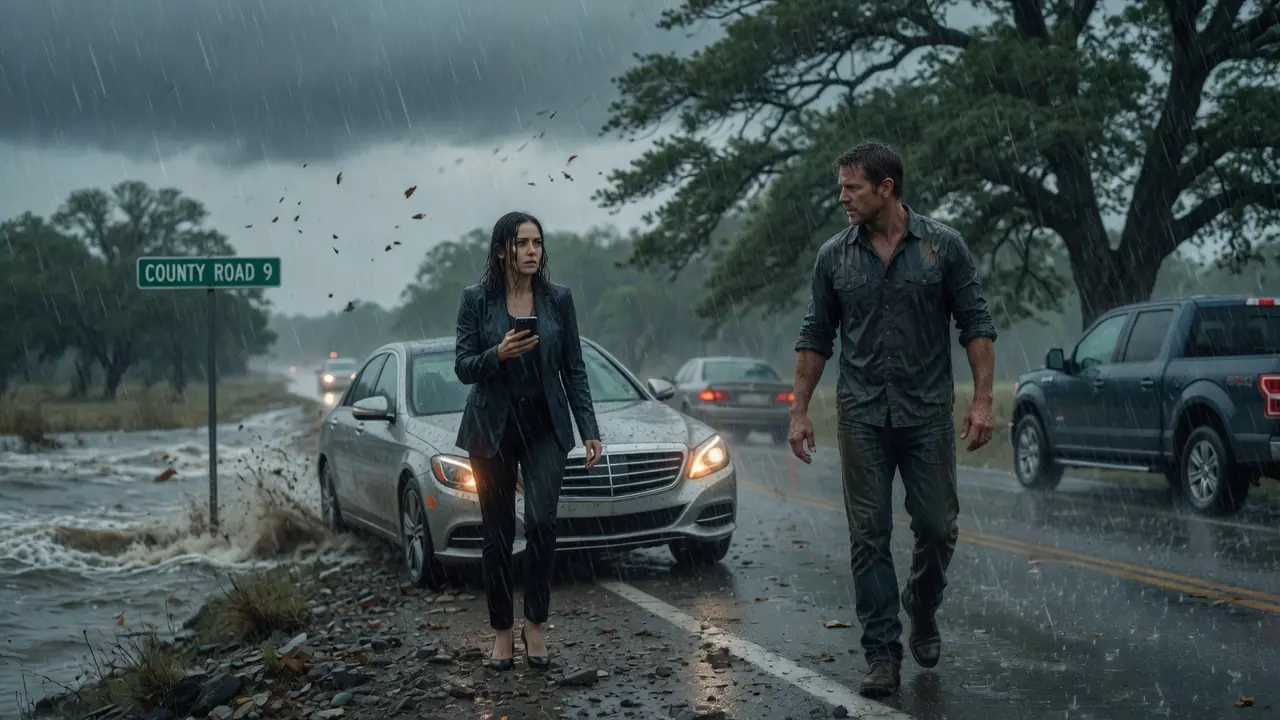
Weather alerts screamed from every television and phone in the county. Schools released children early. Businesses locked their doors. Gas stations ran out of fuel as people rushed to fill their tanks and get home before the storm turned the roads into rivers.
Highways clogged with the panicked impatience of people who had waited too long.
By midafternoon, the city that prided itself on efficiency, commerce, schedules, and relentless forward motion had come to a complete and undignified stop.
Traffic lights swung on their cables above empty intersections.
Gutters overflowed.
Awnings ripped loose from storefronts and tumbled down Main Street like discarded paper.
Somewhere near the financial district, a transformer blew with a flash of blue light and took out power to six blocks of office towers. The morning newspaper would later call it the storm’s most symbolically appropriate act.
By four o’clock, the river had already started to climb its banks. Police blocked two underpasses. Firefighters pulled a stranded delivery driver from waist-deep water near the old textile mill. A woman abandoned her sedan in the middle of Grant Street and carried her poodle through the rain under her coat.
And still, somewhere in the middle of that chaos, on a flooded stretch of County Road 9, one quiet act of kindness had already begun to take shape.
It began in the headlights of a man who almost did not stop.
Ethan Carter had spent the morning beneath the belly of a 1972 Chevy pickup, elbow-deep in a transmission rebuild, when his assistant knocked on the garage bay door and told him the radio was saying everyone needed to clear the roads within the hour.
“Ethan,” Marcus Webb called from the open bay, rain already needling the asphalt outside. “They’re closing the east bridge. Emergency management says roads are going under fast.”
Ethan slid out from under the truck on a creeper, his gray T-shirt streaked with oil, one cheek marked by a black smudge he had not noticed.
He was forty-six years old, broad through the shoulders, with dark hair beginning to silver at the temples and the kind of calm that made people lower their voices around him without knowing why.
He listened to the radio for ten seconds.
Then he looked toward the open bay.
The sky had gone almost green.
“Lock it down,” he said.
Marcus did not argue. Nobody at Carter Mechanical argued with weather, and nobody argued with Ethan when he used that particular tone.
Carter Mechanical sat at the edge of the Millbrook industrial district, between a tire warehouse and a welding supply shop. It was a modest operation with three working bays, four loyal employees, a waiting room with mismatched chairs, and a reputation built on nearly a decade of honest work.
The sign above the office door was plain.
CARTER MECHANICAL
REPAIRS DONE RIGHT
That was not clever advertising.
It was simply the way Ethan lived.
Do good work.
Charge a fair price.
Do not make promises you are not prepared to keep.
If a job cost less than expected, he said so. If a customer did not need a repair another shop had recommended, he said that too. It had made him less money than dishonesty would have, but it had earned him something he valued more.
The kind of sleep that did not argue with a man at night.
He wiped his hands on a rag that had long ago surrendered any claim to cleanliness, checked that the lifts were down, made sure the compressor was off, and waited until Marcus, Lena, Ray, and Joey had all left before locking the office himself.
“You heading straight home?” Marcus asked, pulling his hood over his head.
“That’s the idea.”
“Storm like this, idea and reality may have different plans.”
Ethan almost smiled.
“Drive slow.”
Marcus nodded and ran to his car.
Ethan stood under the awning for one extra moment, watching the rain turn the parking lot into a sheet of hammered steel.
He could have stayed at the shop. There was a couch in the office, a coffee maker, and enough canned soup in the breakroom cabinet to survive a minor siege. But the shop was not home.
Home was twelve minutes away.
A small clapboard house on Maple Ridge Lane, with a sloped roof, books on every available surface, a kitchen table scarred by use, and a porch that needed repainting when the weather turned kinder.
Ethan climbed into his truck.
It was a well-maintained Ford he had driven for eight years and intended to drive for at least eight more. He was that kind of man. He did not chase newer things just because newer things existed.
He took what worked and held on to it.
His life was small by design.
Quiet.
Contained.
Unimpressive to anyone who valued scale for its own sake.
And exactly what he had needed it to become.
He had not always been a mechanic in Millbrook.
There were people in other cities, people who wore suits that cost more than his monthly shop rent, who once knew the name Ethan Carter in a very different context.
They knew him as the man who built Meridian Capital.
They knew him as the numbers prodigy from Ohio State who understood risk the way other men understood weather. They knew him as the founder who walked into investment rooms in his thirties and made older, richer, louder men stop speaking. They knew him as the one who saw value before markets admitted it existed.
And then they knew him as the man who disappeared.
No scandal.
No indictment.
No dramatic collapse.
No farewell interview.
One quarter he was there, guiding one of the most respected regional investment funds in the country. The next, Meridian Capital was dissolved, investor money was returned in full with interest, and Ethan Carter vanished from every conference list, boardroom, and financial profile.
Rumors had grown in the empty space he left behind.
Burnout.
Secret illness.
Regulatory trouble.
A private tragedy.
Some said he had lost everything.
Some said he had made so much money that he no longer needed the world.
A few came close to the truth.
Not close enough.
By the time the rumors found him, he had already bought a small repair garage in Millbrook, learned the rhythm of honest physical work, and decided he liked engines because engines did not flatter you while hiding knives.
Engines were better than people that way.
They failed honestly.
He was four blocks from home when the rain hit in earnest.
Not the gradual kind of rain that builds from drizzle to downpour, but a sudden wall of water that reduced visibility to almost nothing in thirty seconds. Ethan slowed to a crawl, his wipers thrashing uselessly against the windshield.
The road had already begun to flood near the ditches.
Water crossed the pavement in thin moving sheets.
His headlights caught leaves, broken branches, and a trash can rolling wildly across someone’s front lawn.
That was when he saw it.
A silver Mercedes pulled halfway onto the shoulder, hazard lights blinking orange through the gray curtain of rain.
He almost kept going.
The rational part of his mind, the part that had learned through many years and many hard lessons not to invite complications into a life he had carefully simplified, told him to drive past and let someone else handle it.
A stranded luxury car was rarely simple.
Luxury cars came with owners who had expectations, insurance policies, lawyers, and a talent for turning favors into obligations.
Then his headlights swept across the figure standing beside the car.
A woman.
One hand pressed to the roof for balance against the wind.
The other holding her phone toward the sky as if she could drag a signal down from the clouds through sheer force of will.
She was soaked completely through.
Her dark blazer was plastered to her frame. Her hair had come loose and was driven sideways by the gusts. Even from fifty feet away, Ethan could see that she had nowhere to go and no available way of getting there.
He pulled over.
Then he cut the engine.
For one second, sitting in the sudden quiet of his truck, he almost laughed at himself.
So much for not inviting complications.
He got out without an umbrella because he had never owned one and never saw the point.
The rain hit him hard enough to sting.
He jogged toward her with one hand raised in what he hoped was an obvious gesture of harmlessness.
The woman stepped back as soon as she saw him.
One hand dropped to the handle of the Mercedes. Her eyes moved over him quickly, assessing his size, his clothes, his face, his hands, the distance to her car, the distance to the road, the odds of trusting him versus the odds of staying alone in a storm that was already turning dangerous.
Ethan saw the calculation run across her face.
He had seen that look before.
Not fear exactly.
Measurement.
He stopped several feet away and let her finish measuring.
“I’m not going to bother you,” he called over the wind. “But your car isn’t starting in this weather, this road is going to flood, and I live about ten minutes from here.”
She stared at him.
The rain ran down her face, but she did not wipe it away.
“Dry house,” he added. “Working stove. You can use the phone when the line comes back, and I’ll leave you completely alone if that’s what you want.”
“I can call someone,” she said.
Her voice was controlled, clipped by cold, but still carrying authority.
Ethan pointed at her phone, then at the sky.
She looked down.
No signal.
The wind gusted so hard that the Mercedes rocked on its suspension. A sheet of water washed over the shoulder and ran across both their shoes.
A branch cracked somewhere behind them.
She looked at him again.
Whatever she found in his face was not comfort, exactly.
But it was enough.
“One night,” she said. “Just until it passes.”
Ethan nodded.
“One night.”
She opened the passenger door, grabbed a leather bag and a laptop case, then locked the car with hands that were trying not to shake.
He did not mention the shaking.
He had learned that dignity sometimes depended on what you chose not to notice out loud.
They drove through the worst of it without speaking.
The radio flickered between emergency weather updates and static while the city dissolved behind them into sheets of dark water.
A warning tone blared from her phone, though it still had no signal.
Ethan took the back roads when the main road ahead dipped too low. The truck moved steadily through the rain, tires pushing through water with a low, steady hiss. Twice, he had to stop and wait for the floodwater to reveal where the edge of the road still was.
The woman sat rigidly in the passenger seat, wet bag in her lap, watching each turn.
She did not ask if he knew where he was going.
For some reason, that made him respect her.
His house was warm.
He had left the heat running that morning out of old habit, and the contrast when they stepped inside was immediate and physical, like crossing into another season.
The woman stood in the entryway and dripped onto the hardwood floor.
Her arms were folded across her chest. Her eyes moved through the room in the practiced way of someone who could read spaces quickly and extract information from them.
Books everywhere.
Two full walls of shelves packed tightly. Stacks on the coffee table. A paperback wedged beside the armchair. A half-finished chess puzzle on the corner desk. A framed photograph near the bookcase.
The photograph showed a mountain lake taken from low to the ground, water perfectly still, light flat and silver, as if the person behind the camera had been sitting right at the edge with nowhere else to be.
The woman stopped at that photograph.
Only for a second.
But Ethan noticed.
He had already gone to the linen closet. When he returned, he held out a towel and an old flannel shirt two sizes too large for her.
“Bathroom is down the hall,” he said. “There are dry socks in the cabinet under the sink. They’re clean. Not elegant, but clean.”
She took both.
“Thank you.”
He nodded and went directly to the kitchen.
For one small moment, standing alone in a stranger’s living room with the storm hammering the windows, something in the rigid architecture of her posture softened.
Not much.
Just enough.
Ethan made pasta.
Nothing elaborate. Rigatoni, jarred sauce made better with garlic, dried oregano, black pepper, and a splash of red wine vinegar that had been sitting in the cabinet for months. It was hot, substantial, and prepared without any of the theatrical hospitality people sometimes perform when they want to be admired for being generous.
He put two bowls on the table.
She had changed into the flannel shirt and wrapped the towel around her hair. Sitting across from him, she looked for the first time that evening like something other than a woman still managing a crisis.
“My name is Olivia,” she said.
Just Olivia.
No last name offered.
None asked for.
“Ethan,” he said.
She repeated it once, carefully, the way someone does when storing information they expect to need.
“Ethan.”
He found a half-decent bottle of red wine at the back of the pantry and set it between them.
She reached for it before he did.
They ate while the wind threw branches against the windows and the lights flickered twice.
At first, the conversation was careful.
Weather.
Road closures.
The likelihood of her car being salvageable by morning.
The strange arrogance of people who believed hazard lights made a vehicle immune to floodwater.
Then it loosened.
Not quickly.
Not dramatically.
But steadily, the way a knot loosens when no one is pulling at it too hard.
Olivia was controlled without being cold. Precise without being stiff. She spoke like someone who had spent years deciding exactly how much of herself to reveal and how much to keep behind sealed doors.
Ethan recognized that kind of discipline.
He also recognized its cost.
In most rooms Olivia entered, she could feel the exact moment recognition landed.
The slight correction in posture.
The sudden brightness in the eyes.
The adjustment of tone.
People changed when they realized who she was.
Olivia Vale.
Chief executive of Valeon Group, one of the most visible companies in the region. Her face had appeared on the cover of two major financial publications in the past eighteen months. She sat on three boards, was constantly invited to speak at conferences, and had learned years ago to treat every public sentence as something that could be clipped, quoted, analyzed, and weaponized.
She was skilled at reading rooms before she entered them.
She knew which handshakes would cost her.
She knew which smiles were invoices in disguise.
She knew exactly how warm to be without inviting presumption.
It was a kind of labor she had performed so long that she no longer experienced it as labor.
But in Ethan Carter’s kitchen, wearing an oversized flannel shirt with a towel around her hair, she was simply a woman who had been caught in the rain.
The anonymity of it felt almost dizzying.
Like removing a piece of armor she had worn so long she had stopped noticing its weight.
She found herself saying things she had not said aloud in years.
Not names.
Not confidential details.
But truths.
The exhaustion of being required to decide everything.
The loneliness of being surrounded by people who wanted something.
The strange way success had filled her calendar while emptying her life.
“People think power means freedom,” she said at one point, turning the wineglass slowly between her fingers. “Most of the time it means fewer safe rooms.”
Ethan looked at her across the table.
“Safe from what?”
She almost said enemies.
That would have been too dramatic, though not inaccurate.
She settled on the better word.
“Need.”
He nodded.
Not like he fully understood her world.
Like he understood the shape of what she meant.
“That’s a hard way to live,” he said.
“It is a useful way to live.”
“Those are different things.”
Olivia looked at him then.
Really looked.
Most people would have softened that sentence. They would have smiled, made it lighter, wrapped the truth in politeness so it would not risk offending her.
Ethan did not.
He also did not seem impressed with himself for saying it.
That made it harder to dismiss.
Her phone buzzed.
The signal had flickered back for a moment.
She looked at the screen and excused herself to take the call in the next room.
Ethan cleared the plates and began washing up.
From the kitchen, he could hear only the rhythm of the conversation, not every word.
Controlled urgency.
Then a male voice on the other end said clearly enough, “The entire board has been trying to reach you. The Hartwell acquisition, the minority shareholders are organizing, and Harrison won’t wait past Monday.”
Olivia’s voice changed in a single breath.
It steadied.
Sharpened.
Reassembled itself.
“Tell Marcus to circulate the capital memorandum with no revisions until I approve language personally. I want Harrison’s last two emails flagged. Also call Dana’s office and confirm whether she spoke with Crowe Capital before or after the vote notice.”
A pause.
“No, not tomorrow. Now.”
She handled the call in under five minutes.
When she returned to the kitchen doorway, she was already watching Ethan’s face to see what he had registered.
He was drying a glass.
He looked up.
“Want more wine?”
She stood in the doorway for a beat longer than necessary.
Then she said, “Yes.”
The storm did not break that night.
It settled over the city with the patience of something that had nowhere else to be. By midnight, the roads were closed, power had gone out twice, and the rain had become a steady roar.
They ended up in the living room with candles on the coffee table and the gas fireplace burning.
The conversation moved again.
This time, it became something neither of them had planned.
Ethan told her about what he privately thought of as his philosophy of small. He had never named it that before, but the words came naturally when she pressed him to explain the life he had built.
The quiet neighborhood.
The modest shop.
The controlled scale of things.
He said he had learned late that the size of a thing and the value of a thing were not the same measurement.
Often, they moved in opposite directions.
Olivia looked toward the shelves of books, the chess puzzle, the simple room arranged for use rather than display.
“I understand that intellectually,” she said. “But I cannot remember the last morning I woke without an agenda already running.”
“That’s probably why you were working at six at night when the roads were flooding and you couldn’t go anywhere anyway.”
She laughed.
Quickly.
Unguarded.
The sound seemed to surprise her more than it surprised him.
Ethan thought it was a very good sound.
Not polished.
Not useful.
Real.
Before she went to bed in the spare room, she passed the bookcase in the hallway. Candlelight caught the edge of an old folder on the bottom shelf.
Yellowed paper.
A company name printed on the tab in the bold font of another decade.
Meridian Capital.
She stared at it a moment longer than she should have.
Then she went to the spare room, lay awake in the dark, listened to the rain, and wondered why she recognized that name.
She was up before Ethan.
The storm had softened overnight to a steady gray rain that showed no intention of stopping before noon. Three different apps confirmed that the roads were still closed once her phone signal stabilized.
Olivia made coffee in his kitchen, navigating his cabinet arrangement with systematic patience, then sat at the table with her laptop open before seven.
When Ethan came downstairs, he stopped in the doorway.
She looked up over her screen.
“Good morning,” he said.
“Coffee is in the pot.”
He nodded, poured a cup, and sat across from her with a book.
They stayed like that for an hour.
She worked.
He read.
Rain pressed softly against the windows.
The silence between them was more comfortable than most conversations Olivia had been in recently.
She watched him between emails.
He turned pages with the same quality of attention he had given her the night before. Complete. Unperformed. Without restlessness or the low-level performance of someone aware of being observed.
Midmorning, he looked up and asked a question about the Hartwell situation.
Not casually.
Precisely.
He named the exact structural pressure point in the acquisition dispute she had been managing. Not with jargon. Not with the shallow confidence of someone repeating something they had read online. But with the clean instinct of someone who understood how such systems failed from the inside.
Olivia slowly lowered her laptop screen.
“How do you know that?”
He looked at his coffee.
“I followed a similar situation years ago.”
“When?”
“A while back.”
“Where?”
He paused.
She noticed the pause.
“I worked in finance before the shop,” he said.
“You worked in finance.”
“Briefly.”
She looked at the man across from her, the worn sweatshirt, the calloused hands, the unreadable face.
“Briefly is doing a lot of work in that sentence.”
He turned a page.
“It has always been an ambitious word.”
She let it go.
For the moment.
That afternoon, while Ethan was outside checking the garage and then her Mercedes, Olivia photographed the folder on the bookshelf and sent the image to her executive assistant with two words.
Find everything.
Marcus called her back in under two hours.
His voice carried a careful neutrality she had heard from him only a handful of times, always when he had discovered something significant and was deciding how best to present it.
“Olivia,” he said, “Ethan Carter is not just a mechanic.”
She stood near the spare room window, looking out at the rain.
“Go on.”
“He built Meridian Capital from a rented office in his early thirties. Partial scholarship kid from Ohio State. Mathematics, economics, later quantitative finance. By thirty-eight, the fund was managing assets most regional institutions never get near.”
Olivia closed her eyes briefly.
“He was that Ethan Carter?”
“Yes. That Ethan Carter.”
She remembered now.
Case studies during her MBA.
Profiles in financial journals.
A fund built on unconventional portfolio construction and an almost uncanny ability to identify systemic undervaluation in markets that everyone else considered fully priced.
Marcus continued.
“At his peak, he was worth nine figures. Turned down acquisition offers from three major banks. Then one Thursday morning, about ten years ago, he vanished from the public record.”
“Vanished?”
“Dissolved the fund. Returned all investor capital in full with interest. No lawsuits. No regulatory investigation. No scandal. No farewell statement. Nothing. He simply walked away.”
Olivia said nothing.
Marcus waited.
“The man now runs a three-bay repair shop in Millbrook,” Marcus added. “And, apparently, fixes fuel pumps.”
When the call ended, Olivia remained at the window.
Downstairs, she could hear Ethan moving in the kitchen.
She did not confront him immediately.
Instead, she watched.
That was what she knew how to do.
She watched him make soup from scratch because the power was unreliable and he wanted something warm on the stove. She watched the way he moved through his house without any residue of old grandeur clinging to him.
No bitterness.
No performance of humility.
No trace of a man secretly waiting to be recognized.
He did not occupy his smaller life as if it were punishment.
He occupied it as if it had become true.
That evening, over soup, she told him what Marcus had found.
She did not apologize for looking.
She was not the kind of person who apologized for gathering available information.
The habit had kept her alive in rooms where everyone was doing the same thing and pretending otherwise.
Ethan listened.
When she finished, he was quiet for a long time.
Then he said, “Old news.”
“Not to me.”
“No,” he said. “I suppose not.”
“Why did you leave?”
He stood, went to the stove, stirred the soup though it did not need stirring, and came back.
Then he told her.
Plainly.
Someone he had trusted had betrayed him. His co-founder. His closest friend. A man he had known for twenty-two years.
Robert Walsh.
They had met in college, two boys with cheap jackets, cheaper coffee, and the kind of ambition that makes sleep feel optional. Robert had been the charming one. Ethan had been the architecture behind the charm. Robert sold the vision. Ethan built the engine that made the vision possible.
For years, that balance worked.
They built Meridian Capital together.
They rented their first office above a dental clinic, worked on folding tables, and once lost power in the middle of an investor call because the old building could not handle the copy machine and the space heater at the same time.
By the seventh year, the fund was no longer humble.
The office had glass walls, a reception desk, and views of a river Ethan rarely took time to look at. The money under management grew with each quarter. Investors who had once ignored them now sent private invitations. Robert began speaking on panels. Ethan began declining panels.
Then one night, because something in a reconciliation file did not sit right, Ethan stayed late.
He found a structure that should not have existed.
A subsidiary arrangement.
Fee diversion.
Side vehicles tied to accounts Robert controlled indirectly.
It was not illegal by the narrowest technical reading.
That made it worse.
It had been designed by someone who knew exactly where the technical line was and built his dishonesty one inch short of it.
“The money wasn’t the wound,” Ethan said.
Olivia sat still.
“The wound was realizing that the person I trusted most had been building a private version of our work alongside the one I thought we shared.”
He could have exposed Robert.
He could have destroyed him.
There were enough records to make him untouchable in certain rooms forever.
Instead, Ethan dissolved the fund.
Returned every dollar to every investor, with interest.
Walked away without public explanation.
“Why not expose him?” Olivia asked.
“Because public war requires you to become fluent in public cruelty. I knew he deserved it. I also knew I did not want to live inside the version of myself who could do it well.”
He said it without self-pity.
He also told her the part most people never knew.
He had not lost his wealth. His assets had been structured years earlier in ways Robert could not touch. Not because Ethan had suspected Robert then, but because risk management had been a habit long before it became salvation.
His holdings remained vast, scattered quietly across entities that kept his name out of public conversation.
The total value exceeded what he could reasonably spend in several lifetimes.
He said this like a footnote.
Factual.
Unimportant to the point.
Olivia looked around the kitchen. The old table. The chipped mug. The simple stove. The man who could have been anywhere and had chosen here.
“You left all that and bought a repair shop.”
“Engines are honest.”
“People can be honest.”
“Some,” he said.
She looked down at her hands.
The situation inside her company was worse than her public communications suggested. The Hartwell acquisition had exposed a structural gap in the company’s capital accounts that her CFO, Lawrence Cade, had been managing with optimistic projections and selective disclosure for nearly four months.
The minority shareholders now organizing against her position were not acting spontaneously.
Someone inside the building had given them exactly what they needed.
Olivia had three possible suspects.
No proof.
No margin for error.
That evening, she laid out the outline for Ethan as a hypothetical.
He listened.
Then asked three questions.
Each one identified a different structural weakness. Each one cut past the noise and went directly to the load-bearing points.
By the time she finished answering, he had found what her official advisory team had spent four months circling.
The danger was not in the acquisition itself.
It was in the internal communication trail surrounding it.
If read together by a hostile party, those documents could make it appear that the executive team had known about the capital gap for months and pushed forward anyway.
Ethan explained it in plain language.
No jargon.
No softening.
Olivia sat across from him with the soup cooling between them and felt the precise discomfort of being outthought by someone she had already known was smart but had not fully prepared for.
After midnight, he pushed a legal pad across the table.
It was covered in his handwriting.
Observations.
Risks.
Structural recommendations.
Priority sequence.
Language precise enough to take into a boardroom.
She read it while he washed dishes.
Then she read it again.
It was more useful than anything she had received in four months of expensive consulting.
The next morning, the rain finally stopped.
The roads reopened.
Ethan had her Mercedes running before nine. Fuel pump issue, diagnosed in under a minute. He checked the engine, cleaned his hands, and closed the hood.
Olivia stood beside the car, legal pad in hand.
“Thank you,” she said.
“For the car?”
“For all of it.”
He nodded.
“Drive carefully.”
That was all.
She drove back into the city in thin winter sunlight, thinking for most of the way about the complete absence of performance in how he had treated her for seventeen hours.
No flattery.
No pressure.
No transaction disguised as kindness.
He had helped because she needed help.
That was all.
It should not have felt extraordinary.
The fact that it did troubled her.
She implemented his recommendations in pieces over the next two weeks.
The results were immediate.
The capital exposure was corrected. The paper trail was supplemented with documentation that reframed the narrative. The minority shareholders, finding that the leverage they had been counting on had evaporated, went quiet in the particular silence of people regrouping.
Her CFO’s expression at the next board briefing told her what his reports had not.
Across the table, Harrison Merrill and Dana Croft received the news of stabilization with expressions Olivia had learned to read over fifteen years in boardrooms.
Not relief.
Not surprise.
Disappointment, tightly covered.
She made note of both.
She called Ethan three times in the first two weeks after leaving his house.
Each call lasted longer than the one before.
After the third, she stopped pretending even to herself that the professional purpose was the only reason.
Ethan told her, during that third call, “I don’t want to be drawn back into any version of my former life.”
“I understand,” Olivia said.
Then she asked him a specific question about a hedge structure she was considering for the company’s next capital round.
He spent twenty minutes explaining exactly why it could work and precisely under what conditions it would fail.
By the end of the call, they both understood that his disclaimer had been reflex rather than resolution.
The work pulled at him.
He did not want it to.
But it did.
Not the money. Not the status. Not the public recognition.
The logic.
The rare pleasure of a complex system surrendering itself when examined correctly.
He drove to the city on a Tuesday for what he described to himself as one document review.
He stayed four hours.
The second visit was not shorter.
By the third, he stopped counting.
He met Marcus during that visit. The assistant received him with the careful neutrality of someone who had done considerable research and decided not to reference any of it. Ethan noticed and appreciated that.
He sat in a glass-walled conference room on the thirty-fourth floor and looked out at the city from an angle he had not occupied in years.
It looked exactly as he remembered.
The same density of ambition packed into vertical space.
The same hunger behind polished glass.
The same energy, bright and dangerous.
He found himself less hostile to it than he had expected.
Olivia was different here.
In his kitchen, she had been a woman in borrowed flannel, exhausted enough to be honest.
On her own floors, she was something else entirely.
Exact.
Total.
The full force of what she had built radiated off her as naturally as heat off machinery at operating temperature.
He watched her run a briefing through the glass and understood, for the first time, the true scale of what she managed.
It did not diminish what had happened between them.
Somehow, it deepened it.
Because she had brought none of this into his kitchen.
For seventeen hours in the storm, she had been only a person.
The problem beneath Valeon Group was larger than she had first told him. Ethan suspected she had known that and had been waiting to see how far his instincts would carry without being directed.
Harrison Merrill and Dana Croft were not simply ambitious board members.
They were coordinating with an outside investor group preparing to trigger a technical covenant violation in the company’s primary credit facility. Under the terms of the agreement, that violation would give them grounds to call for a leadership review.
As attacks went, it was elegant.
No public confrontation.
No visible aggression.
No hostile takeover language.
Just contractual pressure disguised as governance concern.
The company’s own structure would become the weapon used against its chief executive.
Ethan sat with the documents spread across the conference table and felt something arrive in his chest that he had not felt in ten years.
Cold clarity.
He had seen this play before.
He had once been the target.
Back then, he had walked away.
He looked out at the city and considered whether he was going to do the same thing again.
Then he thought of Olivia.
The way she answered his questions without hedging.
The way she trusted the shape of an honest answer even when she did not like its implications.
The way she had stood in the rain, calculated the risk, and chosen to trust him anyway.
He pushed back from the table.
When Olivia entered, he told her what he had found.
She received it without surprise, confirming that she had already suspected the shape of the attack and had been waiting for the specifics.
“What do we do?” she asked.
“I need to think.”
“I need an answer before the end of the week.”
He stood at the conference room window, looking down at the city.
“If we do this,” he said, “we do it precisely. Completely. No improvisations. No shortcuts.”
Olivia waited.
“You will have to trust me to make calls you may not like in the moment.”
“Okay,” she said.
Without pause.
Without condition.
Ethan thought about that single syllable for a long time afterward.
The complete absence of negotiation.
The simple, dangerous gift of trust.
He drove back to Millbrook that night and did not sleep.
The work of exposing the conspiracy took three weeks.
It required the kind of methodical patience Ethan had always done well.
He built the case the way he had once built investment theses. From first principles outward. Every piece of evidence supporting the next until the whole structure could bear weight from every angle and could not be dismantled by removing one element.
He worked with Marcus, who turned out to be sharper and more discreet than Ethan had expected.
He worked with an outside legal firm Olivia trusted, one with no existing relationship to any board member or entity adjacent to the opposition.
He worked with Olivia daily, in calls, documents, late-night revisions, and one long session in the thirty-fourth-floor conference room with takeout containers scattered across the table and the city glowing darkly beyond the glass.
They moved around each other with the easy efficiency of people who had become fluent in one another’s rhythms without planning to.
She did not perform confidence for him.
He did not perform certainty for her.
They disagreed twice.
Once about timing.
Once about the legal threshold for actionable evidence.
Both disagreements were direct, quiet, and useful.
Both produced better answers.
It was the most functional working partnership either had experienced in years.
They both knew it.
Neither said it.
Some things are better left unnamed until the work is done.
On a Thursday night, after eleven, Ethan stood at the conference room window while Olivia sat at the table behind him reading the final memorandum.
Most of the building had emptied. The lights on the thirty-fourth floor were reduced to a few active rooms and the soft glow of emergency panels. Below them, the city looked controlled and orderly, as if chaos were not always waiting beneath paperwork.
“You’re quiet,” Olivia said.
“I’m often quiet.”
“Not like this.”
He did not turn around.
She closed the folder.
“You’re thinking of leaving again.”
That made him turn.
She was watching him carefully. Not accusing. Not pleading. Measuring.
“You see a thing through,” she said. “Then you go before anyone can make staying complicated.”
He did not answer.
She had seen him more clearly than he had intended.
“I may not need you after Wednesday,” she said.
“No.”
“That is not what I meant.”
“I know.”
The silence stretched.
He looked at her then, really looked, and saw the exhaustion under the precision. The weight she carried without asking anyone to admire it. The woman from the storm and the CEO from the boardroom occupying the same body, both real, neither canceling the other.
“I am not good at staying,” he said.
She nodded once.
“I gathered.”
That should have ended it.
Instead, she asked, “Do you want to be?”
The question hit him with more force than he expected.
He had built a decade around peace. Around distance. Around keeping his world small enough that no betrayal could take down anything too large. He had told himself he was content because most days, he was.
But contentment and avoidance sometimes wore the same clothes.
He looked out at the city again.
“I don’t know,” he said.
Olivia accepted that answer because it was honest.
The emergency board session convened on a Wednesday morning.
Harrison Merrill had called it, ostensibly to address ongoing concerns about the company’s capital position. The same capital position that had, in fact, been resolved the week before through a subsidiary restructuring that Merrill’s group had not known existed.
Ethan had insisted the restructuring remain undisclosed until the specific moment disclosure would do the most damage.
“The element of surprise is not cosmetic,” he had told Olivia. “It is structural. Once they know the trigger is gone, they pivot. Reactive attacks are harder to predict than planned ones.”
So the restructuring had been completed quietly, documented precisely, and held in reserve.
Merrill walked into the boardroom expecting to table a motion for leadership review.
Instead, he found Olivia already seated at the head of the table, legal counsel present, presentation loaded.
She wore navy.
No dramatic colors.
No statement jewelry.
No visible tension.
The forty minutes that followed would later be described by three independent board members as the most exact corporate defense they had ever witnessed.
Olivia named names.
She cited documents.
She presented the communication trail between Merrill, Croft, and the outside investor group in sequence. Every claim supported. Every inference tied to evidence. Every denial anticipated.
She showed the covenant trigger they had planned to use.
Then she showed why it no longer existed.
She showed the capital gap.
Then she showed the lawful restructuring that had closed it.
She showed their communications.
Then she showed the exact timeline proving they had coordinated with outside interests before raising their supposed governance concerns internally.
When she finished, the room held a silence long enough to feel deliberate.
Merrill looked at the table.
Croft looked at the door.
Lawrence Cade, the CFO, stared at his hands with the exhausted resignation of a man whose omissions had been exposed but whose cooperation had likely saved him from worse.
Both board resignations were on file before five.
A review of Cade’s role began before six.
The outside investor group withdrew its challenge the following morning.
Ethan did not attend the press statement.
He was two floors below in a secondary conference room with a video feed available if needed. Not because of false modesty. Not because he underestimated his role.
Because he had come to help.
And he did not need recognition as a condition of having done so.
He watched long enough to confirm that Olivia was handling it cleanly.
Then he turned the feed off.
He sat alone in the quiet room and looked at his hands on the table.
This, he realized, was what it felt like to finish something.
Not win.
Finish.
A decade earlier, he had walked out of a boardroom on the wrong end of betrayal and told himself leaving was the cleanest choice.
Maybe it had been.
Maybe it had also left something unfinished inside him.
Today did not reverse that day.
It completed it.
By early afternoon, Ethan was in his truck, headed back to Millbrook.
He went home, put the kettle on, and sat in his kitchen as the house settled around him.
He felt okay.
Not triumphant.
Not relieved in any dramatic sense.
Just okay.
The specific okay of a weight set down cleanly in the right place.
Then he thought about what came next.
He thought about Olivia for a long time.
And then, quietly, he started making plans to go.
She found him two days later, on a Sunday morning, loading boxes into the bed of his truck.
She pulled into his driveway in a smaller car, one less likely to be recognized, and got out with her hands in the pockets of her coat.
Ethan set down the box he was carrying.
Olivia looked at the truck.
Then at him.
“I have one question.”
“Okay.”
“Why do you always leave?”
He stood in the pale Sunday light and did not answer immediately.
Because the question deserved a real answer.
And Olivia was the kind of person who would wait for it without filling the silence with something easier.
A dog barked somewhere down the street.
Bare branches moved in the cold wind.
Then Ethan told her the part of the story he had left out before.
After Robert betrayed him, Ethan had not left immediately.
For three months, he tried to find another way.
He slept in his office. He reviewed every structure. He met with attorneys. He wrote letters he never sent. He stood in conference rooms with Robert and watched the man perform friendship as if nothing had cracked underneath them.
The final day came quietly.
Robert had walked into Ethan’s office with coffee in one hand and a joke about a client call.
Ethan had looked at him and realized something that frightened him.
He could destroy Robert.
And part of him wanted to.
Not for justice.
For punishment.
That was when he knew he had to leave.
Not because Robert deserved mercy.
Because Ethan did.
He did not want the worst thing done to him to become the thing that defined how he moved through the world afterward.
So he left.
He built a life where no one needed him too much.
No one could betray him too deeply.
No one could ask him to become ruthless in order to survive.
He bought a repair shop because metal was easier than ambition.
He built Carter Mechanical because honest work was a language he could still speak.
He made his world small enough to control.
Then he confused control with peace.
Olivia listened without interrupting.
When he finished, she said, “And now?”
He looked at the boxes in the truck.
They were not even important boxes. Old files. Spare tools. Things he had packed because packing was easier than deciding.
“Now I’m not sure small is enough anymore.”
She took a breath.
“Because of the work?”
“Partly.”
“Because of the city?”
“No.”
She waited.
He looked at her.
“Because of you.”
No softening.
No performance.
Just the truth.
She held his gaze.
“I’m not easy,” she said.
“I know.”
“I work too much. I trust too slowly. I manage things I should probably let breathe. I am not naturally good at letting anything simply be what it is.”
“I know,” he said again.
“I’m not saying it to discourage you. I’m saying it because you deserve the full picture before deciding.”
He considered that.
“I already have the full picture. I’ve been paying attention since the night you sat in my kitchen and forgot to perform anything.”
She laughed.
That quick, unguarded laugh from the night of the storm.
The one that had surprised both of them the first time.
Ethan thought it was one of the better sounds he knew.
Not because it was beautiful.
Because it was true.
He left the boxes in the truck bed.
Unloading them at that exact moment would have been too clean, too symbolic for two people who had earned their complications honestly.
Instead, he went inside and put the kettle on.
Olivia followed him.
The door closed behind them.
And the quiet of the house settled around both of them.
They did not become simple overnight.
People like them rarely did.
Olivia still worked too much.
Ethan still retreated sometimes when things became emotionally crowded.
She still tried to manage silence.
He still occasionally mistook leaving the room for solving a problem.
But they learned.
Slowly.
Deliberately.
With a patience that surprised them both.
He began splitting time between Millbrook and the city, at first as an outside strategic adviser, then as the quiet architect behind Valeon Group’s long-term restructuring. He refused a title for months. Olivia stopped offering one after the third refusal and simply began routing the difficult problems to him because that was more honest anyway.
Carter Mechanical stayed open.
Ethan kept it.
He promoted Marcus Webb to general manager, gave every employee a raise, added health insurance, and expanded the shop’s training program for young mechanics who could not afford technical school.
When Marcus asked if this meant Ethan was becoming “fancy again,” Ethan said, “Unfortunately.”
Marcus laughed for almost a full minute.
Olivia visited the shop once without warning.
She wore jeans, a black coat, and boots that were too nice for the oil-stained floor. Lena recognized her immediately and nearly dropped a clipboard. Ethan looked up from beneath the hood of a pickup and saw Olivia standing near Bay Two, watching him with a smile she did not try to hide.
“You lost?” he asked.
“Possibly.”
“This is not a boardroom.”
“I noticed. No one has offered me sparkling water.”
Marcus appeared behind Ethan and said, “We have coffee old enough to qualify as structural material.”
Olivia accepted a cup.
She drank half of it without flinching.
Ethan found this unnecessarily impressive.
Several months later, a major financial publication ran a feature its editors described as the unexpected story of the year in the region’s business landscape.
The article traced Olivia Vale’s survival of the covenant conspiracy. It described the resignations of Harrison Merrill and Dana Croft. It reported on the outside investor group’s failed attempt to trigger a leadership review.
It also revived the mystery of Ethan Carter.
The disappearing financier.
The man who had once built Meridian Capital, vanished from public life, and reappeared beside one of the city’s most powerful executives during the most dangerous fight of her career.
The piece was careful and well researched.
It got many facts right.
It described Ethan and Olivia as a powerful pairing.
Complementary strengths.
Strategic and personal alignment.
Those words were not wrong.
They were only incomplete.
Because no article, constrained by sources and attribution and the clean lines of public narrative, could capture the texture of the night that had started it all.
The warmth of a kitchen during a power outage.
Candles on a coffee table.
Rain on every window.
A towel placed on the arm of a couch without ceremony.
Pasta made from a jar of sauce and whatever was in the cabinet.
A bottle of wine from the back of a pantry.
A chess puzzle on a desk.
A photograph of a still lake.
Two people who had both, in different ways, built functional defenses against vulnerability finding themselves, during one long storm-bound evening, setting those defenses down one conversation at a time.
It could not capture the strange relief of being seen without being used.
The rarity of being helped without being managed.
The quiet force of someone listening without waiting to profit from what they learned.
The article could describe the boardroom victory.
It could not describe the bowl of soup.
It could describe Meridian Capital.
It could not describe Ethan drying a glass and asking if Olivia wanted more wine after realizing exactly who she was.
It could describe the covenant conspiracy.
It could not describe the moment on County Road 9 when a man almost drove past a stranded woman and then decided not to.
Some choices are small by every outward measure.
A truck pulled to the shoulder.
A door opened.
A dry shirt offered.
A meal set on the table.
But the choices that matter most are rarely about the truck, the door, the shirt, or the food.
They are about the person making the choice when no audience is watching.
When changing course would cost almost nothing.
When driving past would be easier.
Ethan Carter had spent a decade becoming the kind of man who stopped.
Quietly.
Without applause.
Without even thinking of it as virtue.
And it took the right storm, on the right road, at the right moment, to show him what that had been worth all along.
Because the night he stopped in the rain, he did not just rescue Olivia Vale from a flooded road.
He brought himself back from a life he had mistaken for peace.
And Olivia, who had spent years surrounded by people who wanted access to her power, found something far rarer in a modest house in Millbrook.
A man who did not need anything from her.
A man who saw her.
A man who stopped.
In the end, that was where the whole story began.
Not in a boardroom.
Not in a magazine profile.
Not in the collapse of a corporate conspiracy.
But on a storm-battered road, beneath the glare of headlights, when one person was standing alone in the dark and another person decided that was reason enough to pull over.