On a drizzly Friday in late autumn, Dr. Sofia Bennett signed a lease for a small room in a quiet house on Willow Creek Lane. She did not believe in attachment, not after years of training herself to feel nothing beyond precision and control.
But the house belonged to Ethan Cole, a single father raising his daughter alone, a man who carried exhaustion as though it had been woven into the fabric of his skin.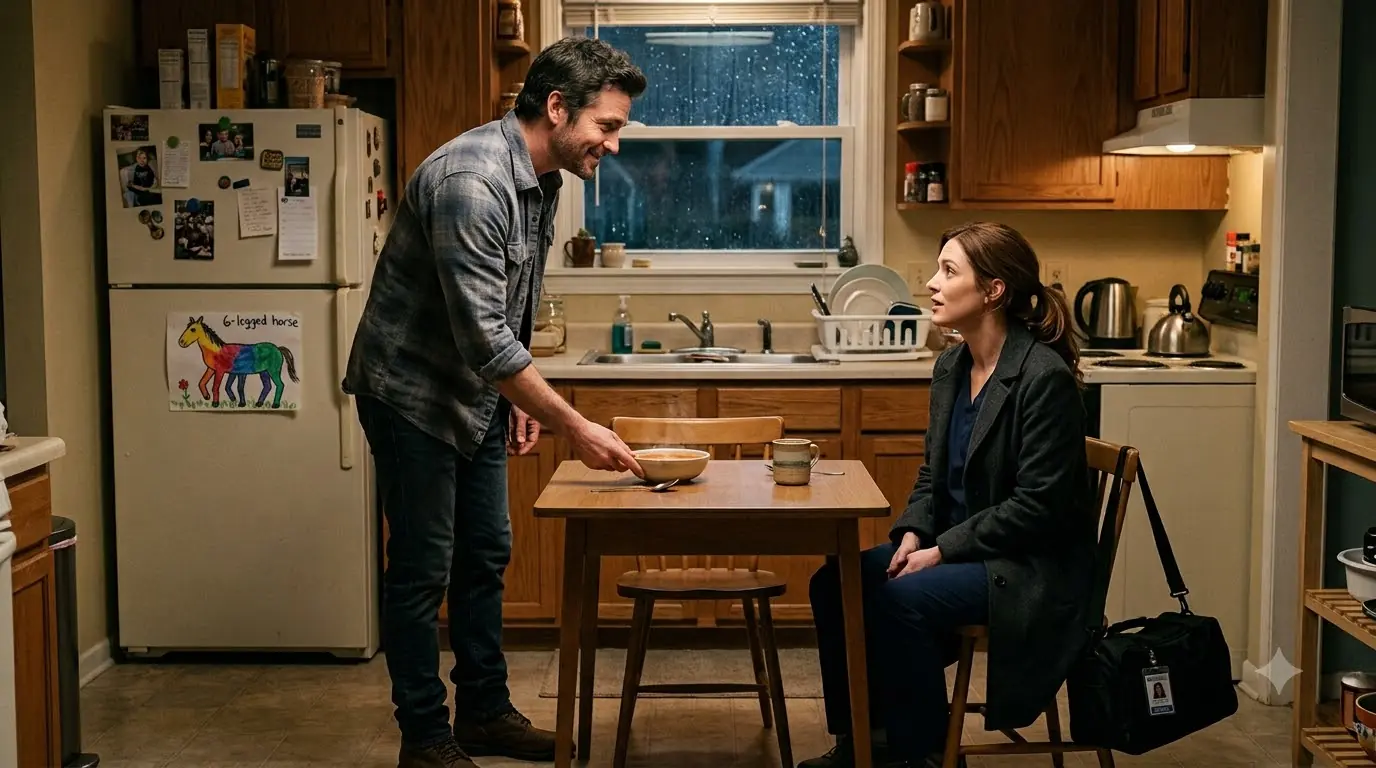
One night, through a closed door and the soft sound of rain, she heard something that broke the rule she had lived by for years, and everything began to change.
The rain had been falling since noon. Not heavily, not dramatically, just a thin, persistent drizzle that turned the pavement a shade darker and made the streetlights blur at their edges like watercolors left too long in the sun.
Dr. Sofia Bennett sat in her car for four minutes before getting out. She counted them on the clock on her dashboard, the way she counted everything: seconds between compressions during a code, milliliters in a syringe, hours of sleep she was unlikely to get.
Four minutes.
Then she picked up her bag and walked to the front door.
The house was smaller than the listing photos suggested. Most of them were. The porch had a wooden step that dipped slightly on the left side, and a clay pot near the door held a mum the color of rust, its petals curled inward against the cold. Someone had watered it recently. The soil was dark and damp in a way that had nothing to do with rain.
She knocked.
The man who answered was not what she expected, though she had told herself she had no expectations. He was tall, taller than the doorframe seemed to allow, with dark hair that needed cutting and a flannel shirt that had clearly been washed many more times than it had been ironed. He looked at her for a moment before he spoke, the way people look at someone when they are trying to decide how honest to be.
“Dr. Bennett?”
“Ethan Cole.”
He stepped back.
“Come out of the rain.”
The interior of the house was warm. That was the first thing she noticed. Not the furniture, not the layout, but the warmth, which was the particular warmth of a place where the heat was kept on because a child lived there. The kitchen light was on, amber and low, and there was the lingering smell of something recently cooked, onions, perhaps, or the memory of them.
On the table was a crayon drawing of what appeared to be a horse with six legs.
“My daughter made that,” Ethan said, following her gaze. “She says it’s faster that way.”
Sofia looked at the drawing.
She said nothing.
He showed her the room.
It was at the end of a short hallway, past a bathroom they would share. Sofia noticed the small pink step stool beside the sink and, across from it, a bedroom door decorated with paper stars. Her room itself was plain: a single bed with a navy cover, a wooden desk that had been recently cleared though the faint ring from a coffee mug remained on its surface, and a window overlooking the backyard, where the rain was putting small circles into a puddle near the fence.
“The Wi-Fi password is on the nightstand,” Ethan said. “The water pressure is better in the morning.”
He paused and leaned slightly against the doorframe.
“Mia, my daughter, she’s eight. She goes to sleep by nine. She’s not loud, but she’s a kid, so some days she is.”
Sofia looked at the window and then at the desk. She took out a pen and the lease he had emailed her.
“I won’t be home much,” she said.
“I figured.”
She signed.
He thanked her.
They did not shake hands.
Dr. Sofia Bennett was thirty-four years old and had not cried in front of another person since she was twenty-six.
She was not proud of this, exactly. It was simply a fact about herself that she had come to understand the way she understood other facts, without drama and without revision. She had cried at twenty-six over a patient named Harold Finch, sixty-one, a carpenter with three grandchildren. Sofia had made a decision about his care that was textbook correct and still wrong in a way that no textbook covered.
He had recovered.
But the attending physician who found her afterward in the supply closet had said, gently but clearly, “You can’t do this work if you can’t separate yourself from it.”
Sofia had taken that to mean stop.
So she had.
Carefully. Methodically. The way she did most things.
She stopped visiting patients after hours. She stopped learning their hobbies and the names of their dogs. She became, in the language of her evaluations, exceptional, efficient, precise. A doctor who did not waste motion.
She told herself this was maturity.
She told herself this was the only way to last.
She moved into the house on Willow Creek Lane because the lease on her apartment had ended, the hospital dormitory was undergoing renovation, and she needed somewhere within thirty minutes of the hospital. It was the only listing in her price range that did not smell of cigarettes or have a landlord who called her “honey” during the showing.
She did not move in because the house was warm.
She did not move in because the mum on the porch had been recently watered.
She did not move in because a child inside had drawn a faster horse.
She told herself this clearly on the first night while she unpacked her three boxes and arranged her books in the order she always arranged them. Medical texts first. Then the small collection of poetry she had not opened in two years. Then the single photograph she kept, which she placed face down on the desk.
Afterward, she lay on the navy cover and listened to the rain.
In the room across the hallway, she heard the low sound of a child being put to bed.
Sofia ate breakfast at 5:15 before anyone else was awake. She had done this for years, not as an act of avoidance exactly, but because 5:15 was when she woke, and she was hungry, and she did not see the value of waiting.
She made coffee quickly and quietly in the kitchen. She rinsed her mug before leaving and placed it in the drying rack.
She was gone by 5:45.
She returned most nights after nine.
Ethan was usually still awake. She could hear the low murmur of something playing on his laptop from behind his door or the occasional sound of tools from the garage, as though he were repairing something. She did not investigate.
Sofia heated whatever she had bought from the hospital cafeteria or, sometimes, a small portion of whatever she had prepared the Sunday before. She ate at the kitchen table with a journal article open beside her plate.
Then she went to bed.
They developed a system without designing one.
Ethan left the hallway light on when he was still awake, which Sofia appreciated. She kept her belongings in the shared bathroom to a minimum, one set of toiletries efficiently arranged. She replaced the toilet paper without being asked. Ethan cleared the dryer when her laundry was finished and folded it into a neat stack without comment.
They were polite.
They were nearly invisible to each other.
This was, Sofia told herself, ideal.
She had lived in apartments before where the neighbors spoke too much, where the walls were too thin and carried the weight of other people’s arguments and laughter and the particular sounds of other people’s evenings. She had found it exhausting in a way she could not fully explain. Not because she disliked people, but because proximity without purpose felt like static.
She had learned to prefer silence.
This house was different.
The silence here had texture.
It was not the silence of emptiness, but the silence of restraint. Two adults had decided, without discussing it, that the other person’s space was worth protecting.
Sofia found she could breathe in it.
She found that, on most nights, she could sleep without the white noise machine she had been using for three years.
She did not examine this.
She simply noted it.
Then there was Mia.
The girl was eight years old and had her father’s dark hair and a way of appearing in doorways as though she had been considering the doorway for some time and had finally decided that now was the appropriate moment to enter.
On Sofia’s third morning in the house, Mia appeared in the kitchen at 6:40 holding a plate.
“I made pancakes,” Mia said. “There are extra.”
Sofia looked at the plate.
The pancakes were slightly uneven in shape, and one had what appeared to be a blueberry smiley face pressed into it with careful deliberateness.
“I’ve already eaten,” Sofia said.
“Oh.”
Mia looked at the plate and then back at Sofia.
“I’ve already eaten,” Sofia repeated, more gently. “Thank you.”
Mia nodded once, the way children nod when they are being polite back, when they understand the answer but have not yet decided what to do with it.
Then she disappeared from the doorway.
Sofia finished her coffee.
Through the wall, she could hear Mia talking to her father about something she could not quite make out. Then came Mia’s laugh, unexpectedly loud for such a small person. A chair scraped against the floor, and Ethan said something in a low, amused voice that made Mia laugh again.
Sofia put on her headphones.
She told herself she did not notice them.
She was a doctor.
She noticed things for a living. Clinical things. The slight asymmetry of a resting face. The color beneath a fingernail. The pause before an answer that suggested the answer was incomplete.
But she did not notice the Coles.
Except she noticed that Ethan’s work boots were always beside the door when she came home.
Which meant he had returned before her.
Which meant he had probably left before her.
Which meant his day was somehow longer than hers, and Sofia worked twelve-hour shifts.
She noticed that the left side of the refrigerator held Ethan’s meals, carefully portioned and labeled with days of the week in blue marker. A small section at the bottom held Mia’s juice boxes and the specific brand of string cheese that Mia apparently preferred over all others.
She noticed that on Thursdays, the house smelled like tomato soup.
Which meant Thursdays were the day Ethan cooked it.
And she noticed that one Thursday evening, when she returned at 9:40, there was a container of soup on the stove with a Post-it note attached.
In case you haven’t eaten.
E.
Sofia had already eaten.
She put the soup in the refrigerator.
She did not throw it away.
The next morning, it was gone.
Which meant Sofia had eaten it sometime before 5:15.
In the dark.
Standing in front of the open refrigerator with a spoon.
She had no memory of consciously deciding to do this.
It was the third week of November.
Rain had been falling since afternoon, heavier now than the usual drizzle, pushing against the windows in slow, irregular bursts. Sofia was sitting at her desk with a patient file open on her laptop and a pen she had been clicking without noticing for the past ten minutes.
She clicked it once more.
Became aware of it.
Set it down.
Then she heard the cough.
It came from across the hallway.
Mia’s room, the one with the paper stars on the door, was usually quiet by nine. It was 9:30 now, and the cough came again, a dry, tight sound that told Sofia the chest was working harder than it should.
She heard footsteps.
Ethan’s door opening.
The soft creak of Mia’s door.
Sofia did not move.
Through the wall, she heard his voice. She could not distinguish the words, only the tone. Low, even, careful.
The way you speak when the goal is not to communicate information but to communicate presence.
She heard him shift.
The sound of him sitting on the edge of the bed.
The slight protest of the frame.
Mia coughed again.
Then Ethan spoke.
Gradually, the coughing stopped.
Sofia sat very still.
She knew she was listening to something that was not her concern. She knew she could close the file on her laptop, open a different one, and redirect her attention the way she had learned to redirect it swiftly and cleanly, without leaving a thread.
She had done it for years.
It was not difficult.
She did not do it.
Instead, Sofia sat in the dark of her room.
She had turned off her lamp sometime earlier and could not remember when.
She listened.
Ethan’s voice came again, barely above a whisper.
Then a long silence.
Then what might have been the beginning of a song, or perhaps just words repeated softly enough that they became a kind of rhythm.
Then quiet.
The particular quality of quiet that meant a child had finally fallen asleep.
Sofia heard Ethan get up.
Mia’s door closed softly.
There was another pause.
She imagined him standing in the dark hallway outside his daughter’s room for a moment, doing nothing except making certain she was still settled.
Then she heard him walk toward the kitchen.
Water ran briefly.
Then nothing.
Sofia looked at her hands resting on the desk.
She did not know how to classify what she had just felt.
It was not pity.
She was careful about pity.
Careful not to mistake it for something more useful.
It was not sentiment either.
It was something quieter and more difficult to name. The kind of feeling that does not ask for a definition but simply sits in the room until you admit it is there.
Sofia did not open another file.
She remained in the dark and listened to the rain until it thinned into something almost peaceful.
Then she went to bed.
She left her door slightly open.
She had no explanation for this.
She did not try to find one.
The following morning, she found Ethan in the kitchen at 5:20.
This was unusual.
He was normally gone before five, but today he stood at the counter in yesterday’s flannel shirt, holding a mug in both hands and staring at nothing in particular.
He turned when she entered with the particular alertness of someone who had not slept.
“I’m sorry,” he said immediately. “Did the noise—”
“How long has she had that cough?”
He looked at her.
A pause.
“About a week. It gets worse at night.”
Sofia set her bag down on the counter.
She did not sit.
She was already wearing her coat and had shifted almost immediately into clinical mode, the mode in which she felt safest.
“Has she had a fever?”
“Low-grade. 99.1 last night.”
“Wheezing?”
“Not consistently.”
Sofia nodded, processing.
“She should be seen. Could be early bronchitis. Could be reactive airway. I can write down what to tell the pediatrician.”
“We have an appointment,” Ethan said.
“When?”
“Next Thursday.”
“That’s six days.”
“I know.”
Something in the way he said it stopped her.
Not defensive.
Not exactly resigned.
Just carrying a weight that existed separately from argument.
Sofia looked at him more carefully.
The mug.
Yesterday’s shirt.
The slight forward angle of his body, as though the counter were carrying part of his weight for him.
“She’s been sick before?” Sofia asked.
He nodded.
“And she doesn’t tell you?”
He was quiet for a moment.
Then he said, “She tries not to worry me.”
Eight years old, Sofia thought.
Eight years old and already managing her own symptoms to protect her father’s peace of mind.
Sofia went to her bag and took out a small notepad.
She wrote quickly and clearly, using only what was necessary, then tore off the page and placed it on the counter.
“That’s a pediatric dosing reference for an over-the-counter expectorant. It may help with the chest congestion until Thursday. Follow the package directions for her age and weight, and if the breathing worsens, she develops a significant fever, or she seems unusually tired, don’t wait for the appointment.”
Ethan looked at the paper.
Then at her.
“Thank you.”
Sofia picked up her bag.
She was nearly at the door when she stopped.
She did not know why.
Then she turned around.
“She drew another horse,” Sofia said. “On the refrigerator. I saw it this morning.”
Ethan’s face changed slightly.
Not a smile.
Something immediately before a smile, as though the muscles remembered how.
“Eight legs this time,” he said. “She says she’s improving the design.”
Sofia said nothing.
But she thought about it on the drive to the hospital.
The eight-legged horse.
The eight-year-old who had drawn it.
The father standing in the kitchen at 5:20 in yesterday’s shirt, holding a mug in both hands.
She thought about all of it considerably more than she intended.
It was Mia who told her on a Saturday afternoon in December.
Sofia was sitting at the kitchen table working while Mia occupied the opposite end with construction paper, tape, glue, and what appeared to be the beginnings of something complicated.
Sofia had not planned to be home on a Saturday afternoon.
She had intended to be at the hospital reviewing charts, doing the kind of administrative work that was easier without interruption. But a water main had broken behind the hospital, the parking structure had partially flooded, and after forty-five minutes of rerouting she had decided the trip was no longer worth making.
She was not happy about being home.
Her laptop was open.
Her headphones rested around her neck.
Her expression was set at the particular angle that most adults understood to mean, Do not speak to me.
Mia did not interpret it that way.
“Did you go to school for a really long time?”
Sofia looked up.
“Yes.”
“How long?”
“Thirteen years of university and medical training.”
Mia absorbed this.
“My dad almost went for that long.”
Sofia looked from her laptop to Mia.
“Almost?”
“He was in pre-med.”
Mia said it conversationally, without any apparent awareness that the information might be significant.
“He was going to be a doctor, but then my mom got sick and they needed money, so he stopped.”
She peeled a strip of tape from the dispenser with intense concentration.
“He still reads the books, though.”
Sofia was quiet.
“What books?”
“Medical ones. He has a whole shelf.”
Mia pressed the tape onto the construction paper.
“He taught me how to take my own temperature and how to know if a cut needs stitches or just a bandage. He says it’s important to know things even if they’re sad to know.”
Sofia stared at her laptop screen without reading it.
“Your dad reads medical textbooks?”
“At night, mostly. After I go to sleep.”
Mia looked up.
“Is that weird?”
“No,” Sofia said. “It’s not weird.”
She turned back toward the screen.
She was not reading.
She was thinking about the bookshelf she had once glimpsed through Ethan’s open bedroom door. Among the books had been a worn copy of Robbins and Cotran and, beside it, something she had assumed was an old reference volume but now suspected was Gray’s Anatomy.
There had also been a journal she had taken for a work log.
Now she wondered.
She thought about a man who had made a choice thirteen years earlier that closed a door and had then quietly, without announcement and apparently without expecting anyone to notice, continued reading.
Continued learning.
Kept the door cracked open, if only on the inside.
Sofia did not know what to do with this information.
So she did nothing.
An hour later, when she closed her laptop and stood from the table, she glanced toward Mia’s project.
“Your paper crane is crooked on the left wing.”
Mia examined it.
“I know. I’m working on the right one first.”
“That’s a reasonable approach,” Sofia said.
Mia grinned at the construction paper.
Sofia went to her room.
She sat on the edge of the bed for a moment without doing anything.
Then she opened her laptop again and searched for the expectorant she had recommended to Ethan, only to verify that the pediatric dosing guidance remained current.
It did.
She closed the laptop.
Sofia sat in the quiet of her room for a while longer, listening to Mia making things in the kitchen.
She did not put on her headphones.
The call came on a Tuesday.
Sofia was sitting in her car in the hospital parking structure when her phone rang from a number she did not recognize.
When she answered, the voice on the other end belonged to a school administrator and carried the careful, pre-scripted tone people use when the news is bad.
Mia had collapsed in the gymnasium during lunch.
She was conscious.
She was stable.
But she had been taken to the emergency room.
And they had been unable to reach her father.
Sofia sat completely still for one second.
Then she started the car.
She had privileges at the hospital where Mia had been taken. She knew the attending physician in pediatric emergency. She knew the protocols, the language, and the fastest route through a department that was not her own.
She used all of it.
Not urgently.
Not dramatically.
With the particular efficiency of someone who had navigated a hundred versions of this walk and knew how to do it without breaking stride.
Mia was in Bay 4.
She was sitting upright on the hospital bed, looking pale, tired, and somehow younger than eight. In her hands was a paper cup of apple juice she had not yet drunk.
Mia looked up when Sofia entered.
Something flashed across the child’s expression.
Relief, perhaps.
Or recognition.
Which, Sofia was beginning to understand, could sometimes be nearly the same thing.
“Hi,” Mia said.
“Hi.”
Sofia pulled up a stool.
She looked at the monitor.
Then at Mia’s color.
Her posture.
The way she was breathing.
Finally, Sofia read the chart at the foot of the bed with the speed she had spent years developing, the kind of reading that took in information almost all at once and sorted it while it landed.
Arrhythmia.
Intermittent.
Likely congenital.
Possible family-history connection.
Cardiology consult requested.
Sofia put the chart down.
“Does your chest hurt?”
“It felt weird,” Mia said carefully. “Like it was going too fast and then too slow at the same time.”
“How long has it felt like that?”
Mia looked down at the apple juice.
“Sometimes. Sometimes for a while.”
Sofia looked at her.
Then she said, “Okay. The doctors here are going to take good care of you. I’m going to call your dad.”
“He might be in the crawl space,” Mia said. “He does electrical work. Sometimes his phone doesn’t get signal.”
“I’ll find him.”
Sofia stepped outside the bay and called Ethan.
No answer.
She called again.
Still nothing.
She sent a text.
Then, remembering the rental agreement, she called the secondary contact Ethan had listed. A woman named Patricia Cole, whom Sofia assumed was his mother.
Patricia answered immediately and said she would find him.
Ethan arrived twenty-two minutes later.
He came through the emergency department looking exactly like a man who had been working inside a crawl space. There was dust in his hair, and a dark mark ran along one forearm.
He walked directly toward Bay 4.
No stop at the nurses’ station.
No wandering.
No asking for directions.
Sofia was standing outside the bay.
Ethan stopped when he saw her.
“How bad?”
“She’s stable. Arrhythmia. Cardiology needs to see her. They’re running more tests.”
“SVT?”
Sofia looked at him.
“Supraventricular tachycardia,” Ethan said immediately. “It runs in my family. My father had it. I mentioned it to the pediatrician two years ago.”
Sofia was quiet.
“It was in her file?” she asked.
“It was noted. I asked them to watch for it.”
Sofia understood then.
Or began to understand.
The appointment Ethan had scheduled was not simply about a cough.
It was connected to something else he had been monitoring quietly.
Tracking.
Preparing for.
Carefully.
Without asking for assistance and without explaining how much he already understood.
“Go see her,” Sofia said.
Ethan nodded and went through the curtain.
Sofia remained outside.
She looked down at the floor.
Then up at nothing.
And for the second time in as many weeks, she found herself experiencing something for which she had no category.
She found the attending physician and had a brief, professional conversation about the consultants who should be involved.
She made two recommendations.
Her voice remained even.
Her language remained precise.
She did everything she had been trained to do.
Then she returned to Bay 4.
Sofia sat in the corner while Ethan stayed beside Mia’s bed, holding his daughter’s hand and discussing the six-legged horse.
“The original design,” Ethan was telling her, “was structurally sound. Adding legs eight and nine might be over-engineering.”
Mia laughed.
The monitor above her maintained a steady rhythm.
The cardiology consult came three hours later.
The diagnosis was confirmed.
There was a procedure available.
Minimally invasive.
High success rate.
Not immediately urgent.
But necessary.
And there was a cost.
Sofia watched from across the room as the cardiologist explained the plan.
She watched Ethan listen.
Watched him ask the right questions in the right order.
Watched him sign the paperwork for preauthorization.
Then she saw him look, only for a moment, at the section marked estimated patient responsibility.
Something crossed his face.
He erased the expression almost immediately.
But Sofia had seen it.
He had known.
He had probably known for months that this possibility existed, and he had been quietly moving toward this appointment, this moment, this conversation, making calculations that had nothing to do with medicine.
Sofia looked at the floor.
After that, she started noticing differently.
Not observing.
She had always observed.
But there was a difference between observation that cataloged and observation that cared.
Without permission, she was beginning to do the second kind.
She noticed the schedule on the refrigerator.
It had been printed on a single sheet and laminated. The edges were visible beneath the magnets.
The schedule was divided into color-coded blocks.
Blue for Ethan’s electrical contracting work.
Green for what Sofia now realized were evening tutoring sessions.
Yellow blocks filled the weekends and were labeled only CP.
She did not understand what CP meant until a Saturday morning when she found Ethan at the kitchen table at six with a calculator and a stack of receipts.
He explained, without her asking, that he did caregiving shifts on weekends for an elderly neighbor two streets away.
Three jobs.
Sofia looked toward the laminated schedule.
“You do all of this?”
“Most of it.”
He was already looking back at the receipts.
“Some of it I’ve learned to do faster.”
Sofia thought about the word.
Faster.
As though speed were the important variable.
As though the goal were simply to compress the hours further, do more with less, and create efficiency in a life that had run out of room a long time ago.
“You don’t have to explain it to me,” Ethan said without looking up. “I’m not asking for anything.”
Sofia realized she had been staring.
She went to her room.
But that evening, after ten, when the house was quiet and she had been sitting at her desk for an hour without actually reading anything, Sofia heard Ethan in the kitchen.
A drawer opened.
Water ran.
Then silence.
A few moments later, his voice drifted through the hallway.
Very low.
“I don’t need you to be perfect,” he said. “I just need you to be okay.”
He was in Mia’s room.
Mia must have awakened.
Sofia stood in the doorway of her room with one hand resting against the frame.
“I don’t need you to be perfect. I just need you to be okay.”
She pressed her back against the wall.
Something shifted inside her.
Not dramatically.
Not with revelation or spectacle.
Just a quiet internal rotation, like a key turning inside a lock that had been stiff for a very long time.
She thought about Harold Finch.
The supply closet.
The attending physician who had told her to separate herself from the work.
She thought about the way she had interpreted that instruction as permanent rather than temporary.
She thought about eight years of clinical precision.
About the specific weight of becoming extremely good at something while staying just far enough away from the people she was doing it for.
She thought about Ethan, who had kept a door cracked open for thirteen years and, as far as Sofia could tell, had never once asked anyone to notice.
Sofia returned to her desk.
She did not open the laptop.
Instead, she picked up the photograph that had been lying facedown since the day she moved in.
The picture showed Sofia at twenty-two, before residency, before Harold Finch, before the rule she had made for herself.
She was standing outside a hospital with her arm around a woman she had once been close to.
Both of them were squinting into bright sunlight.
Both of them were laughing.
Sofia looked at the photograph for a long time.
Then she made a decision.
There was a fund.
She had known about it for two years.
The Hartley Medical Assistance Foundation, named for a pulmonologist who had died in his fifties and left part of his estate for exactly this purpose, provided financial assistance for pediatric cardiac procedures for families who could not reasonably absorb the cost.
The application process was rigorous.
The waiting list was long.
And there was an informal but widely understood expectation.
Physicians generally did not personally advocate for families with whom they had close personal relationships.
It was not a formal prohibition.
It was the kind of boundary that existed in the space between professionalism and something less easy to define. Physicians with personal stakes sometimes made different arguments from physicians without them, and the integrity of the process depended on transparency and distance.
Sofia had spent eight years protecting that distance.
She made an appointment with Dr. Leonard Marsh, the foundation’s medical liaison, for Thursday afternoon.
His office was neutral and unremarkable, with one window overlooking a parking structure.
Sofia sat across from him and explained exactly who Mia Cole was.
She also explained exactly what her relationship to the family was.
Dr. Marsh waited until she had finished.
Then he said, “You’re aware of the conflict-of-interest concern, and you’re disclosing it.”
He studied her.
“Most people come in here and try to minimize that.”
“I’m not most people,” Sofia said. “And I’m not trying to minimize anything. I’m telling you I have a conflict of interest and that I’m advocating anyway because I believe the case merits advocacy. I’d rather be transparent about my position than pretend to a neutrality I don’t have.”
Another pause.
“Why?” he asked.
Sofia thought.
She had not prepared for that question.
She had prepared data.
Probability.
Medical necessity.
Cost-benefit ratios.
Every type of answer that could be defended in a meeting.
But Dr. Marsh had asked sincerely, and suddenly all of those answers seemed like the wrong ones.
So Sofia put them aside.
“I’ve spent eight years treating disease and missing the person,” she said. “This is me trying to stop doing that.”
Dr. Marsh looked down at his desk.
Then toward the window.
Finally, he picked up a pen and opened a drawer.
“Send me the file,” he said. “Full workup. I’ll expedite the review.”
The application was approved nine days later.
Sofia did not tell Ethan she had personally advocated for it.
She told him only that she knew of a foundation and had passed along his information, and that he should expect a call.
She kept her voice even.
Her hands remained still.
And she did not watch his face because she was learning that waiting for gratitude was its own kind of distance.
Ethan was quiet.
Then he said, “Sofia.”
She had never heard him use her first name before.
She looked up.
“Thank you.”
Two words.
No qualification.
No expansion.
Then he went back to the receipts on the table.
Sofia went back down the hallway.
Neither of them said anything else about it that night.
She sat at her desk until one in the morning without reading anything.
She did not feel happy exactly.
She felt lighter.
The specific lightness of someone who had finally put down something she had not realized she was still carrying.
Mia’s procedure was scheduled for a Wednesday in January.
Sofia was not on shift.
She had formally requested the day off through the proper channels and offered no explanation.
She sat in the cardiology waiting area for four hours.
The same chair the entire time.
She had chosen it when she arrived and saw no reason to move.
Ethan sat two seats away.
He had a paper cup of coffee that went cold during the first hour.
He never replaced it.
He did not read.
He barely touched his phone.
Twice, he looked at it.
Once, Sofia assumed, to text his mother.
The second time he opened a photograph.
He did not turn the screen toward Sofia, but she knew it was Mia because of the brief softening that crossed his face before he put the phone away.
Then he sat still again.
So did Sofia.
Occasionally, a nurse passed.
One or both of them looked up.
Then down again.
The fluorescent light above them had a barely audible flicker that Sofia noticed within the first twenty minutes and eventually taught herself to ignore.
The room was quiet enough that she could hear Ethan breathing.
Not because he was distressed.
Simply because the room was very quiet, and she had been paying attention to him long enough that the specific rhythm of him had become familiar.
At the three-and-a-half-hour mark, the surgeon came out.
Ethan stood immediately.
Sofia watched the surgeon speak to him.
Watched Ethan listen.
Absorb.
Process.
The way he did everything.
Quickly.
Completely.
Without waste.
He asked one question.
The surgeon answered.
Ethan nodded.
And then, just for a moment, he pressed the heels of both hands against his eyes.
Not crying.
Not collapsing.
None of the dramatic things people sometimes did when relief became too large to contain.
Just one small gesture.
The movement of someone who had been holding something very carefully for a very long time and had finally, quietly, received permission to set it down.
Sofia looked away.
She gave him the moment.
When she looked back, Ethan had lowered his hands.
He was standing straight again.
His expression had returned to the composed one Sofia had come to think of as his default, except softer at the edges.
Like the same face viewed through slightly less glass.
“She’s good?” Sofia asked.
“She’s good.”
They stood in the hallway for a moment.
Then Ethan said, “I don’t know how to say this correctly.”
“Then don’t say it correctly.”
He looked at her.
“I’ve been very alone in this for a long time,” he said. “And I got used to that. Somewhere in the last few months, I stopped being alone in it without noticing. I don’t know what the right thing to say about that is.”
Sofia looked down the hallway.
The faintly flickering light.
The linoleum floor.
“There’s nothing to say,” she replied. “It’s just what happened.”
Ethan nodded.
They went to see Mia.
She was awake, still slightly groggy from the anesthesia, and had apparently already asked when she would be allowed to return to school.
The nurse relaying this information looked both amused and mildly exasperated.
Mia saw Sofia standing in the doorway and lifted one hand in a small, deliberate wave, the kind designed to conserve energy.
“Did you wait?” Mia asked.
“Yes.”
“The whole time?”
“Yes.”
Mia nodded slowly as if Sofia’s answer confirmed something she had already suspected.
“I drew another horse.”
“In your head?”
“While I was waiting. It’s the best design yet.”
“How many legs?” Ethan asked.
Mia looked at him.
“That’s between me and the horse.”
Then she closed her eyes.
Ethan laughed.
A real laugh.
Unrestricted.
The first time Sofia had heard it at full volume.
It changed his face completely.
She noted this the way she noted clinical details.
As a fact.
As something she wanted to understand.
Then Sofia looked at Mia’s monitor.
Steady.
Perfect.
The rhythm of a heart that had been corrected.
She stayed until visiting hours ended.
Sofia moved out in February.
The hospital had offered her an apartment in a residential building three blocks away, one of the benefits attached to the new attending position she had accepted.
The promotion was something she had been working toward for two years.
The apartment made practical sense.
Closer to the hospital.
Dedicated parking.
Washer and dryer inside the unit.
Everything Sofia’s practical self had always wanted.
She packed her three boxes on a Saturday morning.
Ethan helped carry them to the car without being asked.
He did it the way he did almost everything else.
Without announcement.
Without making it into a moment.
Simply doing what was useful once it became clear that it was useful to do it.
Mia stood on the porch in her coat and watched.
Her expression was the expression of someone trying to be practical about something she would have preferred not to be practical about.
“You’ll come back,” Mia said.
It was not a question.
“I’ll come back.”
“For dinner?”
“For dinner.”
Mia nodded once, satisfied.
Then she turned and went inside.
Sofia understood that this was Mia’s version of composure.
Learned from her father.
Applied now in the small, dignified way of a child who had decided certain things were worth being dignified about.
Ethan closed Sofia’s trunk.
Sofia looked at him.
“I should tell you something.”
He waited.
“That first soup you left for me, I ate it in the dark at four in the morning. Standing in front of the refrigerator.”
Ethan looked at her.
“I figured.”
Sofia got into her car.
She returned the following Sunday.
And the Sunday after that.
And the one after that.
She brought things.
Sometimes a book she had finished.
Sometimes the particular brand of string cheese that she had somehow begun buying without consciously deciding to.
Sometimes a medical journal article she had printed because part of her had thought Ethan might find it interesting.
She did not examine that thought too closely.
Sofia sat at the kitchen table while Mia showed her the latest horse.
By then the horse had evolved into what Mia called an optimization study.
A sequence of drawings arranged chronologically on graph paper, each annotated with small notes explaining structural decisions.
Sofia studied one page.
“This one has twelve legs.”
“Distributed asymmetrically,” Mia explained. “For terrain variety.”
Sofia examined it more carefully.
“That’s actually a reasonable biomechanical argument.”
Mia beamed.
Ethan set a bowl of soup in front of Sofia without asking.
She ate it.
Nobody made it into anything.
The kitchen light was amber and low.
When rain came, it came softly against the window in the particular way it always seemed to on Willow Creek Lane.
Sofia had come to know that sound without intending to.
The way you come to know the specific sounds of a house.
Something was shifting at the hospital, too.
Sofia noticed it in the margins of her days.
Not in diagnoses.
Not in procedures.
There, she remained what she had always been.
Precise.
Skilled.
Efficient.
The difference appeared in the spaces around those things.
She began staying in patient rooms for a few extra minutes when previously she would have exited as soon as the necessary conversation ended.
She began making small personal notes in the margins of her own chart preparations.
Not medical observations.
Human ones.
Patient mentioned his sister is visiting next week. He seems lighter.
She started asking questions she already knew the medical answers to because she had realized that what patients said often contained information the clinical answer did not.
One of the senior residents noticed.
“You’re different,” Dr. Claire Whitfield said one afternoon during a post-shift coffee in the break room.
Sofia looked at her.
“Not bad different,” Claire added. “Just... I don’t know. You used to feel like a scalpel.”
Sofia looked down at her coffee.
“And now?”
“Now you feel more like a person.”
Sofia was quiet.
“I used to think those were the same thing.”
Claire laughed.
“They’re not.”
“I know,” Sofia said. “I’m learning.”
It was a Sunday in early April when the small thing happened.
The thing Sofia did not have a name for at the time, but later recognized as the moment she stopped thinking of herself as a visitor.
She arrived at the house on Willow Creek Lane at noon.
The mum in the clay pot had been replaced by a small cluster of pansies.
Purple.
Yellow.
The stubborn kind that did not mind the cold.
Sofia stood on the porch for a moment looking at them.
Someone had replanted them recently.
The soil was dark.
She knocked.
Mia opened the door with flour on both hands and an expression of extreme professional concentration.
“We’re making bread,” Mia said. “You’re late. Wash your hands.”
Sofia washed her hands.
Ethan stood at the kitchen counter with a mixing bowl and a look of mild exasperation that shifted when Sofia entered.
She had learned the way his face changed.
Not loudly.
Not all at once.
In layers.
Like text that revealed itself the longer you looked.
“She’s been in charge for twenty minutes,” Ethan said, gesturing toward Mia. “I’ve been demoted.”
“You kept adding too much salt,” Mia said without looking up from the dough.
“Once.”
“Twice,” Sofia said.
Ethan looked at her.
Sofia shrugged.
Then she found herself standing beside Mia at the counter.
Mia handed her a portion of dough and delivered a series of instructions with the efficiency of someone who had read the recipe once and now considered herself its definitive interpreter.
The kitchen smelled like yeast and something warm underneath it.
Outside the window, the April afternoon was doing what April afternoons do, neither fully cold nor fully warm, suspended in that particular in-between that makes the world feel as though it is gathering itself.
Sofia pressed both hands into the dough.
She did not think about the apartment three blocks from the hospital.
She did not think about the dedicated parking space.
Or the washer and dryer.
Or efficiency.
Or proximity.
Or what any of this meant in terms that could be filed, measured, or categorized.
She thought about flour.
She thought about the sound of rain against this specific window.
She thought about an eight-legged horse.
About soup eaten in the dark while standing at an open refrigerator.
About a man wearing yesterday’s flannel shirt who had stood outside his daughter’s bedroom door after comforting her and then quietly gone to the kitchen for water.
This is what I have been missing, Sofia thought.
Not something dramatic.
Just this.
There had been no epiphany.
No single moment she could identify and say, Here. This is exactly where I changed.
She understood now that change rarely worked like that.
Change was not an event.
It was an accumulation.
Small observations.
Soup eaten in the dark.
Doors that had once been kept closed and were now left slightly open.
A child’s laughter she had once put on headphones to avoid and now would not have traded for anything.
It was the slow work of remaining present in a place long enough for that place to begin meaning something.
Long enough for the people inside it to stop being peripheral and become something else.
Something without a clean clinical category.
Sofia kneaded the dough.
She listened to Mia explain the exact ratio of water to flour with absolute authority.
She listened to Ethan challenge one of Mia’s claims with the gentle precision of someone who had been challenged by Mia many times before and knew which battles were worth fighting.
The kitchen filled with the smell of something rising.
And Sofia stayed inside all of it.
She did not step backward.
This, she thought.
This is what presence feels like.
Later, after the bread had risen and baked and been eaten at the kitchen table with slightly too much butter, which none of them mentioned, Sofia stood on the porch preparing to leave.
Mia had already gone to bed.
Ethan stood in the doorway inside the rectangle of amber light from the kitchen.
The evening was cool and still smelled faintly of bread.
Somewhere along Willow Creek Lane, a dog barked at something it had decided was important.
“Same time next week?” Ethan asked.
Sofia looked down at the pansies growing in the clay pot.
“Same time.”
She walked to her car.
Then she sat inside for a moment before starting it.
She did not count the minutes.
She just sat.
Through the house window, she could see the kitchen light.
Ethan moved at the counter, cleaning up with the specific unhurried movements of someone who was not performing calmness but simply inhabited it.
Somewhere upstairs, behind the door decorated with paper stars, a small girl with her father’s dark hair was probably drawing horses on the inside of her eyelids.
Twelve-legged.
Terrain-adaptive.
Optimized for a world that kept being redesigned.
Sofia started the car.
Maybe I don’t need to be perfect, she thought.
Maybe I just need to be okay.
For the first time in eight years, that felt like enough.
Not a conclusion.
Not an ending.
Just a beginning, dressed quietly as an ordinary Sunday.
Which, Sofia suspected, was how the best things usually arrived.
Without announcement.
Without ceremony.
Through a door she had never quite managed to close all the way.