Rain hammered U.S. Route 12 so hard that the lanes seemed to dissolve beneath the water. Ethan Cole had already driven past the stranded black sedan before his conscience forced him to slow down, check his mirror, and pull onto the narrow shoulder. He had less than twenty minutes to reach Pine Ridge Elementary before the emergency storm closure, and his eight-year-old son, Noah, would be waiting with a backpack, an inhaler, and the growing fear that his father had forgotten him. Ethan had never forgotten him, but that afternoon, the highway appeared determined to make it look that way.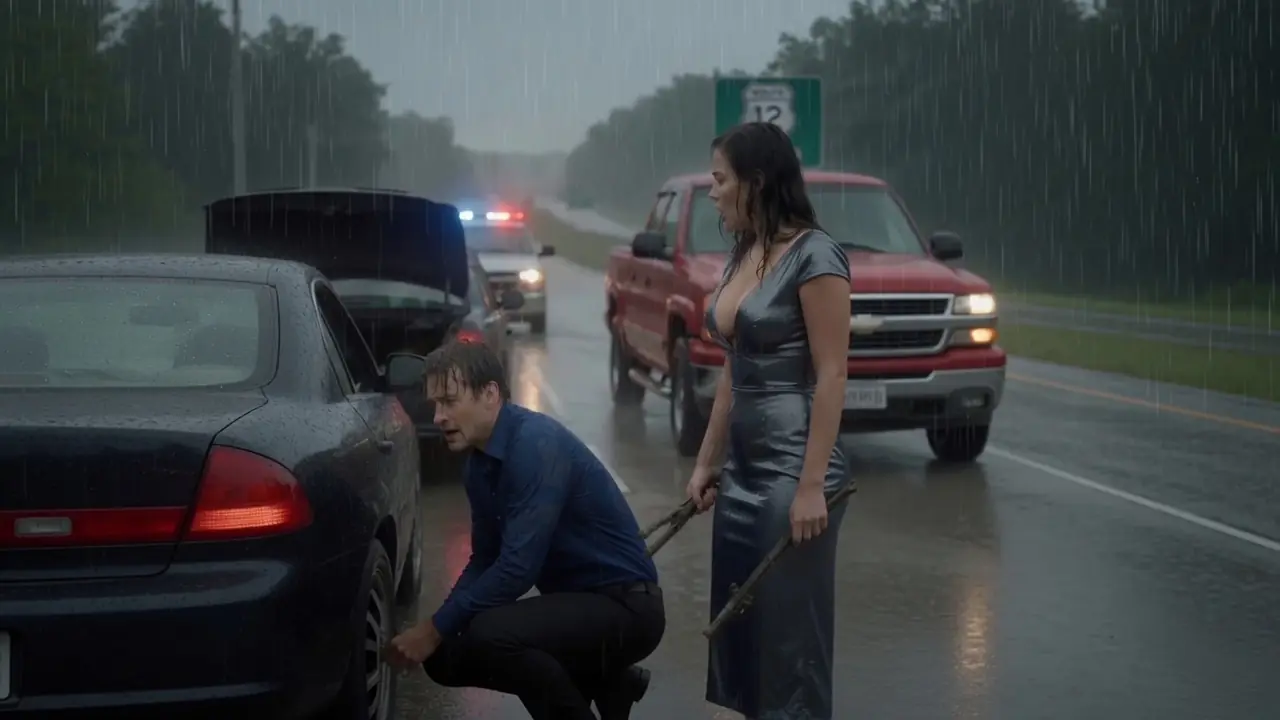
The woman beside the sedan wore a red satin dress that belonged in a private dining room, not on the shoulder of a flooded Indiana highway. Her long black hair was soaked against her face, one heel had sunk into the mud, and her phone kept losing its signal every time she attempted another call. A red pickup sat fifty yards behind her vehicle with its headlights on, apparently waiting for the traffic to clear. Ethan noticed it only because the driver never tried to pass.
He parked his aging station wagon in front of the sedan and stepped into water deep enough to cover his shoes. His white dress shirt immediately clung to his shoulders, and the navy tie he had worn for a morning appointment became a wet rope against his chest. Elena watched him open the rear hatch and remove a dented tool case, jumper cables, and a portable diagnostic reader. To her, he looked like a desperate roadside mechanic who had seen an expensive car and smelled an opportunity.
Ethan had heard that tone before. It was the voice wealthy customers used when they entered the garage where he had worked for fourteen years, looked past the oil on his hands, and asked whether someone more qualified could inspect their vehicle. He did not answer Elena’s insult because the engine bay had already told him something was wrong. The battery terminals were clean, the alternator belt was intact, and the voltage reading was nearly perfect.
“This car should start,” he said.
“It started fifteen minutes ago,” Elena replied. “Then it shut down while I was driving.”
“Did the dashboard flicker first?”
“No. Everything died at once.”
That answer made Ethan stop. Ordinary electrical failures usually left clues—warning lights, weak ignition, dimming accessories, a clicking starter. Elena’s sedan had lost power as if someone had turned a master switch. He removed the plastic cover beside the fuse box and found a thin black wire that did not belong there.
A square relay had been installed beneath the original harness and disguised with factory-colored tape. It was too clean to be old and too carefully hidden to be an emergency repair. Ethan followed the wire toward the firewall and discovered a compact transmitter secured beneath the cowl. A green indicator blinked once, paused, and blinked again.
Then the sedan’s locks clicked by themselves.
Elena stepped back. “What did you do?”
“Nothing.”
The engine attempted to turn over, failed, and went dead again. Ethan looked past her toward the red pickup. Its brake lights had illuminated even though it had not moved.
The state trooper approaching from behind Ethan’s wagon reduced his speed when he saw the disabled vehicles. Ethan raised both hands and pointed toward the pickup before the officer had even stepped out. Elena began explaining that the stranger had touched her car without permission, but Ethan interrupted only long enough to tell the trooper that the sedan contained an unauthorized remote ignition cutoff. He asked the officer to record the pickup’s plate before the driver disappeared.
The pickup moved immediately.
Its tires sprayed water across the shoulder as it accelerated into traffic. The trooper returned to his cruiser and followed, emergency lights reflecting across the flooded pavement. Ethan watched until both vehicles disappeared around the bend. Elena no longer looked angry; she looked as though the storm had become the least dangerous thing around her.
“My company designed that relay,” she said quietly.
Ethan turned toward her. “Then someone from your company wanted your car stopped.”
Elena Vargas was the founder and chief executive of Halcyon Mobility Systems, an Indiana technology manufacturer that produced electronic safety modules for commercial vehicles. The company had begun twelve years earlier in a rented South Bend warehouse with six engineers and one contract to build emergency shutdown systems for municipal buses. It now employed more than fourteen hundred people and supplied components to fleets throughout the Midwest. The device hidden beneath Elena’s hood was an unreleased Halcyon prototype.
She had been traveling to an emergency board meeting when her sedan died. The board was scheduled to vote on an acquisition offer from Northstar Equity, a private investment group that had spent months pressuring Halcyon to sell. Elena opposed the deal because Northstar intended to close the Indiana manufacturing plant, move production overseas, and eliminate almost six hundred local jobs. Her presence was required to block the vote.
“If I don’t reach headquarters before four,” she said, “the board can proceed under the emergency proxy agreement.”
Ethan checked his watch. It was 3:22.
His first thought was Noah.
His second was that the woman standing before him had not merely experienced a breakdown. Someone had selected the exact road, the exact time, and the exact technology needed to keep her away from a vote. Ethan called the elementary school, but the signal dropped twice before the secretary answered. He explained that he was stranded on Route 12 and asked whether Noah could remain inside until he arrived.
“The building closes at four,” the secretary said. “We cannot keep staff here beyond the emergency dismissal.”
Ethan closed his eyes. His neighbor, Mrs. Carter, lived three blocks from the school and had watched Noah several times when repair jobs ran late. He called her next. She answered on the first ring and agreed to collect Noah, but Ethan could hear disappointment in his son’s voice when the secretary placed him briefly on the phone.
“I’m coming,” Ethan promised.
“You always say that.”
The words cut deeper than the rain. Ethan had worked nights, weekends, and roadside calls since Noah’s mother died three years earlier. Every decision was supposed to protect his son, yet too many of those decisions ended with Noah waiting somewhere while Ethan helped someone else. He told Noah that Mrs. Carter would take him home and that he would explain everything soon.
When Ethan returned to the sedan, Elena had removed her heels and placed them inside the passenger compartment. She was trying to send documents from her phone, but the network remained weak. Ethan could have left. The trooper had the pickup’s plate, Elena had roadside assistance on the way, and Noah needed him.
Then he noticed a second transmitter beneath the dashboard.
The device was connected to the sedan’s communication network, which meant it could do more than shut down the engine. It could record locations, monitor calls routed through the vehicle, and possibly access documents sent through the car’s wireless system. Elena had been using that system during confidential conversations about the Northstar offer.
“They weren’t only trying to stop you,” Ethan said. “They’ve been listening.”
Elena stared at the small module in his hand. “Can you remove it without destroying the data?”
“Yes, but not here. Water is reaching the harness.”
“My headquarters is twenty-eight miles away.”
“My garage is six.”
Ethan’s garage was not a commercial business. It was a converted two-car structure behind the modest house he had inherited from his father, filled with salvaged diagnostic equipment, labeled drawers, and the unfinished projects he repaired for neighbors after his dealership job disappeared. Halcyon’s roadside team would take at least an hour to arrive in the storm. Elena studied his soaked clothing, battered wagon, and careful hands before making her decision.
“Get the car running,” she said. “I’ll follow you.”
“I’m not charging you.”
“I did not ask for charity.”
“Neither did I.”
Ethan bypassed the unauthorized relay without disconnecting the transmitter. If the people controlling it believed the sedan remained disabled, they might continue sending commands, creating a record of their activity. He insulated the exposed wire, secured the factory circuit, and instructed Elena not to connect her phone to the vehicle. The engine started on the first attempt.
They reached Ethan’s house at 3:41. Mrs. Carter’s car was not yet in the driveway, which meant Noah was still on his way home. Ethan guided Elena’s sedan into the garage, raised it on low ramps, and placed a collection tray beneath the passenger side. He removed the lower dash panel while Elena called her general counsel from an old landline mounted beside the workbench.
The hidden equipment was more sophisticated than Ethan had expected. The kill switch, tracking device, and communication tap were connected through a cloned diagnostic gateway carrying a legitimate Halcyon serial number. Whoever installed it had access to internal inventory records. Ethan photographed every connection before touching it, then placed each removed component inside clean food-storage bags because he had no evidence containers.
At 3:53, the transmitter received another command.
A tiny red diode flashed three times, and the relay attempted to interrupt the ignition circuit again. Ethan connected the module to an isolated power source and routed the output through his diagnostic reader. The command contained a device identification number and a network address registered to Ridgeway Fleet Solutions, a maintenance contractor that serviced Halcyon’s executive vehicles.
Elena repeated the company name to her attorney.
Ridgeway had been approved eighteen months earlier by Halcyon’s chief operating officer, Adrian Kessler. Adrian was also the board member who had introduced Northstar’s acquisition proposal. For months, he had argued that Halcyon’s rising warranty costs and unreliable vehicle modules made the company too vulnerable to remain independent.
Ethan looked at the relay in his hand. “How many of your recent product failures involved vehicles maintained by Ridgeway?”
Elena became silent.
She asked her attorney to retrieve the warranty records. The answer arrived seven minutes later: eleven of the thirteen serious failures reported during the previous quarter came from vehicles serviced by Ridgeway. Those failures had reduced Halcyon’s valuation, frightened two major clients, and strengthened Adrian’s argument that the company needed Northstar’s capital.
The car had not been the first target.
It had simply been the first one examined by someone who did not know he was supposed to ignore what he saw.
Noah entered the garage at 4:06 with Mrs. Carter behind him. His wet jacket was zipped to his chin, and his dark hair stuck out beneath a yellow rain hood. He stopped when he saw the luxury sedan, the dismantled dashboard, and Elena standing barefoot beside his father’s workbench.
“You missed me again,” he said.
Ethan removed his gloves. “I know.”
“You were fixing somebody’s car?”
“Somebody made her car stop on purpose.”
Noah looked at Elena. “Are you important?”
Elena considered the question longer than any executive had ever considered her title. “Today, your father is more important than I am.”
Noah did not smile. He walked into the house with Mrs. Carter, leaving Ethan to feel the weight of a promise once again broken for a reason that sounded noble only to adults. Elena noticed the photograph above the workbench showing Ethan, Noah, and a smiling woman at a county fair. She understood that his decision to stop had cost him something personal.
At 4:12, Elena’s attorney called again. The board had delayed the vote by thirty minutes after learning that police were investigating interference with Elena’s vehicle. Adrian had objected and demanded that the acquisition proceed. Elena needed evidence strong enough to justify freezing the transaction before the delay expired.
Ethan connected the cloned gateway to an offline laptop. The device contained an installation log that its creators had apparently forgotten to erase. It showed twelve activation dates, twelve vehicle identification numbers, and repeated remote commands originating from a protected Ridgeway account. Elena’s sedan was the twelfth vehicle.
The first eleven matched Halcyon’s warranty failures.
The log also contained a scheduled instruction marked EXECUTIVE HOLD — 15:10. Ethan opened the attached configuration file. It had been designed to disable Elena’s vehicle at highway speed, wait six minutes, and then block all restart attempts until 4:30—long enough to keep her away from the board vote.
Elena photographed the screen and sent it to her attorney. The board’s legal committee suspended the acquisition vote at 4:24. All company accounts belonging to Adrian Kessler and Ridgeway Fleet Solutions were frozen pending an emergency investigation.
For the first time since Ethan had stopped on the highway, Elena allowed herself to breathe.
“You prevented the sale of my company,” she said.
“I found a wire.”
“You found what my legal department, security team, and engineers missed.”
“They were looking at reports. I was looking at a car.”
The trooper called shortly afterward. The red pickup had been stopped ten miles east near a closed gas station. Its driver, Grant Bell, owned Ridgeway Fleet Solutions. Officers had found a laptop on the passenger seat running software capable of controlling the relay beneath Elena’s hood.
Grant insisted he had only been testing approved Halcyon equipment. He claimed Adrian had authorized the installation as part of a confidential security project. The problem with his explanation was that the laptop still displayed the command history, including the signal sent while Ethan was beneath the hood.
By evening, investigators had obtained a warrant for Ridgeway’s maintenance facility. Inside a locked office, they discovered identical cloned gateways, altered service records, and invoices billed to shell companies. One company, North Lake Advisory, had received more than three million dollars from Northstar Equity during the previous year. North Lake had then paid consulting fees to Adrian Kessler.
The conspiracy was larger than a boardroom disagreement.
Adrian and Grant had been manufacturing product failures to depress Halcyon’s value. Each disabled vehicle produced an expensive warranty claim and another frightened customer. Adrian used those failures to convince the board that Halcyon lacked the capital to repair its technology, while Northstar prepared to buy the company for less than half its previous valuation.
Elena’s absence from the final vote was supposed to complete the plan.
Adrian denied everything when investigators arrived at headquarters. He said Grant had acted independently and accused Elena of inventing a crisis to retain control. Then the cloned gateway from her sedan produced a digital authorization certificate created with Adrian’s executive credentials.
The certificate alone did not prove he had issued the command. The investigation needed evidence connecting his account to Ridgeway’s system at the exact time of the highway shutdown. Elena remembered Ethan’s warning that the device had also been monitoring communications.
The transmitter had recorded fragments of nearby audio whenever it received a remote signal. Ethan recovered the files from the memory chip using an adapter he had built years earlier to retrieve data from damaged engine controllers. The final recording contained Grant’s voice inside the pickup and another man speaking through the laptop.
“Keep her down until the proxy vote clears,” the second voice said. “After four-thirty, restore the car and make it look intermittent.”
Elena recognized Adrian immediately.
Two days later, Adrian Kessler was removed from the board and arrested on charges connected to fraud, unlawful interception, evidence manipulation, and conspiracy. Grant Bell lost every Halcyon contract, and Ridgeway Fleet Solutions entered court-supervised receivership. Northstar Equity withdrew its offer before regulators could freeze the acquisition funds.
The company survived, but Elena refused to present the result as a simple victory. Eleven fleet operators had paid for repairs that should never have been necessary. Drivers had been placed at risk, workers had feared losing their jobs, and Halcyon’s own reporting system had dismissed technicians who questioned why failures kept occurring after Ridgeway service visits.
Elena ordered an independent review of every warranty claim, contractor relationship, and executive authorization. Customers received full reimbursement for fraudulent repairs, along with compensation for downtime. Halcyon created a protected reporting channel allowing mechanics and drivers to submit technical concerns directly to an outside safety panel.
Three weeks after the storm, Elena returned to Ethan’s garage.
He was replacing the wheel bearing on a delivery van while Noah completed homework at a small folding table near the workbench. Elena wore a navy suit instead of the red dress, and she arrived in a company vehicle that had been inspected by an independent technician. Ethan assumed she had come to pay him despite his refusal.
Instead, she placed a sealed component box on the bench.
Inside was a malfunctioning Halcyon control unit from one of the affected vehicles. Elena explained that five senior engineers had examined it and disagreed about whether the damage resulted from sabotage or an unrelated manufacturing defect. She wanted Ethan’s conclusion.
“Is this another favor?” he asked.
“It is a paid technical assessment.”
“I don’t want a position because I stopped on the highway.”
“I know. That is why I brought you a problem instead of an offer.”
Ethan spent two hours testing the unit. Noah watched him compare circuit resistance, inspect solder joints, and photograph a microscopic fracture near the power regulator. The remote gateway had triggered the original shutdown, but repeated voltage surges had also exposed a genuine weakness in Halcyon’s protective circuit.
Ethan wrote his conclusion on a yellow legal pad.
The sabotage had created the failures, but the design flaw had made the damage worse. Ignoring either fact would be dishonest. Elena read the report twice and asked whether he understood that identifying the genuine defect could force an expensive recall.
“If your company sells safety equipment,” Ethan said, “the expensive answer is cheaper than the hidden one.”
Elena offered him a six-month contract as an independent field diagnostics specialist. His assignment would be to examine failures from the perspective of the mechanics who encountered them instead of relying entirely on laboratory reports. The salary was more than Ethan had earned at the dealership, but he still asked for one condition.
He needed to collect Noah from school every afternoon.
Elena agreed without negotiation.
Ethan’s work led Halcyon to replace the vulnerable regulator before it caused an accident. He also discovered that service technicians had been documenting early warning signs for nearly a year, but their comments were buried beneath numerical performance reports. Elena reorganized the quality division so field mechanics could speak directly with engineers during safety reviews.
Noah began spending occasional Saturdays in Halcyon’s workshop, where he learned to identify tools, build simple circuits, and ask questions adults sometimes considered inconvenient. He never forgot the afternoon his father had missed school pickup, but he eventually understood why Ethan had stopped. More importantly, Ethan changed his own habits so helping strangers no longer meant making his son feel like an afterthought.
A year after the storm, the court convicted Adrian and Grant using financial transfers, activation logs, audio recordings, altered warranty files, and the laptop recovered from the red pickup. Halcyon recovered millions through restitution and civil judgments. Northstar faced a separate investigation after records showed its executives had financed the shell company used to reward Adrian.
Elena refused to hide the scandal. She published the independent review, acknowledged the company’s internal failures, and invited affected customers to examine the reforms. Some board members warned that transparency would damage Halcyon’s reputation.
Elena answered that reputation without truth was only advertising.
The black sedan remained at headquarters after the trial. Instead of repairing and selling it, Elena placed the removed kill switch, cloned gateway, and tracking transmitter inside a glass case in Halcyon’s training center. Beneath them, a metal plaque carried one sentence:
THE FAILURE WAS HIDDEN IN THE SYSTEM—UNTIL SOMEONE TOOK THE TIME TO LOOK.
Ethan saw the display for the first time while attending the opening of Halcyon’s new technician apprenticeship program. The program recruited single parents, laid-off mechanics, and workers whose experience had never been recognized by a college degree. Ethan had helped design the practical examination so applicants were judged by what they could diagnose, explain, and repair.
Elena found him standing beside the glass case with Noah.
“You still think you only found a wire?” she asked.
Ethan looked at the small relay that had nearly cost hundreds of people their jobs.
“I found a car that wouldn’t start.”
Noah shook his head. “You found the bad guys.”
Elena smiled. “Your son tells a better story.”
Outside, rain began tapping softly against the training center windows. It was nothing like the violent storm on Route 12, but Ethan could still remember kneeling in the water, hearing Noah’s disappointed voice, and wondering whether stopping had been the right decision. He no longer believed integrity meant sacrificing the people closest to him whenever a stranger needed help.
Integrity meant refusing to look away while also returning for those who trusted you to come home.
Elena had not hired Ethan because he rescued a powerful woman. She hired him because he had refused to give her a comforting lie, even when the truth exposed a flaw inside her own company. Ethan had not changed his son’s future by impressing a CEO.
He changed it by proving that honest work could reveal what powerful people had spent millions trying to hide.