The night Evan Cole found his drunk boss sitting barefoot on the porch outside his apartment building, he had no idea she was his boss at all.
He just saw a broken woman soaked through, shivering in the worst storm the city had seen in a decade, her expensive dress torn at the hem and her eyes empty in a way that made the rain feel almost gentle by comparison.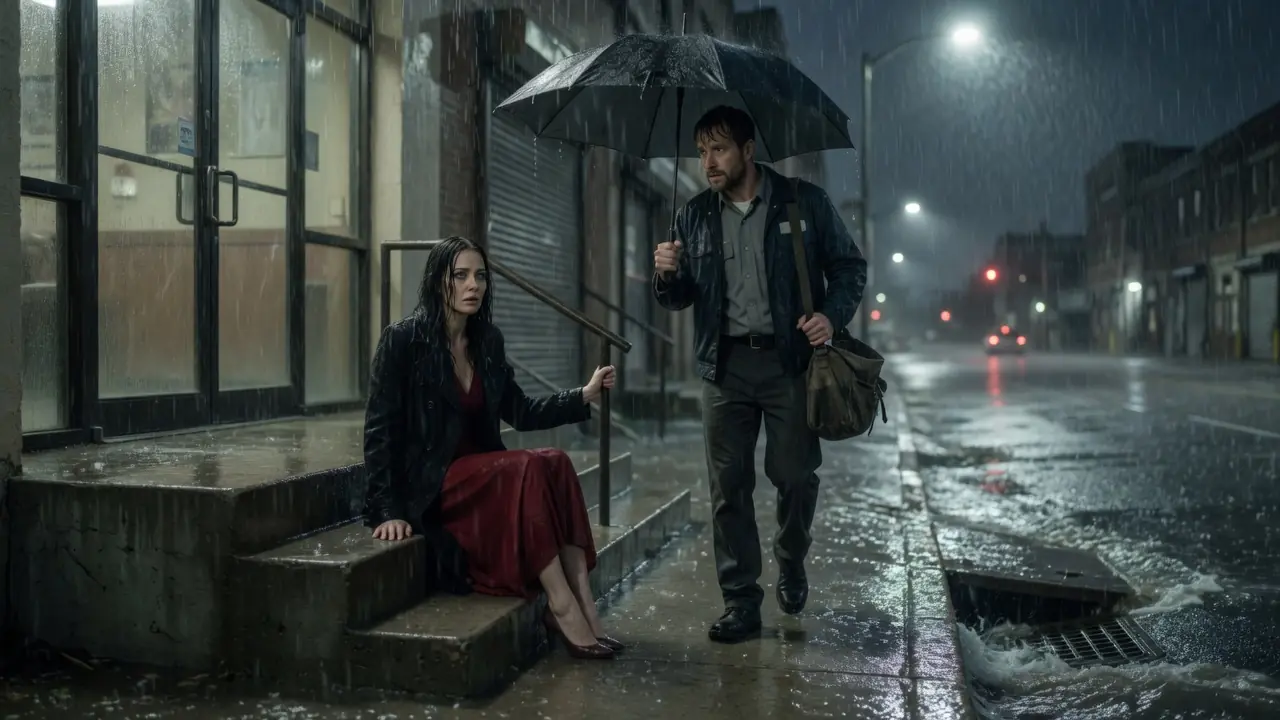
By morning, she had vanished from his couch like a ghost.
But when Grace Harlo, CEO of the very company whose floors he mopped, showed up at his door the next night stone-cold sober, she brought with her a secret that would shatter everything Evan thought he knew about survival, sacrifice, and second chances.
The rain did not fall that October night.
It attacked.
It came sideways through the downtown streets, hard enough to sting exposed skin and loud enough to drown out traffic lights clicking from red to green. Wind screamed between buildings, tearing at awnings, snapping cheap umbrellas inside out, and sending trash cans rolling across intersections like metal animals escaping their cages.
Water poured from storm drains faster than the drains could swallow it. Gutters became rivers. Sidewalks shone black under streetlamps. Lightning split the sky in white flashes so bright the whole city appeared frozen for half a second at a time.
The city had issued warnings all day.
Stay inside.
Shelter in place.
Avoid unnecessary travel.
But Evan Cole did not have the luxury of unnecessary.
His shift at Harlo Industries had ended at midnight, and the last bus had stopped running early because of flooding on the east route. A ride-share would have cost more than he had in his checking account. His phone was dead, and even if it had not been, calling anyone for help had never come easily to him.
So he walked.
Three miles from the Harlo Industries tower to his apartment on the south edge of the industrial district.
He walked past shuttered warehouses, loading docks, chain-link fences, and empty lots where streetlights flickered like dying stars. He walked with his head down, one hand shielding his face, the other clutching the strap of his worn canvas bag.
He had made this walk a thousand times before.
In rain.
In snow.
In the suffocating heat of summer.
He had walked after twelve-hour shifts and double shifts, after days when his back hurt so badly he had to sit on the curb before climbing the stairs to his apartment. He had walked in silence, in exhaustion, in anger, in prayer, and sometimes in a numbness that was worse than all of them.
Because this was what you did when you were a single father working nights for eleven dollars an hour.
You walked.
You endured.
You survived.
Evan was thirty-five years old, though some mornings his body felt closer to fifty. He had a lean frame made thinner by skipped meals, a tired face, short dark hair he cut himself with clippers in the bathroom, and brown eyes that had learned to stay calm even when life kept demanding more than he had to give.
At Harlo Industries, he was invisible in the way cleaning staff often become invisible.
He wore a navy uniform shirt with his name stitched over the pocket. He carried a mop bucket, trash liners, disinfectant bottles, and keys that opened rooms where he was never meant to belong. He cleaned conference rooms where executives argued over budgets larger than his entire lifetime income. He emptied trash cans beneath glass walls covered in strategy notes. He vacuumed around chairs that cost more than his monthly rent.
Most people did not look at him.
Some said thank you without meaning it.
Some left coffee cups on desks inches from empty trash cans.
Some looked uncomfortable when he entered, as if his presence reminded them the building did not clean itself.
Evan did not resent them exactly.
Resentment required spare energy.
Most of his energy belonged to Liam.
Liam Cole, eight years old, asleep in their cramped apartment six blocks from the old rail yard, curled around the stuffed bear his mother had given him before she got sick.
Liam was thin, bright-eyed, serious in the way children sometimes become when life teaches them too early that adults can break. He loved dinosaurs, pancakes, drawing robots, and asking questions Evan could not always answer.
Why does thunder happen?
Could a T. rex beat a tank?
Do angels remember people’s birthdays?
Is Mom still sick in heaven?
That last one had nearly undone Evan the first time Liam asked it.
Sarah had been gone for three years.
Cancer took her at thirty-two, slow enough to make them hope and fast enough to feel cruel. She had been a school librarian with a laugh that filled rooms and a way of making cheap things feel magical. She could turn a can of soup into dinner, a cardboard box into a spaceship, a rainy afternoon into an adventure.
When Sarah died, Evan did not just lose his wife.
He lost the person who made hardship feel temporary.
After the funeral, the bills came faster than condolences. Medical debt. Rent. Utilities. Child care. School fees. Groceries. A cracked tooth he could not afford to fix. Sneakers Liam outgrew before Evan could replace them. The kind of expenses that did not care whether a man was grieving.
So Evan took what work he could get.
Warehouse loading.
Night security.
Cleaning contracts.
Weekend moving jobs.
Eventually, he became part of the overnight facilities crew at Harlo Industries, a company whose name appeared on buildings, press releases, and economic reports. Harlo made industrial logistics software, manufacturing systems, supply-chain platforms, and more money in a quarter than Evan could imagine without getting tired.
He had never met Grace Harlo.
He had seen her photo in the lobby, framed beside a company mission statement about innovation with humanity.
Grace Harlo looked like the kind of woman who did not know what it meant to check the price of milk.
Mid-thirties.
Elegant.
Sharp-eyed.
Dark hair smooth around a face made for magazine profiles and shareholder meetings. She wore expensive suits and looked directly into cameras as if she expected the world to move when she spoke.
Evan had cleaned her executive floor twice.
Once, he had seen her office from the doorway.
Glass walls.
A black desk.
A view of the city.
A framed photograph turned facedown beside her computer.
He remembered that detail because everything else in the office looked too controlled for something to be left facing the wrong way.
That night, walking home through the storm, Evan was not thinking about Grace Harlo.
He was thinking about Liam’s field trip permission slip.
The class was going to the science museum, and Liam had been talking about it for two weeks. The cost was eighteen dollars. Evan had eleven in cash and maybe nine in checking after rent cleared, unless the power company took its automatic payment earlier than expected. He needed to sign the form, send the money, and somehow replace Liam’s sneakers before the hole in the right one reached the sock.
His phone was dead because he had forgotten to charge it at work. At home, he had chosen to leave the only working charger plugged into the power strip by Liam’s bed so his son’s alarm clock would not reset again.
He always chose Liam.
Even when the choice was small.
Especially then.
Thunder cracked overhead so loudly Evan felt it in his chest.
He pulled his jacket tighter, though it was already soaked through. Water ran down his neck and under his collar. His boots squished with every step. His canvas bag banged against his hip, heavy with a lunch container, a torn paperback, and the cheap flashlight Mrs. Chen insisted he carry.
Mrs. Chen lived next door to Evan and Liam.
She was seventy-one years old, small, sharp-tongued, and kinder than she wanted people to know. She watched Liam during Evan’s night shifts and never accepted payment. She brought dumplings on Sundays, scolded Evan for looking too thin, and said he reminded her of her own son who died young.
Evan never asked how.
Some wounds you did not poke.
He was almost home when he saw her.
At first, he thought someone had left a pile of wet clothes under the narrow porch awning outside his building.
Then the pile moved.
A woman sat curled beside the front steps, barefoot, soaked through, hugging her knees to her chest while rain blew across the porch in silver sheets. Her expensive dress hung in torn, rain-heavy fabric around her legs. Her dark hair was plastered to her face. One hand dangled over the edge of the step as if even lifting it required more strength than she had left.
Evan stopped at the bottom of the stairs.
The hallway light behind the glass front door flickered over her face.
She was beautiful in the distant, polished way expensive people sometimes were, but whatever world she had come from had been washed off her by the storm. Her makeup had run beneath her eyes. Her lip was split. Her skin looked too pale, and her body shook violently from cold.
For one second, Evan wondered if she was dead.
Then she laughed.
Not happily.
Brokenly.
The kind of laugh that came from somewhere beyond despair.
“You live here?” Evan asked, raising his voice over the rain.
The woman turned her head slowly, as if sound had to travel a long way before reaching her.
“No,” she slurred.
“Are you hurt?”
She looked down at herself with vague curiosity.
“Probably.”
“Do you know where you are?”
A small, empty smile touched her mouth.
“No.”
Evan climbed the first step carefully, keeping his hands visible.
“I’m going to call someone.”
He reached for his phone before remembering it was dead.
The woman watched him with unfocused eyes.
“No one’s coming,” she whispered.
The words were so quiet he almost missed them beneath the storm.
Evan felt something tighten inside him.
“What’s your name?”
She closed her eyes.
“I’m… no one.”
“That’s not a name.”
“It’s the truest answer I have tonight.”
Evan looked at the street behind him.
No cabs.
No police.
No neighbors.
No help.
Just rain, lightning, and a woman sitting on his porch like the storm had placed her there because it did not know what else to do with her.
“You can’t stay out here,” he said.
“Why?”
“Because you’re freezing.”
“That sounds peaceful.”
The answer went through him colder than the rain.
She was not just drunk.
She was not just lost.
She had the voice of someone who had stopped negotiating with survival.
Evan crouched two steps below her.
“I have a son upstairs,” he said. “He’s asleep. I’m not going to leave you on the porch where he might find you in the morning.”
Her eyes opened slightly.
“You have a child?”
“Yes.”
A tear slipped down her face, though it was impossible to tell where rain ended and grief began.
“I had one too.”
Evan went still.
The woman shivered harder, arms locked around herself.
“I’m sorry, baby,” she whispered. “I’m so sorry.”
Evan did not ask questions.
Some wounds you did not poke.
Instead, he said, “Okay. You’re coming inside.”
She tried to shake her head.
“I don’t want to bother anyone.”
“You’re already on my porch in a hurricane. We passed bother ten minutes ago.”
That drew the smallest sound from her.
Not quite a laugh.
Not quite a sob.
He stepped closer.
“I’m going to help you stand. I’m not going to hurt you. My neighbor is inside with my son. She’ll help too.”
The woman stared at him.
“You don’t know me.”
“Don’t need to.”
He reached for her carefully.
She was so cold that her fingers felt almost bloodless when they touched his wrist. She tried to stand, but her legs folded immediately.
Evan caught her before she hit the step.
She collapsed against him, shaking, her wet hair brushing his jaw.
“Easy,” he said. “I’ve got you.”
She made a weak sound that might have been protest.
He ignored it.
He shouldered open the front door, half carrying, half guiding her into the building. The lobby smelled like damp carpet, old mail, and the lemon cleaner Mrs. Chen used when she got nervous. The lights buzzed overhead. Rain hammered the glass behind them as if angry he had taken something away from it.
The stairs felt longer than usual.
Second floor.
Left hallway.
Apartment 2B.
By the time Evan reached his door, his shoulder ached from supporting her weight, and both of them were dripping water onto the floor.
He knocked once before opening it so Mrs. Chen would not panic.
She looked up from the couch immediately.
She had been knitting beside a lamp, with one eye on the muted television and one ear tuned toward Liam’s room.
“Evan!” she cried. “What happened?”
“Found her on the porch,” Evan said quickly. “She’s freezing.”
Mrs. Chen took one look at the woman and immediately moved into action.
“She needs dry clothes and tea.”
“I know.”
“You are bleeding?”
“No. Just soaked.”
“You are always just something,” she snapped, already moving toward the bathroom. “Bring her.”
Evan helped the stranger into the bathroom and sat her gently on the closed toilet lid. Mrs. Chen brought towels and warm water while Evan grabbed sweatpants and an old flannel shirt from his room.
“I’ll help her,” Mrs. Chen said firmly. “You check on Liam.”
Evan hesitated.
Mrs. Chen gave him the look that had frightened generations of neighborhood children.
“Go.”
He went.
Liam was asleep in his tiny room, curled on his side beneath a faded dinosaur blanket. The stuffed bear Sarah had given him before the final hospital stay sat tucked under his arm, one ear worn thin from years of being held too tightly.
Evan stood in the doorway for a moment, breathing hard.
Then he crossed the room and brushed a hand over his son’s hair.
“Daddy?” Liam murmured sleepily.
“Right here, buddy.”
“Storm’s loud.”
“I know. But we’re safe.”
Liam’s eyes opened halfway.
“You came home.”
“Always.”
That was their promise.
Evan had made it after Sarah died, when Liam began waking in the night terrified that everyone who left might never come back.
I always come home.
Even if I’m late.
Even if it rains.
Even if you’re asleep when I get here.
I always come home.
Liam drifted back to sleep.
Evan stood there longer than necessary, staring at his son and reminding himself why he endured everything.
When he returned to the living room, the stranger sat wrapped in two blankets on the couch, damp hair falling around her face. Mrs. Chen had put Evan’s old flannel shirt on her, and the borrowed clothes made the woman look younger somehow.
Not powerful.
Not rich.
Not untouchable.
Just broken.
Mid-thirties maybe.
Beautiful in a tired, haunted way.
Mrs. Chen touched Evan’s shoulder gently before leaving.
“Your Sarah would be proud,” she whispered.
The words hit harder than they should have.
Evan looked away.
Mrs. Chen went back to her apartment after making him promise to knock if the woman’s breathing changed, if she vomited, if she became feverish, or if he felt too foolish to ask for help.
Evan made tea.
The woman held the cup with shaking hands.
“Thank you,” she said softly.
“You could’ve frozen out there.”
“Yeah,” she whispered. “I know.”
Her voice was clearer now, though still hoarse.
“What’s your name?” he asked again.
She hesitated.
“I’m… no one.”
Evan studied her.
“You said that already.”
“It still feels true.”
He did not push.
“You can sleep on the couch,” he said. “We’ll figure things out in the morning.”
She looked around the apartment then.
Not with judgment.
With confusion, as if she had landed in a world where things were small but real. The sagging couch. The chipped coffee table. Liam’s drawings taped to the fridge. A pair of child’s sneakers near the door, one of them splitting at the side. A sink with two cups drying beside it. A framed photograph of Sarah holding Liam as a toddler.
The woman’s eyes stopped on that photograph.
“Your wife?” she asked.
Evan swallowed.
“Was.”
“I’m sorry.”
“Me too.”
The woman looked at him then, really looked.
“You have a kind face, Evan.”
He did not know how to answer that.
Kindness had not paid rent.
Kindness had not saved Sarah.
Kindness had not stopped the hospital bills.
But kindness had opened the door to a stranger in the storm because whatever else Evan had lost, he had not lost that.
“Sleep,” he said.
She did.
Evan did not.
He sat in the chair across from the couch, a blanket around his shoulders, wet boots beside the door, watching her breathe because he was afraid she might stop. Every hour, he checked on Liam. Every time thunder shook the windows, the woman flinched in her sleep.
Once, near dawn, she whispered one word.
“Henry.”
By morning, she was gone.
The blanket was folded.
The cup washed.
The borrowed clothes neatly draped over a chair.
Like she had never been there.
Except for one thing.
A business card left in the pocket of his flannel shirt.
Evan found it when he lifted the shirt from the chair, intending to throw it into the laundry basket. The card slipped out and landed on the floor, black letters on thick cream paper.
Grace Harlo
Chief Executive Officer
Harlo Industries
Evan stared at the card in disbelief.
Then he laughed once, quietly and without humor.
The woman he had found sitting on his porch in the storm was not just anyone.
She owned the building where he worked.
The building where he cleaned bathrooms, emptied trash cans, and refilled soap dispensers.
The building where her name was carved into the lobby wall in steel letters.
He turned the card over.
On the back, written in unsteady handwriting, were two words.
I’m sorry.
Evan sat down at the kitchen table.
For a long time, he did nothing.
Then Liam shuffled out of his room, hair messy, bear under one arm.
“Daddy, who was here?”
Evan looked at the card in his hand.
“Someone who needed help.”
“Is she okay?”
“I hope so.”
Liam climbed into the chair across from him.
“Can we have pancakes?”
Evan looked at the empty pancake mix box on the counter.
“Toast.”
“Toast is not pancakes.”
“No, but it is breakfast.”
Liam sighed with the weary disappointment of a child forced to endure difficult truths.
Evan smiled despite everything.
Then he made toast.
At work that night, Harlo Industries felt different.
Evan had always known the building belonged to Grace Harlo in some abstract way, the way people know a city belongs to mayors and developers and names on plaques. But now every polished floor, every elevator, every glass wall seemed connected to the woman who had sat trembling on his couch in old sweatpants.
He wondered whether she remembered him.
He wondered whether she was ashamed.
He wondered whether she had woken up somewhere safe or simply returned to the glass office with the facedown photograph and pretended nothing had happened.
He did his job.
He mopped the lobby after the evening foot traffic ended. He wiped fingerprints from elevator buttons. He cleaned the executive restrooms on the top floor. He emptied trash cans in conference rooms still smelling faintly of coffee and expensive cologne.
At 2:15 a.m., he passed Grace Harlo’s office.
The lights were off.
The facedown photograph was still on her desk.
He stood there too long, holding a trash bag.
Then he moved on.
The next night, Grace Harlo knocked on his apartment door.
Evan had just finished helping Liam with a math worksheet and was washing the two plates from dinner when the knock came. It was soft, controlled, almost too polite for the building.
Mrs. Chen had already gone back to her apartment.
Liam was in his room, drawing a robot dinosaur with rocket feet.
Evan opened the door and found Grace standing in the hallway.
This time she was sober.
Sharp.
Controlled.
She wore a dark wool coat, black trousers, and her hair pulled back from her face. No smeared makeup. No torn dress. No barefoot trembling. She looked like the woman from the company lobby photograph again, except her eyes carried something no executive portrait could hide.
Sadness.
Deep, disciplined sadness.
“I’m sorry for coming without calling,” she said.
Evan stared at her.
“You know where I live.”
“I had your employee file.”
“That’s not comforting.”
“No,” she said. “It isn’t. But I didn’t know how else to apologize.”
He looked down the hallway, then back at her.
“You shouldn’t be here.”
“I know.”
“You shouldn’t have been on my porch either.”
“I know.”
“You could have frozen to death.”
Her face tightened.
“I know.”
Evan stepped into the hallway and closed the door behind him so Liam would not hear too much.
“You could have at least left a note that said you were alive.”
“I did.”
He pulled the business card from his pocket.
“That was not enough.”
Grace looked down.
“No. It wasn’t.”
For the first time, Evan realized she was afraid.
Not of him.
Of this conversation.
She took a breath.
“I spent all day trying to work up the courage to thank you properly.”
“You don’t owe me anything.”
“I owe you my life.”
“You were drunk and freezing. I helped. That’s all.”
Grace’s mouth trembled slightly.
“Is that how you survive? You make enormous things sound small?”
Evan did not answer.
She reached into her coat pocket and pulled out a photograph.
Not a phone image.
A real photograph, worn at the edges.
A little boy smiled up from it, holding a toy dinosaur in one hand. He had dark curls, bright eyes, and one front tooth missing.
“My son,” Grace said quietly. “Henry.”
Evan felt something inside him go still.
Grace looked at the photograph as if it might vanish if she stopped holding it carefully.
“He was seven.”
Evan did not move.
“A drunk driver ran a red light ten years ago,” she said. “My husband was driving. Henry was in the back seat. I was supposed to pick him up from school that day, but I had a board presentation. So I asked Daniel to do it.”
Her voice remained controlled, but every word had blood beneath it.
“Daniel survived for six hours. Henry died before the ambulance got there.”
Evan closed his eyes briefly.
“I’m sorry.”
Grace nodded, but the words did not reach the place inside her that needed them. Evan recognized that too. Some grief sits beyond apology.
“I built Harlo Industries after that,” she said. “Or rebuilt it. My father started the company, but it was failing when I took over. Everyone said work saved me.”
“Did it?”
She looked at him.
“No. It kept me moving. That is not the same thing.”
A pipe groaned somewhere behind the hallway wall.
Grace did not seem to notice.
“I learned how to function. How to smile for investors. How to speak at charity events. How to make decisions. How to become someone people called strong because they didn’t know the difference between strength and numbness.”
Evan thought of Sarah’s hospital room.
The way people had called him strong because he filled out forms, spoke to doctors, handled the funeral, and remembered to feed Liam.
They had not seen him sitting on the bathroom floor at 3:00 a.m. with a towel pressed against his mouth so his son would not hear him break.
“Last night was the anniversary,” Grace said.
“The accident?”
She nodded.
“Every year I tell myself I will handle it better. Every year I fail differently.”
Evan looked toward the stairwell.
“You ended up on my porch.”
“I don’t remember all of it,” she admitted. “I left a memorial event early. I drank too much. I walked because I could not stand the idea of getting into a car. I think I wandered for a long time.”
She folded the photograph against her chest.
“When I sat down outside your building, I think part of me knew I should stand up, find help, call someone. But I couldn’t. I was so cold, and for the first time in years, I did not care what happened next.”
Evan understood then.
The hollow laugh.
The empty eyes.
The apology whispered to a child who was not there.
Grace looked at him.
“Then you came home.”
“I was walking from work.”
“Through a storm.”
“No bus.”
“Because you couldn’t afford a ride?”
He stiffened.
Grace saw it and looked ashamed.
“I’m sorry. That sounded…”
“Like a CEO?”
A tiny, sad smile touched her mouth.
“Yes.”
Evan almost smiled too.
Grace took another breath.
“I looked you up.”
“Clearly.”
“Then you know I work for you.”
“Yes.”
“You know I clean your building.”
“Yes.”
“And now you’re here to give me money?”
Her face changed.
“I thought about it.”
“At least you’re honest.”
“I thought about it because money is the easiest thing for me to offer. And because it would be selfishly comforting to write a check and pretend I had repaid you.”
“I don’t want a check.”
“I know.”
“Good.”
“But I do want to offer you something.”
Evan’s jaw tightened.
Grace saw it.
“Not charity,” she said. “An opportunity. Work you’re qualified for but were never given the room to reach. Training. Better pay. Benefits. School if you want it.”
“I’m not a redemption project.”
“No,” Grace said softly. “You’re the man who opened his door when I had stopped caring whether I lived or died. But that is not why I want to help you.”
“Then why?”
“Because I read your file.”
Evan’s face hardened.
Grace held up one hand.
“I know. I should have asked. I own the company, and I still should have asked. But I read it. Former logistics coordinator. Community college credits. Excellent supervisor notes. Repeated applications for internal operations roles. Never interviewed.”
Evan said nothing.
Grace continued.
“Do you know why?”
“Because I’m cleaning staff.”
“Because Richard Sterling blocked them.”
Evan frowned.
Richard Sterling was Chief Operations Officer. Everyone knew him. Tall, silver-haired, smiling in a way that never reached his eyes. Evan had seen him in the executive elevator twice.
“Why would he block me?”
“I don’t know yet,” Grace said. “But your applications never reached HR review. Someone marked them as incomplete after submission. Three times.”
Evan stared at her.
He remembered those applications.
He had spent nights filling them out after Liam slept. He had asked Mrs. Chen to proofread one. He had worn his only decent shirt to work the week he hoped for an interview that never came.
Incomplete.
He had believed it.
He had thought he had missed something.
Failed again.
Grace watched his face.
“I can open a door,” she said. “You decide whether to walk through.”
Evan looked toward his apartment door.
On the other side, Liam was probably still drawing his robot dinosaur. Mrs. Chen was probably listening through her wall because she listened to everything. The sink still had a slow leak. The power bill still waited on the counter. The hole in Liam’s sneaker was still growing.
He thought of Sarah telling him once, near the end, “Do not let pride starve our son.”
“I need to think,” he said.
Grace nodded.
“Of course.”
She handed him another card.
This one had only a phone number written on it.
“My personal number. Call when you decide. Or don’t. I won’t punish you for saying no.”
Evan studied her.
“You’re not what I expected.”
Grace’s smile was faint and hollow.
“Neither are you.”
Six days later, Liam came home from school crying because his sneaker had fallen apart in front of his classmates.
Evan had just returned from the laundromat. He found Liam sitting on the edge of the bed, holding the right shoe in both hands. The sole had peeled almost completely away from the upper, flapping open like a mouth.
“Tommy said we’re poor,” Liam whispered.
Evan sat beside him.
“Tommy says a lot of things.”
“He said I should ask Santa for shoes that aren’t trash.”
The words hit Evan with a force that made him dizzy.
Liam was not angry.
That was worse.
He looked ashamed.
An eight-year-old boy ashamed of a shoe.
Evan put an arm around him.
“Hey. Look at me.”
Liam did.
“Your shoes being worn out is not your fault.”
“But we are poor.”
Evan closed his eyes briefly.
“Yes,” he said. “Right now, things are hard. But hard is not forever.”
“Promise?”
Evan wanted to.
But he had learned promises could become cruelty if you could not keep them.
So he said, “I promise I’m trying.”
That night, after Liam fell asleep, Evan sat at the kitchen table and stared at Grace’s number.
For a long time.
Then he called.
Grace answered on the second ring.
“Evan?”
“I’m not accepting charity.”
“I know.”
“I’ll work.”
“I know.”
“And I don’t want anyone knowing about the storm.”
“They won’t.”
“I want to earn whatever this is.”
Grace’s voice softened.
“I never doubted you would.”
That call changed everything.
The position Grace arranged was not glamorous.
Operations trainee.
Temporary probationary placement.
Day shift.
Real salary.
Health insurance after thirty days.
Tuition support after ninety.
A manager named Alana Brooks was assigned to supervise him, not Richard Sterling. Alana was tough, direct, and unimpressed by sob stories. Evan liked her within ten minutes.
“You were facilities?” she asked his first morning.
“Yes.”
“Good. Then you know where the building lies.”
He blinked.
“What?”
“Executives know what reports say. Facilities knows what actually happens. Pay attention. Write things down. Don’t try to impress me. Try to be accurate.”
That was the first time anyone at Harlo Industries had spoken to Evan as if his previous work gave him knowledge instead of shame.
He worked harder than anyone in the department.
He arrived early, stayed late when Mrs. Chen could take Liam, and studied training manuals during lunch. He learned routing software, vendor codes, shipment variance reports, warehouse delay patterns, and compliance procedures. He asked questions carefully. He wrote everything down.
People whispered.
Of course they did.
The janitor had been moved into operations.
The CEO had noticed him.
There had to be a story.
Some assumed pity.
Some assumed scandal.
Richard Sterling assumed weakness.
He stopped by Evan’s desk on the fifth day, smiling with executive warmth.
“Mr. Cole,” he said. “Quite a transition.”
Evan stood.
“Yes, sir.”
“Grace has a generous heart. Sometimes too generous.”
Evan said nothing.
Richard looked at the training binder on his desk.
“Operations is complicated. No shame if it proves too much.”
Alana, passing behind him with coffee, said, “He’s doing fine.”
Richard’s smile tightened.
“I’m sure.”
When he left, Alana looked at Evan.
“Document every interaction with that man.”
Evan did.
Within weeks, Evan noticed something strange.
A shipment of machine components marked delayed had actually been received on time at a secondary warehouse.
A vendor invoice included a service fee tied to a route that did not exist.
A set of supply orders had been split into smaller amounts just below the threshold requiring executive review.
Most people might have missed it.
Evan did not.
He had spent years noticing small things because small things decided whether Liam got field trip money, whether the electric bill cleared, whether dinner could stretch two more nights. Poverty trains the eye brutally. It teaches patterns, shortages, inconsistencies, and lies hidden in numbers.
Evan followed the trail quietly.
He found duplicate freight charges.
Ghost vendors.
Rerouted shipments.
Data access logs tied to accounts that should have been inactive.
The pattern led toward Richard Sterling.
Evan brought it to Alana first.
She went still as she reviewed his notes.
“How long have you been looking at this?”
“Two weeks.”
“You did this yourself?”
“Yes.”
She leaned back.
“Do you understand what this is?”
“Fraud.”
“Possibly more.”
Grace was brought in that evening.
Not in her top-floor office.
In a small conference room near operations, where Evan sat across from her with Alana beside him and a stack of printed evidence between them.
Grace read every page.
Her face changed slowly, not with surprise exactly, but with grief sharpened into focus.
“Richard has been with this company for twelve years,” she said.
Alana said, “That may be how he knew where to hide it.”
Evan watched Grace absorb the betrayal.
He knew that look.
The moment when someone you trusted becomes two people in your mind: the one you knew and the one who did the damage.
Grace looked at Evan.
“How certain are you?”
He pointed to the access logs.
“Certain enough to keep digging. Not certain enough to accuse without backup.”
Something like approval moved through her eyes.
“What do you need?”
“IT security. External audit. And someone who can look at vendor ownership records.”
Grace nodded.
“You’ll have it.”
The investigation took three weeks.
Richard Sterling had been rerouting shipments through shell vendors, selling internal logistics data to competitors, and hiding losses under emergency freight adjustments. The scheme was elegant in the way rot can be elegant when painted over. It had cost the company millions and compromised client contracts.
The man everyone assumed was a charity case became the employee who saved Harlo Industries from a scandal that could have destroyed it.
Richard was removed quietly at first.
Then publicly, when regulators became involved.
Executives who had whispered about Evan stopped whispering when Grace presented the evidence at an emergency leadership meeting.
She did not tell them about the storm.
She did not mention the porch, the rain, the borrowed flannel shirt, or the couch in a poor apartment.
She simply said, “Mr. Cole saw what others missed because he paid attention. That is the standard we should have rewarded long before now.”
Respect did not arrive all at once.
But it arrived.
Doubt turned into curiosity.
Curiosity became admiration.
And Evan, who had spent years moving through the building unseen, became difficult to ignore.
Liam’s life changed alongside his father’s.
The first change was shoes.
Evan took him to a real store, not the discount bin at the back of the supermarket, and let him choose a pair that fit. Liam picked blue sneakers with white stripes and lights in the heels, even though Evan tried to guide him toward something practical.
At the register, Liam whispered, “Are these too much?”
Evan’s throat tightened.
“No, buddy. They’re yours.”
Liam wore them out of the store, stepping carefully at first, then jumping once to make the lights flash.
The second change was the field trip.
Then a winter coat that actually closed.
Then groceries that did not require math in the aisle.
Then a new phone charger.
Then dentist appointments.
Then an apartment application.
Grace remained careful.
She did not sweep into Evan’s life with grand gestures. She did not show up with photographers, checks, or speeches. If anything, she kept her distance at first, as if afraid that helping too much would turn kindness into control.
But Liam became curious.
“Is your new boss nice?” he asked one night over spaghetti.
“She’s fair.”
“That means maybe nice but scary.”
Evan smiled.
“Maybe.”
“Does she like dinosaurs?”
“I don’t know.”
“You should ask. It’s important.”
A week later, Evan mentioned it to Grace after a meeting.
Grace blinked.
“Do I like dinosaurs?”
“My son considers it a character test.”
Her face softened.
“I had a son who loved dinosaurs.”
The silence after that was gentle, not empty.
“What was his favorite?” Evan asked.
Grace looked down at her hands.
“Ankylosaurus.”
“Liam says that’s a respectable choice.”
For the first time since Evan had known her, Grace laughed.
A real laugh.
Small, startled, almost rusty from disuse.
A month later, Grace met Liam.
Not at the office.
Not as a CEO.
At a diner near Evan’s new apartment after Liam’s school science night.
She arrived in a simple coat, hair down, carrying a book about dinosaurs wrapped in brown paper. Liam stared at her for five seconds, then asked, “Are you rich?”
Evan closed his eyes.
Grace smiled.
“Yes.”
“Do you have a pool?”
“No.”
“Then what’s the point?”
Grace laughed so hard she had to put the menu down.
After that, Liam accepted her.
He explained his science project. She listened as if the baking soda volcano were a board-level innovation. He corrected her pronunciation of several dinosaur names. She accepted the correction with appropriate seriousness.
At the end of dinner, Liam asked, “Do you want to come to my school play? I’m a tree.”
Grace’s face changed.
Evan saw the grief move through her, but this time it did not swallow her.
“I would be honored,” she said.
She came.
She sat in the third row beside Evan, applauded every child with equal dignity, and cried quietly when Liam, dressed as Tree Number Four, forgot his line and whispered loudly, “Photosynthesis is hard.”
Afterward, Liam ran to Evan first, then paused in front of Grace.
“Did you see me?”
Grace knelt so they were eye level.
“I did.”
“I was the best tree.”
“Without question.”
Liam looked satisfied.
Then, because children often walk through sacred places without knowing it, he hugged her.
Grace froze.
Only for a second.
Then her arms came around him carefully, as if holding something both precious and breakable.
Evan looked away to give her privacy.
But he heard her breath catch.
Over the next year, the idea that began between Grace and Evan became something larger than either of them expected.
It started with a question Evan asked during a leadership meeting after his promotion to operations coordinator.
“What happens to employees who are capable but stuck because one crisis keeps knocking them backward?”
The room looked at him.
He kept going.
“Child care. Transportation. Medical bills. Housing instability. Most development programs assume people have enough stability to attend training. But the people who need opportunity most often can’t survive long enough to reach it.”
Grace did not speak immediately.
Then she said, “Build me a proposal.”
He did.
Not alone.
Grace helped.
Alana helped.
Mrs. Chen, when asked what single parents needed, said, “Time, food, and someone who does not treat them like a problem.”
That line became the heart of the program.
They launched the Harlo Second Shift Initiative six months later.
Unlike most corporate charity programs, it focused on real barriers.
Child care.
Transportation.
Emergency rent support.
Utility grants.
Flexible class schedules.
Paid training hours.
Mental health care.
Legal aid referrals.
Mentorship from people who had actually lived through hardship, not only studied it.
The first group had fourteen participants.
Single mothers.
Single fathers.
Grandparents raising grandchildren.
Workers one flat tire away from losing everything.
At the orientation, Evan stood in front of them wearing a suit he still did not feel natural in and told the truth.
“I used to clean this building at night,” he said. “I walked home because I couldn’t afford transportation. My son once cried because his shoe fell apart at school. I am not telling you this program will fix your life overnight. It will not. But it will remove some of the barriers that should never have been there in the first place.”
No one applauded at first.
They listened too hard.
Then a woman in the front row began to cry.
Not because the speech was emotional.
Because it was specific.
Because someone finally named the shape of the wall she had been hitting.
The program grew quickly.
Then carefully.
Grace refused to let marketing turn it into a glossy campaign. When the communications team suggested a video featuring Evan’s story, she said no before Evan could speak.
His privacy was not corporate property.
That mattered to him more than he told her.
Evan rose through the company because he kept doing what he had always done.
He paid attention.
He noticed systems that punished people for being poor. He noticed forms that assumed stable addresses, training sessions scheduled during school pickup hours, benefits explanations written in language that confused even college graduates. He noticed employees skipping lunch, parents using sick days for child care gaps, workers choosing between overtime and seeing their children awake.
Then he fixed what he could.
Grace backed him.
Not blindly.
She challenged him, questioned budgets, demanded measurable outcomes, and forced him to think beyond one good idea. But she never made him feel small for caring.
Their partnership became known inside the company as one of the few places where idealism survived contact with spreadsheets.
Outside work, Grace became part of Liam’s world slowly.
She attended school plays.
Read dinosaur books.
Came to dinner.
Let Liam teach her how to build model rockets.
She brought Henry’s old dinosaur book one evening and asked Evan first if giving it to Liam would be too much.
Evan said, “That depends. For him or for you?”
Grace smiled sadly.
“Both.”
Liam treated the book like treasure.
When he learned it had belonged to Grace’s son, he became very quiet.
“Is it okay if I read it?” he asked.
Grace nodded.
“Henry would like that.”
Liam hugged the book to his chest.
Then he said, with childlike sincerity, “I’ll take good care of it.”
Grace had to leave the room for a minute.
Months later, Liam started calling her Aunt Grace.
It happened accidentally.
They were in the kitchen making pancakes on a Saturday morning. Grace had burned the first one badly enough that Liam declared it “a fossil.” Evan was laughing, and Grace was trying to defend herself when Liam said, “Aunt Grace, you have to flip it before it becomes history.”
The kitchen went quiet.
Liam looked up, suddenly worried.
“Is that okay?”
Grace’s eyes filled.
“Yes,” she said. “That is very okay.”
Evan saw something in her heal and break at the same time.
Three years after the storm, the Second Shift Initiative had expanded to five cities.
Hundreds of single parents returned to school.
Dozens moved into stable positions.
Harlo Industries became known not only for logistics systems but for workforce reform that other companies began trying to copy, usually less well.
The diner Liam loved became a training ground for scholarship participants. Mrs. Chen became an unofficial adviser and terrified three separate executives into improving emergency meal support.
Evan eventually became Senior Vice President of Social Impact, a title that still felt too large when he saw it printed under his name.
The night cleaning worker who once walked home through storms because he could not afford bus fare became one of the most respected voices in corporate reform.
And still, he never forgot what struggle felt like.
He kept the old canvas bag in his office.
Not displayed.
Not sentimental.
Just hanging behind the door where he could see it when meetings got too polished.
Grace wrote a memoir titled After the Storm.
The book became a bestseller, but she protected Evan and Liam’s privacy fiercely. She wrote about grief, leadership, alcohol, survival, and the lie that success can substitute for healing. She wrote about Henry with tenderness so honest it made readers pause. She wrote about a night in the rain without naming the man who helped her.
When interviewers pressed for details, Grace said only, “Someone opened the door when I no longer cared whether I had one to walk through.”
That was enough.
Three years after the storm, they stood together outside Evan’s old apartment building beside the porch where he had found her.
The building had been renovated through a housing partnership connected to the Second Shift Initiative. The old broken porch light was gone. The cracked steps had been repaired. A young oak tree had been planted near the entrance, protected by a small black iron guard.
Around them stood program participants, Harlo employees, city officials, Mrs. Chen, Alana, Liam, and dozens of single parents whose lives had changed because someone had invested in survival before demanding success.
The autumn sky was clear.
No rain.
No thunder.
Just evening light turning the windows gold.
Grace stood with one hand resting on the iron guard around the tree.
“You know what I realized?” she said softly.
Evan looked at her.
“What?”
“That night wasn’t about you saving me.”
He raised an eyebrow.
“I did bring you in from a storm.”
“Yes. You did.” Her mouth curved. “But it was not only that. It was both of us finding exactly who we needed.”
Evan looked at the oak tree, its leaves trembling gently in the wind.
“Like us,” he said.
“Like us.”
Liam, now eleven, stood nearby in a navy jacket, holding Henry’s old dinosaur book under one arm. He had grown taller, but he still leaned into Evan when he was tired.
Grace looked at him, then at Evan.
Her grief had not disappeared.
Evan knew better than to believe grief vanished.
It changed shape.
It made room.
It learned to sit at the table without taking every chair.
That night, Evan tucked Liam into bed inside the house they now lived in.
Grace had not secretly bought it for them. Evan would not have accepted that. Instead, Harlo’s housing assistance program helped him secure a fair mortgage, and Evan paid for it himself every month with pride.
It had solid walls.
Working heat.
A small backyard.
A kitchen where pancakes still sometimes became fossils.
“Daddy?” Liam whispered sleepily.
“Yeah, buddy?”
“I’m glad the storm happened.”
Evan sat on the edge of the bed.
“That’s a complicated thing to be glad about.”
“I know. But if it didn’t happen, you wouldn’t have met Aunt Grace. And the program wouldn’t exist. And I maybe wouldn’t have Henry’s book.”
Evan brushed a hand over his son’s hair.
“The storm was terrible.”
“Yeah.”
“But some good came after.”
Liam nodded.
“That’s what I mean.”
Evan’s throat tightened.
“Me too.”
Outside, the city hummed quietly beneath the stars.
Somewhere in the distance, another storm was probably coming.
There were always storms.
Medical bills.
Lost jobs.
Grief anniversaries.
Broken shoes.
Bad nights.
People sitting too close to the edge of giving up.
But Evan was not afraid of storms the same way anymore.
He had learned something important.
Storms did not only destroy.
Sometimes they revealed.
They stripped away everything unnecessary and showed what still stood.
A father’s promise to come home.
A grieving woman’s chance to live.
An old neighbor’s kindness.
A child’s faith.
A company’s hidden rot.
A new future buried under survival.
And sometimes, if life was merciful, a storm brought someone to your porch who needed a door opened more than she needed a miracle.
Not because either of you was whole.
But because both of you were still willing to stop for someone else in the rain.