On the worst day of my life, the day I lost my job and had exactly one hot meal left to my name, I gave half of it to a shivering young woman on a park bench.
I had nothing.
I mean that literally.
That morning, I had been laid off from the warehouse where I had worked for nearly seven years. I had a six-year-old son waiting for me at home. 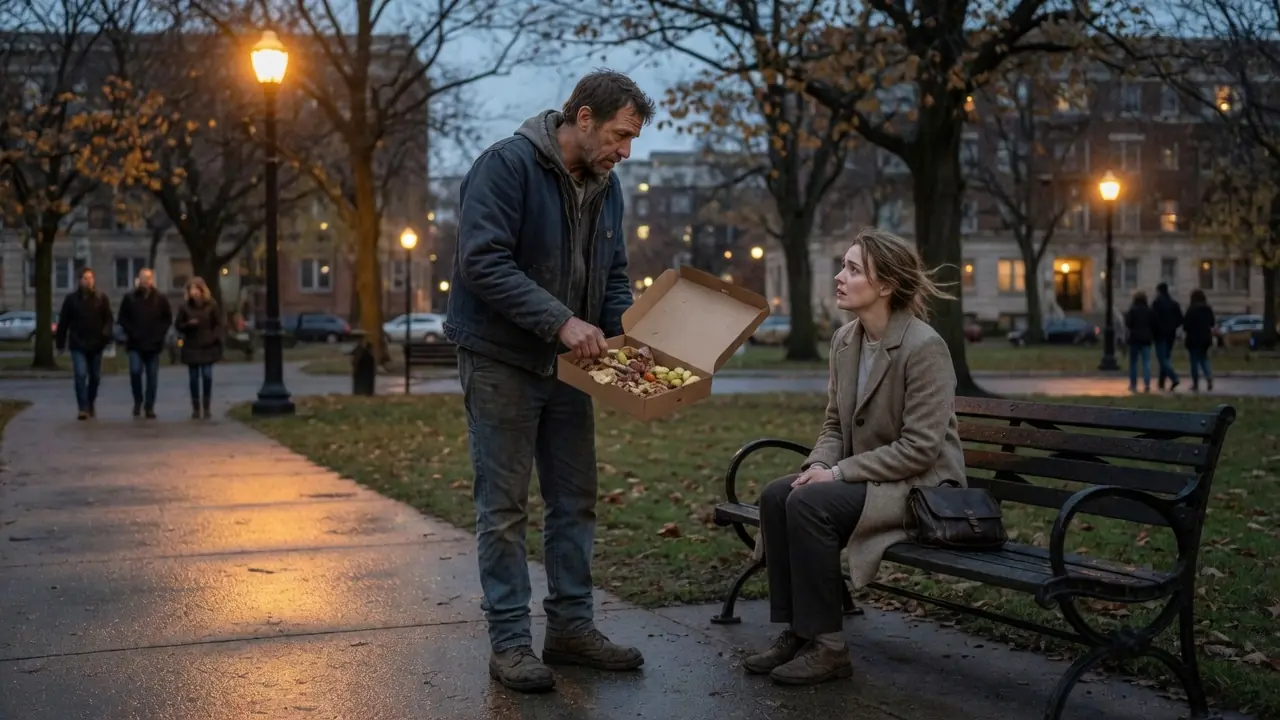
I had rent coming, overdue bills on the kitchen counter, and the food in my hands was the last real food I could afford until I figured something out.
I sat down next to a stranger the whole world had walked past all afternoon, and I split my last meal with her because she looked colder than the rain, hungrier than pride, and more alone than anyone should ever look in a city full of people.
What I did not know, what I would not learn until weeks later, was that the soaked, shaking young woman on that bench was not homeless.
She was not invisible because she had always been invisible.
She was invisible because, for one terrible day, everything that had made the world recognize her had been stripped away.
Her name was Clara Voss.
She was twenty-nine years old.
She was the founder and CEO of one of the fastest-growing logistics technology companies in the country.
She was rich enough to buy the whole block where I lived and powerful enough to walk into boardrooms where men twice her age stopped speaking when she entered.
And that afternoon, she had no wallet, no phone, no coat warm enough for the rain, no one answering her calls, and no one on the street willing to believe she was anything other than another lost woman they did not want to see.
Not the people in expensive coats who passed her.
Not the executives leaving the glass towers nearby.
Not the comfortable ones with full stomachs, full wallets, and full calendars.
The one man who stopped for her was the one man on that whole street who had, that very morning, lost nearly everything he had.
I have never been able to decide whether that is the saddest part of this story or the most beautiful.
Maybe it is both.
This is the whole story of who Clara really was, why a young CEO was sitting on a park bench looking like the world had thrown her away, and what happened after she discovered that the only person who shared with her was a man who had just lost his job, his insurance, and almost all of his hope.
More than that, it is the story of something I have come to believe with my whole heart.
The people who have the least are often the ones who still remember how to give.
Now let me take you back to the worst day of my life, which somehow turned into the day that saved it.
My name is Sal Romano.
I was thirty-nine years old when this happened, and at the time, I worked on the warehouse floor for a regional supply company on the west side of the city. It was not glamorous work. I moved freight, loaded trucks, scanned inventory, handled returns, cleaned up after damaged shipments, and did whatever else needed doing before a supervisor could bark twice.
It was steady.
That mattered more than glamour.
Steady meant rent.
Steady meant groceries.
Steady meant my son, Nico, could keep believing his father had the world handled.
And I was raising Nico on my own.
My wife, Gina, had passed away two years earlier.
Cancer.
I still hate that word.
I hate how small it looks on a page compared to the size of what it takes.
When Gina was alive, she filled our apartment with noise and music and the smell of garlic and basil. She laughed with her whole body. She sang when she cleaned. She kissed Nico on both cheeks every morning and called him her little lion because he roared at cartoons and cried when he saw dead bugs on the sidewalk.
When she got sick, the world became hospitals, insurance forms, medication schedules, whispered conversations in hallways, and the strange terror of watching someone you love become smaller while trying to smile so you do not scare your child.
Near the end, Gina took my hand one night and made me promise her something.
“Keep his world warm,” she said.
She did not say keep him rich.
She did not say give him everything.
She did not say make sure nothing hurts him, because by then we both knew life did not let people make promises like that.
She said, “Keep his world warm.”
That became my whole religion.
From the day I lost her, my life narrowed down to one purpose.
Take care of Nico.
Keep him fed.
Keep him safe.
Keep the apartment warm.
Keep bedtime stories steady.
Keep pancakes on Sundays even if they were from the cheapest mix on the shelf.
Keep his mother’s picture on the dresser and her name alive in our house.
Keep him from feeling the hole where Gina used to be any more than he already had to.
That was it.
That was the whole job.
And on the morning this story begins, I lost the means to do it.
The warehouse made cuts.
A whole shift of us was let go without warning.
I had known things were tight. Everybody had. We had seen the new software come in, the consultants walking the floor with tablets, the managers talking in low voices behind glass walls. But knowing something might happen does not prepare you for the exact moment it does.
At 10:17 that morning, I was called into the break room with eighteen other people.
At 10:23, we were told our positions had been eliminated.
At 10:31, I was handed a final check that was already mostly spoken for.
At 10:42, I stood in the parking lot holding a cardboard box with my work boots, my gloves, a cheap thermos, and a photo of Nico taped to the inside of my locker door.
Nobody yelled.
Nobody threw anything.
Nobody made a movie scene out of it.
That is the thing about having your life quietly cave in.
It often happens with polite voices and paperwork.
A woman from human resources told us we were valued. A supervisor who had once borrowed money from me for lunch could not meet my eyes. Somebody said there would be resources available online. Somebody else said we should check our email.
Then we were outside.
The sun was shining.
Cars moved on the road.
A delivery truck backed into a dock.
The world kept going exactly as it had five minutes earlier.
Except my whole life had just fallen through the floor.
I stood there in that parking lot and did the math.
I had almost nothing in the bank.
Rent was coming.
The electric bill was already late.
Nico needed new shoes.
The final check would keep us alive for a little while, but not long enough if I did not find work fast.
In my actual pocket, I had a small handful of dollars.
That money had to feed my son and me until I figured something out.
However long that took.
If you have never been in that kind of parking lot, I am not sure I can make you feel it.
If you have, I do not need to explain.
The worst part is not only fear.
It is shame.
Even when it is not your fault, even when the whole shift is cut, some animal part of you whispers that you failed. That you were not useful enough. That you were not strong enough. That you could not protect the child waiting for you at home.
I stood there thinking about Nico’s face.
I thought about Gina.
I thought about the promise I made beside her hospital bed.
Keep his world warm.
And I felt like I was breaking that promise right there in a warehouse parking lot on a Tuesday.
That was the man I was that afternoon.
Not just broke.
Ashamed.
Scared.
Carrying a promise to a dead woman that I suddenly did not know how to keep.
I did not go straight home.
I could not.
Nico would be at after-school care until five, and I had hours before I needed to pick him up. I should have spent that time applying for jobs. I should have walked directly to the unemployment office or called every warehouse in the city.
Instead, I walked.
I walked because if I stopped moving, I thought I might fall apart.
I walked past chain stores and parking garages, past office towers and restaurants where people inside were already sitting down to lunch that cost more than I had in my pocket. I walked past workers in suits, students with backpacks, delivery bikes weaving through traffic, men laughing into phones, women carrying shopping bags, everyone moving with the confidence of people whose floors had not collapsed that morning.
By late afternoon, I stopped at a little corner place called Mariano’s Kitchen.
It was not fancy.
Just a narrow family-run spot with fogged windows, three small tables, and the smell of roasted chicken and rice that made my stomach twist with hunger. I stood outside for a full minute looking at the menu, arguing with myself.
The sensible thing would have been to buy cheap bread, peanut butter, and noodles. Stretch every dollar. Plan like a man who knew hard days were coming.
Instead, I bought one hot meal.
Roasted chicken, rice, beans, and a little container of soup.
More than I should have spent.
I want to explain why, because it matters.
That night, I was going to have to sit Nico down and find some gentle way to tell him that Daddy had lost his job. I was going to have to tell a six-year-old that things might be tight for a while without letting him see how scared I was.
And I could not bear the thought of doing that over nothing.
I wanted us to have one good, warm meal together first.
One normal dinner.
One evening where the apartment smelled like food and not fear.
One night where Nico could sit cross-legged on the chair like Gina used to scold him for, ask for extra beans, tell me about the turtle his class had drawn in science, and feel the world remain steady before I had to explain that it had shifted.
It was probably foolish.
But I think any parent understands foolishness like that.
A child’s sense of safety is sometimes the last thing a parent can afford to give, and we will spend what little we have to give it one more time.
So I bought the meal.
I held the warm bag in both hands as I walked toward home through the little park between the corner place and our street.
That was where I saw her.
The young woman on the bench.
At first, I thought she was asleep.
She sat hunched beneath a leafless tree, her arms wrapped tightly around herself, shoulders trembling under a thin black blazer that had been soaked through by the rain. Her hair, dark and cut just below her jaw, clung to her face. One side of her blouse was torn near the sleeve. One of her shoes was missing, and the foot without it was tucked beneath her on the bench, wrapped in what looked like a dirty scarf.
Beside her sat a leather handbag, open and empty.
A cracked badge holder hung from one strap, but the ID inside was gone.
She was young.
Maybe late twenties.
Maybe younger.
Her face was pale, not just from cold but from shock. There was a small cut near her temple. Mascara had run beneath her eyes in gray lines, but even through the rain and exhaustion, there was something about her posture that did not fit the picture people had already made of her.
She looked broken down, but not broken.
That was what struck me.
She was not begging.
She was not calling out.
She was just sitting there, trying to remain upright, enduring the way people endure when they have learned the world is not coming.
The park was not empty.
People were walking through it, plenty of them.
Office workers.
Couples.
Students.
A man in a wool coat holding an umbrella that probably cost more than my groceries.
Two women with shopping bags from stores I had never walked into.
A group of executives coming from one of the glass towers near the park, their polished shoes stepping around puddles with careful irritation.
Every single one of them walked past that young woman like she was part of the bench.
Some glanced once.
Most did not.
A few saw her and looked away faster.
One man slowed, saw the empty bag, saw her wet hair, made whatever calculation people make, and moved on.
She was invisible.
Not because nobody saw her.
Because everyone decided not to.
I watched for a minute before I moved, and it did something to me.
There were people in that park who could have fed her for a month and never felt it. People carrying single shopping bags that probably held scarves worth more than my rent. People who had assistants, expense accounts, second homes, full stomachs.
And every one of them had perfected that little trick of the eyes.
The one where you see suffering and then quickly look at your phone, or the trees, or the traffic, anywhere except directly at the person.
I had done it myself plenty of times in better days.
That is the part I need to be honest about.
I am not some saint.
I have looked away before.
Most of us have.
Not because we are evil.
Because it is easy, when you are comfortable, to make another person’s suffering disappear by refusing to focus your eyes on it.
But that day, I could not do it.
That day I had just learned how fast a person can fall.
That morning, I had a job.
By afternoon, I had a box of boots, a final check, and a countdown clock on my whole life.
I looked at that young woman on the bench and did not see a stranger from another world.
I saw someone maybe just one terrible day further down the road I had started walking.
I thought, That could be me.
That could be Nico and me if the wrong doors close.
And I could not pass somebody that cold while holding a hot meal, even if it was almost the last food I could afford.
The other thing working on me was Gina.
Near the end, when she was sick and tired and frightened, one of the things she hated most was how some people stopped seeing her as a person. They saw a patient. A tragedy. A difficult conversation. A body in a bed.
She used to say, “Being sick makes people talk around you like you already left.”
I had watched invisibility hurt the woman I loved.
So when I saw that young woman being looked through by a whole park full of people, something in me that still belonged to Gina would not let me add myself to the line.
Not that day.
Not holding a hot meal.
Not as the man Gina had loved.
So I stopped.
And I sat down.
The young woman flinched when I lowered myself onto the far end of the bench.
Not dramatically.
Just enough to tell me she had spent the day expecting the next person to make things worse.
I kept my hands visible and my voice low.
“Rough day?” I asked.
She looked at me.
Her eyes were green.
Sharp.
Exhausted.
Terrified in a way she was trying hard not to show.
“You should keep walking,” she said.
Her voice was hoarse.
“I probably should,” I said.
That almost made her smile.
Almost.
I opened the bag from Mariano’s Kitchen. Steam rose into the cold air. Her eyes moved to it before she could stop them.
I did not ask permission.
Sometimes asking makes hunger perform pride.
I just opened the container, split the chicken and rice into two portions as evenly as I could, and held one half out to her with the plastic fork.
“It’s still hot,” I said. “You should eat something.”
She stared at the food.
Then at me.
“I can’t pay you.”
“I didn’t ask.”
“I’m not—”
“I know,” I said gently. “Neither am I.”
She went very still.
“I mean, I’m not asking for charity,” she said.
“It’s not charity. It’s dinner. There’s a difference.”
Her hands shook when she took the container.
Not a little.
A lot.
The kind of shaking that comes from cold, hunger, adrenaline, and trying to hold yourself together too long.
We ate in silence for a minute.
Two strangers on a wet bench.
The rain had softened into a mist, but the wind was still cold enough to cut through my jacket. She ate slowly at first, as if she expected me to change my mind. Then hunger won, and she took two quick bites of rice, then stopped, embarrassed by her own speed.
“Eat,” I said. “I’m not grading you.”
This time she did smile.
Only for a second.
But it was there.
We sat side by side, eating half a meal each while the city walked past us with its eyes turned away.
I did not ask her why she was there.
I did not ask why her bag was empty.
I did not ask about the cut on her temple or the missing shoe.
Some questions are not help. They are only curiosity wearing a clean shirt.
After a while, she spoke.
“Why did you stop?”
I looked at her.
“What?”
“All these people walked past me,” she said. “All day. You stopped. Why?”
I could have lied.
I could have said something noble.
Instead, I laughed once, a sad little sound.
“Bad timing, I guess.”
She frowned.
“What does that mean?”
“It means I lost my job this morning. I’m not feeling too far away from anybody sitting on a bench today.”
She turned toward me fully.
“You lost your job?”
“Warehouse cut a whole shift. I was on it.”
“And you gave me half your food?”
“Looks that way.”
“Was it extra?”
“No.”
She stared at me.
“Then why would you do that?”
The question was not suspicious now.
It was almost angry.
As if my answer mattered for reasons I did not understand.
I looked down at the food container in my lap.
“My mother used to say anybody can share when they’ve got plenty,” I told her. “But when you’ve got next to nothing, that’s when you find out what kind of person you are.”
She said nothing.
I kept going, maybe because I was tired enough for truth to leak out.
“I’ve got a little boy at home. Six years old. His name is Nico. I was bringing this back so we could have one good dinner before I told him things might get hard.”
Her face changed.
I saw it.
“You have a son?”
“Yeah.”
“And this was for him too?”
I swallowed.
“Yes.”
Her hands tightened around the container.
“Then take it back.”
“No.”
“Please.”
“No,” I said again, softer. “He’s eaten today. You look like you haven’t.”
Her eyes filled suddenly.
She looked away fast, but not fast enough.
I pretended not to see because sometimes dignity means letting a person keep the small privacy of their tears.
We ate a little more.
After a moment, she asked, “What is your name?”
“Sal. Sal Romano.”
She nodded slowly, as if she were making herself remember.
“I’m Clara.”
“Nice to meet you, Clara.”
She laughed again, but this time the sound broke halfway through.
“That’s a strange thing to say right now.”
“Maybe. Still true.”
For a few minutes, we ate without talking.
Then she said, “What happened to your son’s mother?”
I should have been offended.
Maybe on another day I would have been.
But there was something in the way she asked. Not prying. Not fishing for tragedy. More like she recognized the shape of loss in my face and wanted to know its name.
“Gina passed two years ago.”
“I’m sorry.”
“Me too.”
“Do you still talk to her?”
The question hit me harder than I expected.
“Sometimes,” I said. “When Nico’s asleep. When I don’t know what to do.”
“And does it help?”
I looked at the wet path ahead of us.
“Not exactly. But it keeps me from feeling like I’m deciding everything alone.”
Clara nodded as if she understood that too well.
That was the first time I wondered what had happened to her.
Not because of the clothes or the empty bag.
Because of the eyes.
There was too much behind them.
We finished eating.
I gave her the little container of soup too. She tried to refuse. I told her I did not want it spilling in the bag on the walk home, which was a lie, but she accepted it because we both needed the lie to make the kindness easier to hold.
Then I took the last few dollars from my pocket.
It was not much.
A few crumpled bills and coins.
I pressed them into her hand.
“Get somewhere warm if you can.”
She looked down at the money as if it hurt her.
“Sal, no.”
“Yes.”
“You just told me you lost your job.”
“I did.”
“You have a child.”
“I do.”
“Then you need this.”
“So do you.”
She looked at me for a long moment.
Rain clung to her eyelashes.
“You don’t know who I am,” she said.
“No,” I said. “But I know you’re cold.”
That was the sentence that finally broke her.
Not loudly.
Not dramatically.
Her face simply folded for one second before she pulled it back together.
“Thank you, Sal Romano,” she said. “You have no idea what you’ve done.”
“I didn’t do much.”
“You did.”
I stood because if I stayed any longer, I knew I would start thinking about the half meal I no longer had, the money I no longer had, and the boy I still had to face.
“Take care of yourself, Clara.”
She looked up at me from that bench.
“I will find you.”
I gave a tired smile.
“People usually say thank you and leave it at that.”
“I’m not people.”
I did not know what to say to that.
So I nodded and walked home.
I went home to my son.
I opened our apartment door and Nico came running toward me in socks, holding a drawing of a dinosaur with wings.
“Daddy, look! It’s a flying T-rex.”
I picked him up even though my back hurt.
“That’s scientifically concerning.”
He laughed into my shoulder.
The apartment smelled faintly of laundry soap and old radiator heat. Gina’s picture sat on the little table near the window. I looked at it over Nico’s head and felt my chest tighten.
I still had half the meal.
Enough to put on a plate and pretend it was dinner.
I added toast. I cut up an apple. I made the rice look bigger than it was. Parents become artists when there is not enough food.
Nico ate happily, telling me about school, about the flying dinosaur, about how Leo from his class said worms had no bones, which Nico found both fascinating and disgusting.
I watched him and kept delaying the hard talk.
Finally, after dinner, after bath, after pajamas, after brushing teeth with the dinosaur toothbrush he loved, I sat on the edge of his bed.
“Buddy,” I said. “I need to tell you something.”
He looked up at me with Gina’s eyes.
“What?”
“My job ended today.”
He frowned.
“You don’t go to the warehouse anymore?”
“Not that one.”
“Did you do something bad?”
The question nearly broke me.
“No,” I said quickly. “No. They had to let a lot of people go. It wasn’t because I did something wrong.”
He absorbed that in the serious way children do when they understand more than you wish they did.
“Are we going to be okay?”
I lied with all the love I had.
“Yes,” I said. “We’re going to be okay.”
He nodded because he trusted me.
That trust was the heaviest thing I had ever held.
I looked at Gina’s photo again after he fell asleep.
“I don’t know how,” I whispered. “But I’m trying.”
For the next three weeks, I looked for work.
I applied everywhere.
Warehouses.
Delivery companies.
Grocery stores.
Building maintenance.
Loading docks.
One restaurant.
Two security jobs.
A night shift cleaning position at a hospital.
Most places did not answer. A few sent automated emails. One warehouse manager told me I was overqualified and then hired someone younger for less money. Another said my availability was difficult because I had a child.
Every day, I stretched food further.
Every night, I told Nico things were temporary.
Every morning, I looked in the mirror and tried to believe myself.
I thought about Clara sometimes.
I wondered whether she had found somewhere warm.
I wondered whether she had eaten the soup.
I wondered whether she had meant it when she said she would find me, or whether that had been the kind of thing people say in emotional moments because it feels better than goodbye.
Then, on a Friday morning, my phone rang.
The number was unfamiliar.
I almost did not answer.
“Mr. Romano?” a woman asked.
“Yes.”
“My name is Dana Ivers. I’m calling from Voss Meridian Group. Ms. Clara Voss would like to meet with you.”
I looked at the phone.
“Who?”
“Ms. Clara Voss.”
“I think you have the wrong Sal Romano.”
“I don’t believe so, sir. You met Ms. Voss three weeks ago in Mercer Park.”
My kitchen went very quiet around me.
Nico was at school. The radiator clicked. A truck passed outside.
“Is she okay?” I asked.
There was a pause on the other end.
“Yes,” Dana said, softer now. “She is okay. She asked me to tell you that first.”
That was how I learned the woman from the bench was not who I thought she was.
Two days later, I stood in the lobby of a tower I had walked past many times but never entered.
The building was all glass, steel, and quiet confidence. People crossed the marble floor wearing badges and expensive shoes. A security guard checked my name and gave me a visitor pass. An elevator took me up so high my ears popped.
I was wearing my one good shirt, the one Gina had bought me for a wedding six years earlier. I had ironed it twice. It still looked like a man trying his best.
The assistant, Dana, met me outside a pair of tall office doors.
She was kind in a careful way.
“Ms. Voss is ready for you.”
I stepped inside.
The office was enormous.
Not flashy exactly, but powerful.
Floor-to-ceiling windows. A long dark table. Shelves filled with awards, books, architectural models, framed patents, and photographs from company openings around the country.
Behind the desk stood a young woman in a charcoal suit.
Her hair was clean and sleek now, cut just below her jaw.
No rain.
No torn sleeve.
No missing shoe.
No empty handbag.
But the eyes were the same.
Green.
Sharp.
Haunted.
“Sal,” she said.
I stopped walking.
My brain could not make the two versions of her fit together.
For weeks, Clara had lived in my mind as a freezing young woman on a bench, someone fragile and hungry, someone I hoped had survived the night.
Now she stood in front of me as the most powerful person I had ever been in a room with.
The suit probably cost more than my rent.
The desk was bigger than my bedroom.
The city stretched behind her like something she owned.
And yet, when she looked at me, I saw the bench.
I saw the shaking hands.
I saw the woman who had asked why I stopped.
“You’re Clara,” I said stupidly.
She smiled faintly.
“I am.”
“You’re...”
“The CEO of Voss Meridian Group.”
I looked around the office.
“You said you were not people.”
That made her laugh once, and there was real warmth in it.
“I did say that.”
Then the laugh faded.
She came around the desk slowly, not with the glide of someone performing power, but with the hesitance of someone approaching a moment that mattered.
“I owe you the truth,” she said.
She gestured toward the seating area near the window.
We sat.
She did not sit behind the desk.
I noticed that.
Clara told me what had happened that day.
She had founded Voss Meridian at twenty-three with a piece of software that made supply chains faster and cheaper. By twenty-nine, she had become one of the youngest CEOs in the industry. Her company moved freight data, warehouse systems, shipping schedules, and logistics operations for hundreds of businesses.
I almost laughed when she said logistics.
Of course.
While I had been lifting freight with my hands, she had been running the kind of company that decided how freight moved across half the country.
But success had brought enemies.
Her chief operating officer, a man named Adrian Kline, had been quietly organizing a board coup. He wanted to force Clara out, sell pieces of the company, cut thousands of jobs, and take an enormous payout from a private equity group waiting behind the curtain.
That morning, while I was losing my warehouse job, Clara was sitting in a boardroom being betrayed by people she had made rich.
“They froze my access during the meeting,” she said. “Company accounts, building credentials, executive driver, internal phone system. They claimed it was temporary pending an emergency governance review. It was all illegal, but legality takes hours and lawyers. Humiliation takes seconds.”
She had walked out before security could escort her.
She was furious, not frightened yet.
Then, outside the building, things went worse.
Her personal phone slipped from her hand during an argument with Adrian and shattered on the pavement. Her handbag was stolen minutes later by someone on a bike while she was trying to flag a cab. Her wallet, backup cards, ID, and apartment keys were all inside.
“I tried to enter another company building,” she said. “My badge had been deactivated. I tried to call from a lobby phone, but nobody would connect me without verification. I walked to three places where people knew my name when I arrived in a car, but not when I arrived wet, bleeding, and without proof.”
She looked toward the window.
“By late afternoon, I realized something terrifying. I had spent years building systems around myself, and the moment those systems were cut off, I became nobody.”
I listened without speaking.
“I had money,” she said. “Millions. On paper. In accounts. In assets. In shares. But on that street, without a phone, without ID, without anyone willing to believe me, I could not buy soup.”
Her voice changed on the last word.
Soup.
She remembered.
“All day,” she continued, “people looked through me. Executives who had shaken my hand at conferences walked past without recognizing me. A woman pulled her child away from me. A café asked me to leave because I couldn’t pay before sitting down. A hotel lobby refused to let me use a phone.”
She looked back at me.
“I had been powerful at nine in the morning. By five, I was cold, hungry, injured, and invisible.”
I thought of the bench.
Of the way she had held the food.
Of how angry she had sounded when asking why I gave it to her.
“I was close to believing something terrible,” Clara said. “That everything I had built rested on a world where people only see money, position, proof, and polish. That without those things, a person disappears.”
She swallowed.
“Then you sat down.”
Neither of us spoke for a moment.
The city moved beneath the windows.
Far below, people crossed streets, entered buildings, carried lunch bags, rushed toward meetings, hurried through lives that could change at any second.
“You told me you lost your job,” she said. “You told me the meal was for your son. And you still gave me half.”
“I thought you needed it.”
“I did.”
She leaned forward.
“Sal, you did not just feed me. You interrupted the worst conclusion I was about to make about people.”
I looked down at my hands.
They felt too rough for that office.
“I just did what my mother taught me.”
“And that is exactly why I wanted to find you.”
She stood, went to her desk, and picked up a folder.
“I investigated what happened at your warehouse.”
My stomach tightened.
“The layoffs,” she said, “were connected to a restructuring plan pushed by one of our subsidiary partners. A plan I had not personally reviewed before everything happened. It prioritized automation savings and short-term margin improvements without adequate transition support for workers.”
She set the folder in front of me.
“People like you were treated like numbers on a cost sheet.”
I did not know what to say.
“I am not going to insult you by offering charity,” she said. “That is not why you are here.”
My throat tightened unexpectedly.
“I wouldn’t know how to take charity from you.”
“I know,” she said. “That is why I’m offering work.”
I looked at her.
“Work?”
“A real position. Full salary. Full benefits. Stability. Not because I feel sorry for you, but because on the worst day of your life, with nothing left, you showed the exact kind of character my company desperately needs near its decisions.”
I sat very still.
“What kind of position?”
“Worker Transition and Field Operations Liaison.”
I blinked.
“I don’t know what that means.”
For the first time, she smiled like a person and not a CEO.
“It means I want someone who has actually worked on warehouse floors to sit in the rooms where executives make decisions about warehouse workers. I want you to help us understand what policies sound like when they land at kitchen tables. I want you to visit facilities, talk to employees, identify where systems are failing people before they are crushed by them.”
“I don’t have a degree.”
“I didn’t ask for one.”
“I’ve never worked in an office like this.”
“Good.”
I laughed because I could not help it.
She did not.
“I am serious,” she said. “I have spent years surrounded by polished people who know how to make harmful things sound efficient. I need someone who remembers what efficiency costs when it hits a man holding a box in a parking lot.”
My eyes burned.
I looked away.
“What about Adrian? The board?”
Her face hardened.
“I won.”
The words were quiet.
No bragging.
Just fact.
“My legal team proved the coup was coordinated through undisclosed conflicts of interest. Adrian is gone. Three board members resigned. The restructuring plan has been halted.”
She tapped the folder.
“And I am rebuilding the company with one question in mind.”
“What question?”
“What happens to the actual human beings down where this lands?”
I stared at her.
“That sounds like something a tired man would say on a bench.”
“It is.”
For a moment, Gina felt very close.
Not like a ghost.
Like warmth.
Like a hand on my shoulder.
I thought about Nico.
Rent.
Groceries.
The electric bill.
School shoes.
The promise.
Keep his world warm.
“What are the benefits?” I asked, because even miracles need details when you are a parent.
Clara slid the offer letter toward me.
The salary was more than I had made in my life.
Not rich.
Not ridiculous.
But solid.
Enough.
Health insurance from day one.
Childcare support.
Paid time off.
Retirement plan.
Tuition assistance.
I stared at the paper until the words blurred.
“This is too much,” I said.
“No,” Clara said. “It is what the job is worth.”
“I don’t know if I can do it.”
“You can learn the office part. I cannot teach someone to be the kind of man who shares his last meal.”
That was when I cried.
Not hard.
Not dramatically.
Just enough that I had to put one hand over my face and breathe through it.
I had been holding myself together for weeks with tape and stubbornness.
Her offer did not just give me a job.
It gave me back the one thing I had lost in that parking lot.
The ability to take care of my son.
I took the job.
Of course I took it.
That evening, I picked Nico up from after-school care and took him to Mariano’s Kitchen.
I bought the same meal.
This time, I bought two.
He asked why we were celebrating.
I told him Daddy had a new job.
His face lit up so fast it hurt.
“Does that mean we’re okay?”
I looked at him.
This time, I did not have to lie.
“Yes, buddy,” I said. “We’re okay.”
A week later, after my first day at Voss Meridian, I took Nico to Mercer Park.
We sat on the bench where I had met Clara.
I told him a simple version of the story.
That Daddy had once shared dinner with a woman who was having the worst day of her life, and that sometimes helping people mattered more than you could ever know.
Nico swung his legs under the bench.
“Was she hungry?”
“Yes.”
“Were we hungry too?”
“A little.”
He thought about that.
“Did Mommy see?”
The question almost knocked the breath out of me.
I looked toward the trees.
“I think she did.”
He nodded, satisfied.
“Then you did good.”
I put my arm around him and held him close.
Children can hand you forgiveness you did not know you were asking for.
Working for Clara changed my life.
It also changed hers.
Not because of me alone. I would never claim that. Clara had already started seeing the cracks in the world she had built before I ever sat beside her. But the bench gave those cracks a human face.
She changed the company’s layoff policy first.
No more same-day terminations with cardboard boxes and vague resource links.
No major workforce reductions without severance, job placement support, extended health benefits, and direct review of family impact. She created an emergency employee fund for medical crises, housing instability, and childcare disruptions. She raised wages in the lowest-paid divisions. She required executives to spend time every quarter at warehouse sites without advance notice, not to inspect workers, but to listen.
At the first executive meeting I attended, I sat at the end of a table that looked expensive enough to make me nervous.
A finance director explained a proposed efficiency plan that would “reduce labor dependency” at three facilities.
Clara looked at me.
“Sal?”
Every face turned.
My mouth went dry.
I looked at the slide.
Then I thought of parking lots.
Kitchen tables.
Kids asking whether everything was going to be okay.
“It says two hundred and twelve positions,” I said. “But the slide makes them look like a math problem. Before anybody votes, I want to know who they are. How long they’ve worked there. How many are parents. How many are close to retirement. How many will lose insurance. What jobs exist within thirty miles. What support we are offering.”
The room went silent.
One man shifted in his chair.
Clara nodded.
“Get those answers,” she said. “Then we discuss it.”
That was the first time I understood she had meant it.
She had not hired me as a symbol.
She had hired me to make rooms uncomfortable in the direction of decency.
Months passed.
Then a year.
Then three.
Nico grew taller. He got the new shoes. Then a bike. Then braces. Then a school laptop I did not have to buy used. He started asking about college before I was emotionally prepared for the idea that my little boy would one day leave home.
Our apartment changed too.
Not fancy.
Just easier.
The fridge had food in it.
The bills got paid before the red notices came.
The radiator still clanked, but I no longer listened to it wondering whether we could afford heat.
On Gina’s birthday each year, Nico and I made her favorite pasta. We set a place for her at the table, not because we believed she would sit there, but because love deserves a chair.
Clara came once.
Just once, the second year after everything happened.
She brought red flowers and stood awkwardly in our kitchen like a woman who could run a company but did not know where to put her hands in someone’s grief.
Nico liked her immediately.
Children sense when adults are trying.
He told her about the flying T-rex drawing.
She asked careful questions.
He decided she was “serious but not mean,” which Clara later said was the best review she had ever received.
Her life changed too.
She became a different kind of CEO.
Not softer.
People mistake compassion for softness because they have never seen how much discipline it takes.
Clara became harder in the right places.
Harder on executives who hid cruelty inside spreadsheets.
Harder on board members who spoke of workers as costs.
Harder on herself when convenience tempted her to stop looking.
But she became gentler where gentleness mattered.
She learned names.
She visited night shifts.
She sat in break rooms.
She listened to warehouse workers explain scanner failures, impossible quotas, childcare emergencies, broken vending machines, and managers who treated adults like disposable parts.
She told me once that the day on the bench had ruined a certain kind of comfort for her.
“I can’t unsee it,” she said.
“Good,” I told her.
She laughed.
“You sound like my conscience.”
“No. I’m hourly wisdom in a salaried position.”
She laughed harder at that than it deserved.
The company did not become perfect.
No company does.
There were still hard decisions, difficult quarters, layoffs we could not always prevent, mistakes we had to repair. But the difference was this: people were no longer allowed to disappear quietly inside the math.
And that mattered.
Years later, Clara invited me to speak at a leadership gathering.
I hated speaking in public.
She knew that.
She asked anyway.
“Tell them the bench story,” she said.
“You tell it better.”
“No,” she said. “I tell my side. They need yours.”
So I stood in front of executives, managers, investors, and department heads in a suit that still felt like a costume no matter how many times I wore it.
I told them about losing my job.
About the hot meal.
About Nico.
About the woman on the bench.
About how I had not stopped because I had plenty, but because I understood how close I was to needing someone else to stop for me.
Then I said the thing my mother used to say.
“It’s the people with empty pockets who keep the world from freezing over.”
I looked at Clara when I said it.
Her eyes filled the same way they had on the bench.
After the speech, a warehouse supervisor from Indiana came up to me and said he had been planning to write up one of his workers for missing a shift without notice. Then he found out the man had been sleeping in his car after leaving a dangerous home situation.
“What should I do?” he asked.
I said, “Start by asking what he needs.”
That was all.
Start there.
The rest may not be easy, but at least it begins in the right place.
I still think about that day often.
The warehouse parking lot.
The cardboard box.
The hot meal.
The bench.
Clara’s shaking hands.
The way she said, “You don’t know who I am.”
She was right.
I did not know she was a CEO.
I did not know she had been betrayed by her board.
I did not know she had the power to change my life.
I did not know she would later change policies that touched thousands of workers.
I did not know my half a meal would travel that far.
But I knew she was cold.
And that was enough.
That is the part I hold onto.
Because most of the time, kindness does not come with a revelation later.
Most of the time, you do not discover the person on the bench is powerful.
Most of the time, nobody calls from a tower.
No job offer comes.
No life-changing opportunity arrives.
Most kindness disappears into the day, unseen by anyone except the person who needed it.
But that does not make it smaller.
It may make it purer.
If I had known who Clara was, the act would have been contaminated by possibility. I might have hoped for something. I might have performed goodness instead of simply giving it.
But I did not know.
And because I did not know, the act was clean.
That is what changed both of us.
Two people on a bench, stripped of titles.
A broke single father.
A betrayed young CEO with no proof of power left.
Half a meal.
A few dollars.
A moment of company in the cold.
The disguise was not real, but the hunger was.
The wealth was real, but so was the helplessness.
My poverty was real, but so was my ability to give.
That is the strange truth life taught me.
You can have billions and still end up on a bench needing someone to see you.
You can have almost nothing and still be rich enough to keep the world from freezing over for one more person.
I have lived on both sides now.
Poor and more comfortable.
Afraid and steadier.
Invisible and invited into rooms I never imagined entering.
And I believe this more deeply than ever:
Do not wait until your pockets are full to be kind.
Your pockets may never be full.
Do not wait until kindness is easy.
The kindness that costs nothing is fine, but the kindness that costs you something is the one that can change the temperature of the world.
I thought I was feeding one cold woman.
I was actually handing a CEO the one argument strong enough to pull her back from becoming as cold as the people who had betrayed her.
I thought I was losing half my last meal.
I was actually planting the first stone in the road that would lead my son and me out of fear.
I thought I was sitting beside a stranger.
I was sitting beside the future, though neither of us knew it yet.
And that is why, every time I pass Mercer Park, I look at that bench.
Sometimes someone is sitting there.
Sometimes it is empty.
But I always remember the rain, the steam from the food, the young woman’s shaking hands, and the sentence she said before I walked away.
You have no idea what you’ve done.
She was right.
I didn’t.
Maybe we never do.