Megan Morrison stood alone at the empty bus stop on Willow Street in the freezing Oregon rain at 11:47 on New Year’s Eve, watching the taillights of the last bus disappear around the corner three blocks away.
For a few seconds, she could not move.
She just stood there with rain sliding down her face and into the collar of her thin jacket, staring at the place where the bus had vanished. 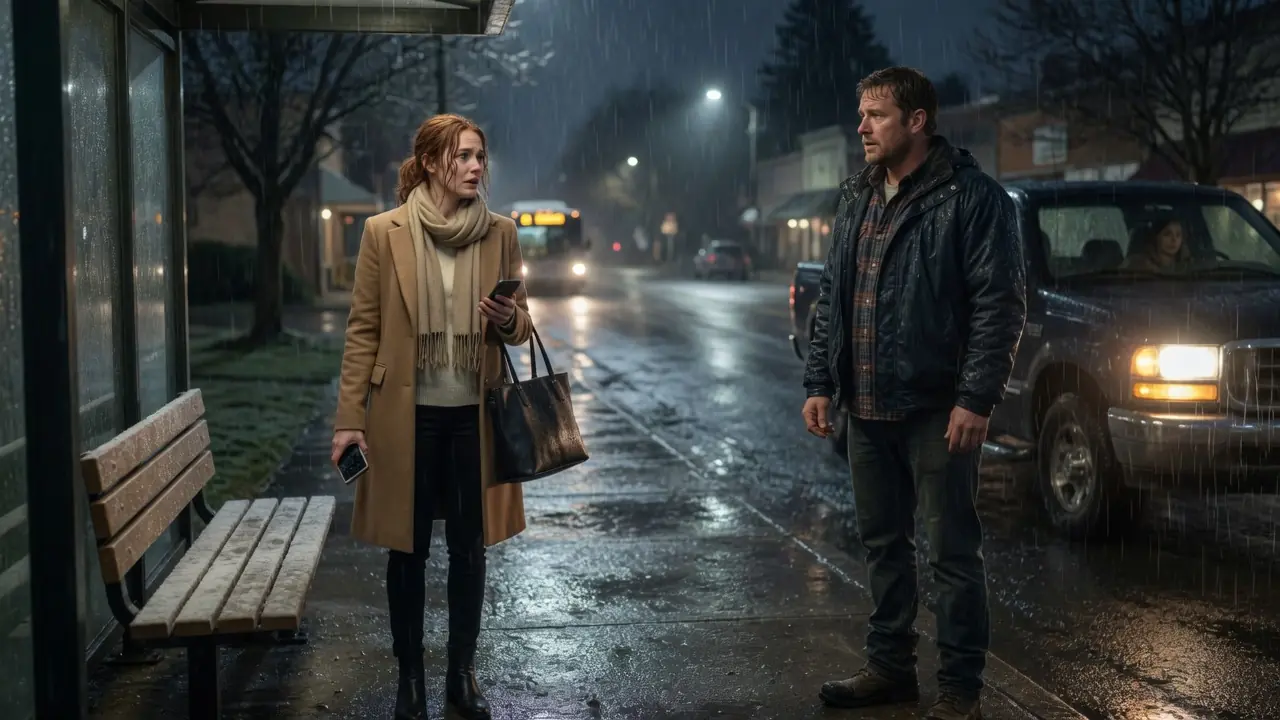
The red taillights blurred, dipped behind the corner, and disappeared completely, leaving nothing but wet pavement, cold wind, and the miserable glow of a streetlamp that flickered every few seconds like it was tired too.
She had missed it by maybe ten minutes.
Maybe less.
That was the part that made her want to scream.
Not an hour. Not half a night. Ten minutes. One elderly patient. One last hand held too long. One funeral home attendant arriving later than expected. One hallway that seemed endless when she finally started running.
And now she was stranded.
The rain in Willow Creek, Oregon, did not fall in dramatic sheets. It needled. It slipped through collars, soaked cuffs, crept into shoes, and settled into bones. The temperature had dropped to twenty-eight degrees, cold enough that the rain kept threatening to become ice. Every gust of wind pushed it sideways beneath the bus stop shelter, so even sitting under the narrow roof did not keep her dry.
Megan was wearing pale blue scrubs, compression socks, sneakers that had already survived too many hospital floors, and a thin black jacket she had bought at a thrift store during her first week in town. It was not a winter coat. It was barely a jacket. The zipper stuck halfway up, and one sleeve had a small tear near the wrist.
She wrapped her arms around herself and checked the street again, as if the bus might somehow realize its mistake and come back.
It did not.
Behind her, the small town looked almost empty. A few businesses still had holiday lights hanging in the windows. The bakery across the street was dark. The pharmacy sign blinked green and white. Somewhere far away, people were laughing, counting down toward midnight in warm rooms with crowded tables and cheap champagne.
Megan’s breath came out in shaky white bursts.
She had just finished a brutal sixteen-hour shift at Will Valley Hospital, covering for a coworker who called in sick that morning. She had started before sunrise, changed three sets of sheets, administered medications, soothed two frightened families, charted until her eyes burned, and spent the final hour of her shift sitting beside an elderly patient named Mr. Chen.
Mr. Chen had no family left.
At least, none who came.
He had arrived on the oncology unit three weeks earlier with liver cancer that had spread too far for anyone to pretend treatment was still a battle. His body had become fragile and yellowed, but his mind stayed clear enough to understand exactly what was happening.
Megan had learned that he once owned a tiny repair shop. He liked green tea. He hated hospital oatmeal. He had a daughter somewhere in California, but they had not spoken in years, and whenever nurses asked if he wanted them to call her, he would close his eyes and say, “Not now.”
That night, close to the end, he asked Megan what day it was.
“New Year’s Eve,” she told him softly.
He gave the smallest smile.
“Already?”
“Almost.”
Outside his window, early fireworks popped in the distance, faint and muffled through the hospital glass. Megan sat beside him after her shift officially ended because the night nurse was covering two admissions and because Mr. Chen kept opening his eyes to make sure someone was still there.
Nobody should have to die alone.
Especially not on New Year’s Eve, when the rest of the world was pretending time itself could be washed clean at midnight.
At 11:15 p.m., Mr. Chen passed away holding Megan’s hand.
There was no dramatic final sentence. No sudden revelation. No perfect goodbye. Just a soft exhale, a hand going still, and the monitor’s quiet confirmation of what Megan had already felt in her own palm.
She stayed.
She charted.
She notified the charge nurse.
She waited until the funeral home arrived.
Then she realized the time.
The last bus.
She had run down two hospital corridors, shoved her arms into her jacket, skipped the staff elevator because it was too slow, and sprinted three blocks through freezing rain.
But ten minutes was still ten minutes.
Now she stood at the bus stop with a phone at three percent battery and a body so tired it felt borrowed.
She unlocked her phone with numb fingers.
The screen dimmed immediately to save battery.
She opened the Uber app.
The spinning circle took forever.
Then the price appeared.
$87.
Megan stared at it and laughed once, a small broken sound that turned into a sob before it left her throat.
Eighty-seven dollars might as well have been a thousand. She had exactly thirty-two dollars and eighteen cents in her checking account until payday on Friday. Rent had cleared. Her student loan payment had cleared. Her car, which had broken down for the final time two months earlier, still sat behind her apartment building like a monument to bad decisions and worse timing.
Her phone dropped from three percent to two.
She closed the app.
Here was the thing about moving to a small town six months ago to escape a bad breakup and start over completely alone.
Starting over looked brave when people said it out loud.
It looked clean in movies.
A woman packed her car, drove somewhere new, cut her hair, found a cute apartment, and became the better version of herself by the second act.
Real starting over was different.
Real starting over was not knowing which mechanic would cheat you, which grocery store was cheapest, which streetlights worked after midnight, which neighbors were safe, or who to call when the last bus left without you.
Megan had no friends to pick her up from a bus stop at midnight.
No family within five hundred miles.
No ex she could call without reopening a door she had almost died trying to close.
Her mother lived in Boise but had made it clear years ago that emotional emergencies were best handled quietly. Her father had remarried and disappeared into a second family where Megan existed mostly as a birthday text. Her older brother answered calls when it suited him, which meant never after ten at night.
And so Megan sat down on the frozen metal bench, lowered her face into her hands, and started crying.
Not prettily.
Not softly.
She cried from exhaustion.
From cold.
From the death of a lonely old man.
From the humiliation of not having eighty-seven dollars.
From the crushing realization that she had been in Willow Creek for half a year and still did not have a single person she could call in an emergency.
Five miles away, Nathan Sullivan was driving home from his sister Jess’s New Year’s Eve party with his seven-year-old daughter, Ellie, half asleep in the back seat.
He had been waiting to leave since 9:30.
Actually, if he was honest, he had been waiting to leave since he arrived.
Nathan hated New Year’s Eve with every fiber of his being.
He hated the countdowns. The glitter hats. The noise makers. The forced hope. The cheerful insistence that one year could become another and grief would politely stay behind with the old calendar.
His wife, Clare, had died on January 2nd three years earlier after an eight-month battle with ovarian cancer. Every New Year’s Eve since then felt like the anniversary of the beginning of the end. It had been the last holiday they celebrated before everything fell apart completely.
He could still see her that final New Year’s Eve.
Thin but smiling.
Wrapped in a cream sweater on Jess’s couch.
Letting Ellie place a gold paper crown on her head even though her hair had already begun to thin from chemo.
At midnight, Clare had kissed him and whispered, “Promise me next year will be better for you two.”
He had said, “Don’t talk like that.”
She had smiled sadly.
“Nathan.”
He had refused to answer.
Two days later, she was gone.
Since then, New Year’s Eve had become something Nathan survived for Ellie’s sake. His sister Jess invited them every year. Every year he considered making an excuse. Every year he went because Ellie needed cousins, noise, snacks, and proof that her father could still stand in a room full of people without collapsing inward.
That night, Ellie had worn a silver headband with bobbing stars. She had played board games with her cousins, eaten too many cookies, and fallen asleep halfway through a cartoon at 11:20. Nathan carried her to the truck at 11:31, telling Jess he was tired.
Jess did not argue.
She only hugged him too tightly and whispered, “Text me when you get home.”
Now Ellie was bundled in the back seat of his pickup, her cheeks pink from sleep, her blond hair tangled against her coat collar. Clare’s eyes looked out of her face sometimes, and when Nathan caught them in the rearview mirror, it still hurt.
He drove down Willow Street because it was the fastest route home.
The windshield wipers slapped steadily across the glass. The heater hummed. The road was mostly empty except for occasional cars heading toward late parties or away from them. Holiday lights blurred in the wet darkness.
Then he saw the woman at the bus stop.
She was sitting on the bench in scrubs, face buried in her hands, shoulders shaking.
Nathan slowed without meaning to.
Then he kept driving.
His first instinct was practical.
It was almost midnight.
He had his daughter in the truck.
He did not know this woman.
Stopping for strangers was complicated now. The world had become a place where kindness required risk assessment. He imagined headlines, misunderstandings, bad outcomes, and Ellie watching all of it from the back seat.
Not our problem, he told himself.
The sentence felt ugly the moment it formed.
He made it about two blocks before Ellie’s sleepy voice came from the back seat.
“Daddy?”
Nathan glanced in the mirror.
“Yeah, peanut?”
“Why didn’t we help that sad lady?”
His stomach tightened.
“She’s probably waiting for someone, honey. I’m sure she’s fine.”
Even as he said it, he knew it was a lie.
Nobody was fine sitting alone at a bus stop crying on New Year’s Eve in freezing rain.
Ellie sat up straighter, rubbing one eye with her mitten.
“But she was really crying. Like, a lot.”
Nathan kept his eyes on the road.
“She might not want help.”
“Mommy always said we should help people who are sad, especially if they’re alone.”
The words hit him hard enough that he almost missed the next intersection.
Ellie continued, softer now.
“Remember Mommy said that?”
Yes.
He remembered.
Clare had said it constantly.
At grocery stores, hospitals, parking lots, playgrounds, church, school pickup, everywhere. She had been the kind of person who noticed crying women, lost children, confused elderly men, overwhelmed cashiers, and people trying not to fall apart in public.
She stopped for everyone.
Nathan used to tease her.
“One day you’re going to adopt a whole parking lot.”
She would smile and say, “Good. You can build them a house.”
He had been trying to live up to her example for three years.
And here he was, driving past someone in obvious distress.
Nathan slowed.
The road ahead was empty.
He looked in the rearview mirror at Ellie, sitting upright now, watching him with Clare’s eyes.
He sighed.
“You’re really good at guilt for someone who still needs help tying her shoes.”
Ellie gave a sleepy smile.
“Mommy taught me.”
Nathan made a U-turn in the middle of the empty street and drove back to the bus stop.
When he pulled up, the woman looked terrified.
She shot to her feet, stepping back from the curb, wiping her face quickly with both hands. In the truck’s headlights, Nathan could see how soaked she was. Her scrubs clung to her legs. Her jacket was useless. Her lips had gone pale from cold.
He rolled down his window, keeping both hands visible on the steering wheel.
“Hey,” he said carefully. “I know this is really weird, and you have zero reason to trust me, but my daughter saw you, and we were wondering if you need a ride somewhere. It’s freezing out here, and it’s New Year’s Eve.”
The woman took another step back.
Nathan did not blame her.
He lowered his voice.
“I’m Nathan Sullivan. I own Sullivan Construction here in town. You can Google me if your phone works. I have my seven-year-old daughter in the back seat. I promise I’m not a creep. I’m just a dad who got guilted into stopping.”
Ellie popped her head up and waved through the window.
“Hi. I’m Ellie. You look really cold. We have heat in our car.”
Despite everything, the woman laughed a little.
It sounded rusty, like laughter had not expected to be needed.
She walked closer, still cautious.
“I’m Megan,” she said. “Megan Morrison. I’m a nurse at Will Valley Hospital. I just got off a double shift, and I missed the last bus. My phone is basically dead, and I can’t afford an Uber.”
Her voice shook on the last part.
She looked embarrassed by the confession.
Nathan unlocked the doors.
“Where do you need to go?”
“Riverside Apartments on 4th Street, if that’s not too far out of your way.”
“It’s not.”
“It is,” she said. “But thank you for lying politely.”
Nathan almost smiled.
Megan climbed into the back seat next to Ellie instead of the front passenger seat. Nathan respected that immediately. It meant she was being smart about safety, even while exhausted.
The warm air hit her, and she shuddered so hard Ellie’s eyes widened.
“You’re freezing,” Ellie said.
“I’m okay.”
“My dad says people say they’re okay when they’re not.”
Nathan glanced at the mirror.
“That was supposed to be private wisdom.”
Megan gave another small laugh.
Ellie leaned closer, studying the hospital badge clipped to Megan’s scrub top.
“Were you crying because someone died? You’re wearing hospital clothes, so maybe someone died, and that’s really sad.”
“Ellie,” Nathan said gently, “sweetheart, we don’t ask people things like that.”
But Megan looked at Ellie with surprising softness.
“Actually, yes. A patient passed away tonight.”
Ellie’s face became solemn.
“Was he old?”
“Yes.”
“Did he have a family?”
Megan swallowed.
“Not with him.”
Ellie nodded as though that confirmed something important.
“So you stayed?”
Megan blinked.
“Yes.”
“My mom died three years ago,” Ellie said. “It’s really sad when people die. I’m sorry your patient died. You’re really nice for staying with him.”
Nathan gripped the steering wheel a little tighter.
Megan’s eyes filled again, but this time she did not look away.
“Thank you, Ellie.”
They drove toward Riverside Apartments through quiet streets and cold rain. The truck heater blasted steadily, and little by little, color returned to Megan’s cheeks.
Nathan asked safe questions at first.
How long had she worked at the hospital?
Six months.
What unit?
Oncology.
Did she like Willow Creek?
She hesitated.
“It’s pretty,” she said, which Nathan understood meant not really, not yet.
Megan asked about Ellie’s mother gently, without the clumsy pity people often used. Nathan gave the short version.
Married young.
Ovarian cancer.
Eight months from diagnosis to goodbye.
Just him and Ellie now, figuring life out one school permission slip and one burned dinner at a time.
Megan listened without interrupting.
That mattered.
When they pulled up to Riverside Apartments at 12:03 in the morning, fireworks cracked somewhere across town.
For one second, Nathan thought the flashing red lights ahead were part of the celebration.
Then he saw the fire trucks.
The emergency vehicles.
The red tape blocking the entrance.
Water pouring out of second-floor windows in silver sheets.
Megan leaned forward between the front seats.
“No,” she whispered.
The apartment complex was a long beige building with three floors, sagging balconies, and exterior staircases slick with ice. Residents stood in clusters near the parking lot, wrapped in blankets and coats, some holding pets, some holding plastic bags of whatever they had managed to grab.
Megan was out of the truck before Nathan fully stopped.
She ran toward the building manager, a miserable-looking man in a raincoat holding a clipboard that was getting soaked despite his attempt to shield it.
Nathan and Ellie followed because there was no way to drive away now.
“What happened?” Megan demanded.
The manager looked up, exhausted.
“Pipe burst around eight. Second floor. Spread fast. Multiple units flooded. Fire department shut off water, but building inspector says nobody goes back in tonight.”
“I live in 2B.”
The manager scanned the clipboard and winced.
“That’s one of the worst ones.”
Megan’s face went white.
“What do you mean, worst?”
“Ceiling damage below it, standing water, electrical concerns. The building’s condemned until repairs can be made.”
“Condemned?” Megan repeated.
“Temporarily.”
“How temporary?”
“Two to four weeks minimum.”
Megan looked at him like he had spoken another language.
“You called people?”
“We posted notices. Tried calling all residents. We left voicemails.”
“My phone died. I was at work.”
“I’m sorry.”
The phrase came out flat from overuse.
Megan’s hands curled into fists.
“What am I supposed to do tonight? Where am I supposed to go?”
The manager shifted uncomfortably.
“Hotel, maybe? Family?”
Like it was obvious.
Like the world came equipped with backups.
Nathan watched Megan’s face crumple as she realized she had neither.
Fireworks went off in the distance, bright and cheerful over the dark roofs of Willow Creek, celebrating the new year.
Megan sat down on the curb, soaked scrubs and all, and lowered her head into her hands.
Ellie tugged on Nathan’s jacket.
“Daddy,” she whispered, “she doesn’t have anywhere to go.”
Nathan closed his eyes briefly.
He knew where this was going.
“We have to help her,” Ellie said. “We have the guest room.”
The guest room.
Clare’s craft room.
The room Nathan had not properly touched in three years.
The room where quilts still sat folded on shelves, where a sewing machine rested beneath a dust cover, where Clare’s measuring tape hung from a hook near the window.
He knew it was crazy.
You did not invite strangers to live in your house.
You especially did not do it as a single father with a little girl.
But he also knew what Clare would have done.
And worse, he knew what Clare would have said if he came home and told himself he had done enough by giving a ride.
Nathan walked over and crouched in front of Megan.
“Do you have somewhere you can stay tonight?”
Megan did not look up.
“I’ll figure something out. Thank you for the ride. You’ve already done more than enough.”
He heard the pride and exhaustion fighting in her voice.
Ellie stepped right in front of Megan.
“You can stay at our house.”
Megan lifted her head.
“What?”
“We have a guest room,” Ellie said. “It’s really nice. And Daddy makes good pancakes in the morning if he doesn’t burn the first ones.”
Nathan rubbed his forehead.
“Ellie.”
“It’s true.”
Megan stared at them, tears streaming down her face now.
“I can’t just move into a stranger’s house. That’s insane.”
Nathan kept his voice calm.
“It’s New Year’s Eve. Every hotel in town is probably booked or overpriced. You clearly don’t have family nearby. You can’t sleep in your car in this weather, and I don’t think you even have one here.”
Megan looked away.
“No.”
“Just stay tonight. Tomorrow you can figure out something else. One night. My daughter is right. We have space.”
“I don’t know you.”
“That is a very reasonable objection.”
Despite herself, Megan almost smiled.
Nathan continued, “Text someone my name and address. Take a picture of my license plate. Keep your phone charging in your room. Lock the door if it makes you feel safer. I will not be offended.”
Megan looked between him and Ellie for a long moment.
Then she whispered, “Just tonight.”
“Just tonight,” Nathan said.
“I’ll be out of your hair first thing tomorrow.”
“You don’t have to decide anything tonight.”
“Thank you,” she said. “I don’t know what else to say.”
Ellie slipped her small hand into Megan’s.
“You can say yes to pancakes.”
Megan laughed through tears.
They drove to Nathan’s house in silence.
When they pulled up to the modest craftsman on Maple Ridge Lane, Megan stared through the rain-streaked window. Christmas lights still hung from the gutters, though one strand near the porch had gone dark. A small wooden reindeer stood crooked near the steps. The front porch light glowed warmly.
It looked like a home from outside.
That alone hurt.
Inside, the house made Megan’s chest tighten.
Not because it was fancy. It was not. It was lived-in, slightly cluttered, warm in a way that came from old wood floors, mismatched blankets, and children’s drawings taped to the refrigerator.
But it was also clearly a shrine.
Photos of a beautiful blonde woman were everywhere.
On the mantel.
On the hallway table.
In the dining room.
On the bookshelf.
Clare smiling in a hiking jacket.
Clare holding newborn Ellie.
Clare at the beach, laughing with wind in her hair.
Clare in a hospital scarf, thinner but still bright-eyed, holding Ellie in her lap.
Decorations looked like they had not been moved in years. A ceramic bowl of pinecones sat in the center of the coffee table. A framed cross-stitch hung near the stairs. A pair of women’s gardening gloves lay on a shelf by the back door, dusty but untouched.
Everything felt frozen in time.
Like a museum maintained by love and fear.
Nathan noticed her looking.
His face tightened with embarrassment, or grief, or both.
He cleared his throat.
“Guest room is upstairs.”
Ellie skipped ahead, suddenly energized by the importance of hosting.
“This way. It used to be Mommy’s craft room, but Daddy says guests can sleep there if they don’t mind fabric.”
Nathan shot his daughter a look, but it was too late.
Megan followed them upstairs.
The guest room was small and neat. A twin bed with a quilt folded at the foot. Shelves lined with fabric. A sewing machine in the corner. Clear plastic bins labeled in careful handwriting.
Blue scraps.
Binding.
Holiday prints.
Baby quilts.
Megan stood in the doorway, suddenly unsure whether stepping inside would be disrespectful.
Nathan seemed to sense it.
“I know it’s a lot,” he said quietly. “I can move some things tomorrow.”
“No,” Megan said quickly. “It’s okay. It’s beautiful.”
And it was.
Sad, but beautiful.
“Bathroom’s across the hall,” Nathan said. “Towels in the closet. Help yourself to anything you need. I can put your scrubs in the wash if you want.”
“I’m fine.”
He smiled faintly.
“That word gets used a lot in this house by people who are not fine.”
Megan looked down.
“Thank you, Nathan.”
“You’re welcome. And Megan?”
She looked up.
“Seriously, don’t worry about leaving early. Get some rest. You’ve had a hell of a night.”
After he left, Megan sat on the edge of the bed and looked around at Clare’s things.
A half-finished quilt lay folded in a basket near the window, made from soft squares of yellow, blue, and white. On the sewing table sat a small pincushion shaped like a tomato. Beside it was a mug that read Best Mom Ever, filled with fabric pencils.
Megan thought, I just moved into a dead woman’s craft room on New Year’s Eve.
Then she thought, This is either the beginning of something or the biggest mistake of my life.
She plugged in her phone.
It turned on at one percent.
A text from her landlord appeared.
Emergency flooding. Building closed until inspection. More info tomorrow.
Megan laughed once.
Then she cried quietly into Clare Sullivan’s quilt until sleep finally took her.
Megan woke up on January 1st at 8:06 in the morning to the smell of pancakes and the sound of a seven-year-old climbing onto her bed.
“You’re still here,” Ellie announced. “You didn’t leave.”
Megan blinked awake, confused by warmth, soft blankets, and a child’s face six inches from hers.
“Good morning?”
“Daddy’s making breakfast, and he never makes breakfast. This is so exciting.”
Megan pushed herself up on one elbow.
“Does your dad know you’re waking guests by jumping on them?”
Ellie considered this.
“Probably not.”
“Should we tell him?”
“Probably not.”
For the first time in six months, Megan woke up feeling like maybe she was not completely alone in the world.
She followed Ellie downstairs in borrowed sweatpants and an old sweatshirt Nathan had left folded outside the door. The sweatshirt said Sullivan Construction across the front and smelled faintly like cedar and laundry soap.
In the kitchen, Nathan stood at the stove with flour on his shirt, flipping pancakes while the radio played an old country station. A bowl of batter sat near the sink. Coffee brewed on the counter. Ellie climbed onto a stool and immediately stole a strawberry from a cutting board.
“Hey,” Nathan said, turning. “Morning. I hope Ellie didn’t tackle you.”
“She only lightly invaded.”
“That’s growth.”
Megan smiled.
The domestic normalcy of it hit her so hard she almost had to sit down.
She had spent months eating cereal over her sink, microwave soup between shifts, vending machine crackers for dinner. Now she was standing in a kitchen where a man had made pancakes because his daughter brought home a stranded nurse like a lost puppy.
Over breakfast, Megan’s phone buzzed with updates from the apartment manager.
The inspection would take several days.
Repairs could take three to four weeks.
Residents would be contacted when temporary access for personal items became available.
Megan read the message twice, doing math in her head.
A hotel for a month was impossible.
A short-term rental was impossible.
A coworker’s couch, maybe, if she could bring herself to ask someone she barely knew.
Nathan watched her face change.
“How bad?”
“Three to four weeks.”
Ellie’s eyes widened.
“You can stay here.”
Megan immediately shook her head.
“No, sweetheart, I can’t.”
Nathan set down his coffee.
“Look,” he said carefully, “this is going to sound crazy.”
“That is rarely a comforting start.”
“Fair. But the guest room is sitting empty, collecting dust. Why don’t you stay here until your building is fixed?”
Megan stared at him.
Nathan raised one hand.
“Before you say no, hear me out. You would actually be helping me. I work long construction hours, especially when weather causes delays. Jess helps when she can, but Ellie gets home from school before I do most days. If you happened to be around in the afternoons sometimes, that would be huge.”
Megan’s mouth fell open.
“I can’t just move into your house. We literally met twelve hours ago. That’s insane.”
“I agree.”
“You agree?”
“Yes. But sometimes the practical option is insane.”
Ellie bounced in her seat.
“Please stay. Please, please, please. I really like you. And Daddy’s never home after school, and Mrs. Brenner is boring.”
“Mrs. Brenner is your babysitter,” Nathan said.
“She smells like cough drops and watches court shows.”
“She is reliable.”
“She told me glitter is messy.”
Nathan looked at Megan.
“She may have a point there.”
Megan rubbed both hands over her face.
“I am not a nanny.”
“I’m not asking you to be,” Nathan said. “I’m saying if we’re both here anyway and you happen to be around, it could be mutually beneficial. You get a free place to stay. I get peace of mind. Think of it as roommates, not charity.”
“I would pay rent.”
“No.”
“Nathan.”
“No,” he said firmly. “If you pay rent, then I’m a landlord, and this becomes weird in a different direction. Help with groceries if it makes you feel better. Be around for Ellie when you can. That’s enough.”
Megan looked at Ellie.
Ellie clasped her hands under her chin, eyes huge.
“That face is manipulative,” Megan said.
Nathan nodded.
“She gets it from her aunt.”
Megan should have said no.
She knew that.
But she thought about the flooded apartment, the freezing bus stop, her empty contact list, and the warmth of the kitchen around her.
“Until my building is fixed,” she said.
Ellie cheered.
Nathan gave a small smile, but there was something cautious behind it.
“Until your building is fixed.”
Megan moved in temporarily with four boxes that contained everything she owned.
Nathan helped carry them up to the guest room.
One box of clothes.
One box of books and kitchen items.
One box of nursing supplies, documents, and old photos.
One small box marked Personal.
When he realized that was all there was, his face changed.
Not pity.
Worse.
Understanding.
Megan looked away quickly.
“I travel light.”
Nathan set the box down gently.
“Sometimes people have to.”
That almost broke her.
Over the next few weeks, they fell into a routine that felt shockingly natural.
Megan worked night shifts or long hospital days, depending on the schedule. When she came home in the mornings, Nathan would already be leaving for job sites, travel mug in hand, work boots muddy, hard hat tucked under one arm.
“Coffee’s still warm,” he would say.
“Don’t forget Ellie has library day,” she would answer after the first week, surprising both of them.
By mid-January, she knew the rhythm of the house.
Ellie’s school bus arrived at 3:18.
Homework took twenty minutes if Ellie cooperated, ninety if math was involved.
Nathan came home around six, smelling like sawdust, cold air, and drywall dust.
Megan started cooking because frozen dinners offended her after the third night. Nothing fancy. Pasta. Soup. Chicken and rice. Tacos. Stir-fry. Meals that made enough for leftovers.
Nathan pretended not to be grateful at first.
Then one night he took a bite of homemade beef stew, closed his eyes, and said, “I forgot food could taste like somebody cared.”
Megan stirred her bowl, suddenly embarrassed.
“Hospital cafeteria trauma will do that.”
Ellie pointed her spoon at her father.
“Say thank you properly.”
Nathan smiled.
“Thank you properly.”
Ellie groaned.
“Dad.”
He looked at Megan.
“Thank you, Megan. Really.”
The house slowly changed.
Not much at first.
Megan bought fresh flowers from the grocery store clearance bin and put them on the kitchen table. She opened curtains that had stayed half-closed for years. She replaced a burned-out bulb in the hallway because Nathan kept forgetting. She cleaned out the fridge, not asking why there were expired condiments from before Clare died.
Nathan noticed everything.
He did not always comment.
But he noticed.
Ellie thrived.
Her teacher emailed Nathan to say she seemed more engaged in class. She started bringing home drawings with three stick figures: Daddy, Ellie, Megan. Sometimes there was a fourth figure with yellow hair and wings near the top of the page.
“That’s Mommy,” Ellie explained once. “She’s watching, but not in a creepy way.”
Megan had to turn toward the sink so Ellie would not see her cry.
By late January, Ellie had started speaking of Megan as if she were permanent.
“Megan and I are going to plant flowers in spring.”
“Megan says I can learn to braid if I practice.”
“Megan likes oatmeal cookies, so we should make them.”
Every time, Megan felt a little thrill of love followed by fear so sharp it stole her breath.
She knew better than to become necessary to a child unless she intended to stay.
And she did not know if she could stay.
Everything shifted one night near the end of January.
Ellie woke up at 2:00 in the morning with a fever of 103.
Megan heard Nathan first.
His footsteps pounding down the hall.
Then Ellie crying.
Then Nathan’s voice, too tight and too loud.
“Megan? Megan!”
She was out of bed instantly.
Ellie lay curled beneath her blankets, cheeks flushed, hair damp at her temples. Nathan stood beside the bed holding a thermometer like it had personally betrayed him.
“She’s too hot,” he said. “We need to go to the hospital. Something’s wrong. Something’s really wrong.”
Megan moved to Ellie’s side, pressing a hand to her forehead, checking her breathing, her pulse, her responsiveness.
“Ellie, sweetheart, can you look at me?”
Ellie opened glassy eyes.
“My head hurts.”
“I know, honey.”
Nathan was already grabbing socks from the drawer.
“Megan, we need to go.”
“Nathan, stop.”
He froze, but only barely.
“She has the flu,” Megan said. “It’s going around her school. Her fever is high, but manageable right now. I’m a nurse. I’ve got this, but I need you to breathe.”
His face had gone gray.
“She’s burning up.”
“I know. We’re going to treat it. But panic won’t help her.”
“I can’t just stand here.”
“Then get a cool washcloth, water, and children’s fever reducer if you have it.”
The instruction helped.
Nathan moved because she gave him something to do.
Megan stayed up all night monitoring Ellie’s temperature, giving medication on schedule, coaxing her to sip water, changing the cloth on her forehead, and watching for warning signs.
Nathan sat in the hallway outside Ellie’s room with his head in his hands.
At 4:12, Ellie’s fever finally broke.
Her breathing eased.
She slept.
Megan stepped into the hall and found Nathan still sitting there, elbows on knees, hands clasped like prayer.
She sat beside him.
For a minute, neither spoke.
Then she said, “Want to tell me what that was about?”
Nathan’s voice came out wrecked.
“Clare’s cancer started with symptoms we thought were just the flu.”
Megan went still.
“She was tired,” he said. “Bloated. Achy. Feverish sometimes. We thought it was a virus. Stress. Normal stuff. By the time we realized it was serious, it was stage four.”
He pressed his palms into his eyes.
“Every time Ellie gets sick, I’m right back there. Watching my wife die and being completely powerless to stop it.”
Megan reached for his hand.
He let her take it.
“I’m an oncology nurse,” she said softly. “That’s my specialty. I work with cancer patients every day.”
Nathan looked at her then.
Really looked.
“God,” he whispered. “Of course you do. That’s some kind of cosmic joke, isn’t it? The universe putting you in my house when hospitals are the last place I ever want to think about.”
“Maybe,” Megan said. “Or maybe it put someone in your hallway who knows what a fever is and what it isn’t.”
He let out a shaky breath that almost became a laugh.
They sat there in the quiet, their shoulders touching lightly.
Then Nathan said, “Thank you for tonight. For knowing what to do. For not letting me spiral. I don’t know what I would have done without you here.”
“You would have figured it out.”
“No.”
She squeezed his hand.
“You’re a good dad, Nathan. You’re doing better than you think.”
His eyes filled, and he looked away before she could see too much.
February arrived with gray skies, wet sidewalks, and a closeness neither of them knew how to name.
Megan’s apartment was technically cleared for limited return in early February, though some repairs still continued. The manager texted that residents could move back if they accepted temporary inconvenience.
Megan did not tell Nathan right away.
That silence sat inside her like a stone.
One night after Ellie went to bed, Megan and Nathan sat on the couch watching a movie neither of them was following. The living room was warm. Rain tapped softly against the windows. The Christmas lights had finally been taken down, but one small string remained wrapped around the banister because Ellie said it made the stairs look magical.
Megan sat close enough that her shoulder brushed Nathan’s.
Neither moved away.
On the screen, two characters argued in a city neither of them cared about.
Nathan turned to say something.
Megan turned at the same time.
Their faces were inches apart.
For one suspended second, everything became quiet.
Nathan’s eyes dropped to her mouth.
Megan’s heart slammed against her ribs.
They both leaned in.
Almost.
Then Nathan pulled back.
“This is really complicated.”
Megan’s chest tightened.
“I know.”
He ran a hand over his face.
“I’m sorry.”
“Don’t be.”
“No, I am. I don’t want to make you feel like...”
“Like what?”
He looked toward the mantel, where Clare’s photo stood in a silver frame.
Megan followed his gaze.
The answer sat there between them.
Megan stood slowly.
“My apartment has been ready for two weeks,” she said.
Nathan looked up sharply.
“What?”
“The landlord texted. I didn’t say anything because... I don’t know. Because this started feeling like home, and that scared me.”
Nathan stood too.
“You don’t have to go.”
“I think I do.”
“Megan.”
“I’m not your wife, Nathan.”
He flinched.
She hated that she had said it so bluntly, but the truth had been growing teeth.
“I can’t replace her,” Megan continued. “And I shouldn’t have to. Look around. You haven’t changed a single thing in this house in three years. I’m sleeping in her craft room surrounded by quilts she made. Her gloves are still by the back door. Her pictures are in every room. This isn’t healthy for either of us.”
Nathan looked wounded.
But he did not deny it.
“I don’t want you to go.”
“I don’t want to go either.”
That made it worse.
They stood in the living room with the almost-kiss between them and Clare’s photograph on the mantel, and neither knew how to cross the distance honestly.
Valentine’s Day made everything harder.
Nathan’s in-laws, Tom and Linda Whitaker, showed up unannounced for their monthly visit with Ellie. They had always been part of Ellie’s life, and Nathan had never wanted to take that away from them. They loved her deeply. They loved Clare fiercely. Sometimes those two loves left little room for anything else.
They walked in at five-thirty to find Megan cooking dinner while Ellie set the table.
It looked domestic.
Too domestic.
Linda noticed immediately.
She was a slender woman in her early sixties with short silver-blonde hair and a face that could become polite in a way that hurt more than rudeness. Tom was broader, quieter, a retired high school principal who measured rooms before speaking inside them.
Introductions were painfully awkward.
Nathan explained that Megan was staying temporarily after her apartment flooded.
Tom looked around the kitchen.
“Temporarily? It’s been six weeks. That’s not really temporary anymore, is it?”
Megan wished the floor would open beneath her.
Dinner was tense.
Linda barely spoke to Megan and kept mentioning Clare in ways that seemed soft until they landed.
“Clare always made pot roast on Sundays. Ellie loved that.”
“Clare used to keep the napkins in the left drawer.”
“Clare picked that paint color. She had such an eye for warmth.”
Ellie frowned more deeply each time.
Finally she said, “Grandma, Megan makes good food too.”
Linda’s mouth tightened.
“I’m sure she does, sweetheart.”
After Ellie went to bed, the confrontation Megan had been dreading finally happened.
Linda stood in the living room, arms folded.
“I need to know what’s going on here, Nathan. Who is this woman really? Because it looks an awful lot like you’re replacing our daughter.”
Nathan’s face hardened.
“That’s not fair.”
“Isn’t it?”
“Megan needed help, and we had space. It’s not like that.”
Tom stepped in, voice controlled but heavy.
“She’s an oncology nurse, Nathan.”
Megan had gone into the hallway to grab her phone from the side table.
She stopped.
Tom continued, “Really? You’re working through your grief by playing house with someone who reminds you of the hospitals and doctors who couldn’t save Clare. This is textbook transference.”
Megan felt as though she had been slapped.
Nathan said something she could not hear over the sudden rush in her ears.
She went upstairs quietly.
The guest room looked different now. Her few things had softened it, but Clare’s fabric still filled the shelves. Clare’s sewing machine still sat under its cover. Clare’s handwriting still labeled the bins.
Megan took out her boxes.
By morning, her bags were by the door.
Nathan found her in the entryway before Ellie woke.
His face changed.
“No.”
“I’m going back to my apartment,” Megan said. “It’s time.”
“Megan, don’t do this because of Linda and Tom.”
“I’m doing this because they’re partly right.”
“They’re not.”
“Aren’t they?” Her voice broke. “You haven’t moved on, Nathan. Your entire house is a museum to Clare. I can’t compete with a ghost. I shouldn’t have to.”
“You’re not competing.”
“Then where do I fit?”
He had no answer.
That silence did it.
Ellie came running down the stairs in pajamas, hair wild from sleep.
She saw the bags and stopped so abruptly her hand grabbed the railing.
“No,” she said.
Megan closed her eyes.
Ellie flew down the last steps.
“No, Megan, don’t go. Please don’t leave us.”
Megan knelt.
Ellie threw herself into her arms.
“I love you,” Ellie sobbed.
Megan’s heart broke cleanly in two.
“I love you too, sweetheart.”
“Then stay.”
“I can’t.”
“Why?”
Megan held her tighter.
“Because grown-ups have to make careful choices when hearts are involved.”
“I hate careful choices.”
Megan laughed through tears.
“Me too.”
“I’ll still see you?” Ellie asked.
Megan hesitated half a second too long.
Then she said, “I promise.”
They both knew promises could be fragile.
March and April were miserable for everyone.
Ellie’s grades dropped.
She cried over homework, fought bedtime, and asked every single day when Megan was coming back. She stopped drawing the three stick figures and went back to drawing only herself and Clare with wings. Nathan noticed, and every drawing felt like a verdict.
Nathan threw himself into work.
Twelve-hour days. Emergency repair calls. Site visits he could have delegated. Anything to avoid the house that had become quiet again in the worst possible way.
He tried moving a few of Clare’s things and failed.
He opened the craft room door once, stood there for ten minutes, then closed it again.
Megan picked up every extra shift the hospital offered.
She worked herself to exhaustion because sleeping meant dreaming about a family that had almost been hers. She went back to Riverside Apartments, but it felt smaller than before. The walls smelled faintly of fresh paint and water damage. Her few belongings looked temporary. Even her bed felt like a waiting room.
She and Nathan did not text.
Neither wanted to be the first to admit the silence was hurting.
One evening in late April, Nathan found a folded sheet of notebook paper beneath Ellie’s pillow while changing her sheets.
It was addressed to Megan.
He should not have read it.
He did anyway.
Dear Megan,
I miss you so much. Daddy is sad again like he was before you came. I think he loves you, but he is too scared to say it. Can you please come back?
Love, Ellie.
Nathan sat at the kitchen table staring at his daughter’s handwriting for over an hour.
The next day, April 30th, he drove to the cemetery where Clare was buried.
The cemetery sat on a hill outside town, surrounded by fir trees and wet grass. Clare’s headstone was simple, because she had asked for simple. No angels. No dramatic scripture. Just her name, dates, and one line Nathan had chosen.
Beloved wife. Devoted mother. Light in every room.
He stood in front of it with his hands in his jacket pockets.
For a long time, he said nothing.
Then he exhaled shakily.
“I think I’m falling in love with someone,” he said aloud.
The words sounded strange in the open air.
“And I feel guilty.”
Wind moved through the trees.
Nathan looked down at the grass.
“I’m so tired of being sad, Clare. Ellie is tired too. And Megan... I think you’d like her. She saves people for a living. She stayed with a dying man on New Year’s Eve so he wouldn’t be alone. She makes Ellie laugh. She knows when I’m spiraling before I do.”
His voice broke.
“I don’t know how to love someone else without feeling like I’m leaving you behind.”
A voice behind him said, “She’d want you happy, Nathan.”
He turned.
Linda stood a few feet away, holding flowers.
Her face was wet, either from mist or tears.
Maybe both.
“Linda.”
She walked closer and placed the flowers near Clare’s headstone.
“Tom and I have been talking a lot since Valentine’s Day.”
Nathan looked away.
“I know you were trying to protect Clare’s memory.”
“We were trying to protect ourselves,” Linda said quietly. “There’s a difference.”
Nathan looked at her.
Linda touched the top of the headstone.
“When I saw Megan in that kitchen, I didn’t see her. I saw a world where my daughter was not coming back, and someone else was standing where she used to stand.”
Her voice trembled.
“That was not Megan’s fault.”
Nathan swallowed hard.
“No.”
“Clare wouldn’t want this,” Linda said. “She wouldn’t want Ellie living in a museum. She wouldn’t want you frozen in grief. She loved life too much to ask everyone else to stop living because she had to.”
Nathan’s eyes burned.
Linda stepped closer.
“That girl Megan is good for both of you.”
“She left.”
“Because you gave her nowhere honest to stand.”
The words hurt because they were true.
Linda gave him a small, sad smile.
“Go get her before it’s too late.”
Nathan showed up at Will Valley Hospital on May 1st at 11:00 p.m., knowing Megan’s shift ended at midnight.
He sat in his truck in the parking lot rehearsing what he would say for the hundredth time. Every version sounded wrong. Too dramatic. Too late. Too selfish. Too much like he was asking her to step back into uncertainty.
At five minutes past midnight, Megan walked out of the hospital entrance.
She looked exhausted, hair pulled back, scrubs wrinkled, shoulders slumped under the weight of another long shift. When she saw Nathan leaning against his truck, her face moved through shock, fear, hope, and guarded confusion.
She walked over slowly.
“Nathan? What are you doing here? Is Ellie okay?”
“Ellie’s fine. She’s at Jess’s.”
That was only partly true.
He hoped Ellie was at Jess’s.
He had not checked the back seat carefully after stopping for gas.
Megan folded her arms.
“Then what happened?”
“I needed to see you.”
Her face tightened.
“Nathan.”
“I know. I know I should have called. I know showing up like this is not fair. But I needed to tell you something I should have said two months ago.”
Megan looked terrified.
He held out both hands.
After a moment, she let him take hers.
They were cold.
He held them gently.
“You’re not a replacement, Megan. You’re not a stand-in for Clare. You’re not filling a Clare-shaped hole in our lives. You’re Megan. The real, actual you. The nurse who stayed with Mr. Chen. The woman who made Ellie eat vegetables by calling them tiny trees. The person who knew how to calm me down when Ellie had a fever. The person who made my house feel like a home without erasing what came before.”
Megan’s eyes filled.
Nathan kept going because if he stopped, he would lose his nerve.
“I’ve been living in the past for three years. Keeping everything exactly the same because changing anything meant admitting Clare is really gone. But you showed me that I can honor her memory and still build a new life. Those two things can exist together.”
Megan was crying now.
“I’m scared,” she whispered. “I’m terrified of not being enough. Of you comparing me to her. Of Ellie losing someone else if this doesn’t work out. I can’t break that little girl’s heart.”
Nathan wiped tears from her cheek with his thumb.
“I can’t promise everything will be perfect. But I can promise I see you. Not Clare. Not a nurse. Not a temporary roommate. You.”
Megan shook her head slightly.
“I love her so much. I love both of you so much. That terrifies me.”
Nathan’s own eyes filled.
“Then come home for real this time. Not as a temporary roommate. Not because your apartment flooded. Come home because we want to build something together.”
Megan let out a broken laugh.
“This is insane.”
“Probably.”
“We are complicated.”
“Definitely.”
“She has to come inside sometime,” said a small voice from Nathan’s truck.
Both adults jumped.
Ellie popped up from the back seat, where she had apparently been hiding under a blanket the entire time.
Nathan stared at her.
“Ellie Marie Sullivan.”
Ellie grinned.
“You needed backup.”
“You were supposed to stay at Aunt Jess’s house.”
“I was there. Then I was in your truck.”
“That is not an explanation.”
“It is if you think about it.”
Megan covered her mouth, half laughing, half sobbing.
Ellie climbed out and ran toward her.
“Hi, Megan. I missed you so much.”
Megan dropped to her knees and hugged her.
“I missed you too.”
Nathan looked at both of them, crying now because there was no use pretending he was not.
The three of them stood in a hospital parking lot under cold white streetlights, holding on to each other like people pulled from water.
Then Megan looked at Nathan and said, “Okay.”
“Okay?”
“I’ll come home.”
Ellie cheered so loudly a security guard near the entrance looked over.
Nathan laughed through tears.
They drove home together, all three of them.
When they walked into the house, Megan noticed immediately that things had changed.
Clare’s photos were still there, but they had been rearranged. Some were in places of honor instead of everywhere at once. New photos were mixed in: Ellie at school, Nathan and Ellie at the beach, a framed drawing Ellie had made of all four of them, including Clare with wings above the house.
The craft room had been partially cleared out.
Not erased.
Changed.
The sewing machine remained, but one shelf had been emptied for Megan’s books. The half-finished quilt had been folded carefully into a cedar chest. The bed had new sheets. The curtains were open.
Small changes.
But real ones.
Megan stood in the doorway.
Nathan came up behind her.
“I didn’t know what to move,” he said. “So I started with dust.”
She laughed softly.
“That is very you.”
“I am going to grief counseling,” he added.
She turned.
“Really?”
“First appointment next week.”
Megan’s eyes softened.
“Good.”
“I should have gone years ago.”
“Probably.”
He smiled faintly.
“Honesty is one of your charms.”
“Only one?”
“One of many.”
Over the next seven months, they made the house truly theirs.
Slowly.
Carefully.
Megan and Nathan redecorated together, keeping what mattered but making room for new memories. Clare’s photos stayed up in respectful places because she would always be part of their story, but the house stopped feeling like a museum and started feeling like a home.
Clare’s gardening gloves moved from the back shelf into a shadow box with a photo of her in the garden.
The craft room became Megan’s room too, then eventually a guest room again, with Clare’s quilts displayed instead of stored like relics.
Megan brought in plants, and half of them survived.
Nathan built new shelves.
Ellie painted a sign for the kitchen that said Sullivan-Morrison Pancake Lab, even though Megan insisted no one had proposed anything involving hyphens.
In July, Tom and Linda came to visit.
Megan was nervous for three days before.
Linda arrived carrying a worn recipe book with a blue cover. She stood in the kitchen, hands tight around it.
“This was Clare’s,” she said.
Megan did not reach for it.
“I can’t take that.”
Linda’s eyes filled.
“I want you to have it.”
“Linda...”
“She wrote notes in the margins. Some recipes are terrible, honestly. She had too much faith in casseroles. But she would want Ellie to keep eating these meals, and she would want the person cooking in this kitchen to have them.”
Megan cried before she touched it.
Linda placed the book in her hands.
“You’re family now,” she said. “Welcome.”
Tom cleared his throat roughly and looked out the window.
“Also, her pot roast was overrated.”
Linda gasped.
Ellie shouted from the table, “Grandpa!”
Nathan laughed so hard he had to sit down.
December 31st arrived exactly one year after the night Megan and Nathan met.
Nathan told Megan he wanted to take her somewhere special, but he would not say where.
Ellie was suspiciously dressed in a sparkly coat and refused to explain why.
At 11:35 p.m., Nathan drove through town. The streets were wet again, though not as cold as the year before. Holiday lights glowed in shop windows. Fireworks popped early in the distance.
When he pulled up to the bus stop on Willow Street at 11:47, Megan looked at him like he had lost his mind.
“Nathan.”
He parked.
“Come on.”
“This is either romantic or deeply strange.”
“Can be both,” Ellie said from the back seat.
Nathan helped Megan out and walked her to the exact bench where she had been sitting a year earlier.
The shelter looked the same. Same flickering streetlamp. Same scratched plastic panel. Same route sign. But Megan was different. She wore a real winter coat now, one Nathan had bought her in November after declaring her thrift store jacket “a crime against weather.”
He stood in front of her, holding both her hands.
“One year ago right now, you were sitting here, crying and alone and freezing,” he said. “And I almost drove past you.”
Megan’s eyes already shone.
“But Ellie made you come back.”
“She did. And you changed our entire lives. You brought light back into a house that had been dark for three years. You showed me that moving forward is not betraying the past.”
He lowered himself to one knee.
Megan’s hands flew to her mouth.
Ellie made a sound behind them that suggested she had been waiting all day to explode.
Nathan pulled out a ring.
“Megan Morrison,” he said, voice shaking, “will you marry me? Will you make this family permanent? Will you be my wife and Ellie’s almost-too-enthusiastic bonus mom officially?”
Megan was crying too hard to speak.
So she nodded.
Again and again.
Nathan slipped the ring onto her finger and stood to kiss her.
Then Ellie came running from the truck, holding a sign that said, We’re a family now in glitter letters.
The glitter was everywhere.
On the sign.
On Ellie’s gloves.
On Nathan’s sleeve.
Probably on the entire truck.
Megan laughed through tears.
“You made a sign?”
Ellie nodded proudly.
“Aunt Jess helped. Daddy said no glitter, but love requires sparkle.”
Nathan sighed.
“I lost that argument early.”
They stood at the bus stop at midnight while fireworks burst over town, celebrating the new year.
Megan looked at the bench where she had once sat alone and broken, then at the man and little girl holding her hands.
A year earlier, she had thought she had no one.
Now she had everything she had not known how to ask for.
They were married in June in Nathan’s backyard.
Simple.
Beautiful.
Fifty people.
White folding chairs.
Wildflowers in mason jars.
A handmade arch Nathan built himself and complained about for two weeks because one side leaned until Tom helped fix it.
Ellie was the flower girl and took the job with military seriousness.
She wore a dress she had chosen herself and informed every guest that she was the reason the wedding was happening.
“She is not wrong,” Jess told everyone.
Megan’s own father did not come. They had been estranged for years, and he said in a brief email that the wedding felt “too fast” and “complicated.” Megan cried over it for one night, then let Tom walk her down the aisle.
Before they stepped onto the grass, Tom squeezed her hand.
“You’re our daughter now too,” he whispered.
Megan cried before the ceremony even started.
Nathan’s vows wrecked everyone.
“You taught me that hearts can break and heal and love again,” he said, voice trembling but steady enough to carry. “Clare will always be part of my story. She gave me Ellie. She taught me how to love a family. But you, Megan, are my future. You are my home. You are the person I choose every single day, not because you replaced what I lost, but because you helped me remember I was still alive enough to build.”
Megan’s vows were quieter.
“I was lost and alone on the coldest night of the year,” she said. “You stopped when nobody else did. You gave me shelter before you knew my story. You gave me a family when I had none. You showed me that home is not always the place you planned to reach. Sometimes home is the people who turn around when they see you stranded.”
Ellie cried loudly into Linda’s lap and then denied it during cake.
Two years later, on New Year’s Eve, they were home with their family of four.
Ellie was ten now, taller, more sarcastic, and still convinced she had personally engineered the marriage. She sat on the couch holding her baby brother, Noah, who was six months old and fascinated by the shiny numbers on the television countdown.
Megan leaned against Nathan on the couch.
Clare’s picture was still on the wall in a place of honor. Next to it were Nathan and Megan’s wedding photos, Ellie’s school pictures, Noah’s baby photos, and a framed copy of the glitter sign from the proposal night.
Past and present coexisted peacefully.
Just like Nathan had promised they could.
At midnight, Nathan kissed Megan while Ellie made gagging noises and Noah laughed because everyone else was making noise.
Nathan rested his forehead against Megan’s.
“Remember when you missed that bus?”
Megan smiled.
“Best missed bus in the entire history of transportation.”
Ellie lifted one hand.
“I’m basically the reason you guys are married. I told Daddy to help you. So really, this whole family exists because of me.”
Nathan and Megan looked at each other.
Then they said together, “You’re absolutely right.”
Because it was true.
None of it would have happened without a seven-year-old’s insistence that they help a sad stranger.
Megan missed the last bus on New Year’s Eve and thought she had lost everything. Her apartment was flooded, her phone was dying, and she was stranded in a town where she believed nobody cared whether she made it home.
Nathan almost drove past her.
Almost let fear and grief and caution keep him moving.
But Ellie saw what adults sometimes teach themselves to ignore.
A person alone in the cold.
A person crying.
A person who needed someone to stop.
So Nathan turned around.
And three lives changed forever in the best possible way.
Moving on from grief did not mean Nathan forgot Clare. Loving Megan did not erase the woman who came before her. Becoming Ellie’s new mother figure did not mean Megan took Clare’s place.
Love did not replace love.
It made room beside it.
That was the miracle they learned slowly, through pancakes, fevers, tears, apologies, rearranged photographs, and one cold bus stop that became holy ground in the story of their family.
Sometimes the worst night of your life is not the end.
Sometimes it is the place where everything good begins.
Sometimes the bus leaves.
The rain falls.
The phone dies.
The apartment floods.
And just when you think you are completely alone, headlights return through the dark because a little girl in the back seat still believes sad people should not be left behind.
That was how Megan found home.
Not by reaching the place she meant to go.
But by being seen, stopped for, and loved on the road there.