Vanessa Hale had spent most of her adult life believing preparation could defeat almost anything. She prepared for courtrooms, hostile negotiations, failed mergers, and executives who smiled while hiding damaging clauses inside contracts. She carried two phones, three charging cables, printed copies of every important document, and enough cash to solve most ordinary emergencies. None of that mattered when her luxury sedan died on a flooded road beneath the worst storm northern Massachusetts had seen in years.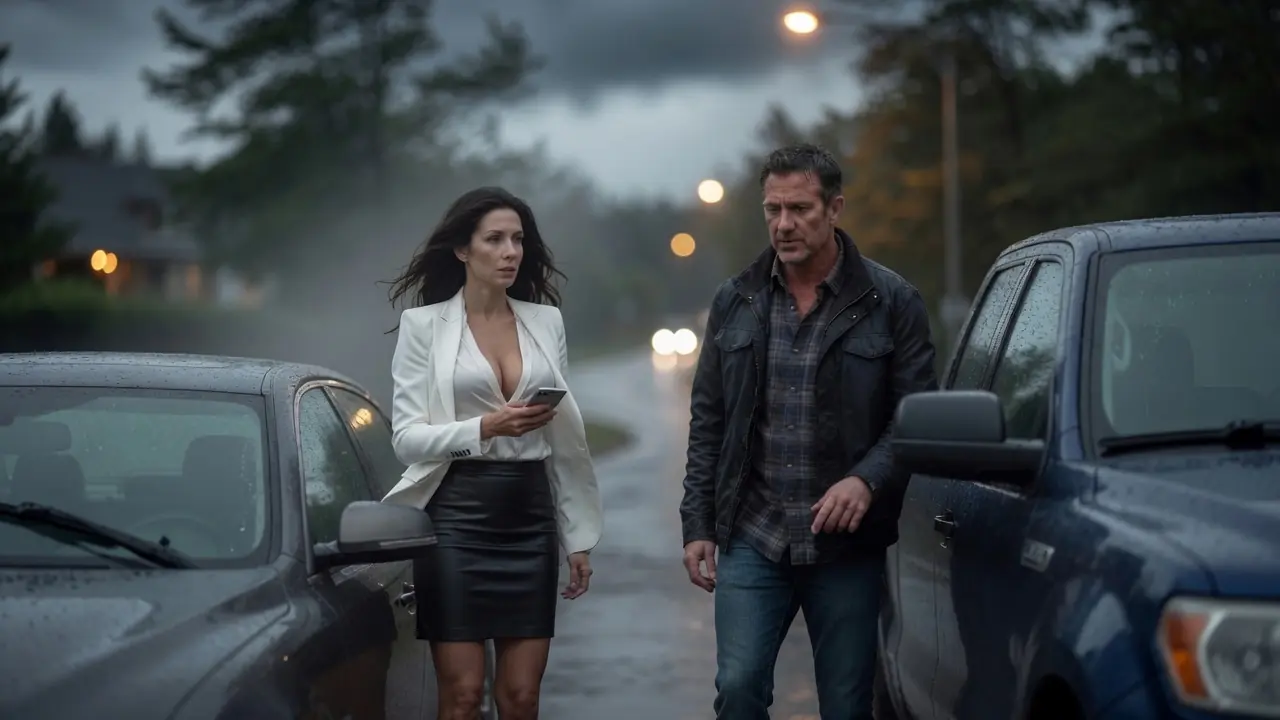
The temperature gauge climbed into the red before the engine lost power. Vanessa guided the car onto the narrow shoulder as rain hammered the windshield and tree branches bent violently above the pavement. When she lifted the hood, a burst of steam rolled toward her face, forcing her backward into the rain. Her phone displayed one weak bar of service, then none.
She stood beside the disabled sedan wearing a dark tailored coat over the deep navy blouse she had chosen for an important closing meeting. Loose blonde waves whipped across her face, rainwater streaked over her striking green eyes, and the gold necklaces resting against her collarbone felt suddenly ridiculous in the middle of a storm. Her heels sank into wet gravel each time she moved. The road was empty except for rising water and distant headlights.
Vanessa was thirty-two, a senior corporate attorney for Alden Development, and less than an hour away from completing the largest land acquisition of her career. Her client planned to purchase nearly eighty acres surrounding the small town of Millbrook, including an aging repair garage, several family homes, and a strip of riverfront property. The project would bring a logistics complex, hundreds of jobs, and enough profit to secure Vanessa’s partnership position before the end of the year.
At least, that was how the transaction had been presented.
Headlights appeared behind her through the rain. An old dark-blue pickup slowed, passed her car by several yards, then reversed carefully onto the shoulder. A tall man stepped out wearing a weathered black jacket over a dark plaid shirt, faded jeans, and heavy work boots.
He was thirty-six, broad-shouldered, and ruggedly handsome, with short dark hair already soaked by the rain and a strong face marked by exhaustion rather than age. He moved with the steady confidence of someone accustomed to solving problems without waiting for permission. Vanessa tightened her grip on her phone as he approached.
Luke Carter looked at the steam pouring from the engine, then toward the water moving across the road.
“You need to step away from the car.”
“I need it repaired.”
“You need to move before the creek reaches this bend.”
“My meeting starts in forty minutes.”
Luke glanced at the dead phone in her hand. “Then your meeting is going to begin without you.”
Vanessa disliked his tone immediately. It was not disrespectful, but it carried no awareness that she was someone accustomed to being obeyed. He treated the expensive sedan like any other broken machine and her urgent schedule like a minor inconvenience compared with the storm.
Luke opened the driver’s door and checked the warning lights. He found the keys still in the ignition, removed them, and turned toward her.
“Why are you still standing here arguing when your engine’s overheating and this entire road is about to flood?”
Vanessa crossed her arms despite the rain. “Because I don’t need a lecture. I need my car running before this storm traps me out here.”
“Then stop pretending money can scare the weather and hand me the keys.”
She stared at him.
Luke pointed toward the water creeping across the pavement behind the sedan. “You have maybe five minutes before that shoulder disappears.”
Vanessa finally surrendered the keys. “Fine. Save the car first, and then you can tell me how close I came to losing everything.”
Luke almost smiled. “The car isn’t what I’m trying to save.”
He attached a tow strap between the sedan and his truck, then ordered Vanessa into the passenger seat of the pickup. She objected to leaving her vehicle unattended, but another surge of brown water spilled across the road, making the decision for her. Luke pulled the sedan backward until both vehicles reached higher ground near an abandoned gas station.
The radiator hose had split near the clamp. Luke carried a small toolbox behind his seat and managed a temporary repair using spare hose, tape, and a metal connector. The engine still needed coolant, and the road ahead had become too dangerous to drive.
“My garage is three miles from here,” he said. “The truck can make it if the lower bridge is still open.”
“I need to reach the Hawthorne Hotel.”
Luke’s expression changed slightly. “For the Alden meeting?”
Vanessa studied him. “How do you know about it?”
“Everyone in Millbrook knows about it.”
He closed the hood of her car. “That meeting decides whether half this town gets bought out.”
“It decides whether an underused property becomes economically productive.”
Luke looked at her in silence.
Vanessa recognized that look from negotiations. It was the expression people gave lawyers when they believed polished language existed to hide something ugly.
“You work for them,” he said.
“I represent Alden Development.”
“Of course you do.”
“What is that supposed to mean?”
“It means you’re dressed for the people waiting at the hotel, not the families whose houses are listed in your contracts.”
Vanessa’s patience broke. “You know nothing about those contracts.”
“I know my garage is in one of them.”
The wind pushed rain beneath the gas-station awning. Luke turned away and secured the sedan, but Vanessa remained motionless. She had reviewed dozens of parcel numbers, property maps, and ownership reports. Carter Auto Repair appeared in the documents as a deteriorating commercial structure on six acres of potentially valuable access land.
She had never imagined the owner pulling her from a flood.
“You’re Luke Carter,” she said.
He opened the pickup door. “Now you know who to blame when you miss your meeting.”
The lower bridge remained open, but water rushed only inches beneath its wooden surface. Luke drove slowly while Vanessa watched the river rise beside them. Several homes stood in darkness, and residents carried sandbags toward doors and basement windows.
Luke stopped twice to help people move vehicles to higher ground. Vanessa checked her phone each time the signal returned, finding twelve missed calls from Alden executives and several increasingly angry messages from her managing partner. She typed that the storm had delayed her, but the message would not send.
Carter Auto Repair stood at the edge of town inside an old brick building with three service bays and an apartment above the office. A hand-painted sign hung over the entrance, and several damaged cars occupied the lot. Luke drove directly into one of the bays before closing the heavy door against the storm.
A young girl rushed down the interior stairs.
She was nine years old, with dark hair braided over one shoulder and wide brown eyes filled with relief. She wore a yellow sweatshirt, leggings, and mismatched socks.
“Dad!”
Luke caught her as she wrapped both arms around him. “I’m okay, Emma.”
“You said you’d be back before the warning started.”
“I had to help someone.”
Emma noticed Vanessa standing near the truck. Her gaze moved from Vanessa’s wet coat to the gold jewelry and muddy heels.
“Is she rich?”
Vanessa blinked.
Luke sighed. “Emma.”
“What? Her shoes look expensive.”
“They were,” Vanessa said, looking down at them. “They may not survive the evening.”
Emma accepted that answer and introduced herself. Luke explained that his neighbor, Mrs. Bennett, had stayed with Emma while he delivered a repaired truck. The neighbor lived upstairs during the storm because her small house near the river had already been evacuated.
Within minutes, Vanessa found herself inside the apartment above the garage wearing borrowed sweatpants, thick socks, and one of Luke’s oversized gray shirts. Her wet clothes hung near a heater, while Emma placed a mug of hot chocolate in her hands.
The apartment was modest but comfortable. Family photographs covered one wall, including several of Luke beside a smiling dark-haired woman. Another showed that woman holding a newborn Emma while Luke slept in a hospital chair.
Vanessa looked away before Luke noticed.
“My mom died when I was four,” Emma said quietly.
Vanessa turned back toward her. “I’m sorry.”
“She got sick. Dad says remembering her isn’t supposed to make us stop being happy.”
Luke entered carrying a weather radio and gave his daughter a warning glance. Emma shrugged as though she had only provided necessary information.
The woman in the photographs had been named Hannah. She taught science at Millbrook Elementary and died after an aggressive illness that gave the family less than a year together after diagnosis. Luke had raised Emma alone ever since, running the garage while balancing school schedules, medical appointments, and the thousand invisible responsibilities of parenthood.
Vanessa had spent years sitting across from powerful executives who spoke proudly about working eighteen-hour days. Watching Luke prepare soup, answer an emergency call from a stranded neighbor, check the storm warning, and help Emma finish her homework made those men seem less impressive.
The power failed just after eight.
Luke started a generator behind the garage, restoring lights to the apartment and enough electricity to run essential tools. His phone began ringing almost immediately. The volunteer fire department needed help moving an elderly couple whose car would not start.
“I’m coming with you,” Vanessa said.
“No.”
“You may need another driver.”
“You’re wearing my socks.”
“I can still drive.”
Luke looked at the storm beyond the window. “Emma stays here.”
Mrs. Bennett appeared from the spare room and promised she would keep the girl safe. Luke reluctantly handed Vanessa a raincoat and warned her not to argue if he told her to move.
They spent the next two hours helping people.
Vanessa drove an elderly couple’s station wagon to the high-school parking lot while Luke followed in his truck. She carried bottled water into a temporary shelter and used her legal voice to calm an angry landlord who refused to unlock a vacant building for displaced families. When a local pharmacist needed permission to access refrigerated medicine during the outage, Vanessa drafted a quick liability agreement on her phone and convinced the building owner to approve it.
Luke watched her differently after that.
“You’re useful,” he admitted while they loaded blankets.
“Try not to sound surprised.”
“I thought corporate attorneys mostly moved paper around.”
“I thought mechanics mostly gave unsolicited lectures beside broken cars.”
“Fair.”
At midnight, they returned to the garage soaked and exhausted. Emma had fallen asleep on the sofa beneath two blankets. Mrs. Bennett was dozing in a chair.
Luke heated coffee on a gas stove. Vanessa sat at the kitchen table, staring at the rain streaming down the windows.
“You really intend to refuse the sale?” she asked.
“My father opened that garage thirty-two years ago.”
“Alden is offering above the appraised value.”
“The appraisal is based on flood-risk projections that suddenly changed last year.”
Vanessa frowned. “The county updated those maps.”
“After Alden hired the consulting firm that produced the new study.”
She looked at him sharply.
Luke continued. “The revised map labels our side of town high risk, but leaves the proposed development zone safe. Anyone who understands the river knows that makes no sense.”
“Are you accusing my client of manipulating public records?”
“I’m telling you what people here believe.”
“Belief is not evidence.”
Luke opened a kitchen drawer and removed a thick folder. Inside were old flood maps, photographs, county letters, and engineering reports collected by residents. Hannah had helped organize the records before her illness worsened.
Vanessa read for nearly an hour.
The documents did not prove fraud, but they revealed inconsistencies she had never seen in Alden’s closing file. One engineering report warned that paving the proposed riverfront area could redirect water toward existing homes. That report was missing from the materials provided to her firm.
Another document showed Alden purchasing an option on the consulting company weeks before the revised flood map was submitted. The conflict had never been disclosed.
“Where did you get this?” Vanessa asked.
“Public records, mostly. Some from an engineer who quit the project.”
“Why didn’t you send it to Alden’s attorneys?”
“We did.”
Vanessa’s stomach tightened. “When?”
“Two months ago.”
She opened her laptop and searched the internal matter database. No resident objection file appeared. She tried several terms, then found a restricted entry she did not have permission to open.
That restriction made no sense. Vanessa was lead counsel on the acquisition.
Luke watched her expression. “Still think I know nothing about your contracts?”
She did not answer.
The hotel meeting was postponed until the following afternoon because of the storm. By morning, several roads were damaged, but Vanessa’s temporary car repair held long enough for Luke to drive it into the garage bay.
He replaced the hose properly while she stood nearby in her dried navy blouse, dark coat, and ruined heels. Her hair had dried in loose waves, and exhaustion softened the composed expression she usually carried.
“How much?” she asked.
“For the repair?”
“Yes.”
“Eighty dollars for the part and coolant.”
She looked surprised. “That’s all?”
“I’m not charging for pulling you off the road.”
“You should.”
“You helped at the shelter.”
“That was not payment.”
“Neither was stopping for you.”
Vanessa placed a hundred-dollar bill on the workbench. Luke returned twenty.
“You are extremely difficult,” she said.
“So I’ve been told.”
At the hotel, Alden executives greeted Vanessa with anger disguised as concern. Graham Alden, the company president, demanded to know why she had arrived with Luke Carter. Vanessa explained that he had rescued her during the flood.
Graham barely acknowledged Luke before ordering staff to escort him from the private meeting area.
Luke looked at Vanessa. “This is where you decide which side of the table you’re sitting on.”
Then he left.
During the meeting, Vanessa asked for the missing engineering report and the resident objection file. Graham claimed both were irrelevant to the closing. Her managing partner, Charles Bennett, quietly instructed her to focus on final signatures.
Vanessa refused.
She demanded access to the restricted file. When Charles denied permission, she called the firm’s ethics counsel from the conference room and placed the call on speaker. The room changed instantly.
Within an hour, the truth began emerging.
Alden Development had financed the consulting firm responsible for the revised flood map. The company used exaggerated risk ratings to lower property values and pressure residents into selling, while concealing a report showing that the planned logistics complex could increase flood danger. Charles Bennett had received the residents’ evidence and buried it to protect the firm’s largest client.
Vanessa stopped the closing.
Graham threatened to destroy her career. Charles warned that her partnership vote would disappear. Vanessa looked through the hotel windows toward Millbrook, where people were still cleaning mud from their homes.
“Then keep the partnership,” she said. “I won’t build it on fraud.”
She resigned from the firm that afternoon and delivered copies of the documents to state regulators. The acquisition collapsed within days. Investigators opened inquiries into Alden, the consulting company, and county officials who had approved the manipulated maps.
Vanessa’s name appeared in newspapers, though not always kindly. Some praised her for exposing the scheme. Others called her disloyal, reckless, and responsible for threatening a project that promised employment.
For several weeks, she wondered whether she had destroyed everything she had worked for.
Then Luke called.
“I need a lawyer,” he said.
Vanessa sat inside her nearly empty home office surrounded by unopened job inquiries. “For what?”
“The town is forming a land cooperative. We need help protecting the riverfront and rebuilding the damaged properties.”
“You cannot afford my old rate.”
“We can afford coffee and eighty dollars for a radiator hose.”
She smiled for the first time that day.
Vanessa began representing Millbrook’s cooperative at a reduced rate. What started as temporary work became the foundation of her own legal practice, focused on small businesses, land rights, and communities facing predatory development.
She spent more time at Carter Auto than she expected.
Sometimes she reviewed documents in the office while Luke repaired engines. Sometimes Emma sat beside her doing homework and asking questions about courtrooms. Vanessa learned to make pancakes badly, attend school science fairs, and leave her phone unanswered during dinner.
Luke never treated her like a hero. He challenged her when she worked too much, refused unnecessary gifts, and reminded her that protecting the town did not mean controlling it.
Vanessa, in return, helped him obtain a fair loan to modernize the garage without surrendering ownership. She discovered that Luke had turned down several expansion opportunities because he feared losing time with Emma. Together, they created a schedule allowing him to hire two apprentices and spend fewer evenings beneath broken trucks.
Their relationship grew slowly.
Neither wanted gratitude confused with love. Luke had lost a wife he still remembered every day, and Vanessa had spent years believing vulnerability gave other people leverage. They argued often, apologized reluctantly, and learned that trust was less like a contract than a machine requiring constant maintenance.
One year after the storm, Millbrook held a small celebration beside the river. The state approved corrected flood maps, Alden’s project was permanently canceled, and conservation funding allowed the town to restore wetlands that naturally absorbed floodwater.
Luke stood beside Vanessa beneath strings of white lights.
She wore a deep navy dress, gold hoop earrings, layered necklaces, and her blonde hair loose over her shoulders. Luke wore a dark jacket and looked uncomfortable with the attention residents kept giving them.
Emma ran toward them carrying a framed photograph. It showed Vanessa beside her disabled car on the flooded road, taken by a volunteer who had passed shortly after Luke arrived.
“You looked angry,” Emma said.
“I was stranded.”
“You always look a little angry.”
Luke tried not to laugh.
Vanessa examined the photograph. “Your father looked irritated too.”
“I was trying to keep you alive.”
“You were lecturing me.”
“You were arguing with rising water.”
Emma placed the picture in their hands. Beneath it, she had written:
THE NIGHT DAD FIXED THE WRONG THING FIRST.
Vanessa frowned. “What does that mean?”
Emma smiled. “He thought he was fixing your car.”
Luke looked at Vanessa across the frame.
The storm had destroyed a road, exposed a corrupt deal, and taken away the career Vanessa believed defined her. Yet it had also brought her into a town she would have helped erase without ever understanding what lived there.
It had brought Luke someone who did not replace Hannah, but who made room beside her memory. It had given Emma another adult who showed up, listened, and stayed even when life became complicated.
Luke reached for Vanessa’s hand.
“I still think you overcharged me,” she said.
“I charged you eighty dollars.”
“The lecture was excessive.”
“That part was free.”
Vanessa rested her head briefly against his shoulder as the celebration continued around them.
A year earlier, she had stood beside a smoking luxury car convinced the worst thing she could lose was an important meeting. Luke had seen the flood rising and understood that the car, the appointment, and even the business deal were temporary problems.
What mattered was getting her safely off the road.
Only later did they understand that the same storm had pulled them both away from lives that no longer fit. Luke had stopped for a stranded stranger because leaving her there was never an option.
Then the woman he rescued discovered that her company was trying to take his home—and chose to help him protect it instead.