“Sir, please leave. This place isn’t for people like you.”
The manager’s voice echoed across Aldridge’s restaurant.
Every table went quiet.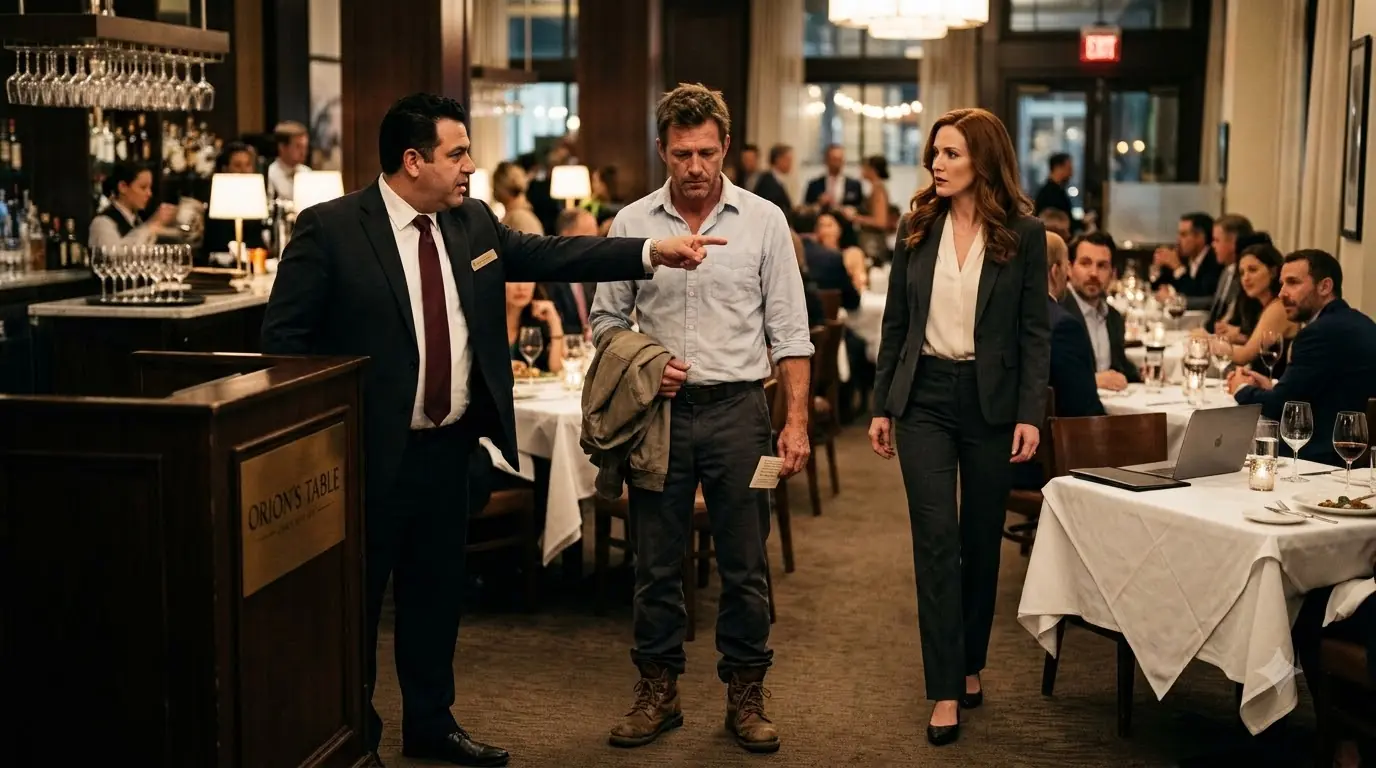
Ryan did not argue. He simply stood there in his cleanest button-down shirt, his work boots still marked with stains from a job he could not afford to lose.
Beside him, Sophie held his hand tightly. She wore the same blue birthday dress her mother had bought before she disappeared from their lives.
Ryan gently placed a hand on Sophie’s shoulder.
“Hey, it’s okay,” he whispered. “Nothing’s wrong.”
Sophie did not cry.
She looked around the silent room until a woman seated at a corner table suddenly pushed back her chair and stood.
Three weeks before that evening, Ryan Callister completed a repair shift at Voss Tower at six o’clock in the afternoon.
The electrical panel on the ninth floor had been incorrectly diagnosed by two contractors before him. Ryan found the fault inside a corroded junction hidden behind a secondary conduit that had not been opened since the building was commissioned.
Finding it required more than knowing where to look.
It required understanding why the failure would have developed there in the first place.
Ryan completed the repair, repacked his tools, signed out at the front desk, and stopped at a grocery store on the way home.
He stood in the baking aisle longer than necessary.
Claire’s recipe notebook remained on the second shelf of the bookcase in their kitchen. Her handwriting covered every page, rounded and deliberate, with small notes written in the margins about substitutions in case he could not find a particular brand.
Ryan had placed the notebook on that shelf after she died three years earlier.
He had not touched it since.
He knew her birthday cake recipe was inside.
Instead of opening the notebook, he purchased the ingredients from memory and told himself he would look at it another time.
That same Friday evening, at Portland General Hospital on the west side of the city, Natalie Voss sat on a wooden bench in a small garden that did not appear on the visitor map.
The garden occupied a narrow space between the hospital’s west wing and the service road. A row of maple trees shaded it, planted years earlier through a donation from her father when he was still healthy.
Edmund Voss had discovered the garden during an earlier hospitalization.
That stay had been for something minor, a procedure years before the lung cancer. He had walked through the garden every afternoon while recovering.
Natalie discovered it two months into his current treatment, on the first day she needed somewhere to go after leaving his room.
The oncologist had been direct that afternoon.
Edmund’s response to the first cycle of chemotherapy had been partial rather than complete. He would need another cycle.
The doctor used phrases such as adjustment and realistic expectations.
Natalie nodded at each one with the composed expression she used during board meetings.
Then she walked outside, sat on the bench, and realized for the first time in months that she did not know what to do next.
She was thirty-six years old.
She ran a company with four hundred employees and managed a capital portfolio larger than the annual budgets of some cities.
She had not cried in a doctor’s office since childhood.
She did not cry that afternoon either.
She sat beneath the maple trees and watched the daylight flatten against the hospital’s west wing. She remained there until she felt capable of returning upstairs.
What Natalie did not know was that the garden would soon have a second regular visitor.
Portland General’s outpatient pediatric unit occupied the same hospital wing.
Sophie Callister had been admitted ten days earlier for outpatient treatment of pneumonia. It was not severe enough to require an overnight stay, but it was stubborn enough to require daily monitoring.
Ryan dropped her off each morning before his shift and collected her every afternoon.
Sophie tolerated the waiting room for approximately forty minutes before discovering a side door that a nurse sometimes held open with a brick.
The first time Natalie saw her, Sophie was already seated at the far end of the wooden bench.
A hospital bracelet encircled her left wrist. She held a pencil in her right hand, and a folded square of paper napkin rested on her knee.
She had not asked permission to sit there.
She had simply taken the seat in the way certain children occupy space completely, without apology and without any apparent awareness that another arrangement might be expected.
Natalie looked at the child.
Sophie did not look up.
Natalie watched the pencil moving across the napkin in small, careful strokes.
After a moment, she asked, “What are you drawing?”
Sophie raised her head and considered the question with brief seriousness, as though determining whether it deserved a genuine answer.
“A building,” she said. “Dad designed it, but he doesn’t work there anymore.”
“What does he do now?”
“He fixes electricity.”
Sophie returned to the drawing.
The silence that followed possessed a particular quality.
It was not awkward and did not seem to be waiting for someone to fill it.
Natalie remained within it without searching for another question.
She was not accustomed to leaving silence alone.
In every other part of her life, she moved quickly to fill empty space.
Something in the garden told her not to.
Sophie continued drawing for several minutes, then looked up again.
“My father,” Natalie answered.
Sophie nodded.
“My dad visits me here. He always brings a sandwich because he says hospital food is bad.”
She paused and appeared to consider the statement.
“It is bad.”
Natalie laughed before deciding to.
The sound came quickly and unexpectedly.
It was the first time she had laughed in several days, and the surprise of it passed through her without comment.
That evening, Natalie returned to Edmund’s room.
He was sitting upright, which was a positive sign on the afternoons when he could manage it.
Edmund looked at her the way he always did, reading something she did not know she was displaying.
“You look better than when you arrived,” he said.
Natalie told him she had met a child in the garden.
Edmund smiled without hurry.
“Children have that effect.”
Natalie remained with him for another hour.
When she left, she carried an unfamiliar feeling with her, the sense that the afternoon had been, in some small and specific way, all right.
She returned home and opened her laptop at the kitchen table.
She told herself she was answering emails.
She was answering emails.
Still, some part of her mind remained on the wooden bench, listening to a child describe a building her father had designed.
Sophie returned the following afternoon.
She came back the day after that as well.
She never announced her arrival or checked whether Natalie would be waiting.
She simply appeared during the same afternoon window, as though their arrangement were obvious and did not require discussion.
Natalie began arriving by 3:15.
She did not examine the change closely.
They talked in the way of people who were not performing conversation.
Sophie discussed her preferred breakfast foods, whether pigeons were stubborn or merely patient, and the precise difference between a skyscraper and a high-rise.
She considered that distinction meaningful and held strong opinions about it.
Natalie listened without redirecting her.
In her regular life, Natalie constantly redirected conversations, negotiations, and her own attention.
In the garden, she allowed Sophie to take the conversation wherever she wanted.
Natalie found that unexpectedly relieving.
Sophie told her about Ryan in fragments and without any clear order.
Children often reported important information without worrying whether the listener understood the sequence.
She said Ryan woke very early and made coffee before doing anything else.
She said he was quiet in a way that was not exactly the same as being sad, although he was sometimes sad.
She told Natalie that he used to draw buildings with pencils on actual paper rather than a computer.
Sophie had kept several of those drawings inside a folder beneath her bed.
She reported this without drama, like someone describing the contents of a drawer.
She also said her mother had loved the building Ryan designed.
Claire had visited it while it was still under construction, before she became sick.
Sophie delivered that information with the same flatness she applied to most facts about her mother.
Natalie did not rush to answer.
She allowed the sentence to remain between them.
That seemed to be what Sophie preferred.
One afternoon, near the end of her treatment, Sophie unfolded a napkin and held it up so Natalie could examine it properly.
It showed the elevation of a tall building, drawn in careful lines. A deliberate asymmetry appeared along the upper third of the eastern facade.
The proportions were too precise to be the result of guessing.
Children did not accurately draw load-bearing geometry by accident.
Someone had taught Sophie how to see that building.
“This is Dad’s building,” Sophie said. “He designed it, but now he fixes the electricity there.”
Natalie studied the drawing.
“What is it called?”
“Voss Tower.”
Sophie returned to her pencil.
Natalie kept her expression neutral.
She said something without substance and waited until she was alone that evening before opening her laptop.
The original Voss Tower project archive remained on the company server.
The listed lead architect of record was R. Callister of Harlan and Associates.
Natalie searched for the name.
The public record was nearly empty.
The architectural firm had dissolved in 2021.
Professional profiles had either been removed or left inactive.
Natalie found one result, a short feature published in an architectural journal in 2020.
The article focused on emerging architectural voices from the Pacific Northwest.
A photograph showed Ryan at a construction site.
He looked younger.
His expression had not yet developed the particular stillness that comes from carrying something heavy for years.
Still, the face was recognizable.
Natalie remained in front of the photograph for a long time.
On the day Sophie was discharged, she came to the garden to say goodbye.
She wore her own clothes and carried a purple backpack.
Sophie offered the napkin drawing to Natalie.
“You can keep it. Dad has lots more.”
Natalie accepted it carefully.
Sophie hooked her thumbs beneath the straps of her backpack.
“Dad is taking me to Aldridge’s for my birthday,” she said without particular emphasis. “Mom used to take me there. He’s been saving money.”
She waved and walked toward the hospital entrance without looking back.
Natalie remained on the bench for several minutes.
The folded napkin rested in her hand.
She was aware that she held something more significant than a child’s drawing.
Ryan had made the dinner reservation for seven o’clock.
He had Sophie ready by 6:45 because she wanted to leave early, and he did not argue.
He parked two blocks from the restaurant.
They walked together along the illuminated sidewalk.
Sophie kept pace beside him, as she always did.
She did not hurry ahead or fall behind.
She simply walked beside her father with the quiet steadiness of a child who had decided that his pace was the correct one.
They stopped outside the entrance of Aldridge’s before going in.
Warm light filled the front windows.
Inside was the low murmur of a room where people were comfortable and in no hurry.
Ryan looked at the door.
Sophie looked at the door.
Neither said what they both understood.
The last time Sophie had entered that restaurant, her mother had been there to hold the door.
Ryan opened it, and they went inside.
Marco had managed the Friday evening shift at Aldridge’s for four years.
During that time, he had developed a reliable visual shorthand for the dining room.
He believed he could identify who was celebrating, who was negotiating, who had made a reservation they could not comfortably afford, who belonged, and who had entered from somewhere else.
He looked first at Ryan’s shirt.
Acceptable.
Then his attention moved to the work boots and remained there.
Marco wore the expression of a man who had already reached a conclusion before beginning to speak.
He addressed Ryan at a volume that demonstrated confidence in his authority.
“Sir, we have a dress code. I’m going to have to ask you to take your daughter and leave.”
Sophie looked at Marco.
She became completely still.
It was the particular stillness of a child who had already survived something more difficult than a restaurant.
She looked at the tables where people had turned to watch.
Then she looked at her father.
Ryan placed a hand on her shoulder.
“Okay.”
One syllable.
He was already turning toward the door.
There was no argument, no raised voice, and no attempt to explain.
The absence of those things made the scene difficult to witness.
Ryan looked like a man who had long ago accepted that arguing consumed energy better spent elsewhere.
He guided his daughter toward the exit without allowing her to feel the full weight of the humiliation.
Natalie was seated at her usual corner table when it happened.
She visited Aldridge’s on Friday evenings after leaving Edmund.
She ordered salmon, opened her laptop, and worked until eight, when the restaurant became too crowded for concentration.
She heard Marco’s voice and looked up.
Natalie recognized Sophie before fully understanding the situation.
She recognized the posture, the careful stillness, and the slight tension in the child’s jaw.
It was the visible effort of refusing to cry in public.
Natalie placed her phone facedown on the table.
Then she stood and crossed the dining room.
She approached Sophie first.
Natalie crouched until her face was level with the child’s.
“Hey,” she said. “Happy birthday.”
Sophie looked at her.
Recognition crossed her face.
Then she smiled, sudden and complete.
It was the kind of smile children produced when something genuine surprised them beyond their defenses.
Ryan looked at the woman kneeling before his daughter in the center of a silent restaurant.
He did not know who she was.
He knew only that she had looked at Sophie first.
Not at him.
Not at the people watching.
At Sophie.
Natalie stood and faced Marco.
“She is my guest,” she said. “Both of them are.”
Her voice was the one she used in rooms where people needed to understand that something was not negotiable.
Marco looked at her face.
Recognition spread through the employees near the host station.
Natalie Voss.
The regular guest who always received the corner table.
The dining room understood that an error had been made.
It could no longer be corrected.
It could only be absorbed.
Ryan did not know any of this yet.
He stood with one hand against Sophie’s back and watched a stranger hold open a door that had been closed to them.
Then he walked his daughter through it.
Natalie led them to her table.
It had four seats and stood in a corner away from the center of the room.
The position offered natural privacy without requiring a physical barrier.
Sophie opened her menu with focused seriousness.
As was usually the case when Sophie was present, the conversation began with her.
She explained the garden at Portland General to Ryan.
She described the wooden bench, maple trees, and the woman who appeared every afternoon at the same time.
Ryan listened.
Natalie listened to Sophie describe her without filling in the things Sophie left unsaid.
They talked about the hospital, Sophie’s birthday, and her drawings on napkins.
Neither adult introduced the subject of their professions or status.
The absence of that conversation felt correct to both of them.
They ordered dinner.
The food arrived.
Natalie did not explain her title.
Ryan did not ask.
When the check came, Ryan reached for it.
Natalie had already paid.
He looked at her.
“You didn’t have to do that.”
“I know.”
Ryan accepted the answer with one nod.
It was the response of a man who did not perform gratitude but did not withhold it either.
He understood the difference between a gesture that demanded a response and one that simply existed.
Sophie fell asleep in the car before they passed the first intersection.
One cheek rested against the window, and her hands lay loosely in her lap.
Ryan drove through the quiet.
At a red light, he reached back to adjust her jacket.
Something fell from her pocket onto the seat.
Ryan picked it up.
It was a business card printed on clean white paper with plain black text.
Natalie Voss.
Chief Executive Officer.
Voss and Harlan Development.
Ryan studied it for the duration of the red light.
Then the signal changed.
He drove the rest of the way home with the card lying on the passenger seat.
When he carried Sophie upstairs, he placed it in the zippered pocket of his jacket.
He left it there.
The following morning, at the Voss and Harlan offices on the fourteenth floor, a junior assistant mentioned that Natalie had been seen at Aldridge’s with a man and a young girl.
The comment arose casually during a conversation about something unrelated.
Derek Paulson stored it as he stored everything else, information of uncertain value awaiting context.
He asked the assistant for the restaurant’s name.
Then he called Marco.
Marco described a man wearing work boots and a navy shirt.
The reservation had been under the name Callister.
Derek searched the company’s contractor management system.
Ryan Callister.
Electrician.
Employed through Meridian Maintenance and currently assigned to Voss Tower.
At that stage, Derek did not know Ryan had designed the building he now maintained.
What he knew was more immediately useful.
Natalie Voss had spent Friday evening with a contract worker and apparently intervened on his behalf during a public confrontation.
It was the kind of information that could be shaped according to whatever it later became.
Derek called Carol Finch.
Carol had managed Meridian’s contracts with Voss and Harlan for eleven years.
She knew the records of every contractor who had worked at company properties.
“Who is Ryan Callister?” Derek asked. “Who is he really?”
Carol paused before answering.
The silence lasted three seconds longer than it should have.
Derek noticed.
He treated silence as information in another form.
Carol said Ryan was a competent and dependable electrician with nothing concerning in his file.
Derek thanked her and ended the call.
Carol remained at her desk afterward.
Ryan’s contract renewal form was open in front of her.
She had been preparing to approve it before Derek called.
She did not complete the renewal.
That same morning, Natalie reopened the original Voss Tower archive on her office computer.
She went through the project carefully for the first time in years.
The complete drawing set remained intact.
Site plans.
Floor plates.
Elevations.
Sections.
Structural coordination documents.
Every title block carried the handwritten signature R. Callister, Harlan and Associates.
Natalie opened the east elevation.
She placed Sophie’s napkin beside it on the desk.
The proportions were the same.
The asymmetry along the upper third appeared identically in both drawings.
Natalie had always assumed it was primarily an aesthetic choice, the kind of gesture architects used to interrupt symmetry on a less prominent facade.
She followed the load path through the structural documents until she understood why the asymmetry existed and what function it performed.
The aesthetic decision had not been primary.
The drawing on Sophie’s napkin had somehow understood that.
Natalie took the elevator to the fourteenth floor.
Ryan was replacing a breaker panel at the end of the east corridor.
The electrical room door stood open.
His back was toward her, and both hands were inside the panel.
Ryan turned when she said his name.
Not his first name.
“Callister.”
It was the way someone addressed a person after thinking of him in terms of a file.
He looked at her without surprise.
“The east facade,” Natalie said. “The asymmetry in the upper third. Was it structural or aesthetic?”
Ryan was silent for a moment.
His expression was neither guarded nor open.
It was more deliberate than either.
“Both,” he said. “The load path runs diagonally beneath that panel. The aesthetic was secondary.”
Natalie nodded slowly.
“You designed this building.”
It was not a question.
Ryan answered anyway.
“That was a different time.”
He turned back toward the electrical panel.
Natalie remained in the doorway for another moment.
Then she walked toward the elevator.
Ryan’s sentence stayed with her throughout the afternoon in a way she could not explain.
Two days later, Derek called Carol into his office and closed the door.
He instructed her to terminate Ryan Callister’s Meridian contract before the end of the month.
The official reason would be restructuring.
Carol asked why.
Derek said Ryan was becoming a distraction.
Carol returned to her desk and opened the termination form.
She stared at it for a long time.
Then she closed it without entering any information.
It was the first time in nine years she had failed to complete an assignment Derek gave her.
That evening, Ryan returned home and found Sophie seated at the kitchen table.
A new group of napkin drawings surrounded her.
He sat across from her.
After a moment, he reached into his jacket and placed Natalie’s business card on the table.
Sophie looked at it.
“That’s Miss Natalie’s card.”
“I know.”
Sophie studied her father.
“She’s nice.”
Ryan nodded.
“Yeah.”
He left the card on the table when he stood to prepare dinner.
He did not put it away again.
Natalie had not been reviewing company operating figures because she suspected anyone.
She did it because she was thorough.
It was a habit she learned from Edmund, who examined every document placed in front of him with the attention of someone who understood how carelessness in details allowed large things to go wrong.
Over several months, Natalie noticed a pattern she could not precisely describe.
Certain approval sequences bypassed the dual-signature requirement mandated by company bylaws for expenditures above a specific threshold.
Other line items appeared under categories broad enough to make detailed accounting optional.
Natalie raised the matter indirectly during one meeting.
Derek offered a smooth explanation involving operational efficiency.
She accepted the answer in the room.
Then she returned to her office and spent the following week unable to explain why it had not satisfied her.
Natalie contacted an independent accounting firm through her personal email account.
She provided three years of operating data and requested a complete reconciliation of all maintenance and facilities expenses against the contracts on file.
She told no one at Voss and Harlan.
The accounting report arrived nine days later.
Over three years, $1.2 million had been categorized under a heading called Operational Contingency.
That classification required no detailed accounting.
In practice, none had been provided.
The funds were transferred quarterly to Halcyon Services LLC, a company registered in Delaware.
A standard beneficial ownership investigation identified one of Halcyon’s silent shareholders.
Derek Paulson.
Natalie read the report twice at her desk.
She placed it inside a physical folder, put the folder in her bag, and drove home.
She did not sleep particularly well.
The next morning, Natalie requested a board meeting for the following Thursday.
She gave no reason in the subject line.
When Derek received the notification, he submitted his own meeting request for the same morning.
The listed subject was Executive Leadership Concerns.
Derek arrived in the conference room early.
Before the others entered, he moved slowly around the table.
He had spoken privately with three board members the previous day.
He believed he knew where the weight of the room would fall.
When the board members filed in, Derek invoked his authority under the governance charter to raise concerns about executive conduct.
He spoke in controlled, neutral language.
Derek described what he called a pattern of divided attention.
He claimed Natalie’s concentration had shifted away from a critical merger and acquisition pipeline because of a personal relationship with a contract worker.
He referenced Aldridge’s.
He referenced Carol’s observations that the contractor’s name had appeared during executive discussions.
Derek presented it as a leadership concern rather than a personal attack.
His tone suggested a man reluctantly performing an unpleasant duty.
Three board members nodded.
Two remained unreadable.
The balance of the room was moving in the direction Derek had prepared.
Natalie opened her laptop and connected it to the display.
A single slide appeared.
It contained a table of figures covering three years.
“Before we discuss my personal life,” she said, “let’s discuss this.”
The room became quiet.
It was the kind of silence that appears when the expected form of a situation abruptly changes.
Natalie explained the numbers without performance.
The $1.2 million.
The Operational Contingency classification.
The absence of required dual-signature approvals.
The transfers to Halcyon Services LLC.
Derek Paulson’s name in the beneficial ownership records.
Derek said it was an accounting classification error.
He used the word misunderstanding twice.
He had survived difficult meetings before and now relied on the composure that had always protected him.
Natalie placed a printed email on the table before the board chair.
It contained Derek’s instructions to Carol Finch to terminate Ryan Callister’s contract.
The email had been sent forty-eight hours after Natalie first asked about Ryan’s professional background.
“This is retaliation against someone whose name emerged while I was investigating these accounts,” Natalie said. “The order came the day after I asked who the electrician was.”
The board chair called for a vote.
Derek’s suspension passed seven votes to two.
He left the room without speaking.
In the hallway, he made a telephone call.
His voice remained carefully controlled.
After the meeting, the board expected a press statement.
The communications department expected Natalie to call.
The company’s legal counsel expected a meeting to plan the next steps.
Natalie picked up her bag and keys instead.
She walked through the lobby, entered the parking garage, and drove across Portland.
She did not call ahead.
Natalie drove to a residential building on the city’s east side.
The surrounding apartment complexes had been built during the 1970s.
The maple trees along the sidewalk were old enough to possess real mass.
Natalie found the correct buzzer and pressed it.
She stood inside the concrete entrance and listened to the building’s quiet.
She thought about the fact that she was doing something she had not planned and could not have imagined doing twelve hours earlier.
It was probably the most honest action she had taken in a long time.
Ryan’s voice came through the intercom on the second ring.
“Yeah?”
“It’s Natalie Voss.”
There was a pause.
Then the door unlocked with a buzz.
Ryan was standing in the hallway when Natalie stepped out of the elevator.
He wore a gray T-shirt.
His hair was uncombed, and he looked like a man who had returned home an hour earlier after a morning shift.
Sophie was visible at the kitchen table with a bowl of cereal, a napkin, and a pencil.
She looked up when Natalie entered.
Her face brightened.
“Miss Natalie.”
Then she returned to her cereal.
Ryan looked at Natalie with the expression of someone who had expected this conversation eventually but had not known when it would occur.
He stepped away from the doorway.
Natalie entered.
She told him his contract was secure.
Then she apologized for what had happened at the restaurant.
“You weren’t the one who said it,” Ryan replied.
“No,” Natalie said. “But I should have spoken sooner about many things.”
She said it plainly.
There was no qualification and no attempt to soften it.
Ryan looked at her for a moment.
He was deciding whether the statement was true, not whether it was gracious.
Then he moved farther from the door, allowing her fully into the apartment.
Natalie explained the board meeting.
The audit.
The missing funds.
Derek.
The vote.
Ryan listened without interrupting.
He did not perform surprise or outrage.
He gave her the same complete attention he seemed to bring to everything else.
When she finished, he asked, “Is it handled?”
“The investigation is continuing, but yes.”
Natalie placed an envelope on the kitchen table.
“Voss and Harlan is moving forward with a second tower. The board approved the concept several months ago. We still don’t have an architect.”
She looked at the envelope rather than at him.
“You don’t have to answer now. You don’t have to answer at all.”
Ryan looked at the envelope without touching it.
“Why me?”
Natalie met his eyes.
“Because the first building is still standing. I want to know whether that was luck or intention.”
The kitchen became quiet.
Sophie had stopped drawing.
She stared into her cereal bowl with the concentrated expression of a child who was listening to everything and understood that the appropriate response was to appear not to be listening.
“It wasn’t luck,” Ryan said.
Something settled in the room.
It was small, quiet, and without ceremony.
Sophie stood, carried her bowl to the sink, and walked past Natalie.
She placed her small, warm hand once against the back of Natalie’s hand.
“You should stay for breakfast.”
Then Sophie returned to the table and picked up her pencil.
Ryan and Natalie looked at each other across the kitchen.
Neither spoke.
After a moment, Natalie pulled out a chair and sat down.
The investigation concluded fourteen days later.
Derek Paulson was terminated with cause on a Wednesday morning.
The file was transferred to an independent auditing firm hired by the board.
There was no final confrontation.
No public confession.
No speech.
There was a cardboard box carried from the corner office overlooking the Willamette River.
Three weeks later, Derek’s name disappeared from the company directory.
On the following Tuesday morning, the fourteenth floor felt slightly different, although no one could say exactly why.
Justice, when it arrives through institutional procedure rather than a dramatic confrontation, often resembles administration.
Carol found Ryan in the parking garage two days after Derek’s termination.
She had rehearsed what she intended to say for several days.
The apology came out less organized than she had planned.
Carol clarified that she was not apologizing for the restaurant incident because she had not been there.
She was apologizing for the period before it.
For knowing what Derek was doing with contractor renewals.
For remaining silent because silence had been easier.
For taking too long to understand that silence was not neutrality.
Ryan listened.
“You were protecting your job,” he said. “I understand that.”
He did not say her choices had been acceptable.
They had not been entirely acceptable, and Ryan was not someone who said untrue things merely to make a moment easier.
He acknowledged what she had said without anger.
Then he returned to loading equipment into his truck.
Carol walked back to her car.
It was enough.
That weekend, Natalie sat beside Edmund’s hospital bed and spoke to him in a way she had not managed for months.
She did not edit herself.
She did not attempt to control his concern by limiting what she disclosed.
Natalie told him about the audit, Derek, and the board meeting.
She told him about Ryan Callister and the building Edmund commissioned during the years when Voss and Harlan was still discovering its scale.
She explained that a young architect had designed Voss Tower with real care.
After his wife died, he left architecture.
He had been maintaining the building as an electrician ever since without telling anyone what he had once been.
Edmund listened to all of it.
When she finished, he was silent for a moment.
“The little girl who sat in the garden,” he said. “Her father?”
“Yes.”
Edmund looked toward the ceiling in the way he did while working through a thought.
“She is a good judge of character.”
“She is.”
They remained together for another hour.
The room held the particular quiet that appears after a great deal has been said and nothing further is necessary.
Just after nine o’clock that night, Natalie’s phone rang.
She was seated at her kitchen table with a glass of water and a report she had not been reading.
The caller was Ryan Callister.
She answered.
“I read the project brief,” he said. “The eastern parcel has a drainage problem you haven’t accounted for.”
Natalie turned the unread report facedown.
“The grade drops four feet across sixty feet of the property line,” Ryan continued. “The preliminary site plan doesn’t address it.”
Natalie smiled alone in her kitchen.
“Can you come to the office on Thursday?”
“I’ll bring Sophie. She’ll want to see the site.”
“I know.”
A pause followed.
It was not uncomfortable.
Then they said good night, and the call ended.
Natalie remained at the table for several minutes.
City lights appeared beyond the window above her sink.
Something that had been compressed inside her chest for a long time had slowly begun to open during the previous weeks.
She did not yet know what it would become.
She believed she could wait to discover it.
Three months later, Ryan signed a contract with Voss and Harlan.
The title was his own condition.
Design Integrity Consultant.
He completed his remaining Meridian assignments before transferring them to someone else.
The money no longer required it.
Ryan completed them because he had begun the work, and he finished what he began.
Sophie asked whether the new arrangement meant they would need to move.
Ryan told her it did not.
She returned to her drawing.
On a Tuesday afternoon in late October, the maple trees outside Portland General had turned copper and amber.
Sophie sat on the wooden bench in the west garden and drew.
She was not sick.
She was there because Natalie had been visiting Edmund.
Ryan had come with Natalie.
Sophie had come with Ryan.
For Sophie, the hospital now possessed the quality of a place where something important had begun.
She could not name it, but she recognized it.
Natalie came through the side door and sat beside her.
“What are you drawing?”
The question was identical to the one she had asked the first time.
The same bench.
The same afternoon light.
Sophie held up the napkin.
Two tall towers stood on opposite sides of an open space.
Between them was a smaller structure with a flat roof.
Small, careful marks covered the roof, suggesting plants.
“That’s the new one,” Sophie said. “Dad says it needs a garden on the roof because buildings need to breathe.”
Natalie studied the drawing.
Then she looked toward a third-floor window on the western face of the hospital.
Through the glass, she could see Ryan sitting beside Edmund’s bed.
They were talking.
Edmund moved his hands in the way he did while making a point he considered important.
Ryan listened the way he always listened.
Without performance.
Without impatience.
Completely present.
Upstairs, Edmund was in the middle of a sentence when Ryan looked through the window and saw them seated below.
Sophie bent over the drawing.
Natalie sat beside her.
Both figures were still beneath the gold afternoon light.
Edmund stopped speaking and followed Ryan’s gaze.
He looked down for a moment, then turned back to Ryan.
“You’re good for her,” Edmund said without preamble or qualification. “She stops pretending when she is around you.”
Ryan continued looking toward the bench.
“She’s good for both of us.”
He went downstairs.
Ryan walked through the side door, crossed the stone path, and sat on the far side of Sophie.
She occupied the center of the bench, as she always did.
Natalie slid the napkin across Sophie’s lap toward him.
Ryan picked it up.
He examined the two towers, the smaller building between them, the rooftop garden, and Sophie’s approximate but earnest lines.
He remained silent for a long time.
Then he noticed the words written along the bottom.
They appeared in the rounded, uneven letters Sophie used when printing by hand.
“All of ours.”
Nobody spoke.
Wind moved through the maple trees, the same trees that had been dropping leaves into the garden since before any of them had stood there.
Sophie picked up her pencil and began a new drawing on a fresh square of napkin.
She worked with the quiet concentration of someone who had found the thing she intended to continue doing.
October light rested across all three of them.
None of them needed the moment to be anything other than what it was.