If you saw Miles Donovan for the first time, you would probably think he was simply a quiet man living alone at the edge of a small New England town.
Every morning, he opened his workshop before sunrise and bent over an old watch with a jeweler’s loupe pressed to one eye.
Every evening, he sat on his porch with a cup of black coffee, watching maple leaves drift onto the damp street.
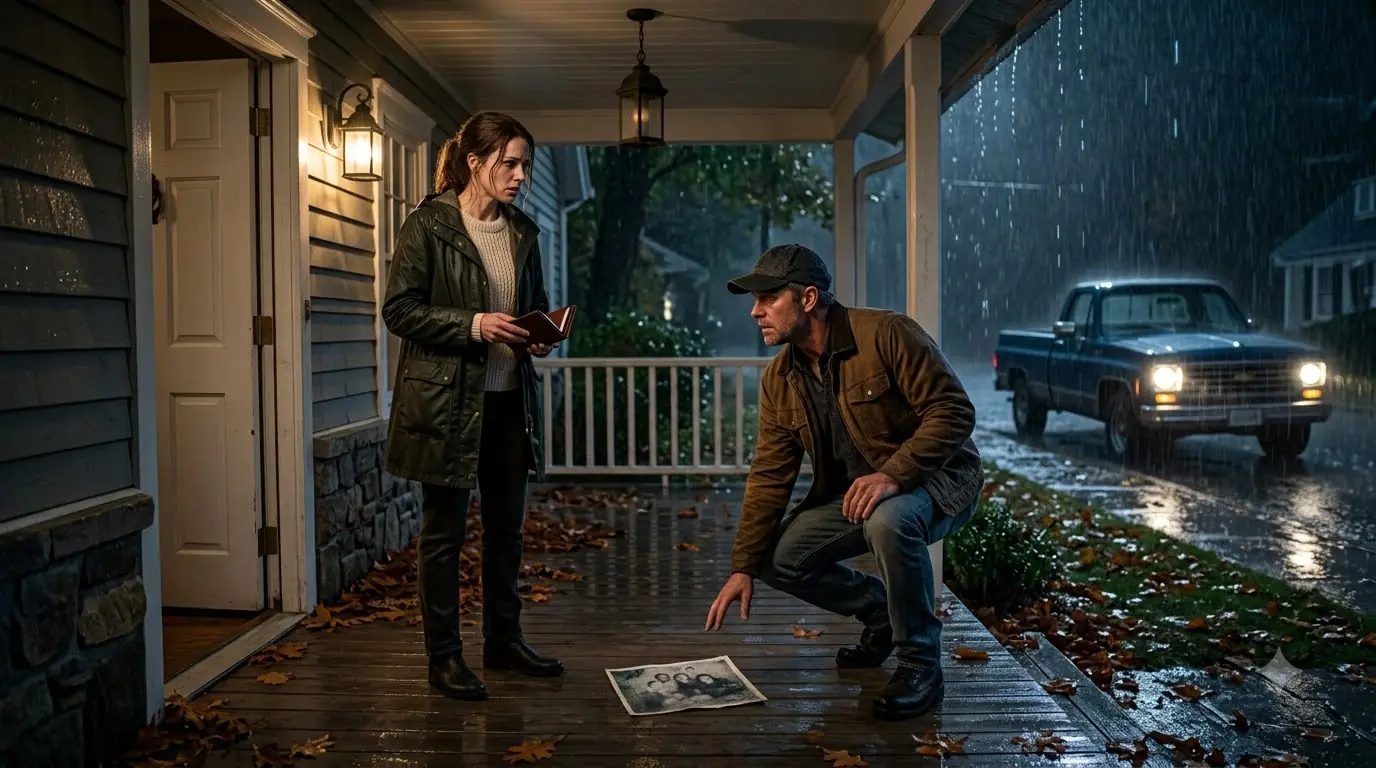
For eleven years, his old blue pickup truck sat in the driveway, rarely driven and almost never carrying a passenger.
Nobody in town knew why.
Then, on a gray afternoon in late October, with rain falling in thin silver threads over the rooftops, a woman he had never met knocked on his door and asked him a question that would change both of their lives before the night was over.
She only wanted a ride into town.
Miles said yes.
Neither of them understood that fifteen quiet minutes inside an old pickup would begin undoing years of silence.
The town itself seemed built for slow living. The church bell still rang twice on Sundays, and the owner of the hardware store remembered every customer’s name without needing a computer. Streets narrowed as they climbed toward the hills, lined with clapboard houses painted in fading blues and whites, their porches sagging gently beneath decades of winters.
In autumn, the valley turned the color of embers.
Wood smoke drifted from chimneys before the first frost arrived. Fallen leaves collected in roadside ditches, and the air smelled of wet earth, pine, and cold rain. It was the kind of town where everyone recognized everyone else’s car but almost nobody recognized what lay beneath another person’s habits.
People waved across the street without slowing down.
They assumed they already knew the whole story of their neighbors.
They assumed nothing important ever changed there.
Miles kept his lawn trimmed and his gutters clear. He painted his fence every third spring whether it needed it or not. He waved at every neighbor who passed, always with the same short nod and the same half-smile that never quite reached his eyes.
He fixed the widow’s mailbox across the street without being asked.
When her porch bulb burned out, he replaced it before she noticed. On the first icy morning of every winter, a bag of rock salt appeared beside her front door. He shoveled snow from an elderly couple’s driveway before sunrise and was always gone before their curtains opened.
People called him kind.
They also called him strange.
Not cruelly.
Small towns often used that word for men they could not quite explain.
In eleven years, nobody had been invited inside Miles Donovan’s house.
No friend’s car ever remained in his driveway overnight.
No laughter spilled through his windows.
No one could remember a holiday when smoke rose from his chimney because company had arrived rather than because Miles was simply keeping warm.
Children liked him without understanding why.
They sensed something steady in him that adults, distracted by assumptions, often missed. Miles always stopped what he was doing when a child spoke to him. He repaired broken bicycle chains for free and once spent an entire afternoon restoring the wooden wheels of a little girl’s toy wagon because her grandfather had made it before passing away.
To almost everyone in town, Miles Donovan was a good man with a locked door where his past should have been.
Vivien Sinclair arrived on a Tuesday in a car far too polished for the cracked pavement of that street.
She brought two suitcases.
And a silence of her own.
Vivien was thirty-seven years old and had once built a boutique hotel company from almost nothing. Her name had been stitched into embroidered pillows in luxury suites across six cities. She had spent fifteen years moving through boardrooms filled with investors, champagne, contracts, expansion plans, and people who wanted to be close to success.
Then four months destroyed nearly everything.
A business partner she trusted had diverted money from company accounts.
Her fiancé, whom she trusted even more, disappeared with him.
Lawsuits followed.
Investors panicked.
Reporters gathered outside her apartment for almost three weeks.
Headlines repeated her name until it no longer felt like it belonged to her.
Even after the reporters finally left, the silence they left behind felt worse than the noise.
Vivien purchased the small house beside Miles Donovan’s without ever seeing it in person.
She bought it because it was far away.
Far from Boston.
Far from New York.
Far from investors.
Far from the people who used to call when her company was growing and stopped calling when it began collapsing.
The real-estate listing showed little more than a modest colonial house with peeling shutters and an overgrown garden.
But something about its quiet appealed to her.
She made the purchase while sitting in a lawyer’s office nearly three hundred miles away, surrounded by people offering opinions about what she should do next.
Vivien noticed Miles on her second morning.
She stood in her kitchen holding coffee in a mug she had purchased from a gas station because her own dishes were still packed.
Through the window, she watched him kneeling in his garden.
Broad shoulders.
Gray beginning to streak his hair.
Old work shirt.
He moved with the unhurried patience of someone who had nowhere else he needed to be.
That stillness fascinated her.
For years, Vivien had lived according to calendars divided into fifteen-minute blocks. Breakfast meetings. Airport lounges. Conference calls. Investor dinners. Messages arriving faster than she could answer them.
Watching Miles turn soil around a row of dormant plants felt almost unreal.
She asked Naomi Brooks about him during her first week.
Naomi owned the small café on Elm Street and had spent nearly twenty years watching the town grow older one cup of coffee at a time.
Vivien asked mostly because she was bored.
Mostly because the silence inside her new house had become much louder after the moving truck left.
“Your neighbor?” Naomi said.
“Miles Donovan.”
Naomi smiled faintly.
“Kindest man in town.”
Then, without changing her expression, she added, “Loneliest too.”
The two descriptions seemed to belong together in Miles’s case.
Naomi explained that he had moved there years earlier with almost nothing.
He opened a workshop repairing antique watches and clocks, especially pieces other repairmen had already declared worthless. People drove from other counties to bring him heirlooms because Miles seemed able to revive mechanisms everyone else had abandoned.
He never talked about where he came from.
Never mentioned a wife.
Never mentioned children.
Never mentioned brothers, sisters, parents, or old friends.
Vivien laughed it off as ordinary small-town curiosity.
She returned home to unpack boxes labeled in her former assistant’s handwriting.
Most of them represented a life she no longer wanted to think about.
She told herself she had come to disappear quietly.
Not to collect the mysteries of strangers.
But the image of Miles Donovan stayed with her.
A closed, careful man restoring things everyone else had given up on.
Vivien had no idea that within days, her own car would die in the middle of a rainstorm and place that quiet man directly in the path of her life.
The storm arrived on Thursday evening.
New England rain turned gutters into rivers and streetlights into blurred halos.
Vivien received an emergency call from her attorney in the city. A set of records had surfaced in connection with the lawsuit against her former partner, and there was one narrow opportunity to review them before an upcoming hearing.
The meeting could not wait until morning.
Vivien grabbed her coat.
Her car refused to start.
The engine coughed once.
Then silence.
She tried again.
Nothing.
Her phone battery showed four percent.
The charger was somewhere inside one of thirty unlabeled boxes.
The taxi company did not answer.
The last bus had already left.
Vivien checked the schedule twice, convinced she had misunderstood it.
She had not.
For several minutes, she stood on her porch watching rain blow sideways beneath the streetlamp.
Then she looked toward the house next door.
Miles’s porch light was still on.
Vivien crossed the wet grass.
Her heels sank slightly into the softened ground.
At the base of Miles’s steps, she nearly turned around.
What was she doing?
She barely knew this man.
The whole town described him as private.
And here she was, standing on his porch in a storm asking for transportation.
She knocked twice.
Miles opened the door.
A folded newspaper remained in one hand.
Reading glasses were pushed into his gray-streaked hair.
His expression was unreadable in the dim light behind him.
Vivien explained quickly.
Her car would not start.
She had an urgent meeting.
No taxi.
No bus.
Her phone was dying.
She expected him to say no.
A man who spoke to almost nobody would hardly want a stranger inside his truck.
Miles listened without interruption.
His eyes moved briefly toward the rain behind her.
Then back toward Vivien.
He said one word.
“Okay.”
That was all.
He took his keys from a hook.
Pulled on a canvas jacket worn soft at the elbows.
Closed the door.
And walked into the rain as though Vivien’s emergency had simply become something he needed to help with.
No negotiation.
No demand for explanation.
No questions about why the meeting mattered.
The blue pickup started on the second attempt.
The two of them pulled away beneath a sky blurred by rain and headlights.
The wipers struggled against the storm.
Vivien immediately noticed how clean the interior was for such an old truck.
No fast-food wrappers.
No dust.
No clutter.
Everything was wiped down and cared for like an instrument rather than a machine.
On the bench seat between them sat two antique pocket watches wrapped in soft cloth and a worn paperback about the history of New England shipping routes.
The spine was cracked from repeated reading.
Neither spoke for several minutes.
Only the wipers.
The heater.
Rain against metal.
Vivien eventually asked what Miles did for a living.
“I restore clocks and watches.”
“Antiques?”
“Mostly.”
“Why antiques?”
Miles kept his eyes on the road.
“They’re usually the ones people give up on too quickly.”
Vivien looked toward him.
Something about the answer stayed with her.
“How long have you lived here?”
“A long time.”
“That’s not very specific.”
“No.”
She almost smiled.
Miles was not rude.
He was careful.
There was a difference.
Vivien noticed the way his hands rested on the steering wheel.
Steady.
Loose.
Never hurried.
He reminded her of people who had learned that words could become liabilities once spoken.
Against every instinct built during months of betrayal, she found herself trusting his silence.
They reached the office building downtown.
Miles pulled directly beneath the awning.
He waited until Vivien was safely out of the rain.
She turned back.
“Thank you. I really—”
But he was already pulling away.
No request for repayment.
No phone number.
No expectation.
The meeting lasted longer than expected.
By the time Vivien returned home, the storm had weakened but had not stopped.
She entered her cold house.
Dropped her handbag on a chair.
Then froze.
Her wallet was missing.
Vivien searched the bag once.
Then again.
She checked her coat.
Her suitcase.
The floor.
Nothing.
She knew almost immediately.
The truck.
Her wallet had been on the bench seat.
For a few minutes, panic began rising.
Credit cards.
Identification.
Cash.
Documents.
After everything that had happened in her life, losing control of anything financial made her hands shake.
She sat down heavily on an unopened moving box.
Could the day possibly contain one more problem?
Headlights swept across her curtains.
Vivien stood.
Someone was outside.
She opened the front door.
Miles Donovan stood on her porch.
Rain dripped from the brim of his cap.
His jacket was soaked.
Her wallet was in his hand.
No speech was necessary.
Vivien took it.
She opened it automatically.
Not because she truly suspected him.
Because recent months had trained her to verify everything.
Every bill remained where she remembered.
Every card.
Every receipt.
Nothing disturbed.
She removed twenty dollars.