"You're a handyman. You fix things for people like me."
"That's all this is."
Daniel didn't flinch. He didn't raise his voice.
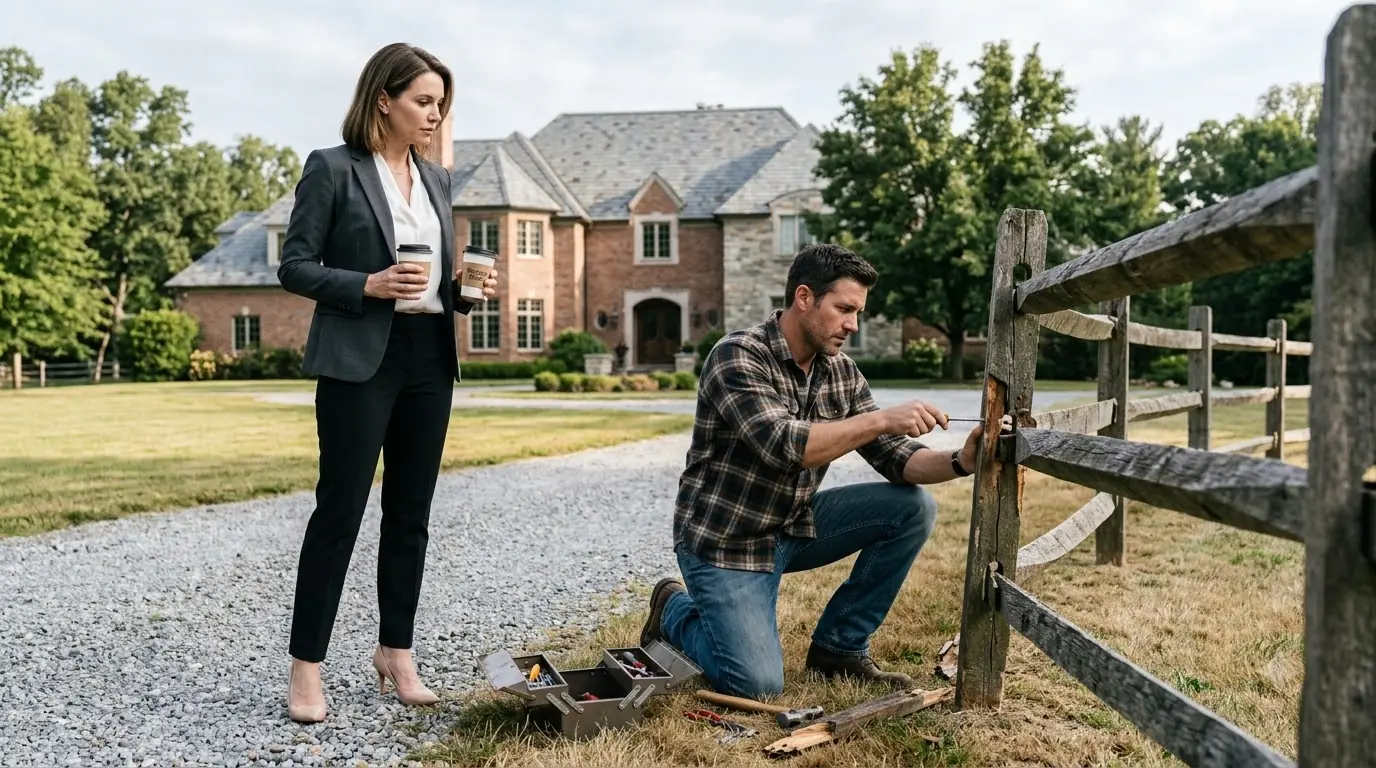
He just looked at her, this woman who ran a company worth $40 million and couldn't hold her daughter's hand without checking her phone first, and said quietly, "Yes, ma'am. That's all this is."
He picked up his toolbox and walked back to the broken fence.
And she stood there alone in her perfect driveway, suddenly unable to move.
The morning it started, Daniel Mercer burned his hand on the coffee pot. Not badly, just enough to matter.
He was pouring into a thermos one-handed because his other hand was already holding Noah's lunchbox, his keys, his phone with three unread texts from a contractor who owed him $400 and kept finding reasons not to pay. He hissed, set the pot down, ran his hand under cold water for 30 seconds, and then kept moving.
That was the thing about Daniel's life. You kept moving.
You didn't have the option of stopping in the middle of the kitchen and letting the burn be what it was. Because there was a boy down the hall who needed breakfast and a truck that needed to leave by 6:15 and a job that had been slow this month in the way that made him do math in his head at 2:00 in the morning, dividing the numbers and not liking what they said.
He wrapped his hand in a dish towel, made Noah's eggs, and called down the hallway twice. And when Noah finally appeared, still in pajamas, hair sideways, dragging his backpack by one strap, Daniel felt the specific fullness that had no name, the kind that lives in the chest and is too large and too quiet to explain to anyone who hasn't felt it themselves.
"You burned your hand," Noah said immediately.
"I'm fine."
"You're using the dish towel. You only use the dish towel when you don't want me to see."
Daniel looked at his son. Nine years old, with his mother's eyes and his father's refusal to be fooled.
"Eat your eggs," Daniel said. Noah sat down and ate his eggs and watched his father move around the kitchen with the careful attention of a child who has learned that his father's silences are a language.
He was learning to be fluent in it.
The call came at 6:11. Unknown number.
Whitfield Hollow area code. Daniel almost sent it to voicemail.
He was loading the truck thermos under one arm, tarp half folded over the tailgate, hand still throbbing slightly under the glove he'd pulled on. He answered, "Is this Mercer Repairs?"
The voice was controlled in a way that took effort. He could hear the effort.
"It is," Daniel said.
"My name is Catherine Hail. I need a fence repaired, possibly replaced."
"Two contractors have already looked at it, and both said it was outside their scope. I need someone who can actually assess it and give me a number today, not next week."
"Today."
"What happened to it?"
A delivery truck took the corner too wide on my easement road two weeks ago. The driver's insurance is disputing liability.
I have a property line issue that my attorney says could become complicated if the fence stays down. I need it fixed.
"When do you need me there?"
"Now would be ideal. 8:00 is acceptable."
He checked the time: 6:11. Whitfield Hollow was 40 minutes away.
"I can do 8:00," he said. "I'll need to see it before I give you a number."
"Obviously," she said, and then came a half-second pause, almost too brief to catch.
"Thank you." She hung up.
Daniel finished loading the truck, drove Noah to school, watched his son walk through the front doors without looking back because Noah had decided this year that looking back was something younger kids did. Daniel looked back for both of them.
Then he drove toward Whitfield Hollow.
The gate was open. The assistant Catherine had mentioned wasn't there.
What was there was the fence, and it was worse than a truck clipping a corner. The east property line had partially collapsed along a 30-foot section.
Three posts were leaning badly. The concrete footings cracked underneath.
The wire mesh had torn and folded back on itself. And somewhere in the mess, someone had already tried to zip tie part of it back up, a temporary fix that had made everything slightly worse.
Post rot had set into the base of two of them. This wasn't just truck damage.
This fence had been struggling before the truck ever touched it. He walked the line slowly.
He crouched. He pressed.
He made notes. He was reading the second post's base when he heard heels on gravel.
You're not the man I called. He didn't stand up.
He finished what he was doing, made the note, and then straightened and turned. Catherine Hail was not what he expected, and he couldn't have said exactly what he'd expected.
She was in her mid-40s, charcoal blazer and phone in hand, and she had the specific kind of exhaustion that money cannot fix because money was never the problem to begin with. She was looking at him the way you look at a flight that has landed in the wrong city.
Marcus subcontracts overflow to me when he's booked. Daniel said he's booked.
I called Marcus specifically. I understand that.
I can do the job Marcus would have done, and I'll be honest with you, in a way that Marcus sometimes isn't. Her eyes sharpened.
What does that mean? It means this fence had problems before that truck hit it.
Two of these posts were already rotting at the base. Whoever inspected them last either didn't look carefully or didn't want to tell you what they found.
I'll tell you what I find, even if it costs more than what you want to hear. A pause lasted long enough to have weight.
Come to the house at 8:30, she said. I'll hear the number then.
She turned and walked back. He went back to the posts.
The number he brought to the door was fair. And the moment he showed it to her, he could tell she knew it was fair because her expression did not do what expressions do when people are looking for a place to negotiate.
She studied it. She looked up.
This is lower than the estimates I already got. The other estimates probably included contingency padding, he said.
I price what I see. If I find something I didn't expect, I call you before I touch it.
You decide how to proceed. I don't run the meter while you're deciding.
Why not? She said, and it was a genuine question, not suspicious.
Genuinely wanting to know. Because that's not how I'd want to be treated, he said.
She looked at him for a moment that lasted slightly longer than a business moment should. "Start today," she said.
"I was planning to." Something crossed her face.
Not quite a smile, the shape of one. Do you need anything from the house?
Spigot access. That's enough.
"South side," she said, and went back inside.
He was setting the first new footing at 11:40 when the girl appeared. She came around the corner of the house with the particular energy of someone who had been watching for a while and finally decided to stop pretending otherwise.
11, Maybe 12. Dark eyes, her mother's precision, but with the edges still soft, still unguarded.
You pulled out all three posts, she said. The third one looked okay from the outside, Daniel said.
It wasn't. How could you tell?
Put your hand on the wood at the base. If it gives even a little, the rot is already inside.
He paused. You want to try it on that one?
He pointed to a removed post lying on the ground. She walked over and pressed her palm against it.
The wood gave under her hand. Oh, she said quietly.
Things that look solid aren't always solid, he said. And things that look broken aren't always as broken as they seem, she looked at him.
He hadn't meant it as anything more than a comment about fences, but she heard something else in it. He could see her hear it.
I'm Lily, she said. Daniel, do you want a sandwich?
I made three. There are only two of us for lunch and mom doesn't eat enough when she's on calls.
He had a lunch in the truck. He'd packed one because he always packed one because you did not put yourself in the position of needing something from someone you were working for.
It was a rule he'd made and kept. Sure, he said.
She came back with a turkey sandwich on a plate with a real napkin under it folded in half and a glass of water with ice. She handed him both like it was completely natural, like she'd been feeding people who were working in her yard her whole life.
He ate standing up. She watched him.
You have a kid? She said, "What makes you say that?"
She pointed at his thermos. The Minecraft sticker.
Noah had pressed it on three months ago, tongue between his teeth, concentrating. Daniel had never taken it off.
A son, he said. He's nine.
Where is he? Oh, school.
Does he come with you sometimes? On shorter jobs after school.
She nodded slowly. Mom used to bring me with her, she said.
To the office when dad first left and she didn't want to leave me with a sitter. She paused.
I used to sit in the conference room and draw. She'd come check on me between meetings.
Every 40 minutes exactly. Daniel was quiet.
She stopped bringing me. Lily said when she decided I was old enough to stay alone.
Another pause. I was nine.
He looked at her. She was looking at the fence.
Nine is old enough for some things. He said carefully.
Not everything. No, she said.
Not everything.
At 1:15, he heard Catherine's voice through the kitchen window. Not words.
Tone. The controlled, precise tone of a woman receiving information she does not want and processing it in real time without allowing herself the reaction she is having.
He recognized that tone. He had heard it in his own voice in hospital corridors four years ago, talking to doctors, answering questions steadily because there was a five-year-old boy in the next room who was already frightened enough for both of them.
Then silence, then quieter. I understand.
No, I understand completely. Thank you for telling me directly.
A long pause. Nothing.
He worked mixed concrete, checked levels. He gave her voice all the privacy a wall couldn't give it.
But 15 minutes later, the back door opened and Catherine walked to the far corner of the yard to where the fence line had been and stopped, arms crossed, jaw set, looking at nothing. She was not on her phone.
She was not doing anything. She was just standing in the posture of a person who has made a decision not to break and is holding that decision in place with sheer will.
Daniel kept working. After two full minutes, he noticed because he was timing his concrete, he said without looking up.
"There's a post that needs someone to hold it steady while I check the angle." "If you've got a minute."
A silence. "I'm not dressed for this," she said.
"You're just holding it still. You don't have to dig anything."
Another pause, shorter, then the sound of heels on grass. Deliberate, careful.
She came and stood where he pointed and she wrapped both hands around the post with the kind of grip that said she'd decided to do the thing completely or not at all. He checked the angle.
Level in one direction off by a quarter inch in the other. He adjusted, checked again.
Level there, he said. She let go, stepped back, looked at her hands, which now had concrete dust on them.
I don't usually do this kind of work, she said. I know.
Does it bother you when people say that? He considered it honestly.
No, he said. Everyone's got their own kind of work.
I just know mine. She looked at him again with that measuring look.
The call, she said quietly, not explaining, not asking for anything. Just the call.
You don't have to tell me, he said. I know I don't.
She paused. The board is removing me from my own company. constructive dismissal they're calling it, which is a legal term for they found a way to make me want to leave.
She paused again. I built that company for 11 years.
I started it in my second bedroom with a laptop and a phone and a daughter who didn't sleep through the night. She stopped.
Daniel didn't say I'm sorry. He'd learned that I'm sorry was sometimes just something people said to close a door.
Instead, he said, "And Lily." Catherine turned her head.
What about Lily? "Does she know?"
A beat. "No."
She's going to notice something's wrong. He said, "She already does.
She's been watching you through the kitchen window for the last hour." Catherine turned and looked at the house.
In the kitchen window, visible for just a moment was the shape of Lily. Not spying, just present.
Near. The way children are near when they sense their parent needs them and haven't been taught yet that adults call that space something unwelcome.
Catherine's jaw tightened. But her eyes did something different.
Something cracked slightly the way ice cracks in spring. Not breaking, just opening.
She doesn't need to worry about this, Catherine said. She already is.
Daniel said. Worrying alone is harder.
Catherine looked at him. Do you speak from experience?
He met her eyes. "Every day," he said.
Noah arrived at 4:10, backpack dragging, cheeks flushed from walking six blocks faster than necessary. He stopped at the gate, assessed the situation with a nine-year-old's complete confidence, and announced, "Dad, that's galvanized mesh, the new kind.
Good choice. Get in the gate."
Daniel said, "I know. I know. stay on the driveway.
Noah stepped inside, looked at the progress, nodded with the authority of someone who had watched this work done enough times to have opinions about it. You set three footings today.
Two and a half, Daniel said. Last one needs more time.
You should have started earlier. I started at 8.
Earlier than 8. Daniel looked at his son.
Inside that statement is a lesson you will understand when you have your own business. Noah considered this, decided it was probably true, and let it go.
Catherine appeared in the doorway. She looked at Noah the way people sometimes look at children of single fathers with a specific and unguarded kind of tenderness, seeing both the child and the shape of everything that made the child.
"You must be Noah," she said. Yes, ma'am.
Noah said with a politeness that Daniel had worked on. Your fence was already struggling before the truck hit it.
Dad says things that look solid sometimes aren't. Catherine blinked.
She looked at Daniel. He was watching his son with the expression of a man who has long since given up trying to prepare for the things that come out of that particular mouth.
He's right. Catherine said it was.
Dad fixes things that were already struggling. Noah said completely matter-of-factly, not just the new damage.
He goes back to where the problem actually started. The silence that followed lasted four full seconds.
Daniel picked up his level and pretended to check something that didn't need checking. There's snacks.
Catherine said to Noah. Lily's inside.
She's been wanting someone to argue with about fractions. Noah's face lit up.
He loved arguing about math. It was perhaps his greatest pleasure.
Okay, he said, and walked toward the house like it was a place he'd been before, with the openhearted confidence of a child who has not yet learned to be afraid of belonging somewhere new. Catherine watched him go.
Then she looked at Daniel, and the look on her face was something he recognized in the way you recognize something you haven't seen in a very long time and didn't realize you'd missed. She was seeing him, not his work, not his estimate, not his usefulness.
Him. He goes back to where the problem actually started," she said softly, repeating Noah's words, turning them over.
Daniel cleared his throat and looked at the fence. "I'll be back at 6:30 tomorrow," he said.
"Pour the last footing before the temperature drops." "6:30," She said.
He packed his tools. He collected his son from the kitchen where Noah and Lily were in the middle of what appeared to be a deeply satisfying argument about whether fractions or decimals were morally superior.
He said goodbye to Catherine at the door. She said, "Thank you for today."
He said, "I didn't finish." She said, "I know.
I'm not talking about the fence."
He drove home in the thick of the early dark. Noah asleep in the passenger seat inside 12 minutes cracker still in his hand.
Daniel drove and didn't think about Catherine Hail. He drove and didn't think about the way she'd gripped the post like she'd decided to do it completely.
He didn't think about what she'd said about 11 years and a second bedroom and a daughter who didn't sleep through the night. He didn't think about the way she had said I understand into a phone in the specific voice of a person choosing not to fall apart.
He didn't think about any of it. He thought about the fence.
He thought about the third post, the one that looked solid from the outside that gave under the hand when you pressed it. He thought about how easy it was to drive past something like that to accept the outside to not press.
He thought about that. He merged onto the highway.