The glass slipped from her hand at exactly 11:47 p.m.
It did not fall loudly.
That was what Logan Pierce remembered later.
There was no dramatic crash that made everyone in the glowing lobby of the Arcadia Hotel turn their heads. 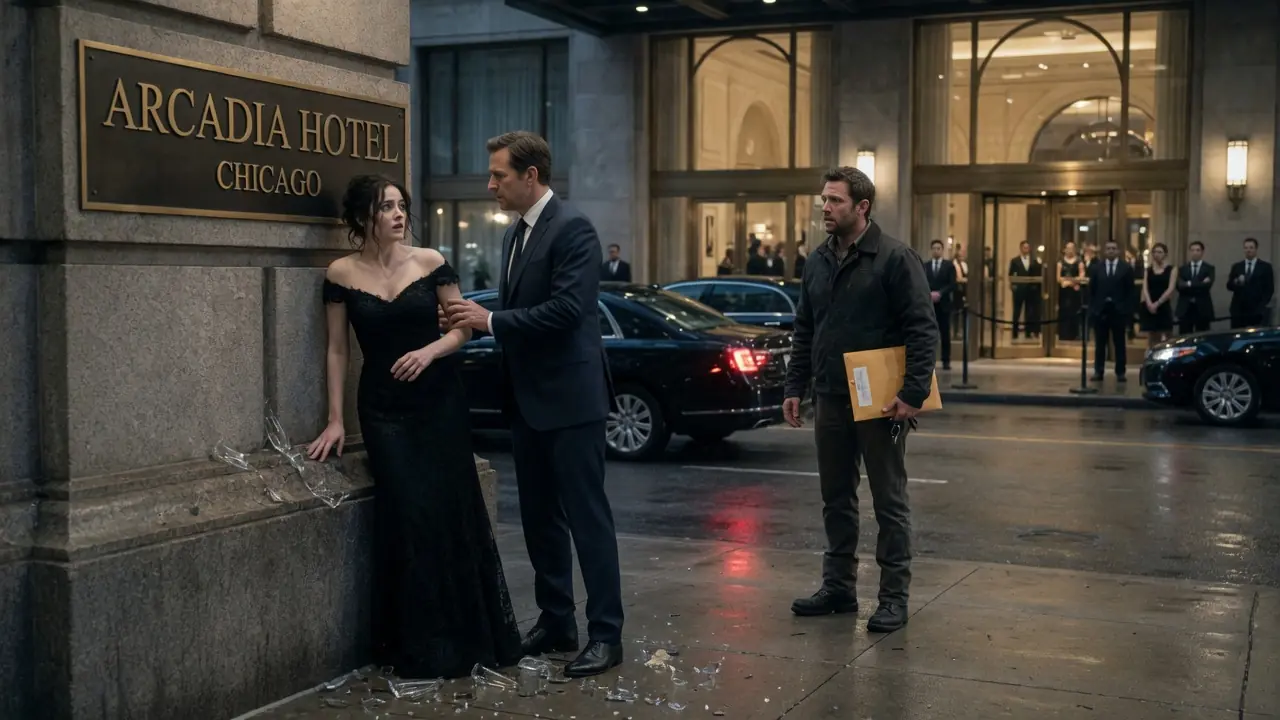
No startled gasp from a crowd. No sudden silence in the ballroom. No violin string snapping in the middle of the jazz band’s polished performance.
The glass simply slid from Isabella Vaughn’s fingers, struck the pavement near her silver heels, and broke into three bright pieces beneath the cold Chicago lights.
One small sound.
One small failure.
And somehow it looked more dangerous than if she had screamed.
Isabella Vaughn, the woman who controlled half of Chicago’s skyline, who never stumbled in public, who never raised her voice in boardrooms because she never needed to, was standing outside the Arcadia Hotel with one hand pressed against the stone wall, trying not to collapse where the whole city could see her.
Logan saw it happen from across the curb.
He did not know her personally.
He did not work for her.
He was not one of her employees, not one of her assistants, not one of the polished men in expensive suits waiting inside that glittering ballroom for a chance to impress her.
He was just a tired single father walking back to his car after picking up an emergency delivery envelope from the hotel concierge.
He had every reason to keep walking.
His daughter, Mia, was asleep at home with a babysitter who charged by the hour after midnight. He had two early pickups scheduled the next morning, one medical document run that could not be late, and a company account balance low enough to make him check it twice a day even when he already knew the number.
He was exhausted.
He was underpaid for half the things he did.
He was not dressed for the world behind the Arcadia’s marble doors.
And in the middle of the cold Chicago night, he saw a woman struggling to stay on her feet while a man in a $1,500 suit moved too close.
Logan had thirty seconds to decide.
Keep walking, get home to his daughter, and tell himself someone else would help.
Or step into a situation that had nothing to do with him.
Three years of single fatherhood had taught Logan Pierce exactly two things: how to function on four hours of sleep, and how to spot danger before it arrived.
Tonight, danger wore a tailored navy suit, an expensive watch, and the kind of smile men used when they believed the world would excuse them.
Logan stood beside the valet lane of the Arcadia Hotel with his car keys in one hand and a sealed delivery envelope tucked beneath his arm.
He owned a small logistics company called Pierce Priority Logistics. The company handled urgent document transfers, private courier runs, medical records, legal filings, and late-night corporate deliveries for clients who paid extra when mistakes were not an option.
It was not glamorous work.
It was reliable work.
And reliability had kept food in the refrigerator since his wife walked out three years ago and left him raising their six-year-old daughter alone.
The hotel behind him glowed like another world.
Crystal chandeliers shimmered through the tall windows. Music drifted faintly through the glass. Men and women in formal clothes moved inside like figures in a painting, laughing over champagne while drivers waited outside in the cold.
Logan did not belong in that world.
He knew it the moment he stepped into the lobby twenty minutes earlier.
His jacket was clean but old. His shoes were polished only because Mia had once asked if shoes could look sad, and he had become self-conscious about it. His hands were rough from loading boxes, checking tires, and fixing things he could not afford to replace.
He had come only because a client needed a signed contract collected from the Meridian Children’s Hospital charity gala and delivered before morning. The concierge had given him the envelope, the client had confirmed receipt instructions, and Logan had been ready to leave.
Then he saw her.
Isabella Vaughn.
Even Logan knew that name.
Everyone in Chicago knew it.
At thirty, she was the youngest self-made billionaire in the city, founder and controlling partner of Vaughn Urban Group, owner or investor in towers, hotels, residential districts, redevelopment sites, and mixed-use projects that had changed the city’s skyline.
Magazines called her untouchable.
Business reporters called her brilliant.
People who hated her called her cold.
But standing outside the Arcadia Hotel at 11:47 p.m., Isabella did not look untouchable.
She looked dizzy.
Her dark evening gown moved slightly in the wind. One hand clutched a small purse. The other pressed against the stone wall near the valet stand as if the building itself was the only thing keeping her upright.
Her champagne glass slipped from her fingers and shattered quietly near her feet.
No one inside noticed.
One valet glanced over, uncertain, then looked away when the man in the navy suit stepped closer to her.
That was the part Logan noticed.
Not the broken glass.
Not the dress.
Not even the way Isabella’s face had gone pale beneath the streetlights.
The man.
Mid-forties. Smooth hair. Confident posture. One hand hovering near Isabella’s elbow, not quite touching at first, then touching as if he had earned the right.
Logan had seen men like that before.
In bars.
At corporate events.
Outside restaurants late at night, when women laughed too softly and tried to pull away without making a scene.
The man leaned in.
“You look like you could use some air,” he said, voice low and intimate. “My car is around the corner. I’ll take you somewhere quiet.”
Isabella tried to straighten.
“I’m fine, Marcus.”
Her voice was controlled, but the effort behind it was obvious.
Marcus.
Logan stored the name without meaning to.
“You’re not fine,” Marcus said, tightening his hand lightly around her arm. “Don’t be difficult. I’m trying to help.”
That was when Logan moved.
He did not run.
Running would draw attention, and attention was the last thing she needed if she was trying to hold herself together.
Instead, he walked across the valet lane with purpose, his expression calm, his pace steady, his eyes fixed on Isabella rather than Marcus.
“Excuse me,” Logan said.
Both of them turned.
Marcus looked irritated before he even knew who Logan was.
Isabella’s eyes took a second to focus.
Up close, she looked exhausted.
Not just drunk, though she had clearly had too much champagne. Exhausted in a way that seemed older than one night.
“Yes?” Marcus snapped.
Logan ignored him and looked at Isabella.
“Ma’am, your driver asked me to check whether you still wanted the car brought around.”
It was a lie.
A clean one.
A useful one.
Marcus frowned.
“What driver?”
Logan kept his gaze on Isabella.
For a fraction of a second, confusion crossed her face.
Then understanding.
Maybe relief.
“Yes,” she said. “The car. Right. I need the car.”
Marcus’s smile tightened.
“I can take care of that, Isabella.”
“I said I need the car,” she replied, pulling her arm back.
This time, Marcus let go.
Logan extended one hand, not touching her, simply offering balance.
“This way. The curb is uneven.”
Isabella looked at his hand.
For a moment, pride fought with practicality.
Then she placed her hand lightly on his forearm.
She was colder than he expected.
And unsteady.
Logan guided her away from the hotel entrance, past the valet stand, toward the line of parked cars along the curb.
Marcus followed for three steps.
“Isabella,” he called, his voice sharper now. “You’re making this very awkward.”
She stopped.
Logan felt the tension in her hand.
Then she turned, slowly, with the kind of dignity people used when they were holding themselves together by force.
“No, Marcus,” she said. “You are.”
The words landed cleanly.
Marcus’s face hardened.
Logan kept his body angled between them without making it obvious.
A valet finally seemed to understand something was wrong and looked toward the hotel doors as if considering whether to get security.
Marcus saw it too.
His expression changed, recalculating.
Then he gave a small, cold smile.
“Get home safely, Isabella.”
It did not sound like concern.
It sounded like a warning.
When he disappeared back toward the hotel, Isabella released a breath that trembled.
“I don’t have a driver waiting,” she said.
“I know.”
She looked at Logan.
“Then why did you say that?”
“Because you looked like you needed a way out.”
The answer was simple.
Too simple, maybe.
Isabella stared at him like he had spoken in a language she had forgotten.
Then the cold hit her harder. She swayed slightly, her fingers tightening around his arm.
Logan caught her elbow gently.
“Easy.”
“I’m fine.”
“I’m sure you are,” he said. “But you’re also standing next to broken glass in heels and you look like you might faint.”
Her eyes sharpened.
“I don’t faint.”
“Great. Then we’ll call it aggressively leaning toward the pavement.”
Despite herself, she gave one short laugh.
It vanished quickly.
“I need to go home.”
“Do you have someone you can call?”
She opened her purse, searched through it, and frowned.
“My phone is dead.”
“Taxi?”
“I don’t want to wait here.”
Logan glanced back toward the hotel doors.
Marcus was no longer visible, but that did not make him gone.
Logan understood enough about men like that.
They circled.
They waited.
They returned when the witness left.
“My car is right there,” he said, nodding toward a dark gray sedan parked at the curb. “I can drive you home if you want.”
Her expression closed immediately.
“I don’t get into cars with strange men.”
“Smart rule.”
“Then why offer?”
“Because your phone is dead, you’re dizzy, and the man who had his hand on your arm did not seem like someone you wanted driving you anywhere.”
She looked at him carefully.
Really looked.
He could almost see her weighing risks.
Unknown man.
Dark street.
Late hour.
Cold night.
But he did not step closer. He did not pressure her. He simply held out his phone.
“Call someone from mine if you want. Or take a photo of my license plate and send it to someone once your phone charges. I have a charging cable in the car. You can sit in the back if that feels safer. Window down, door unlocked. Your choice.”
The word choice seemed to matter.
Her jaw softened a fraction.
“What’s your name?”
“Logan Pierce.”
“Do you know who I am?”
“Yes.”
“And that doesn’t make you nervous?”
“It makes this more complicated,” he said honestly. “But not helping would make me feel worse.”
She studied him for another moment.
Then she nodded once.
“Fine.”
Logan opened the back door of his car.
She hesitated again, then slid inside with careful control.
He closed the door gently, walked around to the driver’s side, and got in.
Before starting the engine, he reached back and handed her a charging cable.
“Here.”
She took it.
“Thank you.”
The words sounded stiff.
Like she did not use them often.
Or did not know how to use them when they mattered.
“Where to?”
She gave him an address in the Gold Coast, because of course she lived in the Gold Coast.
Logan entered it into his phone and pulled away from the curb.
For the first five minutes, neither of them spoke.
Chicago moved around them in silver and black. Streetlights reflected off wet pavement. The lake wind pushed between buildings, shaking bare tree branches along the sidewalks.
In the rearview mirror, Logan could see Isabella sitting straight-backed despite her exhaustion.
Armor, he thought.
Even in the back seat of a stranger’s car, half-frozen and shaken, she still wore armor.
“You didn’t have to do that,” she said finally.
“I know.”
“Marcus will remember you.”
“I don’t know Marcus.”
“That won’t matter to Marcus.”
Logan glanced at the mirror.
“Should I be worried?”
“Yes.”
Her answer came too quickly.
Then she looked out the window.
“But I’ll make sure he doesn’t bother you.”
That surprised him.
“I wasn’t asking you to protect me.”
“No one ever does,” she said quietly. “They just expect me to.”
Something in her tone made him stop looking for a response.
He knew exhaustion when he heard it.
Not physical exhaustion.
The soul-deep kind.
The kind he heard in his own voice on nights when Mia had a fever, bills were late, and every adult decision belonged to him alone.
“You looked like you needed help,” he said. “That’s all.”
“Most people would have looked away.”
“Most people did.”
The words left his mouth before he could soften them.
In the mirror, her eyes lifted to his.
For a moment, they both understood the same thing.
The valet had looked away.
People leaving the gala had looked away.
The doorman had looked uncertain and then busy.
The whole shining machine around Isabella Vaughn had failed to notice she was struggling right in front of it.
“I hate that you’re right,” she said.
Logan drove in silence.
A few minutes later, she asked, “Why were you there?”
“At the hotel?”
“Yes.”
“Work. I picked up a delivery envelope from the concierge.”
“You’re a courier?”
“I own a logistics company. Small one. Mostly urgent documents, private deliveries, medical transfers sometimes. Things people want handled carefully.”
“Your company works with Meridian?”
“Not directly. My client was attending your event.”
She was quiet.
“So you don’t work for me.”
“No.”
That seemed to relax her more than anything else had.
“Good.”
Logan smiled faintly.
“That bad?”
“Yes.”
“Fair enough.”
“It’s not personal.”
“I didn’t take it personally.”
“I just…” She stopped, searching for words. “People around me are rarely honest. Employees tell me what they think I want to hear. Investors tell me what benefits them. Men tell me whatever they think will get them closer.”
“And strangers?”
“Strangers usually want something too.”
Logan nodded.
“Usually.”
“You don’t?”
“I want to get home before my daughter wakes up and realizes I’m not there.”
Isabella looked up.
“You have a daughter?”
“Six years old. Mia.”
“And her mother?”
“Not in the picture.”
The answer hung in the car.
Simple.
Not inviting more.
But Isabella heard what sat beneath it.
“So you’re raising her alone.”
“Yes.”
“That must be hard.”
“Every day.”
“But you do it.”
“What else would I do?”
She looked out the window again.
“I don’t know,” she said softly. “People leave all the time.”
Logan did not answer.
He thought about Rachel, the morning she left, the way she stood in their bedroom with two suitcases and said she could not be a mother anymore.
Not safely.
Not honestly.
Not without disappearing inside herself.
Logan had hated her that day.
Then he had pitied her.
Then, slowly, he had accepted that some people ran not because they were evil, but because staying would destroy everyone differently.
Still, Mia had been three.
There was no philosophy gentle enough to make that fair.
When they reached Isabella’s building, Logan pulled up outside a glass tower with discreet lighting and a doorman who straightened immediately when he saw her.
Before Logan could get out, Isabella opened the back door herself.
Then she paused.
Her phone had charged enough to turn on. She glanced at the screen, then tucked it away.
“Thank you,” she said.
“You’re welcome.”
“I mean it.”
“I know.”
She looked toward the building, then back at him.
“You didn’t ask for my number.”
“No.”
“Why?”
“Because you were having a bad night. That didn’t feel like the time.”
Something flickered in her expression.
Surprise.
Maybe respect.
Maybe confusion.
She reached into her purse and pulled out a business card.
Not a regular one.
Heavy paper.
Embossed name.
A private number handwritten on the back.
“Take it.”
Logan hesitated.
“Ms. Vaughn—”
“Isabella,” she said.
The correction sounded like an order, but a tired one.
He took the card.
She held his gaze.
“If Marcus or anyone from that hotel contacts you, call me.”
“Okay.”
“And Logan?”
“Yeah?”
Her voice softened.
“Thank you for giving me a choice.”
Then she turned and walked into the building.
The doorman opened the door for her. She did not look back.
Logan sat at the curb for a few seconds, the business card resting between his fingers.
Then his phone buzzed.
A text from Mia’s babysitter.
Everything okay?
Logan typed back.
On my way home.
He drove away from the Gold Coast with the strange feeling that he had just stepped into a story much bigger than one late-night ride.
The apartment was quiet when Logan got home.
Emma, the babysitter, looked up from her textbook on the couch.
“She went down around 8:30. No problems.”
“Thanks.”
Logan paid her, adding an extra twenty for the late hour.
“You didn’t have to do that,” Emma said.
“You stayed late.”
“You always say that.”
“Because you always do.”
After she left, Logan checked on Mia.
His daughter was sprawled across her bed, one arm flung over her stuffed elephant, hair tangled on the pillow. Six years old and already so independent it terrified him.
He kissed her forehead and pulled the blanket up around her shoulders.
Some nights, the weight of it all tried to crush him.
The rent.
The business.
The clients who paid late.
The old sedan that needed repairs.
The constant calculation of whether he was doing enough, being enough, giving Mia the life she deserved.
Tonight, standing in his daughter’s doorway at 12:47 a.m., Logan felt every single hour of the past three years pressing down on his shoulders.
He closed Mia’s door and went to the kitchen.
He poured water.
Then he took Isabella’s card from his coat pocket and placed it on the counter.
The name seemed too heavy for the small room.
Isabella Vaughn.
Private number.
A woman like that did not belong in his apartment, even on paper.
He should throw the card away.
Or put it in a drawer and forget it.
Instead, he stared at it for a long time.
He kept seeing her hand pressed against the hotel wall.
The broken glass near her feet.
The relief she tried to hide when he gave her a way out.
He kept hearing her say, “Thank you for giving me a choice.”
That was not something people said unless choice had been taken from them before.
Sleep did not come easily.
Saturday morning arrived with Mia jumping on his bed at 7:15.
“Pancakes!” she announced as if she were delivering breaking news. “You promised.”
“I did.”
Logan pulled her into a hug, breathing in the kid smell of her, shampoo and sleep and something indefinably Mia.
“Give me ten minutes.”
“Five.”
“Seven.”
“Six.”
“Deal.”
She ran off to choose socks that did not match, and Logan dragged himself toward the shower.
The hot water helped, but it could not wash away the feeling that his life had shifted the night before.
He made pancakes.
Mia drowned hers in syrup and chattered about her school play, her friend Emma’s birthday party, and whether penguins could be ballerinas.
“Can penguins be ballerinas?” she asked.
“In their imagination, probably.”
“That’s what I said.”
“Then you’re already smarter than me.”
She grinned, maple syrup on her chin.
Then she tilted her head.
“Dad, why do grown-ups lie?”
The question came from nowhere, as Mia’s questions often did.
Logan set down his coffee.
“Sometimes because they’re scared.”
“Of what?”
“Getting in trouble. Hurting someone. Losing something. Being honest can be hard.”
“But lying hurts people too.”
“Yes,” he said. “It does.”
She thought about that.
“Then being honest is better.”
“Usually.”
“Even if it’s hard?”
“Especially then.”
Mia nodded and returned to her pancakes as if the matter had been settled.
Logan wished life worked that cleanly.
The weekend passed in the ordinary chaos of single fatherhood.
Laundry.
Groceries.
A school project about bears.
A client calling twice about a misplaced pickup receipt that was not misplaced at all, only sitting unread in the client’s own email.
On Sunday night, after Mia went to bed, Logan found Isabella’s card again on the kitchen counter.
He had moved it twice.
It kept reappearing in his thoughts anyway.
At 10:18 p.m., his phone buzzed.
Unknown number.
This is Isabella Vaughn.
Logan stared at the screen.
Then a second message appeared.
I wanted to make sure you got home safely.
He almost laughed.
She had been the one half-collapsing outside a hotel, and she was checking on him.
He typed back.
I did. Thank you. I hope you’re feeling better.
Three dots appeared.
Disappeared.
Appeared again.
Better is a flexible word.
That sounded honest.
More honest than he expected.
He sat at the kitchen table and replied.
Fair.
A few seconds passed.
I owe you an apology for getting into your car while barely knowing you.
You made a reasonable choice under bad circumstances.
That sounds like something a logistics man would say.
Occupational hazard.
The reply took longer.
Marcus Webb called me today.
Logan’s shoulders tightened.
What did he want?
To remind me that Friday could look very different if people described it the wrong way.
Logan’s jaw clenched.
Threat?
Suggestion.
Same thing, Logan typed.
Yes.
Are you safe?
I’m always safe.
He stared at that sentence.
Then he typed carefully.
That’s not what I asked.
For a long moment, nothing came.
Then:
I don’t know.
The honesty landed heavy.
Logan sat back, looking toward Mia’s closed bedroom door.
He had known Isabella Vaughn for less than forty-eight hours. He had no obligation to step further into her life. He had done his good deed. He could stop here.
But he remembered the hotel.
Most people had stopped at noticing.
No one had stepped in.
Do you need help tonight? he asked.
No.
Then:
Maybe.
Then:
I don’t know what I need.
Logan understood that too.
He had spent the first year after Rachel left not knowing what he needed, only what Mia needed, because that was easier.
Sometimes needing nothing felt safer than admitting need might go unanswered.
Start with simple, he typed. Did you eat today?
The response came faster.
That’s not relevant.
It usually is.
I had coffee.
That’s not food.
It was expensive coffee.
Still not food.
Isabella sent no reply for almost a minute.
Then:
You sound like someone’s father.
I am someone’s father.
Right.
Then, unexpectedly:
What does she like? Your daughter.
Logan looked toward Mia’s room.
Pancakes. Dinosaurs. Drawing on every available surface. Asking questions that make adults rethink their entire lives.
That sounds inconvenient.
It is. Also great.
You love being a father.
More than anything. And sometimes I’m terrible at it.
Can both be true?
Most true things come in pairs.
No response.
Then:
I don’t have many true things in pairs.
Logan did not know what to say to that.
Finally, he wrote:
Maybe start collecting some.
The read receipt appeared.
No response came for ten minutes.
Then:
Good night, Logan.
Good night, Isabella.
He set the phone down and stared at it for a while.
This was unwise.
He knew that.
A powerful woman with enemies.
A man named Marcus Webb who knew how to twist stories.
A single father with a fragile business and no room for scandal.
But the world had never become better because people chose only what was wise.
Monday morning, Logan was loading delivery schedules into his system when his office phone rang.
Pierce Priority Logistics occupied two rooms above a dry cleaner in a neighborhood where parking was terrible and rent was still barely manageable.
His assistant, Nora, was sixty-two, smoked too much, and had the organizational instincts of a military commander.
She leaned into his doorway, holding the phone.
“Call for you. Woman says her name is Isabella Vaughn.”
Logan froze.
Nora raised one eyebrow.
“Should I ask why Chicago’s ice queen is calling my little office at nine in the morning?”
“No.”
“Shame.”
He took the call.
“This is Logan.”
“Are you free at eleven?” Isabella asked.
“Good morning to you too.”
A pause.
“Good morning.”
That small correction almost made him smile.
“What’s at eleven?”
“I need to meet somewhere public. Not my office. Not yours. There’s a cafe on State and Oak called Lucia’s.”
“Is something wrong?”
“Yes.”
The answer was immediate.
“Is this about Marcus?”
“Yes. And no.”
“I’ll be there.”
Nora was watching through the glass.
Logan turned away.
“I can make eleven work.”
When he hung up, Nora crossed her arms.
“You are either about to get the biggest client of your life or the biggest problem.”
“Possibly both.”
“At least wear the blue jacket. Makes you look less exhausted.”
“I am exhausted.”
“Then lie with clothing.”
Lucia’s Cafe was small, expensive, and filled with people pretending not to listen to other people’s conversations.
Logan arrived at 10:52 and ordered an Americano he did not need.
Isabella walked in at exactly 11:00.
She wore black trousers, a gray coat, and no visible jewelry beyond a watch that could probably pay Logan’s rent for a year.
Her face was composed.
Too composed.
She sat across from him.
“Thank you for coming.”
“Of course.”
A waitress appeared.
Isabella ordered tea.
Then she waited until the waitress left before speaking.
“Marcus Webb is dangerous.”
“I figured.”
“You don’t understand. He runs one of the largest private investment networks in the city. He is connected to developers, judges, donors, journalists. He doesn’t need to break laws to ruin people.”
“Has he threatened you before?”
Her hands tightened around the edge of her napkin.
“Yes.”
The single word changed the air between them.
Logan stayed quiet.
Isabella looked down.
“Two years ago, he tried to pressure me into approving a joint development bid. I refused. He cornered me after a private dinner and told me I needed powerful allies more than I needed principles.”
Her mouth tightened.
“I made it clear I wasn’t interested in his business or anything else.”
“And he didn’t take it well.”
“No.”
“What happened?”
“He started rumors. Nothing direct. Nothing provable. Suggestions that I was unstable. Difficult. Emotionally volatile. That my success had made me reckless.”
She laughed bitterly.
“Men like Marcus know exactly which words to use against powerful women.”
Logan’s jaw tightened.
“And Friday?”
“Friday was the anniversary of my divorce. My father called that morning to remind me I’m thirty and running out of time to have a real life. Then I went to that gala and Marcus was there, smiling like he had been waiting for me to have one weak night.”
Her voice lowered.
“I drank too much. I know that. I was angry and tired and stupid. But I still knew I didn’t want to go anywhere with him.”
“You weren’t stupid.”
She looked up sharply.
“You don’t have to make me feel better.”
“I’m not. I’m telling you the truth.”
Her eyes held his.
Something in them softened, then retreated.
“Marcus called yesterday and implied you might be paid to describe the night differently if someone asked.”
Logan leaned back.
“Paid by whom?”
“He did not say. He wanted me to understand that stories are flexible.”
“He wanted you scared.”
“He succeeded.”
The admission seemed to cost her.
Logan respected her more for saying it.
“What do you need from me?” he asked.
“I need a statement. Written. Dated. Exactly what you saw. That I was struggling, that Marcus had his hand on my arm, that I pulled away, that you offered me a ride and I accepted.”
“You’ll have it.”
She blinked.
“That easily?”
“Yes.”
“You don’t want to consult a lawyer?”
“I’ll write what happened. If a lawyer needs it later, fine.”
“Marcus could come after your business.”
“I know.”
“Logan.”
“My daughter asked me yesterday if honesty is better even when it’s hard.”
Isabella stared at him.
“What did you tell her?”
“That it’s better especially then.”
For a long moment, she did not speak.
Then she looked down at her tea.
“I envy her.”
“My daughter?”
“She has a father who answers questions like that.”
Logan did not know what to do with the sadness in her voice.
So he did what he had learned to do with Mia.
He did not rush to fix it.
He listened.
“My father gave me everything except softness,” Isabella said. “After my mother died, he became obsessed with making sure I was strong. No tears. No weakness. No dependence. He sent me to boarding school because grief, according to him, needed structure.”
She smiled without humor.
“I was eight.”
Logan felt something twist in his chest.
“I’m sorry.”
“So was everyone. Quietly. Briefly. Then they moved on because rich children are expected to be fine in better rooms.”
The line landed hard.
Logan had no elegant response.
“That’s awful,” he said.
“It was normal.”
“That doesn’t make it less awful.”
Her eyes lifted to his.
“You keep doing that.”
“What?”
“Not making things sound prettier than they are.”
“Does it bother you?”
“No.” She looked surprised by her own answer. “It helps.”
They sat in silence while the cafe moved around them.
Cups clinked.
Rain tapped against the windows.
Someone nearby laughed too loudly.
Then Isabella said, “I was going to handle this the way I handle everything. Lawyers. Strategy. Silence. Control.”
“And now?”
“Now I’m tired.”
The words were simple.
The weight under them was not.
“I’m tired of being untouchable,” she continued. “People think it means no one can hurt you. Really, it means no one checks if you’re hurt.”
Logan understood loneliness.
He understood the kind that came after a child went to sleep and the apartment became too quiet.
He understood making every decision alone.
He understood being strong because there was no one else to take a turn.
“You’re not untouchable,” he said.
She looked at him.
“No?”
“No. You’re just surrounded by people afraid to reach.”
For a moment, Isabella Vaughn looked like she might cry in the middle of Lucia’s Cafe.
She did not.
But the armor cracked.
Just enough.
“I need that statement,” she said.
“You’ll have it today.”
“And Logan?”
“Yeah?”
“I’m glad you were the one who stopped.”
He nodded.
“So am I.”
Over the next week, Logan wrote the statement.
Then he gave a second one to Isabella’s attorney.
Then Marcus Webb’s people called his office twice, pretending to be potential clients before Nora hung up on them with great satisfaction.
“Rich bullies are always boring,” she told Logan. “They think a private number makes them mysterious.”
By Friday, the story had shifted.
Quietly.
Behind closed doors.
Marcus had underestimated Isabella’s willingness to fight back with documentation. Logan’s statement was not the only one. A valet came forward. Then a junior event planner admitted she had seen Marcus follow Isabella out. Then security footage confirmed enough of the timeline to make Marcus’s version fragile.
Fragile stories break quickly when powerful people stop protecting them.
But something else happened during that week too.
Isabella kept calling.
At first, the calls were practical.
The statement.
The lawyer.
The timeline.
Then they became something else.
“How is Mia?” she asked one night, after they had finished discussing the attorney’s latest message.
Logan looked toward his daughter’s closed bedroom door.
“Asleep. She lost another tooth today and tried to negotiate for five dollars from the tooth fairy.”
“Did it work?”
“She got three.”
“Hard bargain.”
“She drives a tough deal.”
A pause.
“Does she know about me?”
“She knows I helped a woman outside a hotel.”
“And?”
“And she asked if the woman liked pancakes.”
Isabella laughed.
A real laugh.
Unexpected and warm.
“What did you say?”
“I said I didn’t know.”
“I haven’t had pancakes in ten years.”
Logan nearly dropped the phone.
“That’s tragic.”
“My nutritionist would disagree.”
“Your nutritionist is wrong.”
“You haven’t met her.”
“I don’t need to. Pancakes are above criticism.”
“You sound very certain.”
“I am. Pancakes are one of the few things I believe in without evidence.”
She laughed again.
Logan found himself smiling in his dark kitchen like an idiot.
That became the beginning of something neither of them named.
Calls at night.
Texts in the morning.
A photo from Logan of Mia’s drawing of a dinosaur wearing a crown.
A reply from Isabella: That dinosaur has better posture than most board members.
A message from Isabella at midnight: Do you ever feel like your whole life is something you built to survive, not something you chose?
Logan stared at that one for a long time.
Then he replied: Every day. But survival can become a foundation if you stop treating it like a prison.
Her answer came ten minutes later.
I don’t know how to do that.
He wrote back: Start small.
She replied: How small?
He thought about it.
Then he typed: Saturday. Noon. Millennium Park. Wear normal clothes.
Normal clothes?
Jeans. Shoes you can walk in. No boardroom armor.
This sounds like a terrible idea.
Probably.
Why should I come?
Because you haven’t had pancakes in ten years and that’s unacceptable.
A long pause.
Then:
Fine. But if anyone photographs me eating pancakes in public, I’m blaming you.
Saturday arrived cold and clear.
Mia spent the day at Emma’s house, thrilled because Emma had a trampoline and a dog named Pickle.
Logan stood near the Bean at noon, hands in his coat pockets, wondering whether Isabella would actually come.
At 12:03, she appeared.
Jeans.
Cream sweater.
Hair pulled back.
No sharp blazer. No entourage. No driver hovering nearby.
She looked younger.
Still intimidating, but human in a way that felt almost secret.
“You’re late,” Logan said.
“Three minutes.”
“My daughter would call that late.”
“Your daughter sounds strict.”
“She is.”
Isabella looked around at the tourists, families, street performers, and children running in circles.
“I haven’t been here in years.”
“You live in Chicago.”
“I work in Chicago. Different thing.”
“Then today you live here for a few hours.”
Her eyes narrowed.
“That sounds dangerously motivational.”
“Come on.”
He took her to a small breakfast place near the park where the tables were crowded, the coffee was strong, and nobody cared who Isabella Vaughn was because everyone was too busy eating.
She stared at the menu like it contained a legal trap.
“This is too many options.”
“Pancakes.”
“There are seven kinds.”
“Blueberry.”
“Why?”
“Because Mia says plain pancakes are pancakes with no imagination.”
Isabella smiled.
“Blueberry, then.”
When the pancakes arrived, she looked at them with suspicion.
Then she took one bite.
Her eyes closed.
“Oh.”
Logan grinned.
“That good?”
“I forgot food could be uncomplicated.”
“That’s the saddest sentence I’ve ever heard.”
“It might be true.”
They spent the afternoon walking through the city.
Logan showed her small places she had driven past for years and never noticed: a bookstore tucked between office towers, a park where musicians played jazz, a tiny bakery that sold cinnamon rolls too large to be respectable.
Isabella listened more than she spoke.
But slowly, she began to talk.
About her father.
Her divorce.
Her company.
The endless performance of being perfect.
“People think money gives you freedom,” she said as they walked near the lake. “It does, in some ways. But after a certain point, it becomes a wall. Everyone assumes you don’t need anything.”
“What do you need?”
She looked at him.
The question seemed to unsettle her.
“I don’t know.”
“Start small.”
She gave a faint smile.
“You like that phrase.”
“It works.”
She looked out at the water.
“I need one day where nobody wants anything from me.”
“Then today is that.”
“You want something.”
“I want to know whether you prefer cinnamon rolls or blueberry pancakes.”
“That’s not wanting something.”
“It is. I take breakfast preferences seriously.”
She laughed.
Then she said, “Blueberry pancakes. But the cinnamon roll was close.”
“Noted.”
As the sun began to set, they sat on a bench overlooking the lake.
The city stood behind them.
The water moved ahead of them.
For the first time all day, Isabella seemed still.
Not controlled.
Still.
“There’s something I should say,” she said.
“Okay.”
“I was scared that night. Outside the hotel.”
“I know.”
“I hate that you know.”
“I know that too.”
She turned toward him.
“I have spent my whole life making sure nobody could say that about me. Isabella was scared. Isabella needed help. Isabella couldn’t handle herself.”
Logan kept his voice quiet.
“Being scared doesn’t mean you couldn’t handle yourself. It means you were in a bad situation.”
“And if you hadn’t stopped?”
He did not answer.
They both knew.
That was enough.
“I keep thinking about that,” she said. “How many people walked past. How easy it would have been for you to do the same.”
“I almost did.”
She looked at him.
“I did,” he said honestly. “I thought about Mia. About getting home. About how it wasn’t my business.”
“Why didn’t you?”
“Because I want my daughter to grow up in a world where someone stops.”
Isabella looked away quickly.
This time, a tear slipped free before she could stop it.
Logan did not comment on it.
He simply sat beside her.
After a while, she said, “You make me feel like I can stop running.”
“Can you?”
“I don’t know.”
“Try.”
“Just like that?”
“Nothing is just like that. But yes.”
She wiped her cheek.
“Logan, this is complicated.”
“It doesn’t have to be anything.”
“That’s not true.”
He looked at her.
She looked back.
The air shifted.
Not dramatically.
Not like lightning.
Like two people recognizing the edge of something at the same time.
“I don’t know what this is,” Isabella said.
“Me neither.”
“I don’t date.”
“I barely remember how.”
“I’m difficult.”
“I have a six-year-old who once cried because I cut toast diagonally instead of straight across. Difficult doesn’t scare me.”
That made her laugh through the last of her tears.
“I’m serious.”
“So am I.”
She studied him for a long time.
Then she said, “I want to see you again.”
“You are seeing me.”
“You know what I mean.”
His heart started beating harder.
“Yes,” he said. “I know.”
“And?”
“I want that too.”
For a moment, she looked almost relieved.
Then her phone rang.
The name on the screen made her face close.
Father.
She did not answer.
“Good,” Logan said.
She glanced at him.
“You don’t know what he wanted.”
“Did it matter?”
She looked at the silent phone.
Then at him.
“No.”
The calls continued after that.
So did the meetings.
A coffee here.
A walk there.
A breakfast with Mia after three weeks, because Mia demanded to meet the important pancake lady.
Isabella arrived at Logan’s apartment on a Sunday morning wearing jeans and carrying a box of pastries expensive enough that Logan almost commented until Nora’s voice in his head told him not to be an idiot.
Mia opened the door.
She stared up at Isabella.
“You’re tall.”
Isabella blinked.
“Hello to you too.”
“Do you like dinosaurs?”
“I don’t know many personally.”
Mia considered that.
“That’s funny. You can come in.”
Logan covered his mouth to hide his smile.
Isabella looked at him over Mia’s head.
“I passed?”
“For now.”
They ate pancakes at Logan’s small kitchen table.
Isabella looked wildly out of place among the crayon drawings, mismatched mugs, and Mia’s plastic dinosaur army.
But she listened when Mia explained the difference between a stegosaurus and a triceratops.
She asked questions.
She did not check her phone once.
Later, when Mia went to her room to find a drawing she wanted to show, Isabella looked at Logan.
“She’s wonderful.”
“She is.”
“And terrifying.”
“Also yes.”
“I don’t know how to talk to children.”
“You talked to her fine.”
“I asked if dinosaurs paid taxes.”
“She loved that.”
Isabella smiled, nervous and soft.
“This is your real life.”
“Messy, loud, always behind on laundry.”
“It’s beautiful.”
He looked around his small apartment.
The worn couch.
The toys.
The dishes in the sink.
The bills stacked near the toaster.
“It doesn’t always feel beautiful.”
“Real things rarely do while you’re inside them.”
That stayed with him.
Over the next months, real life became the place where they met.
Not gala rooms.
Not penthouses.
Not polished restaurants where Isabella’s name changed the behavior of everyone around them.
Instead, they built something in ordinary spaces.
A park bench.
A breakfast table.
A grocery aisle where Isabella learned Mia believed cereal should be chosen by box color rather than nutrition.
A small movie theater where Isabella cried during an animated film and then denied it until Mia handed her a napkin and said, “It’s okay. Dad cries too.”
Isabella started therapy.
She stopped answering her father’s calls immediately.
She restructured her company so she no longer carried every decision like a punishment.
She filed a formal complaint against Marcus Webb after two other women came forward, encouraged by the fact that Isabella Vaughn had finally put her name on the truth.
Marcus’s reputation did not collapse overnight.
Men like him rarely fell quickly.
But the armor cracked.
Investors pulled back.
Invitations disappeared.
His calls went unanswered.
For once, the story did not bend in his favor.
Still, Marcus did not disappear quietly.
Men who built power on intimidation rarely accepted losing it without reaching for someone smaller to punish.
One Thursday afternoon, Pierce Priority Logistics lost two major contracts within twenty minutes.
The first email came from a law firm that had used Logan’s company for eighteen months.
Due to changes in internal vendor policy, we will no longer require external courier services.
The second came from a private clinic that had never once complained about Logan’s work.
We are moving in a different direction.
Logan stared at the screen for a long time.
Then Nora walked into his office holding her phone.
“You need to see this.”
A local business gossip page had posted a photo of Logan and Isabella leaving the pancake restaurant weeks earlier. The caption did not mention pancakes.
It suggested impropriety.
It suggested influence.
It suggested a single father courier had found a very profitable way to get close to one of Chicago’s richest women.
Logan read it once.
Then again.
He felt the old shame rise before anger could reach it.
Not because it was true.
Because lies did not need truth to cause damage.
Nora stood in the doorway.
“I can start calling clients.”
“No,” Logan said.
“You sure?”
“No. But don’t call yet.”
He picked up his phone.
Isabella answered on the second ring.
“I saw it,” she said.
Of course she had.
“Marcus?”
“Almost certainly.”
“I lost two contracts.”
Silence.
Then Isabella’s voice changed.
Not panic.
Focus.
“I’ll replace them.”
“No.”
“Logan—”
“No.”
“They are attacking your business because of me.”
“They are attacking my business because of him.”
“And I can fix it.”
“I know you can. That’s not the point.”
“Then what is the point?”
He took a breath.
“The point is I will not become another person people say you bought.”
That stopped her.
He could hear the silence on the line.
“I didn’t mean it that way,” she said.
“I know.”
“I want to help.”
“I know that too.”
“Then let me.”
“Help me fight the lie. Don’t solve it by making me dependent on your money.”
Another pause.
This one longer.
Then she said quietly, “Okay.”
That was one of the things Logan would later realize he loved first.
Not that Isabella was powerful.
Not that she could fix things.
But that when he told her no and meant it, she listened.
She did not enjoy it.
But she listened.
By the next morning, Isabella’s legal team sent formal notices to the gossip page, but she did not stop there. She held a press briefing that afternoon about the Marcus Webb complaint and the broader pattern of intimidation used against women in corporate charity and development circles.
She did not mention Logan by name until a reporter asked.
“Is it true you have a personal relationship with the owner of Pierce Priority Logistics?” the reporter asked.
Isabella stood at the podium, camera lights reflecting off her face.
“Yes,” she said.
The room sharpened.
She continued before anyone could twist the silence.
“He is a private citizen, a father, and a business owner who helped me on a night when people with far more reason to intervene chose not to. Attempts to punish him for doing the right thing reveal exactly why this matter required public accountability.”
The room went quiet.
Then she looked directly into the cameras.
“I will not allow a decent man’s livelihood to become collateral damage because a powerful man is embarrassed by the truth.”
It was the kind of sentence that could not be clipped cleanly against her.
It did not erase the gossip.
But it changed the posture of the story.
By Monday, the first law firm called Logan back.
Then the clinic.
Then three new clients who had seen the press briefing and wanted courier services from a company whose owner, as one woman put it, “apparently still knows how to tell the truth.”
Nora stood in Logan’s office reading the updated schedule and shook her head.
“I hate rich people less this week.”
“That’s growth.”
“Don’t get sentimental.”
Logan smiled for the first time in three days.
That evening, Isabella came over after Mia was asleep.
She stood in Logan’s kitchen holding a bag of takeout and looking uncertain, which was still strange enough to soften something inside him.
“I brought food,” she said.
“I see that.”
“I didn’t know if that was allowed.”
“Food is generally allowed.”
“You’re still angry.”
“A little.”
“I deserved that.”
“I don’t want you saying that because it sounds noble.”
Her eyes lifted.
“What do you want me to say?”
“That you understand why I said no.”
She set the food on the table.
“I understand why you said no.”
“And?”
“And I hated it.”
He almost laughed.
“That sounds more honest.”
“I am learning.”
They ate noodles at the table.
The silence was not easy at first.
Then it eased.
“I have spent my whole life fixing things by applying pressure,” Isabella said. “Money. Influence. Strategy. Force. I know how to move systems. I am less skilled at sitting beside someone while they are in pain and not turning it into a project.”
Logan looked at her.
“My life is mostly projects.”
“Not to me.”
The words were soft.
He looked down at his food because sometimes being seen landed harder than being criticized.
“I’m not used to being helped,” he said.
“I noticed.”
“I’m also not used to being able to say no.”
“I noticed that too.”
She reached across the table but stopped halfway, letting him choose.
He placed his hand in hers.
That was how they went on.
Not smoothly.
But honestly.
One evening, six months after the night outside the Arcadia Hotel, Isabella stood in Logan’s kitchen washing dishes while Mia colored at the table.
Logan watched from the doorway.
“You know,” he said, “you don’t have to wash dishes.”
Isabella glanced back.
“I know.”
“Billionaires usually outsource this.”
“Formerly untouchable billionaires are allowed to evolve.”
Mia looked up.
“Isabella, are you rich-rich?”
“Mia,” Logan warned.
Isabella laughed.
“Yes.”
“Then why are you washing our plates?”
Isabella turned off the water and thought about it seriously.
“Because I ate from them. And because helping clean up makes me feel like I belong here.”
Mia nodded.
“That makes sense.”
Then she went back to coloring.
Logan looked at Isabella.
Something passed between them.
Quiet.
Deep.
Terrifying.
Later that night, after Mia fell asleep, Isabella stood by the window of Logan’s apartment looking out at the city.
“I used to think love was something that made you weaker,” she said.
Logan came to stand beside her.
“And now?”
“Now I think maybe love is the only place where you’re allowed to stop pretending to be strong.”
He took her hand.
She let him.
“I’m in love with you,” she said.
The words came out steady, but her fingers trembled.
Logan turned toward her.
“I’m in love with you too.”
She closed her eyes, and for once, she did not hide the tears that came.
“This scares me.”
“I know.”
“I don’t want to ruin it.”
“Then don’t run.”
She laughed softly.
“That simple?”
“No. But start there.”
She leaned into him.
“I can do that.”
A year later, people still told the story wrong.
Some said Isabella Vaughn fell in love with a courier.
Some said Logan Pierce rescued a billionaire outside a hotel and somehow ended up inside her life.
Some said she changed because of him.
That was not exactly true.
Logan did not change Isabella.
He simply stopped on a cold night when everyone else kept walking.
He offered her a choice.
A ride home.
A way out.
A moment of dignity when someone else was trying to take it.
What Isabella did after that was her own courage.
She faced Marcus.
She faced her father.
She faced the loneliness behind the empire she had built.
She learned how to sit at a small kitchen table with a child who asked rude questions and a man who told the truth even when it was inconvenient.
She learned that pancakes could be eaten at midnight.
That crying did not make her weak.
That love did not always arrive dressed as power.
Sometimes it arrived in a tired gray sedan with a booster seat in the back and a man who kept his distance because he wanted her to feel safe.
On a cold evening almost exactly one year after they met, Logan and Isabella walked past the Arcadia Hotel again.
This time, Mia was between them, holding both their hands and swinging her arms dramatically.
“That’s where you met?” Mia asked.
“Outside,” Logan said.
“Was Isabella wearing a princess dress?”
“Basically,” he said.
Isabella smiled.
“It was not a princess dress.”
“Was Dad wearing a suit?”
“No,” Isabella said. “Your father was wearing a tired jacket and carrying an envelope.”
Mia wrinkled her nose.
“That’s not romantic.”
Logan laughed.
“No?”
“No. Romantic is flowers and music.”
Isabella looked at Logan.
“Sometimes romantic is someone noticing you’re in trouble and helping without asking for anything.”
Mia thought about that.
Then she nodded.
“That’s better than flowers.”
“I think so too,” Isabella said.
They passed the hotel entrance.
For a moment, Isabella slowed.
Logan felt it.
He squeezed her hand.
“You okay?”
She looked at the spot near the wall where she had once stood dizzy, frightened, and trying not to fall.
Then she looked at him.
Then at Mia.
“Yes,” she said.
And she meant it.
Because the place no longer belonged to fear.
It belonged to the moment someone stopped.
The moment everything changed.
The moment a woman who had spent her life being untouchable discovered that being seen was not the same as being used.
And the man who saw her was not beneath her.
Not above her.
Not employed by her.
Not owned by her world.
Just a stranger passing by on a cold night.
A single father with too much on his shoulders.
A man who could have kept walking.
But didn’t.
And sometimes, that is where love begins.
Not with destiny.
Not with perfection.
Not with grand speeches beneath chandeliers.
But with a simple offer at the curb.
“You’re struggling. Let me take you home.”