Every morning before work, Ethan Walker parked his old blue pickup outside Miller’s Pharmacy on Cedar Avenue.
He always arrived around 7:15.
Not because the pharmacy opened exactly then, and not because he enjoyed waking before the town had fully stretched itself awake, but because life had become a narrow road with no room for delay.
At 6:20, he woke his daughter, Lily.
At 6:35, he made oatmeal or toast, depending on what they had left.
At 6:50, he checked her backpack, her inhaler, her lunch box, and the little purple hair clip she always lost.
At 7:10, he drove her toward school, stopping first at Miller’s Pharmacy whenever she needed her asthma medication refilled.
Then he went to the construction site on the edge of town and spent the day lifting, carrying, measuring, and pretending his body did not ache from doing the work of two lives at once.
Ethan was thirty-four years old, though grief had added years to his face.
Three years earlier, his wife, Emma, had passed away after a road emergency on a rainy night. Since then, Ethan had learned to function with a piece of himself missing.
People called him strong.
They said it admiringly, as if strength were something grand and shining.
But Ethan knew the truth.
Strength was making breakfast while your heart was breaking.
Strength was smiling at your child when you wanted to sit on the kitchen floor and disappear.
Strength was paying bills late, sleeping badly, and still remembering to pack a clean sweater for school picture day.
He did not feel strong.
He felt tired.
But Lily needed him, so he kept going.
She was seven years old, small for her age, with bright eyes and a stubborn kindness that reminded Ethan painfully of her mother. She asked questions constantly, believed every stray animal needed rescuing, and collected tiny flowers from cracks in sidewalks because, as she once told him, “Even little things want to be noticed.”
That was why she noticed the woman before Ethan really did.
The first time Ethan saw her, the woman was struggling beside a taxi outside the pharmacy.
Her wheelchair had caught against the curb. The taxi driver stood awkwardly near the open door, unsure what to do and clearly hoping someone else would solve the problem.
Ethan had just stepped out of his truck with coffee in one hand and Lily’s backpack in the other.
He saw the woman trying to push herself backward, then forward, her lips pressed tight in frustration.
He did not think.
He simply moved.
“Ma’am,” he called gently. “Can I help?”
The woman looked up quickly.
She had dark auburn hair pulled back at the nape of her neck and a pale blue coat folded neatly across her lap. Her face was tired, but not bitter. Her eyes held that careful expression people wore when they had learned to expect embarrassment before kindness.
“I’m sorry,” she said. “The wheel caught.”
“No need to be sorry.”
Ethan handed Lily the backpack and stepped beside the chair.
“Is it okay if I lift from the back?”
The woman nodded.
Together, they managed to guide the wheelchair over the uneven curb and onto the pavement. It took only a few seconds, but when it was done, the woman rested one hand against her chest as if she had been holding her breath.
“Thank you,” she said softly.
“You’re welcome.”
Lily peered from beside the truck.
“Are you okay, lady?”
The woman blinked, then smiled.
It was a small smile. Fragile, but real.
“I am now.”
“What’s your name?” Lily asked.
The woman smiled a little wider.
“It’s all right. My name is Grace.”
“That’s a pretty name,” Lily said.
Grace looked at the child for a moment, and something moved behind her eyes.
“Thank you, sweetheart.”
Ethan thought that would be the end of it.
But the next morning, Grace was there again.
This time, she was alone near the entrance, trying to balance a paper pharmacy bag on her lap while adjusting the wheel of her chair. Ethan held the door for her.
The morning after that, one of her gloves slipped to the pavement, and Ethan picked it up before she could lean too far forward.
By the end of the second week, helping Grace had become part of the rhythm.
Park the truck.
Check Lily’s inhaler.
Hold the pharmacy door.
Help Grace up the little slope near the entrance.
Say good morning.
Watch her smile softly and thank him.
Then go on with the day.
They never talked much.
Grace seemed shy, or maybe careful. She never asked too many questions. She never lingered. But Ethan began noticing things despite himself.
He noticed how she always arrived in the same taxi, but never seemed comfortable asking the driver for help.
He noticed how her hands trembled slightly when mornings were cold.
He noticed how she looked toward Lily with a tenderness that seemed to carry both joy and ache.
He noticed, too, that whenever Ethan smiled at her, she looked away as if kindness still surprised her.
One Thursday morning, Lily climbed into the truck after school drop-off and asked, “Daddy, why is Miss Grace always sad?”
Ethan started the engine.
“Some people just have hard days, Lil.”
“She has hard eyes.”
He glanced at her in the rearview mirror.
“What does that mean?”
Lily shrugged, hugging her backpack.
“Like her eyes remember something bad.”
Ethan did not answer right away.
Children often saw what adults trained themselves to ignore.
“She might,” he said finally.
“We should bring her something.”
“Like what?”
“A flower.”
The next morning, Lily came out of the house holding a small yellow flower she had picked from the narrow strip of soil beside their porch.
“It’s not fancy,” she said, studying it seriously. “But it tried hard.”
Ethan’s throat tightened.
“I think that makes it perfect.”
When they reached the pharmacy, Grace was already near the entrance, adjusting the blanket over her lap.
Lily ran ahead before Ethan could stop her.
“Miss Grace!”
Grace looked up.
Lily held out the flower with both hands.
“This is for you. Because you look like you need a happy morning.”
For a moment, Grace did not move.
Then she took the flower carefully, as if Lily had handed her something priceless.
Her eyes filled.
“Thank you,” she whispered. “You have no idea what this means.”
Lily smiled proudly.
“It means the flower picked you.”
Grace laughed then, but the laugh broke in the middle.
Ethan saw it.
He saw the way her fingers closed around the stem. The way her lips trembled. The way she looked at him for half a second as though she wanted to say something, then lowered her eyes.
That moment stayed with him all day.
He was measuring framing lumber at the construction site when he suddenly pictured Grace’s face again.
Not the sadness.
The recognition.
That was what bothered him.
Some part of her seemed to know him.
But Ethan could not place her.
Three more weeks passed.
October settled over the town. The mornings sharpened. Leaves gathered along curbs. Lily began wearing her pink jacket to school, the one with two missing buttons Ethan kept meaning to replace.
Grace was there every morning.
Then one Tuesday, everything changed.
The air smelled of rain, though the sky had cleared. Ethan parked outside Miller’s Pharmacy and saw Grace near the curb, waiting with both hands folded in her lap.
She was not struggling with the chair.
She was not holding a bag.
She was simply waiting.
For him.
Ethan stepped out slowly.
“Morning, Grace.”
Her eyes lifted.
“Good morning, Ethan.”
It was the first time she had used his name.
He stopped.
“You know my name?”
Grace’s hands tightened on the arms of her wheelchair.
“Yes.”
Lily leaned against Ethan’s truck door, watching quietly.
Grace looked from Lily to Ethan, then back down at her own lap.
“I’ve known it for three years.”
Ethan felt the morning still around him.
“I’m sorry?”
Grace drew a careful breath.
“You don’t remember me, do you?”
The words struck something deep and hidden.
Ethan stared at her face, searching.
The auburn hair. The tired eyes. The softness around her mouth.
Nothing came clearly.
“I’m sorry,” he said. “Should I?”
Grace’s eyes filled.
“Three years ago, on Briar Creek Bridge, there was a storm.”
Ethan’s body went cold.
The pharmacy, the street, the truck, the soft traffic behind him, everything seemed to pull away.
Grace continued, her voice trembling.
“A silver car slid across the bridge. You stopped your truck. You ran into the rain. You pulled me out before the car shifted closer to the edge.”
Ethan could not breathe.
He remembered.
Not all of it. Not clearly. He had buried pieces of that night because they had become tangled with the night he lost Emma.
But now they came back in fragments.
Rain hitting his face.
A woman crying.
A man trapped behind a crushed door.
His own hands shaking.
His boots slipping on wet pavement.
Emergency lights staining the darkness.
He had carried a woman away from the car. She had been barely conscious, her hair soaked, one hand reaching back toward the vehicle.
Her husband had not survived.
Ethan remembered the guilt more than anything.
For months afterward, he had replayed the night in his head, torturing himself with the same question.
Could I have moved faster?
Could I have done more?
He looked at Grace now, and the world blurred.
“That was you?”
She nodded, tears slipping down her cheeks.
“That was me.”
Lily was silent beside the truck.
Grace wiped her face with shaking fingers.
“I recognized you the first morning. I wasn’t sure at first. You looked different. Tired. Older. But then I heard someone call you Ethan, and I knew.”
He swallowed hard.
“Why didn’t you say something?”
“Because I didn’t know how.” Her voice broke. “What do you say to the man who saved your life when part of you is still angry that you lived?”
Ethan closed his eyes.
The words went straight through him.
Grace looked away, ashamed of having said it aloud.
“My husband’s name was Daniel. We were married eight years. That night, we were driving home from visiting his mother. It started raining hard. I remember headlights. Then noise. Then cold. Then you.”
Ethan stood motionless.
Grace continued, “I woke up in the hospital and they told me Daniel was gone. They told me I would need months of therapy, maybe years. They told me I was lucky.”
She gave a small, painful smile.
“I hated that word for a long time.”
“I’m sorry,” Ethan whispered.
Grace looked at him quickly.
“No. Don’t say that. Please don’t carry what was never yours.”
His jaw tightened.
“I couldn’t save him.”
“No,” she said softly. “But you saved me.”
Ethan shook his head.
“I tried.”
“You did more than try.”
Grace looked toward Lily.
“And because you saved me, I got to see my sister’s baby born. I got to sit with my mother before she passed. I got to live long enough to learn how to want morning again.”
Her voice grew softer.
“And every morning I saw you here, helping me like you didn’t know who I was, I realized something. You were still that man from the bridge. Still stopping. Still helping. Still running toward people, even after life had taken so much from you.”
Ethan turned away because his eyes had begun to burn.
He had spent three years thinking grief had made him smaller.
But Grace was telling him he had remained himself.
Lily walked forward then, slowly, with a seriousness beyond her years.
“Did my daddy save you?”
Grace nodded.
“Yes, sweetheart. He did.”
Lily looked up at Ethan.
“You never told me you were a hero.”
Ethan crouched beside her.
“I’m not a hero, Lil.”
Grace’s voice came gently.
“Sometimes heroes are just people who stop when everyone else keeps driving.”
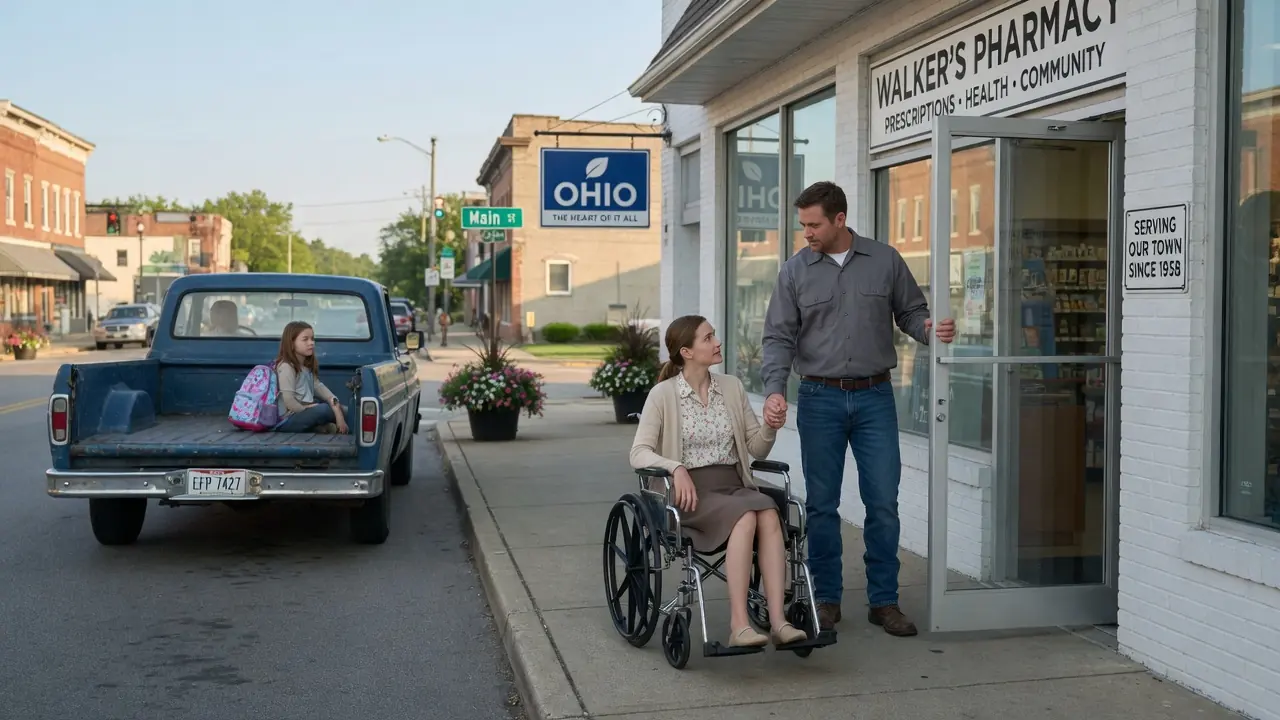
Ethan looked at her then.
For the first time, he saw not only the woman he had helped at the pharmacy, and not only the woman he had carried out of the rain three years ago.
He saw someone who had been living beside pain, just as he had.
Someone who smiled politely while carrying a whole room of grief inside her.
Someone still choosing grace.
After that morning, their routine changed.
They still met at Miller’s Pharmacy, but they no longer moved around each other like strangers. Ethan would help Grace inside, and sometimes they would sit for ten minutes on the bench outside while Lily asked questions about everything from wheelchairs to favorite ice cream flavors.
Grace answered every question with patience.
She told Lily she liked strawberry ice cream best.
Lily gasped.
“That’s my second favorite.”
“What’s your first?”
“Chocolate.”
Grace pretended to consider this deeply.
“Very respectable.”
Lily liked her immediately.
Children know when adults are pretending, and Grace did not pretend with her. She spoke to Lily like she mattered, not like she was too young to understand life.
Soon, Grace became part of their afternoons, too.
At first, Ethan only drove her home once when the taxi was late. Her house was a small white cottage near the edge of town, with a ramp leading to the front porch and wind chimes hanging by the door.
Then Lily asked if they could bring dinner.
Grace said they did not have to.
Lily said, “We know.”
So they came with soup.
Then with cornbread.
Then with a box of board games when rain kept everyone indoors.
Ethan and Grace did not fall in love quickly.
Neither of them would have trusted anything quick.
They built something slowly, in small acts.
He fixed the loose railing on her porch.
She helped Lily with her reading.
He drove her to therapy appointments when her transportation canceled.
She listened when he finally spoke about Emma.
One evening, while Lily colored at Grace’s kitchen table, Ethan stood at the sink washing three bowls.
Grace rolled beside him.
“You don’t have to clean.”
“I know.”
“You say that a lot.”
“So do you.”
Grace smiled faintly.
Then she said, “Tell me about Emma.”
Ethan’s hands stilled in the water.
For a long moment, he could not answer.
Then he did.
He told Grace about Emma’s laugh, how it always came one second before anyone expected it. He told her how she sang badly but confidently. How she used to write grocery lists in tiny neat handwriting. How she loved storms before the night that took her from him.
He spoke until his throat ached.
Grace listened without interrupting.
When he finished, she said, “She sounds wonderful.”
“She was.”
“And you loved her deeply.”
“I still do.”
“I know.”
Ethan looked at Grace then, waiting for discomfort, jealousy, retreat.
But Grace only said, “Love doesn’t disappear because life keeps going. It just changes rooms.”
Something in him loosened.
A week later, Grace told him about Daniel.
How he had proposed in a grocery store parking lot because he was too nervous to wait until dinner. How he always burned toast. How he believed every dog was secretly a good judge of character. How, in their last conversation, they had argued about whether to stop for gas before or after the bridge.
“I spent months thinking if I had said after instead of before, he would still be alive,” Grace admitted.
Ethan sat beside her on the porch.
“I know that kind of thinking.”
“It doesn’t change anything.”
“No.”
“But we do it anyway.”
They sat in the quiet together.
That was the first time Ethan took her hand.
Grace did not pull away.
Winter came.
Grace continued physical therapy at the rehab center two towns over. Ethan drove her every Thursday afternoon when his work schedule allowed, and Lily became her loudest supporter.
“You can do it, Miss Grace!” she would shout from the therapy room doorway until the staff began smiling whenever they saw the three of them arrive.
Grace worked hard.
Some days, progress was small. Some days, pain and frustration turned her quiet. Some days, she snapped at Ethan and apologized ten minutes later, ashamed.
He never took it personally.
“Hard days count, too,” he told her once.
She looked at him with tears in her eyes.
“Who told you that?”
“No one. I had to learn it.”
One bright afternoon in March, Grace stood between the parallel bars with both hands gripping the rails. Her therapist stood close. Ethan sat nearby with Lily on his lap.
Grace’s face was pale with concentration.
One careful movement.
Then another.
Her right foot shifted forward.
A sound left her, half laugh, half sob.
Lily jumped up.
“She did it! Daddy, she did it!”
Ethan stood, unable to speak.
Grace took one more assisted step, then sank carefully back into her chair, crying openly now.
The therapist smiled.
“That was good work, Grace.”
Grace looked at Ethan and Lily.
“No,” she whispered. “That was more than work.”
Ethan crouched in front of her.
“You did it.”
Grace reached for his hand.
“We did it.”
That spring, Ethan stopped feeling guilty every time he laughed.
The first time it happened, he was in Grace’s kitchen, trying to flip pancakes for Lily. One landed half on the plate and half on the floor. Lily declared it a pancake tragedy. Grace laughed so hard she covered her face.
Ethan laughed with them.
Then he stopped suddenly, startled by the sound.
Lily noticed.
“It’s okay, Daddy,” she said.
“What is?”
“To be happy and still miss Mommy.”
Ethan stared at her.
Grace looked down, tears gathering again.
Ethan crossed the kitchen and lifted Lily into his arms.
“Who taught you that?”
Lily shrugged.
“Maybe Mommy. Maybe Miss Grace. Maybe me.”
He held her tightly.
“You’re too smart for seven.”
“I know.”
By summer, the town had noticed them.
People saw Ethan helping Grace from the truck, Lily skipping beside them, Grace smiling more often than she used to. Some whispered. Some smiled knowingly. Some asked questions that Ethan ignored.
He was not ready to name what was growing between them.
Neither was Grace.
They were careful with each other because both understood what it meant to love someone and lose them.
But on the anniversary of the bridge night, Grace asked Ethan to drive her there.
He almost refused.
Then he saw her face and nodded.
They went near sunset. Lily stayed with Mrs. Pauline. The bridge was quiet, the water below moving softly through the fading light. A new guardrail had been installed since that night. Wild grass grew along the shoulder.
Ethan parked the truck and helped Grace into her chair.
For a while, neither spoke.
Then Grace said, “I used to hate this place.”
Ethan stood beside her.
“So did I.”
“I thought coming here would break me.”
“Did it?”
She looked out over the water.
“No.”
Then she turned to him.
“I think it gave something back.”
He waited.
Grace continued, “For three years, I thought my life ended here. But it didn’t. Something terrible happened here, yes. But so did something else. A stranger ran into the rain for me. A man who had already known loss still chose to help. And because of that, I’m here.”
Ethan’s eyes burned.
Grace reached for his hand.
“I don’t know what the future is supposed to look like,” she said. “I don’t know how to do this without being afraid.”
“Me either.”
“But I don’t want fear to decide everything anymore.”
Ethan looked down at their joined hands.
“Neither do I.”
Grace smiled through tears.
“Then maybe we keep going.”
He nodded.
“Slowly.”
“Slowly,” she agreed.
They did.
A year after that first morning at the pharmacy, Grace walked six careful steps across Ethan’s small living room using a cane.
Lily counted each one loudly.
“One! Two! Three! Four! Five! Six!”
Then she burst into applause like Grace had won an Olympic medal.
Ethan stood near the doorway, one hand pressed against his mouth.
Grace laughed and cried at the same time.
“I’m still shaky.”
“You’re standing,” Ethan said.
“I’m still scared.”
“You’re moving.”
Grace looked at him.
“So are you.”
He knew what she meant.
The house had changed since Grace entered it. Not because she replaced Emma. No one could. No one should. But because grief no longer sat in every room with the lights off.
There were flowers on the kitchen table now. Lily’s drawings on the fridge. Grace’s favorite tea in the cupboard. Emma’s photo still on the mantel, but no longer surrounded by silence.
One evening, Lily placed one of Grace’s yellow flowers beside Emma’s picture.
Ethan watched her.
“What are you doing, Lil?”
“Introducing them.”
Grace froze in the hallway.
Lily looked between the photo and Grace.
“Mommy should know Miss Grace. They both love us.”
No adult in the room could speak for a moment.
Then Grace knelt slowly, balancing on her cane, and opened her arms.
Lily ran into them.
Ethan turned toward the window, wiping his eyes.
Life did not heal by erasing what came before.
It healed by making room.
One October morning, Ethan parked outside Miller’s Pharmacy at 7:15, just as he always had.
But this time, Grace was already waiting near the entrance, standing with one hand on her cane and the other resting on the handle of her wheelchair beside her.
Lily gasped from the truck.
“She’s standing!”
Ethan stepped out slowly, smiling before he could stop himself.
Grace looked nervous and proud and beautiful in the clear morning light.
“I wanted you to see,” she said.
Ethan walked toward her.
“You didn’t have to wait outside.”
“Yes, I did.”
“Why?”
Grace looked at the pharmacy door, then at the curb where they had first met as strangers.
“Because this is where you helped me before you knew my name.”
Her voice trembled.
“And this is where I wanted to tell you that I’m not just surviving anymore.”
Ethan swallowed.
Grace continued, “You gave me a second chance once on that bridge. Then without knowing it, you gave me another one every morning here.”
Lily stepped beside her father and took Grace’s free hand.
“Does that mean we’re your family now?”
Grace looked down at her.
Then at Ethan.
Tears filled her eyes.
“If your dad says yes.”
Lily turned to Ethan immediately.
“Daddy?”
Ethan looked at Grace, at the woman who had carried pain with dignity, who had helped his daughter laugh, who had listened to his grief without trying to silence it, who had taught him that love after loss was not betrayal.
It was courage.
He took Grace’s hand.
“Yes,” he said softly. “It means family.”
Grace cried then, but she was smiling.
So was Ethan.
So was Lily.
Cars passed behind them. The pharmacy door opened and closed. The town moved through its ordinary morning without realizing that three people were quietly becoming something new on the sidewalk.
Ethan still carried Emma in his heart.
Grace still carried Daniel.
Neither love disappeared.
But now, beside those memories, there was room for morning sunlight, Lily’s laughter, pharmacy flowers, therapy steps, shared dinners, and hands held carefully across the space between past and future.
Years later, when Lily was old enough to understand the whole story, she would ask her father if he believed everything happened for a reason.
Ethan would think about the bridge.
The rain.
The guilt.
The pharmacy curb.
The yellow flower.
Grace’s first steps.
Then he would answer honestly.
“I don’t know if everything happens for a reason,” he would say. “But I believe kindness can give meaning to things that nearly broke us.”
And Lily, who had always understood more than most children, would nod.
Because she had seen it herself.
A tired single father helped a woman in a wheelchair every morning without knowing who she was.
A grieving woman found the courage to say thank you.
A little girl offered a flower because someone looked like they needed a happy day.
And from those small acts, a broken circle slowly became whole again.
Not through miracles.
Not through luck.
But through the quiet power of stopping, helping, and choosing to keep living.
Because sometimes, the person you help without expecting anything in return is the person who helps you find your way back to life.