In the heart of a Montana blizzard, where Highway 2 disappeared beneath sheets of white and every sensible driver was racing toward distant gas stations, Liam Carter slammed the brakes of his battered pickup when he saw the spinning SUV.
The road was almost gone.
Snow flew sideways across the windshield so violently that the wipers were useless.
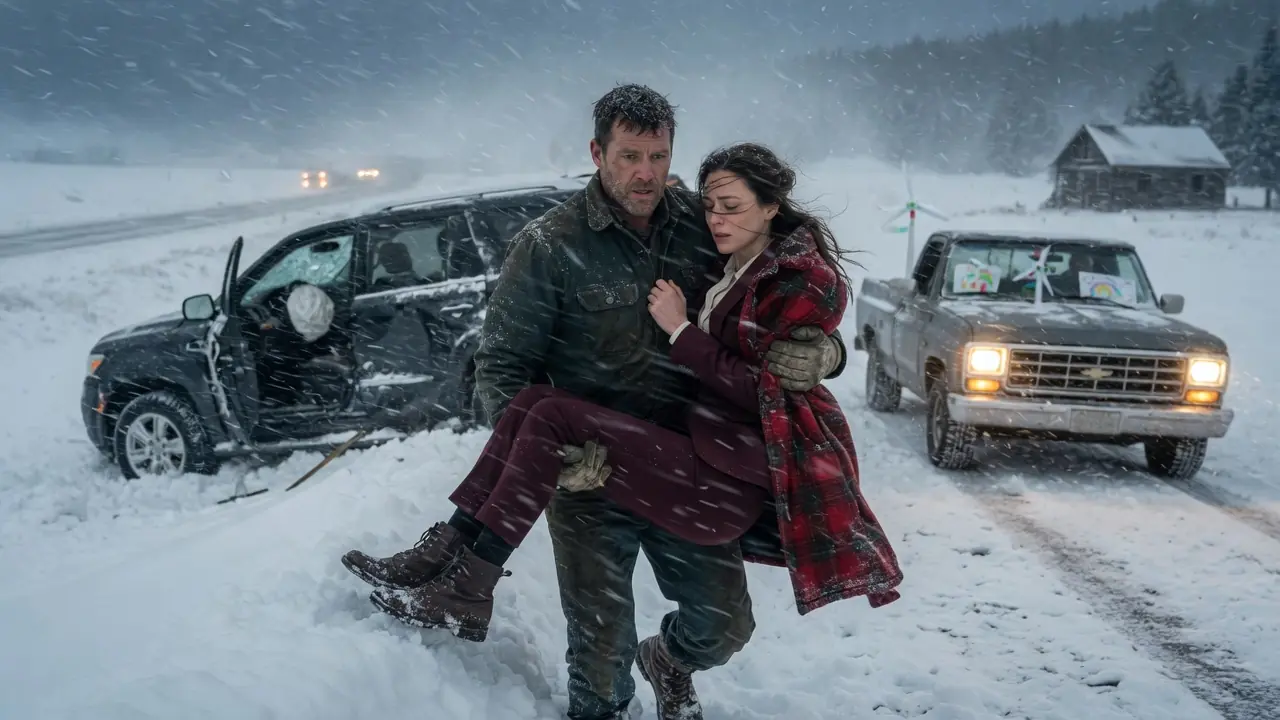
Headlights appeared and vanished in the storm like ghosts. Cars had been sliding into ditches for miles, their hazard lights blinking weakly beneath gathering ice.
The radio had stopped playing music fifteen minutes earlier and now gave only emergency warnings in a voice too calm for the world outside.
Liam had one thought in his mind before the SUV spun.
Get home to Bridget.
His seven-year-old daughter was waiting at Mrs. Alvarez’s house with her backpack, her science fair project, and the patient faith of a child who believed her father could survive any storm because he always had.
Then the SUV lost control.
It crossed the highway sideways, its tires sliding over black ice, headlights swinging like searchlights through the snow. It hit the guardrail hard enough to throw sparks. The front end crumpled. Glass burst outward. The vehicle spun once more, then slammed into a snowbank on the shoulder, tilted at an angle that made Liam’s stomach drop.
For half a second, he gripped the steering wheel.
Every instinct told him to keep moving.
The storm was worsening. The temperature was falling. His truck was old. His tires were not good enough for heroics. He had a daughter waiting for him. He had a night shift starting in a few hours at the Sterling Dynamics plant, and missing work was the kind of mistake poor men could not afford to make.
Then he saw a pale hand against the shattered driver’s side window.
Still.
Too still.
Liam muttered one word under his breath.
“Damn it.”
He threw the truck into park, grabbed his emergency kit and toolbox from behind the seat, and stepped into the storm.
The wind hit him like a wall.
Snow filled his beard, his eyebrows, the collar of his work shirt. His boots slid on the ice as he crossed the road. A semi roared past in the opposite lane, blasting him with dirty slush and enough wind to nearly knock him sideways.
He kept moving.
The SUV’s front end was buried deep in the snowbank, the driver’s side door crushed inward. The airbags had deployed. Through the cracked glass, Liam saw a woman slumped against the steering wheel, her hair fallen across her face, blood running from a cut near her temple.
He banged on the window.
“Ma’am! Can you hear me?”
No response.
He tried the door.
Jammed.
He ran back to his truck, grabbed the pry bar from his toolbox, returned, wedged it into the bent frame, and threw his weight against it.
The metal groaned.
The wind screamed.
Liam shoved again.
The door gave an inch.
He dug his boots into the ice, put both hands on the bar, and pulled until his shoulders burned. The door popped open with a sharp metallic scream.
Cold air flooded the SUV.
The woman’s head lolled slightly.
Liam reached in and pressed two fingers against her neck.
Pulse.
Weak, but there.
“Okay,” he breathed. “Okay. Stay with me.”
The seat belt had locked across her body. He pulled his folding knife from his pocket and cut through the strap. She fell forward, and he caught her before she struck the dashboard.
She was dressed completely wrong for Montana in a blizzard. Expensive dark wool coat, thin blouse beneath it, tailored trousers, leather shoes meant for polished floors, not ice. A sleek watch flashed beneath her sleeve. Her handbag had spilled open across the passenger seat, scattering papers, a phone with a cracked screen, lipstick, a black leather notebook, and a silver pen.
Whoever she was, she did not belong out here.
Liam stripped off his red flannel coat.
It was old, heavy, and warm, patched once at the elbow by his own clumsy hand after Bridget complained that “Daddy’s fire coat has a hole.”
He wrapped it around the woman’s shoulders, then lifted her from the wrecked SUV.
She was lighter than he expected.
Or maybe adrenaline made everything lighter.
The abandoned hunting cabin sat two hundred yards from the highway, down an old trail that only locals knew. Liam had passed it for years, always telling himself that if the weather ever truly turned deadly, that cabin might save someone.
Tonight, someone was her.
He carried her through snow that came nearly to his knees in places. Twice he slipped. Once he went down hard on one knee, twisting his body so she landed against his chest instead of the frozen ground. Pain shot up his leg, but he stood again.
The cabin door was half frozen shut.
Liam kicked it once.
Then again.
The old wood cracked open.
Inside, the air was bitter cold, but at least it did not move.
He laid the woman near the stone fireplace on a dusty rug, then worked quickly. Fire starter from the emergency kit. Old newspapers. Broken chair pieces. Dry kindling stacked in a corner by some hunter who had unintentionally become a saint.
Within ten minutes, flames licked up the stone chimney.
Within twenty, the cabin had a pocket of warmth.
Liam checked the woman’s breathing again. Her eyelids fluttered. Her lips were pale. Her right wrist was swelling, and her left ankle looked badly twisted. He found a blanket in a storage trunk, shook dust from it, and layered it over her.
She stirred when he splinted her wrist.
Her eyes opened slowly.
Gray.
Sharp even through pain.
For one strange second, she looked less afraid than offended, as if unconsciousness itself had violated her schedule.
“Where am I?” she rasped.
“Cabin off Highway 2,” Liam said. “Your SUV spun out. You hit the rail.”
She tried to sit up.
Bad idea.
Pain took the color from her face, and she sank back with a breath that shook.
“My phone.”
“It’s cracked. No signal anyway.”
“My bag.”
“In the SUV. I can get it when the wind drops.”
“I need to call—”
“You need to stay still.”
Her eyes sharpened.
She was used to giving orders.
Liam could see it immediately.
Some people carried authority like a coat. This woman carried it like skin.
“Who are you?” she asked.
“Liam.”
“Liam what?”
“Liam Carter.”
She absorbed that, then looked toward the fire.
“I’m Audrey.”
No last name.
He noticed the omission.
He did not press.
Outside, the storm battered the cabin walls. Snow hissed through cracks around the door. The fire snapped and popped, orange light moving over the rough logs, the old table, the dusty shelves, and the woman lying beneath his patched red flannel coat.
Audrey turned her head toward him.
“You stopped.”
Liam added another piece of wood to the fire.
“Yeah.”
“Why?”
He looked at her, confused by the question.
“Because you crashed.”
“That’s not an answer.”
“It is where I come from.”
She watched him for a long moment.
Then she looked away first.
Montana winter had a way of stripping people down to the truth.
In the city, Audrey Sterling was surrounded by glass walls, executive elevators, assistants, drivers, climate control, boardrooms, security, and the kind of distance money creates when it has been protecting someone for too long.
In that cabin, none of it mattered.
She had no signal.
No staff.
No control.
No private jet waiting.
No boardroom table between herself and the world.
Only a stranger in work boots feeding a fire so she would not freeze to death.
Audrey Sterling was thirty-four years old and CEO of Sterling Dynamics, a global manufacturing and aerospace systems corporation headquartered in Denver, with plants in six states and contracts across three continents.
People called her cold.
They were not entirely wrong.
Cold had kept her alive.
Her father, George Sterling, had founded the company with three investors, two machines, and a tolerance for risk that bordered on madness. By the time Audrey was ten, Sterling Dynamics had become a serious supplier. By the time she was sixteen, her father had stopped asking what she wanted to do with her life and started telling her what the company would need from her.
She learned margins before she learned how to trust people.
She learned to read annual reports before she learned what it felt like to fall asleep in someone’s arms without wondering what they wanted from her.
Her mother had left when Audrey was thirteen.
There was no dramatic goodbye. No screaming fight in the foyer. No suitcase on the stairs. Just a note on thick stationery that said she could not live inside George Sterling’s ambition anymore.
Audrey had found the note before her father did.
She still remembered the sentence that had stayed lodged inside her all these years.
Your father loves the future more than he loves the people standing in front of him.
Audrey had hated her mother for writing that.
Then she hated herself for understanding it.
George Sterling raised his daughter like a successor, not a child. Every mistake became a lesson in weakness. Every emotional reaction became evidence that she needed discipline. Every softness had to be cut away before someone else used it against her.
By twenty-eight, Audrey was chief operating officer.
By thirty-two, CEO.
By thirty-four, she had become what the board wanted: brilliant, controlled, frighteningly efficient, and capable of signing decisions that changed hundreds of lives without letting her voice tremble.
She told herself that was leadership.
But lately, in the quiet hours between 2:00 and 4:00 a.m., when the penthouse was dark and the city lights looked like distant warning signals, she had begun to wonder whether leadership was supposed to feel this empty.
The Montana plant was the next test.
Sterling Dynamics had missed two quarterly profit targets. Shareholders were restless. The board wanted a seven percent margin increase. Consultants had combed through every department with software that measured output, labor, overtime, health insurance costs, absenteeism, error rates, and projected savings.
Their recommendation was simple.
Cut eleven percent of the workforce at the Ridgemont plant.
Start with the night shift.
The consultants called it optimization.
Henry Blake, the CFO, called it strategic discipline.
Clinton Morris, the chief operating officer, called it overdue correction.
Audrey had called it necessary.
She had flown to Montana under the cover of a routine inspection, but the real reason sat encrypted on her laptop.
PHASE 1 REDUCTIONS.
Seventy-three names.
Line seventeen read:
Liam Carter — Night Shift Mechanic — Redundant Maintenance Function.
Audrey did not know that yet.
Not in the cabin.
Not while wearing his coat.
Not while watching him melt snow in an old pot so she could drink water.
Liam Carter was thirty-six years old and had learned early that machines were easier to understand than people, but people mattered more.
He had once been an aviation maintenance engineer, the kind of man who could hear a wrong vibration inside an engine before a diagnostic system noticed anything was off. He had worked for regional carriers, then military contractors, then a private aerospace firm that paid well enough for him to buy a little house outside Ridgemont with his wife, Natalie.
Natalie had been a school librarian with a laugh that could turn a bad day around.
She loved thunderstorms, old novels, and naming stray cats she had no intention of adopting until she inevitably adopted them.
When Bridget was born, Natalie told Liam, “This one’s going to rebuild the world.”
Liam had looked at the tiny sleeping baby in his arms.
“She can start after she learns to hold her head up.”
Natalie died when Bridget was three.
Not in a dramatic accident.
Not from something anyone saw coming.
A brain aneurysm took her in the middle of a school day, between shelving picture books and helping a second grader find a dinosaur encyclopedia.
Liam got the call while inspecting a turbine housing.
By the time he reached the hospital, she was gone.
For months afterward, life narrowed to the size of Bridget’s needs.
Breakfast.
Laundry.
Preschool.
Bedtime.
Nightmares.
Bills.
Grief waited until Bridget slept, then climbed into the room with him.
He tried to keep his old job. The pay was good. The work mattered. But aviation engineering did not care that he was suddenly the only parent. Travel was required. Overtime was expected. Emergencies did not wait for school pickup.
One night, Bridget woke crying after a babysitter forgot Natalie’s bedtime song.
Liam found his daughter sitting on the floor beside her bed, clutching Natalie’s old scarf.
“I don’t remember Mommy’s voice right,” she whispered.
The next day, Liam resigned.
He moved to a smaller rental outside Ridgemont. Took the night-shift mechanic job at Sterling Dynamics. Delivered packages during the day when he could. Fixed engines for neighbors on weekends. Did whatever kept food on the table and kept him close enough to Bridget that she never had to wonder who would come when she called.
He had less money.
Less status.
Less sleep.
But he was there.
That mattered more than the rest.
In the cabin, Audrey learned pieces of this slowly.
Not because Liam told the story dramatically.
He did not.
He answered questions plainly while feeding the fire.
“Your daughter’s mother?” Audrey asked once, then immediately regretted it.
Liam was quiet for a moment.
“Gone.”
“I’m sorry.”
“Me too.”
The fire cracked.
“How old is your daughter?”
“Seven.”
“What’s her name?”
“Bridget.”
His face changed when he said it.
Not softened exactly.
Opened.
“She builds wind turbines out of cardboard and scrap parts,” he said. “Says one day she’s going to power the whole valley.”
Audrey almost smiled.
“Ambitious.”
“She gets that from her mother.”
“And from you?”
“I mostly teach her not to use duct tape as a structural theory.”
This time Audrey did smile.
It surprised both of them.
The wind howled hard enough to shake the door.
Audrey shivered despite the blanket.
Liam noticed immediately. He moved his own body between her and the worst draft without mentioning it, as if decency did not need to announce itself.
She watched him from the edge of the firelight.
“You are very calm for someone trapped in a storm.”
“I’m not calm. I’m busy.”
“What’s the difference?”
“Calm is how you feel. Busy is what you do so feelings don’t get in the way.”
Audrey looked toward the flames.
“That sounds useful.”
“It can be. Until it isn’t.”
She heard more in that than he intended.
For a while, they sat without speaking.
The storm gave them no choice but stillness.
Audrey hated stillness.
Stillness allowed thoughts to find her.
She thought of the termination list. Of the faces she had not yet attached to names. Of the board members waiting for her to prove she could cut deep without flinching. Of her father telling her that sentiment was a luxury leaders could not afford.
Then she looked at Liam’s coat around her shoulders.
A poor man’s warmth.
Given without calculation.
The next morning came gray and bitter.
Snow lay deep around the cabin, smoothing the world into silence. Search and rescue lights appeared faintly on the highway. Liam had gone out at dawn to tie a strip of red cloth to a branch by the trail, giving rescuers something to spot.
When the rescue crew arrived, Audrey was alert enough to give her name.
One of the responders froze.
“Audrey Sterling?”
Liam looked up from packing his emergency kit.
The name hit him, but did not land fully at first.
Sterling.
Sterling Dynamics.
CEO.
The woman in his coat was the woman whose face appeared in quarterly reports taped to plant bulletin boards.
Audrey saw recognition move through his expression.
Something tightened inside her.
There it was.
The shift.
The calculation.
The sudden awareness of power.
But Liam only nodded once.
“Ma’am.”
Ma’am.
After everything, that was all.
The rescue team helped her toward the vehicle. She paused at the door and looked back.
“Your coat.”
“Keep it until you’re warm.”
“I can return it.”
“I work at the plant,” he said. “You’ll know where to find me.”
He said it without accusation.
That somehow made it worse.
Liam drove home before going to work.
Bridget was waiting at Mrs. Alvarez’s kitchen table, still in yesterday’s sweater, eyes swollen from worry but trying to be brave.
The moment Liam stepped inside, she ran at him.
He dropped to one knee and caught her.
“I knew you were okay,” she said into his neck. “I knew, but I didn’t like knowing without seeing.”
Liam closed his eyes.
“I’m sorry, Bug.”
Mrs. Alvarez stood at the stove, pretending not to cry while stirring oatmeal.
“He saved somebody,” she told Bridget. “Your daddy was being your daddy.”
Bridget pulled back.
“Who?”
“A woman who crashed.”
“Did she say thank you?”
Liam smiled tiredly.
“She was a little busy being injured.”
“That is not an excuse. Good manners matter.”
“I’ll tell her you said that.”
Bridget inspected him.
“Where’s your fire coat?”
“I gave it to her.”
Bridget’s eyes widened.
“The red one?”
“She needed it.”
Bridget considered that seriously, then nodded.
“Warm beats storm.”
She said it like a law of physics.
Liam kissed her forehead.
“Yes, it does.”
He slept for ninety minutes, showered, put on his work clothes, and drove to the Sterling Dynamics Montana plant.
The plant sprawled across the Ridgemont valley like a steel animal. Hangars, assembly buildings, fabrication units, loading docks, exhaust stacks, warehouses, offices, security gates. It ran twenty-four hours a day, producing precision aerospace components for commercial and defense contractors.
Liam worked the night maintenance shift.
The forgotten shift.
The shift that kept equipment alive while executives slept.
He knew every groan, leak, rattle, and false alarm in the older wings of the plant. He knew which hydraulic press needed gentle coaxing in subzero weather. Which coolant line froze first. Which conveyor motor ran hot when production pushed past safe output. Which valves had outlived their intended service life by a margin that made him lose sleep.
He had filed reports.
Many reports.
Some were acknowledged.
Most disappeared upward into the soft graveyard of budget review.
At 9:30 a.m., everyone important was summoned to Conference Room B.
Liam attended only because Otis Palmer, the plant floor manager, pointed at him and said, “You know the old systems better than anybody. Sit in.”
Conference Room B smelled like burned coffee and anxiety.
Supervisors gathered around the long table. HR sat near the wall. Clinton Morris stood by the screen, smiling like a man who enjoyed difficult conversations as long as they were difficult for other people.
Henry Blake joined by video call.
Audrey Sterling entered last.
Burgundy business suit. Hair pulled back. Wrist wrapped discreetly. A faint bruise near her temple half covered by makeup. Liam’s red flannel coat folded over one arm.
The room stood.
Liam did too.
Their eyes met.
For one heartbeat, the cabin was there between them.
Then Audrey’s CEO mask settled into place.
“Sit,” she said.
Clinton began the presentation.
Charts.
Metrics.
Efficiency.
Headcount.
Output ratios.
Maintenance redundancy.
Audrey watched the room while he spoke. Normally, she would have followed every number with focused attention. Today, she found herself watching hands.
The hands of the supervisors twisting pens.
The hands of HR holding prepared folders.
The hands of Otis Palmer clasped tightly in front of him.
The hands of Liam Carter folded on the table, still cracked from cold, grease beneath the nails no soap could fully remove.
Hands that had pulled her from wreckage.
On the screen, a spreadsheet appeared.
Phase 1 Reduction Candidates.
It moved quickly, but Liam saw his name.
So did Audrey.
Line seventeen.
Liam Carter.
Redundant Maintenance Function.
Something moved across his face.
Not shock.
Not fear.
Something quieter.
Recognition.
The tired understanding of a man who had been waiting for the other boot to drop.
Audrey’s stomach tightened.
Clinton spoke smoothly.
“The night shift carries the highest labor inefficiency. We propose eliminating redundant maintenance roles and transitioning to digital monitoring combined with vendor support.”
Otis leaned forward.
“Those ‘redundant’ roles are why the old casting sector hasn’t killed anybody.”
Clinton smiled.
“With respect, Otis, that kind of thinking is exactly why modernization stalls.”
“Modernization doesn’t mean firing the people who know which machines lie.”
Henry Blake’s voice came through the speaker.
“Machines don’t lie. People overstate risk to protect jobs.”
Liam did not speak.
Audrey noticed.
“You have something to add, Mr. Carter?”
The room turned toward him.
He looked at her, then at Clinton, then at Otis.
“No, ma’am.”
That answer bothered her more than a speech would have.
After the meeting, Audrey toured the plant.
Liam was assigned to assist with technical questions, a decision Clinton clearly disliked but Otis insisted on.
They moved through the fabrication floor, past machines tall as small houses, robotic arms, conveyor systems, hydraulic presses, coolant tanks, and safety stations mounted along yellow lines.
Audrey asked questions.
Liam answered precisely.
“How long has this press exceeded recommended service life?”
“Six years.”
“Why is it still operating?”
“Because every replacement request has been deferred.”
“By whom?”
“Budget review.”
Clinton stepped in.
“Deferred does not mean denied. We prioritize based on risk assessment.”
Liam said nothing.
Audrey turned to him.
“Do you disagree with the risk assessment?”
Liam looked at the machine.
“I think some risks don’t show up correctly on spreadsheets because spreadsheets can’t hear metal fatigue.”
Clinton laughed softly.
“That is not exactly data-driven.”
“No,” Liam said. “It’s experience-driven.”
Audrey wrote that down.
Experience-driven.
They reached Sector 7 after lunch.
The casting sector was one of the oldest parts of the plant. Heat shimmered in the air. The floor smelled of oil, hot metal, and industrial coolant. A coolant line near the service panel was leaking in a thin, steady thread.
Clinton frowned.
“That should have been reported.”
“It was,” Liam said.
Otis gave him a look.
Liam continued.
“Three weeks ago.”
Audrey turned.
“Why isn’t it repaired?”
“Vendor backlog,” Clinton said quickly.
Liam crouched, examined the fitting, and held out one hand.
“Otis, compression clamp.”
Otis grabbed one from a maintenance cart.
Clinton stiffened.
“Let’s not improvise during an executive inspection.”
Liam did not look at him.
“It’s not improvising. It’s fixing.”
In nineteen minutes, he sealed the leak, pressure-tested the line, and documented the repair.
Audrey watched every step.
There was no waste in him.
No performance.
No attempt to impress.
He simply saw what was wrong and corrected it.
“How much would the vendor repair have cost?” she asked.
Otis checked the work order.
“Twenty-four hundred dollars. Three-day delay.”
Audrey looked at Liam.
“And your method?”
“Twenty-dollar clamp, proper torque, pressure test, written verification.”
Clinton’s smile tightened.
“With respect, CEO Sterling, field fixes can create compliance exposure.”
“Then Mr. Carter will write the verification,” Audrey said. “And you will explain why a three-week-old leak remained open.”
Clinton stopped smiling.
That afternoon, Liam’s phone rang.
He stepped aside.
Audrey was close enough to hear his voice change.
“Hey, Mrs. Alvarez. Everything okay?”
A pause.
Then his tired face transformed.
“First place?”
Another pause.
“She did? No, no, I’m not crying. There’s coolant fumes in here.”
Audrey looked down at her notes, pretending not to listen.
Liam laughed softly.
“Tell Bridget I’m so proud of her I might explode. No, not actually explode. Bad word choice near the plant.”
He hung up, smiling in a way Audrey had not seen in any boardroom.
“Your daughter?” she asked before she could stop herself.
“Science fair,” he said. “She built a wind turbine from scrap parts. First place.”
“You must be proud.”
“I’m always proud. Today she just gave me a new excuse.”
Audrey wanted to say something ordinary.
Congratulations.
That’s wonderful.
Instead, she said, “You should take the call as personal time.”
It came out stiff.
Corporate.
Liam only nodded.
“Thank you.”
The gas line warning came at 2:15 p.m.
It started as a sound.
A high, thin whistle beneath the machinery.
Most people missed it.
Liam did not.
He turned toward Sector 7.
The digital sensor panel showed green.
All clear.
But the analog gauge near the C7 safety valve trembled above safe range.
Liam moved fast.
“Otis!”
Otis looked up.
Then heard it too.
His face changed.
“Shut it down!”
Liam hit the emergency stop and pulled the manual alarm.
The casting line went dead.
A red light flashed.
The plant floor erupted in confusion.
Clinton’s voice came over the radio.
“Who authorized shutdown?”
Liam grabbed the radio.
“Pressure spike, Sector 7. C7 valve critical.”
“Digital reads clear,” Clinton snapped.
“Analog says otherwise.”
“Restart the line.”
“No.”
The word was flat.
Immediate.
Audrey, standing in the observation corridor above the floor with two executives, heard everything through the radio.
Clinton turned to her.
“This is exactly the kind of unauthorized—”
The valve blew.
Not a catastrophic explosion, but close enough to show everyone what catastrophe might have looked like.
A burst of flame shot along the lower panel. White smoke filled the sector. Metal screamed. A pressure pipe split near the bracket, spraying vapor across the empty zone where twelve workers had been standing less than ninety seconds earlier.
Audrey froze.
For one impossible second, all the numbers in her head vanished.
Only the empty floor remained.
The empty floor Liam had created by stopping the line.
Then smoke rolled into the observation corridor.
A small secondary flare caught near the stairwell.
Someone shouted.
Liam was already moving.
He grabbed a fire blanket from the safety station, ran up the access stairs through smoke thick enough to sting his eyes, and found Audrey coughing near the railing.
“This way!”
She stumbled.
He wrapped the blanket around her shoulders and pulled her toward the emergency exit.
A spark caught his sleeve.
He slapped it out against the wall, winced, kept moving.
They burst into clear air near the loading dock.
Audrey doubled over coughing.
Liam stayed beside her until she could breathe.
Then he turned to run back inside.
She grabbed his arm.
“No.”
“There are people in there.”
“They evacuated.”
“You don’t know that.”
He pulled free.
Audrey watched him disappear into the smoke and understood something with terrible clarity.
She had almost fired the man who had just saved twelve workers, possibly more, because his value was invisible to a spreadsheet.
In the medical bay, Liam sat on the examination table while the nurse treated a burn on his forearm.
Second-degree, small but painful.
He tried to downplay it.
Audrey stood near the door, still wrapped in the emergency blanket, her hair loosened, makeup smudged, wrist aching.
The red flannel coat hung over the back of a chair.
She stared at it.
“You keep doing that,” she said.
Liam looked up.
“Doing what?”
“Saving me.”
He gave a tired half smile.
“Bad habit.”
“Why?”
The question came out sharper than she intended.
He studied her.
Then answered simply.
“Because you’re a person.”
Audrey looked away.
That answer should not have hurt.
But it did.
Because somewhere along the way, she had stopped thinking that way.
Not completely.
Not consciously.
But enough.
Enough to approve lists before knowing faces.
Enough to measure labor before listening to workers.
Enough to believe efficiency was neutral when it was often just cruelty in clean font.
An emergency board call began at 4:00 p.m.
Conference Room B again.
Same table.
Different air.
Henry Blake led with costs.
Production delay.
Equipment damage.
Emergency response.
Downtime.
Preliminary loss estimate: ninety thousand dollars and rising.
Clinton blamed Liam.
“Carter initiated an unauthorized shutdown based on an analog gauge contradicted by digital systems. His decision caused panic, production loss, and possible reputational damage.”
Otis slammed one hand on the table.
“That shutdown saved lives.”
Clinton turned cold.
“We don’t know that.”
“We damn well do.”
Amanda Pierce from HR placed a folder on the table.
A termination packet.
Already prepared.
Audrey looked at it.
Liam Carter.
Her signature line waited at the bottom.
She thought of Bridget’s drawing.
Warm beats storm.
She thought of Liam cutting her from the SUV.
She thought of him saying, “Because you’re a person.”
Then she closed the folder.
“No.”
Clinton blinked.
“No?”
“No termination pending investigation.”
Henry’s voice came through the speaker.
“Audrey, decisive action is important here.”
“Decisive action without facts is panic wearing a suit.”
The room went silent.
Audrey stood.
“Full safety audit. Forty-eight hours. Independent review of the C7 valve, sensor procurement, deferred maintenance reports, and any cost-saving decisions tied to this sector. Nobody is fired until I know whether we are punishing a man for preventing a disaster.”
Clinton’s face tightened.
“CEO Sterling, with respect—”
“You are confusing respect with permission to continue.”
He stopped.
That night, Liam resigned.
He did it because he knew how these stories worked.
A company needed a scapegoat.
A CEO needed clean hands.
A single father with modest income and no political power was easier to blame than executives who had ignored warnings.
His resignation letter was two sentences.
Effective immediately, I resign my position at Sterling Dynamics. I will not allow my presence to become the excuse leadership uses to avoid the truth.
He left it on Audrey’s desk after the plant quieted.
Then he went home.
Bridget met him at the door with her science fair ribbon.
“Dad! Look!”
He lifted her carefully with his unburned arm.
“I knew you’d win.”
“You did not. You said winning isn’t the point.”
“That was before you won.”
She giggled, then noticed his bandage.
“What happened?”
“Small burn.”
Her face went serious.
“Work?”
“Yeah.”
“Are you okay?”
“I am now.”
She pressed her small hand beside the bandage, not touching it.
“Warm beats storm,” she whispered.
Liam closed his eyes.
“Always.”
Audrey found the resignation at 6:12 a.m.
By then, she had not slept.
She and Otis had spent the night in the records room, pulling maintenance logs, procurement files, deferred work orders, and archived email chains.
The truth was worse than she expected.
Liam had flagged C7 four months earlier.
Then again three months earlier.
Then again six weeks ago.
Each report recommended replacement before winter load increase.
Each had been routed to Clinton’s office.
Each had been marked:
Non-critical. Defer to Q2 budget review.
The digital sensor that contradicted the analog gauge had been purchased from a budget vendor against engineering recommendation. The approved vendor had quoted forty-two thousand dollars more. Clinton had chosen the cheaper option and called it “margin discipline.”
Henry had praised the savings in an email.
Amanda had been told to prepare labor reductions to offset “maintenance inefficiency.”
Clinton had written:
Carter is a useful target. Push redundancy angle.
Audrey read that line three times.
Then she printed it.
At 8:30 a.m., an independent safety inspector confirmed the valve had been past service life and under dangerous load. The digital sensor had failed intermittently. The shutdown had prevented a far larger rupture.
At 9:00, Audrey left the plant and drove to Liam’s home.
He lived in a small trailer park on the edge of Ridgemont, where the lots were narrow but clean and mountains rose in the distance like sleeping giants.
His trailer was old but cared for. Flower boxes sat beneath the windows. A child’s wind turbine made from cardboard and scrap metal spun crookedly near the steps.
Audrey stood outside holding the red flannel coat folded over one arm.
Bridget answered the door.
She wore yellow socks, a blue sweater, and the proud expression of a scientist interrupted during important research.
“You’re the lady from the storm,” she said.
Audrey blinked.
“Yes.”
“You kept Dad’s fire coat.”
Audrey looked down at it.
“I came to return it.”
Bridget stepped aside.
“You can come in. But you have to wipe your boots. Dad says mud is just outside trying to become inside.”
Audrey almost smiled.
Inside, the trailer was small, warm, and full of life. Books stacked beside the couch. A jar of pencils on the table. Drawings taped to the wall. A tiny wind turbine model made from bottle caps and wire sat near the window.
Liam appeared from the kitchen.
When he saw Audrey, his expression closed.
“CEO Sterling.”
That title landed between them like a wall.
“Liam.”
Bridget looked between them.
“Are you mad?”
“No,” Liam said.
“Yes,” Audrey said at the same time.
Bridget frowned.
“Grown-ups are bad at answers.”
Audrey knelt and handed Bridget the coat.
“Thank you for letting your dad give this to me.”
Bridget hugged it to her chest.
“It’s his warmest one.”
“I know.”
“You needed it?”
“Yes.”
“Then it was okay.”
Audrey swallowed.
“Your father saved my life.”
Bridget looked at Liam.
“He does that.”
Liam looked away.
Audrey stood.
“I found the reports.”
His eyes returned to her.
“The valve reports. The sensor procurement. Clinton’s emails. You were right about everything.”
“I know.”
The words were not arrogant.
Only tired.
“I need you to come back,” Audrey said.
“No.”
Bridget went very still.
Audrey accepted the answer without flinching.
“Not as night mechanic. As emergency systems restoration lead. Full authority over safety review. You choose the team. You write the new protocols.”
“I’m not interested in being your redemption project.”
“You’re not.”
“Then what am I?”
Audrey looked at the drawings on the wall.
At the science fair ribbon.
At the small shoes by the door.
At the warm, fragile, human world Liam had built with far fewer resources than she had wasted trying to feel safe.
“You are the person who saw the truth when my systems didn’t,” she said. “And I need someone like that more than I need another executive who knows how to make bad decisions sound efficient.”
Liam said nothing.
Audrey continued.
“I almost signed your termination. I won’t pretend otherwise. Your name was on the list. Line seventeen.”
His jaw tightened.
“I figured.”
“I was wrong.”
That word cost her more than she expected.
Wrong.
She had spent her whole life avoiding it.
Now it felt strangely clean.
“I was wrong,” she repeated. “And I am asking you to help me fix what my leadership allowed.”
Liam studied her for a long moment.
Then Bridget said, “Dad, if something is broken and someone asks you to fix it, you usually fix it.”
He looked down at her.
“That is unfairly logical.”
“I’m gifted.”
Audrey’s mouth twitched.
Liam sighed.
“Full authority?”
“Yes.”
“No Clinton.”
“He’s suspended pending board review.”
“No cuts to night maintenance until the audit is complete.”
“Agreed.”
“My team gets paid for the extra hours.”
“Agreed.”
“And Bridget gets to tour the plant after the safety systems are fixed.”
Audrey looked at Bridget.
Bridget straightened.
“I need to inspect the wind stuff.”
“Agreed,” Audrey said.
Forty-seven hours later, the plant restarted safely.
Liam’s team replaced C7, recalibrated the sensor network, rewrote emergency procedures, restored overlap between shifts, and created a maintenance escalation protocol that could not be buried by one executive’s budget preference.
The final cost came in dramatically lower than Clinton’s projected vendor plan.
More importantly, the independent report concluded that Liam’s shutdown had prevented potential catastrophic injury.
At the board meeting, Audrey stood alone at the head of the table.
No Clinton beside her.
No Henry controlling the numbers.
No father whispering cold leadership into her ear.
She presented everything.
The valve reports.
The ignored recommendations.
The faulty sensor procurement.
The email naming Liam as a target.
The projected casualty risk.
The cost comparison.
The conclusion.
Then she closed the folder.
“This company did not almost fail because a mechanic trusted his instincts. It almost failed because executives ignored the people closest to the work.”
Henry Blake shifted in his seat.
“We should be cautious about overcorrecting based on one incident.”
Audrey looked at him.
“One incident is what we call it when nobody dies.”
No one spoke.
She moved to the final slide.
Sterling Dynamics Safety Reform Plan.
No workforce reductions in critical maintenance.
Independent review authority for safety concerns.
Whistleblower protection.
Executive accountability tied to safety metrics, not only margins.
Creation of Night Systems Engineering Supervisor role.
Appointment: Liam Carter.
One board member frowned.
“He lacks the formal degree requirement.”
Audrey nodded.
“He has demonstrated expertise, prior aviation engineering experience, and judgment under pressure that saved this company from disaster. If our hiring system cannot recognize that, then the hiring system is also broken.”
The vote was unanimous.
Clinton Morris was terminated after the audit confirmed misconduct. Henry Blake was placed under review and resigned two months later after additional procurement irregularities surfaced.
Audrey announced the reforms on the plant floor.
Every shift gathered.
Workers stood shoulder to shoulder, arms crossed, faces guarded.
They had heard speeches before.
Corporate speeches were usually just bad news wearing polished shoes.
Audrey stepped onto a loading dock with a microphone and no prepared smile.
“I came here to cut costs,” she said.
The honesty startled them.
“I came here believing numbers would tell me who mattered. I was wrong.”
The room went silent.
“Liam Carter stopped a machine because he understood something the data missed. He did not do it because it was easy. He did it because it was right. That decision saved lives.”
She looked across the floor.
“We will not build a company that punishes people for protecting one another. Not while I lead it.”
The applause began near the back.
Otis Palmer first.
Then the maintenance crew.
Then the floor workers.
Then the supervisors.
It rose slowly, not like corporate applause, but like trust beginning to breathe again.
Liam stood near the side wall, uncomfortable with every eye turned toward him.
Bridget stood beside Mrs. Alvarez, wearing her science fair ribbon.
She cupped her hands around her mouth and shouted, “That’s my dad!”
The plant laughed.
Liam covered his face for a second.
Audrey smiled.
A real one.
Three months later, the Montana plant recorded ninety consecutive days without a safety incident. Production increased, not because workers were pushed harder, but because the machines were finally maintained properly. Overtime stabilized. Turnover dropped. The board, which respected nothing quite like improved numbers, praised Audrey’s reforms as visionary.
She did not correct them.
But she knew the truth.
It had not been vision.
It had been humility forced through fire.
Spring came slowly to Ridgemont.
Snow stayed on the mountains, but the valley softened. Mud replaced ice. The sky opened. The wind turbines on distant ridges turned steady and white against blue.
Bridget won the regional science competition with her scrap-built turbine.
Audrey attended in the back row, wearing jeans and a dark sweater, trying very hard not to look like a CEO and failing slightly because expensive posture is difficult to hide.
Bridget spotted her immediately.
“You came!”
“I was invited.”
“I invited everyone. Most people didn’t come.”
“Then most people made a poor decision.”
Bridget grinned.
After the ceremony, Liam found Audrey standing near the display table, studying Bridget’s turbine.
“She says the blade angle needs work,” Liam said.
“It does.”
“You’re encouraging the perfectionism?”
“I’m encouraging engineering honesty.”
“That sounds dangerous.”
“It is.”
They stood side by side, watching Bridget explain air resistance to a boy twice her size.
Audrey held something folded over one arm.
The red flannel coat.
Liam glanced at it.
“You keep stealing that.”
“I was told it is the warmest one.”
“It is.”
“I can buy you a new coat.”
“I know.”
“I didn’t.”
“I noticed.”
She looked at him.
“I like this one.”
He smiled faintly.
“So does Bridget.”
“I’ll return it eventually.”
“Sure you will.”
That evening, Liam grilled burgers outside his trailer. Otis came. Mrs. Alvarez came. Several plant workers came with potato salad, folding chairs, and stories that grew less accurate as the night went on.
Audrey sat at the picnic table with Bridget, helping her sketch improvements to the turbine.
The CEO of Sterling Dynamics held a pencil behind one ear and listened seriously as a seven-year-old explained that wind was “just air with ambition.”
Liam watched from the grill.
For the first time in years, he felt something he had not allowed himself to feel fully.
Not happiness exactly.
Something quieter.
Room.
Room for a future that was not only survival.
Bridget ran over with a laminated copy of her old drawing.
The fireplace.
The orange flames.
The words beneath it:
Warm beats storm.
“I made one for Audrey,” she said.
Audrey took it carefully.
Like it was a contract.
Like it was worth more.
Her eyes shone.
“Thank you.”
“You can put it in your office so the mean spreadsheet people remember.”
Liam coughed to hide a laugh.
Audrey nodded solemnly.
“I will put it where they cannot miss it.”
She did.
The next Monday, the drawing appeared in Audrey Sterling’s executive office at the Montana plant, framed beside safety reports and production charts.
Board members noticed.
No one dared ask.
Months later, when an interviewer asked Audrey what had changed her leadership philosophy, she did not mention the blizzard in full. She did not describe the cabin, the fire, the red coat, the mechanic who saved her, or the little girl who believed warmth could defeat anything.
She simply said:
“Systems matter. But people keep systems honest.”
Then she returned to the plant floor, where Liam Carter was teaching a new apprentice how to listen to a valve before trusting a sensor.
Outside, Montana wind moved across the valley.
Cold still came.
Storms still came.
They always would.
But inside the plant, inside Liam’s home, inside Audrey’s changed understanding of power, something steadier had taken root.
A fire.
Not the kind that destroys.
The kind that gathers people close.
The kind that helps a single father make it home.
The kind that reminds a CEO that being strong does not mean being cold.
The kind Bridget had understood all along.
Warm beats storm.
And this time, the warmth won.