The auctioneer had already lowered his voice by the time he reached the final pen at Blue Mesa Wildlife Ranch. Forty bison stood behind rusted steel fencing with dull coats, visible ribs, and the exhausted stillness of animals that had learned not to expect much from people anymore. Most buyers had already purchased what they wanted and were lingering only because watching the final worthless lots disappear provided entertainment before the long drive home. Rowan Hale had come looking for used fencing wire, not a herd capable of eating through every dollar she had left.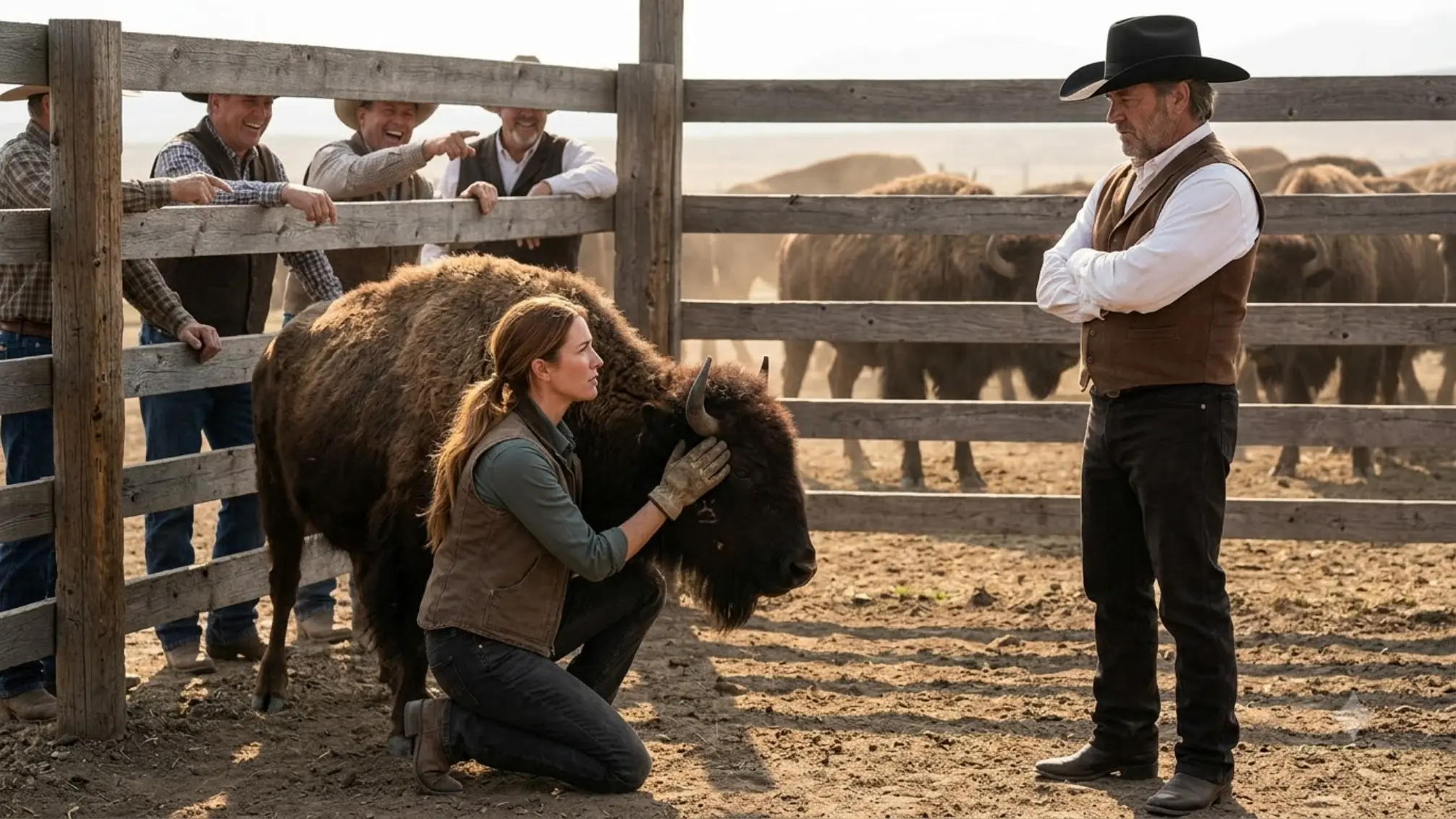
She stopped anyway. At thirty-five, Rowan had spent enough time around livestock to know the difference between an animal that was sick and one that was simply empty. These bison looked terrible, but their eyes remained alert, their hooves were generally sound, and even in their weakened condition they had arranged themselves in a loose defensive circle around the smallest members of the herd. One gaunt cow stood at the front with her head lowered, clearly exhausted but unwilling to surrender her place.
Rowan rested both hands on the fence. She wore a dark sage-green work shirt beneath an old brown vest, dark jeans, muddy boots, and gloves that had been repaired so many times they looked stitched from different decades. Her husband, Daniel, had died two years earlier, leaving Rowan to raise their nine-year-old son Finn and somehow keep one hundred sixty acres of struggling Wyoming grassland from becoming another parcel in Augustus Blackthorn’s expanding empire. She had survived mostly by repairing fences for neighbors, boarding horses, and refusing every offer Augustus sent.
Then she noticed the brand.
It was nearly invisible beneath the rough coat of the cow nearest her. Three faint points formed something resembling a crown, old enough that most buyers probably assumed it was meaningless. Rowan reached carefully through the fence and brushed away loose hair with her glove.
“Don’t waste your hand lotion,” a man behind her said.
Laughter followed.
Rowan turned.
Augustus Blackthorn stood near the auction ring with several ranchers surrounding him. At fifty-six, Augustus owned more grassland than anyone else in Red Hollow County and dressed as if even dirt needed permission before touching him. His white ranch shirt was spotless, his brown vest expensive, and his black cowboy hat looked like it had never experienced bad weather.
He studied the weak bison with amusement.
“Those things are already halfway buried.”
Rowan looked back at the crown-shaped brand.
Augustus noticed where her attention had gone.
For less than a second, his smile disappeared.
Then it returned.
That was enough.
The auctioneer stepped onto the platform.
“Final lot. Entire remaining herd. Forty head. Buyer responsible for removal by noon tomorrow.”
Nobody raised a paddle.
The auctioneer sighed.
“Eight hundred dollars for the lot.”
Silence.
Augustus folded his arms.
“Whoever buys them will spend more burying them than feeding them.”
Several men laughed.
Rowan kept staring at the herd.
The cow at the front turned her head toward Rowan and held her gaze.
Before Rowan had time to calculate whether what she was doing qualified as courage or stupidity, her paddle went up.
“Eight hundred.”
The entire yard became quiet.
Then the laughter exploded.
Augustus actually turned around to make certain everyone had seen who placed the bid.
“Rowan Hale.”
She refused to look at him.
The auctioneer waited.
No competing bid came.
“Eight hundred once.”
Rowan’s stomach tightened.
“Twice.”
She thought about her checking account.
Nine hundred eighty-three dollars.
“Sold.”
The gavel fell.
Rowan had one hundred eighty-three dollars left and forty starving bison that needed to leave the property within twenty-four hours.
Augustus walked toward her slowly.
“You just spent your last eight hundred dollars on forty walking corpses, Rowan.”
She knelt beside the front cow, reaching through the fence carefully until her glove touched the animal’s matted forehead.
“Funny.”
Augustus stopped.
Rowan looked up.
“You’ve been staring at their brands harder than their ribs.”
His face changed.
Only slightly.
“By spring,” Augustus said, stepping closer, “those animals will be gone, and your land will belong to me.”
Rowan brushed dirt from the crown-shaped mark.
“Then you’d better pray I never find out why you wanted this herd before the auction even started.”
Augustus said nothing.
That frightened Rowan more than another insult would have.
She drove home with the auction receipt folded inside her coat and spent the entire trip wondering whether she had just destroyed Finn’s future. Forty bison could consume feed faster than her horses, and her fencing had never been designed to hold animals capable of pushing through ordinary wire as though it were thread. Winter was approaching early, according to every forecast she had heard that week. Rowan had no livestock trailer, barely enough hay for her existing animals, and no money left for mistakes.
She did have a telephone.
That first night, her kitchen table disappeared beneath lists.
Feed.
Transport.
Fencing.
Veterinary care.
Minerals.
Water.
Rowan called everyone she knew.
Most declined politely.
A few laughed.
Wade Roark, an older rancher who had known Rowan’s father, was the first to say yes. His stock truck was ancient and far too small to move forty bison at once, but he agreed to make multiple trips in exchange for Rowan repairing nearly half a mile of fencing on his property the following spring.
“You know this is insane,” Wade told her.
“Yes.”
“Good.”
“Why good?”
“Means I don’t have to waste time convincing you.”
By sunrise, another person had agreed to help.
Dr. Silas Boone had spent decades treating cattle and conservation bison before partially retiring. He arrived at Blue Mesa wearing an old canvas jacket and the expression of a man expecting disaster.
“These animals are starved.”
“I noticed.”
“You cannot just feed them everything they’ll eat.”
Rowan frowned.
“Why?”
“Because after prolonged starvation, suddenly giving rich feed can cause serious metabolic problems.”
Rowan stared at the herd.
“So even feeding them wrong can kill them?”
Silas nodded.
“Welcome to the easy part.”
They separated three dangerously weak animals from the rest. Silas examined eyes, breathing, hooves, and movement. He expected disease and found mostly exhaustion.
That mattered.
“These animals aren’t finished,” he eventually said.
Rowan looked toward him.
“That your professional opinion?”
“My professional opinion is that you’ve purchased several months of expensive anxiety.”
“I’ll take it.”
The first trucks arrived at Hale Ranch late that afternoon.
People lined the county road to watch.
Some held phones.
By evening, videos were circulating with captions about the desperate widow who bought forty dying bison.
Finn saw one.
He sat at the kitchen table with Rowan’s old laptop and turned the screen toward her.
“They’re laughing at you.”
Rowan glanced at the comments.
“People laugh when they don’t understand something.”
“Do you understand it?”
She looked toward him.
“No.”
Finn considered that.
“Then why did you buy them?”
Rowan looked through the window.
The bison stood beneath the fading sky.
“Because everyone was looking at how bad they looked.”
“And?”
“I wanted to know why Augustus was looking at the brand.”
Finn smiled.
“That sounds more like you.”
The first crisis arrived that night.
The weak cow Rowan had touched at the auction collapsed near the north pasture.
Rowan found her lying on frozen ground, breathing hard and unable to rise.
She called Silas.
For the next several hours, he guided her through what could safely be done.
Wind protection.
Measured water.
Careful feed.
Observation.
Rowan built a barrier from spare panels and old plywood while temperatures continued dropping. Her fingers became numb even inside thick gloves.
Finn watched from the kitchen window.
He wanted to help.
Rowan would not let him enter the pasture.
“Being brave doesn’t mean standing near a frightened thousand-pound animal,” she told him.
Finn argued until midnight.
Then he eventually fell asleep near the window with a blanket around his shoulders and a notebook open on his knees.
Rowan stayed outside.
She spoke softly to the cow because silence made the hours feel longer.
“You’re making me look foolish.”
The bison breathed heavily.
“Whole town already thinks I lost my mind.”
Nothing.
“You could at least stand up out of spite.”
Shortly before dawn, the cow moved.
First her head.
Then one front leg.
Then the other.
Rowan backed away.
The cow pushed.
Her first attempt failed.
The second nearly did.
On the third, she stood.
Unsteady.
Exhausted.
Alive.
Rowan laughed into both hands.
When Finn woke, he found his mother sitting in the mud crying.
He ran outside until Rowan stopped him at the fence.
“She made it?”
Rowan nodded.
“What are you calling her?”
She looked toward the cow.
“Hope.”
Winter arrived properly two weeks later.
The feed supplier Rowan had arranged called one morning and canceled the entire order.
“What happened?”
The man sounded uncomfortable.
“Someone bought everything available.”
“Who?”
Silence.
Rowan already knew.
“Blackthorn Ranch and Beef?”
Another silence.
“I’m sorry, Rowan.”
Augustus had done nothing illegal.
That almost made it worse.
A wealthy ranch could purchase as much hay as it wanted.
If doing so happened to leave every smaller operator scrambling, that was simply business.
Rowan adapted.
She located abandoned fields where owners permitted her to cut old grass. She purchased lower-cost feed that Silas confirmed was safe. She divided the pasture into smaller sections and rotated the herd carefully, allowing the bison to consume shrubs and rough native vegetation cattle usually ignored.
People laughed again.
Augustus publicly called her strategy “slow starvation disguised as ranch management.”
Rowan kept records instead.
Every pound of supplementary feed.
Every pasture rotation.
Every veterinary observation.
Every animal gaining or losing condition.
Finn recorded weather conditions in his notebook.
Temperature.
Snowfall.
Wind direction.
By January, it had become his job.
“Four below,” he announced one morning.
Rowan poured coffee.
“Congratulations.”
“Wind from northwest.”
“Tell the bison.”
“They already know.”
He was right.
The herd behaved differently before severe weather, gathering into tighter formations and positioning themselves naturally against the wind.
Rowan began noticing more.
They pawed through snow to expose buried grass.
Older cows created openings younger animals followed.
They shifted toward low ground before storms.
They conserved movement on the coldest days.
This did not look like a broken herd.
It looked like a herd remembering how to survive.
Silas noticed too.
“These aren’t ordinary commercial animals.”
Rowan looked toward the crown marks.
“Then help me find out what they are.”
Before they could, Augustus invited Rowan to his office.
She almost refused.
Curiosity won.
Blackthorn Ranch headquarters occupied a building larger than Rowan’s home and barn combined. Augustus sat behind an enormous desk surrounded by photographs of prize cattle and expensive land acquisitions.
“Ninety thousand dollars.”
Rowan remained standing.
“For?”
“Your ranch.”
“No.”
He smiled.
“You haven’t heard the terms.”
“I heard the number.”
“Your debt disappears. You keep the house six months. I absorb the animals.”
Rowan stared.
“You want the bison too.”
“I want the land.”
“Then why mention them?”
Augustus leaned back.
“Because somebody eventually has to clean up the mess.”
Rowan smiled faintly.
“You still haven’t answered why you bought every bale of hay within fifty miles.”
“Business.”
“Right after I bought this herd.”
“Coincidence.”
“And why you contacted Blue Mesa before the auction?”
Augustus’s expression changed.
Rowan noticed.
He changed the subject.
“Your loan comes up for review this spring.”
Rowan became still.
“That sounds like information my bank shouldn’t be sharing.”
“I know people.”
“Apparently.”
“Take the money.”
“No.”
“Think about your son.”
Rowan’s eyes hardened.
“Do not use Finn to sell me my own fear.”
Augustus leaned forward.
“Pride makes people stupid.”
“Maybe.”
She stood.
“But it keeps making you raise the offer.”
By February, thirty-nine of the forty original bison remained alive.
Only one elderly animal died, and Silas considered the survival rate extraordinary given the condition in which Rowan received them.
More importantly, at least eighteen cows appeared pregnant.
Rowan should have celebrated.
Instead Silas pointed toward the dry mountains.
“Drought.”
Forecasts predicted one of the worst spring and summer dry periods in years.
Rowan looked toward the pregnant herd.
“Of course.”
Her problems multiplied.
Augustus’s operations manager, Preston Vale, filed formal complaints claiming Rowan’s fencing presented a public safety risk.
County inspectors arrived.
They found most conditions acceptable but ordered upgrades to one section within thirty days.
The cost threatened to empty what little money Rowan had managed to earn through winter work.
Then neighbors began arriving.
Not all.
Only a few.
Wade brought posts.
Silas brought tools.
Two smaller ranchers brought steel wire.
One of them had laughed at the auction.
Rowan recognized him.
He avoided her eyes.
“You charging me?”
“No.”
“Why?”
He drove a post into the earth.
“Because Blackthorn buying hay is business.”
Another strike.
“Trying to crush you through every other direction is something else.”
Rowan nodded.
“Thank you.”
He shrugged.
“Don’t make me emotional about it.”
During the fencing work, Rowan found another crown.
Then another.
Seven animals.
Twelve.
Eventually more than half the herd carried faint variations of the same three-point mark.
Silas stared at one for several minutes.
“I’ve seen that.”
“Where?”
“Years ago.”
He could not remember.
Rowan visited county records with Maren Cole, a clerk who understood that old paperwork often contained answers wealthy people assumed had disappeared.
They searched bankruptcies.
Shipping manifests.
Livestock transfers.
Ownership changes.
Then Maren pulled a faded document from a mislabeled folder.
HIGH PRAIRIE CONSERVATION LINE — RED CROWN HERD.
Silas almost dropped the page when Rowan showed him.
“You know it?”
“Everybody who worked serious bison conservation twenty years ago knew Red Crown.”
Rowan’s pulse quickened.
“What was it?”
“A selective conservation herd.”
He read the document.
“Cold tolerance. Drought resilience. Strong maternal behavior. Low domestic cattle genetic mixing.”
Rowan stared toward the pasture.
“And valuable?”
Silas looked at her.
“If these animals are actually intact Red Crown descendants?”
He paused.
“Very.”
The laboratory wanted more than twelve thousand dollars for complete genetic testing.
Rowan did not possess twelve thousand.
So she sold Daniel’s old work truck.
That decision hurt more than purchasing the herd.
Finn found her sitting inside it one final time.
“You okay?”
“Fine.”
“You always say that when you’re not.”
Rowan looked toward him.
“Your father loved this truck.”
Finn climbed into the passenger seat.
“He loved us more.”
Rowan closed her eyes.
“That’s annoyingly wise.”
“I’m nine.”
“I know.”
“It’s just a truck.”
Rowan smiled sadly.
“Don’t tell your father that.”
The samples went to the laboratory.
Then the drought arrived.
Pastures turned brittle.
Ponds shrank.
The old well pump failed.
Rowan hauled water by trailer while pregnant cows approached delivery.
She slept in two-hour stretches.
The first calf was born after midnight while Rowan knelt in dry grass holding a flashlight between her teeth.
A reddish little bull emerged.
Healthy.
Strong.
Rowan named him Copper.
Seventeen more calves followed.
Eighteen births.
Eighteen living calves.
Even Silas stopped pretending not to be impressed.
Augustus’s own premium herd was struggling.
Feed expenses soared.
Pregnancy rates fell.
Several animals lost condition badly during the heat.
Meanwhile Rowan’s bison consumed a wider range of vegetation and moved intelligently through her rotational grazing system.
People started visiting again.
This time they were not laughing.
Preston arrived one morning.
“Blackthorn wants the calves.”
“They’re not for sale.”
“He’ll pay premium.”
“They’re still nursing.”
“He’ll contract future ownership.”
“No.”
Preston smiled.
“You’re about to need cash.”
“So?”
“We can make market problems disappear.”
Rowan’s eyes narrowed.
“What problems?”
“Questions about whether your herd is truly pure conservation stock.”
“You mean rumors.”
“I mean uncertainty.”
“You’re threatening to damage their reputation before the laboratory report comes back.”
Preston shrugged.
“I’m telling you markets dislike uncertainty.”
Rowan stepped closer.
“Tell Augustus something for me.”
“What?”
“If he knows these animals are worthless, he should stop trying so hard to buy them.”
The laboratory email arrived five days later.
Silas drove to Rowan’s house without calling.
His face told her everything before he spoke.
“What?”
He handed her the report.
“Thirty-one animals carry direct Red Crown genetic markers.”
Rowan stared.
“Thirty-one?”
“Sixteen of the eighteen calves tested exceptionally strong.”
She sat down.
Silas continued.
“The herd has extraordinarily low domestic cattle genetic influence.”
Rowan looked toward the pasture through the window.
“So?”
“So you didn’t buy forty dying animals.”
He smiled.
“You bought one of the largest intact Red Crown breeding groups anyone has documented in years.”
Rowan laughed once.
Then stopped.
“What are they worth?”
Silas shook his head.
“Don’t ask that yet.”
“Why?”
“Because if Augustus knew what they were before the auction, this is about to get ugly.”
He was correct.
Within days, Augustus publicly accused Rowan of exaggerating the herd’s genetics.
He claimed she was using her reputation as a struggling single mother to attract sympathy and inflate value.
Then he produced a document claiming Blackthorn Ranch possessed a right of first refusal if Blue Mesa ever sold the Red Crown animals.
For one terrifying afternoon, Rowan thought everything might disappear.
Maren examined the document.
Then she smiled.
“What?”
“Look at the date.”
Rowan did.
“I don’t understand.”
“Blue Mesa legally dissolved three months before this agreement was signed.”
Rowan stared.
“So?”
“So whoever signed this had no authority to bind Blue Mesa anymore.”
“The document is worthless?”
“Legally?”
Maren smiled.
“Very close.”
Rowan decided she was finished defending herself privately.
She invited everyone.
Journalists.
County officials.
Ranchers.
Veterinarians.
Potential conservation buyers.
Even Augustus.
The inspection occurred at Hale Ranch on a bright morning after the first real rain in months.
Dozens of trucks lined the road.
Rowan wore her familiar green shirt and brown vest.
Finn stood safely beyond the fence with his weather notebook.
Celeste Whitmore from the High Plains Grassland Fund presented the independent findings.
The genetics were confirmed.
Red Crown.
The health data was extraordinary.
Thirty-nine recovered adults.
Eighteen surviving calves.
Lower supplementary feed use than neighboring operations.
Strong pasture recovery.
Excellent maternal behavior.
High drought adaptability.
Then Maren explained why Augustus’s supposed ownership document was legally meaningless.
Reporters turned toward him.
One asked the question Rowan had been waiting months to hear.
“Mr. Blackthorn, why did your company contact Blue Mesa before the public auction?”
Augustus refused to answer.
Preston did.
Perhaps he was tired of carrying the secret.
Perhaps he saw which direction the story was moving.
Either way, he spoke.
“Blackthorn intended to buy the herd after discouraging other bidders.”
The yard became completely silent.
Augustus turned toward him.
Preston continued.
“We knew the brand might be Red Crown.”
Rowan felt no triumph.
Only confirmation.
Augustus had known.
He had mocked her because he expected humiliation to make her surrender.
He had bought feed because he expected pressure to finish the job.
Celeste then announced a conservation agreement with Rowan.
Funding for improved water infrastructure.
Support for continued genetic monitoring.
Guaranteed placement within recognized conservation programs.
Advance reservations for future calves.
The bank called Rowan before sunset.
Her loan was no longer under threat.
The following morning, Finn woke her before sunrise.
“Mom.”
Rowan pulled a pillow over her head.
“What?”
“There are trucks outside.”
“Whose?”
“A lot.”
Rowan dressed quickly.
Pickup trucks lined the county road.
Ranchers from Wyoming.
Montana.
South Dakota.
Some had driven all night.
They wanted calves.
Breeding agreements.
Genetic access.
Information about her grazing methods.
One man Rowan immediately recognized removed his hat when she approached.
He had laughed at the auction.
“Mrs. Hale.”
“Rowan.”
“I’d like to put a deposit on a calf.”
She looked down the line.
“How many of you laughed last year?”
Nobody answered.
Finn whispered from beside her.
“Almost all of them.”
Rowan fought a smile.
She could have made them beg.
Could have doubled prices.
Could have repeated every insult they had thrown at her.
Instead she carried out a stack of application forms.
“No animal leaves before safe weaning.”
The men listened.
“Buyers need proper fencing, land, and veterinary plans.”
More silence.
“Conservation programs and smaller qualified operations receive priority.”
One rancher raised a hand.
“What about highest bidder?”
Rowan looked toward him.
“Money doesn’t automatically make somebody the right owner.”
Then Augustus’s truck arrived.
The line parted.
He stepped out carrying an envelope.
“Highest offer here.”
Rowan remained still.
“All eighteen calves. Exclusive future breeding rights.”
“No.”
“You haven’t read the number.”
“Doesn’t matter.”
Augustus stared at her.
“You’d turn down a fortune?”
“I’ll sell qualified animals under the program.”
“To me?”
“If you qualify.”
His face darkened.
“You’re putting me in line with these people?”
Rowan looked toward the ranchers he had once treated as smaller competitors.
“Yes.”
Silence.
Augustus finally understood.
For the first time, his money could buy access only under someone else’s rules.
One year after the auction, Hale Ranch became Red Crown Prairie Ranch.
Rowan did not build a mansion.
She built a better well.
Solar-powered.
Reliable.
She replaced dangerous fencing.
Paid urgent debts.
Secured permanent ownership of the ranch.
Set aside money for Finn.
Then she stopped spending.
The original herd remained largely intact.
Rowan sold only limited calves each season.
Silas became the ranch’s veterinary consultant.
Wade handled transport.
Maren created transparent genetic and ownership records.
Celeste connected Rowan with conservation projects throughout the West.
The most satisfying visitor came late one spring afternoon.
The auctioneer.
He stood beside the barn holding his hat.
“Mrs. Hale.”
“Rowan.”
“I’m representing someone interested in a Red Crown calf.”
She stared at him.
He looked uncomfortable.
“You remember me.”
“You called them forty walking corpses.”
The man looked toward his boots.
“I did.”
Rowan handed him an application.
“What’s this?”
“The process.”
“You’re not going to say anything else?”
“No.”
“Why?”
Rowan smiled.
“Because everybody waits their turn.”
Finn laughed from inside the barn.
Rowan kept auction paddle number 47 mounted near the office door.
Eight hundred dollars.
That was all the herd had cost.
Not really.
The true price had been months of cold nights, borrowed trucks, broken equipment, sold possessions, fear, debt, exhaustion, and refusing offers that could have ended the struggle instantly.
Sometimes visitors called Rowan lucky.
She stopped arguing.
Luck might have helped her notice the crown.
Luck might have placed the paddle in her hand before caution stopped her.
But luck did not keep Hope alive that first frozen night.
Luck did not haul water through drought.
Luck did not rebuild fencing.
Luck did not sit beside eighteen calving cows when sleep became something Rowan remembered other people doing.
Late one evening, Rowan walked the fence after Finn went inside.
The new steel wire shone beneath the fading sky.
Across the pasture, Hope moved slowly toward the ridge.
She was healthy now.
Her body filled out.
Her coat thick.
Behind her followed calves, cows, and younger animals descended from a herd everyone once considered worthless.
Hope reached the slope.
The others followed.
Rowan rested both hands on the fence.
A year earlier, Augustus had stood beside her and said he would own everything by spring.
He still owned thousands of acres.
Still had money.
Still possessed influence.
But he did not own this.
Rowan looked toward the barn.
The old auction paddle hung inside.
Number 47.
Finn appeared behind her.
“You coming in?”
“In a minute.”
He leaned beside her.
The herd climbed steadily toward open grass.
“You think Dad would’ve bought them?”
Rowan laughed softly.
“Absolutely not.”
Finn looked surprised.
“He was smarter than me.”
“So you think it was a bad decision?”
Rowan considered that.
“At the moment?”
“Yes.”
She looked toward Hope.
“But sometimes a bad-looking decision teaches you something.”
“What?”
“That survival and value aren’t always visible at the beginning.”
Finn nodded as though committing it to memory.
They watched the animals disappear over the ridge.
Forty starving bison had arrived with ribs showing and futures nobody wanted.
A year later, the herd had nearly doubled.
Ranchers who once laughed now waited for permission to buy descendants.
Scientists studied the Red Crown genetics.
Conservation programs wanted partnerships.
And Rowan Hale no longer spent every night wondering whether someone wealthier would eventually take her home simply because he could endure financial pressure longer than she could.
She had something stronger than a miracle.
Records.
Ownership.
Income.
Experience.
And terms nobody else could dictate.
Rowan touched the fence.
The old patched wire was gone.
The fear attached to it was fading too.
She finally understood something she had been too exhausted to see during the worst months.
She had believed she was saving forty rejected animals.
But every morning those animals forced her to get up.
Every crisis forced another decision.
Every threat forced her to discover exactly how much ground she was willing to defend.
Somewhere between that eight-hundred-dollar bid and the line of buyers outside her gate, Rowan stopped seeing herself as the widow barely holding Daniel’s ranch together.
It had become hers.
Her land.
Her herd.
Her decisions.
Her future.
Hope reached the top of the ridge and turned for a moment.
The old bison stood against the Wyoming sky, steady and strong.
Then she continued forward.
Rowan smiled.
A year earlier, nobody believed that animal would survive until winter.
Nobody believed the herd would survive until spring.
And almost nobody believed Rowan Hale could stand against Augustus Blackthorn long enough to find out what those animals truly were.
They had all been wrong.
Not because Rowan possessed secret wealth.
Not because somebody powerful appeared and rescued her.
Not because the bison suddenly transformed into something valuable.
The Red Crown blood had always been there.
So had Rowan’s stubbornness.
The world simply needed enough time to see both.
And by the time it finally did, the woman everyone laughed at was standing behind her own gate deciding who deserved the privilege of buying what they once refused to take for eight hundred dollars.