At twenty-nine, Grace Whitaker had learned that single motherhood made a woman hear the world differently.
She heard danger in the wind before the storm arrived.
She heard hunger in the way her son opened the refrigerator and said nothing.
She heard worry in her own voice when she told him everything was fine.
And on the coldest night of December, she heard loneliness in a knock on her front door.
Grace lived in Briar Falls, Pennsylvania, a small town tucked between dark hills, old railroad tracks, and roads that became dangerous the moment winter decided to stay.
Her house sat near the edge of town, a narrow white rental with peeling porch paint, a leaning mailbox, and a kitchen window that looked out toward the woods.
It was not much.
The roof complained when the wind came hard.
The furnace rattled like an old truck.
The back steps sagged in the middle.
But it was home.
And home mattered more when you were raising a child alone.
Grace had fair skin, tired green eyes, and long brown hair she usually tied into a loose bun before sunrise. Her six-year-old son, Noah, had soft brown curls, bright eyes, and a way of asking questions that made ordinary life feel larger than it was.
“Do snowflakes have families?”
“Why do old houses creak?”
“If soup is hot, does that mean it’s brave?”
Grace never laughed at his questions.
She answered every one as if it mattered, because to Noah, it did.
Grace worked at a small roadside diner called The Blue Lantern. It stood near the edge of town, where Main Street gave way to the highway and the old railroad tracks. The diner had a blue neon sign, red vinyl booths, a long counter with silver stools, and windows that rattled whenever the wind came from the west.
It had belonged to Grace’s father once.
After he died, Grace took over because she had no better option and too much history to let the place close. She made coffee before dawn, flipped pancakes, served truck drivers and nurses and farmers, and kept a little stool behind the counter where Noah did homework after school.
Money was always tight.
The diner roof needed repairs.
The freezer made a whining sound she pretended not to hear.
The electric bill had climbed again.
And her landlord had begun leaving polite messages about raising the rent on the building after New Year’s.
Grace did not tell Noah any of that.
Children deserved as much safety as a mother could build, even if the walls behind that safety were trembling.
So she smiled.
She packed his lunch.
She patched his coat sleeve.
She watered down soup when needed.
She learned how to make one roasted chicken become three meals.
She kept going because mothers often did.
The night the elderly stranger came, snow had been falling since late afternoon.
At first, it came gently, soft flakes drifting past the diner windows while the dinner rush moved through. By six o’clock, the wind had strengthened. By seven, the highway radio warned of dangerous conditions outside town. By eight, Grace had closed The Blue Lantern early, turned off the blue neon sign, wrapped Noah in his dinosaur blanket, and driven home slowly through white roads.
Their little house looked half-buried when they reached it.
Snow covered the porch steps.
The mailbox leaned under a white cap.
The wind pushed against the front door as if trying to enter before they did.
Grace carried Noah inside even though he insisted he was not asleep.
“I’m awake,” he mumbled against her shoulder.
“Of course you are.”
“I’m just resting my eyes with my whole body.”
“That sounds serious.”
“It is.”
She smiled tiredly, kicked the door closed behind them, and set him on the couch. The house was cold, but not freezing. The furnace clicked, coughed, and finally breathed warm air through the vents.
Grace moved through the kitchen by habit.
She hung Noah’s coat near the door.
She set a pot of leftover chicken noodle soup on the stove.
She checked the flashlight batteries.
Then she looked at the small stack of bills near the toaster and immediately looked away.
Not tonight.
Tonight, she only wanted warmth, soup, and her son safe inside.
Noah ate half a bowl before sleep pulled him sideways. Grace wiped his mouth, carried him to his small bedroom, and tucked him under two blankets. His room had glow-in-the-dark stars on the ceiling, a shelf of secondhand books, and a cracked plastic dinosaur lamp he refused to replace because, according to Noah, “old dinosaurs still have feelings.”
Grace kissed his forehead.
“Good night, baby.”
“Don’t let the snow eat the house,” he whispered.
“I won’t.”
“Promise?”
“I promise.”
She left the door open a few inches so the hallway light could reach him.
Downstairs, the wind pressed snow against the windows.
Grace washed the dishes, wiped the counter, and poured herself coffee she was too tired to drink. She stood at the kitchen sink, looking out at the dark yard, and let the silence settle around her.
That was when someone knocked.
Not hard.
Not urgent in the way a strong person knocks.
It was small.
Weak.
Almost swallowed by the storm.
Grace froze.
Her first thought was Noah.
Her second was danger.
She was a single mother alone in a small house at the edge of town, in a storm, with no one close enough to hear if something went wrong. She slowly reached for her phone on the counter and checked the window.
A figure stood on the porch.
Small.
Bent slightly against the wind.
An elderly woman in a pale gray coat, one gloved hand pressed to the doorframe for balance. Snow clung to her scarf, her shoulders, the edges of her glasses. Her face was pale from cold, and her lips trembled so badly Grace could see it through the glass.
The woman knocked again.
Weaker this time.
Grace’s fear did not disappear.
But something else rose above it.
The woman looked like someone who had already been turned away once.
Grace opened the door with the chain still on.
Cold rushed through the narrow gap.
“Can I help you?” Grace asked, keeping her voice careful.
The elderly woman lifted her face.
“I’m sorry,” she whispered. “I know it’s late. I saw the porch light. I didn’t know where else to go.”
Her voice cracked on the last word.
Grace looked past her.
No car.
No footprints except the uneven ones leading up the driveway.
No one else on the road.
The woman swayed slightly, and Grace’s decision made itself.
She closed the door, slid off the chain, and opened it fully.
“Come inside.”
The wind shoved the door inward so hard Grace had to brace it with her shoulder. The old woman stepped over the threshold carefully, moving as if every joint hurt. Grace shut the door quickly and locked it again.
For a moment, the woman only stood on the mat, dripping snow onto the floor.
“I’m sorry,” she said again. “I didn’t mean to frighten you.”
“You’re inside now,” Grace said. “That matters more.”
The elderly woman’s eyes moved toward the hallway.
“I don’t want to disturb anyone.”
“My son is asleep.”
“Oh.” The woman lowered her voice immediately. “I can leave if this is not safe for you.”
Grace studied her.
Even half-frozen, the woman was still trying not to be a burden.
That did something to Grace’s heart.
“No,” Grace said gently. “You can sit by the heater.”
The woman looked ashamed, as if warmth were too much to accept.
Grace guided her to the living room couch. The old woman lowered herself slowly onto the cushion, both hands gripping a worn brown handbag. Her gloves were wet. Her coat was too thin for the storm. Her black shoes were soaked through.
Grace brought a towel from the bathroom and placed it near her feet.
“What’s your name?”
The woman looked up.
“Eleanor Whitman.”
“I’m Grace. My son is Noah.”
Eleanor glanced toward the hallway.
“You have a child.”
“Yes.”
“Then you are very brave to open your door.”
Grace gave a tired smile.
“Brave or foolish. Sometimes mothers don’t know the difference until later.”
Eleanor’s mouth trembled.
“I promise I mean no harm.”
“I know.”
The strange thing was, Grace did know.
Not because she trusted the world.
She did not.
But she trusted what she had heard in Eleanor’s knock.
Fear.
Pride.
Exhaustion.
And the last small hope that someone might still open a door.
Grace went to the kitchen and returned with a mug of hot coffee.
“Do you drink coffee?”
“Yes. But dear, I can pay.”
“We’ll talk about payment after you stop shaking.”
Eleanor looked down at her hands.
They were trembling badly.
Grace set the mug in front of her.
Then she brought a bowl of chicken noodle soup, two slices of buttered toast, and a small plate with the last piece of apple pie.
When Eleanor saw the food, she shook her head.
“Oh no. Dear, no. I only needed to get out of the snow.”
“You also need to eat.”
“I don’t have enough money for all that.”
“Then it’s on the house.”
“I don’t take charity.”
Grace sat across from her for a moment.
“Then call it storm policy.”
Eleanor blinked.
“Storm policy?”
Grace nodded seriously.
“Anyone who knocks on my door during a snowstorm must eat soup. It’s very strict.”
For the first time, Eleanor gave a tiny laugh.
“That sounds made up.”
“It is. But it’s still policy.”
Eleanor’s eyes filled with tears.
She picked up the spoon with shaking fingers.
“Thank you.”
Grace stood and returned to the kitchen, giving her privacy while she ate. She watched without staring. Eleanor tried to eat slowly at first, but hunger overcame manners. She finished the soup, then the toast, then paused over the apple pie as if it were something precious.
Grace turned away to wipe the counter, pretending not to notice the tears Eleanor brushed from her cheeks.
After a few minutes, a small voice came from the hallway.
“Mom?”
Grace turned.
Noah stood there in his pajamas, curls messy, dinosaur blanket around his shoulders.
“I’m here, baby.”
He looked at Eleanor.
“Who’s that?”
“This is Miss Eleanor. She came in from the snow.”
Noah padded into the living room in his socks, dragging his blanket behind him.
“You cold?” he asked Eleanor.
Eleanor looked at him with such tenderness that Grace felt something catch in her chest.
“I was,” Eleanor said.
Noah held out one corner of his dinosaur blanket.
“You can have some.”
Grace almost told him not to bother their guest.
But Eleanor reached out and touched the blanket corner gently.
“That is very kind.”
Noah nodded.
“My mom says warm things are for sharing.”
Eleanor looked at Grace.
Grace smiled faintly.
“He remembers the good parts.”
“The good parts are the important parts,” Eleanor said.
Grace tried calling the local taxi service.
No one was driving.
She tried the community emergency ride line, but the voicemail said service was suspended until morning due to road conditions.
Then she asked Eleanor where she had been trying to go.
“My niece’s house,” Eleanor said, looking down at her handbag. “I took the bus from Harrisburg this morning.”
“In this weather?”
“It wasn’t this bad when I left.”
“Did someone expect you?”
“Yes. But my phone died, and the last bus into Briar Falls stopped before I reached the transfer point. A man at the station said my niece’s street was not far from here.”
Grace’s eyes moved toward the window.
The bus station was almost a mile away.
“You walked from the station?”
Eleanor’s cheeks flushed with embarrassment.
“I thought it was closer.”
“In this snow?”
“I didn’t want to sit there alone after they closed the waiting room.”
Grace pressed her lips together.
She wanted to be angry at someone.
The station clerk.
The weather.
The systems that left an old woman walking through snow with a dead phone.
But anger would not warm Eleanor.
So Grace chose action.
“Do you know your niece’s number?”
“It’s in my address book.”
Eleanor searched her handbag and pulled out a small paper book with a faded floral cover. Grace called the number twice. No answer. She left a message.
“Hi, this is Grace Whitaker in Briar Falls. I’m with your aunt Eleanor. She’s safe and warm at my house, but she missed her bus connection and her phone died. Please call this number as soon as you can.”
She hung up.
Eleanor stared at the floor.
“Linda works late sometimes. She probably doesn’t know I’m missing yet.”
“She’ll call.”
“If she doesn’t, I can leave in the morning.”
Grace looked at the storm outside.
Then at Noah, who had climbed onto the couch beside Eleanor and was fighting sleep again.
Then at Eleanor’s wet shoes.
“No,” Grace said. “You’re staying here tonight.”
Eleanor stiffened.
“Oh, I couldn’t possibly.”
“You can.”
“You don’t know me.”
“I know your name. I know you were walking alone in a snowstorm. I know you’re tired and hungry and trying very hard not to need help.”
Eleanor looked away.
That last part had reached her.
Grace softened her voice.
“I’m not inviting the whole world in. I’m giving one elderly woman one safe night.”
Noah mumbled from the couch, “She can have my dinosaur blanket.”
Grace smiled at him.
Eleanor covered her mouth.
“I don’t know how to accept that.”
“One step at a time,” Grace said. “First, dry socks.”
Grace gave Eleanor clean socks, a towel, and one of her own oversized sweaters. Eleanor resisted the sweater until Grace said, “Storm policy.”
That made the old woman laugh again.
Noah showed Eleanor the couch and explained very seriously that the left cushion was softer than the right one. Grace brought extra blankets from the closet, including the blue quilt her father had kept in the diner office years ago.
The house was small.
A narrow kitchen.
A living room with a worn sofa.
Two bedrooms upstairs, though Noah’s was barely bigger than a closet.
A bathroom with cracked tile.
A window that whistled when the wind hit from the north.
But that night, with soup warming the air and Eleanor’s wet shoes drying by the vent, it felt like shelter.
Grace made tea while Eleanor changed in the bathroom. When she came out, her silver hair was loosened from the scarf, and she looked even older than before.
Not weak.
Just worn down by too much weather, too much travel, and too much pride.
They sat at the small kitchen table with tea and crackers. Noah sat on Grace’s lap, wrapped in his blanket, blinking slowly.
Eleanor looked at them for a long time.
“I had a daughter once,” she said softly.
Grace became still.
“What was her name?”
“Claire.”
The old woman smiled sadly.
“She had brown curls like your boy.”
Noah touched his hair.
“Like me?”
“Yes,” Eleanor said. “Like you.”
“What happened?” Noah asked before Grace could stop him.
Eleanor did not seem offended.
“She got sick when she was young.”
Noah’s face changed.
“Did she get better?”
Eleanor’s eyes glistened.
“No, sweetheart.”
Noah looked at Grace, then back at Eleanor.
“That’s sad.”
“Yes,” Eleanor whispered. “It is.”
Grace pulled Noah closer.
“I’m sorry,” she said.
“Thank you.”
Eleanor looked into her tea.
“My husband died not long after. Arthur. He said grief had made a house with too many rooms, and he didn’t know where to sit.”
Grace felt tears prick her eyes.
“That’s beautiful.”
“He was a schoolteacher. He made everything sound wiser than it was.”
“I doubt that.”
Eleanor smiled.
After a while, Noah fell asleep against Grace’s shoulder. She carried him upstairs, tucked him into bed, and returned to the kitchen.
Eleanor was still there, holding the mug with both hands.
“I should not have come in,” she said quietly.
“Why?”
“Because now I feel how tired I am.”
Grace sat across from her.
“Sometimes safe makes tired show up.”
Eleanor looked at her.
“That is very true.”
“Do you live alone?”
“Yes.”
“In Harrisburg?”
“Yes. For now.”
“For now?”
Eleanor hesitated.
“My apartment building is being sold. The new rent will be more than I can pay. My niece Linda said I could stay with her for a while. I did not want to, but I also did not know where else to go.”
Grace listened.
“I thought if I made the trip myself, I would feel less like a burden.”
“And then the storm came.”
“And then the storm came,” Eleanor repeated.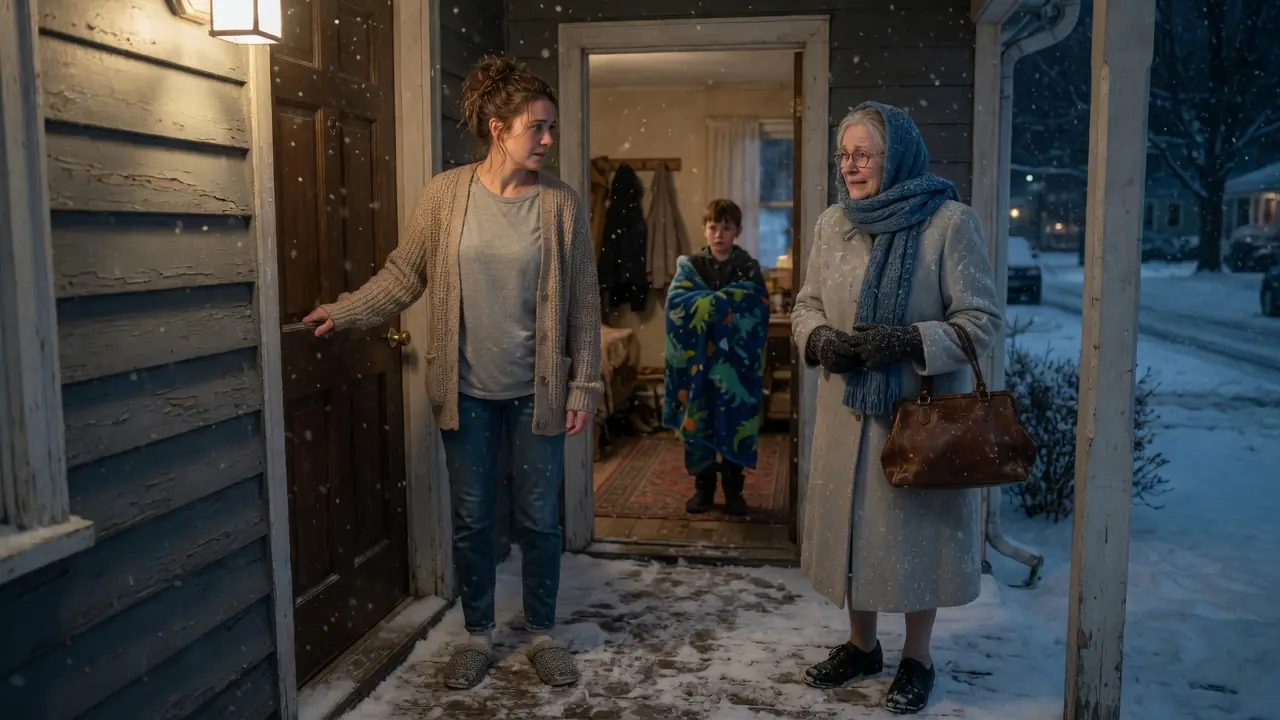
Grace looked at the woman’s tired face and saw something she recognized.
Not exactly homelessness.
Not exactly poverty.
But the terrifying edge near both.
One rent increase.
One missed bus.
One dead phone.
One storm.
A whole life could tilt.
Grace knew that edge.
She lived near it too.
The diner was behind on repairs. Her savings were thin. The landlord had hinted the building might be worth more to someone else. She had not told Noah because six-year-olds should not have to worry about leases.
But fear had a way of sitting at the table even when no one invited it.
Eleanor noticed her silence.
“You look worried too.”
Grace gave a small laugh.
“Motherhood.”
“No,” Eleanor said gently. “Something else.”
Grace almost denied it.
Then she surprised herself by telling the truth.
“The diner might not last.”
Eleanor’s eyes sharpened.
“Why?”
“The building lease is changing. Repairs are expensive. Business is slow except in storms, and storms don’t pay regular bills.”
Eleanor looked toward the living room, then toward the stairs where Noah slept.
“And this house?”
Grace lowered her gaze.
“It’s a rental. If the diner goes, I don’t know how long we can keep this either.”
Eleanor’s face softened.
“So you opened your home to me while you were afraid of losing your own.”
Grace swallowed.
“I didn’t think of it that way.”
“No,” Eleanor said. “That is why it matters.”
They sat in quiet understanding for a long time.
Outside, snow brushed against the windows.
Inside, the little house held three people who had all lost something and were still trying to remain standing.
Grace made up the couch with sheets and two blankets. Eleanor lay down slowly, still apologizing until Grace finally said, “If you apologize one more time, storm policy requires another bowl of soup.”
Eleanor laughed in the dark.
“All right. I’ll stop.”
Grace slept lightly that night.
She woke twice to check the living room. Both times, Eleanor was asleep on the couch, one hand resting near her handbag, her face softer than it had been downstairs.
By morning, the storm had passed.
The world outside was bright, buried, and silent.
Snow covered the porch, the yard, the road, and the roof of Grace’s old car.
Grace woke to the smell of coffee.
She hurried downstairs and found Eleanor standing carefully at the counter, wearing Grace’s sweater and making toast.
“Oh,” Grace said. “You didn’t have to.”
Eleanor turned, embarrassed.
“I woke early. I wanted to do something useful.”
Grace smiled.
“You found the bread.”
“And the toaster. It is a very dramatic toaster.”
“It has opinions.”
“I noticed.”
They laughed quietly.
Then they ate breakfast together: toast, scrambled eggs, coffee, and orange slices Grace had been saving for Noah’s lunch.
Eleanor protested over the oranges.
Grace said, “Storm policy includes fruit.”
Noah woke and came downstairs rubbing his eyes.
“Miss Eleanor still here?”
“I am,” Eleanor said.
“Good,” Noah said. “You didn’t freeze.”
“No, thanks to you and your couch advice.”
He looked proud.
At eight-thirty, Grace called Linda again.
This time, she answered.
Her voice broke the moment Grace explained.
“Aunt Eleanor? Oh my God. I thought the bus was canceled completely. I kept calling her phone. I didn’t know she made it that far.”
Eleanor took the phone.
“Linda, I’m all right.”
“Aunt Eleanor, I was terrified.”
“I know. I’m sorry.”
“Where are you?”
“At a kind woman’s home. Grace Whitaker. She and her son sheltered me overnight.”
There was a long pause.
Then Linda said, “Thank God for Grace.”
Linda could not drive immediately because the roads were still being cleared, but by noon she arrived in a red SUV, eyes swollen from worry.
She hugged Eleanor tightly in Grace’s snowy driveway.
Then she hugged Grace too.
“Thank you,” Linda whispered. “Thank you for not turning her away.”
Grace looked uncomfortable.
“She needed shelter.”
“Many people need things and still don’t get them.”
That stayed with Grace.
Before Eleanor left, she stood in Grace’s living room, looking around carefully.
At the worn sofa.
The drying shoes near the vent.
Noah’s dinosaur blanket folded on the chair.
The old framed photograph of Grace and her father on the bookshelf.
“This house has a good soul,” Eleanor said.
Grace smiled sadly.
“I hope that’s enough.”
Eleanor looked at her.
“Sometimes a good soul needs help with paperwork.”
Grace laughed.
“That is less poetic.”
“But more useful.”
Eleanor reached into her handbag and took out a small white card.
It read:
Eleanor Whitman
Whitman Family Trust
Grace frowned.
“What is this?”
“My husband left a family trust. It funds community projects sometimes. I don’t run it alone, but I still have a voice.”
Grace stared at her.
“I didn’t help you for money.”
Eleanor’s expression sharpened.
“I know.”
“I mean it.”
“So do I.”
Eleanor placed the card gently on the small table beside the couch.
“You gave me one safe night inside your home. I may be able to help your home and your diner give many more.”
Grace could not speak.
Eleanor touched Noah’s head gently.
“Take care of your mother, little one.”
Noah nodded solemnly.
“She makes soup.”
“That is an important qualification.”
Eleanor left with Linda.
Grace watched the red SUV drive slowly down the snowy road until it disappeared around the curve.
Then life returned to its ordinary difficulty.
Grace opened the diner.
Served coffee.
Made pancakes.
Cleared snow from the entrance.
Paid what bills she could.
Tried not to think too much about the business card tucked in her coat pocket.
Three days later, Noah found the letter.
It was early morning.
Grace had gone downstairs to start the coffee before driving to the diner. Noah had been allowed to sit on the inside stairs and put on his boots by himself, which he considered a very adult responsibility.
When Grace returned from warming the car, Noah was standing by the front door holding an envelope with both hands.
“Mom! Porch letter!”
Grace turned.
“What?”
“It was by the door.”
The envelope was cream-colored, sealed, and slightly damp at one corner. On the front, in careful blue handwriting, it said:
For Grace and Noah.
Grace’s heart began to beat faster.
She dried her hands on a dish towel and opened it.
Inside was a handwritten letter from Eleanor.
Dear Grace,
I have tried several times to write this simply, but gratitude refuses to stay simple.
The night you opened your home, I was more frightened than I admitted.
I had lost my phone, my route, my courage, and for a little while, my belief that I still belonged anywhere.
You gave me soup.
You gave me warmth.
You gave me your couch.
You gave me your son’s kindness and your mother’s courage without asking what I could give back.
That is rare.
I spoke with Linda and with the board of the Whitman Family Trust.
We cannot solve every problem, but we can do one useful thing.
If you are willing, we would like to fund repairs to The Blue Lantern Diner and establish it as an official winter safe-stop location for stranded travelers, elderly residents, and families needing emergency shelter during storms.
The trust would also cover one year of rent increase protection on the diner building, repairs to your home’s furnace and roof, and support for a small guest room so no one has to sleep in a booth or walk through snow looking for help.
This is not charity.
It is partnership.
You already built the heart of the place.
We would only be helping the walls hold.
With gratitude,
Eleanor Whitman
Grace sat down hard on the bottom stair.
Noah climbed onto the step beside her.
“Mom?”
She could not answer at first.
Her eyes filled so quickly the words blurred.
Noah touched her arm.
“Is it bad?”
Grace shook her head.
“No, baby.”
“Good?”
She laughed through tears.
“Yes.”
“How good?”
Grace pulled him close.
“Like someone opened a door when I thought there was only a wall.”
Noah thought about that.
“Miss Eleanor?”
“Yes.”
“She writes big letters.”
Grace laughed and cried at the same time.
“She does.”
The repairs began two weeks later.
Not grand renovations that erased the diner’s history.
Careful repairs.
Respectful repairs.
The Blue Lantern’s roof was fixed.
The old heater was replaced.
The freezer stopped whining.
The front door was insulated.
A backup generator was installed.
The small storage room in the back became an emergency rest room with a cot, clean blankets, phone chargers, a first-aid kit, and a lock on the door.
Then Grace’s little house was repaired too.
The furnace was serviced.
The porch steps were rebuilt.
The kitchen window was sealed.
The roof leak above Noah’s room was fixed before spring rain could make it worse.
Grace cried when the workers finished.
Noah asked if the house was “less scared now.”
Grace hugged him and said, “Yes. I think it is.”
The Blue Lantern Diner became part of Briar Falls’ winter emergency map.
A sign appeared near the entrance:
Winter Safe Stop
Warm meals, emergency calls, and overnight shelter coordination during severe weather.
Grace cried when she saw it.
Noah asked if they were famous now.
Grace said no.
“Useful?” he asked.
Grace smiled.
“Yes. Useful.”
Eleanor visited often after that.
Sometimes with Linda.
Sometimes alone, when the weather was good.
She sat at the counter, drank coffee, and helped fold napkins. She brought old recipes from her mother’s kitchen. She taught Grace how to make apple dumplings the way Arthur had loved them.
Noah adored her.
He showed her drawings.
Asked her questions.
Let her borrow his crayons but not the purple one, because purple was “emotionally important.”
Eleanor accepted this rule with great seriousness.
The winter safe-stop program grew quietly.
A truck driver stranded in freezing rain slept in the back room one night.
An elderly woman whose ride never came waited at the diner until her grandson arrived.
A family with two children stayed for three hours during a whiteout.
A man traveling to see his sick wife used the diner phone when his battery died.
And once, when a frightened young mother knocked on Grace’s front door during another storm because the diner had already closed, Grace opened it without hesitation.
She saw herself in that woman.
Cold hands.
Tired eyes.
A child bundled against her chest.
Grace brought them inside.
Soup first.
Questions second.
Eleanor called that “Grace’s law.”
Grace called it common sense.
Years passed.
The Blue Lantern became known as more than a diner.
It became a place where lights stayed on during storms.
Where coffee was hot.
Where children could sleep under clean blankets.
Where elderly travelers could call family.
Where no one had to explain fear before receiving warmth.
The Whitman Family Trust eventually helped Grace create a small nonprofit branch called The Porch Letter Project.
It supported rural diners, libraries, churches, and community buildings willing to become safe stops during extreme weather.
The name came from the letter Noah found.
Grace resisted at first.
“It sounds too sentimental.”
Eleanor disagreed.
“Sentiment is only dangerous when it refuses to work. This works.”
So The Porch Letter Project was born.
It funded emergency cots, backup heaters, phone chargers, food supplies, volunteer training, and transportation partnerships.
Grace, who once feared losing the diner and her home, became the director of a growing network of safe stops across the county. She never stopped cooking. She never stopped wiping counters. She never stopped being Noah’s mother first.
But her world expanded.
Noah grew up inside the work.
He learned to make coffee before he learned algebra.
He learned to fold blankets and label emergency supply bins.
He learned that strangers could become people with names if you asked the right question.
And he never forgot the night Miss Eleanor slept on their couch.
Eleanor lived long enough to see The Porch Letter Project open its tenth safe stop.
At the ceremony, she sat beside Noah, now a teenager, and squeezed his hand.
“You found the letter,” she told him.
He smiled.
“I was six.”
“That was old enough.”
“For what?”
“To carry a story forward.”
Eleanor passed away peacefully the next spring.
At her memorial, Grace placed a bowl of chicken noodle soup on the reception table beside apple pie and coffee. People laughed softly when they saw it.
They understood.
After the service, Linda handed Grace one final envelope.
“She wrote this for you and Noah.”
Grace waited until she and Noah were back at The Blue Lantern to open it.
They sat in the booth closest to the window, the one Eleanor had liked best.
The letter was written in the same careful blue handwriting.
Dear Grace and Noah,
The night I came to your door, I thought I was only asking to escape the snow.
But I was also asking, though I did not know how to say it, whether I still mattered enough for someone to make room.
You made room.
Noah, you shared your blanket.
Grace, you shared your home.
Because of that, The Blue Lantern became what it was always meant to be: a light left on for people who feared they had reached the end of the road.
The Porch Letter Project was never repayment.
It was continuation.
You sheltered one elderly stranger.
Then you taught a county how to shelter many.
Keep the soup warm.
Keep the door wise.
Keep the light blue.
With love,
Eleanor Whitman
Grace framed the letter and hung it near the diner entrance.
Beside it, she hung the first letter Noah had found on the porch, carefully protected behind glass.
Years later, whenever people asked how The Blue Lantern became a winter safe stop, Grace told them the truth.
“It began with an elderly woman knocking during a snowstorm and a little boy finding a letter on the porch.”
Then she would point to the frame.
The gift Grace received was not only money.
Not only repairs.
Not only rent protection.
It was a chance.
A partnership.
A future in which the home she opened for one stranger helped create shelter for many.
And every winter after that, when snow began to fall and the highway turned white, Grace kept the diner lights on.
At home, she kept the porch light on too.
Noah, older now, still checked the porch every morning after a storm.
Not because he expected another letter.
But because he had learned that sometimes life left miracles quietly by the door.
And sometimes, opening that door for one stranger was enough to change the home behind it forever.