Mariana Cárdenas had learned that grief did not stop babies from crying, laundry from piling up, or hunger from returning every evening. Four months after her husband died beneath a falling tree on the San Laureano Hacienda, she still woke before sunrise because five-month-old Emiliano and Jacinta depended on her for everything. By midmorning, she had fed them twice, swept the adobe floor, gathered eggs from three thin hens, and carried two buckets of water from the shallow well. Then she began washing clothes for families in town because mourning did not pay for beans, flour, lamp oil, or medicine.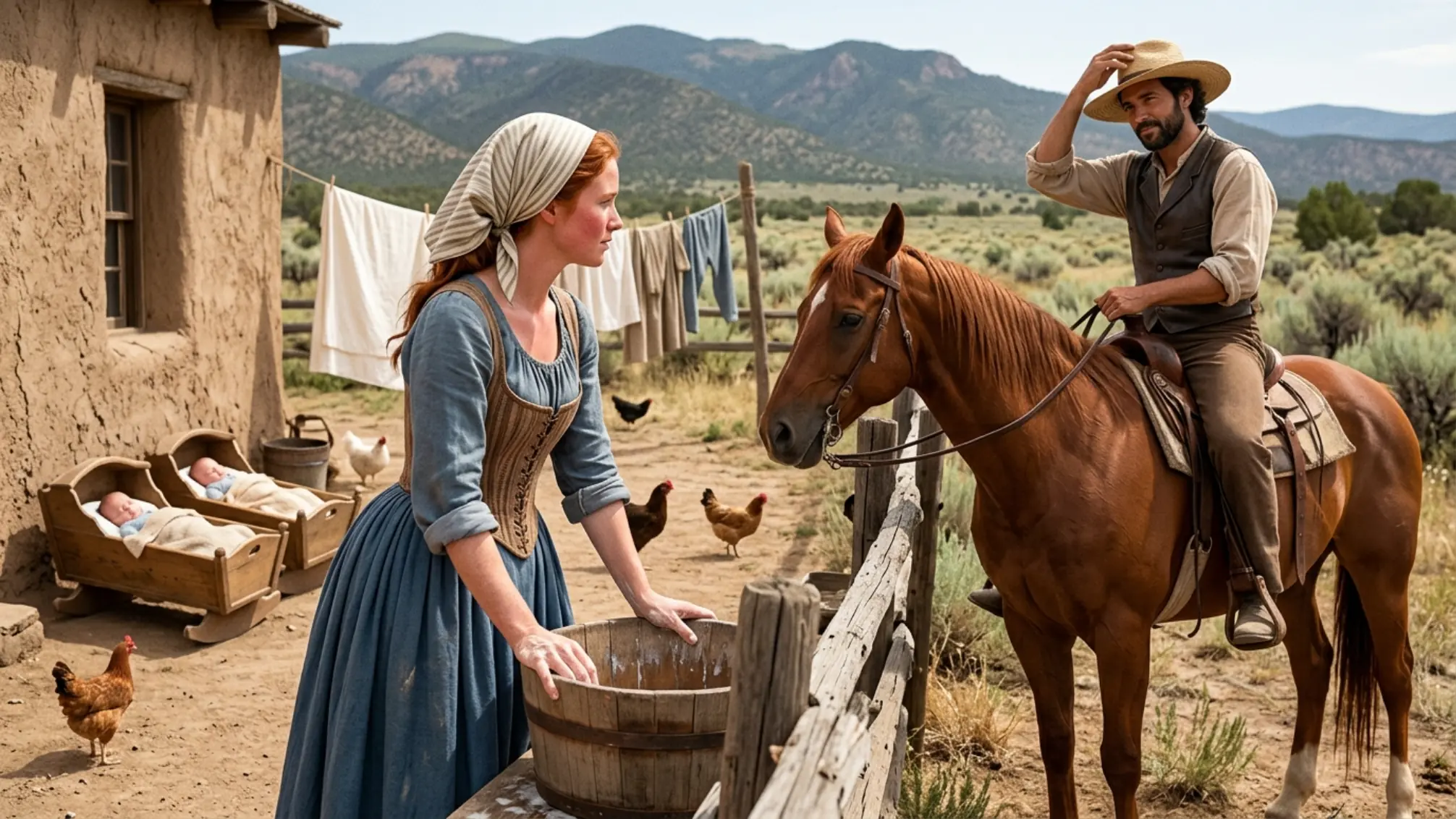
The old wooden washbasin stood beneath the uneven shade of the house wall, and Mariana bent over it with both sleeves rolled above her forearms. Her copper-red hair was hidden beneath a striped cream headscarf, and she wore the same faded blue frontier dress she had repaired so many times that several seams contained more thread than original cloth. A brown lace-up bodice supported her back while she worked, but hours of twisting wet sheets still sent pain into her shoulders. Beside her, the twins slept inside two small wooden cradles that Jacinto had built from leftover boards during the final weeks of her pregnancy.
Jacinto Morales had promised those cradles would last long enough for grandchildren to use them someday. Instead, he had been buried before either baby learned to roll over. The official explanation said a rotten tree had fallen unexpectedly while he cleared brush for Don Anselmo Robledo, the wealthiest landowner in the valley. Mariana had never seen the accident site because workers had already removed the tree and cleaned everything before anyone came to fetch her.
She had asked questions at first. Why had Jacinto been working alone? Why had no foreman inspected the tree before ordering him beneath it? Why had Don Anselmo refused to speak with her afterward?
Nobody answered.
A widow with infants, no savings, and a house built on borrowed land did not possess the kind of power that made wealthy men nervous. Don Anselmo sent twenty pesos for burial expenses and then informed Mariana that because Jacinto was dead, his employee housing arrangement would end within six months. Mariana could remain temporarily if she paid rent. The amount he demanded was almost exactly what she earned washing other people’s clothes.
That Friday afternoon, the heat pressed heavily across the yard despite the mountains rising blue in the distance. Mariana was wringing out a white bedsheet when the sound of hoofbeats reached her from the canyon road. She straightened slowly, water dripping from both hands, and looked toward the broken fence. A strong chestnut horse appeared between the cottonwoods carrying a stranger she had never seen before.
He did not ride directly into the yard. Instead, he stopped several yards beyond the fence and removed his broad straw hat before speaking. He appeared to be somewhere around thirty-eight, with lightly tanned skin, wavy dark hair, a short beard, and the sturdy build of a man accustomed to ranch work rather than salons. His beige shirt was dusty at the shoulders, his leather vest had seen years of use, and his boots were worn enough that Mariana knew he probably worked harder than his clean saddle suggested.
“Good afternoon,” he called. “Forgive me for disturbing you.”
Mariana did not answer immediately. A woman living alone with babies learned to judge men first by how close they stood, how quickly they moved, and whether their eyes traveled where they should not. This man remained beyond the fence.
“My horse and I took the canyon road,” he continued. “I underestimated the heat.”
Mariana glanced toward the water jar near the house. “You want water?”
“If you can spare some.”
She dried her hands on her apron before walking inside. When she returned, she carried a clay mug filled nearly to the brim. The stranger dismounted but waited for her to close half the distance first.
He accepted the mug with both hands. “Thank you.”
Mariana watched him drink. He did not gulp despite clearly being thirsty, and when he finished, he wiped the edge with his thumb before offering the mug back. “That may be the best water I’ve had all week.”
“You’ve had a poor week.”
The man smiled.
His eyes shifted briefly toward the babies.
Mariana stiffened.
“They’re mine.”
“I assumed so.”
His tone contained no judgment. He looked at the small cradles again and said, “They sleep like they’ve never had a worry in the world.”
Mariana had heard people describe the twins many ways. Expensive. Fragile. Trouble. Two mouths she could not afford.
No one had ever looked at them and simply called their sleep peaceful.
“The boy is Emiliano,” she said. “The girl is Jacinta.”
“Beautiful names.”
Mariana immediately wondered why she had told him.
“And yours?”
“Rafael Arriaga.”
She recognized it.
There was an Arriaga ranch beyond the western canyon, almost twenty miles away, known for cattle, horses, and one owner who rarely attended town celebrations. Some people said Rafael Arriaga had inherited considerable land after his father died. Others claimed he preferred sleeping beside cattle during calving season to attending dinners with wealthy neighbors.
Mariana held out her hand for the mug.
“Thank you, Doña Mariana,” Rafael said.
She raised an eyebrow.
“I never told you my name.”
He paused.
Then he pointed toward a wooden board nailed beside the door.
J. MORALES & M. CÁRDENAS
Jacinto had carved it years earlier.
Rafael’s expression changed slightly when he noticed the second name.
“Your husband?”
“Dead.”
“I’m sorry.”
Mariana had grown tired of hearing those words because people usually said them only to escape uncomfortable silence. Rafael did not rush to add anything. He simply lowered his hat respectfully.
Then he mounted his horse.
“Thank you for the water.”
“You already said that.”
“I might be thirsty again someday.”
Mariana nearly smiled.
“You have wells on your ranch, Señor Arriaga.”
“So I’ve been told.”
He rode away.
Mariana returned to the washbasin, but something had shifted inside the afternoon. She told herself it was nothing important. A man had asked for water, she had given it, and he had left.
Yet when Emiliano woke crying twenty minutes later, Mariana found herself glancing toward the road.
Three days passed.
Rafael returned.
This time he arrived shortly before noon carrying no visible excuse except the same horse and the same hat.
Mariana was hanging sheets across a rope when she saw him.
“Thirsty again?”
“Terribly.”
“You crossed twenty miles of ranch country without finding another well?”
“Unfortunate, isn’t it?”
She stared at him.
Rafael smiled.
Mariana filled the mug anyway.
While he drank, he studied the house rather than her. Several clay roof tiles had shifted during recent winds, one support beam beside the kitchen wall leaned visibly, and half the fence had fallen inward after a storm. Rafael lowered the cup.
“Those roof tiles won’t survive heavy rain.”
“I know.”
“Storms are expected this week.”
“I also know that.”
“I have tools.”
Mariana immediately shook her head. “No.”
“It would take an hour.”
“I have nothing to pay you.”
“I didn’t ask for money.”
“That makes it worse.”
Rafael seemed genuinely confused. “Why?”
“Because people always want something.”
He looked at her for several seconds.
Then his eyes moved toward the twins.
“Sometimes they don’t.”
Mariana hated how much she wanted to believe him.
She crossed both arms.
“You can fix the roof.”
Rafael nodded.
“You do not enter the house.”
“Understood.”
“And if you fall, I cannot pay a doctor.”
“I’ll try to remember that.”
He worked for almost two hours.
Mariana pretended not to watch while he climbed onto the roof, reset loose tiles, reinforced the damaged corner, and replaced two rotting pieces of wood with boards he somehow produced from his saddle pack. After finishing the roof, he straightened the support near the kitchen and then repaired the fence without being asked. He worked quietly, stopping only once when Jacinta began crying.
Mariana lifted the baby from the cradle.
Rafael remained several steps away.
“She hungry?”
“Always.”
He nodded thoughtfully. “Good sign.”
“How would you know?”
“My sister had four.”
Mariana looked surprised.
“You have family?”
“Had.”
His expression closed for a moment.
She did not ask.
When Rafael finally prepared to leave, Mariana discovered a small sack of beans and a wrapped wedge of cheese beside the doorway. She looked toward him sharply. “What is this?”
“I bought too much.”
“Liar.”
Rafael adjusted his saddle.
“A little.”
“You cannot keep bringing food here.”
“Then next time I’ll bring nails.”
“There should not be a next time.”
He smiled faintly.
“Then I suppose I’ll have to become thirsty somewhere else.”
Mariana watched him ride away.
That evening rain began.
For the first time since Jacinto died, not a single drop landed beside the babies’ cradles.
Rafael returned the following week.
Then again six days later.
Sometimes he brought nothing. Sometimes he repaired something minor. Once he traded Mariana two sacks of cornmeal for six jars of preserves she had made from wild berries, deliberately insisting that the preserves were worth more than she believed.
Mariana eventually realized he was creating excuses because direct charity would offend her.
She began creating excuses too.
If Rafael arrived near noon, there happened to be extra tortillas. If he repaired a gate, there happened to be coffee already boiling. If he sat beneath the cottonwood after working, Mariana happened to need someone to hold Jacinta while she folded laundry.
The first time Rafael held the baby, he looked terrified.
“She’s smaller than a saddlebag.”
“She bites harder.”
Jacinta immediately grabbed his beard.
Rafael winced.
Mariana laughed harder than she had laughed since Jacinto died.
Emiliano became fascinated with Rafael’s hat. Whenever the rancher leaned close, the baby reached upward with both hands. Rafael began removing the hat before entering the yard and placing it near the cradle simply so Emiliano could slap it.
Mariana noticed.
She noticed many things.
Rafael never entered her home unless invited. He never touched Mariana casually. He never spoke badly of Jacinto.
Most importantly, he never behaved as though kindness entitled him to gratitude.
That made trusting him more dangerous.
Trust meant having something worth losing.
People in San Laureano noticed Rafael’s visits before Mariana understood how frequently he came.
The first warning arrived from Doña Eulalia, whose laundry Mariana washed.
“You should be careful.”
Mariana continued scrubbing a sheet.
“With soap?”
“With Arriaga.”
Mariana stopped.
“He visits you.”
“He drinks water.”
Doña Eulalia laughed.
“A man does not travel twenty miles for water.”
“Apparently mine is exceptional.”
“I’m serious.”
Mariana resumed washing.
“So am I.”
By Sunday, whispers followed her through the market. Some women implied she had begun entertaining a wealthy rancher before her husband’s grave had settled. Several men joked that Rafael must be purchasing something besides water.
Mariana went home furious.
Rafael arrived that afternoon.
She met him at the fence.
“You cannot come anymore.”
His expression immediately changed.
“What happened?”
“Nothing.”
“Mariana.”
She hated how gently he said her name.
“People are talking.”
“People always talk.”
“You can afford not to care.”
He became quiet.
“I cannot.”
Rafael looked toward the house.
“Do you want me to leave?”
Mariana wanted to say yes.
Instead, she whispered, “I don’t know.”
He nodded.
“All right.”
Then he mounted his horse.
Mariana had expected persuasion, promises, perhaps wounded pride.
Rafael simply tipped his hat.
“If you decide you want me here, you know where my ranch is.”
He left.
The yard felt larger after he disappeared.
For ten days Rafael did not return.
Mariana discovered quickly that silence could become a habit and then become a wound. She missed his horse at the fence, his terrible excuses, the way he held Jacinta as though she were made of glass, and the strange peace of having another adult nearby.
She told herself missing someone was not the same as needing them.
Then Don Anselmo Robledo arrived.
He came in a polished black carriage with his estate administrator, Luis Herrera, beside him. Don Anselmo was nearly sixty and still dressed as though every patch of dirt beneath his boots belonged to him. In San Laureano, that was almost true.
Mariana remained beside the washbasin.
“What do you want?”
Don Anselmo looked around the property.
“This house is still company land.”
“I know.”
“Your six months are nearly finished.”
“I have paid every rent installment.”
“Terms are changing.”
Mariana’s stomach tightened.
“How?”
“The rent doubles next month.”
“That is impossible.”
“Then you leave.”
She stared at him.
“You told Jacinto this house would remain ours while he worked for you.”
“Jacinto is dead.”
The cruelty in the sentence stunned her.
Don Anselmo noticed the babies.
“You have family somewhere.”
“No.”
“Then perhaps Arriaga will take responsibility for you.”
Mariana’s face burned.
“So that is why you came.”
“I came because my property has become inconvenient.”
“You came because people told you Rafael visits.”
Don Anselmo’s expression hardened.
“Be careful, widow.”
Mariana stepped closer.
“You be careful speaking about my children’s home as though it were a stable you can empty whenever you wish.”
Herrera shifted nervously.
Don Anselmo smiled coldly.
“Thirty days.”
Then he left.
That evening Mariana searched through Jacinto’s belongings.
She found clothing, tools, his Bible, and several old pay receipts. Near midnight, she discovered a folded paper hidden inside the wooden bottom of his work chest. It was a rough map of the San Laureano northern forest.
A red mark appeared near the location where Jacinto died.
Beside it he had written:
They are cutting beyond the boundary. Robledo knows.
Mariana stared at the note.
Jacinto had been clearing brush near disputed land.
His death suddenly felt different.
The following morning, Mariana saddled the old mare Jacinto had left behind.
She strapped the twins securely into a small covered cart and traveled west.
Rafael’s ranch took almost four hours to reach.
When she finally arrived, Rafael was repairing a corral gate.
He saw her from across the yard and immediately dropped the hammer.
“Mariana?”
She climbed from the cart.
“I decided I want you there.”
Rafael approached slowly.
“What happened?”
She handed him Jacinto’s map.
Rafael read it.
His expression changed.
“I know this boundary.”
Mariana stared.
“How?”
“Because part of this forest borders my property.”
He pointed toward the red mark.
“Robledo has been cutting timber there illegally for years.”
“Jacinto knew.”
“Yes.”
Mariana felt suddenly cold despite the afternoon heat.
“And then he died.”
Rafael looked at her.
“Tell me everything.”
They spent the next several hours reviewing Jacinto’s old receipts and Rafael’s land records. Several timber deliveries from San Laureano listed quantities far larger than Don Anselmo could legally harvest from his own acreage. Rafael had suspected theft but never knew exactly where it originated.
Jacinto had apparently discovered the operation.
The tree that killed him may not have fallen by accident.
Rafael wanted to contact the territorial land office immediately.
Mariana refused to rely on suspicion alone.
“We need proof.”
Rafael looked at her with something like pride.
“Yes.”
They found it three nights later.
A former San Laureano worker named Tomás Vega agreed to speak after Rafael assured him he would not be left alone against Don Anselmo. Tomás admitted that Jacinto had confronted Herrera about illegal logging only two days before his death.
“He said he would report it.”
Mariana’s hands tightened.
“What happened the morning he died?”
Tomás looked down.
“Herrera told everyone to work south except Jacinto.”
“Why?”
“He said Jacinto had one tree to clear.”
“What tree?”
Tomás swallowed.
“The one that fell.”
Rafael leaned forward.
“Was it unstable?”
“No.”
Mariana stopped breathing.
Tomás continued.
“The trunk had already been cut halfway through before Jacinto arrived.”
Silence filled the room.
Mariana felt tears in her eyes but refused to let them fall.
“Who cut it?”
“I don’t know.”
“But Herrera knew?”
“Yes.”
That was enough to begin an investigation.
The territorial inspector arrived within a week, accompanied by two deputies and a forestry surveyor. They examined the disputed boundary, measured old stumps, compared shipping records, and interviewed former workers.
The evidence grew quickly.
Don Anselmo had stolen thousands of dollars in timber from public and neighboring land. Herrera had falsified work orders and payroll records. Jacinto’s final assignment appeared deliberately arranged to isolate him beneath a partially cut tree.
Herrera broke first.
Facing charges that could leave him imprisoned for years, he admitted Don Anselmo had ordered him to “frighten Jacinto into silence.” He claimed nobody intended for the tree to kill him.
Mariana did not care what they intended.
Her husband had still died.
Don Anselmo was arrested for conspiracy, illegal logging, fraud, and reckless conduct connected to Jacinto’s death. The court also discovered that the land containing Mariana’s house had never legally belonged to San Laureano Hacienda.
It belonged to Jacinto.
Years earlier, part of his wages had been paid through a small land grant that Don Anselmo never properly recorded.
Rafael found the original document inside county archives.
When he brought it to Mariana, she stared at the paper for a long time.
“The house is mine?”
“And the twelve acres around it.”
Mariana looked toward the twins.
“Jacinto gave them a home.”
Rafael smiled.
“He did.”
Weeks passed.
The gossip in town changed tone as quickly as wind changing direction. People who had called Mariana foolish now praised her courage. Those who had criticized Rafael suddenly claimed they always believed him honorable.
Mariana ignored them.
She had learned that public opinion had little value.
Rafael continued visiting.
This time nobody could frighten him away because Mariana no longer wanted him gone.
He still stopped at the fence.
One afternoon Mariana walked toward him carrying the clay mug.
“You know you can come inside now.”
Rafael smiled.
“I like being invited.”
She handed him the water.
“You have been invited.”
“To the yard?”
“To stay.”
His smile disappeared.
Mariana’s heart began beating faster.
“I mean for supper.”
Rafael exhaled.
“That is considerably less terrifying.”
She laughed.
“Coward.”
“I’ve faced stampeding cattle with less fear than you.”
“Good.”
Their courtship became simple.
Rafael ate supper with Mariana and the children. He repaired fences with her rather than for her. Mariana began helping him organize ranch accounts because she discovered his bookkeeping system consisted mainly of remembering which drawer contained which unpaid bill.
The twins grew.
Jacinta learned to sit.
Emiliano learned to crawl and immediately developed a fascination with escaping every blanket placed beneath him.
Rafael became part of their daily life so gradually that none of them noticed exactly when it happened.
Then one winter evening Emiliano developed a fever.
Mariana panicked.
The nearest doctor lived almost twenty miles away.
Before she could even ask, Rafael was already saddling his horse.
He rode through freezing rain and returned before dawn with the doctor.
Emiliano recovered.
Mariana sat beside the baby after the physician left, exhausted beyond words.
Rafael remained near the doorway.
“You can go home.”
“I know.”
“You’ve been awake all night.”
“So have you.”
Mariana looked at him.
“Why are you still here?”
Rafael hesitated.
Then he answered honestly.
“Because this feels like home.”
Mariana’s breath caught.
He stepped closer but did not touch her.
“I loved once before.”
She waited.
“My wife died twelve years ago.”
Mariana had never known.
“We were married eight months.”
“I’m sorry.”
Rafael nodded.
“I decided afterward that one grief was enough.”
“And then?”
His eyes moved toward the twins.
“Then a woman gave me water.”
Mariana smiled through sudden tears.
“That was a very expensive cup.”
“The best investment I’ve made.”
She laughed softly.
Rafael reached into his coat.
He removed no extravagant ring.
Only a simple silver band.
“Mariana, I don’t want your land.”
She looked at him.
“I don’t want you because you need help.”
He swallowed.
“I want to wake up hearing you tell me what I repaired incorrectly.”
Mariana laughed again.
“I want Emiliano stealing my hat and Jacinta destroying my beard.”
His voice softened.
“And I want whatever years we get together.”
Mariana looked toward the sleeping twins.
Then back at Rafael.
“You know I loved Jacinto.”
“I would be worried if you didn’t.”
“You will never replace him.”
“I’m not trying to.”
That answer decided everything.
Mariana held out her hand.
“Yes.”
Rafael stared.
“Yes?”
“Before I reconsider.”
He slid the ring onto her finger.
Then Mariana pulled him close enough to kiss him.
Their wedding took place beneath the cottonwood tree outside Mariana’s house.
There were no wealthy guests, expensive decorations, or grand promises. Tomás Vega brought flowers. Doña Eulalia baked bread.
Even several San Laureano workers attended.
Rafael held Emiliano during part of the ceremony because the boy refused to remain quiet. Mariana carried Jacinta.
When the minister asked Rafael whether he accepted not only Mariana but the life she already carried with her, he answered before the sentence finished.
“Yes.”
Everyone laughed.
Mariana did too.
They did not abandon her small ranch.
Rafael expanded it.
He helped build a new barn, repaired the well, and purchased cattle in Mariana’s name so nobody could ever claim she survived only because of him. She continued washing laundry for several older customers until she no longer needed the money.
Then she stopped.
Instead, Mariana opened a small dairy business.
Her cheeses became popular enough that merchants began traveling from neighboring towns to purchase them.
Rafael joked that the cup of water had somehow turned into an agricultural empire.
Mariana reminded him he still owed her for the first drink.
Years later, people told the story differently.
They said a mysterious horseman rode past a poor widow’s house, fell in love immediately, rescued her from poverty, and gave her children a better life.
Mariana always corrected them.
Rafael had not rescued her.
She had already been surviving.
What he gave her was not rescue.
It was partnership.
And Rafael always added that Mariana had changed his life first.
He had possessed land, cattle, money, and a large empty ranch house.
None of those things had made it a home.
One afternoon years later, Rafael rode toward Mariana’s original adobe house with Emiliano and Jacinta racing behind him on small ponies.
Mariana stood near the same old wooden washbasin, though now flowers grew around it instead of laundry piling beside it.
Rafael stopped at the fence.
He removed his hat.
“Good afternoon, ma’am.”
Mariana immediately recognized the game.
“You look thirsty.”
“Desperately.”
She picked up the same clay mug she had kept all those years.
“I have water.”
Rafael dismounted.
Mariana handed him the cup.
He drank slowly.
“Still the best in the mountains.”
“You still have wells on your ranch.”
Rafael looked toward their laughing children.
Then he looked at her.
“So I’ve been told.”
Mariana smiled.
The first time Rafael Arriaga stopped outside her fence, she believed he was only another traveler passing through her life.
She had been wrong.
He had come asking for nothing more than water.
And somehow, one simple cup became the beginning of the family neither of them had believed they would ever have again.