“Can I sit here?”
Claire Navarro looked up from the bowl of soup cooling on the tray across her lap.
The man standing beside her table was tall, broad-shouldered, and dressed in camouflage. His dark hair was cut short, and exhaustion sat beneath his blue eyes in a way that suggested sleep would not be enough to remove it. Beside his left leg stood a large German Shepherd wearing a black tactical service vest.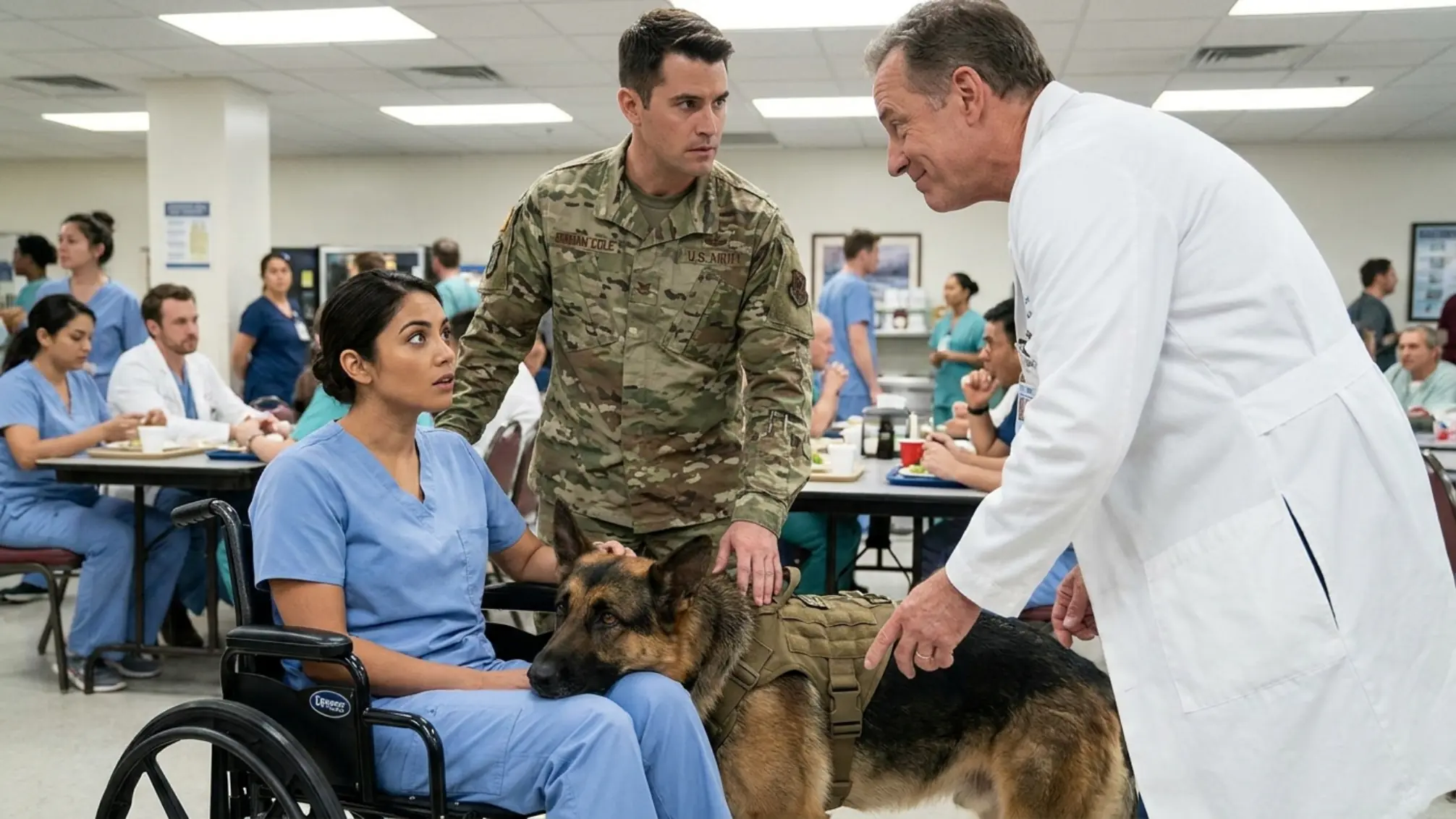
The dog remained perfectly still.
Its amber eyes studied Claire with an intensity that made her feel as though she were being examined by someone far more perceptive than most of the people in the cafeteria.
Claire glanced at the empty chair opposite her.
“Sit,” she said. “But don’t expect me to move for anyone.”
The corner of the man’s mouth lifted.
“I wouldn’t ask you to.”
He pulled out the chair and sat. The German Shepherd lowered itself beside him, remaining close enough that its shoulder touched his boot.
Around them, the hospital cafeteria continued moving through its familiar afternoon rhythm. Surgeons occupied the tables near the windows, their conversations loud and confident. Residents crowded together in the center, eating too quickly while checking phones and unfinished charts. Nurses sat wherever they could find space during the few minutes between medication rounds, emergencies, and families demanding answers.
Claire always sat at the end table beside the service station.
Not because she preferred it.
Her wheelchair made most other tables difficult to reach.
The path between the central tables was narrow, and chairs were often pushed carelessly into the aisle. Near the windows, the tables were mounted too close to the wall for her wheelchair to turn comfortably. The end table beside the service station was noisy, constantly interrupted by carts and employees, but it was accessible.
Claire had stopped asking why accessibility always seemed to mean accepting the worst available place.
She had been a nurse for nine years and a wheelchair user for two. During that time, she had become skilled at recognizing the difference between curiosity, discomfort, and pity.
The stranger across from her displayed none of them.
His eyes moved once toward the wheelchair, registering it as part of the scene, then returned directly to her face.
Claire lifted her coffee.
“Your dog has been staring at me.”
The man looked down.
“Ranger stares at everyone.”
“No, he scans everyone. He’s staring at me.”
The man studied the dog more carefully.
“You may be right.”
Claire glanced at the name patch on his uniform.
Commander Ethan Cole.
She had noticed the insignia on his sleeve the moment he entered, though she had trained herself not to react. Everyone else in the cafeteria had noticed too. Several conversations had softened when he walked through the doors.
Ethan had entered like someone accustomed to evaluating a room before stepping fully inside it. He identified the exits, the busiest paths, the people watching him, and the table offering enough space for Ranger.
Then he came directly to Claire.
She returned her attention to her soup.
“What brings you to Mercy General?”
“Medical evaluation.”
“For you or him?”
Ethan looked at Ranger. “Both, in different ways.”
Before Claire could ask what that meant, Ranger stood.
The movement was sudden but controlled. He stepped around the table, approached Claire’s wheelchair, and placed his massive head directly across her lap.
Claire froze.
So did Ethan.
Ranger exhaled slowly and looked up at her.
The cafeteria’s noise began fading as people noticed.
Claire could feel eyes turning in their direction. A resident stopped halfway through raising a fork. A cafeteria employee held a cleaning cloth motionless above a table. Two nurses near the beverage station leaned closer to one another.
Claire hated becoming a scene.
For two years, she had built her hospital life around being useful without becoming visible. She completed her work, advocated for patients, and refused assistance unless she truly needed it. She had learned that attention often led to the same invasive questions.
What happened to you?
Can you still work properly?
Isn’t nursing too physically demanding now?
Why didn’t you choose a desk job?
Each question disguised a conclusion the speaker had already reached.
Claire lowered one hand cautiously onto Ranger’s broad head.
The dog’s ears softened.
He pressed closer.
“Ranger,” Ethan said. “Come.”
The dog did not move.
Ethan’s expression changed from surprise to concern.
“He has never ignored that command.”
Claire scratched gently behind Ranger’s ear. “Maybe he likes me.”
“He doesn’t do this.”
“Never?”
“In eight years.”
Claire looked down at the animal resting across her lap.
“What does he normally do when he senses something?”
“Depends on what he senses.”
Before Ethan could explain further, a loud voice traveled from the window tables.
“I didn’t realize we were allowing animals in the cafeteria.”
Chief of Surgery Marcus Hale leaned back in his chair with an amused smile. Two senior residents sat beside him, watching closely for instructions on whether they were expected to laugh.
Marcus was fifty-one, expensively dressed beneath his white coat, and accustomed to entering every room as its most important person. He had spent years building a reputation for surgical brilliance and treating everyone outside the operating room as an inconvenience.
His eyes moved from Ranger to Claire.
“Or is this some therapy program for the mobility impaired?”
One resident laughed.
The other lowered his gaze.
Claire felt the familiar heat of public humiliation rise along her neck. Marcus had made similar remarks before, usually disguised as jokes. He questioned whether she could respond quickly enough during emergencies and once suggested patients might find her wheelchair “emotionally distracting.”
Claire had always answered through silence and competence.
She tightened her hand around the wheelchair’s armrest.
“Say it again,” she said, “without hiding behind your title.”
The laughter stopped.
Marcus’s eyebrows rose.
“Excuse me?”
“You heard me.”
His chair scraped against the floor as he turned toward her more fully.
“I was making an observation about hospital policy.”
“You were insulting me because you expected everyone to laugh.”
Marcus smiled coldly. “Perhaps you’re becoming overly sensitive.”
Ethan turned his head toward the surgeon.
“Were you addressing my service animal or the nurse?”
The question was quiet.
That made it more dangerous.
Marcus looked at Ethan’s uniform and recalculated his tone.
“I was simply noting that animals are generally restricted in dining areas.”
“Ranger is a certified service animal.”
“Then perhaps his handler should keep him from interfering with other people.”
Ethan glanced at Ranger, whose head remained across Claire’s lap.
“He isn’t interfering with her.”
“He’s blocking the aisle.”
“No,” Claire said. “Your ego is blocking the aisle.”
A few people gasped.
Marcus stood.
“You should remember who supervises clinical standards in this hospital.”
Claire met his stare. “And you should remember that standards include basic respect.”
Marcus stepped toward the table.
Ranger lifted his head.
The dog did not growl, bark, or bare his teeth. He simply repositioned himself beside Claire’s wheelchair and watched Marcus approach.
That calm attention stopped the surgeon several feet away.
Ethan rose.
He was taller than Marcus and carried himself with the effortless stability of someone who had spent years remaining controlled in situations far more dangerous than a cafeteria confrontation.
“Take the empty chair, Doctor,” Ethan said. “Then listen while she tells this room who she really is.”
Claire turned sharply toward him.
“You don’t know who I am.”
Ethan looked at her hands.
The hands Marcus and other physicians regularly ignored.
The hands that had tied tourniquets, stabilized airways, packed wounds, and held pressure against damaged arteries while vehicles shook beneath incoming fire.
“I know Ranger,” Ethan said. “And he knows something.”
Marcus laughed dismissively. “Now the dog is evaluating hospital credentials?”
Ethan’s face hardened.
“Ranger completed four combat deployments. He has found injured men beneath collapsed structures, detected threats before trained operators saw them, and interrupted panic attacks before the person experiencing them understood what was happening.”
He looked toward Claire.
“In eight years, he has never placed his head in a stranger’s lap.”
The cafeteria fell silent.
Ethan addressed Claire directly.
“What did you do before working here?”
Claire’s first instinct was to refuse.
Her past belonged to her. She did not owe it to Marcus, the residents, the staring surgeons, or the nurses who had watched her struggle through inaccessible hallways without once asking whether she needed help.
She had come to Mercy General because she wanted ordinary work.
Ordinary patients.
Ordinary emergencies.
She no longer wanted people studying her as a symbol of bravery, sacrifice, or tragedy. She wanted to be judged by the care she gave that day, not the life she had lived before it.
Marcus folded his arms.
“She worked at another hospital. Her personnel file is available to anyone who needs it.”
Claire’s eyes moved toward him.
“You read my current file.”
“That’s the relevant one.”
“No. It’s the convenient one.”
Something changed inside the room.
For years, Claire had accepted every assumption because correcting them required exposing memories she preferred to leave closed. Marcus mistook that silence for proof that there was nothing more to know.
She looked at Ethan.
“Seventy-Fifth Ranger Regiment,” she said.
Ethan became completely still.
Claire continued.
“I was attached to a forward trauma team for two years. Kunar Province. Forward Operating Base Salerno.”
Recognition moved through Ethan’s face.
“You were at Salerno?”
“Yes.”
“What year?”
She told him.
Ethan lowered himself slowly into the chair, not because he was weak, but because the information carried weight.
“I know what happened there.”
Claire’s jaw tightened. “Then you know enough.”
Marcus looked between them.
“What exactly are we discussing?”
Ethan ignored him.
“You were part of the medical evacuation team during the eastern valley attack.”
Claire did not answer.
She did not need to.
Ethan looked toward Ranger.
The dog remained close to her wheelchair, his body relaxed for the first time since entering the cafeteria.
“Ranger was deployed in that region later,” Ethan said. “He was trained around trauma personnel. Certain movements, scents, and stress patterns remain familiar to him.”
Claire looked down at her own hands.
The dog had recognized something no person in the hospital had bothered to notice.
Not her uniform.
Not her wheelchair.
Her.
Marcus cleared his throat. “Whatever her previous experience, we are discussing conduct inside this hospital.”
Claire turned toward him.
“Then let’s discuss it.”
He stiffened.
“You questioned whether I could work here before my first shift,” Claire said. “You reassigned two critical patients after seeing my wheelchair, even though I had the highest trauma evaluation on the unit. You dismissed my internal bleeding assessment last month until the patient collapsed.”
“I made a clinical judgment.”
“You ordered another scan forty minutes after I requested it. The patient went directly into surgery.”
“That case was complicated.”
“The case was clear. You just didn’t trust the nurse who identified it.”
Marcus looked around the room and realized that several employees were listening with expressions no longer under his control.
Claire continued.
“You asked whether patients would feel uncomfortable seeing me. You referred to accessibility equipment as special treatment. Today you used my disability as entertainment because you expected everyone here to protect your title.”
Marcus’s face reddened.
“You are speaking emotionally.”
“No. I’m speaking specifically.”
Ethan remained silent.
This was Claire’s confrontation. He understood that stepping in too quickly would turn her strength into something borrowed from him.
One of Marcus’s residents looked up from the table.
“She did identify that bleed,” he said.
Marcus turned.
The young doctor swallowed but continued.
“I was present. Nurse Navarro requested imaging twice.”
Another nurse near the service station spoke.
“She also caught the medication error in room 411 before it reached the patient.”
A cafeteria employee added, “She stayed three hours after her shift when my husband was admitted.”
The statements began coming from different parts of the room.
Patients Claire had calmed.
Errors she had prevented.
New nurses she had trained without humiliating them.
Families she had guided through the worst nights of their lives.
For two years, people had witnessed her work individually. Nobody had ever assembled those moments into a complete picture.
Marcus raised one hand.
“This is becoming inappropriate.”
Claire almost laughed.
The surgeon who had publicly insulted her now wanted privacy because the room had stopped supporting him.
Hospital administrator Helen Walsh entered the cafeteria through the rear doors. She had been called by an employee after Marcus approached Claire’s table.
“What is happening?” Helen asked.
Marcus answered first.
“There has been a misunderstanding involving an animal and an employee becoming confrontational.”
Ethan turned toward her.
“There was no misunderstanding.”
He identified himself and explained exactly what Marcus had said. Several staff members confirmed the account.
Helen looked at Claire.
“Would you like to file a formal complaint?”
Claire thought about the previous two years.
She had documented several incidents privately but never submitted them. She convinced herself that maintaining peace protected her career. In reality, silence had protected Marcus.
“Yes,” she said. “And I want my previous reports reviewed with the patient cases connected to them.”
Marcus’s expression changed.
“What previous reports?”
“The ones you thought I would never file.”
Helen instructed him to leave the cafeteria pending an immediate review.
Marcus did not move.
“You cannot remove the chief of surgery based on one emotional accusation.”
“One?” Claire asked.
Helen looked around the room.
Employees raised their hands.
Not dramatically. Not all at once.
One nurse.
Then another.
A resident.
A physical therapist.
A cafeteria employee whose complaint Marcus had dismissed after shouting at her in front of patients.
The room had been silent for years because each person believed they were alone.
Claire’s refusal gave everyone else permission to speak.
Marcus finally left.
No one watched him go.
The cafeteria’s normal noise returned slowly, but the atmosphere had changed. People no longer stared at Claire’s wheelchair. They looked at her face.
Ethan sat across from her again.
“I’m sorry,” he said.
“For what?”
“Making your past public.”
“You asked. I answered.”
“I pushed.”
Claire looked toward the doors Marcus had exited through.
“I think I was tired of hiding it.”
Ranger placed his head back in her lap.
Claire smiled for the first time.
“What exactly did he recognize?”
Ethan considered the question.
“Possibly how you positioned yourself when Marcus approached. You angled your wheelchair to keep the table from trapping you. Your dominant hand remained free. You watched his shoulders instead of his face.”
Claire glanced at her body.
She had done all of it unconsciously.
“Or,” Ethan added, “Ranger recognized someone carrying the same kind of history we are.”
Claire rested her hand on the dog.
The accident had happened three months after she returned to the United States.
A distracted driver ran a red light and struck the side of Claire’s car. Her left leg could not be saved. Nerve damage weakened her right leg, leaving her able to walk short distances with assistance but dependent on the wheelchair during long shifts and painful days.
People assumed her disability came from deployment.
Sometimes she allowed them to believe it because the truth felt almost insulting in its ordinariness. She had survived dangerous places only to lose her leg at an intersection five minutes from home.
“I came back to nursing because I didn’t know who I was without it,” Claire said.
Ethan nodded. “I understand that.”
“Do you?”
He looked toward Ranger.
“Eighteen months ago, my team medic died during an evacuation. Lieutenant Sara Voss. She had been a nurse before joining special operations.”
Claire had heard the name.
“Sara Voss stabilized three people after she was wounded.”
“Four,” Ethan said. “I was the fourth.”
His voice lowered.
“She kept working until the helicopter arrived. She died before landing.”
Claire looked at him steadily.
“I’m sorry.”
“People gave speeches after she died. They called her fearless, exceptional, irreplaceable. Most of those same people had overlooked her during planning meetings because she was the medic and the only woman in the room.”
Ethan’s eyes moved toward the table Marcus had occupied.
“I’ve been thinking about how often we recognize people only when recognition no longer costs us anything.”
Claire understood.
Honoring the dead was easy.
Respecting the living required changing behavior.
The hospital investigation lasted seven weeks.
Reviewers found a pattern of discriminatory remarks, ignored nursing assessments, retaliatory scheduling, and patient-safety concerns connected to Marcus Hale. Several residents admitted they had remained silent because their evaluations depended on him.
Marcus was removed from his leadership role and later resigned rather than accept supervised practice and behavioral conditions.
Mercy General revised accessibility policies, but Claire insisted that ramps and tables were not enough.
“Accessibility is also authority,” she told the board. “A nurse cannot be treated as capable only when someone important confirms it.”
She became a co-director of the hospital’s new clinical inclusion and patient-safety council. The position did not remove her from bedside care because she refused to become another administrator who discussed patients without seeing them.
Months later, Ethan returned to the cafeteria.
He wore civilian clothing this time, and Ranger walked beside him with the same quiet focus.
Claire sat at her usual end table.
The hospital had offered her a reserved accessible table near the windows, but she asked them to redesign the entire cafeteria instead. Several tables were now properly spaced throughout the room, allowing wheelchair users to choose where they sat rather than being assigned a corner.
Ethan stopped beside her.
“Can I sit here?”
Claire looked at the empty chair.
“You know you don’t need permission anymore.”
“I know.”
“Then why ask?”
“Because it mattered the first time.”
She moved her coffee aside.
“Sit.”
Ranger immediately approached and placed his head across her lap.
Ethan shook his head.
“He still doesn’t do that with anyone else.”
Claire scratched behind the dog’s ears.
“Maybe he has good judgment.”
“He certainly has better judgment than most hospital committees.”
They laughed.
Near the windows, two new residents watched them. One whispered something to the other, then stood and approached Claire’s table.
“Excuse me,” the young doctor said. “Are you Nurse Navarro?”
Claire nodded.
“I heard you teach the trauma assessment workshop.”
“I do.”
“May I register?”
Claire noticed the physician’s gaze remain on her face rather than falling toward the wheelchair.
“Yes.”
The doctor thanked her and returned to his table.
Ethan smiled.
“Things have changed.”
“Some things.”
“Not enough?”
“Never enough.”
Claire looked around the cafeteria. Nurses now sat near the windows. Residents shared tables with technicians and cafeteria staff. People still formed groups, still made assumptions, and still sometimes required correction.
Change had not transformed the hospital into a perfect institution.
It had made silence less comfortable.
That mattered.
Ranger exhaled across Claire’s lap.
The first time Ethan asked to sit with her, she believed he only needed an empty chair. She did not know his dog would expose the history she had buried or that one cruel remark would force an entire hospital to examine how it treated people whose strength did not arrive in the expected form.
Marcus saw a wheelchair and assumed limitation.
The cafeteria saw a service dog showing affection and assumed vulnerability.
Ethan saw the disciplined movements of someone who had survived more than she revealed.
Ranger simply saw Claire.
Not the injured nurse.
Not the hidden veteran.
Not the woman who needed inspiration attached to her existence before others considered it meaningful.
Just Claire Navarro, a person worthy of trust.
For two years, she had made herself smaller so nobody could accuse her of demanding special treatment. She accepted the worst table, ignored insults, and allowed other people to treat her competence like a question.
One simple invitation changed that.
“Can I sit here?”
The question did not rescue her.
It created a space where she finally chose to stop disappearing.
And once Claire Navarro allowed the room to see her completely, nobody inside Mercy General could ever look past her again.