“I don’t have enough.”
Jimmy Henderson’s voice was flat, almost embarrassed, as he patted down the pockets of his leather vest.
“I don’t have my wallet.”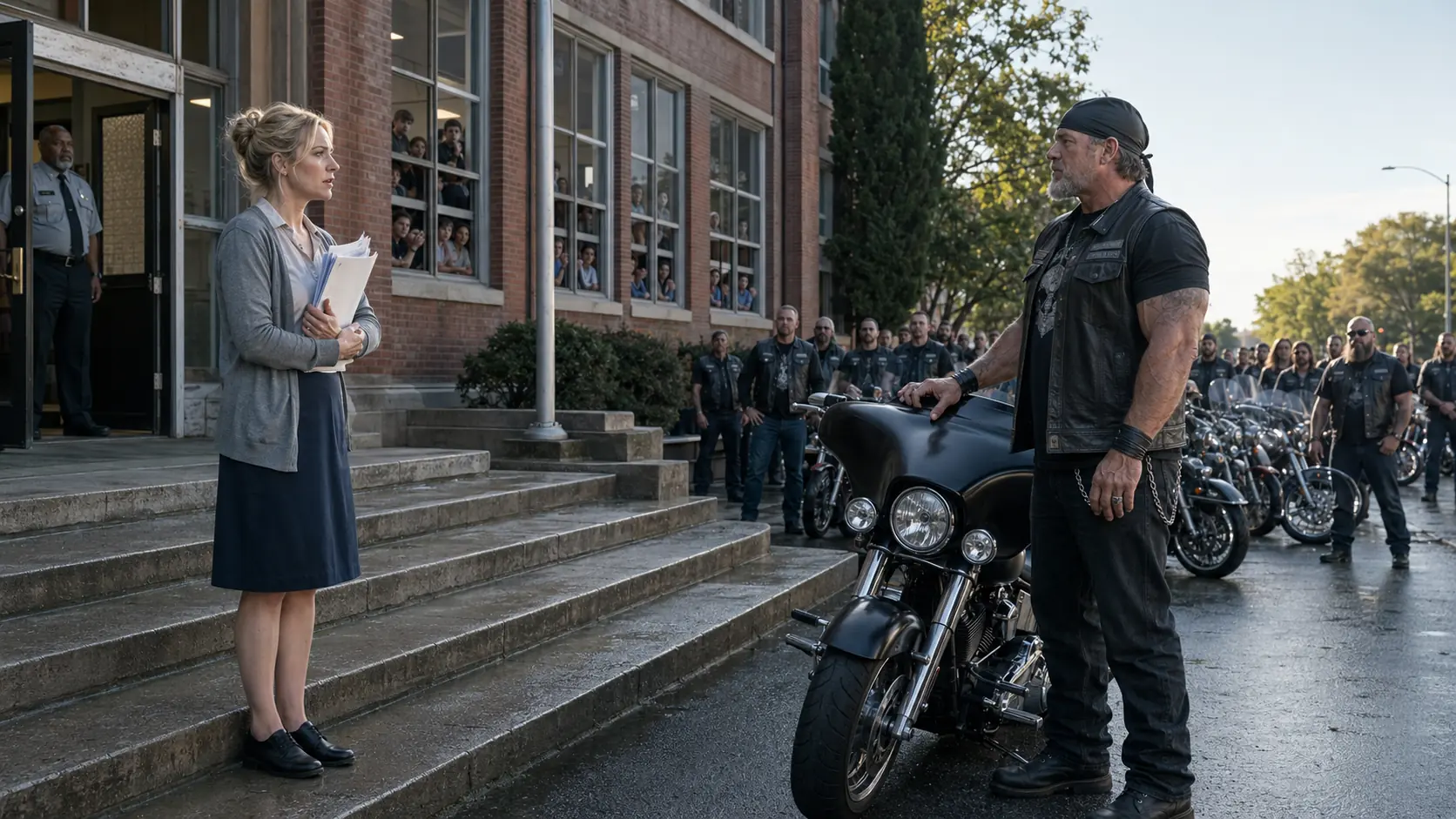
The manager’s hand was already reaching for the phone.
“Then I’m calling the cops right now.”
Emily Carter did not even look up from her papers when she said it.
“Put it on my card.”
Nobody in that diner understood what that one sentence was about to summon by morning.
Not the manager.
Not the cook watching through the kitchen window.
Not Jimmy himself.
None of them knew that one quiet act of decency was about to bring one hundred eighty motorcycles to a high school before the next sunrise.
The diner was called Pop’s.
At 11:40 on a Tuesday night, it was the kind of empty that made every sound feel too loud.
The buzz of the overhead lights.
The hum of the refrigerator case by the register.
The scratch of a red pen against paper.
Emily Carter sat in the corner booth, the one under the flickering bulb nobody had bothered to fix in two years, with a stack of junior year history essays in front of her and a cup of coffee that had gone cold an hour ago.
She was thirty-four years old, and she felt fifty.
Her blonde hair was pulled back in a knot that had stopped looking neat sometime around six that evening. Her cardigan had a coffee stain on the cuff she had not noticed yet.
She was not grading papers because she wanted to.
She was grading them because if she went home, she would just sit in her apartment and stare at the stack of bills on the kitchen counter, and that felt worse than red ink and run-on sentences.
The bell over the door jingled.
Emily did not look up.
People came and went from Pop’s all night, mostly truckers, sometimes insomniacs, sometimes people who had nowhere else to sit when the rest of the city had gone quiet.
She was three sentences into a paragraph about the Missouri Compromise when she heard the booth across the aisle groan under weight.
Real weight.
The kind of weight that made vinyl seats sound like they were filing a complaint.
That was when she looked.
The man filled the entire booth.
He had to be six foot four, maybe taller, with shoulders so wide he had to angle himself sideways just to slide all the way in. His arms were sleeves of ink, faded blue-green tattoos that told stories Emily could not read from across the room.
His beard was gray and trimmed close. His hair was slicked back and tucked under a worn leather skull cap.
The vest he wore over a black T-shirt had patches on it, and even from twenty feet away, Emily could read the big one across the back.
Hell’s Angels.
She felt her stomach tighten the way it always did around men like that.
Not because she had ever had trouble with bikers specifically.
Because she had had trouble with men who took up space like they owned it.
And this man took up space like the whole world was already his.
The waitress, a tired woman named Donna who had worked the night shift at Pop’s for longer than Emily had been a teacher, approached his table with the forced cheerfulness that came from twenty years of customer service.
“What can I get you, hon?”
“Whatever’s biggest,” the man said.
His voice was low and rough, like gravel dragged over concrete.
“Burger, fries, the works. And coffee. Black.”
“You got it.”
Emily went back to her papers.
She told herself she was not watching him, but she was, in the way a person watches a storm cloud on the horizon, even when she is pretty sure it is heading the other direction.
Twenty minutes later, the food came.
He ate like a man who had not eaten all day.
Methodical and quiet, his eyes occasionally drifting to the window, to the parking lot, to the dark street beyond it.
Emily noticed he never fully relaxed.
Even eating a burger at midnight, some part of him was watching the exits.
She went back to her essays.
A student named Marcus had written three pages about the Civil War without once mentioning slavery, and she sat there with her pen hovering, trying to figure out how to write a comment that would not crush a sixteen-year-old’s confidence while still telling him the truth that he had missed the entire point.
That was when she heard the manager’s voice rise.
“Excuse me.”
The manager, a thin, balding man named Carl, who Emily had seen maybe a dozen times and never liked, was standing at the biker’s table with his arms crossed.
“Sir, the bill.”
The big man was patting his vest, then his jeans, then his vest again, like maybe the wallet would materialize on the second pass.
“I don’t have enough,” he said.
His voice was flat, almost embarrassed.
“I don’t have my wallet.”
Carl’s face went from annoyed to something harder.
“Then I’m calling the cops right now.”
“Sir, just give me a minute. I can—”
“I’ve heard that before.”
Carl was already moving toward the register, his hand reaching for the phone mounted on the wall.
“You people come in here, you eat, and then suddenly there’s no wallet. I’m not doing this tonight.”
You people.
Emily felt something in her chest tighten at those two words.
The biker’s jaw flexed.
His hands, which had been resting flat on the table, curled slightly.
Not into fists exactly, but close.
“I’m not running out on the bill,” he said. “I live twenty minutes from here. Let me leave my bike as collateral. Let me call somebody. I’m good for it.”
“Sure you are.”
Carl’s hand was on the phone now.
“911’s real quick around here. You know that?”
The air in the diner changed.
Emily felt it the way a person feels a drop in pressure before a storm.
Donna had backed up against the counter, her eyes wide. The cook had appeared at the kitchen window, wiping his hands nervously on a towel.
The biker had not moved.
He had not raised his voice.
He had not done a single threatening thing.
And yet the entire room felt like it was holding its breath, waiting to see whether this would end in handcuffs or worse.
Emily had spent eleven years in classrooms watching tension build between teenagers right before a fight broke out.
She knew the signs.
The stillness that was not calm, but control.
The way Carl’s voice had gotten higher, more nervous, masking fear with aggression.
The way the biker’s eyes had gone flat and careful, a man calculating exactly how bad this could get and deciding, for now, to absorb the insult rather than answer it.
She thought about Marcus’s essay.
About slavery.
About history.
About how easy it was to watch injustice happen in slow motion and tell yourself it was not your problem.
She thought about every time in her life someone had looked at her and decided who she was before she opened her mouth.
Too young to be taken seriously as a teacher.
Too soft to handle a classroom full of kids surrounded by violence and pressure.
Too broke to matter.
She stood up.
“Carl.”
Her voice surprised her with how steady it came out.
“How much is the bill?”
Carl blinked at her like she had spoken a foreign language.
“Emily, this isn’t your—”
“How much?”
“Eighteen fifty,” Donna said quietly from behind the counter, eager to defuse anything that might result in broken plates.
Emily was already pulling her wallet out of her bag.
She had exactly forty-one dollars to last her until Friday’s paycheck.
She set a twenty on the counter.
“Keep the change for Donna’s tip,” she said.
The diner went silent in a different way now.
Carl’s mouth opened and closed.
Up close, his eyes were not what she expected.
She had expected hard.
Mean, maybe.
Drunk.
Instead, she found something tired.
Something that looked almost like the exhaustion she saw in her own bathroom mirror every morning.
“You don’t have to do that,” he said.
“I know.”
Emily zipped her bag shut.
“I’m not doing it for you. I’m doing it because he”—she nodded at Carl without looking at him—“was about thirty seconds from making a bad night a lot worse for no reason.”
Carl sputtered.
“Now hold on. I was just—”
“You were about to call the police on a man for forgetting his wallet,” Emily said, and something in her voice had teacher in it now, the same tone she used to shut down a hallway fight. “That’s not a crime, Carl. That’s Tuesday.”
The biker watched her with an expression she could not read.
Something complicated was happening behind those eyes.
Something that looked like surprise wrestling with suspicion, like a man trying to find the angle, trying to find the catch, and slowly realizing there was not one.
“What’s your name?” he asked.
Emily hesitated.
Some old instinct, some leftover voice from every safety seminar she had ever sat through, told her not to give it.
But she was tired.
It was midnight.
She had forty more essays to grade and rent due in nine days.
None of that mattered more than the simple fact that she had just done something true.
“Emily,” she said. “Emily Carter.”
He nodded slowly, like he was filing it away somewhere permanent.
“Jimmy Henderson.”
“Well, Jimmy Henderson, eat your fries before they get cold.”
She slid back into her booth and picked up her pen like nothing had happened at all.
But something had happened.
Carl stood frozen by the register, his ego too bruised to apologize, too embarrassed to keep arguing.
Donna gave Emily a small, grateful smile from across the room.
And Jimmy Henderson sat very still in his booth, watching the blonde woman in the coffee-stained cardigan go back to grading papers like she had not just done something that, in his world, was not small at all.
In Jimmy’s world, debts were sacred.
You did not forget who helped you when you were down.
You did not forget who stood between you and trouble for no reason except that it was the right thing to do.
He finished his fries slowly.
He drank his coffee slower.
He watched Emily Carter for almost twenty more minutes.
Watched her circle sentences.
Watched her rub her eyes when she thought no one was looking.
Watched the particular exhaustion of someone carrying more weight than they let on.
When he finally stood to leave, he paused beside her booth.
Emily looked up.
“Thank you,” he said.
Two words.
No flourish.
No charm.
Nothing performative about it.
“You’re welcome.”
She almost smiled.
“Get home safe.”
He nodded once.
Then he walked out into the parking lot, and a moment later, Emily heard the unmistakable thunder of a motorcycle engine roaring to life, the sound rattling the diner’s windows before fading into the night.
She did not think much more about it.
She finished Marcus’s essay, wrote a comment about primary sources and perspective that took her ten minutes to get right, and packed up her bag a little after one in the morning.
She had no idea, walking out to her seven-year-old Honda in the empty parking lot, that the man she had just helped did not forget kindness.
He collected it like a debt owed.
And Jimmy Henderson always paid his debts.
Roosevelt High School sat on the east side of a city that had stopped pretending it could fix itself.
The building had been beautiful once, eighty years ago, with its brick facade, tall windows, and a bell tower that did not ring anymore because some kid had broken the mechanism back in 2019 and the district never had the money to fix it.
Emily pulled into the staff lot at 7:15 the next morning, her eyes gritty from four hours of sleep, a granola bar serving as breakfast because that was all she had time for.
She had taught American history at Roosevelt for six years.
She had watched it slide from struggling, to surviving, to something closer to a war zone with a school bell.
The metal detectors at the front entrance had been installed her second year.
The security guard, a heavyset man named Reggie, who Emily genuinely liked, gave her a tired nod as she walked through.
“Morning, Miss Carter.”
“Morning, Reggie.”
“Quiet so far.”
Reggie’s eyes flicked toward the east hallway, toward the cluster of boys in red bandanas loitering by the lockers, and Emily understood his silence perfectly.
Quiet was relative at Roosevelt High.
The East Side Kings had been operating in and around the school for almost three years now.
What started as a handful of older brothers and cousins running small-time stuff on the corner had metastasized into something that controlled entire hallways, extorted lunch money from freshmen, and made sure everyone—students, teachers, the principal himself—understood who really ran the building between eight and three.
Emily made her way to her classroom, room 214, and found Tyler Brooks already waiting outside her door, hunched against the wall, a fresh bruise blooming under his left eye.
“Tyler.”
Emily’s voice softened immediately, the teacher voice falling away into something more like a worried aunt.
“What happened?”
“Nothing.”
He would not look at her.
He was fifteen, skinny, the kind of kid who carried three different library books at once because reading was the only place he felt safe.
“I fell.”
“Tyler.”
“I fell, Miss Carter.”
His eyes finally met hers, and there was a warning in them.
A plea, really.
Do not make this worse.
Please.
Emily had been down this road enough times to know that if you pushed too hard, you lost them entirely.
She unlocked her door instead.
“Come sit in here until the bell rings. I’ve got ice in my desk.”
She always kept ice in her desk.
A small cooler restocked every week, because at Roosevelt High, a teacher who did not keep first-aid supplies on hand was a teacher who was not paying attention.
Tyler sat at the front desk, pressing the cold pack to his cheek while Emily set up for first period.
“Was it the Kings?” she asked quietly, not looking at him, giving him the dignity of not having to make eye contact with the question.
A long silence.
Then, barely audible, he said, “They want me to carry something in my backpack between classes.”
Emily’s hand stilled on her desk.
“Carry what?”
“I don’t know. I didn’t look. I said no. And Marcus—not your Marcus, the other one, DeShawn’s cousin—he said I’d regret it.”
Tyler’s voice cracked slightly.
“I regretted it.”
Emily crouched down so she was at his eye level again.
“Tyler, listen to me. You did the right thing saying no. Do you hear me?”
“Mr. Patterson said not to get involved in gang stuff.”
Tyler’s voice carried a bitterness too old for a fifteen-year-old.
“He said it’s above his pay grade.”
Principal Patterson.
Of course he did.
Emily had heard some version of that sentence in three different staff meetings this year alone.
The district had cut two security positions for budget reasons last spring, right around the same time the East Side Kings had expanded their territory inside the building.
Nobody in the front office wanted to call it what it was.
A school slowly being handed over to people who did not belong inside it.
“I’m going to talk to someone,” Emily said.
“Don’t.”
Tyler’s eyes went wide with real fear now.
“Please don’t say anything came from me.”
“I won’t use your name. I promise.”
Emily stood, smoothing her skirt, feeling the familiar cocktail of rage and helplessness that had become as routine to her mornings as coffee.
“Just keep that ice on it. And Tyler, if anyone asks you to carry anything again, you come find me first. Not after. Before.”
The bell rang.
Tyler slipped out into the hallway just as the first wave of students began flooding in, loud and tired and teenage, completely unaware that their history teacher had spent the last six minutes trying to keep one of them from drowning.
By third period, the day had already worn Emily down to a thin edge.
She was midway through a lesson on the Reconstruction era when she heard shouting from the hallway.
The unmistakable rhythm of a fight building.
The slap of sneakers.
The rising chorus of “oh” from a crowd of phones already filming.
“Stay in your seats,” Emily said to her class, and walked out into the hallway before she had fully decided to.
Two boys were circling each other near the lockers.
But it was not really a fight.
Not yet.
One was a Kings affiliate, the kind of kid Emily recognized by his walk before she ever saw his face.
The other was smaller, a sophomore named Aaron, who Emily had taught the year before, backed against the locker with his hands up defensively.
“Give me the bag,” the Kings kid was saying low and mean. “Last time I ask.”
Emily stepped directly between them.
It was instinct more than strategy.
The same instinct that had stood her up in a diner booth twelve hours earlier.
“Class is in session,” she said, her voice carrying the particular authority she had spent eleven years building. “Both of you. Names. Now.”
“Miss Carter, this ain’t your business.”
The boy’s eyes were hard, performing toughness for the small crowd that had gathered.
“It became my business the moment it happened in my hallway.”
She did not move.
Her heart was hammering, but she had learned a long time ago that showing fear to a teenager performing dominance only made things worse.
“You can walk away right now, or I can walk you to Mr. Patterson’s office myself. Your choice.”
A long beat.
The crowd watched.
Phones stayed up, recording.
The boy spat near her feet.
Not on her.
Near her.
A calculated insult that stopped just short of an actual offense.
Then he walked away, muttering something Emily chose not to hear clearly.
Aaron exhaled like he had been holding his breath for an hour.
“Thank you, Miss Carter,” he whispered.
“Go to class, Aaron.”
Her voice was steady, but her hands were shaking as she walked back into her classroom.
She pressed them flat against her thighs so her students would not see.
This was Roosevelt High.
This was every day.
And every day, Emily Carter walked back into it anyway because somebody had to.
Increasingly, it felt like she was the only one who still believed that.
That afternoon in the front office, she finally cornered Principal Patterson between his second and third meeting of the day.
“We need more security,” she said without preamble. “I had a kid with a black eye this morning who’s being pressured to run something through the building. I broke up an extortion attempt in the hallway during third period. This is escalating, and if we don’t do something—”
Patterson held up a hand.
The universal gesture of a man who had already decided the conversation was over before it started.
“I hear you. I do. But the district cut our security budget eleven percent last year. I don’t have the bodies. I don’t have the funding. What do you want me to do?”
“I want you to call the police. I want you to call the district. I want you to do something other than hope it goes away.”
“You think I haven’t called the police?”
Patterson’s voice had an edge of exhaustion that mirrored her own.
“You think this is news to anyone? The Kings have been operating three blocks from here for years. The cops know. The district knows. Nobody has the resources or the political will to actually fix it. Emily, we’re a public school in a neighborhood nobody with power lives in. That’s the whole equation.”
“So we just let it happen.”
“We survive it. That’s different.”
He rubbed his eyes.
“I know that’s not the answer you want. It’s not the answer I want either. But I’ve got two hundred staff members, twelve hundred kids, and a budget that covers about sixty percent of what we actually need. I am doing what I can.”
Emily left his office with her jaw tight.
The same helpless fury she carried home most nights.
The kind that made her stare at the ceiling at two in the morning, wondering why she had not gone into literally any other profession.
She did not know, walking to her car that evening, exhausted and defeated in the particular way only a teacher at the end of a long day can be, that twelve hours earlier she had set something in motion that no amount of district budget cuts or administrative cowardice could stop.
She did not know that Jimmy Henderson had already started making calls.
Jimmy rode home that night with Emily Carter’s name sitting in his chest like a coal that would not go out.
He pulled into the clubhouse a little after one in the morning, a converted warehouse on the industrial side of town with a chain-link fence, motion lights, and forty bikes parked in neat rows outside.
Inside, the place smelled like motor oil, cigarette smoke, and old leather, the bar in the corner still serving the handful of brothers who had not called it a night yet.
Big Earl, the chapter sergeant-at-arms, a man even larger than Jimmy with a beard down to his chest, looked up from his beer.
“You’re back late.”
“Got held up.”
Jimmy pulled a stool out and sat.
“Forgot my wallet at a diner.”
Earl raised an eyebrow.
“And?”
“Some woman paid my bill.”
Jimmy stared at the bar top for a long moment.
“Schoolteacher. Tired as hell. Looked like she hadn’t slept right in a year. Manager was about to call the cops on me for forgetting twenty bucks. She just stood up and paid it. Didn’t ask for anything. Didn’t even want my name at first.”
Earl set his beer down slowly.
He had ridden with Jimmy for almost twenty years. He knew that particular tone in his brother’s voice, the one that meant something had lodged itself somewhere deep and was not coming loose.
“You got a name?”
“Emily Carter.”
Jimmy was already pulling out his phone.
“Teaches at Roosevelt High. East Side.”
“Roosevelt?”
Earl whistled low.
“That’s Kings territory. Whole school’s basically theirs at this point, from what I hear.”
“Yeah.”
Jimmy’s jaw tightened.
“That’s what I’m finding out.”
He spent the next two hours on his phone quietly and methodically, the way Jimmy did everything.
He had a cousin who worked dispatch for the city and owed him a favor. He had a prospect whose sister had graduated from Roosevelt two years back.
By two in the morning, Jimmy Henderson knew more about Emily Carter than she probably would have been comfortable with.
He knew she had been teaching for eleven years.
He knew she lived alone in a one-bedroom apartment on Fifth Street.
He knew her salary was public record, and it made him angrier than he expected to see exactly how little this country paid the people who spent every day standing between children and chaos.
He knew about the East Side Kings.
He knew about the extortion, the intimidation, the slow rot eating through a building full of kids who had done nothing to deserve it.
And he knew, with the kind of certainty that had guided every important decision in his thirty years with the club, that this was not something money could fix.
Big Earl found him still sitting at the bar at three in the morning, phone dark now, staring at nothing.
“You’re quiet,” Earl said.
“I’m thinking about the teacher.”
“About what?”
“About debts.”
Jimmy turned the empty coffee cup in his hands.
“You know what she did tonight, Earl? She had no idea who I was. Didn’t matter to her. She saw somebody about to get steamrolled over something small and stupid, and she stepped in. Didn’t think twice.”
“People do that sometimes.”
“Not like this. Not before a stranger. Not when she’s got nothing herself.”
Jimmy shook his head slowly.
“And then I find out she does that every single day. Walks into a building full of kids getting eaten alive by gangs. Nobody’s stopping it, and she keeps showing up anyway. Keeps standing between them and the worst of it. Nobody’s paying her enough to do that. Nobody’s protecting her while she does it.”
Earl was quiet for a long moment, watching his old friend’s face in the dim bar light.
“What are you thinking, Jimmy?”
Jimmy looked up, and there was something in his eyes that Earl had seen before.
Seen it the night Jimmy organized the run for the burned-down veteran shelter.
Seen it the time three Angels quietly handled a string of break-ins terrorizing an elderly neighborhood while the cops did nothing.
It was the look Jimmy got when a wrong crossed some line inside him that could not be uncrossed.
“I’m thinking,” Jimmy said slowly, “that the East Side Kings have been running that school for three years because nobody’s ever shown up who scared them more than they scared everybody else.”
Earl leaned back on his stool, a slow grin spreading under his beard.
“You thinking what I think you’re thinking?”
“I’m thinking we owe Emily Carter a debt.”
Jimmy stood, draining the last of his cold coffee.
“And the Hell’s Angels don’t pay debts in twenty-dollar bills.”
He walked to the chapter’s old corkboard, the one where club business got posted, where runs got planned, where brothers signed up for charity rides and funeral escorts.
He pulled a pen from his vest and wrote three words at the top of a blank sheet of paper.
Roosevelt High School
Behind him, Big Earl was already reaching for his phone, already starting to make the first of what would become dozens of calls that night and into the morning.
Calls to chapter presidents two counties over.
Calls to brothers who had not ridden together in months.
Calls that all carried some version of the same message.
A debt needs paying, and it is going to take more than a few of us.
By four in the morning, the word had spread through three chapters.
By five, confirmations were rolling in faster than Earl could write them down.
And while Emily Carter slept fitfully in her one-bedroom apartment on Fifth Street, dreaming the shallow, anxious dreams that came from too much worry and not enough rest, one hundred eighty motorcycles across four counties were being fueled, checked, and prepared for a ride that would arrive at Roosevelt High School in just a few hours.
None of them were coming for trouble.
They were coming to settle a debt that money could never touch.
By the time the sun rose over the east side of the city, nothing at Roosevelt High would ever be the same again.
By 5:30 in the morning, the staging lot off Route 9 looked like something out of a war film.
Bikes lined up in columns, engines off.
Men checked saddlebags, tightened straps, and lit cigarettes with hands that did not shake, even though most of them had not slept.
Big Earl walked the rows with a clipboard, counting heads from four chapters that had answered the call overnight.
“We’re at one hundred sixty-two,” he called out to Jimmy. “Got reports of eighteen more coming up from the south chapter. Should put us right around one-eighty by the time we roll.”
“One-eighty.”
Jimmy repeated the number like he was tasting it.
He stood beside his bike, arms crossed, eyes fixed on the horizon where the sky was just starting to bruise purple before dawn.
“That enough?”
“Enough for what?” Earl asked. “We’re not starting a war, Jimmy. We’re making a statement.”
“Same thing, depending who’s listening.”
A younger rider named Cole, no older than twenty-five, his patches still stiff and new on his vest, sidled up nervously.
“Jimmy, can I ask something?”
“Go ahead.”
“We really doing this for a schoolteacher we don’t know? Because she bought you a burger?”
The lot went quiet around them.
A dozen older riders within earshot stopped what they were doing.
Jimmy turned slowly, and his voice, when it came, was low and even, the kind of calm that carried further than shouting ever could.
“Let me tell you something, Cole. Last night, a woman with forty-one dollars to her name looked at a man twice her size getting threatened with handcuffs over a forgotten wallet, and she didn’t think about herself for one second. She thought about what was right. You understand how rare that is?”
Cole shifted his weight.
“I guess.”
“You guess?”
Jimmy stepped closer.
“I’ve ridden with men for thirty years. I’ve seen brothers die for less reason than what she did without blinking. She works in a building where kids get extorted in the hallway and teachers get told to look the other way, and she keeps showing up anyway. That’s not charity. That’s character. And in this club, when somebody shows us character, we show up.”
The lot stayed silent for a long beat.
Then somewhere in the back, an older rider named Frank, gray-bearded and quiet, started his engine.
One by one, the others followed until the whole lot thundered with idling pipes, the sound rolling out over the empty fields like distant artillery.
Cole swallowed hard and climbed onto his own bike.
“Yes, sir.”
Jimmy looked at Earl.
“Lead column ready?”
“Ready when you are.”
“Then let’s go pay a debt.”
Twenty minutes earlier, three miles east, Emily Carter’s alarm had gone off at 5:45, same as every weekday, and she had hit snooze twice before dragging herself upright with the particular heaviness of a woman who had slept four hours and dreamed about hallway fights the whole time.
She made coffee.
She stared at the bills on the counter, did quick math in her head, and decided again that she would figure out the electric bill on Thursday.
She got dressed in the same gray cardigan she had worn three days that week already because laundry was a Sunday problem, and it was not Sunday.
She thought about Tyler Brooks’s bruised eye.
She thought about the boy who had spat near her feet in the hallway.
She thought, just for a second, about the massive biker from the diner the night before.
Jimmy something.
She remembered and found herself almost smiling at the strange randomness of it.
A moment of simple decency in an otherwise exhausting week.
She had no idea that moment was about to detonate across the front of her school.
By the time she pulled into the staff lot at 7:10, everything looked normal.
Reggie at the metal detectors.
Kids filing in loud and half asleep.
The East Hallway crew already posted by the lockers like they owned the place, because as far as anyone at Roosevelt High could tell, they did.
Emily set up her classroom, wrote the day’s date on the whiteboard, pulled up her lesson on Reconstruction-era voting rights, and drank coffee from a thermos that had seen better decades.
At 7:42, she heard it.
At first, it was just a vibration.
Something felt rather than heard.
A low hum that rattled the windowpanes in their old frames.
Emily looked up from her desk, frowning.
A few students near the windows perked up, too.
“What is that?” asked a girl in the front row.
The hum became a rumble.
The rumble became a roar.
“Miss Carter.”
A boy near the window had stood up, pressing his face to the glass.
“Miss Carter, you got to see this.”
Emily crossed the room.
The moment she looked out the window, her stomach dropped through the floor.
The street outside Roosevelt High was filling with motorcycles.
Not five.
Not twenty.
An endless river of them.
Chrome catching the early morning sun.
Leather and engines and noise stretching down the block in both directions.
More bikes than Emily had ever seen in one place in her entire life.
They moved in formation, disciplined and deliberate, rolling to a stop in perfect rows along the curb, around the corner, down the side street, until the entire perimeter of the school was boxed in by a wall of motorcycles and the men who rode them.
“Oh my God,” Emily whispered.
Down the hallway, she could already hear chaos building.
Lockers slamming.
Teachers shouting for students to stay calm.
The unmistakable sound of Principal Patterson’s voice cracking over the intercom.
“Attention, staff and students. We are initiating a precautionary lockdown. Please remain in your classrooms. This is not a drill.”
The intercom clicked off, and immediately the room exploded into noise.
Students scrambling for their phones.
Someone shrieking.
A boy near the back already filming through the window with shaking hands.
“Everyone away from the windows,” Emily said, her teacher voice kicking in instinctively even as her own heart hammered against her ribs. “Sit down now. Away from the glass.”
But she could not make herself move from the window.
Not yet.
Because down on the street, stepping off the lead bike, was a man she recognized instantly.
A massive figure in a leather vest, gray beard trimmed close.
The same man who had sat across the aisle from her at Pop’s Diner less than twelve hours earlier.
Jimmy Henderson stood in the street, hands at his sides, looking up at the building like he was reading it floor by floor.
He knows where I work.
The thought hit Emily like ice water.
Every safety seminar she had ever sat through screamed at her at once.
Stranger danger.
Retaliation.
The hundred ways a kind gesture to the wrong person could come back as something far darker.
Had she been wrong about him?
Had paying for his meal somehow marked her, made her a target, painted a bullseye on the one school she had spent six years trying to protect?
“Miss Carter, are those the Hell’s Angels?” a student asked, voice trembling.
“Get away from the window,” Emily said again, but her own legs would not carry her backward.
In the front office, pure pandemonium had broken loose.
Principal Patterson stood at the window of his office, phone pressed to his ear, sweat already beading on his forehead despite the cool morning.
“Yes, this is Roosevelt High. We need units here immediately. We have what appears to be a hundred or more motorcycle club members surrounding the building. No, I don’t know what they want. They haven’t approached the entrance, they’re just—”
He paused, listening.
“What do you mean units are already en route? Who called it in?”
Down the hall, Reggie the security guard stood frozen at his post by the metal detectors, watching through the glass double doors as the bikers dismounted in eerie, coordinated silence.
No shouting.
No weapons drawn.
No chaos at all.
Which somehow made it more terrifying.
The sheer discipline of it.
The sense that whatever was about to happen was being controlled by people who knew exactly what they were doing.
A young teacher’s aide ran past Patterson’s office in tears.
“They’re going to attack the school. Oh my God, they’re going to attack the school.”
“Nobody is attacking anybody until we know more,” Patterson barked, though his own hands were shaking as he dialed the district superintendent’s number with fumbling fingers.
Outside, Jimmy Henderson had not moved from his spot in the middle of the street.
Big Earl stood at his right shoulder, surveying the building’s windows, where dozens of terrified faces now peered out from behind glass.
“They think we’re here to burn the place down,” Earl said quietly.
“Let them think it a minute longer.”
Jimmy’s eyes were scanning the building’s east side, where he could see a cluster of teenagers in red bandanas had gathered near a side exit, frozen midstep, clearly trying to decide whether to bolt or hold their ground.
“Look at that,” Jimmy said. “Three years running this school, and the second real power shows up, they don’t know what to do with themselves.”
“Kings,” Earl said.
Jimmy’s jaw set hard.
“Get a count on them. I want eyes on every one of them that’s visible.”
Sirens were already wailing in the distance.
Two.
Then four.
Then what sounded like half the city’s patrol fleet converging on a single block.
Jimmy did not flinch.
He had expected that.
One hundred eighty motorcycles outside a high school was never going to go unnoticed.
And that was, in its own way, exactly the point.
The first squad car screeched to a halt at the edge of the bike formation.
An officer climbed out, hand hovering near his holster, voice raised.
“Sir, I need you to state your business here right now.”
Jimmy turned to face him, unhurried, hands open and visible.
“Officer, my name is Jimmy Henderson. I’m here to speak with a teacher at this school. Nobody’s armed. Nobody’s here for trouble. You can search every bike on this street if you want.”
“A teacher?”
The officer’s eyes narrowed, clearly skeptical of a one-hundred-eighty-strong motorcycle club assembling outside a high school over what sounded like a parent-teacher conference.
“Which teacher?”
“Emily Carter.”
The name hung in the air.
The officer’s radio crackled.
More units arriving.
More sirens stacking on top of one another.
For a moment, the entire street felt suspended between two outcomes.
Violence, or something else entirely.
Back inside, the lockdown had reached its peak hysteria.
In room 214, students were huddled along the far wall as instructed, but the windows were impossible to ignore, especially when the sirens started.
“It’s the cops,” someone said. “They’re going to shoot them.”
“Shut up, Marcus.”
Emily’s voice was sharper than she meant it to be, fear bleeding through her authority.
She forced herself to breathe.
Forced herself to think like the adult in the room, even though every instinct screamed at her to panic right alongside her students.
Her phone buzzed.
A text from her colleague, Mrs. Alvarez, two doors down.
They’re saying it’s not an attack. Cops are talking to them. Nobody’s drawn a weapon.
Emily’s thumbs hovered over the screen, unsure what to even ask.
She looked back out the window one more time, just in time to see Jimmy Henderson say something to the officer, calm and unhurried, and then point directly toward the building.
Toward her window.
Emily’s blood went cold.
A moment later, the classroom phone rang.
The old beige intercom phone mounted by the door, the one that almost never got used except for emergencies.
Emily’s entire class went silent, watching her cross the room and lift the receiver with a hand that was not quite steady.
“This is Carter.”
It was Patterson’s secretary, her voice pitched with barely controlled panic.
“Emily, Miss Carter, Principal Patterson needs you in the front office now.”
“Me? Why me?”
“He says it’s about the bikers outside. He says they’re asking for you by name.”
The floor seemed to tilt slightly under Emily’s feet.
Twenty pairs of teenage eyes were locked on her face, watching every flicker of emotion she failed to hide.
“Miss Carter,” whispered the girl in the front row. “Why do they want you?”
Emily did not have an answer.
She set the phone down slowly, her mind racing through every possibility.
None of them good.
Had she misjudged Jimmy entirely?
Was this retaliation for something she did not even understand?
Some biker code she had unknowingly violated by being kind to the wrong man at the wrong diner?
“Stay here,” she told her class, her voice steadier than she felt. “Mrs. Alvarez is right next door if you need anything. I mean it. Nobody leaves this room.”
She walked out into the hallway.
The silence there was its own kind of horror.
Empty corridors.
Lockers shut tight.
Distant sirens bleeding through the windows.
Every classroom door closed.
Every face she passed through narrow door windows pale with fear, watching her walk alone toward whatever waited at the front of the building.
By the time she reached the front office, Patterson was waiting for her, his face the color of old paper.
“Emily,” he said, his voice cracking slightly, “there’s a man outside. Big guy. Leather vest. Says his name is Jimmy Henderson. He’s telling the police he’s here to see you specifically. The Hell’s Angels are demanding to speak with you.”
“Demanding?” Emily repeated faintly.
“That’s the word the officer used. Yes.”
Patterson swallowed hard.
“Do you know this man?”
Emily’s mouth had gone completely dry.
She thought about the diner, the bill, the way Jimmy had looked at her before he left, something heavy and unreadable in his eyes.
“I met him once,” she said slowly. “Last night. At a diner. I paid for his meal. He’d forgotten his wallet, and the manager was about to call the police on him.”
Patterson’s eyes widened to an almost comical degree.
“You paid for a Hell’s Angel’s meal, and the next morning, one hundred eighty of them showed up at our school.”
“I didn’t know who he was beyond what was on his vest. I didn’t think—”
Emily’s voice trailed off because there was no good way to finish that sentence.
She had not thought.
Period.
She had just acted.
The same instinct that had her stepping into hallway fights and giving Tyler ice packs and standing between trouble and people who did not deserve it.
“Well,” Patterson exhaled shakily, running a hand over his thinning hair. “I suppose we’re about to find out what that bill cost you.”
Through the front office windows, Emily could see the police had formed a loose perimeter, but nobody had drawn a weapon.
Nobody had moved to arrest anyone.
The energy outside had shifted somehow, from imminent threat to something more like a standoff.
Both sides watching.
Waiting.
Uncertain what came next.
“They’re not attacking,” Emily said slowly, almost to herself. “Look at them, Patterson. They’re not even agitated. They’re just standing there.”
“Standing there with one hundred eighty motorcycles outside a high school,” Patterson snapped, panic finally breaking through his composure. “Forgive me if that doesn’t reassure me.”
A young officer pushed through the front doors, breathing hard, eyes scanning the office until they landed on Emily.
“Ma’am, are you Emily Carter?”
Emily’s heart hammered.
“Yes.”
“The man outside is asking to speak with you directly. He says it’s important. He says…”
The officer hesitated, clearly aware of how strange the next words were going to sound.
“He says he owes you a debt, and he intends to pay it.”
The office went utterly silent.
Patterson stared at Emily like she had grown a second head.
The secretary had stopped typing entirely.
“A debt,” Emily repeated.
“That’s what he said, ma’am.”
Emily looked toward the front doors, toward the wall of leather and chrome visible through the glass, toward the man who had promised her nothing the night before, and yet had apparently spent the hours since assembling what looked like a small army outside her school.
She thought about Tyler’s bruised eye.
About the Kings controlling her hallways.
About every administrator and every district official who had told her, in a dozen different ways, that this was simply how things were and nothing could be done.
And for the first time all morning, underneath the fear, something else stirred in Emily Carter’s chest.
Something that felt dangerously, impossibly like hope.
“I’ll talk to him,” she said.
“Emily, you don’t have to,” Patterson started.
“I know.”
She was already moving toward the door, her legs steadier now than they had any right to be.
“But I think I started this. I think it’s only fair I finish it.”
The officer escorted her toward the front entrance, past Reggie’s frozen post at the metal detectors, past windows full of terrified students and teachers pressed against the glass, watching their history teacher walk toward one hundred eighty bikers like she was walking toward the edge of the world.
When the front doors opened and morning light spilled across the entrance steps, Emily Carter stepped outside into the middle of the most terrifying, most extraordinary moment of her entire life.
She found Jimmy Henderson already walking toward her.
His expression unreadable.
The entire street behind him had gone completely, deliberately silent.
Emily’s legs carried her down the steps before her brain fully agreed to the decision.
The closer she got to Jimmy Henderson, the more aware she became of every single eye on her.
Students pressed against windows.
Officers with hands hovering near their belts.
One hundred eighty bikers standing in absolute silence like the whole street was holding its breath.
Jimmy stopped a few feet away.
Up close in daylight, he looked even bigger than he had in the booth at Pop’s.
But his face was not hard the way she had braced for.
It was almost gentle.
“Emily.”
Just her name, said the way someone might greet a person they had known for years, not someone they had shared eighteen dollars and fifty cents worth of history with twelve hours earlier.
“Jimmy.”
Her voice came out steadier than she expected, though her pulse was hammering so hard she could feel it in her throat.
“You want to tell me why there are one hundred eighty motorcycles outside my school?”
“One hundred eighty-two, actually,” Earl corrected quietly from behind Jimmy’s shoulder. “South chapter brought two more than expected.”
Emily blinked at him, then back at Jimmy.
“That wasn’t really the part I was confused about.”
A ripple of something almost like amusement passed through the nearest riders, quickly suppressed.
Jimmy’s mouth twitched just barely.
“Nobody’s here to hurt anybody,” Jimmy said, his voice carrying further than he probably intended, loud enough for the officers nearby to hear, loud enough for the windows full of frightened faces above them. “I want that understood right now by everybody listening. Not one person in this club has a weapon drawn. Not one person came here looking for trouble.”
The lead officer, a stocky man with a name tag reading Delgado, stepped closer, hand still resting near his holster.
“Then you mind explaining what exactly you did come here for? Because I’ve got a building full of terrified kids and a superintendent blowing up my phone.”
Jimmy turned to him, unhurried.
“Last night, this woman paid a bill for a stranger when the manager was fixing to call the cops over a forgotten wallet. She didn’t ask my name. Didn’t ask for anything back. Just did the decent thing because it was the decent thing to do.”
He paused, letting that land.
“In my world, officer, that’s not nothing. That’s a debt. And debts get paid.”
“By bringing a small army to a high school?” Delgado’s eyebrows climbed.
“By making sure everybody watching understands she’s not alone anymore.”
Jimmy’s eyes shifted just for a second toward the east side of the building, toward the cluster of red bandanas Emily knew, without looking, were still huddled by the side exit, frozen and uncertain.
“I did some asking around last night,” Jimmy continued. “Found out Miss Carter here teaches in a building that’s been bled dry by a gang running these halls for three years, while the people supposed to protect these kids keep telling her it’s above their pay grade.”
Emily’s breath caught.
“How do you know about that?”
“I know things, Miss Carter. It’s what I do.”
Jimmy’s gaze swept the street, slow and deliberate, taking in the windows, the officers, the visible tension radiating from the east side exit doors.
“I know your principal’s been told to look the other way. I know a kid named Tyler got pressured to carry something through these halls and got a black eye for saying no. I know you’ve been standing between these children and people who’d hurt them for three years with nobody backing you up.”
The air left Emily’s lungs in a rush.
“How could you possibly know about Tyler?”
“Word travels fast when you know who to ask.”
Jimmy’s expression did not change, but something in his voice hardened.
“And I’ll tell you something else I know, Emily. Things like that don’t get better on their own. They get worse every single time.”
Officer Delgado’s radio crackled with updates.
More units staging two blocks over.
A captain demanding status.
The superintendent reportedly already en route.
The whole situation was a powder keg with too many lit matches standing around it, and everyone on that street could feel it.
“Sir,” Delgado said carefully, “I’m going to need you to start moving these motorcycles off school property. We can discuss whatever debt you think you owe somewhere that isn’t surrounding a building full of minors.”
“We’re not on school property,” Jimmy said evenly. “We’re on a public street. Every bike here is parked legally. Nobody’s trespassing. Nobody’s threatening anybody. And the second you can show me otherwise, I’ll move every single one of these bikes myself.”
Delgado’s jaw tightened because Jimmy was right, and they both knew it.
That was when it happened.
A commotion broke out near the east exit.
Shouting.
The scrape of a door thrown open too hard.
Four boys in red bandanas came spilling out onto the side lawn, clearly trying to use the chaos of the lockdown to slip away unnoticed.
One of them, older, maybe nineteen, the kind of presence Emily recognized instantly as a Kings lieutenant, froze the second he saw the wall of motorcycles blocking every direction out.
“Oh, hell no,” the boy muttered loud enough to carry.
Every head on that street turned at once.
Jimmy’s eyes locked onto the group with a stillness that made Emily’s skin prickle.
“Well,” he said quietly, almost to himself, “speak of the devil.”
The Kings lieutenant was DeShawn, a young man who had been suspended twice last year for things the administration never quite specified.
He tried to play it cool, hands sliding into his pockets, chin lifted in practiced defiance.
“This some kind of joke?” he called out, eyes scanning the rows of bikes, the leather, the patches. “Y’all lost or something?”
Nobody answered him.
A dozen riders quietly shifted position.
Not aggressively.
Not even visibly.
But enough that the four boys found themselves somehow more boxed in than they had been thirty seconds earlier.
“DeShawn,” Jimmy said.
He said the name like he had known it his whole life, and the boy’s bravado flickered just slightly at hearing a stranger know exactly who he was.
“How you know my name?”
“Same way I know about Tyler Brooks’s eye. Same way I know about the lunch money and the backpack you tried to load him up with yesterday morning.”
Jimmy had not raised his voice once.
Somehow, that made it worse.
It made the silence around them feel heavier, more dangerous than any shouting could have.
“Same way I know you and your boys have been running this hallway like it’s yours for three years while these kids had nobody to stand between them and you.”
DeShawn’s eyes flicked toward his three friends, then back to Jimmy, calculating, the gears visibly turning.
“We don’t know what you’re talking about, man.”
“Sure you do.”
Jimmy took one slow step forward.
Officer Delgado tensed, hand drifting toward his radio, but he did not move to intervene yet, watching the dynamic shift with something like fascination.
“Let me ask you something, son. You ever think about what happens when somebody bigger than you decides your little operation’s run its course?”
“Is that a threat?”
DeShawn’s voice cracked slightly on the word, the bravado finally slipping.
“It’s a fact.”
Jimmy’s voice dropped lower and slower, every word landing with weight.
“You’ve spent three years scaring fifteen-year-olds out of their lunch money. Three years making teachers afraid to walk their own hallways. You built your whole reputation on being the biggest thing in a building full of children.”
He gestured slow and deliberate at the wall of leather and chrome surrounding them on every side.
“Take a good look around, DeShawn. You’re not the biggest thing here anymore.”
For one suspended, electric moment, nobody moved.
Emily realized she had stopped breathing entirely.
Officer Delgado’s hand had finally settled on his radio, ready to call for backup if this tipped sideways.
But something in the stillness of the bikers told him it was not going to.
Then DeShawn’s nerve broke.
“This ain’t over,” he muttered, already backing toward the nearest gap in the formation, his three friends scrambling after him. “Y’all don’t run this neighborhood.”
“No,” Jimmy agreed calmly, not bothering to stop them. “We don’t run the neighborhood. We just made sure everybody watching understands exactly how small your little kingdom really is.”
The four boys disappeared down the side street at something close to a run.
The moment they vanished around the corner, a strange sound rippled through the crowd gathered behind the school’s windows.
Something between a gasp and a cheer, muffled by glass but unmistakable.
Emily turned and saw faces pressed against every window on that side of the building.
Students who had just watched, in real time, the gang that had terrorized their hallways for three years turn and flee from a man who had barely raised his voice.
She felt something crack open in her chest.
Something that had been clenched tight for six straight years.
“That’s it,” Emily said almost in disbelief. “That’s been controlling this entire school for three years.”
“Bullies are only as big as the silence around them,” Jimmy said simply. “Nobody’s ever made noise loud enough to scare them before.”
Officer Delgado finally stepped forward, clearly trying to reassert some control over a situation that had spiraled entirely outside his expectations.
“All right. Nobody’s been hurt. Nothing’s been damaged. Apparently, you just scared off four kids who probably had warrants out anyway.”
He exhaled hard.
“But I still need this resolved. I need these motorcycles gone within the hour, and I need to understand exactly what you think you’re accomplishing here.”
“Fair enough.”
Jimmy nodded, then turned back to Emily.
Something in his expression softened in a way that caught her completely off guard after the cold authority he had just shown DeShawn.
“Emily, can we talk just for a minute? Somewhere your principal won’t have a heart attack watching.”
Emily glanced back at the building, where Patterson stood frozen in the front office window, phone still pressed to his ear, looking like a man whose entire understanding of his job had just been rewritten in real time.
“There’s a bench by the flagpole,” she said. “He can probably still see us from there, but at least he won’t be able to hear.”
They walked together, the crowd of bikers parting silently to let them pass, dozens of eyes following without a single word spoken.
Emily was acutely aware of how strange this looked.
The exhausted history teacher in her coffee-stained cardigan walking beside a mountain of a man covered in patches and tattoos, like two characters who had wandered in from completely different stories.
They sat.
The flagpole chain clinked softly in the morning breeze.
The only sound besides distant sirens finally beginning to fade as officers realized, slowly, that no crime was actually being committed.
“I need you to understand something,” Jimmy said, his voice quieter now, stripped of the authority he had used on DeShawn. “What I did last night, asking around about you, I know that probably feels invasive. I know it probably scared you, finding out a stranger you helped for eighteen dollars went and learned your whole life story overnight.”
“It did,” Emily admitted. “It really did.”
“I’m not going to apologize for it, because I’d do it again. But I want you to understand why.”
Jimmy stared out at the rows of bikes, at the brothers who had ridden through the night for a debt that had nothing to do with money.
“I’ve been in this club thirty years, Emily. You learn things riding with men for that long. You learn who talks tough and who actually means it. You learn the difference between somebody doing something because it’ll be seen and somebody doing something because it’s just who they are.”
“And you think I’m the second kind.”
“I know you’re the second kind.”
Jimmy turned to look at her directly.
“You didn’t know who I was last night. For all you knew, I was exactly the kind of trouble that manager was worried about. You stood up anyway. That’s not a decision people make. That’s just who you are.”
Emily felt something tighten in her throat, an unexpected wave of emotion she had not braced for.
Six years of feeling invisible.
Six years of being told her concerns were above somebody’s pay grade.
Six years of fighting a losing battle in a building everyone else had quietly given up on.
And now a stranger was sitting beside her, naming exactly what that felt like as though he had been watching the whole time.
“It’s been a long six years,” she admitted quietly. “I keep waiting for somebody to actually fix what’s broken here. The administration won’t. The district can’t, or won’t. I’m honestly not sure which anymore. The cops show up after things happen, never before. I just keep trying to be the wall between these kids and the worst of it because I don’t know what else to do.”
“You shouldn’t have to be the only wall.”
“I don’t have a choice.”
“You do now.”
Jimmy’s voice carried a quiet finality that made Emily’s pulse jump.
“Those boys that ran a minute ago, they’re not coming back. Not to this school. Not while I’m breathing.”
Emily turned to face him fully, searching his expression for some hint of exaggeration, some performative toughness like she had seen from DeShawn ten minutes earlier.
She found none.
Just absolute, unshakable certainty.
“Jimmy, I appreciate the gesture. I do, more than you probably realize. But you can’t just… you can’t park motorcycles outside a school forever. The Kings aren’t going to disappear because they got scared once.”
“You let me worry about that.”
Jimmy reached into his vest and pulled out a folded piece of paper, worn soft at the creases like it had been handled by a dozen different hands overnight.
“This isn’t a one-time thing, Emily. This is a club making a decision together as of about three in the morning. Roosevelt High is under our protection now. Not because you asked for it. Because you earned it without ever knowing you were earning anything at all.”
Emily took the paper with hands that were not quite steady, unfolding it slowly.
Her eyes scanned down a list of names, dozens of them, chapter affiliations scrawled beside each one.
A rotating schedule was already beginning to take shape.
“What is this?”
“A watch schedule,” Jimmy said. “We’ve got brothers who will be in the area regular as clockwork. Mornings and afternoons on school days. Nothing dramatic, nothing that’ll scare your students worse than they already are. Just enough presence that anybody thinking about running drugs or extortion through these halls thinks twice.”
Emily stared at the list, her mind struggling to catch up with the sheer scope of what was being offered.
“Jimmy, this is… I don’t even know what to say to this.”
“You don’t have to say anything.”
Jimmy stood, brushing off his jeans, glancing back toward the building where Patterson was now visible, standing in the front doorway, clearly summoning the courage to come find out exactly what was happening on his school’s front lawn.
“Looks like your principal’s about to come and ask me some very uncomfortable questions.”
Emily looked down at the paper one more time, at the dozens of names representing a kind of protection she had never once imagined possible, and felt something shift permanently inside her chest.
Something that had been braced and defensive for six straight years, finally, cautiously allowing itself to believe that maybe, just maybe, she was not fighting alone anymore.
“Jimmy.”
She stood too, folding the paper carefully into her cardigan pocket like something precious.
“Why, really? You could have just thanked me last night and ridden away. You didn’t owe me anything close to this.”
Jimmy was quiet for a long moment, watching the building, watching the windows still full of curious, frightened, increasingly fascinated student faces.
“Because somebody showed me kindness when they had every reason not to,” he said finally. “And in my whole life, Emily, I’ve learned that kind of thing is rare enough that you don’t let it pass without answering it properly.”
“You think this is about a hamburger?”
He shook his head slowly.
“It was never about the hamburger.”
Behind them, Principal Patterson had finally worked up the nerve to approach, his expression a complicated mixture of relief, confusion, and barely restrained panic.
Just then, a fresh commotion stirred near the side of the building.
Not the Kings this time, but a cluster of students who had somehow slipped past the lockdown protocols, pressing toward the windows nearest the flagpole, phones raised, already streaming live to followers who had no idea they were witnessing the exact moment Roosevelt High School’s six-year nightmare began, impossibly, to end.
Patterson reached them at a half jog, tie loose and color finally returning to his face now that no shots had been fired and no buildings had burned.
“Miss Carter, I need you to explain to me right now what exactly I’m looking at.”
“Principal Patterson, this is Jimmy Henderson.”
Emily’s voice was steadier than she expected, the folded paper still tucked against her ribs like something she needed to protect.
“He’s here because I paid for his dinner last night.”
Patterson blinked.
Then blinked again.
“I’m sorry, you what?”
“It’s a long story,” Jimmy said, extending a hand the size of a dinner plate. “Short version, sir. Your teacher did something decent for a stranger. And where I come from, decent doesn’t go unanswered.”
Patterson stared at the offered hand for a beat too long before shaking it, clearly still processing the fact that a man who could probably crush his fingers without trying was being, for all appearances, polite.
“And the unanswered part requires one hundred eighty motorcycles?”
“One hundred eighty-two,” Earl corrected again from a few feet back, earning a tired glance from Jimmy.
“The point is,” Jimmy continued, “I did some digging last night. Found out this school’s been bleeding for three years under a gang nobody’s had the resources or the nerve to push out. Found out your teachers are getting black eyes trying to protect kids while the district tells them it’s above their pay grade.”
His eyes settled on Patterson with a weight that made the principal visibly shrink an inch.
“That sound about right to you?”
Patterson’s jaw worked silently for a moment.
The practiced deflections he had used on Emily a hundred times suddenly felt inadequate in front of a man who clearly already knew every uncomfortable truth before he asked the question.
“It’s not inaccurate,” he admitted finally, quietly. “We’ve requested additional security funding three times this year. It’s been denied three times.”
“Then maybe it’s time somebody other than the district stepped in.”
Jimmy’s voice carried no malice.
Just plain fact.
“We’re not asking permission, Mr. Patterson. We’re informing you. This school has our attention now. You’ll see brothers around mornings and afternoons. Nothing dramatic. Consider it neighborhood watch with better bikes.”
Before Patterson could formulate a response to that, a fresh wave of commotion rippled through the crowd of students still pressed against the windows.
Emily turned just in time to see a cluster of red bandanas reappearing at the far end of the block.
Not DeShawn and his three friends this time, but a larger group, eight or nine boys, moving with the deliberate swagger of people trying to reclaim something that had just been taken from them in front of an audience.
“Oh no,” Emily breathed.
Big Earl had already noticed, his posture shifting instantly from relaxed to alert.
“Jimmy.”
Jimmy turned, and Emily watched something in his expression go utterly still.
The easy warmth from moments earlier was replaced by something colder, more calculating.
“I see them.”
The Kings approached the edge of the bike formation with far more bravado than the situation warranted, clearly having spent the last fifteen minutes regrouping, calling in reinforcements, and deciding collectively that retreat was not an option they could survive socially.
At the front walked a man Emily did not recognize, older than the others, maybe mid-twenties, with a presence that immediately marked him as something more senior than DeShawn.
“That’s Marcus Webb,” Patterson said under his breath, color draining from his face all over again. “DeShawn’s cousin. He doesn’t usually come around the school directly. He runs things from a distance.”
“Not today, apparently,” Jimmy muttered.
Marcus Webb stopped at the edge of the bike formation, hands loose at his sides, eyes scanning the rows of leather-clad men with a calculation Emily found genuinely frightening.
“Heard there was some confusion out here,” he called, voice pitched loud enough to carry to the windows above, clearly performing for an audience of his own. “Heard somebody scared off some kids that don’t even run nothing.”
“Funny,” Jimmy said, stepping forward to meet him. “Because that’s not the story I heard.”
“Yeah?” Marcus’s smile did not reach his eyes. “What story you hear?”
“I heard four boys ran like hell the second they realized this street wasn’t theirs to play in anymore,” Jimmy said, his voice carrying easily across the now silent crowd. “I heard you came down here personally because that scared you more than you’re willing to admit out loud.”
A murmur rippled through the gathered Kings behind Marcus.
Officer Delgado, who had been monitoring the situation from a careful distance, started moving closer again, radio already keyed, sensing exactly how fast this could deteriorate.
“You don’t know nothing about what scares me,” Marcus said.
But his voice had lost some of its certainty.
“I know you’ve been running this school for three years off fear and nothing else,” Jimmy replied evenly. “I know the second something bigger than you showed up, your whole operation folded like wet paper. I know you’re standing here right now trying to save face in front of a building full of kids who just watched your cousin run away from a conversation he started.”
Emily felt her pulse hammering as the tension between the two men stretched tighter, the entire street holding its breath, students filming from every visible window.
Patterson stood frozen beside her with his phone still clutched uselessly in one hand.
Then something extraordinary happened.
A side door of the school burst open, and Tyler Brooks—small, skinny, bruised Tyler Brooks, the boy who had begged Emily not to say anything that morning—came stumbling out onto the lawn, having apparently slipped past whatever supervision remained during the chaos.
His face was a mixture of terror and something that looked almost like courage.
“He made me carry it,” Tyler shouted, pointing directly at Marcus Webb, his voice cracking with the kind of fear that comes right before someone finally stops being afraid. “Last month, he made me carry a bag through the cafeteria, and said if I told anybody, he’d hurt my little sister.”
The entire street went dead silent.
Emily’s heart seized in her chest.
“Tyler, no.”
But it was too late.
The words were out, hanging in the morning air, and Marcus Webb’s face had transformed from performative confidence into something far uglier, far more dangerous.
“Shut your mouth, you little—”
“Don’t.”
Jimmy’s voice cut through the air like a blade, and the single word carried enough force that Marcus actually flinched.
Actually took a half step back before catching himself.
“Don’t you dare finish that sentence anywhere near that child.”
“This ain’t your business, old man.”
Marcus’s composure was cracking visibly now, the audience of phones and frightened faces clearly not the dynamic he had planned for.
“This is between me and that little snitch.”
“Wrong.”
Jimmy took one more step forward, close enough now that the height difference between them was almost comedic, except nothing about his expression was funny at all.
“That boy just stood in front of one hundred eighty witnesses and told the truth about what you did to him. You want to threaten a child’s little sister in front of police officers, in front of cameras, in front of every single person on this street?”
Marcus’s eyes darted to the side, to Officer Delgado, now standing close enough to have heard every word, his radio already pressed to his lips, calling for backup with real urgency this time.
“This isn’t over,” Marcus said, the same useless phrase his cousin had used minutes earlier, except this time it sounded even hollower.
“You’re right,” Jimmy said quietly. “It’s not over. It’s just beginning, but not the way you think.”
He turned to Officer Delgado.
“Officer, I believe you just heard a confession to child endangerment and extortion in front of multiple witnesses on school property.”
Delgado, who had clearly been waiting for exactly this kind of legitimate, actionable opening, was already moving.
“Marcus Webb, turn around. Hands behind your back.”
What followed happened fast.
Marcus’s attempt to bolt was cut short immediately by two officers who had been quietly positioning themselves throughout the standoff.
The remaining Kings scattered in every direction the moment handcuffs appeared.
Tyler Brooks stood frozen on the lawn with tears finally streaming down his bruised face, the weight of what he had just done crashing down on him all at once.
Emily ran to him without thinking, dropping to her knees on the grass and pulling the trembling boy into her arms.
“You’re okay. You’re okay, Tyler. You did the right thing. I promise you did the right thing.”
“I was scared,” Tyler choked out against her shoulder. “I’ve been so scared for so long.”
“I know.”
Emily held him tighter, her own eyes burning.
“I know, sweetheart. It’s over now. It’s actually over.”
Behind them, Jimmy Henderson watched the scene with an expression Emily could not quite name.
Something between satisfaction and a deep, old kind of sorrow.
The look of a man who had seen this particular kind of fear in children before and never stopped hating it.
“Earl,” Jimmy said quietly.
“Yeah, boss.”
“Get me everything we know about every name on that watch list. Every Kings affiliate operating anywhere near this school. I want a full picture by tonight.”
“You got it.”
Marcus Webb was loaded into the back of a patrol car, still shouting threats that grew increasingly desperate as the reality of his situation set in, while the remaining bystander Kings melted away into the morning like smoke.
None of them wanted to risk being next.
Patterson stood frozen on the lawn, watching the entire confrontation with the slack-jawed expression of a man witnessing his school’s six-year nightmare collapse in the span of fifteen minutes.
“I…” he started, then stopped, then tried again. “I have requested intervention from the district for three years. Three years, and nothing. You showed up for one morning, and—”
“That’s because you were asking the wrong people,” Jimmy said simply, walking back toward Emily and Tyler.
He crouched down to the boy’s eye level, his massive frame folding with surprising gentleness.
“Son, look at me.”
Tyler lifted his tear-streaked face, eyes wide and uncertain.
“What you just did took more courage than most grown men I’ve ridden with for thirty years,” Jimmy said, his voice softer than Emily had heard it all morning. “You understand that? You stood up in front of the person who hurt you and told the truth anyway. That’s not small. That’s not nothing. That’s the bravest thing that’s happened on this street today, and one hundred eighty of us just watched you do it.”
Tyler’s lower lip trembled.
“He’s not going to hurt my sister now, right? He’s really gone?”
“He’s not going to hurt anybody,” Jimmy said firmly. “And I promise you, son, the people who were supposed to be running with him, watching your back from a distance, they’re done too. Every single one of them.”
Emily looked up at Jimmy over Tyler’s head, something fierce, grateful, and overwhelmed all tangled together behind her eyes.
“Jimmy—”
“Don’t thank me yet,” Jimmy said quietly, standing back up, his eyes drifting once more toward the school building, toward the windows still crowded with students who had just watched everything unfold in real time. “We’re not finished here.”
Within the hour, the street had transformed entirely.
Police tape cordoned off a small section near the front entrance, more for procedural reasons than any actual danger, while officers took statements from Tyler, from Emily, from Principal Patterson, who seemed to age five years over the course of one morning.
The motorcycles had not moved, though the energy among the riders had shifted from tense readiness to something closer to quiet pride.
Brothers exchanged low conversations. A few of them clearly recorded the scene on their own phones, capturing footage that would eventually find its way into chapter newsletters and club legend for years to come.
Emily sat on the curb beside Tyler, a blanket someone had produced from somewhere draped over his shoulders despite the relatively warm morning, more for comfort than necessity.
The boy had stopped crying, but he still trembled occasionally, the adrenaline crash hitting him in waves.
“You’re going to be okay,” Emily told him for what felt like the tenth time. “I’m going to call your mom myself, and I’m going to make sure the school knows exactly what kind of bravery you showed today.”
“Will I get in trouble for leaving the classroom during lockdown?”
Emily almost laughed, the sound catching somewhere between exhaustion and disbelief.
“No, Tyler. I think today, of all days, that’s the very last thing anyone’s going to worry about.”
A shadow fell over them.
Emily looked up to find Jimmy standing there, Big Earl a step behind him, both men looking down at Tyler with an odd protective intensity that Emily found strangely moving.
“Tyler Brooks,” Jimmy said, like he was testing the name out loud, committing it permanently to memory. “I want you to know something. You ever feel unsafe again, not might happen, not maybe, if anybody ever comes near you or your sister trying to finish what Marcus Webb started, you tell Miss Carter and Miss Carter tells me. You understand?”
Tyler’s eyes widened.
“You mean it?”
“I don’t say things I don’t mean, son. Ever.”
Emily watched this exchange with her chest aching in a way she did not fully understand yet, watching a fifteen-year-old boy who had spent a month terrified into silence finally exhale like a weight had genuinely lifted off him.
Patterson approached again, more composed now, though still visibly shaken.
“Miss Carter. Mr. Henderson. The superintendent is fifteen minutes out. I imagine she’s going to have a great many questions.”
“I imagine she will,” Jimmy agreed without concern.
“I don’t know how I’m supposed to explain any of this in a way that doesn’t sound completely insane.”
“You explain it simply,” Jimmy said. “Tell her a gang that’s been terrorizing your students for three years just got its leadership arrested on multiple felony counts in front of a hundred witnesses, with zero violence and zero cost to the district. Tell her whatever security gap the budget couldn’t cover, it just got covered anyway.”
He paused, glancing toward Emily with something unreadable in his expression.
“Tell her exactly how it started, too. Don’t leave that part out.”
Patterson followed his gaze to Emily, and something shifted in the principal’s expression.
Not quite shame, but close to it.
The recognition of six years spent telling a dedicated teacher that her concerns were above his pay grade while she kept showing up anyway.
Kept protecting kids anyway.
Kept doing the jobs nobody else seemed willing to do properly.
“Emily,” Patterson said quietly, “I owe you an apology. A long-overdue one.”
Emily looked up at him, too emotionally wrung out to summon the satisfaction she might have felt on any other day.
“Let’s just focus on the kids, Patterson. That’s always been the point.”
Sirens approached again in the distance.
Not the chaotic, panicked wail from earlier, but something steadier, more procedural.
The superintendent’s motorcade finally arriving to assess a situation that had already, impossibly, resolved itself.
Jimmy crouched down once more beside Tyler, lowering his voice so only the boy and Emily could hear.
“I need you to do something for me, Tyler. Can you do that?”
Tyler nodded eagerly.
“I need you to keep being exactly as brave as you were today. Not for me. Not for the club. For yourself. You hear me?”
“I’ll try.”
“Don’t try. Do it.”
Jimmy’s voice carried the same unshakable certainty he had used on Marcus Webb minutes earlier, except now it was wrapped in something gentler, something almost paternal.
“You’ve got people watching your back now who weren’t watching it yesterday. That’s not pressure, son. That’s permission. Permission to stop being scared.”
Emily watched Tyler’s face shift.
Watched something settle into place behind his eyes that had not been there an hour ago.
She felt the full weight of everything that had happened since 11:40 the previous night crash over her at once.
A forgotten wallet.
A tired teacher’s instinct toward decency.
And now an entire gang’s three-year reign collapsing in a single chaotic, miraculous morning.
She looked up and found Jimmy watching her, something unspoken passing between them.
Somewhere behind that look, she understood with sudden and complete clarity that this still was not finished.
Not the arrests.
Not the watch schedule.
Something else was coming.
Something Jimmy clearly had not said yet.
Something that made Big Earl shift his weight and glance toward the line of bikes like he was waiting for a signal.
“Jimmy,” Emily said slowly. “What aren’t you telling me?”
Jimmy’s expression softened into something almost like a smile.
“Let’s get Tyler back inside to his mother first. Then there’s one more thing the club wants to do. And Emily, I think you’re going to want to be standing right there when we do it.”
Tyler’s mother arrived twenty minutes later.
She was a thin woman in a fast-food uniform who had clearly left work midshift the moment the school called her.
The sight of her sprinting across the lawn toward her son, gathering him up like she could fold him back inside her body and keep him safe forever, was enough to make even Big Earl look away and clear his throat.
Emily stood back and let the moment belong to them.
Tyler’s mother held her son’s face in both hands, checking the bruise, checking his eyes, asking question after question in a voice cracking with relief and fury in equal measure.
When she finally looked up and saw Jimmy standing nearby, she froze.
“Are you the one who…”
She did not finish the sentence.
She did not seem to know how.
“Ma’am, your son is the bravest person on this street today,” Jimmy said quietly. “Not me. Him.”
She crossed the grass in three quick steps, and before Jimmy could react, threw her arms around his middle, her head barely reaching his chest, sobbing into his leather vest like he was the only solid thing left standing in a world that had nearly taken her child’s safety away from her.
Jimmy stood stiffly for a second, clearly unaccustomed to this particular kind of gratitude.
Then his arms came up slowly, and he patted her back with surprising gentleness.
“He’s safe now,” Jimmy said. “I promise you that.”
Emily watched, throat tight, and felt Patterson come to stand beside her.
“I don’t think I’ve ever seen anything like this in my entire career,” he admitted quietly.
“Neither have I,” Emily said. “And I’ve been here six years.”
The superintendent arrived not long after, a sharp-eyed woman named Dr. Reyes, who took one look at the scene—motorcycles, police tape, a sobbing mother, and one hundred eighty bikers standing in disciplined silence—and demanded a full briefing before she would say a single word to the press already gathering at the edge of the block.
Patterson walked her through it as best he could, stumbling over the strangeness of his own story even as he told it.
Dr. Reyes’s expression shifted from disbelief to something more complicated as the pieces fell into place.
By the time he finished, she was staring at Emily with an intensity that made the teacher want to disappear into the pavement.
“You’re the one who paid for his meal,” Dr. Reyes said slowly.
“I didn’t know who he was,” Emily said immediately. “I want to be clear about that. I wasn’t trying to start anything.”
“I know.”
Dr. Reyes’s voice softened unexpectedly.
“Miss Carter, I’ve sat through three budget meetings this year where security funding for this school got cut because there wasn’t enough to go around. I’ve read your emails. All of them. I want you to know that.”
Emily blinked.
“You read them?”
“Every one.”
Dr. Reyes glanced toward Jimmy, toward the bikes, toward the entire impossible scene unfolding on a Tuesday morning that was already going to be retold a thousand different ways by a thousand different students before the day ended.
“I just never had an answer for you. Apparently, the universe found one without me.”
“It wasn’t the universe,” Jimmy said, stepping closer and extending a hand. “It was Emily. The rest of this is just interest on a debt.”
Dr. Reyes shook his hand slowly, sizing him up with the practiced caution of someone who had spent a career navigating difficult people in difficult rooms.
“Mr. Henderson, I appreciate whatever this is. Truly. But I can’t have unsanctioned groups patrolling school property. There are liability concerns. Legal concerns.”
“We won’t set foot on school property,” Jimmy said evenly. “Public sidewalks. Public streets. Nothing more. Same as any neighborhood watch. You want to call your lawyers and double-check that this is within our rights, go ahead. I’ll wait.”
Dr. Reyes studied him for a long moment.
Then she exhaled, some of the rigidity leaving her shoulders.
“I have a feeling fighting you on this would be a losing battle.”
“You’d be right.”
“Then I suppose,” she said slowly, “the district will simply have to express its gratitude for the community’s increased vigilance.”
A small, tired smile crossed her face.
“Off the record, Mr. Henderson, thank you. On the record, I never said that.”
By early afternoon, the police had finished their statements.
The press had gotten their footage of motorcycles lined up outside a high school under a headline that would read very differently by morning.
The formation of bikes finally began to break apart, brothers swinging back onto their machines in twos and threes, engines coughing to life one after another.
Emily stood near the front steps with Jimmy, watching the slow exodus, feeling something she had not expected to feel after a morning that started in terror.
A strange, hollow kind of peace.
The quiet that comes after a storm finally passes through and leaves the air clean.
“This is the part where you tell me it was nice knowing me and ride off into the sunset,” Emily said, only half joking.
“Not quite.”
Jimmy reached into his vest and pulled out a thick envelope, worn at the corners, clearly handled by many hands overnight.
He held it out to her.
“This is from the club. All of us. Every chapter that rode out this morning chipped in.”
Emily took it carefully, feeling the weight of it before she even opened the flap.
Her fingers went numb when she saw the bundled cash inside.
More money than she had ever held in her hands at once.
“Jimmy, I can’t. What is this?”
“Forty-two thousand dollars,” he said simply. “For the school. Not for you personally, unless you want a cut for yourself, which frankly you have earned ten times over. But the club voted. We want it going toward whatever this place actually needs. Security cameras. After-school programs. Books. Whatever keeps another Tyler Brooks from ending up alone in a hallway with nobody to protect him.”
Emily stared at the envelope, then up at Jimmy, her eyes burning.
“I don’t know what to say.”
“Don’t say anything.”
Jimmy’s voice had gone rough, quieter than she had heard it all day.
“Use it for the kids. That’s the only payment that matters to me.”
Patterson, who had wandered close enough to overhear, went pale all over again.
“Forty-two thousand dollars,” he repeated faintly. “Do you understand what that could do for the school? Cameras at every entrance. A real security position fully funded. Tyler’s mother could use help, too, if she needs it. We could—”
“That’s exactly the kind of thinking I was hoping for,” Jimmy said, a faint smile finally breaking through. “Use it wisely. We’ll be watching to make sure you do.”
A ripple of nervous laughter passed between Patterson and Emily.
The first genuinely light moment either of them had felt all day.
As the last of the bikes prepared to roll out, Emily found herself walking Jimmy to his motorcycle.
Neither of them was quite ready to end the conversation, both aware that whatever had started over a forgotten wallet had become something neither of them fully had words for yet.
“Can I ask you something?” Emily said.
“Go ahead.”
“Why me? Really? You could have just paid me back. Twenty dollars, a thank-you card, something simple. Why all this?”
Jimmy considered the question for a long moment, his hand resting on the handlebar of his bike, his eyes distant like he was sorting through thirty years of memory to find the right answer.
“Because the world’s full of people who let something bad happen right in front of them as long as it doesn’t cost them anything,” he said finally. “I’ve seen it my whole life. Good people standing by while somebody gets hurt, telling themselves it’s not their business, it’s above their pay grade, somebody else’s problem.”
His eyes met hers, steady and certain.
“You didn’t do that. Not last night. And from what I’ve learned about you, not ever. That’s worth more than twenty dollars could ever cover.”
Emily felt her throat tighten again.
“I just did what felt right.”
“That’s exactly my point.”
Jimmy swung his leg over the bike, the engine rumbling to life beneath him.
“Most people don’t, Emily. Most people talk themselves out of it. You didn’t even pause.”
“What happens now with the school? I mean, the watch schedule, all of it.”
“Now you keep doing what you’ve always done,” Jimmy said. “Teaching these kids. Standing between them and trouble when it comes. Except now you’ve got people behind you who make sure trouble thinks twice before it comes looking.”
Big Earl pulled up alongside them, engine idling.
“Boss, we’re ready to roll when you are.”
Jimmy nodded, then looked back at Emily one final time.
“You ever need anything, and I mean anything, Emily Carter, you ask around for the Hell’s Angels. They’ll find me. Debt like this doesn’t expire.”
“I don’t even know how to thank you for this.”
“You already did,” Jimmy said. “Eighteen dollars and fifty cents ago. Everything since then was just us catching up.”
He pulled his sunglasses down, gave her one last nod, and revved the engine.
Around them, the rest of the formation came alive in a wave, engine after engine roaring to life until the whole street thundered with the sound of one hundred eighty motorcycles preparing to leave as suddenly as they had arrived.
Emily stood on the curb and watched them go.
Watched Jimmy Henderson lead his brothers down the street and around the corner, the sound slowly fading into the distance until Roosevelt High School sat in something it had not experienced in three long years.
Silence that did not feel dangerous.
Silence that felt, for the first time, like peace.
The weeks that followed unfolded like something out of a dream Emily kept waiting to wake up from.
True to Dr. Reyes’s word, the district fast-tracked security upgrades using the club’s donation.
Cameras at every entrance within ten days.
A new full-time security officer hired by the end of the month.
An after-school tutoring program launched using leftover funds, with Tyler Brooks among the first to sign up.
The East Side Kings, stripped of leadership after Marcus Webb’s arrest and the cascade of charges that followed once investigators started pulling threads, simply evaporated from Roosevelt High’s hallways.
A few stragglers tried to maintain a presence in the first week, only to find themselves quietly, consistently deterred by the steady rotation of leather-vested men who appeared on the sidewalks outside school, morning and afternoon, exactly as promised.
Never threatening.
Never confrontational.
Simply present.
Tyler Brooks walked the hallways differently after that.
Emily noticed it within the first week.
The way his shoulders came up instead of curling inward.
The way he started raising his hand in class again.
The particular lightness that comes back into a child’s face when fear finally stops living there full-time.
“I got an A on my history paper,” he told her proudly one afternoon, three weeks after the morning that changed everything.
“I saw,” Emily said, smiling. “You finally figured out the thesis statement.”
“I had a good teacher.”
Tyler hesitated, then added, “And I’m not scared walking home anymore. My mom says it’s because of you. Because of what you did at that diner.”
Emily felt a familiar ache rise in her chest.
The one that came every time someone tried to credit her for something that had grown so far beyond her original simple act of decency.
“It wasn’t just me, Tyler. It was you, too. You were the one brave enough to tell the truth.”
“I wouldn’t have been brave enough without knowing somebody had my back.”
Emily did not have a response for that.
She just nodded, watched him walk off toward his next class with a confidence that had not existed in him a month earlier, and felt, not for the first time, the strange and humbling weight of having started something she never could have predicted.
Patterson changed, too, in ways Emily had not expected.
The man who had once told her concerns were above his pay grade became, almost overnight, the school’s loudest advocate for additional resources, pushing the district for permanent funding increases, citing Roosevelt High’s transformation as proof that intervention worked when people actually committed to it.
“I should have listened to you years ago,” he told her one evening, both of them staying late grading the kind of paperwork that never seemed to end. “I let the budget excuse become a wall I hid behind instead of something I actually fought against.”
“You’re fighting now,” Emily said. “That matters.”
“It shouldn’t have taken one hundred eighty motorcycles to make me do it.”
Emily allowed herself a small, tired smile.
“No, it shouldn’t have. But it did. And the kids are safer for it. I’ll take the win.”
Emily never saw Jimmy again in person after that morning.
But she heard from him exactly once, three months later, in the form of a handwritten note delivered by a young prospect she did not recognize, who handed it to her wordlessly outside the school gates and rode off before she could even thank him.
The note was short, written in blunt, careful handwriting that matched the man perfectly.
Heard the school’s doing better. Heard Tyler made honor roll. Good debts paid, but the watch never stops.
You ever need anything, you know where to find us.
Jimmy
Emily kept the note folded in her desk drawer alongside the worn schedule sheet from that first impossible morning.
A small, permanent reminder that kindness, even the smallest kind, the kind that costs eighteen dollars and fifty cents and takes thirty seconds to offer, can ripple outward in ways no one could ever predict.
Some mornings, walking into the school parking lot before the sun had fully risen, Emily would catch sight of a single motorcycle parked across the street, engine quiet, rider unmoving, watching the building with the same patient attention Jimmy had shown that very first day.
She never learned all their names.
She never needed to.
The presence alone was enough.
A silent promise kept day after day, long after the cameras and headlines had moved on to other stories.
Roosevelt High School slowly became something Emily had stopped believing it could ever be again.
Hallways where kids walked without flinching.
Teachers who stayed late without fear of who might be waiting outside.
A building that had spent three years surviving and was finally, cautiously beginning to thrive.
And every single time Emily Carter looked back on the night that started it all, she never once thought of it as an act of heroism.
She thought of it the only way she ever had.
The simplest, most obvious choice in the world.
A man needed help.
She had the means to give it.
Nothing about that required courage in her mind.
Only decency.
But Jimmy Henderson had known something Emily had not fully understood that night in the diner.
That kind of decency, genuine and unconditioned, asking for nothing in return, is rare.
And it is more powerful than almost anything else in this world.
It is the kind of quiet, unremarkable goodness that, when answered properly, can summon one hundred eighty motorcycles to a school’s front door.
It can topple a gang that terrorized children for three years.
It can turn a frightened, silenced boy into someone brave enough to speak the truth in front of strangers.
It can remind an entire community, all at once, that kindness offered without condition never truly goes unanswered.
Emily Carter kept teaching.
Kept grading papers late into the night at the same corner booth at Pop’s Diner, where Donna still brought her coffee without being asked and never once let her pay for a refill again.
Kept standing between her students and whatever trouble came their way, because that was simply who she was and always had been.
But she never again felt like she was standing alone.
And somewhere out on the open road, one hundred eighty brothers carried with them the memory of the morning they rode for a debt that money could never repay.
Proof etched permanently into the legend of their club.