“I can fix your engine, sir.”
Gerald Thornton’s laugh cut across the marina deck.
“You?” he said. “What do you know about machinery? You’re just trash made from fish guts.”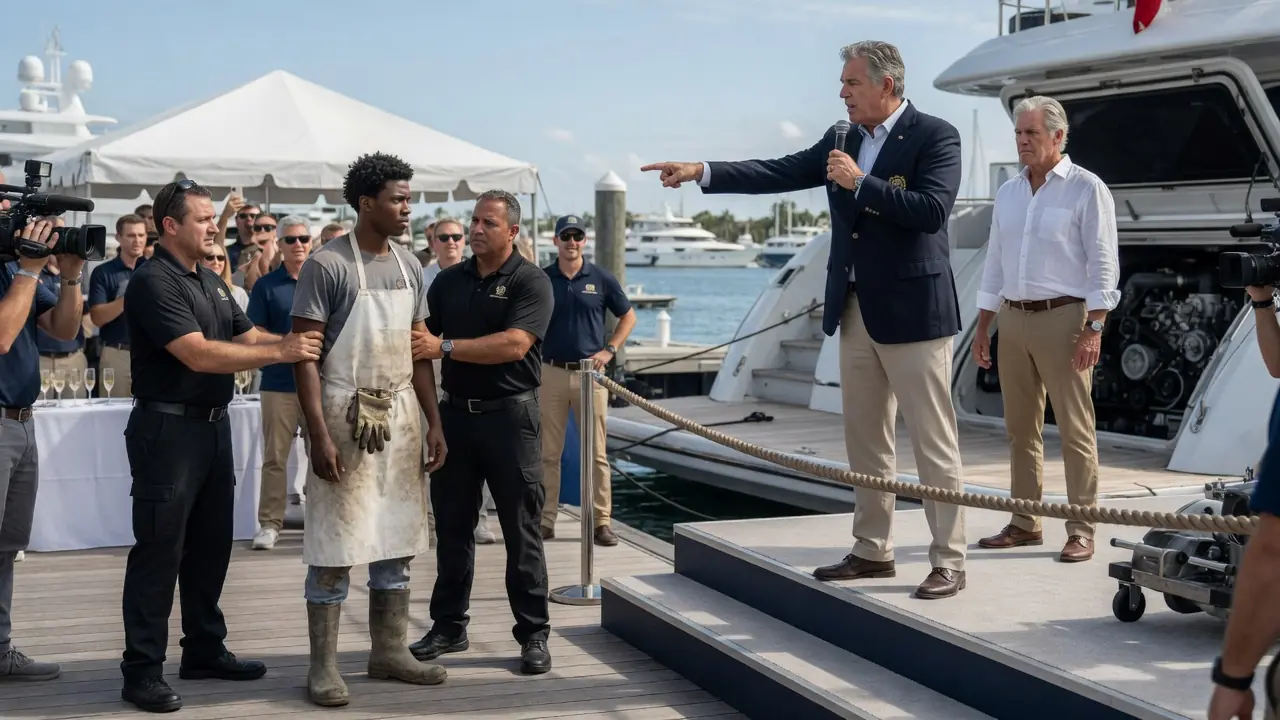
“Just five minutes,” Russell said. “That’s all I need.”
“Security,” Thornton snapped. “Get this street-stinking rat off my boat. This is a ten-million-dollar engineering competition, not charity.”
“Give me a chance,” Russell said quietly.
“Go gut fish for your rats. Don’t bother me anymore.”
Two guards grabbed Russell’s arms.
“I swear I know how to fix it. Please.”
Thornton leaned into the microphone.
“Watch this fish-stinking brat beg me for a chance to humiliate himself.”
The crowd laughed.
Thornton sneered.
“Fine. Go ahead, stinking brat. But none of them would know what miracle that boy would perform just five minutes later.”
Star Island Marina gleamed under the Miami sun like a postcard no one from Overtown would ever receive.
White tents lined the waterfront. Camera crews adjusted their angles. Sponsor banners rippled in the salt breeze.
And at the center of it all, moored against the longest dock like a sleeping beast, sat the Sovereign, Preston Cole’s eighty-five-million-dollar mega yacht.
Today was the day the whole marine engineering world had circled on their calendars.
The Marine Tech Challenge.
Cole Industries’ annual competition drew the sharpest minds from the country’s top programs. Five teams. Five chances to restart the Sovereign’s dead twin-turbine engine.
The first team to get it running would win ten million dollars and a five-year maintenance contract for Cole’s entire fleet.
The rules were simple.
No outside communication.
No preloaded diagnostics.
Just tools, training, and whatever you carried between your ears.
By nine in the morning, the dock was packed.
Three hundred spectators pressed against the velvet ropes. A livestream feed was already pulling six hundred thousand viewers. The comment section scrolled so fast the moderators gave up filtering.
Bankers, yacht brokers, marine consultants, and the kind of crowd that smelled like cologne and talked in millions filled the VIP section with champagne flutes and folded programs.
Gerald Thornton stood at the competition podium in a navy blazer with the Cole Industries crest stitched on the breast pocket.
Twenty-two years as the fleet’s chief engineer.
Three patents in marine propulsion.
A corner office at Cole Tower with a view of Biscayne Bay.
He gripped the microphone like a man who had never once doubted his right to hold it.
“Welcome to the sixth annual Marine Tech Challenge,” Thornton said.
His voice carried across the marina without effort.
“Today, the finest engineering minds in this country will demonstrate what separates theory from mastery.”
He paused.
Let the applause build.
“Let me be clear. This is not a classroom exercise. This is a real vessel, a real engine, and a real problem that my own team has spent seventy-two hours unable to resolve. If your institution sent you here, they believe you’re ready. Prove them right.”
The five teams stood in a row behind him.
MIT in crimson polos.
Georgia Tech in gold.
The Naval Academy in dress whites.
Virginia Tech in maroon.
And the University of Florida in blue and orange.
Each team had four members, a faculty adviser, and a rolling cart of precision tools that cost more than Russell Yates had seen in his entire life.
Russell stood on the far side of the marina parking lot, loading the last crate of yellowtail onto a hand truck.
He worked for Captain Reeves Fish Supply.
Four-thirty wake-ups.
Dock-to-kitchen deliveries.
Eleven dollars an hour.
His rubber boots were cracked at the soles. His apron carried three days of fish smell that no amount of bleach could erase. A line of dried salt ran from his left temple to his jaw, where sweat had dried and come back and dried again.
He wheeled the hand truck toward the marina kitchen entrance and stopped.
The sound hit him first.
A deep, arrhythmic knocking from somewhere below the Sovereign’s waterline.
Most people heard noise.
Russell heard a conversation.
The engine was talking, and nobody on that stage was listening.
Three months ago, Russell had sat at the public library on Northwest Second Avenue and filled out the Marine Tech Challenge application on a borrowed laptop.
The screen had a crack running diagonally across the display. The library’s Wi-Fi dropped twice.
Russell filled out every field anyway.
The online technical exam had forty-six questions covering diesel propulsion, hydraulic systems, electrical diagnostics, and emergency protocols.
Russell finished in fifty-one minutes.
Score: 98 out of 100.
Highest among all applicants that year.
Two weeks later, he received a one-paragraph email.
Thank you for your interest. Unfortunately, all participants must be affiliated with an accredited university or licensed marine engineering firm. We are unable to accommodate independent applicants at this time.
Russell had read it three times.
Then he closed the laptop and walked to the dock for his 4:30 shift.
He never told his grandfather.
Some rejections are easier to carry alone.
Now he stood at the edge of the parking lot, watching MIT’s lead engineer open the engine bay.
Even from sixty feet away, Russell could see the man’s hands were hesitant.
Not from nerves.
From confusion.
He was looking at the wrong system entirely.
The first hour passed.
MIT ran a full diagnostic sweep on the fuel injection array. Their faculty adviser paced behind them, arms crossed, lips tight. The lead engineer called for a sensor recalibration, adjusted the parameters, and ran it again.
Not a cough.
Not a click.
Dead silence.
Georgia Tech took a different approach.
They pulled the exhaust manifold and inspected the turbocharger housing. They found carbon scoring, but nothing that explained the dead start. Their team leader, a doctoral candidate with two published papers on twin-turbine systems, shook his head and requested an extension.
The judges granted fifteen additional minutes.
It did not help.
The Naval Academy went straight for the electrical system.
They rewired the starter relay, replaced the ignition coils, and tested the battery banks.
The engine coughed once, a sound that made the crowd lean forward, then fell silent.
A groan rippled through the spectators.
Virginia Tech focused on the cooling system.
They drained and refilled the coolant loop, checked for air pockets, and replaced the thermostat housing.
Nothing changed.
The University of Florida tried a combination approach.
Fuel, air, and spark simultaneously.
Systematic.
Methodical.
Textbook.
And completely wrong.
Three hours.
Five teams.
Zero results.
The livestream hit two million viewers.
The chat was merciless.
Ten million dollars and nobody can start a boat.
My uncle Earl could fix this with a wrench and a beer.
This is embarrassing for American engineering.
Fire them all and call a real mechanic.
Thornton stood at the edge of the competition zone, arms folded, jaw clenched so tight a vein pulsed at his temple.
Every failed attempt was a mirror.
This was his ship, his engine, his maintenance schedule, and five of the country’s best teams were proving in front of two million people that something had gone deeply wrong under his watch.
The producers kept cutting to his face.
He could feel the camera like a heat lamp on his neck.
He paced the dock, loosened his tie, checked his phone eleven times, and replied to none of the messages.
Russell had finished his delivery twenty minutes ago.
He should have been driving back to Overtown in Captain Reeves’s van. His shift was over. His pay was locked.
There was nothing for him here except the sound of an engine that would not stop talking to him.
He sat on an overturned milk crate near the kitchen entrance, elbows on his knees, head tilted slightly left, listening the way his grandfather had taught him to listen.
He could hear the engine between attempts, that arrhythmic knock.
It had three layers.
Three distinct problems stacked on top of each other like a code no one was bothering to read.
A timing issue buried under a combustion issue buried under a thermal issue.
Russell’s fingers twitched against his knee, tracing the sequence unconsciously.
He knew the answer.
He had known it since the first knock reached his ears an hour ago.
A kitchen worker stepped outside for a smoke break and noticed Russell staring at the yacht.
“You one of those engineer kids?”
“No,” Russell said. “I’m the fish guy.”
The man laughed and shook his head.
“Then why are you looking at that boat like you want to marry it?”
Russell did not answer.
He stood up, wiped his hands on his apron, and walked toward the competition zone.
The velvet rope was chest high. A security guard named Victor Langston stood beside it, thick arms crossed, scanning badges with the kind of boredom that comes from eight hours of saying no.
“I need to talk to someone about the engine,” Russell said.
Langston looked at the apron, the boots, the brown skin.
His expression did not change, but his posture did.
He shifted his weight forward, blocking the gap in the rope.
“Competition area is restricted. Authorized personnel only.”
“I know what’s wrong with it. I can hear it from the parking lot.”
Langston almost smiled.
The kind of smile adults give children who say they want to be astronauts.
“Kid, there are five teams from the best schools in the country in there. PhD engineers. If they can’t figure it out, what makes you think—”
“Because they’re not listening to it. They’re reading screens. The engine is telling them what’s wrong, and nobody is using their ears.”
Langston’s smile faded.
He stared at Russell for a long moment, then reached for his radio.
“Thornton, I got a kid out here says he knows what’s wrong with the engine.”
The radio crackled.
Then Thornton’s voice came through, sharp enough to cut glass.
“Is he with one of the teams?”
“No, sir. He’s, uh, the fish delivery kid.”
Three seconds of silence.
Then Thornton answered loud enough for the nearby crowd to hear.
“Are you serious right now? Get him out of here. I don’t have time for this circus.”
Russell felt Langston’s hand close around his upper arm.
Firm.
Final.
But the livestream camera had already turned.
Two million viewers watched the teenager in the fish-stained apron being pushed away from the rope.
The chat detonated.
Let him try.
What are they afraid of?
This is exactly what’s wrong with this country.
Give the kid five minutes.
Hashtags began forming in real time.
#LetHimTry.
#FishKid.
#MarineTechChallenge.
A producer pressed her earpiece and whispered urgently to the broadcast director. The director whispered to Cole’s assistant. The assistant typed a message on her phone.
Thornton saw none of it.
He was too busy straightening his tie and pretending the last three hours had not happened.
Russell stepped back from the rope.
He looked at the Sovereign one more time.
The engine knocked again.
That same three-layered rhythm.
Fuel.
Exhaust.
Cooling.
Three problems.
One answer.
And nobody who would let him give it.
He turned to walk away.
And that was when Preston Cole stepped out of the VIP tent.
Russell Yates was born in Overtown, Miami, the kind of neighborhood where ambulances took detours and pizza chains did not deliver after dark.
His mother worked double shifts at a hotel laundry on South Beach.
His father left before Russell could walk.
The man who raised him was his grandfather, Earl Yates.
Earl had spent thirty-five years in the United States Navy as a machinist’s mate aboard the USS Carl Vinson.
He could diagnose an engine failure by the way a wrench vibrated in his hand.
He had kept aircraft carriers moving through the Persian Gulf, the South China Sea, and the North Atlantic.
When he retired, the Navy gave him a plaque and a pension that barely covered rent in a neighborhood no one chose to live in.
He opened a small repair shop on Northwest Third Avenue.
A concrete floor.
A corrugated tin roof.
A hand-painted sign that read:
Yates Marine Repair.
He fixed outboard motors for shrimp boats, rebuilt diesel generators for charter fishermen, and patched up whatever broken thing the men of Overtown dragged to his door.
Sometimes he charged half price.
Sometimes nothing.
No yacht owner ever walked through that door.
The marinas on Star Island had their own certified mechanics, men with degrees from maritime academies and uniforms pressed sharper than their skills.
Earl never competed with them.
His hands spoke a language no diploma could teach.
Russell started helping in the shop at eight years old, not because anyone asked him to, but because he could not stay away.
The smell of diesel oil and copper wire pulled him in the way Saturday cartoons pulled other kids to the couch.
Earl would sit him on an overturned bucket beside a stripped-down engine and say nothing for twenty minutes.
Just let the boy look.
Let him touch.
Let him listen.
“Every engine tells you what’s wrong,” Earl told him one afternoon, his fingers with grease. “You just have to shut up and listen.”
That became Russell’s education.
Not textbooks.
Not lectures.
Listening.
By ten, Russell could identify a misfiring cylinder by sound alone.
By twelve, he could rebuild a two-stroke outboard from a box of parts without a manual.
By fourteen, he had moved on to marine diesel engines, the big ones that powered commercial fishing vessels and harbor tugs.
Earl would scavenge dead engines from the salvage yard on the Miami River, bring them home on a borrowed flatbed, and drop them on the shop floor like puzzles waiting to be solved.
“Don’t read the manual first,” Earl would say. “Listen first, then look, then touch. The manual is for people who don’t trust their hands.”
Russell trusted his hands.
He trusted his ears more.
He could hear a worn bearing in a crankshaft the way a musician hears a flat note in a chord.
It was not magic.
It was ten years of silence and grease and repetition in a shop that smelled like diesel fuel and patience.
By sixteen, he had repaired over two hundred engines.
Outboards.
Inboards.
Diesel.
Turbocharged.
He never saw the inside of a classroom that taught any of it.
He never held a certificate.
He never wore a uniform with a company logo on the chest.
What he had was a pair of hands that knew metal the way a blind man knows the face of someone he loves by touch, by memory, by faith.
Earl was seventy-one now.
His knees had surrendered to arthritis three years ago.
His fingers, once steady enough to thread a needle inside a fuel injector, now trembled when he held a coffee cup.
He could not grip a wrench anymore.
Could not crawl under an engine block.
Could not do the work that had defined his entire life.
But every evening after Russell came home from Captain Reeves Fish Supply, Earl would sit in his recliner in the corner of the shop and talk Russell through whatever engine was on the floor.
His body had quit, but his mind had not.
Not yet.
“What do you hear?” Earl would ask.
And Russell would close his eyes, tilt his head, and describe every sound, every click, every hiss, every knock, until Earl nodded and said, “Good. Now fix it.”
That was their routine.
That was their language.
That was the inheritance no one could repossess.
Russell carried it with him everywhere.
To the fish dock at 4:30 in the morning.
To the library where he studied engine schematics on a cracked screen.
To the edge of Star Island Marina, where he stood right now listening to a dying engine speak a language that five university teams could not understand.
“Listen to the engine,” Earl always said. “Not the people.”
Russell had listened to the people his whole life.
The guidance counselor who said trade school was the realistic option.
The marina managers who looked at his skin and saw a delivery boy.
The automated email that told him 98 out of 100 was not enough because he did not have the right letters after his name.
Today, for the first time, Russell decided to stop listening to the people and start listening to the engine.
Preston Cole was seventy-three years old.
He had built Cole Industries from a one-room engine shop in Galveston, Texas, into a maritime empire worth four billion dollars.
He wore a white linen shirt with the sleeves rolled to his elbows.
No tie.
No cufflinks.
His watch cost more than the yacht’s monthly fuel bill, but his hands still carried the calluses of a man who had once earned his living under a hood.
He had been watching the livestream from inside the VIP tent for three hours.
Watching five teams fail.
Watching Thornton pace.
Watching the crowd grow restless and the chat grow cruel.
And then he saw something that made him set down his bourbon and stand up.
A kid in a fish-stained apron being pushed away from the velvet rope by a security guard.
The kid did not fight.
Did not shout.
He just stood there with his hands at his sides, looking at the yacht like he could see through the hull.
Cole had seen that before.
Sixty years ago, he had been that kid.
Different dock.
Different city.
Same rope.
He stepped out of the tent and walked toward the competition stage.
His assistant scrambled to follow.
Two bodyguards flanked him.
The crowd parted without being asked.
“Gerald,” Cole said.
Thornton turned.
His face shifted from frustration to performance-ready composure in less than a second.
“Mr. Cole, I assure you we’re close to a resolution. The Naval Academy team is preparing a second—”
“Stop.”
The word landed like a gavel.
Thornton’s mouth closed.
Cole stepped up to the microphone.
The livestream camera swung to him.
The chat slowed to a crawl.
Two point three million viewers held their breath.
“Ladies and gentlemen,” Cole said.
His voice was unhurried, deliberate, the kind of calm that comes from decades of owning every room he walked into.
“Five teams. Three hours. Zero results. I think we can all agree the conventional approach has had its chance.”
He paused and scanned the crowd.
“I’m opening a new round. I’m calling it the open challenge. No badges required. No degrees required. No institutional affiliation required. If you are standing on this dock right now and you believe you can start this engine, step forward.”
Murmurs rippled through the crowd.
The five team captains exchanged uneasy glances.
A few spectators laughed nervously.
The MIT faculty adviser shook his head and crossed his arms tighter.
Thornton leaned toward Cole’s ear.
“Mr. Cole, with all due respect, this is a professional competition. We can’t just let anyone—”
“I just did.”
Cole did not look at him.
Silence.
Ten seconds passed.
Nobody moved.
The camera panned the crowd slowly, searching for a volunteer.
The chat filled with question marks and exclamation points.
Someone typed, Nobody’s crazy enough.
Then Russell stepped forward.
He came from the edge of the crowd near the kitchen entrance, still wearing the apron, still wearing the cracked boots.
His hands were at his sides.
His chin was level.
He did not rush.
He did not hesitate.
He walked like a man who had already made his decision before anyone gave him permission.
The crowd saw a teenager in a fish apron.
The chat saw contempt.
Thornton saw a problem.
“You cannot be serious,” Thornton said, his voice carrying across the dock without the microphone. “This is the kid I told security to remove twenty minutes ago. He’s the fish delivery boy.”
Russell stopped at the edge of the competition zone.
He looked at Cole.
Not at Thornton.
Not at the cameras.
Not at the crowd.
At Cole.
“I can start your engine, sir,” Russell said. “I’ve been listening to it for the last three hours. It has three problems. Not one. Three. And none of these teams found any of them because they were looking at screens instead of listening to the machine.”
The dock went quiet.
The kind of quiet that happens when everyone in the room realizes they might be witnessing something they will talk about for years.
Cole studied the boy’s face.
The steadiness in his eyes.
The grease under his fingernails that was not from fish.
It was from engines.
Old grease.
Layered grease.
The kind that takes years to build up.
“What’s your name?” Cole asked.
“Russell Yates.”
“How old are you, Russell?”
“Eighteen.”
“And where did you study marine engineering?”
“My grandfather’s shop. Overtown.”
A woman in the VIP section whispered to her husband.
The cameraman zoomed in.
Thornton shook his head slowly, theatrically performing disbelief for the audience.
“Mr. Cole,” Thornton said, stepping forward, “I must formally object. This individual has no credentials, no certification, no liability coverage. If he damages the engine, the insurance implications alone—”
“Gerald,” Cole said, his voice dropping half an octave, “you’ve had seventy-two hours to fix this engine. Your team couldn’t do it. Five university teams couldn’t do it in three more hours. I think we’re past the point of worrying about credentials.”
Thornton’s jaw tightened.
He stepped back, but his eyes stayed on Russell.
Cold.
Measuring.
Already calculating how to make the boy’s failure as public as possible.
Cole turned to Russell.
“You have ten minutes. If the engine starts, you win the challenge. If it doesn’t, you walk away. If you cause any damage, you’re personally liable. Do you accept?”
“I won’t need ten minutes,” Russell said. “And I won’t cause any damage.”
A murmur ran through the crowd.
Someone in the back shouted, “Let him cook.”
The chat exploded with fire emojis and prayer hands.
Cole extended his arm toward the yacht’s engine bay.
“Then show us.”
Russell stepped past the velvet rope for the first time.
His cracked boots hit the polished teak deck of the Sovereign.
He could feel the vibration of the dead engine through the wood.
A faint, persistent tremor that told him the fuel pump was still cycling even though ignition had failed.
The engine was trying to start itself.
It just needed someone who understood what it was asking for.
He walked past the five teams.
Past their rolling carts of precision instruments.
Past their laptops and diagnostic tablets and wireless sensor arrays.
He walked to the engine bay hatch, knelt down, and pressed his palm flat against the metal cover.
Warm.
Not hot.
The heat distribution was uneven.
Warmer on the port side.
Cooler on starboard.
That confirmed his first suspicion.
He closed his eyes, tilted his head left, and listened the way Earl had taught him to listen.
Not for what he expected to hear.
For what the engine was trying to say.
The knock was still there.
Three layers.
Three problems.
Fuel.
Exhaust.
Cooling.
Stacked on top of each other like a lock with three tumblers.
Miss one, and nothing turns.
Professor Harrison Webb, the renowned marine systems expert serving as the livestream’s technical commentator, leaned into his own microphone from the broadcast booth.
He had been silent for twenty minutes, watching the teams fail without comment.
Now he spoke.
“That posture,” Webb said quietly. “He’s not guessing. He’s not testing. He’s diagnosing by vibration and sound. I’ve seen that technique exactly once before, from a Navy machinist who served on the Carl Vinson in the nineties.”
The comment went out to 2.3 million viewers.
Most did not understand what it meant.
Russell did.
He just did not know anyone was watching.
He opened the engine bay hatch, took a breath, and went to work.
Russell’s hands moved before his brain had to tell them what to do.
Ten years of muscle memory took over the moment his fingers touched the engine housing.
He did not reach for a diagnostic tablet.
He did not ask for a wiring diagram.
He reached for a wrench.
The first thing he did surprised everyone watching.
He did not open the main engine panel.
He went underneath, lay flat on his back on the engine room floor, and slid beneath the fuel rail like a mechanic sliding under a car on a creeper.
The five teams had spent three hours working from the top.
Russell started from the bottom.
“What is he doing?” the MIT team captain whispered.
His adviser did not answer.
He was watching too closely to speak.
Russell pressed his ear against the fuel rail.
He could hear the injectors cycling, a rapid series of clicks that should have been perfectly synchronized, like dominoes falling at even intervals.
But they were not even.
One injector was firing late.
Maybe three degrees off the camshaft rotation.
But three degrees was enough to prevent ignition on a twin-turbine system this precise.
He traced the fuel line with his fingertips until he found it.
The camshaft position sensor.
A small electromagnetic unit bolted to the engine block.
It was loose.
Not broken.
Not failed.
Just loose.
The vibration of normal operation had slowly worked the mounting bolt free over weeks. It had shifted just enough to throw off the timing signal to the fuel injection computer.
Every team had checked the fuel injection software.
They had recalibrated the digital parameters.
They had tested the injectors themselves.
But none of them had put their hands on the physical sensor.
None of them had checked the bolt.
Russell pulled a ten-millimeter wrench from his back pocket, borrowed from the kitchen maintenance closet on his way past, and tightened the sensor back into position.
Ninety seconds.
One problem down.
Professor Webb’s voice came through the livestream.
“He just realigned the camshaft position sensor by hand. Five teams ran software diagnostics for three hours and missed a loose bolt. That’s not luck. That’s someone who knows where to look because he’s looked there a thousand times before.”
The chat erupted.
This kid is insane.
Fish boy is cooking.
MIT in shambles.
The Georgia Tech team leader stared at his diagnostic tablet, then at Russell, then at the tablet again.
His face said everything his mouth could not.
Thornton stood at the edge of the zone, arms crossed.
His expression had not changed, but his left hand was gripping his right forearm so hard the knuckles had gone white.
Russell moved to the exhaust side.
He pulled the valve cover, a heavy steel plate held down by eight bolts.
The teams had left this area alone.
Exhaust systems were not typically where you looked for a starting failure.
But Russell was not looking for a starting failure.
He was looking for the reason the engine could not breathe.
The moment the cover came off, he saw it.
Carbon deposits.
Thick, , crystallized carbon caked onto two of the four exhaust valves like tar inside a chimney.
The deposits were so heavy they prevented the valves from opening fully.
The engine could not exhale.
If you cannot exhale, you cannot take the next breath.
If you cannot breathe, you cannot ignite.
This was not a sudden failure.
This was months of neglect.
Someone had been running low-grade fuel through a system designed for premium marine diesel.
The carbon had been building one layer at a time, like plaque in an artery, and whoever was responsible for the maintenance schedule had either missed it or ignored it.
Russell glanced at Thornton just for a second.
Then he looked away.
He pulled a flathead screwdriver from the nearest tool cart and began scraping the carbon from the valve seats.
But not randomly.
He scraped along the grain of the metal, following the machining lines etched during manufacturing.
Never against them.
Never across them.
“Watch his wrist,” Webb said on the livestream.
His voice had changed.
It was no longer analytical.
It was reverent.
“He’s cleaning along the valve seat grain pattern. That technique protects the sealing surface. You don’t learn that from a textbook. You learn that from someone who’s done it five hundred times and taught you where the metal wants the blade to go.”
Russell worked both valves clean in under ninety seconds.
His hands were with carbon.
His apron was streaked with soot.
He looked like he belonged in a coal mine, not on an eighty-five-million-dollar yacht.
But his movements were surgical.
The Naval Academy team leader turned to his adviser.
“Where did this kid come from?”
Thornton had not moved, but the arrogance was gone from his face.
In its place was something he had not felt in twenty-two years.
Fear.
Not of Russell.
Of what Russell was about to reveal.
Because if the carbon buildup was a maintenance failure, it was Thornton’s failure.
His schedule.
His budget.
His signature on the inspection reports that said everything was fine.
Russell moved to the port side.
He placed his hand flat against the coolant manifold.
His palm told him what the temperature gauges could not.
The port side was running fifteen degrees warmer than starboard.
An air lock.
Trapped air in the cooling circuit had created a hot pocket that triggered the engine’s thermal safety shutoff.
This was the invisible killer.
The first two problems were enough to weaken the engine, but the air lock was the one that actually killed it.
The thermal shutoff had engaged, and the engine’s computer had locked itself out of the starting sequence as a safety measure.
Most engineers only encountered air locks in theory, in a textbook diagram with color-coded arrows.
Russell had encountered them in practice.
On fishing boats with patched coolant lines.
On harbor tugs with cracked manifolds.
On every imperfect engine that came through Earl’s shop.
He knew where the bleed valve was.
Not because the schematic told him.
Because on twin-turbine marine engines of this class, the bleed valve was always in the same place, tucked behind the coolant reservoir, accessible only if you knew to reach around the housing and feel for a quarter-turn brass fitting that most engineers did not even know existed.
Russell reached behind the housing.
Found the fitting by touch.
Turned it one quarter rotation counterclockwise.
A soft hiss of trapped air escaped.
Then a trickle of coolant.
Then silence.
He closed the valve and walked to the engine control panel.
He looked at the start button, a flat gray square with a green LED ring that had not glowed in seventy-two hours.
The entire marina had gone still.
Three hundred spectators.
Five teams.
Two point three million viewers.
Gerald Thornton.
Preston Cole.
Professor Webb.
Every one of them watched a teenager in a fish apron reach for the start button of an eighty-five-million-dollar yacht.
Russell pressed it.
Half a second of silence.
Then the twin turbines caught.
A deep rolling thunder started in the engine room, traveled through the hull, up through the deck, and into the souls of every person standing on that dock.
The sound was unmistakable.
It was the sound of an engine that had been waiting patiently, stubbornly, for someone who spoke its language.
Four minutes and thirty-eight seconds.
Three problems.
One kid.
The dock erupted.
Three hundred people were on their feet.
The livestream chat became a wall of capital letters.
The MIT captain dropped his tablet.
The Georgia Tech leader started clapping slowly at first, then faster.
The Naval Academy officer snapped a salute.
Strangers grabbed each other’s arms.
A woman in the VIP section was crying.
Professor Webb stood up in the broadcast booth.
He removed his glasses, wiped his eyes with the back of his hand, then spoke into the microphone to 2.3 million people.
“In thirty years of marine engineering, that is the most extraordinary diagnostic performance I have ever witnessed. That young man didn’t just fix an engine. He gave a master class.”
Russell stood in the engine room, hands with carbon, fish apron still tied around his waist.
The engine hummed behind him.
Steady.
Warm.
Alive.
He did not raise his fists.
He did not shout.
He did not look at Thornton.
He looked at his hands.
The same hands his grandfather had trained.
The same hands the marina had tried to push away from the rope.
And for the first time in a very long time, Russell Yates smiled.
The applause had not died down when Preston Cole walked across the deck toward the engine bay.
His steps were slow, measured.
The crowd quieted with each one, the way a theater goes silent when the lights dim before the final act.
He stopped in front of Russell and extended his hand.
Russell looked at it.
His own hands were with carbon and grease, streaked with engine coolant.
He hesitated.
“Take it,” Cole said. “I’ve shaken cleaner hands that did far less.”
Russell shook it.
The grip was firm.
The kind of handshake that seals things that paperwork only confirms later.
“Where did you learn to do that?” Cole asked.
His voice was quiet enough that only Russell, the nearest camera, and 2.3 million viewers could hear it.
“My grandfather,” Russell said. “Earl Yates. He was a machinist’s mate on the Carl Vinson for thirty-five years. He taught me everything.”
Cole nodded slowly.
“The Carl Vinson? Navy man?”
“Yes, sir.”
“And he taught you to listen to an engine before you touch it.”
“He said that’s the only way to know what’s really wrong. Screens tell you what the computer thinks. Your hands tell you the truth.”
Cole turned to his assistant.
“Pull up the competition’s preliminary applications. All of them. I want Russell Yates’s file on the main screen now.”
The assistant hesitated.
“Sir, that’s confidential applicant data.”
“It’s my competition, my data, my screen. Now.”
Thirty seconds later, Russell’s application appeared on the sixty-inch display mounted on the competition stage, the same screen that had been showing team rankings and countdown timers all day.
Two point three million viewers saw it at the same time.
Name: Russell Yates.
Age: 18.
Institutional affiliation: none.
Technical exam score: 98 out of 100.
A gasp rippled through the crowd.
Ninety-eight.
The highest score of any applicant.
Higher than every member of every team standing on that dock.
Cole scrolled down.
The rejection note appeared in red text at the bottom of the file.
Reviewer: G. Thornton.
Decision: rejected.
Reason: no institutional affiliation. Does not meet competition image standards.
Note: not a fit.
Cole read the note aloud, every word, into the microphone to three hundred spectators, five university teams, and a livestream audience that had now crossed three million.
The dock went silent.
Not the polite silence of an audience waiting for the next speaker.
The thick, airless silence of people who had just heard something they could not unhear.
“Not a fit,” Cole repeated.
He let the words hang in the salt air like smoke.
Then he turned to Thornton.
Thornton stood six feet away.
His face was the color of wet cement.
His hands were in his pockets.
His jaw was working, but no sound came out.
“Gerald,” Cole said, “this young man scored ninety-eight on your exam, the highest score of any applicant, and you rejected him because he didn’t have a university logo on his resume.”
“Mr. Cole, the eligibility criteria clearly state—”
“The eligibility criteria are guidelines, Gerald, not a wall. You had discretion. You used it to keep out the most qualified person in the applicant pool.”
Cole paused.
“Why?”
Thornton’s mouth opened.
Closed.
Opened again.
“He didn’t… the competition has a reputation to maintain. We can’t just let anyone—”
“You just watched ‘anyone’ do in four minutes what your entire division couldn’t do in seventy-two hours. What five PhD teams couldn’t do in three. And you’re standing here telling me about reputation.”
The livestream chat had stopped scrolling.
Not because people had stopped typing.
Because every message was the same word repeated thousands of times.
Fired.
Fired.
Fired.
Thornton looked at the screen.
At his own name.
At the words “not a fit” glowing in red beside a score of 98.
He could feel three million pairs of eyes on him.
He could feel his career, twenty-two years of it, contracting into a single indefensible sentence.
“I made a judgment call,” Thornton said quietly. “I stand by the criteria.”
Cole stared at him for three full seconds.
Then he turned back to the crowd.
“Let me tell you something,” Cole said. “Forty years ago, I walked into a marine shop in Galveston, Texas, with no degree, no certification, and no institutional backing. I was nineteen years old. I had grease under my fingernails and a borrowed wrench in my back pocket.”
The marina was so quiet you could hear the water lapping against the hull of the Sovereign.
“The owner of that shop looked at me the same way Mr. Thornton looked at Russell Yates today.”
He paused.
“The difference is that the man in Galveston gave me a chance, and I spent the next forty years proving he was right. Today, I watched a young man prove the same thing in four minutes and thirty-eight seconds with a borrowed wrench in a fish apron.”
Cole turned to Russell.
The boy was standing with his hands at his sides, carbon still on his fingers, the engine humming steadily behind him.
He had not moved during the entire exchange.
He had not spoken.
He had not needed to.
The engine had spoken for him.
“Russell,” Cole said, “I owe you an apology. Not for what happened today. For what should have happened three months ago.”
Russell nodded.
He did not trust his voice to hold steady if he tried to speak.
Cole turned back to the microphone.
The crowd leaned in.
The livestream held at 3.1 million viewers.
“Russell Yates is the winner of the sixth annual Marine Tech Challenge,” Cole said. “And I want to make something clear. He didn’t win on a technicality. He didn’t win because the rules changed. He won because he was the only person on this dock who could do the job.”
The applause was instant and deafening.
Three hundred people on their feet.
Air horns sounded from somewhere near the back.
The university teams, all five of them, were clapping too.
Not out of obligation.
Out of recognition.
The MIT captain gave Russell a nod that carried more weight than any trophy.
Cole raised his hand for silence.
It came quickly.
“Three things,” Cole said. “First, the ten-million-dollar prize is Russell’s. Every cent. He earned it in four minutes and thirty-eight seconds, which, for the record, makes it the highest-paying four minutes in the history of this competition.”
A ripple of laughter cut through the tension.
Russell blinked.
Ten million dollars.
The number did not feel real.
It felt like something that happened to other people.
People with degrees and blazers and offices with views.
“Second,” Cole continued, “I am personally funding a full scholarship for Russell Yates at the University of Miami’s Rosenstiel School of Marine, Atmospheric, and Earth Science. Four years. Tuition, housing, books, and a living stipend if he wants it.”
Russell’s throat tightened.
He thought of his grandfather.
Of the shop on Northwest Third Avenue.
Of the cracked laptop at the library.
“Third,” Cole said.
This time, the silence was deliberate.
“Effective immediately, Russell Yates will receive a five-year maintenance contract for the entire Cole Industries maritime fleet. Forty-three vessels. He will be the youngest chief maintenance consultant in the history of this company.”
The dock erupted again, louder than before.
The livestream chat was a blur of celebration and disbelief.
Professor Webb leaned into his broadcast microphone one final time.
“I’ve spent my career at the intersection of education and engineering,” Webb said. “Today, I watched an eighteen-year-old with no formal training outperform every credentialed team in this competition. If that doesn’t make us rethink how we identify talent in this country, nothing will.”
He paused, then added, “I’d like to offer my services as Russell’s academic mentor. Personally. Pro bono. It would be my privilege.”
Russell stood on the deck of the Sovereign, the engine humming behind him, the salt wind pulling at his apron.
Three hours ago, he had been carrying fish.
Now the whole world knew his name.
But the part that hit him hardest, the part that made his eyes burn, was knowing that somewhere in Overtown, in a recliner in the corner of a small repair shop, his grandfather was about to find out too.
Cole did not fire Gerald Thornton on the dock.
He did something worse.
He let the evidence do it.
Within an hour of the livestream ending, Cole’s legal team had pulled Thornton’s complete maintenance records for the Sovereign.
Every quarterly inspection report.
Every fuel purchase order.
Every budget allocation for the Marine Division going back three years.
What they found was damning.
The carbon buildup Russell had scraped from the exhaust valves was not an accident.
It was the result of a deliberate cost-cutting decision.
Thornton had switched the Sovereign’s fuel supply from premium marine diesel to a cheaper, lower-grade alternative eighteen months ago.
The savings, roughly forty-two thousand dollars per quarter, had been rerouted into the division’s discretionary budget.
A budget Thornton controlled personally.
The quarterly inspection reports told the rest of the story.
For six consecutive quarters, Thornton had signed off on the exhaust system as within operational parameters.
The carbon scoring Russell found in four minutes had been building for a year and a half.
Thornton had either missed it, which meant incompetence, or ignored it, which meant fraud.
Neither option left room for a defense.
The loose camshaft position sensor told a similar story.
Routine vibration checks, standard protocol on any vessel of this class, would have caught the loosening bolt months before it became a problem.
The maintenance logs showed those checks as completed.
The sensor’s condition proved they had not been.
Cole called Thornton into his office at Cole Tower the following morning.
The meeting lasted eleven minutes.
Thornton was terminated for cause.
Twenty-two years of service.
Three patents.
A corner office with a view of Biscayne Bay.
All of it ended by a single sentence in the termination letter.
Falsification of maintenance records and misallocation of divisional funds.
His Cole Industries badge was deactivated before he reached the parking garage.
The professional consequences followed quickly.
The American Bureau of Shipping opened a compliance review into every vessel Thornton had overseen during his tenure.
His marine engineering certification was suspended pending investigation.
Two former colleagues, engineers who had worked under him, came forward with statements alleging that Thornton had pressured them to sign off on inspections they had not performed.
The social consequences were already in motion.
The livestream clip of Cole reading Thornton’s rejection note, “not a fit,” had been viewed forty-eight million times within seventy-two hours.
It became the most shared engineering clip in YouTube history.
Late-night hosts played it.
News anchors analyzed it.
Opinion columnists wrote about it.
The phrase “not a fit” became shorthand on social media for institutional gatekeeping.
A hashtag.
A meme.
A mirror held up to every hiring manager who had ever rejected someone for the wrong reasons.
Thornton’s LinkedIn profile was deleted within a week.
His name, once associated with marine propulsion patents and industry conferences, was now associated with a single image.
A screenshot of a rejection note glowing red on a sixty-inch screen beside a score of 98 out of 100.
He did not go to prison.
He did not lose his house.
He did not suffer anything beyond what he had built for himself.
And that was the cruelest part.
Every consequence Gerald Thornton faced was one he had authored.
The maintenance failure was his negligence.
The rejection was his signature.
The public humiliation was the result of his own words broadcast on his own company’s livestream in a competition he had judged.
Nobody destroyed Gerald Thornton’s career.
Gerald Thornton destroyed Gerald Thornton’s career.
Russell Yates just turned on the light.
Six months later, Russell Yates walked into his first lecture at the University of Miami’s Rosenstiel School of Marine, Atmospheric, and Earth Science.
He wore a new pair of boots.
No cracks.
No fish smell.
But the grease under his fingernails was still there.
Some things you do not wash off.
Some things you should not.
In the front row of the orientation ceremony sat Earl Yates, seventy-one years old, arthritic hands folded in his lap.
In his breast pocket, wrapped in a piece of shop cloth, was the ten-millimeter wrench Russell had used in the shop for the first time at eight years old.
Russell did not need a badge to prove he belonged.
He did not need a logo.
He did not need permission.
He needed five minutes.
The story was over, but one thing kept sticking with him.
People usually believe permission comes before ability.
First the degree.
Then the certification.
Then somebody in authority says, “Okay, now you are allowed.”
That is the order most people are taught to accept.
But Russell’s story proved something different.
The ability had always been there.
Permission was the only thing missing.
And the people giving permission were not checking whether he could do the job.
They were checking whether he looked like he could.
Those were two completely different questions.
That was what mattered.
A world can become so focused on credentials that the people guarding the gates stop asking, “What can you do?”
Instead, they ask, “Where are you from? What school did you attend? What logo is on your shirt?”
If the answer does not match the picture in their head, the gate stays closed.
It does not matter what is in your hands.
It does not matter what is in your head.
Meanwhile, on the other side of that gate, the problem remains unsolved because the person who could fix it is standing in the parking lot being told they do not belong.
So the lesson is not simply to work harder until they let you in.
The lesson is that the gate was never really about you.
It was about them.
Their comfort.
Their assumptions.
Their fear of being shown up by someone who was never supposed to be that good.
Russell Yates did not ask the engine for permission.
He listened.
And when the chance finally came, he made the whole marina listen too.