At 7:36 on a Friday evening, Raymond Cole walked through the front doors of Bellanova Steakhouse wearing a black button-up shirt, black trousers, understated black shoes, and a silver watch he had owned for nearly twelve years.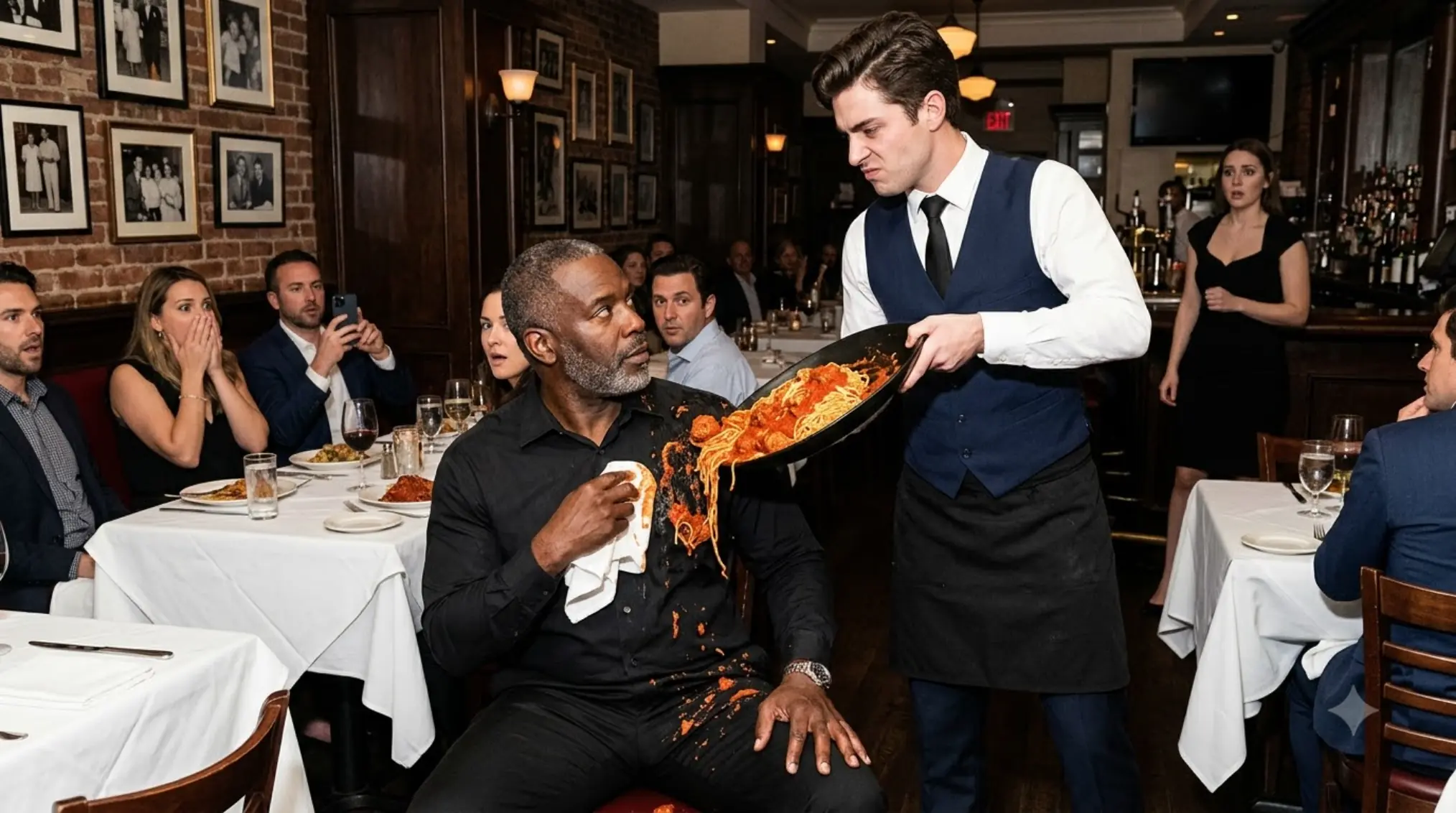
Nobody recognized him.
That was precisely why he was there.
Bellanova occupied the ground floor of a restored nineteenth-century building on West 52nd Street in Manhattan, where dark walnut walls, brass sconces, white tablecloths, and shelves of Italian wine created exactly the atmosphere Raymond had wanted when he opened the first location seventeen years earlier.
The restaurant smelled of garlic, red wine, rosemary, and grilled beef.
Every table was occupied.
Conversations blended with the soft clink of silverware.
A pianist worked quietly in the corner.
The host looked toward Raymond and smiled professionally.
“Good evening, sir. Reservation?”
“Cole.”
The young man checked the tablet.
“Raymond Cole?”
“Yes.”
“Table seventeen.”
Raymond nodded.
The host hesitated for half a second.
“Dining alone?”
“Yes.”
Something changed in the host’s expression.
Not rudeness.
Merely surprise.
Table seventeen was one of the better two-tops in the room, tucked along the paneled wall with a clear view of the bar and central dining area.
Raymond had specifically requested it.
He wanted to see everything.
The host escorted him over.
A chair was pulled out.
Water arrived.
Menu placed neatly in front of him.
So far, completely normal.
Raymond sat.
He did not take out a phone.
He did not announce his name to management.
He did not glance knowingly toward the security cameras.
Instead, he opened the menu like someone who had never seen it before.
In reality, he could have recited half of it from memory.
Bellanova had begun as one narrow restaurant in Chicago.
Raymond had been thirty-five.
He had worked twelve years in hospitality by then, starting as a dishwasher after high school and moving through nearly every job in a dining room.
Dishwasher.
Prep cook.
Busser.
Server.
Bartender.
Assistant manager.
General manager.
Regional trainer.
The industry had taught him two things.
First, guests rarely understood how hard restaurants were to run.
Second, employees almost always knew more about a restaurant’s real culture than the people who owned it.
Raymond remembered working for a wealthy restaurant group where executives arrived once every quarter.
For three hours before their visits, everybody transformed.
Floors were polished again.
Wine bottles rotated perfectly.
Managers became unusually polite.
Troubled employees disappeared from the schedule.
The executives would eat.
Praise the service.
Leave.
By midnight, the restaurant became itself again.
Raymond promised himself that if he ever owned a company, he would never rely only on what people did when they knew the owner was watching.
Seventeen years later, Cole Hospitality Group operated fourteen restaurants in six cities.
Bellanova Manhattan was the most profitable.
It was also becoming the most concerning.
Five complaints had reached Raymond’s office in eight weeks.
Not ordinary complaints.
Every restaurant received those.
Overcooked steak.
Long waits.
Reservation problems.
Wine temperature.
People upset that a particular table was unavailable.
Those were operational issues.
The newer complaints described something else.
A Black attorney said he waited twenty-five minutes before receiving a wine list while two later-arriving white couples received immediate service.
A Latino real-estate developer said a waiter repeatedly suggested cheaper wines after he asked for a bottle from the reserve list.
A Black woman celebrating her medical-school graduation alleged that a server asked whether she “understood the pricing” before taking her order.
Another complaint came from an Asian American software founder who arrived wearing sneakers and was seated beside the kitchen even though his reservation listed a premium table.
None of these proved discrimination by itself.
Raymond hated lazy conclusions almost as much as he hated discrimination.
He ordered a review.
The branch general manager, Arthur Bennett, reported no systemic issue.
Mystery shoppers found inconsistent but inconclusive service patterns.
Several employees privately told corporate human resources that one server in particular, Derek Lawson, judged guests heavily by appearance.
Derek’s sales numbers were excellent.
High check averages.
Strong tips.
Huge wine sales.
Regular wealthy customers requested him.
Arthur defended him.
“Derek knows how to read a room.”
Raymond disliked that sentence immediately.
“What does that mean?”
Arthur had laughed.
“Hospitality instinct.”
Raymond asked again.
“What does it mean?”
Arthur’s answer became less confident.
“He knows which guests want premium service.”
“Shouldn’t every guest receive premium service?”
“You know what I mean.”
Raymond did.
That was the problem.
So he came to Bellanova himself.
No announcement.
No corporate driver.
No jacket expensive enough for servers to recognize at twenty feet.
No visible executive team.
Just a fifty-two-year-old Black American man dining alone.
Ten minutes passed.
Nobody approached.
Raymond watched another table receive bread.
Then another.
The couple seated five minutes after him received cocktails.
Raymond still had water.
He checked his watch.
7:47.
A waiter crossed nearby carrying wine.
White male.
Late twenties.
Styled dark-brown hair.
Navy service vest.
Crisp white shirt.
Black tie.
Black apron.
Raymond recognized him from personnel photographs.
Derek Lawson.
Derek passed table seventeen without looking over.
Two minutes later he returned.
Still nothing.
Raymond raised one hand lightly.
“Excuse me.”
Derek stopped.
Looked toward him.
“Yes?”
“Are you my server?”
A tiny pause.
“I’ll be with you.”
Then he continued walking.
No greeting.
No apology.
No name.
Raymond watched him approach table nineteen, where a white couple in their forties sat beneath a painting of Lake Como.
Derek smiled warmly.
“Mr. Wilkins. Good to see you again.”
The entire tone changed.
Raymond noticed.
He did not yet interpret it.
Good servers developed relationships with regulars.
That was normal.
What mattered was what happened next.
At 7:53, Derek finally approached.
He did not smile.
“What can I get you?”
Raymond closed the menu.
“I’d like a glass of the 2019 Barolo first.”
Derek’s eyes flicked toward him.
“That’s thirty-eight dollars a glass.”
Raymond looked up.
“I saw.”
Derek seemed slightly uncomfortable.
“Would you prefer one of our house reds?”
“No.”
“The Montepulciano is fifteen.”
Raymond held his gaze.
“I asked for the Barolo.”
Derek nodded.
“Sure.”
No apology.
He turned away.
Raymond watched him go.
Interesting.
Not proof.
But interesting.
The restaurant continued around him.
A woman near the bar laughed loudly.
A birthday candle appeared at another table.
The pianist changed songs.
Raymond sat alone.
At 8:02, the wine arrived.
Derek placed it down without presenting the bottle.
Raymond took a sip.
Correct wine.
Proper temperature.
He asked:
“What are tonight’s specials?”
Derek looked toward the room as though he needed to be elsewhere.
“Sea bass. Veal chop. Truffle pasta.”
“Anything off-menu?”
That question mattered.
Bellanova had a rotating off-menu dry-aged porterhouse available only when quantities allowed.
Servers were expected to offer it to guests who asked about special cuts.
Derek answered:
“No.”
Raymond knew there were six portions available.
He had checked inventory that afternoon.
“All right.”
Derek began turning away.
Raymond stopped him.
“I’m thinking about the forty-day porterhouse.”
Derek looked back.
“For one person?”
“Yes.”
“That’s a twenty-eight-ounce steak.”
“I know.”
“It’s one hundred ninety dollars.”
Raymond almost smiled.
Again.
Price explanation before service.
“I know.”
Derek nodded slowly.
“Would you maybe prefer the filet?”
“Why?”
“More practical.”
“For me?”
“Yes.”
Raymond leaned back.
“Why?”
Derek’s expression tightened.
“Just a suggestion.”
Raymond waited.
Derek said:
“Do you want the porterhouse?”
“Yes.”
“Temperature?”
“Medium rare.”
“Sides?”
“Creamed spinach and potatoes.”
Derek wrote quickly.
“Anything else?”
“Bring the bottle list.”
Derek looked at him.
“You’re ordering a bottle?”
“Probably.”
Another pause.
“Okay.”
Raymond watched him leave.
His heart was beginning to sink.
He did not want Derek to fail.
That was something people rarely understood about internal investigations.
The cleanest outcome was finding nothing.
A misunderstanding.
Poor communication.
One bad night.
Raymond did not enjoy discovering problems inside his own company.
Every failure belonged partly to leadership.
If Derek had been behaving this way for months and managers ignored it because his sales numbers were strong, Raymond owned part of that failure.
At 8:11, Arthur Bennett walked out from the kitchen.
Silver-haired.
Sixty-one.
Dark navy suit.
No tie.
Raymond watched him make his rounds.
Table four.
Table seven.
Table twelve.
Arthur stopped beside several regulars.
He never looked toward table seventeen.
Raymond knew him well.
Arthur had worked for Cole Hospitality six years.
Excellent cost control.
Excellent reservations management.
Strong employee retention on paper.
Raymond had personally promoted him.
That fact made the evening heavier.
At 8:18, Derek returned with no wine list.
“Your steak will be about thirty minutes.”
“Wine list?”
Derek stopped.
“Right.”
He looked toward the service station.
“I’ll grab one.”
Another eight minutes.
Nothing.
Raymond finally stood.
He walked toward the bar.
Derek intercepted him.
“Sir, you need something?”
“The wine list.”
“I said I’d bring it.”
“You said that eight minutes ago.”
Derek’s eyes narrowed.
“We’re extremely busy.”
Raymond looked around.
“I can see that.”
“Then maybe give us a little patience.”
Raymond felt something shift.
Not yet anger.
Recognition.
He had worked service.
He knew what real pressure looked like.
Derek was not overwhelmed.
He was choosing priorities.
Raymond asked:
“Is something about my table causing a problem?”
Derek stared.
“What does that mean?”
“I’m asking whether there’s a reason my service is different.”
Derek gave a short laugh.
“Different from what?”
“Other tables.”
The waiter looked toward table nineteen.
Then back.
“You’ve been here forty minutes and already complained three times.”
Raymond’s voice remained calm.
“I’ve asked for things that weren’t brought.”
“Same difference.”
“No.”
Raymond returned to his seat.
He did not want to create a confrontation prematurely.
Ten minutes later, his steak arrived.
Not carried by Derek.
A food runner placed it down.
“Porterhouse, medium rare.”
“Thank you.”
The runner smiled.
“Anything else?”
“Wine list.”
“Absolutely.”
Within ninety seconds, the runner returned with one.
Raymond almost laughed.
Simple.
He opened it.
Derek appeared immediately.
Of course.
“What are you looking for?”
“The Ornellaia.”
Derek’s eyebrows rose.
“That’s eight hundred and fifty dollars.”
Raymond closed the list.
“Is it available?”
“Yes.”
“I’ll take it.”
Derek did not write.
“Sir.”
Raymond waited.