“Morning, Walter. Same as always?”
The question came from behind the counter at Gus’s Corner Diner, where the coffee was strong, the floor tiles were old, and the same bell above the door had been announcing tired customers since 1968.
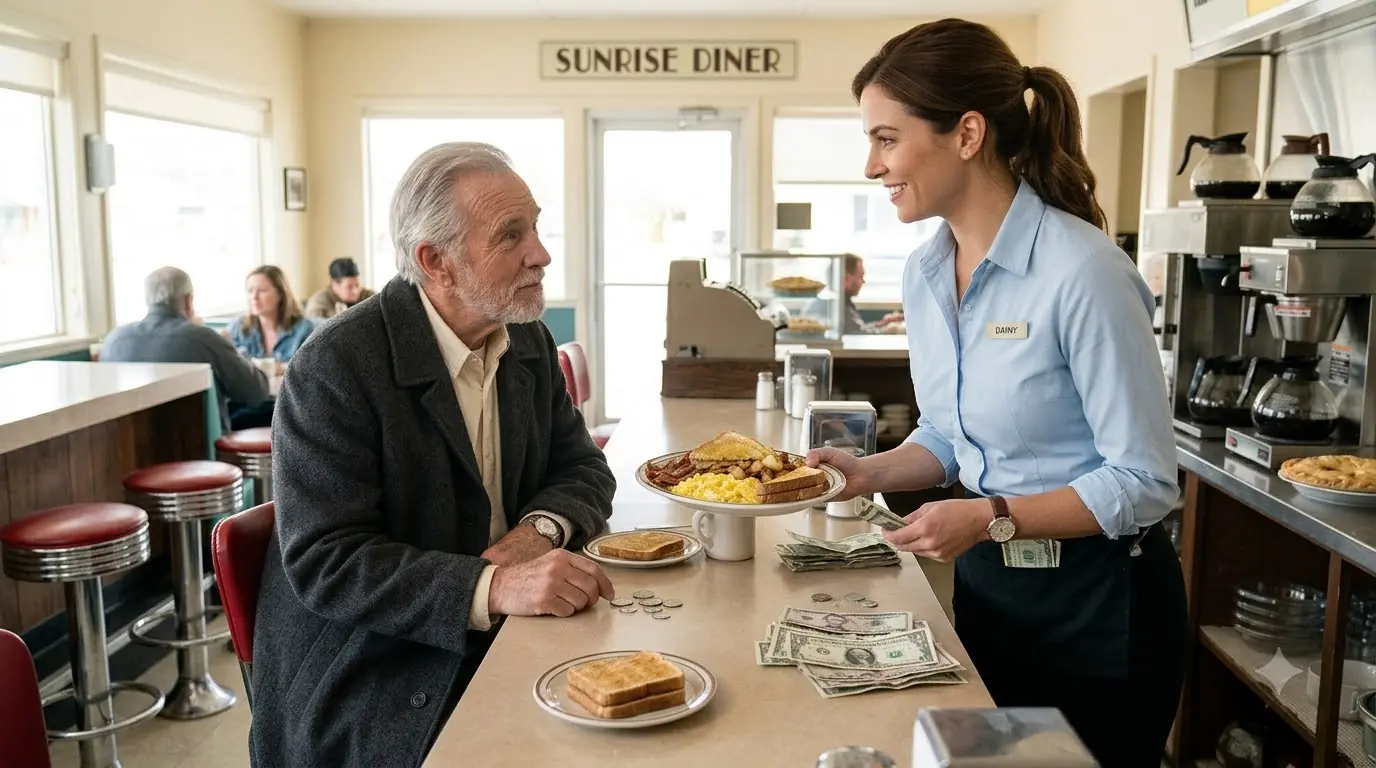
Danielle Mercer, who everyone called Danny, stood with a coffee pot in one hand and an order pad tucked into the pocket of her blue apron. Her dark hair was pinned up messily, a pencil was stuck behind one ear, and there was already a small burn mark on her wrist from reaching too close to the griddle that morning.
The breakfast rush had not fully arrived yet, but the diner was waking up the way it always did.
A truck driver sat at the far end of the counter, eating pancakes with one hand and scrolling through weather reports with the other. Two nurses from the clinic down the street shared a booth by the window, both too tired to talk. Gus, the owner, was in the back arguing with the toaster oven as if the machine had personally offended him.
And in the third booth from the door sat Walter.
He came in every morning at 7:10.
Never 7:08.
Never 7:15.
Always 7:10.
Walter was seventy-four years old, though he looked older when the weather was bad. He wore the same gray coat every day, the kind of coat that had been good once but now hung tired at the shoulders. His hands were thin, his face was lined, and his shoes had been repaired so many times the soles looked like a history of careful survival.
He always sat in the same booth.
Back to the wall.
Face toward the window.
Hands folded around a chipped mug as if the heat in it mattered more than the coffee.
“Coffee and dry toast?” Danny asked.
Walter looked up with a polite smile.
“That’s all I need today, Danny. Thank you.”
Danny studied him for half a second.
She had heard those words every morning for six weeks.
That’s all I need.
Not that’s what I want.
Not that sounds good.
That’s all I need.
There was a difference.
“You’ve had the same order every single morning for six weeks now,” she said, filling his mug. “You know this place does eggs.”
Walter’s smile stayed gentle.
“Eggs are for men with better mornings than mine. I ordered toast.”
Danny clicked her pen once against the order pad.
“Coffee and dry toast,” she repeated.
“That’s right.”
She leaned closer and lowered her voice.
“You sure you don’t want hash browns? Gus only burns them a little on Mondays.”
“I am sure.”
“Bacon?”
“No, ma’am.”
“Two eggs over easy?”
“Danny.”
“All right, all right. Toast.”
She turned toward the kitchen window and clipped the ticket onto the rotating metal rail.
“Dry toast for Walter,” she called.
Then she paused, glanced back at Walter, and added in a lower voice, “Kitchen mistake number three, coming up.”
Gus heard her.
He looked through the pass window with one eyebrow lifted.
Danny gave him the look.
The look meant: Don’t ask.
Gus grunted and turned back to the grill.
Ten minutes later, Danny carried Walter’s plate to the booth.
On it were two slices of toast, yes.
But also two scrambled eggs, a small scoop of hash browns, and three strips of bacon she had claimed were “too crispy to sell” even though they were perfectly fine.
Walter looked down at the plate.
Then he looked up at her.
“Kitchen messed up again,” Danny said, setting it in front of him. “Second time this week.”
Walter’s eyes softened.
“I can’t send it back. It’ll just go in the trash.”
“That’s a very generous mistake for a kitchen to keep making.” She slid a fork beside the plate. “Eat it before it gets cold, Walter.”
He did not touch the fork at first.
Instead, he looked at her with a quiet sadness that made Danny glance away before her own face could betray her.
“The kitchen doesn’t mess up a ticket three Tuesdays running,” he said. “Not for the same man in the same seat.”
Danny put one hand on her hip.
“I don’t know what you mean.”
“I just want you to know I see it, and I’m grateful.”
“Then eat before somebody else’s mistake gets cold, too.”
Walter smiled.
“You’re the best, Danny.”
She pointed at him with the coffee pot.
“Flattery will not get you free pie.”
“I wasn’t asking for pie.”
“Good, because Gus’s apple pie is personal property until after eleven.”
Walter chuckled softly.
Danny walked back behind the counter before he could see how much that sound mattered to her.
For six weeks, she had been watching him count coins.
Not openly.
Not in a way that would shame him.
But Danny was a waitress. Waitresses saw what people tried to hide.
She saw when a customer waited until she turned away before checking the price side of the menu. She saw when mothers split one meal between two children and pretended they were not hungry. She saw when old men ordered dry toast not because they loved dry toast, but because toast was the cheapest thing on the menu that still let them sit somewhere warm.
Walter had never complained.
Never asked for a discount.
Never hinted.
Never looked at anyone else’s plate too long.
That was how Danny knew pride was involved.
Pride, she had learned, could starve a person quietly.
So she had started making mistakes.
One extra egg here.
A few strips of bacon there.
A cup of soup on rainy mornings.
A slice of pie when the register was busy and Gus was not watching too closely.
She paid for it all.
Not through theft.
Not by hiding.
She had Gus put it on her own tab, then deducted it from her tip money at the end of every shift.
At first it had been only a dollar or two.
Then Walter kept coming.
And Danny kept seeing him.
Really seeing him.
By the end of six weeks, the small costs had become real costs.
That night, when Danny got home, her mother found the notebook.
Loretta Mercer was sitting at the kitchen table in a faded robe, reading through clinic papers with a pair of old glasses balanced low on her nose. The apartment smelled faintly of peppermint tea and the lemon cleaner Danny used when she could not afford to buy the nicer kind.
Loretta’s hair was wrapped in a blue scarf, and her face looked thinner than it had a year ago. Kidney disease had carved weight from her body slowly, then all at once. Some days she moved around the apartment with determination. Other days, getting from the bedroom to the kitchen took more strength than she wanted Danny to notice.
Danny had learned to notice anyway.
“What is this, baby?” Loretta asked.
Danny froze near the sink.
The notebook lay open in front of her mother.
Small black cover.
Elastic band.
The kind sold near the register at discount stores.
Inside were dates, names, dollar amounts, and notes written in Danny’s careful handwriting.
Danny set down her work bag.
“Mama.”
Loretta tapped the page.
“Dates, names, dollar amounts. Looks like you’re keeping books on somebody.”
“It’s nothing. Just tracking something at work.”
Loretta looked over the top of her glasses.
“Don’t nothing me. I raised you. I know what nothing sounds like when it’s something.”
Danny rubbed the back of her neck.
Loretta looked back at the notebook.
“Who’s Walter, and why does he owe you four breakfasts this week?”
Danny sighed.
“He doesn’t owe me.”
“According to this, Walter had eggs, hash browns, bacon, coffee refill, and toast. And every single amount is written in your handwriting.”
“I was just keeping track.”
“Why?”
“So I could pay it right.”
Loretta went very still.
“Pay it?”
Danny pulled out the chair across from her mother and sat down.
“There’s an old man who comes in every morning ordering toast because it’s all he can afford. I’ve been adding the rest onto my own tab.”
Loretta closed the notebook slowly.
“Out of your own tip money?”
Danny looked down.
“The same money you need for my next appointment?”
“It’s not that much, Mama.”
“It is exactly that much,” Loretta said. “I do the math too.”
Danny swallowed.
The apartment was quiet for a moment except for the hum of the refrigerator.
Loretta turned the notebook toward herself again.
“Why him? Out of everybody that walks through that door?”
Danny did not answer quickly.
Because the truth was simple, but not small.
“He reminds me of Daddy,” she said at last. “Something in the way he says thank you, like he means it.”
Loretta looked away.
Danny’s father, James Mercer, had been dead four years. He had worked at a manufacturing plant for thirty-two years, came home smelling like metal and machine oil, and carried his lunch in the same dented black box until the handle finally broke. He was not a rich man. But if somebody at that plant forgot lunch, James gave half of his away. If a neighbor’s car would not start, he came outside with jumper cables. If a child needed lunch money, somehow a few folded dollars appeared in their backpack.
“I couldn’t watch him eat dry toast every morning and do nothing,” Danny said. “I just couldn’t.”
Loretta’s expression softened in spite of herself.
“Your father used to give his lunch away at that plant more times than I could count,” she said. “I’d fuss at him same as I want to fuss at you right now.”
Danny gave a sad smile.
“He always said sandwiches tasted better shared.”
“He also said that because he knew I was listening.”
Loretta placed her palm on the notebook.
“I forgot for a second that this is what right looks like.”
Danny’s eyes filled.
Then the truth she had been hiding pushed itself up through her chest.
“I’m behind on this month’s clinic payment, Mama. I didn’t want to say it yet.”
Loretta’s face did not change.
“I know you are.”
Danny blinked.
“You know?”
“I saw the letter before you hid it in the drawer.”
Danny closed her eyes.
“I’m sorry.”
“Don’t apologize to me for having a good heart.” Loretta reached across the table and took her daughter’s hand. “We’ll figure the money out the way we always do.”
Danny laughed once, tired and broken.
“That usually means you say everything will be fine while I panic quietly.”
“No. It means we panic in shifts.”
Danny wiped her cheek.
Loretta squeezed her hand.
“Your daddy would be proud of you.”
That was the one sentence Danny could not handle.
She lowered her head and cried.
The next morning, Walter noticed the watch on Danny’s wrist.
It was too large for her, a man’s watch with a scratched face and a brown leather band that had been patched near the clasp. Danny wore it every day, pushed slightly up her forearm so it would not slide into dishwater while she worked. She had worn it for so long that most regulars no longer noticed it.
Walter did.
“You wear that watch every day,” he said as she poured his coffee. “It’s a man’s watch.”
Danny glanced down at it.
“It was my father’s. He passed four years ago.”
Walter’s face softened.
“I’m sorry.”