At 10:30 on a Saturday morning, every sound in Riverside Cafe stopped. Forks froze midair.
Coffee stopped pouring. Conversations died mid-sentence because the man walking through that door was impossible.
He wore a charcoal suit that cost more than most people made in a year. Two assistants in sharp suits flanked him.
Security stood behind them. Every head in the packed diner turned in perfect unison.
A customer whispered, "That's Arthur Brennan, the billionaire." Lashonda Hayes stood at table 7 holding a coffee pot, her body frozen.
24 hours earlier, she'd given this stranger her only coat in a blizzard. She'd walked him 15 blocks through sub-zero temperatures.
Then she'd gone home alone, shivering, certain she'd never see him again. She was wrong.
What happened next didn't just change her life, it changed an entire neighborhood. But first, she had to survive the worst night of her life.
Friday morning, 5:30 a.m. Lashonda Hayes had exactly $163 to her name. In 3 days, her rent was due.
She needed $420. The alarm clock rattled on the milk crate beside her mattress.
She slapped it silent and stared at the cracked ceiling of her studio apartment. The radiator clanged but produced no heat.
Her breath made small clouds in the cold air. She pulled herself up, wrapped a thin blanket around her shoulders, and shuffled to the corner that served as her kitchen.
One hot plate, a plastic electric kettle with a frayed cord she'd taped together three times. The instant coffee jar was nearly empty.
She'd been stretching the same grounds for 3 days now, adding just a pinch of fresh to the used ones. The coffee tasted like brown water, but it was warm.
She poured a small amount of oatmeal into a bowl, half a serving. She'd eat the rest tomorrow.
While the oatmeal cooked, she examined her work shoes. The sole had separated from the leather on the right one.
She grabbed the duct tape from under the sink and wrapped it carefully around the shoe, pressing hard to make it stick. These shoes had to last another month.
She couldn't afford new ones. Lashonda stood in front of the cracked mirror by the door and practiced her smile.
Waitresses who smiled earned better tips. She'd read that somewhere, and in her two years at Riverside Cafe, she'd found it to be true.
Her reflection looked tired. Gray hairs were coming in at her temples.
She was only 34, but life had a way of aging you fast. She pulled her hair back into a neat ponytail and reached for the coat hanging on the hook.
The burgundy wool coat, her mother's coat. Lashonda ran her fingers over the fabric.
Real wool with a satin lining that still held the faintest scent of her mother's perfume. White Diamonds, cheap drugstore perfume.
But to Lashonda, it smelled like home. Her mother had died 2 years ago.
Breast cancer, stage four. By the time they caught it, the hospital bills had been crushing.
Lashonda had worked double shifts for 18 months to pay them off. She'd sold everything, her mother's furniture, her jewelry, her car, everything except this coat.
This coat was all she had left. She put it on carefully, buttoning it against the cold, and headed out into the pre-dawn darkness.
The bus ride to work required two transfers. Lashonda couldn't afford the direct route.
It cost an extra $1.50 each way. $3 a day added up over a month. She sat by the window and watched the city change as the bus moved through different neighborhoods.
First, the run-down apartment complexes like hers, then the gentrified blocks with coffee shops that charged $6 for a latte. Finally, the tree-lined streets with brownstones that cost more than she'd earn in a lifetime.
A woman in a camel-hair coat sat across from her, scrolling through her phone. The coat looked soft, expensive, probably cashmere.
Lashonda did the math automatically. That coat cost more than 3 months of her wages.
She looked away and noticed the community center passing by her window. She volunteered there on Sundays, teaching kids to read.
It was the one thing she did that had nothing to do with money or survival. It was the thing that made her feel like her mother's daughter.
As the bus turned onto Market Street, she saw Mrs. Lane's apartment building. Another eviction notice on the door.
The third one on her floor this month. Rent was going up everywhere.
Landlords were selling to developers. People were being pushed out.
Lashonda knew she might be next. Riverside Cafe sat on the corner of Market and Ninth, a neighborhood institution for 40 years.
The vinyl booths were patched with duct tape. The floors were scuffed.
The neon sign out front flickered on the second E in cafe, but it was clean. The food was good and the people were family.
Dmitri Palos, the owner, was already in the kitchen when Lashonda arrived. He was 67, a Greek immigrant who'd bought the place in 1985 with his life savings.
She hung her coat in the small staff closet and called out, "Morning, Dmitri." "Morning, koritsi mou," he replied, his accent still thick after 40 years in America.
"You look tired."
"I'm fine." She wasn't fine.
But Dmitri had his own problems. In her locker, Lashonda kept a small photograph taped to the inside of the door.
Her and her mother at her high school graduation 15 years ago. They were both wearing the burgundy coat in the picture, squeezed together to fit in the frame, laughing.
Her mother's arm was around her shoulders. Her smile was wide and proud.
Lashonda touched the photo gently, then closed the locker. She tied on her apron, clipped on her name tag, scratched and faded from years of washing, and headed to the floor.
Maria Rodriguez was already setting up tables. Single mother of two, worked the morning shift so she could pick her kids up from school.
She and Lashonda had become close over the years. "Girl, you look exhausted," Maria said.
"Didn't sleep great."
"Have you ever slept great?" Lashonda smiled.
Not lately. Tommy Bennett came through the back door, still half asleep.
19 years old, community college student, working his way through school one breakfast shift at a time. Lashonda had taken him under her wing when he started 6 months ago.
Taught him how to balance plates, how to read customers, how to smile even when you wanted to scream. The morning rush started at 7.
Lashonda knew every regular's order by heart. Mr. Patterson, two eggs over easy, white toast, coffee, black.
Mrs. Williams, oatmeal with brown sugar, hot tea. The construction crew from the site down the block.
Six orders of the breakfast special. Extra hash browns.
She moved through the routine on autopilot. Her mind running numbers.
Rent $420. Current money: $163.
Shortfall: $257. If she got good tips today and tomorrow, worked a double on Sunday, maybe she could cover it.
Maybe. At 11:30, during a brief lull, Dmitri called her into the kitchen.
His face was drawn, worried. "Lashonda, I need to tell you something," he said quietly.
"But not today. Tomorrow.
I'm having a meeting with the staff tomorrow morning." Her stomach dropped.
"Dmitri, what's wrong?"
"Tomorrow," he said.
"I promise." A customer called for more coffee.
Lashonda grabbed the pot and headed back to the floor. Dmitri's worried face lingering in her mind.
She thought Friday night would be quiet. She thought she'd close up, catch the last bus home, and wake up to another day of barely surviving.
She had no idea that in 9 hours everything would change. At 9:47 p.m., the blizzard warning flashed across every phone in the diner.
By 10:15, the streets were empty, except for one man. The dinner rush had been steady, but not great.
Tips were lower than Lashonda hoped. She'd made $63.
Still not enough. The TV mounted in the corner showed the weather forecast.
A major winter storm was moving in faster than predicted. The meteorologist pointed to the radar, her face serious.
"Temperatures will drop to 12 degrees F within the hour. Wind chill will push it below zero.
Authorities urge everyone to seek shelter immediately. Exposure can cause hypothermia in under 20 minutes."
Customers started asking for checks. Maria wiped down her last table and grabbed her coat.
"Lashonda, I got to go. Babysitter just texted.
She's freaking out about getting home." "Go," Lashonda said.
"I'll close."
"You sure?"
"I need the extra hour anyway." Every hour meant another $12.
Maria squeezed her arm. "Be safe.
Okay? Last bus is at 11:30."
By 10:30, the last customer had left. Wind rattled the windows.
Ice formed in the corners of the glass. Lashonda could see snow coming down in thick sheets, street lights barely visible.
Dmitri had left her the keys with strict instructions. Lock up by midnight.
Be careful going home. She started closing.
Wipe tables. Stack chairs.
Count the register. Sweep.
She'd done this hundreds of times. The radiator clanked, fighting to keep the old building warm.
Outside, the wind screamed. Lashonda glanced at the clock.
10:43 p.m. She could finish by 11:15. Catch the last bus with time to spare.
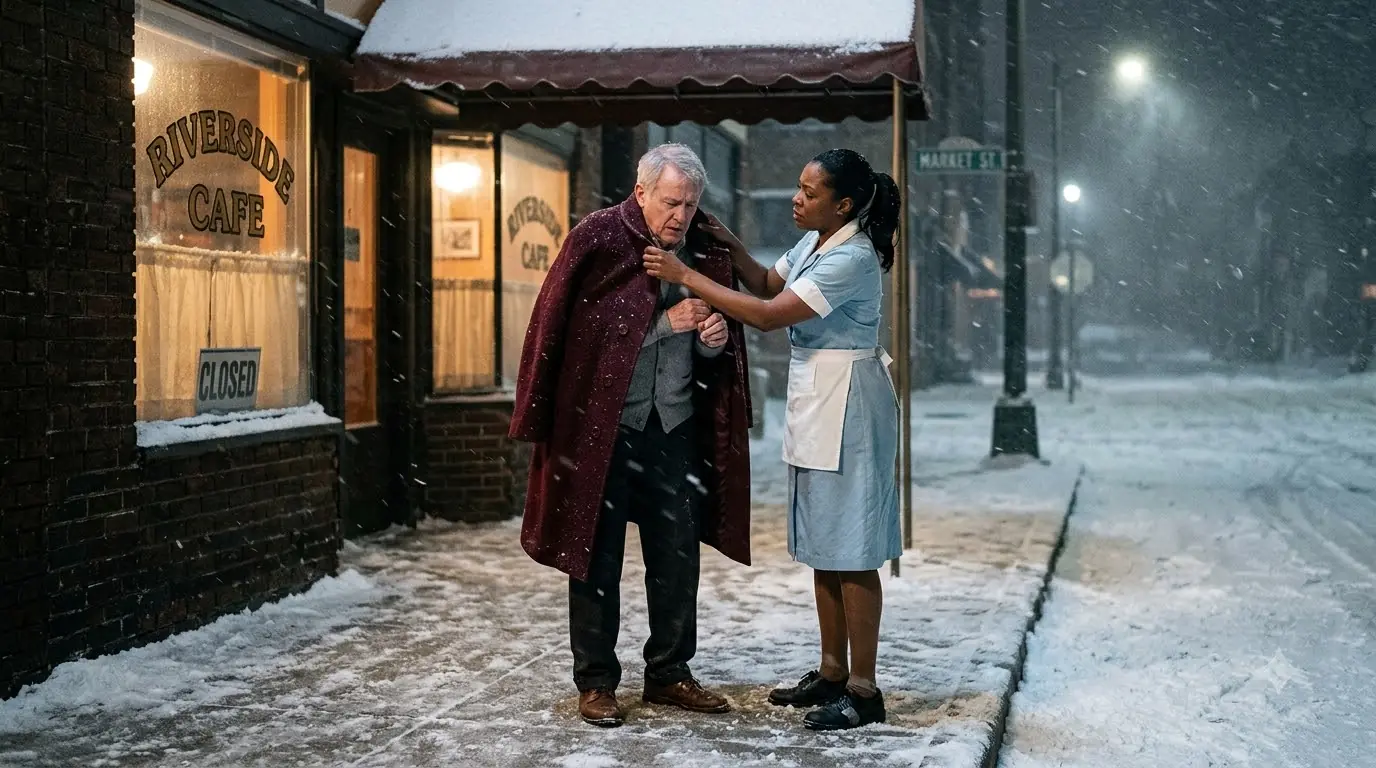
Then she saw him. Through the frosted window, a figure moved on the sidewalk.
Lashonda stopped sweeping and walked closer. A man older, maybe 70, white with silver hair.
He wore wool slacks and a thin cardigan sweater, leather dress shoes, no coat, no hat, no gloves. He stood in the middle of the sidewalk, turning in slow circles like he was looking for something.
His shoulders hunched against the wind. Even from inside, she could see him shivering.
She watched, her hand on the broom. He wasn't asking to come in, wasn't knocking, just standing there patting his pockets over and over, his face confused.
The wind picked up. Snow swirled around him.
He stumbled, caught himself. Lashonda looked at the clock.
10:47 p.m. 43 minutes until the last bus. She should finish and go.
This wasn't her problem. But her mother's voice echoed in her head.
Baby, we don't have much, but we have enough to share. Lashonda set down the broom.
She walked to the door and tapped on the glass. The old man turned, squinting through the snow.
She gestured for him to come inside. He hesitated, then slowly made his way to the door.
She unlocked it and pulled it open. Arctic air hit her face.
The man stumbled inside. She quickly locked the door behind him.
Up close, she could see how bad it was. His lips had a bluish tint.
His hands shook violently. His thin cardigan was dusted with snow, already melting.
He looked disoriented, eyes unfocused. "Sir, are you okay?"
Lashonda guided him to the nearest booth. "Sit down.
Let me get you some coffee." He sank into the seat, trembling.
Lashonda rushed behind the counter and poured hot coffee. She brought it with sugar packets and creamer.
"Here, drink this slowly." His hands shook so badly he could barely hold the cup.
She steadied it, helping him bring it to his lips. He took a small sip, then another.
Slowly, color started returning to his face. "Thank you," he said, his voice weak.