Sebastian Langford entered Langford’s Diner at 10:47 on a rainy Thursday night wearing faded jeans, a plain black polo shirt, and an inexpensive jacket with a damaged zipper. At forty-two, he was a distinguished Black man with deep brown skin, short salt-and-pepper hair, and calm eyes that rarely revealed what he was thinking. Nothing about his appearance suggested that he owned the diner, the land beneath it, and eleven other successful restaurants across Georgia. That was exactly why he had come alone.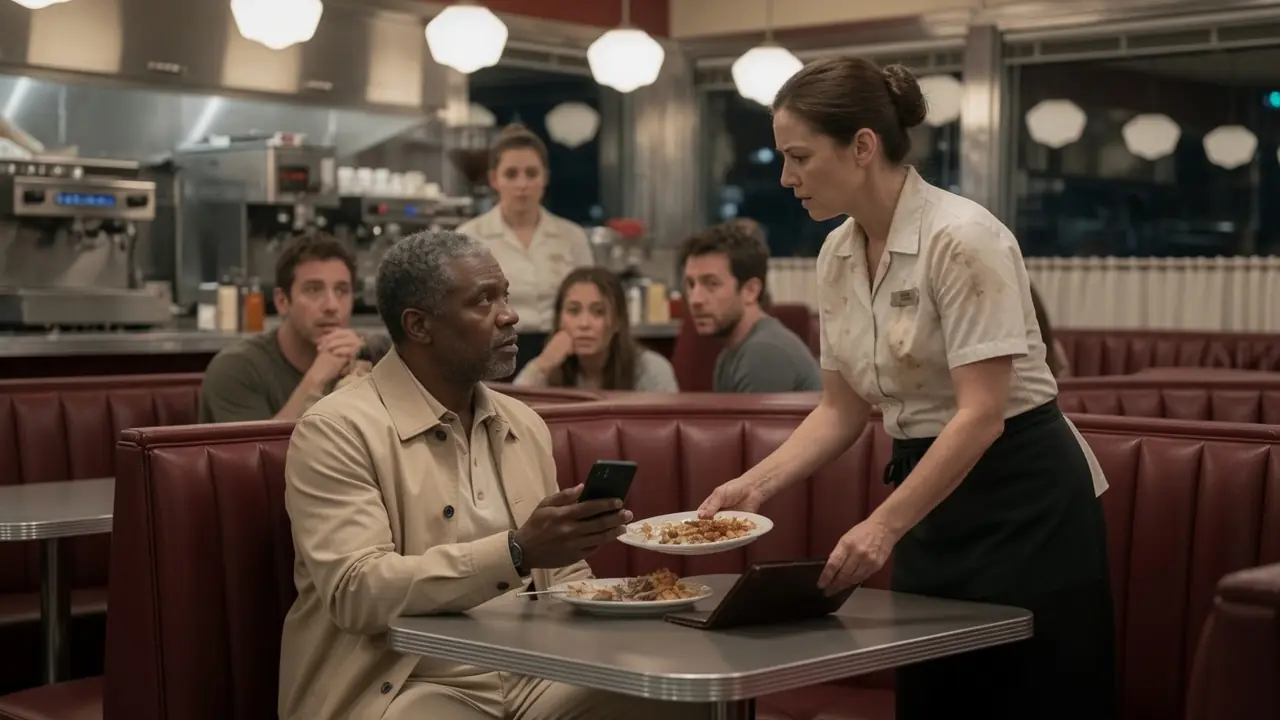
For three months, Sebastian had received anonymous complaints about the downtown Atlanta location. Customers claimed they were treated differently after ten at night, especially Black customers, immigrants, homeless people, and anyone the staff assumed could not leave a large tip. Several complaints mentioned an unwritten rule requiring certain diners to pay before finishing their meals. The general manager, Brandon Cole, repeatedly insisted the accusations were misunderstandings caused by difficult late-night customers.
Sebastian had built his company around one simple promise: nobody entering hungry would be humiliated. His late mother, Lorraine, had spent twenty-two years working as a waitress and often returned home with stories about managers who valued wealthy customers more than exhausted workers or struggling families. After Sebastian opened his first diner, he placed her handwritten words inside every employee handbook. Serve the person before judging the wallet.
Yet handbooks could be ignored, and prepared inspections rarely showed the truth. Managers cleaned kitchens, warned employees, and treated every customer perfectly whenever corporate visitors arrived. Sebastian therefore decided to conduct an unannounced visit without his usual suit, driver, or executive assistant. Only his chief operations officer knew where he was going.
The diner looked ordinary from the outside, with bright windows, a red neon sign, and steam clouding the glass near the kitchen. Inside, chrome-edged tables reflected the hanging lights, red vinyl booths lined the walls, and a tired cook moved behind the open counter. Nearly twenty customers remained, including hospital workers, students, delivery drivers, and two families sharing late dinners. Nobody recognized Sebastian when he entered.
A hostess glanced at him and then toward the clock. “Kitchen closes soon.”
“The sign says midnight.”
“That doesn’t mean you should take all night.”
Sebastian smiled politely. “I’ll order quickly.”
She pointed toward a booth near the restrooms instead of offering him one of the clean tables near the windows. Sebastian noticed three empty booths in the better section but said nothing. He placed his phone face down beside the napkin holder and activated the recording application through his wireless watch. Then he waited.
Seven minutes passed before a waitress approached. Her name tag identified her as Claire Bennett, and she appeared to be in her mid-thirties, with brown hair tied tightly behind her head and a cream uniform marked by an old coffee stain near the collar. She dropped a menu onto the table without greeting him. Her expression suggested that his presence had created unnecessary work.
“What are you drinking?” she asked.
“Coffee and water, please.”
Claire looked toward the clock. “Coffee is full price. No free refills after eleven.”
Sebastian knew no such policy existed. “That’s fine.”
“And we don’t split checks.”
“I’m alone.”
She exhaled impatiently. “Then order.”
Sebastian selected meatloaf, mashed potatoes, green beans, and a slice of apple pie. Claire wrote nothing down, though he had noticed her carefully recording the orders of other customers. Before leaving, she looked at his worn jacket, his inexpensive watch, and the old wallet resting partly inside his pocket. Her judgment was clear before she spoke.
“You sure you can afford everything on there?”
Several nearby customers turned their heads. Sebastian remained still, giving her an opportunity to reconsider. She did not.
“I’m sure,” he replied.
Claire narrowed her eyes. “Because once the kitchen makes it, you’re paying for it.”
“Is that warning given to every customer?”
“It’s given when necessary.”
Sebastian glanced toward a young white couple in the next booth who had ordered steaks, milkshakes, and several desserts. Claire had laughed with them, offered extra bread, and never questioned whether they could pay. At another table, two Black nurses waited with empty glasses while Claire repeatedly passed them. The difference was too consistent to dismiss.
Sebastian kept his voice controlled. “Bring the order.”
Claire walked away muttering something to the cook. Fifteen minutes later, she placed his food down so carelessly that gravy splashed onto the table. She did not bring the water, and the coffee was lukewarm. Sebastian thanked her anyway.
He took two bites, then quietly watched the room. Claire checked on the white couple twice and brought them fresh drinks without being asked. When one of the Black nurses raised her hand, Claire pretended not to notice. Another server eventually brought water and apologized.
A thin Latino delivery driver entered at 11:12 and asked whether he could order soup to go. Claire told him the kitchen was closed, although Sebastian could see the cook preparing food. Three minutes later, two well-dressed businessmen entered and were immediately offered burgers and fries. Sebastian documented the time in a note on his phone.
Claire returned holding a portable payment terminal. She placed it beside his plate before he had finished half the meal.
“Pay now.”
Sebastian looked at the machine. “I haven’t finished eating.”
“After-hours customers pay early.”
“The couple beside me arrived after I did.”
“They’re regulars.”
“Is this written policy?”
Claire folded her arms. “It’s my table, and I decide when the bill gets paid.”
Sebastian lifted his coffee slowly. “I’ll pay when I’m finished, like every other customer.”
Her face hardened. “I knew you were going to be difficult.”
The accusation drew more attention. A man at the counter stopped eating, while one of the nurses turned completely around in her seat. Sebastian had spent years in boardrooms where people shouted, threatened, and lied without moving him. Still, public humiliation carried a different kind of weight.
Claire reached across the table and grabbed his plate.
Sebastian placed one hand on its edge before she could lift it. “Put my food back before this gets worse for you.”
She stared at him in disbelief. “Are you threatening me?”
“I’m warning you not to take food I ordered and have every intention of paying for.”
“You either pay now or leave.”
“Bring your manager.”
“I don’t need him to remove someone causing trouble.”
Sebastian released the plate, allowing her to set it back down. He kept his tone calm because anger would give her the excuse she appeared to want. “You questioned whether I could afford dinner, demanded early payment, and tried to take my meal while other customers are being treated normally.”
Claire leaned closer. “People like you come in late, order too much, and suddenly discover they left their wallet somewhere.”
The room became quiet.
Sebastian looked directly at her. “People like me?”
Claire realized several customers had heard her, but instead of apologizing, she became more defensive. “Don’t twist my words.”
“You made them clear enough.”
She snatched the plate again, this time pulling it completely away. “Pay now or get out before I have you dragged outside.”
Sebastian rose slowly from the booth. His height and calm posture made Claire step backward, though he did not move toward her. He picked up his phone and checked that the recording had captured everything.
“Call your manager,” he said. “Then tell him you just threatened the owner of this diner.”
For one second, Claire appeared uncertain. Then she laughed loudly enough for everyone to hear.
“You own this diner?”
“I do.”
“Of course you do.” She looked toward the counter. “Maybe you own the building next door too.”
“A significant portion of that block, actually.”
More customers began watching openly. Claire interpreted Sebastian’s restraint as weakness and called toward the kitchen for Brandon. A stocky man wearing a white shirt and burgundy tie appeared from the office with irritation already on his face.
“What happened?” Brandon asked.
Claire answered before Sebastian could speak. “This man refuses to pay, threatened me, and now claims he owns the company.”
Brandon looked Sebastian over. No recognition appeared in his eyes because he had met the owner only once during a regional conference where Sebastian wore a tailored suit and stood beneath bright stage lights. Corporate photographs usually showed him clean-shaven, while he had allowed a short beard to grow during the past month. Brandon made the same mistake Claire had made.
“Sir, you need to leave,” the manager said.
Sebastian turned toward him. “Do you always accept accusations without asking the customer what happened?”
“I trust my staff.”
“Even when they lie?”
Claire slammed the bill onto the table. “See? He’s insulting us now.”
Sebastian picked it up. The total included two slices of pie, three coffees, and an eighteen-percent service fee that had never appeared on the menu. He had ordered one pie and one coffee.
“This bill is incorrect.”
Brandon barely looked at it. “Then pay the corrected amount outside.”
“Why outside?”
“Because you’re disrupting my restaurant.”
Sebastian glanced around. “Your restaurant?”
Brandon’s expression tightened. “The restaurant I manage.”
“Under whose authority did you create an after-hours rule allowing staff to demand advance payment from selected customers?”
Brandon went silent for half a second. It was brief, but Sebastian noticed. Claire looked toward him as though expecting support.
“We’ve had theft problems,” Brandon finally said.
“Show me the written policy.”
“It’s an operational decision.”
“Show me the approval from corporate.”
Brandon stepped closer and lowered his voice. “You have two choices. Pay and leave quietly, or we call security and have you removed.”
Sebastian lifted his phone. “Make the call.”
Brandon seemed surprised. “You want security?”
“I want as many witnesses as possible.”
The young white couple in the next booth exchanged uneasy glances. One of the Black nurses stood and said she had watched Claire take Sebastian’s food before he finished. The delivery driver, still waiting near the entrance, added that Claire had refused to serve him while serving people who arrived later.
Brandon raised one hand. “Nobody asked for comments.”
Sebastian looked at the customers. “Actually, I did.”
Claire pointed toward the door. “Get him out.”
Sebastian opened his contact list and selected one number. His chief operations officer, Denise Wallace, answered immediately.
“I’m inside the downtown location,” Sebastian said. “Bring the compliance team through the front entrance, and ask corporate security to preserve tonight’s camera footage before anyone deletes it.”
Brandon’s face changed.
Denise responded loudly enough to be heard through the speaker. “We’re already in the parking lot, Mr. Langford.”
The front doors opened less than ten seconds later. Denise entered wearing a navy business suit, followed by the regional director, an HR investigator, two security officers, and the company’s legal counsel. Every employee in the diner recognized them.
Claire looked from the executives to Sebastian. The plate in her hands began trembling.
Denise approached him directly. “Mr. Langford, are you all right?”
“I’m fine,” Sebastian said. “The customers who have been treated this way for months are not.”
Brandon stepped back. “Mr. Langford?”
Sebastian reached into his jacket and removed his company identification card. He placed it beside the inflated bill.
“Sebastian Langford,” he said. “Founder, chief executive officer, and legal owner of this property.”
The silence that followed was heavier than any shouting could have been. Claire’s face drained of color as she slowly returned the plate to the table. Brandon looked toward the security cameras above the counter, perhaps calculating what they had recorded.
Claire tried to speak. “Sir, I didn’t realize who you were.”
Sebastian’s eyes remained on her. “That is not an apology.”
“I misunderstood the situation.”
“You understood it perfectly. You believed I had no power, so you thought humiliating me carried no consequences.”
She shook her head quickly. “I was only protecting the diner.”
“From a customer eating the meal he ordered?”
“We’ve had people leave without paying.”
“Did you question whether the couple beside me could afford their dinner?”
Claire said nothing.
“Did you demand advance payment from them?”
“No.”
“Did you refuse to serve the delivery driver because the kitchen was supposedly closed?”
Her eyes shifted toward Brandon. “I followed the manager’s rule.”
Every person in the room turned toward him.
Brandon raised both hands. “There was no discriminatory rule. I instructed staff to use judgment with suspicious customers.”
Sebastian’s expression became colder. “Suspicious based on what?”
“Behavior.”
“I had been sitting quietly.”
“Appearance can sometimes indicate—”
Brandon stopped before completing the sentence, but the unfinished words revealed enough.
Denise asked security to escort both Brandon and Claire away from customer areas while HR began collecting statements. Claire immediately started crying and insisted she had never been formally disciplined. Brandon demanded to contact an attorney.
Sebastian did not fire either of them in that moment. He believed consequences required evidence, not performance. He ordered both suspended, preserved all surveillance footage, and announced that the location would close temporarily while corporate investigators reviewed complaints, schedules, bills, and employee communications.
Then he turned toward the customers.
“Every meal tonight is on the company,” he said. “But free food does not erase what happened here. Anyone willing to provide a statement will be heard privately, and nobody’s immigration status, employment, or personal information will be requested.”
The delivery driver slowly stepped forward. “They’ve done this before.”
Sebastian nodded. “Tell us.”
The man explained that he had been refused service four times after ten, even while other customers were welcomed. One nurse said Claire routinely placed their checks down before they finished, while white customers were invited to stay for dessert. A college student revealed that Brandon required certain tables to leave a credit card at the counter.
The cook, Marcus Reed, finally emerged from the kitchen. He admitted Brandon had created a private code written beside table numbers on the ordering screen. The letters PP meant “prepay,” while WL meant “watch closely.” Those labels were disproportionately assigned to Black, Latino, young, homeless, or poorly dressed customers.
“Why didn’t you report it?” Denise asked.
Marcus looked ashamed. “Brandon said anyone challenging the rule would lose shifts.”
Two servers confirmed his statement. One produced screenshots showing Brandon ordering employees to apply the rule while avoiding language that might appear discriminatory. Claire had not created the system, but she had enforced it more aggressively than anyone else.
Sebastian listened without interrupting. He understood that fear kept employees silent, but silence had allowed customers to be degraded night after night. The problem was larger than one rude waitress.
The investigation lasted twelve days. Corporate auditors discovered that Brandon had also inflated bills, added unauthorized service charges, and removed negative customer reports before sending monthly records to headquarters. He rewarded employees who enforced the secret rule and punished those who objected by reducing their hours.
Security footage confirmed Claire had repeatedly taken food from customers before they finished. In several cases, she threatened to call police when people questioned incorrect bills. She had also used openly insulting language in private messages to coworkers.
Brandon and Claire were terminated for misconduct, discrimination, falsification of company records, and violations of customer-service policies. Two supervisors who knew about the system but ignored complaints were demoted and removed from hiring authority. Employees who had lost hours for objecting received back pay.
Sebastian refused to reopen the diner until every worker completed new training led by outside civil-rights and hospitality specialists. He also replaced the complaint process with an independent reporting line that local managers could not control. Secret customer evaluations would occur throughout every location, especially during late-night shifts.
Some executives warned that public acknowledgment might damage the brand. Sebastian disagreed.
“The discrimination already damaged us,” he told the board. “Hiding it would make us dishonest too.”
He issued a public statement accepting responsibility without pretending he had known everything. He explained that ownership meant accountability for what happened under his name, even when managers concealed it. The company refunded affected customers when records could verify unfair charges and invited community leaders to review the reforms.
Not everyone trusted him immediately. Some believed the changes happened only because he had personally experienced the humiliation. Sebastian understood their skepticism.
They were partly right.
He had responded to complaints before the undercover visit, but too slowly. He had allowed Brandon’s reassurances and clean reports to delay decisive action. Sitting in that booth, watching Claire remove his food, forced him to feel what spreadsheets had reduced to numbers.
Three weeks later, Langford’s Diner reopened under new manager Teresa Grant. She was a former server who had spent fifteen years working her way through every position in the restaurant industry. Her first rule was simple: no employee could demand advance payment unless the policy applied equally to every customer during a clearly announced emergency.
The diner also introduced a late-night community menu with affordable meals for hospital workers, drivers, students, and anyone arriving before closing. Customers could purchase prepaid meal cards for people facing financial hardship, but nobody receiving one was required to explain their circumstances publicly.
Marcus became assistant kitchen manager after investigators confirmed he had quietly given food to several customers Claire turned away. Sebastian did not excuse his silence, but he recognized that Marcus had tried to reduce harm while fearing unemployment. The promotion came with leadership training and the responsibility to report future misconduct immediately.
One month after reopening, Sebastian returned without disguise. This time, he wore a dark tailored suit and entered through the front doors while employees greeted him by name. The same red booth was empty.
He sat there deliberately.
Teresa approached with a menu. “Coffee?”
“Please.”
“One refill or as many as you want?”
Sebastian smiled. “As many as company policy allows.”
“Then I hope you have nowhere urgent to be.”
A Black father entered with two children and began studying the prices before choosing a booth. A young server welcomed them warmly, offered crayons, and explained the family dinner special without making assumptions. Sebastian watched the father’s shoulders relax.
That was what dignity often looked like—not a speech, not applause, but the absence of unnecessary fear.
Sebastian ordered the same meatloaf dinner. When it arrived, the gravy stayed on the plate, the coffee was hot, and nobody questioned whether he could pay. He finished every bite before the bill was placed gently near his hand.
The total was correct.
Before leaving, Sebastian paused beside the framed words of his mother that now hung near the entrance instead of remaining buried inside a handbook.
Serve the person before judging the wallet.
Beneath them, Teresa had added one more line approved by Sebastian.
Respect is not reserved for people you recognize.
Months later, the downtown diner became one of the strongest-performing locations in the company. Sales increased, complaints dropped, and late-night customers returned because they felt welcome. The improvements did not come from expensive decorations or a new menu.
They came from treating every person at the door as though they belonged.
Sebastian never forgot Claire’s first question.
“You sure you can afford everything on there?”
She had believed money determined who deserved courtesy. She had also believed the tired Black man in the inexpensive jacket had no authority to challenge her.
But Sebastian had not entered the diner to prove he was wealthy.
He entered to discover how his company treated people when wealth could not be seen.
The answer cost a waitress and a manager their jobs, exposed a hidden system of discrimination, and forced an entire restaurant chain to confront what it had allowed. Yet the most important lesson was not that Claire had accidentally insulted a powerful CEO.
It was that she should never have needed to know his identity before treating him like a human being.