Two men were about to take a young woman out of Hollow Creek Diner against her will.
Carol Whitfield saw it from behind the counter.
Corner booth. Table four.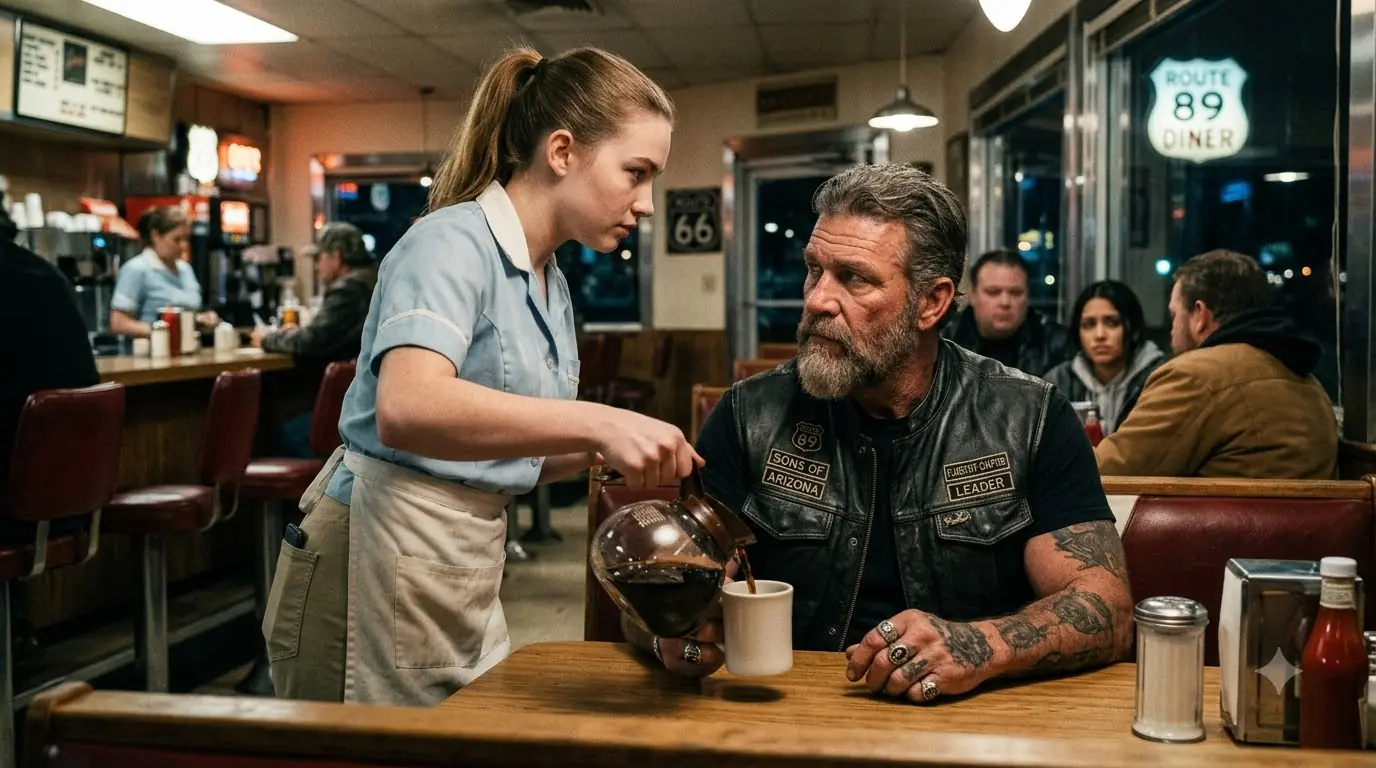
One man, Frank Delinger, kept a hand around Maya Torres’s wrist with the casual confidence of someone who had done it before.
The young woman’s eyes looked emptied out, as though she had run out of tears days ago. An oversized gray hoodie hung from her shoulders, the kind of clothing chosen not because she wanted it, but because somebody needed her to look ordinary.
Carol was only a waitress.
Thirty-six years old. A single mother. Working a Friday night shift outside Flagstaff, Arizona, where help could take time to arrive.
She had no badge.
No authority.
No guarantee that if she intervened openly, she would make the situation better instead of worse.
She had one chance.
So Carol picked up the coffee pot.
Her heart was pounding, but her hands were completely steady.
She walked past the booth without looking directly at Maya, crossed toward the window table near the front of the diner, and placed a folded napkin near the edge.
Triangle.
Fold.
Tuck.
Then she refilled a salt shaker that did not need refilling and walked away as if nothing had happened.
At a table near the entrance, Dale Harker looked at the napkin.
He had been sitting there for more than twenty minutes with black coffee and a plate of pot roast that had gone cold. Carol had stopped bringing him menus years earlier. He came almost every Friday and usually ordered the same thing.
Dale studied the fold for two seconds.
Then he reached for his phone.
“Hollow Creek. Right now.”
That was all he said.
Less than half an hour later, headlights began appearing through the diner windows.
One after another.
And the atmosphere inside Hollow Creek Diner changed.
To understand why a folded napkin mattered so much, you had to go back eleven days.
At 7:41 that Friday evening, Frank Delinger leaned across the table toward Maya.
His voice was low.
“We leave soon. You understand?”
Maya kept her eyes on the laminate tabletop.
A thin crack ran from the salt shaker toward the edge of the booth. She had been staring at it for almost an hour and had memorized its shape without meaning to.
When your world becomes six square feet of vinyl seats and laminate, small details can become the only things your mind has left to hold.
Maya was twenty years old.
She had been missing for eleven days.
Roy Sutter sat beside her on the outside edge of the booth. He was quieter than Frank and constantly aware of the room. He had placed himself between Maya and the aisle the moment they sat down.
That placement had not been accidental.
Very little Frank and Roy did was accidental.
Over eleven days, Maya had learned the way they thought. They liked control. They liked making decisions before she understood there was a decision to make. They tried to make every situation feel closed before Maya could imagine an opening.
But Maya had also learned to watch them.
And Carol had spent nine years learning to watch people too.
She came out of the kitchen holding the coffee pot and began moving along the counter, topping off mugs the way she did every Friday night.
Her left sneaker had a small tear near the toe. Dark circles remained beneath her eyes no matter how carefully she tried to cover them before work.
Her daughter was at home with a trusted neighbor across the hall.
Carol knew almost every regular inside Hollow Creek.
Pete Garland sat at the end of the counter with his usual black coffee. A retired teacher, he had been coming in on Fridays longer than Carol had worked there.
A couple near the window shared pie.
A man in another booth had been reading the newspaper for nearly an hour.
Then there was table four.
The young woman looked twenty, maybe twenty-one.
Dark hair pulled back.
Gray hoodie much too large.
Sleeves pulled over her hands even though the diner was warm.
A backpack sat against the wall, and Maya kept both feet pressed against it, not protectively, but obediently, as if she had been told exactly where everything should remain.
Carol noticed the men had ordered for her.
That was the first thing.
She continued around the counter.
Then she looked again.
Maya’s hands were flat on the table.
Completely flat.
Fingers pressed tightly together.
It looked unnatural.
Or rather, it looked natural only if someone had spent enough time telling you where your hands belonged that the instruction had become part of your posture.
Maya was making herself small.
Carol knew that posture.
She knew it from somewhere she rarely allowed herself to visit.
Fifteen years earlier, Carol had been twenty-one years old and living in Tucson with a man she once believed loved her. Gradually, she realized that the locks on their apartment had stopped being about keeping danger outside.
She eventually left.
The life she built afterward came one piece at a time.
A new town where few people knew her history.
A job.
An apartment.
Her daughter.
Years in which she decided what parts of herself she wanted to carry forward and what she could finally put down.
But she never forgot the hands.
Flat.
Still.
Trying not to attract attention.
That Friday night, she saw those hands again.
Frank looked at his phone.
Roy watched the parking lot.
Maya sat between them like the outcome had already been decided.
Carol had only a few seconds when both men’s attention shifted.
She picked up the coffee pot and walked toward the front window.
A folded napkin went onto an empty table.
Triangle.
Fold.
Tuck.
Frank never looked up.
Dale Harker did.
He was fifty-four years old and had spent much of his adult life around men who believed loyalty meant showing up when somebody needed you.
Years earlier, Dale had returned to Flagstaff after a difficult chapter of his life and eventually became the leader of a local motorcycle club chapter.
The club meant different things to outsiders.
To Dale, its most important meaning was simple.
You showed up.
Especially when someone vulnerable had nobody else.
When he saw the napkin, something inside him became very quiet.
It was a signal he had hoped Carol would never need.
He reached for his phone.
“Hollow Creek. Right now.”
Then he set it down.
Picked up his coffee.
And waited.
Outside, the first distant headlights eventually appeared.
Eleven days earlier, Maya Torres had left her family home in Phoenix expecting a short coffee run.
She never returned.
Maya grew up in Ahwatukee, in a neighborhood where families stayed long enough to know which dogs belonged in which yards and which children had grown up behind which fences.
She was the second of three daughters.
Her father ran a small electrical contracting business.
Her mother worked dispatch for a medical courier service and possessed the kind of organizational energy that made Maya believe almost every problem could be attacked with enough calls, lists, and persistence.
Maya had inherited some of that.
She was studying communications at Northern Arizona University.
Her father jokingly called it her “degree in talking.”
Maya always replied, “That’s exactly what it is.”
He laughed every time, even though he had heard the joke more than once.
She had been home for a long weekend when Frank Delinger and Roy Sutter took advantage of a transportation mix-up and got Maya into a vehicle she believed was legitimate.
Frank had planned carefully.
He preferred places and routes where he thought people would ask fewer questions.
He changed locations repeatedly and tried to keep Maya disoriented.
The exact details mattered less than the pattern.
Nothing about what happened was impulsive.
Frank believed control came from preparation.
He watched people closely, anticipated ordinary reactions, and tried to remove choices before they could become useful.
That was what made him dangerous.
Maya spent the first days trying to stay calm enough to remember.
Vehicle details.
Snatches of conversation.
Places.
Sounds.
Turns.
Anything that might matter if she ever had the opportunity to explain what had happened.
She told herself that information was something Frank could not take from her if she kept it inside her mind.
By the fourth day, that determination became harder.
By the seventh, thoughts of escape were often replaced by thoughts of home.
Especially her mother.
Maya kept seeing her mother’s face as it appeared during Sunday phone calls from college. A face that always carried a thin layer of worry beneath whatever else was happening.
That worry would be different now.
There would be no ordinary joy covering it.
Only fear.
Maya could not bear the idea that her mother might carry that expression for the rest of her life.
So she started watching Frank and Roy differently.
Not obviously.
Quietly.
She learned when their attention drifted.
Which moments made them impatient.
When they became distracted.
When they felt so secure they stopped noticing what was directly in front of them.
On the eleventh day, in a diner along Route 89, Maya watched a waitress pick up a coffee pot.
Then she saw the napkin.
A strange little fold placed on an empty window table.
Maya did not understand what it meant.
But she understood the waitress.
Carol did not look frightened.
At least not from a distance.
Her movements were controlled.
She placed the napkin and walked away without giving Frank or Roy anything to notice.
Maya looked up.
Only once.
Directly at Carol.
Carol met her eyes.
She did not nod.
She did not smile.
She did not make any obvious gesture.
She simply held the look one second longer than an ordinary waitress would.
For Maya, that second was enormous.
She lowered her eyes again.
Then slowly moved her left hand toward the table edge.
Almost nothing.
A few inches.
But to Carol it felt like an answer.
Carol saw it.
Maya returned both hands to the tabletop.
She breathed.
And she waited.
Carol’s hands had been steady when she placed the napkin.
Not because she was unafraid.
She was terrified.
But somewhere between noticing Maya’s posture and picking up the coffee pot, Carol had made a decision.
Once the decision existed, fear no longer had to disappear before she could act.
She could carry both.
Fear in her chest.
Purpose in her hands.
Years earlier, Dale Harker had learned a similar lesson.
He had never planned on becoming someone people contacted during emergencies.
When he was young, Dale expected to become an electrician.
Life moved differently.
After returning to Flagstaff from years that left their own marks on him, he found himself surrounded by other men who also understood what it meant to come back from difficult places without knowing where to put what they carried.
Over time, the motorcycle club became part brotherhood, part support system, part promise.
The promise mattered most.
If you said you were coming, you came.
If someone needed help, you paid attention before you tried to play hero.
Dale believed attention saved more people than bravado ever would.
That belief had been shaped by Rachel Briggs.
Rachel was twenty-three, the daughter of someone close to the club.
She worked at a shipping warehouse on the north side of town.
Years earlier, she had disappeared.
By the time people understood the seriousness of what had happened, crucial time had already passed.
Dale rarely spoke about the details.
What mattered was that he never forgot being late.
Three weeks after that experience, he sat at Carol’s counter on a quiet Tuesday afternoon.
His coffee remained untouched.
He explained the warning signs he had learned to notice.
A person who seemed frightened without an obvious reason.
Someone else controlling their movement.
Answers given for them.
Possessions they seemed afraid to touch.
Someone watching exits without ever moving toward them.
Then he showed Carol the napkin fold.
A simple visual signal.
Not a magic solution.
Just a quiet way for Carol to tell Dale that something inside the diner needed attention and that she could not safely make a normal call.
“If you ever use it,” Dale told her, “I’ll take it seriously.”
Carol remembered his expression.
There had been no excitement in it.
No fantasy of confrontation.
Only the seriousness of a man who knew what happened when people noticed too late.
Three years passed.
Carol never used the signal.
Then came that Friday night.
And Dale saw the napkin.
Less than half an hour later, motorcycles began turning into the Hollow Creek parking lot.
One.
Then another.
Then more.
Their engines were audible before every rider was visible.
Inside the diner, the sound moved through the walls and floor.
Then the motorcycles stopped.
The sudden silence afterward felt larger than the noise.
Carol stood behind the counter and felt something inside her loosen.
Not completely.
But enough.
She was no longer carrying the situation by herself.
Maya heard the engines stop outside.
Later, she would tell her mother it felt like somebody had opened a window in a room she had not realized was sealed.
Roy Sutter looked toward the parking lot.
For the first time all evening, his confidence changed.
Frank was still focused on his phone.
Then Dale walked through the front door.
He did not rush.
He did not scan the room dramatically.
He walked to his usual table near the entrance.
Sat down.
And looked at Carol.
She reached him a few seconds later.
“Coffee?” Dale asked.
Carol poured it.
Her hands remained steady.
Dale wrapped both hands around the mug.
He looked toward the wall behind the counter as though this were any other Friday.
Carol wiped the counter in front of him.
“Corner booth,” she said quietly.
Dale did not look.
“Two men. Young woman between them. She hasn’t touched her food.”
A pause.
“One of them asked for the check. I’ve been slowing things down.”
“How long?”
“Almost an hour.”
Dale turned the mug slightly.
“How is she?”
Carol looked toward the booths without moving her head much.
“She looked at me.”
Dale waited.
“Really looked at me.”
The mug stopped turning.
“Anyone else know?”
“No.”
Dale drank some coffee.
“Keep doing your job.”
Carol waited.
“Give me a minute.”
She picked up her order pad and walked away.
Dale sat alone.
From anyone else’s perspective, he was simply a large man finishing coffee at the end of a long week.
But he was paying attention.
He noted where people were sitting.
Where staff were moving.
Which areas were open.
Most importantly, he understood that the goal was not to create a confrontation.
The goal was to get Maya away from Frank and Roy without frightening them into doing something unpredictable.
After a short time, Dale stood.
He picked up his coffee mug.
Then he walked toward table four.
Frank noticed him immediately.
Something changed in his shoulders.
Dale had a stillness that made him difficult to read.
He reached the booth.
Looked at Frank.
Then Roy.
Then briefly at Maya.
Only long enough to confirm what Carol had seen.
Then back to Frank.
“Mind if I sit?”
He slid into the open side before the question required much of an answer.
The booth became very quiet.
“Name’s Dale.”
His voice was relaxed.
“I’m in here most Fridays. Don’t think I’ve seen you two before.”
“Passing through,” Frank replied.
Dale nodded.
“Sure.”
He looked briefly toward the windows and then back toward the table.
“Cold night for traveling.”
Roy said nothing.
Dale picked up the unused menu near the edge of the table.
“You know what I like about this place?”
No one answered.
“Carol’s been here nine years.”
He placed the menu back down.
“She knows almost every face that comes through that door.”
A pause.
“Pays attention.”
The white coffee mug sat between Dale and Frank.
For several seconds, neither man looked anywhere else.
Then Frank put his phone face down.
Dale noticed.
“Something we can help you with?” Frank asked.
His voice was calm.
Dale leaned slightly forward.
“I think there’s been a problem tonight.”
Frank’s expression remained blank.
Dale did not reveal everything he knew.
He did not need to.
He simply made it clear that the situation had been noticed, that people outside were aware, and that law enforcement had been contacted.
Roy shifted slightly.
Dale looked toward him without raising his voice.
“Stay where you are.”
Roy stopped.
Dale returned his attention to Frank.
“I’m going to ask for one thing.”
Frank watched him.
“Let her use the restroom.”
Silence.
“That’s it.”
Dale’s voice remained almost conversational.
“Let her stand up and go to the back.”
Frank’s eyes narrowed.
The request sounded small.
Reasonable.
Public.
Difficult to refuse without revealing something.
He looked at Roy.
Then at Maya.
“Go ahead.”
The words came out as though Frank wanted them to sound like his decision.
Maya did not move immediately.
Carol appeared near the booth at exactly the right moment, holding her order pad.
“Miss?”
Maya looked up.
“I can show you where the restrooms are.”
Maya looked toward Carol.
Then toward Dale.
Dale did not look back at her.
His attention stayed entirely on Frank.
It was a strange kind of kindness.
He gave Maya the chance to move without making her feel like the center of the entire room.
She slid toward the edge of the booth.
Then she stood.
Her legs trembled during the first step.
Just slightly.
Carol saw it.
She did not grab Maya.
She simply walked beside her.
Close enough to help.
Far enough to let Maya move under her own power.
They passed the restrooms.
Then the staff lockers.
Carol pushed through the kitchen door.
The kitchen was warm and busy.
Marcus, the line cook, looked up.
He had worked enough shifts beside Carol to recognize the expression on her face.
He did not ask unnecessary questions.
Carol led Maya toward the rear of the kitchen.
“There’s another door back here.”
Maya looked at her.
“Some people are waiting outside.”
Her breathing quickened.
“They’re here to make sure you stay safe until the deputies arrive.”
Maya stared at Carol.
“Who are you?”
Carol stopped.
For a moment, neither woman spoke.
Then Carol said, “Someone who knows what it feels like when your choices stop feeling like your own.”
Maya’s expression changed.
Not a collapse.
Something quieter.
Like a person who had spent eleven days holding an unbearable weight alone and had suddenly felt another pair of hands beneath it.
Carol nodded toward the door.
“You’re almost there.”
Marcus was already holding it open.
Cold November air entered the kitchen.
Maya walked toward the threshold.
Then stopped.
She turned back.
Looked at Carol.
Carol held her eyes.
“You’re out.”
She spoke gently.
“Keep walking.”
Maya turned around.
And stepped through the doorway.
No one pulled her.
No one carried her.
She walked.
On her own feet.
Because she decided to.
The door closed behind her.
Carol pressed one hand against the kitchen wall.
Only then did she allow herself one deep breath.
Back at the corner booth, Dale remained seated.
He knew Maya had gone through the kitchen.
Frank knew too.
The smallest shift moved through Frank’s posture.
“You made a mistake,” Frank said.
Dale considered the words.
“Could be.”
He slowly turned the coffee mug.
“I’ve made plenty.”
Then he looked directly at Frank.
“This isn’t one of them.”
“We haven’t done anything.”
“Then you’ll have every opportunity to explain that.”
Dale’s voice never changed.
It remained level.
Quiet.
Immovable.
He had no interest in threatening Frank.
The important part was already over.
Maya was no longer trapped in the booth.
Law enforcement was coming.
And a diner full of witnesses had seen Frank and Roy with her.
Dale leaned slightly forward.
“The only useful thing for you to do now is stay calm and wait.”
Frank looked toward the window.
Motorcycles remained outside.
No one was approaching the building.
No one needed to.
Roy stopped looking for an opening and lowered his gaze to the table.
Dale picked up the menu.
Set it down again.
“Deputies should be here soon.”
He lifted his coffee mug.
“You want more coffee while we wait?”
Nobody answered.
Outside, flashing emergency lights eventually appeared along the road.
Dale noticed them.
He said nothing.
He finished his coffee.
Deputy Kelsey Briggs was the first officer through the door.
She had four years on the job.
Her eyes moved quickly across the diner as she entered.
She saw the motorcycles outside.
The customers sitting unusually still.
Carol behind the counter.
Then Dale seated across from two men at the corner booth.
Carol made eye contact with Deputy Briggs and subtly indicated table four.
That was enough.
Additional deputies arrived soon afterward.
Later, a federal investigator named Agent Carver came from Phoenix. She looked exhausted, as though she had been waiting for a call connected to this case for far too long.
When she entered, she looked toward Dale.
He indicated the corner booth.
Carver studied Frank Delinger for several seconds.
Then she quietly spoke with Deputy Briggs.
Something in the deputy’s expression changed.
Pete Garland, the retired school teacher at the end of the counter, watched the entire sequence without saying a word.
Much later, when someone asked what he remembered most about that night, Pete did not talk about shouting.
There had been very little.
He remembered the quiet.
The way a parking lot full of people managed to make their presence known without rushing the doors or turning the diner into chaos.
“The silence,” he said. “That’s what I remember. I’d never seen so many people say so much without saying anything.”
Marcus watched through the kitchen opening while deputies took control of the situation.
He did not speak for a long time.
Then he looked at Carol.
“You okay?”
“Yes.”
It was true.
And it was not.
Carol understood both versions.
Later that night, Frank Delinger and Roy Sutter were escorted out of Hollow Creek Diner.
The bell above the door rang as they passed through.
Frank paused for a brief moment at the entrance.
He looked back.
Dale was still near the counter, coffee mug between his hands, not celebrating, not smiling.
Frank stared at him.
Something passed across his face.
Recognition, perhaps.
Not of Dale personally.
Of the fact that the situation Frank believed he controlled had been quietly taken away from him before he fully understood what was happening.
Then the deputy guided him through the doorway.
The cold swallowed him.
The investigation that followed connected Frank and Roy to a broader case already being examined by authorities.
What mattered most to Carol that night, however, was not what investigators would eventually prove about the two men.
It was Maya.
Carol found her in the back hallway about twenty minutes later.
Maya sat on the bench outside the staff lockers.
Both hands wrapped around a mug of hot chocolate Marcus had made without being asked.
Agent Carver sat across from her with a notebook open.
Her voice was low and careful.
When Carol stepped through the kitchen door, Maya looked up.
Carver glanced toward Carol.
She seemed to understand immediately.
“Two minutes.”
Then she moved farther down the hallway to give them space.
Carol sat beside Maya.
Neither spoke at first.
The hallway was narrow and warm.
It smelled faintly of coffee and cleaning solution.
On the other side of the wall, Hollow Creek Diner was beginning to sound ordinary again.
Cups.
Silverware.
The coffee machine.
Voices.
Normal sounds.
Carol had never felt so grateful for normal sounds.
“Maya,” Carol said.
Just her name.
Maya stared into the hot chocolate.
“How did you know?”
Carol waited.
“How did you know something was wrong?”
“Your hands.”
Maya looked up.
“The way you held them flat on the table.”
Carol paused.
“And you didn’t order for yourself.”
She looked toward the kitchen door.
“You kept looking at the exit like you’d already learned you weren’t allowed to use it.”
Maya absorbed the answer.
“Most people wouldn’t have noticed.”
Carol looked at her own hands.
“Most people haven’t needed to.”
A long silence followed.
Not an uncomfortable one.
Something deeper.
The kind of silence that exists between people who have understood something about one another that cannot be improved much by explanation.
“I stopped believing anyone was coming.”
Maya’s voice was quiet.
“After a few days, I just stopped.”
Carol looked at her.
“Me too.”
Two words.
Nothing more.
Maya raised her eyes.
Really looked at Carol.
Something passed between them.
Recognition without comparison.
Their experiences were not identical.
They did not need to be.
Carol understood enough.
“Your parents know you’re safe,” she said.
Maya froze.
“Agent Carver called them.”
The expression on Maya’s face finally broke.
For eleven days she had held herself together because falling apart had felt dangerous.
Now she looked toward the ceiling.
Pressed her lips together.
Breathed.
Carol did not immediately hug her.
She did not tell Maya how to feel.
She simply remained on the bench.
Present.
Still.
The way someone had not remained beside Carol when she was twenty-one and needed exactly that.
After a moment, Maya lowered her eyes back to the mug.
“Thank you.”
Carol shook her head.
“You walked through that door yourself.”
Maya looked at her.
“I just held it open.”
Dale was outside in the parking lot when Carol finally found him.
By then, Carol had given her statement.
Most of the deputies were gone.
The remaining diners had finished their meals and left carrying the dazed expressions of people who knew they had witnessed something they would be trying to describe for years.
November air settled cold over Flagstaff.
Stars stretched across the sky.
Most of the motorcycles had already left, one at a time, until the parking lot looked ordinary again.
Carol walked toward Dale.
She stood beside him.
Neither spoke for a while.
“She’s okay,” Carol finally said.
Dale nodded.
“I know.”
“Carver thinks Frank’s connected to something bigger.”
Another nod.
“They’ve been looking at him for months.”
Dale remained quiet.
Carol studied his face.
“You’re thinking about Rachel.”
It was not really a question.
Dale looked toward the road.
“Rachel.”
Just the name.
The way people sometimes said a name when the name itself contained more than any full sentence could carry.
“She would’ve been twenty-six.”
“I know.”
A truck passed along the highway.
Its headlights swept across the parking lot.
Then disappeared.
The darkness returned.
So did the stars.
“You did good tonight,” Dale said.
Carol thought about Maya’s hands.
The oversized hoodie.
The young woman stepping through the kitchen door without anyone pulling her.
Making one choice after eleven days of having choices taken away.
“She did good.”
Dale looked at Carol.
Then back toward the sky.
“Yeah.”
His voice was quiet.
“She did.”
Three weeks later, Carol received a letter.
Phoenix postmark.
No return address.
Inside was a single index card.
Four words had been written in careful handwriting.
I remember your hands.
Carol read the sentence twice.
Then a third time.
She stood at her kitchen counter for a long while.
Her daughter was in the next room.
Morning light fell across the floor.
Eventually, Carol opened the drawer beside the stove.
It was the drawer filled with rubber bands, spare batteries, takeout menus, and all the small objects that never seemed to belong anywhere else.
She placed the card inside.
Then she closed the drawer.
And made coffee.
Because that was what life asked after extraordinary nights.
You continued.
You went back to work.
You showed up for the next shift.
You watched the door.
For years, Carol had believed the worst thing she had lived through was something she needed to hide somewhere deep enough that it would stop defining her.
That Friday night taught her something different.
The past did not have to control her in order to remain useful.
What she had survived had taught her to recognize a posture most people overlooked.
It taught her to understand silence.
It taught her that fear did not always look like screaming or running.
Sometimes fear looked like two hands pressed flat against a diner table.
And courage did not always look the way people imagined either.
It was not always loud.
It did not always arrive already confident.
Sometimes courage was a woman picking up a coffee pot while her heart hammered against her ribs.
Sometimes it was a folded napkin that took three seconds to place.
Sometimes it was a man finishing his coffee before standing up because he understood that panic would help no one.
Sometimes it was a twenty-year-old woman moving one hand a few inches toward the edge of a table because that was the only message she could safely send.
And sometimes courage was walking through a kitchen door.
One step.
Then another.
Fear and decision could exist inside the same person at the same time.
Carol had learned that years earlier without having words for it.
Maya learned it inside Hollow Creek Diner.
You did not have to stop being afraid before you acted.
You only needed one choice that still belonged to you.
Carol noticed.
Dale showed up.
Marcus opened the door.
Maya walked through it.
And something that had begun to feel permanent suddenly was not.
Weeks later, Carol occasionally found herself touching the kitchen drawer where Maya’s card rested.
I remember your hands.
Those four words meant more to her than Maya probably understood.
Carol remembered Maya’s hands too.
Flat on the table.
Then moving toward the edge.
Then wrapped around a mug of hot chocolate.
Different hands at different moments.
The first posture said: I have been taught not to move.
The second said: I think you see me.
The third said: I am still here.
Carol never framed the card.
She never showed it to customers.
She never turned it into some grand symbol.
It remained inside the ordinary kitchen drawer beside ordinary things.
That felt right.
Because the moment that changed Maya’s life had not begun with anything grand.
It began during a Friday night shift.
With a waitress paying attention.
With one folded napkin.
And with a young woman who, after eleven days of having the world narrowed around her, finally saw one small opening and chose to move toward it.