By the time Amara Brooks stepped into the business-class cabin, boarding music was still playing softly through the speakers and the overhead bins had only begun to fill. The bright cream-and-navy seats looked almost untouched, the aisle still clear enough for people to move without bumping elbows, and the entire section carried that polished, expensive calm airlines sold as if it were part of the airfare.
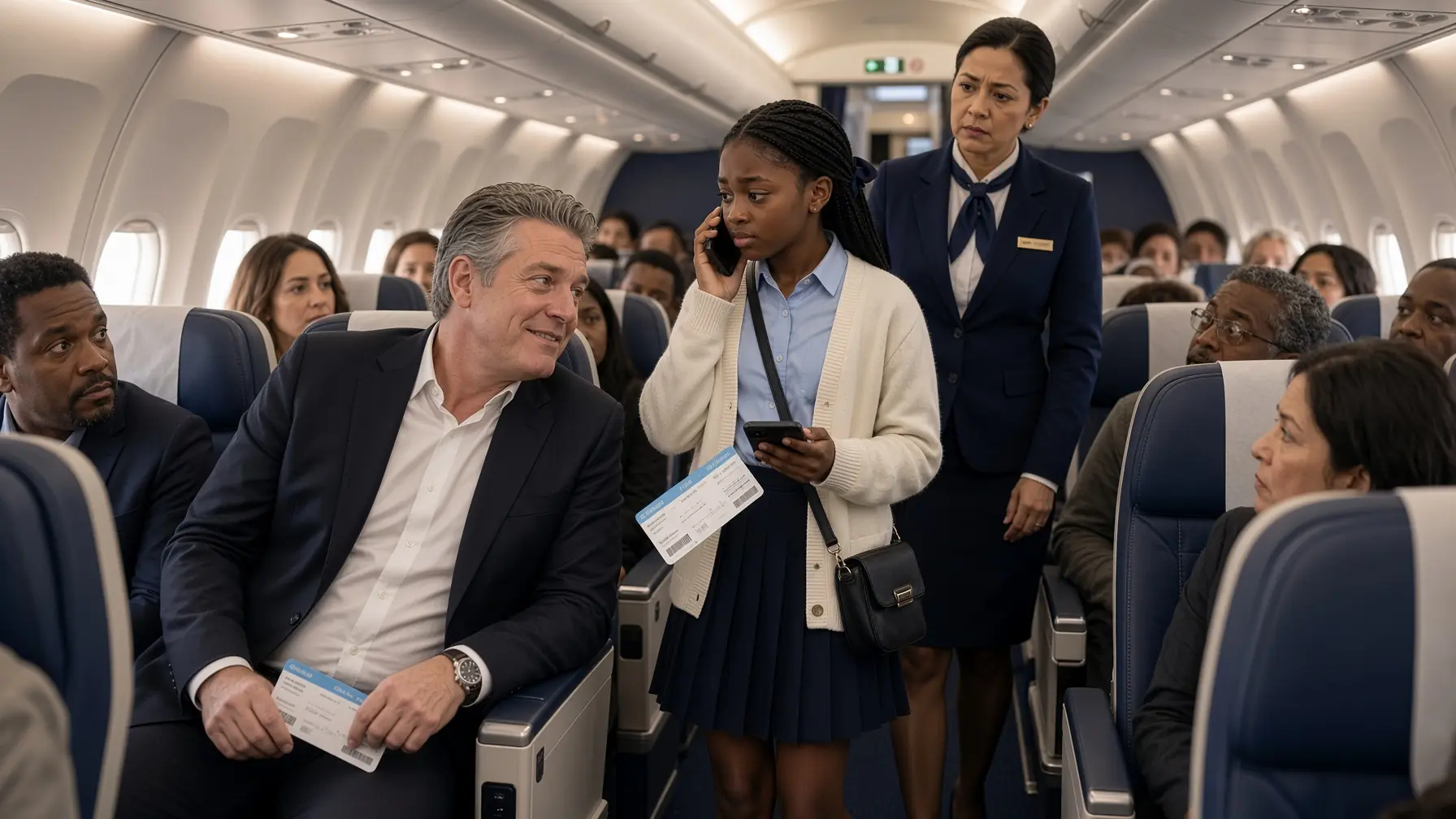
Amara moved carefully anyway.
She was twelve, but she carried herself with the quiet self-control of a child who had been taught not to drift, not to block the aisle, not to touch what did not belong to her, and not to panic when adults got loud. Her neat braids were tied back with a navy ribbon that matched her skirt. Her cream cardigan was buttoned straight. Her small crossbody travel bag rested neatly against her side. In one hand she held her business-class boarding pass. In the other, her phone.
Seat 3A.
She checked the number once.
Then twice.
Then looked up.
A large white man in a designer blazer was already stretched comfortably across the window seat, one ankle resting over a knee like he had been born there. He was too relaxed for a man sitting in someone else’s place. His silver watch flashed under the cabin lights as he adjusted his cuff and glanced at her with the kind of smile adults wore when they had already decided a child was beneath their attention.
Amara stopped beside the seat.
“Excuse me, sir,” she said politely. “I think that’s my seat.”
The man barely looked at her boarding pass.
Instead, he looked at her.
Then at the seat number.
Then back at her face.
“You’re in the wrong section, sweetheart,” he said, leaning farther back into 3A. “Move along.”
Amara lowered her eyes to the paper again, calm and careful.
“No, sir. My boarding pass says 3A.”
A few steps away, a flight attendant in a neat navy uniform paused in the aisle. Her name tag read L. CHEN. She had clearly heard enough to know something was wrong, but not enough yet to know how ugly it was about to become.
Amara held the pass up a little higher, making the seat number easier to see.
The man—Richard Cole, though Amara did not know his name yet—gave a short, amused laugh.
“Business class starts here,” he said, gesturing lazily around him. “You don’t just wander into it because you feel like it.”
Amara’s face did not change.
“That’s my assigned seat.”
The flight attendant stepped forward. “Sir, if there’s a seat issue, I can help—”
Richard held up one finger toward her without taking his eyes off Amara, as though dismissing both a child and a crew member required the same gesture.
Then he did something so petty, so arrogant, and so unnecessary that half the nearby passengers visibly stiffened.
He reached out, snatched the boarding pass right out of Amara’s hand, looked at it for all of one second, and tore it clean across the middle.
One half fluttered down against Amara’s fingers.
The other stayed in his hand.
The cabin went silent in that immediate, shocked way people go quiet when they witness cruelty they had not been prepared to see.
Even the flight attendant froze.
Richard held the torn half loosely and gave Amara a thin, cold smile.
“Do you even know who I am?” he asked.
Amara looked down at the half of the pass in her hand.
Then up at him.
Her face did not crumple.
She did not cry.
She did not argue louder.
She simply reached for the phone still resting in her other hand, unlocked it with calm fingers, tapped one contact, and lifted it to her ear.
“Dad?” she said clearly. “A man just tore my ticket and took my seat.”
That was the moment Richard’s smile changed.
Not vanished.
Not yet.
But weakened.
Only slightly.
Only enough to show that for the first time since she had stopped beside seat 3A, he understood this might not end exactly the way he expected.
The flight attendant found her voice. “Sir, I’m going to need you to give me that portion of the boarding pass.”
Richard turned to her, annoyed now. “This is a misunderstanding. The girl’s in the wrong cabin.”
Amara did not lower the phone.
A calm male voice answered on the other end, too low for most of the cabin to hear.