“Are you done fixing that tire, or are you planning to rob me after?”
Victoria Hale’s words cut through the rain as sharply as the headlights passing along the empty service road outside Columbus. She stood near the rear door of her luxury SUV, one expensive heel sinking into the wet gravel while she clutched her phone against her charcoal coat. Her straight dark-blonde hair had begun sticking to her face, but irritation remained stronger than discomfort. In front of her, a soaked mechanic tightened the final lug nut without looking up.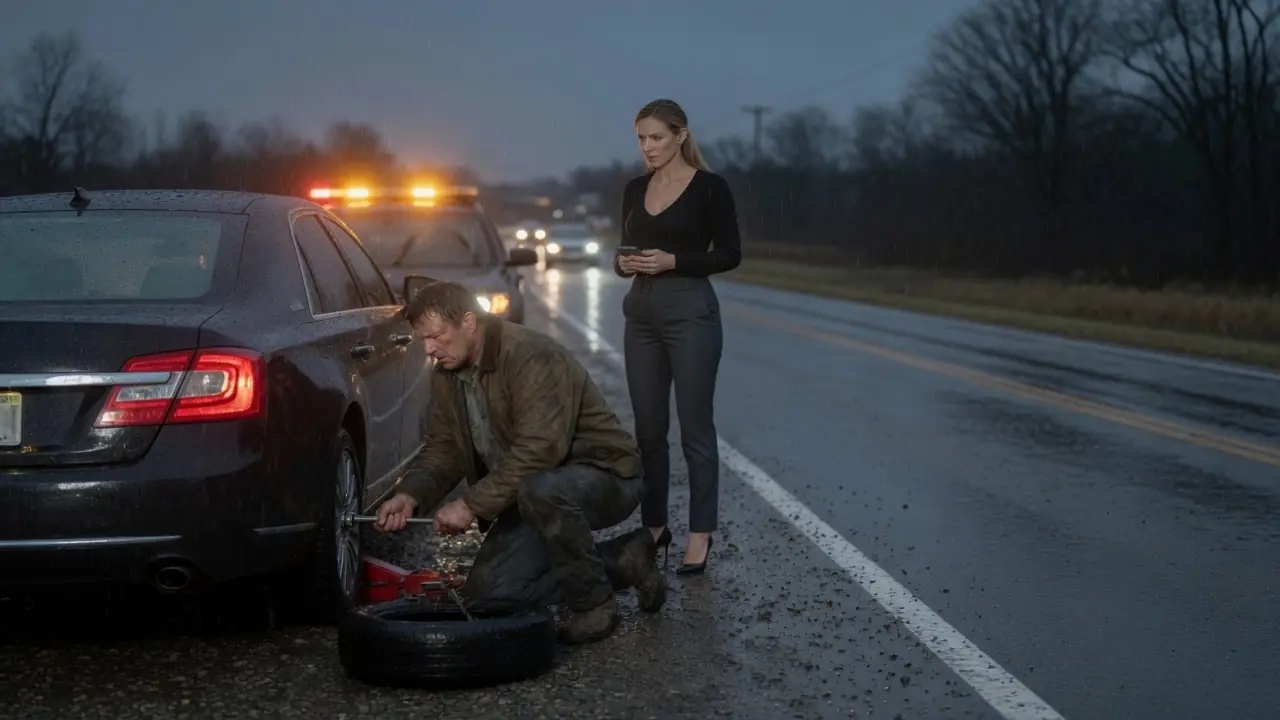
Thirty-eight-year-old Elias Rowan had been driving home when he noticed the disabled vehicle flashing its hazard lights beside the highway. His old pickup contained the tools he used for small repair jobs, and stopping had felt automatic. A stranded driver was still a stranded driver, no matter what kind of vehicle she owned or how suspiciously she watched him. His nine-year-old daughter, Lena, was waiting with their neighbor, but he had promised himself the tire would take only fifteen minutes.
“I stopped because you were stranded,” Elias said. “Not because I wanted anything from you.”
Victoria stepped farther from him. “Finish quickly, take your money, and stay away from the rest of my car.”
Elias placed the tire wrench on the pavement and examined the damaged wheel again. Something about the blowout had bothered him from the moment he removed it. Ordinary road damage produced uneven tears, bent wires, and chaotic cuts, but this tire had failed along a strangely consistent line. Someone had weakened the sidewall before it ruptured.
He leaned closer to the wheel well.
“What are you doing now?” Victoria demanded.
“Looking.”
“You already changed the tire.”
Elias wiped rain from his eyes and focused on the brake assembly. Behind the rotor, a small section of the brake line appeared cleaner than the surrounding metal. Rain coated everything evenly except that one spot, as though someone had recently handled it. A faint incision ran through the protective coating.
He rose slowly.
“Keep your money,” Elias said. “And don’t start the engine.”
Victoria gave a short, humorless laugh. “You expect me to remain here because you say so?”
“I expect you to remain here because someone wanted this car to fail after you reached full speed.”
The confidence left her face.
Before she could answer, bright headlights appeared behind Elias. A black armored SUV entered the shoulder and stopped hard enough to spray water across his boots. Two more vehicles arrived seconds later, one pulling ahead of Victoria’s car while the other angled behind it.
Doors opened almost simultaneously.
Men in dark suits stepped into the rain. Their movements were controlled, coordinated, and fast enough to tell Elias they were not drivers coming to offer help. One scanned the trees, another moved directly toward Victoria, and the largest of them locked his attention on the tire wrench near Elias’s feet.
“Step away from Ms. Hale’s vehicle,” the man ordered.
Elias raised one hand. “The jack is still carrying part of the weight. Move the car too quickly, and you’ll shift it.”
“I said step away.”
Elias took one slow step back.
The man moved between him and Victoria. He appeared to be in his mid-forties, with a square jaw, close-cropped black hair, and an earpiece beneath the collar of his rainproof coat. His right hand remained near the weapon concealed under his jacket.
Victoria finally spoke. “Marcus, he stopped to change the tire.”
Marcus Trent, her head of security, glanced at the damaged wheel. “And now he’s refusing to let you leave.”
“He says the car was tampered with.”
Marcus looked at Elias again, suspicion deepening. “You’re holding a wrench beside Ms. Hale’s disabled car. Step farther away before I put you on the ground.”
Elias’s patience thinned, but his voice remained calm. “Move that vehicle now, and the brake line could finish what the tire started.”
Marcus stared at him.
Victoria stepped around her security chief. “Are you saying someone deliberately trapped my car?”
Elias pointed beneath the chassis. “I’m saying those SUVs arrived just in time to watch whether you survived.”
Every person on the shoulder became still.
Marcus crouched beside the wheel while another guard held a flashlight. At first, he saw nothing beyond water, grease, and road grime. Elias directed the beam toward the narrow section behind the rotor. The cut appeared only when the light reached it from the correct angle.
“That could be wear,” Marcus said.
“No,” Elias replied. “Wear is rough. That incision is controlled.”
Marcus leaned closer.
Elias pointed to the shredded tire. “The sidewall was weakened first. The tire fails at speed, the driver panics, then the brake pressure drops when she tries to slow down.”
Victoria folded her arms tightly. “How far would I have gone?”
Elias looked toward the highway curve less than a mile ahead. “Not far enough to reach the next exit.”
Marcus stood and ordered two guards to inspect the vehicle. One opened the hood while another slid partially beneath the chassis. Victoria remained beside Elias, though her expression had changed from contempt to calculation.
“You noticed all this while changing a tire?” she asked.
“I noticed enough to keep looking.”
“Why didn’t you tell me immediately?”
“You were busy deciding whether I was a criminal.”
The reply struck harder than Elias intended. Victoria looked away for a moment, unable to deny it.
A guard emerged from under the SUV holding a narrow steel wedge. “Marcus, this was lodged near the suspension.”
Marcus took it and examined the sharpened edge. The object had been positioned to worsen the tire damage once the wheel reached highway speed. Another guard discovered a slow leak of hydraulic fluid beneath the brake assembly.
Marcus’s expression hardened. “No one moves this vehicle.”
Victoria watched the fluid gathering on the pavement. “So he was right.”
Marcus did not answer immediately. Admitting that the mechanic had identified a threat his trained team had missed clearly cost him something. Still, protecting Victoria mattered more than pride.
“Full sweep of every vehicle,” he ordered.
Security agents moved from SUV to SUV, checking tires, electronics, engines, and undercarriages. Elias walked toward his pickup, intending to collect his tools and leave before the night became even more complicated. Lena had already called twice.
Victoria stopped him. “Where are you going?”
“Home.”
“You just discovered an attempt on my life.”
“That sounds like a reason for your security team to work harder.”
Marcus approached. “Mr. Rowan, we need to know how you recognized this.”
Elias looked at the dark highway. He had spent years avoiding explanations about the part of his life that existed before Lena. Most people in town knew him as a mechanic who repaired farm trucks, delivery vans, and anything else that arrived at his rented garage.
“I have seen vehicles prepared to fail before,” he said.
“Where?”
“Convoys.”
Marcus studied him more carefully. “Military?”
Elias did not answer.
Victoria tilted her head. “You are not only a roadside mechanic.”
“I’m exactly what I look like now.”
“What you are now doesn’t erase what you were.”
Elias retrieved a pressure clamp from his toolbox. “If you want to move that SUV safely, I need to stabilize the damaged line.”
Marcus inspected the ordinary-looking tool. “You carry equipment for sabotaged armored vehicles in your truck?”
“I carry equipment for customers who cannot afford a second tow.”
He slid beneath the SUV while a guard directed the flashlight. Elias isolated the damaged section, secured the temporary clamp, and tested the remaining pressure. The work took less than three minutes.
“It will hold at low speed,” he said after emerging. “No sudden braking, no sharp turns, and no towing until the system is depressurized.”
Marcus looked at the repaired line. “You did that with a clamp and a pressure gauge held together with tape.”
“Expensive tools do not help if you are solving the wrong problem.”
Victoria almost smiled.
A guard hurried back from the tree line. “A gas-station employee reported a white cargo van parked across from Ms. Hale’s vehicle when she stopped earlier. It left immediately after the convoy passed.”
“How long was my car unattended?” Victoria asked.
“Approximately ten minutes,” Marcus replied.
Elias looked down the road. “Long enough.”
Marcus’s radio crackled. Another agent reported that the remaining convoy vehicles were clear. Relief passed briefly through the group, but Elias could not share it.
“If they expected her vehicle to fail,” he said, “someone may be watching to see whether the trap worked.”
Marcus looked toward the curve. “You think the van followed us?”
“I think careful people check their work.”
As if summoned by the warning, headlights appeared in the distance. A vehicle moved slowly along the far lane, far below the speed of normal traffic. When it came closer, the beams revealed the outline of a white cargo van.
Marcus ordered his guards into defensive positions.
The van slowed near the shoulder.
For several seconds, it appeared ready to stop. Then it accelerated suddenly, passed the convoy, and disappeared down a narrow access road.
“They came back,” Victoria whispered.
“To confirm the result,” Elias said.
Marcus turned toward him. “Which means they saw you.”
“They saw that the plan failed.”
“That does not concern you?”
Elias thought of Lena waiting by the kitchen window. “It concerns me less than being late for my daughter.”
Victoria’s expression softened. “How old is she?”
“Nine.”
“You are raising her alone?”
“Since she was three.”
Marcus looked toward the damaged SUV. “We still need to move Ms. Hale to the city. You should come with us.”
“No.”
“You understand the sabotage better than anyone here.”
“I understand that my daughter expects me home.”
Victoria stepped closer. “Whoever planned this knew my route and timing. If there is another trap, Marcus’s team may not recognize it until too late.”
Elias looked at the guards, the damaged car, and the white van’s disappearing taillights. Once he had seen a danger, pretending it belonged only to someone else had never been one of his talents.
He sighed. “Call your neighbor,” Victoria said. “Tell her you will be late.”
Elias did.
Lena answered instead.
“Dad?”
“I’m safe.”
“You always say that before explaining why you’re late.”
He smiled despite the rain. “A car had more problems than I expected.”
“Did you fix it?”
“Working on it.”
Lena paused. “You’re helping someone again.”
“Yes.”
“Then come home when it’s done.”
Her trust made the decision heavier, not easier.
Elias rode in the front passenger seat of Victoria’s repaired SUV while Marcus drove. Victoria sat behind them, and the remaining security vehicles formed a tight protective formation. They avoided the interstate and took a slower southern route into Columbus.
For the first few miles, the temporary repair held.
Marcus kept the speed below thirty-five while watching the brake-pressure gauge. Victoria asked Elias what kind of convoy work he had done, but he answered only that he once studied ways vehicles failed under hostile conditions.
“Why leave?” she asked.
“My wife died when Lena was three. I was gone more often than I was home. My daughter needed someone who came back every night.”
“So you walked away.”
“I came home.”
The distinction silenced Victoria.
The road descended toward a wooded curve. Elias leaned forward, noticing a faint reflection across the asphalt. It appeared almost beautiful under the headlights, a thin rainbow sheen stretching from one side of the road to the other.
“Slow down,” he said.
Marcus eased off the accelerator. “What is it?”
“Fluid across the road.”
Victoria leaned forward. “From an accident?”
“Too even.”
Marcus saw it a second later. Diesel or hydraulic fluid covered thirty yards of wet pavement precisely where the road curved beside a deep drainage ditch.
“Another trap,” he said.
Elias nodded.
The first sabotage was designed to damage the brakes. The oil-covered curve would complete the crash, pulling Victoria’s vehicle off the road while the convoy collided behind her. Whoever planned the attack understood not only the route but the security team’s likely response.
“Do we stop?” Victoria asked.
“If they are watching, stopping tells them we noticed,” Elias said. “Keep moving slowly. No sudden steering.”
Marcus reduced the speed to twenty.
The tires reached the slick surface. The steering wheel loosened beneath his hands, and the heavy SUV drifted toward the shoulder. Marcus corrected gently while Elias watched the road ahead.
“Hold it straight.”
The rear wheels slid once, then recovered.
The convoy vehicles followed with greater distance between them. One guard reported a minor skid, but no one lost control. After what felt like several minutes, the tires regained solid traction.
Marcus exhaled. “That was planned for the damaged vehicle.”
“Everything tonight was planned for your usual route,” Elias said.
Victoria looked toward the darkness behind them. “Someone inside my organization provided information.”
“Or someone studied you long enough to predict it.”
The alternate road appeared ahead beneath a blinking yellow light. A dark vehicle waited beyond the intersection with its headlights off. Its engine was running, and it sat at an angle that partially blocked the turn.
Marcus slowed.
“Roadblock?” Victoria asked.
Elias studied the position. “No. A funnel.”
The parked vehicle left enough room for the SUV to turn, but only if Marcus moved close to the muddy shoulder. With the ground softened by rain, the heavy armored vehicle would slide into the ditch. The convoy behind it would have nowhere to go.
“What do we do?” Marcus asked.
Elias noticed a narrow maintenance road continuing straight beyond the intersection. It was nearly hidden between trees and wide enough for only one vehicle.
“Do not turn.”
“There is no public road ahead.”
“There is a service lane.”
The parked vehicle’s engine revved. Its driver realized the convoy was not following the expected path.
“Hold on,” Marcus warned.
He accelerated straight through the intersection.
The other driver moved to block them, but the SUV reached the maintenance entrance first. Tires bounced over uneven gravel as branches scraped both sides of the vehicle. The convoy followed, one armored SUV after another, before the waiting car could react.
Victoria gripped the seat. “You saw this road before we reached it?”
“I noticed an opening.”
Marcus laughed once, partly from relief. “You say that as though noticing the only escape route is normal.”
“It used to be.”
The maintenance lane rejoined the highway three miles farther south. By then, the dark vehicle had disappeared. Police units waited at a checkpoint near the city limits, and Victoria’s team transferred the damaged SUV to investigators under Elias’s instructions.
The immediate danger had passed.
Marcus stepped toward Elias after they exited the vehicle. “You dismantled three connected traps without raising your voice.”
“Raising my voice would not have made the road less slippery.”
“You should work for me.”
“No.”
“I haven’t told you the salary.”
“My daughter does not care about your salary.”
Victoria approached with several officers and corporate security executives around her. Dawn had begun brightening the horizon, revealing how exhausted everyone looked.
“You saved my life,” she said.
Elias shook his head. “I changed a tire.”
“You found a damaged brake line, stabilized the vehicle, guided us across an oil trap, and identified an ambush.”
“That was part of the tire job.”
Marcus smiled reluctantly. “Most mechanics charge extra for assassination attempts.”
Victoria reached into her coat for a checkbook.
Elias stepped back. “Do not.”
“You spent the entire night protecting someone who insulted you.”
“I did not do it for your approval.”
“I understand that now.”
She looked ashamed as she remembered her first words beside the disabled vehicle. “I saw your old truck, your clothes, and your tools, and I decided what kind of man you were before you spoke.”
“You were frightened.”
“That does not excuse contempt.”
“No.”
Victoria closed the checkbook. “Then tell me what I can do.”
Elias thought of overdue rent on his garage, Lena’s school expenses, and the transmission job he needed to finish before Friday. Money would help, but accepting a reward in the middle of fear felt wrong.
“Find out who did this,” he said. “And stop treating ordinary people as possible threats simply because they stand near your expensive things.”
Victoria accepted the rebuke.
Her company’s investigators uncovered the conspiracy within two weeks. A senior executive facing removal at an emergency board meeting had supplied Victoria’s route to contractors who specialized in staging mechanical accidents. The white van, road traps, and altered security schedule all traced back to payments hidden inside a consulting account.
Marcus called Elias three times during the investigation.
Elias ignored the first two calls.
He answered the third because Lena insisted anyone that persistent either needed help or had poor manners. Marcus invited him to Victoria’s corporate office and promised the meeting involved no damaged tires.
Elias arrived wearing clean work clothes rather than a suit. Glass walls, silent elevators, and polished floors made him feel more out of place than any dangerous road ever had. Victoria met him personally in the lobby.
“I want to fund an expansion of your garage,” she said after they entered her office.
“No.”
“You have not heard the proposal.”
“I do not want a charity project.”
“It is not charity.” She placed a folder on the table. “My company operates delivery fleets, construction vehicles, and emergency transportation contracts. We need a regional mechanical-safety consultant who understands failure better than someone reading computer reports.”
Elias opened the folder.
The contract allowed him to remain in his own garage, choose his hours, and hire two additional mechanics. It also required him to develop low-cost safety inspections for local school buses and community organizations.
“Why include the school buses?” he asked.
“Because you told me money should not decide who receives protection.”
The answer surprised him.
“What about travel?”
“Limited.”
“Nights?”
“Only emergencies.”
“My daughter comes first.”
Victoria nodded. “That is why you are the person I want.”
Elias accepted after Lena read the contract and asked whether the new income meant he could stop repairing transmissions at midnight. He promised to try.
Months later, Victoria visited the garage without a convoy.
She arrived in an ordinary sedan and waited while Elias helped Lena rebuild a small engine for her school science project. The girl had her father’s steady gray eyes and the habit of examining people before trusting them.
“You are the woman with the tire,” Lena said.
Victoria smiled. “That is one way to describe me.”
“Dad said your car had several problems.”
“Your father solved all of them.”
Lena looked at Elias. “He does that.”
Victoria offered Lena a small box containing a new set of precision tools engraved with her name. Lena accepted only after confirming they were not payment for her father’s kindness.
“She sounds like you,” Victoria said when Lena returned to the workbench.
“That should worry you.”
“It reassures me.”
Elias’s garage grew steadily. He hired two unemployed mechanics, created an apprenticeship program, and began providing free annual safety inspections for vehicles used by foster families and senior centers. Victoria’s company paid for the program but never placed its name on the service.
Marcus continued trying to recruit Elias into corporate security.
Elias continued refusing.
One rainy evening a year later, Elias drove home with Lena beside him. They passed a small car stopped on the shoulder, hazard lights blinking against the dark road. A young mother stood beside it holding a child beneath an umbrella.
Elias slowed.
Lena looked at the stranded family, then at her father. “We’re going to be late for dinner again, aren’t we?”
“Probably.”
She sighed with exaggerated suffering. “I’ll call the neighbor.”
Elias pulled onto the shoulder.
He did not know who the woman was, what she owned, or whether helping her would ever matter beyond that moment. He knew only that someone was stranded and afraid.
That was enough.
The night Victoria Hale mocked the soaked mechanic beside her luxury SUV, she believed power traveled in armored vehicles and arrived surrounded by men in dark suits. But every vehicle, every guard, and every dollar had failed to reveal the danger hidden behind one broken wheel.
The person who saw it was the single father she nearly dismissed as a thief.
Elias did not save her because she was wealthy, influential, or important.
He saved her because he had stopped long before the black SUVs arrived—when she was only a stranger alone in the rain.