The snow had been falling since before dawn.
By the time pale winter light crept through the frost-laced window of the small log cabin at the edge of the Montana pines, the whole world outside had disappeared beneath white silence.
The yard was gone. The narrow path to the road was gone. Even the woodpile looked like a soft mound in the drifting snow.
Maylin stood at the window with both hands wrapped around an empty tin cup.
She had been holding it for nearly an hour, not because there was anything inside, but because holding something gave her hands a reason not to shake.
Behind her, the fireplace held only a few orange coals fighting against the cold. The cabin smelled of ash, pine resin, and the faint memory of food.
There was no breakfast.
There had been no supper the night before either.
And today, of all days, was Christmas morning.
Maylin turned when she heard the soft sounds of her daughters waking.
Shao was seven and always woke slowly, blinking through tangled black hair, clutching her thin wool blanket as if it could protect her from the whole world.
Fen was five and woke all at once, sitting straight up with her dark eyes wide open, already searching the room for something different.
Something better.
Both girls looked at their mother with the careful silence children learn when disappointment has visited too often. They did not ask about Christmas. They did not ask about food. They did not ask whether there would be anything special today.
Maylin had raised them well enough in hardship that they understood, without words, when certain things simply were not coming.
“Come here,” Maylin said softly.
The girls climbed from their bed and came to her.
She knelt near the dying fire and pulled them both against her sides. Shao rested her cheek against Maylin’s shoulder. Fen tucked her cold little hands under her mother’s sleeve.
Maylin closed her eyes.
She told herself she would not cry.
She had been telling herself that every morning for three months, ever since the fever had taken her husband Wei in September. He had been strong, kind, and stubborn enough to laugh at storms. Then one week of sickness had emptied the cabin of his voice.
He left behind two small daughters, forty-seven dollars hidden in a tin beneath the floorboards, and a deed to land that winter had made useless until spring.
Maylin had rationed everything.
She cut food thin as thread.
But thread, no matter how carefully it is stretched, eventually runs out.
The flour was gone.
The salted pork was gone.
The dried beans were gone.
She had fed Shao and Fen the last of the cornbread yesterday afternoon and told them it was a special early Christmas meal.
Shao, who understood more than Maylin wished she did, had eaten slowly and said nothing.
The morning passed the way hard mornings do.
Heavily.
Maylin melted snow in the tin pot, boiled it, and gave each girl a cup of hot water. She tried to smile as she handed it to them.
“Careful,” she said. “It’s hot.”
Fen blew across the surface as if it were soup.
Shao watched her younger sister pretend, then pretended too.
That nearly broke Maylin more than any crying would have.
By noon, Fen had fallen asleep beside the fire, curled up like a small animal. Shao sat beside her, stroking her hair with a grave tenderness no seven-year-old should have known.
Maylin went back to the window.
The road was empty.
The forest stood still.
The snow continued to fall, soft and beautiful and indifferent, the way nature can be beautiful even while it is threatening to kill you.
She thought of the forty-seven dollars beneath the floorboards. She thought of the nearest town. She wondered whether she could make the walk with two children once the storm passed. She wondered whether anyone would hire a widow with two daughters and no family nearby.
Then something moved at the tree line.
Maylin went still.
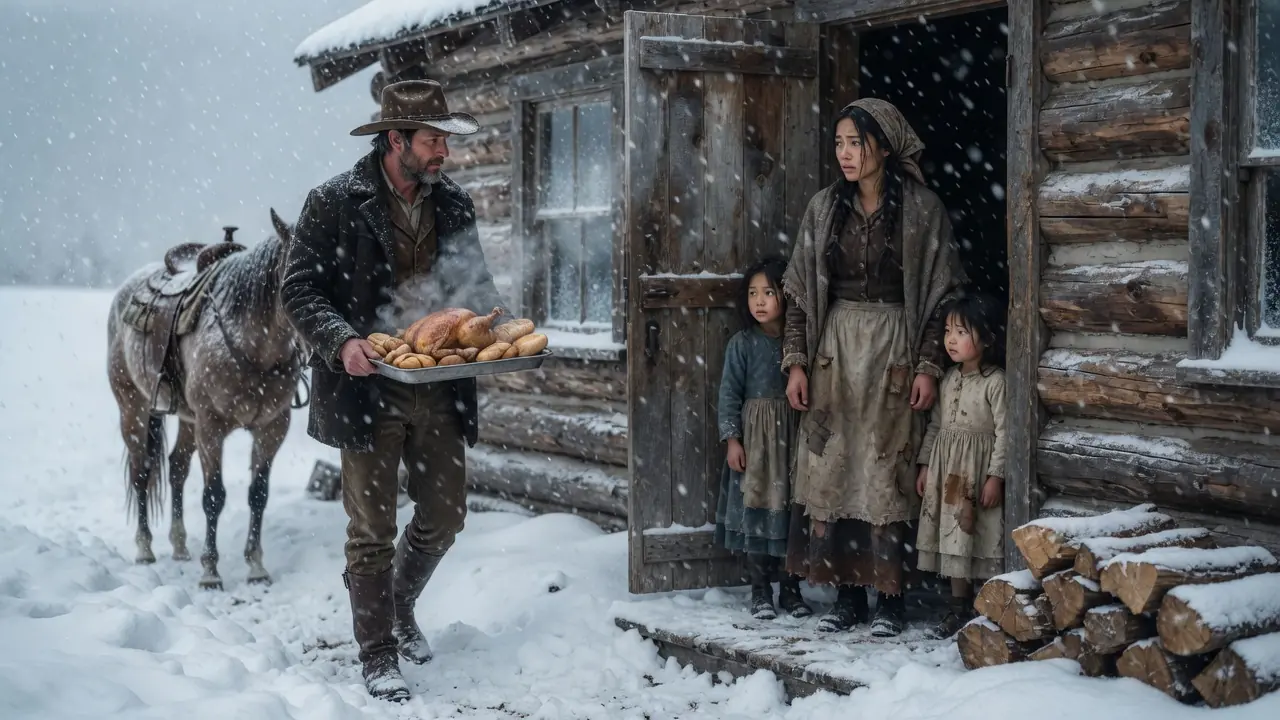
At first, she thought it was a deer. A dark shape moving through white. Then the shape grew larger. A horse appeared, a big gray roan with snow across its back.
A man sat in the saddle, hunched against the cold, hat brim low, something enormous balanced carefully across the front of him.
He was coming toward the cabin.
Maylin stepped away from the window.
Her heart tightened the way it always did now when strangers appeared. A woman alone with two small children on an empty road learned caution quickly.
She went to the shelf where Wei’s old rifle hung. She took it down, checked that it was loaded, and stood near the door.
The knock came a few moments later.
Three solid raps.
No pounding.
No impatience.
Only the sound of someone cold enough to need shelter and respectful enough to ask.
Maylin opened the door with the rifle held across her body.
Not pointed.
But present.
The man on the porch was tall. That was the first thing she noticed. Tall and lean, built by long years outdoors. He wore a brown leather vest over a beige shirt, and snow covered his hat and shoulders. His beard was brown, rough from weeks without a razor. His eyes were pale gray and tired, but clear.
In both hands, he held a large metal tray.
On that tray sat a roasted turkey so golden and full that the steam rose from it like a blessing.
The smell struck Maylin first.
Roasted meat.
Fat.
Herbs.
Bread.
After days of nothing, the scent hit her so powerfully that her knees nearly gave.
The man looked at the rifle.
Then at her face.
He did not step forward.
“Ma’am,” he said, his voice low and calm. “My name is Cole Hadley. I’m not here to cause trouble.”
Maylin did not answer.
He glanced toward the trees behind him.
“I was riding through. I had more food than one man could eat in a week, and I saw your cabin.” He paused. “I saw no smoke.”
Maylin looked past him at the gray roan, then back at the turkey.
“You ride around Montana with a roasted turkey on your saddle?”
Something almost like a smile moved beneath his beard.
“Cooked it this morning at my camp. Caught it two days ago. Was going to eat alone.” He looked down at the tray. “Didn’t feel right. Not today.”
Behind Maylin, Fen woke.
The little girl gave a soft gasp.
Maylin heard the quick patter of small feet, and then Fen appeared at her side. The child stared at the turkey with her mouth open in a perfect circle, her dark eyes enormous.
A second later, Shao came too.
She tried not to stare.
But she did.
Maylin looked down at her daughters’ faces, and something inside her cracked open.
She stepped back from the door.
Cole Hadley came inside.
He moved carefully, as if he knew fear lived in the cabin and did not want to startle it. He set the tray on the table with almost ceremonial gentleness. Then he went back outside without being asked.
When he returned, he carried two saddlebags over his shoulder.
From those bags, he placed one impossible thing after another onto the table.
A sack of flour.
A tin of lard.
Dried apples wrapped in cloth.
A small jar of honey.
Coffee beans.
A twist of salt pork.
A paper packet of beans.
Two tins of peaches.
A bundle of split kindling.
Maylin stared at the table as if it were a vision.
Cole did not explain. He did not make a speech. He did not look proud of himself. He simply unpacked the food like a man who had carried it to the place where it belonged.
Fen had not blinked since the turkey appeared.
Shao moved one step closer to the table, then stopped, as if afraid the food might vanish if she wanted it too openly.
Maylin swallowed.
“Sit down, Mr. Hadley.”
“Cole,” he said.
“Sit down, Cole.”
He took off his hat and sat near the end of the table. His hair was brown and flattened from the cold. He ran a hand through it once, then looked around the cabin.
Maylin saw him notice everything.
The bare shelves.
The dying coals.
The thin blankets.
The children’s hollow cheeks.
The careful poverty she had tried so hard to keep orderly.
But he said nothing about it.
For that, she was grateful in a way she could not have explained.
Maylin carved the turkey herself. Her hands shook so badly at first that Cole quietly took the carving fork and held the bird steady without saying a word.
She gave the first plate to Fen.
The little girl looked at the food for a long moment before picking up her fork, as if she needed to make sure it was real.
Then they ate.
At first, the girls ate quietly, almost cautiously. Then hunger overcame manners, and they ate with the urgency of children whose bodies had been waiting too long.
Cole ate slowly. He seemed to be making his plate last so the others would not feel watched.
Fen asked the first question with her mouth half full.
“Are you a real cowboy?”
Cole looked at Maylin, as if asking permission to answer.
Maylin gave a small nod.
“Yes,” he said. “Most of my life.”
“Do you have a house?”
“No.”
“Do you have a mama?”
“Not anymore.”
“Do you have babies?”
“No.”
Fen considered this.
“Then who eats Christmas with you?”
Cole’s fork stopped.
For the first time, something in his face changed.
“No one,” he said quietly. “Usually.”
Shao had been listening with a seriousness beyond her age.
“Our papa died,” she said.
Maylin closed her eyes briefly.
Cole looked at Shao, not away from her, not around her.
“I’m sorry,” he said.
“He used to make us count in Mandarin and English,” Shao continued. “He said if we knew two languages, nobody could steal our thoughts.”
Cole nodded slowly.
“Sounds like a wise man.”
“He was,” Shao said.
No one spoke for a while after that.
The fire strengthened as Cole added kindling. The cabin began to warm. The smell of turkey and coffee filled the room. For the first time in months, Maylin heard her daughters laugh at the table.
It was a small sound.
Then bigger.
Then real.
After dinner, Cole helped wash the tin plates without being asked. Fen fell asleep sitting upright, full for the first time in weeks, her cheek resting against her own shoulder.
Cole glanced at Maylin.
Maylin nodded.
He picked Fen up with a gentleness that startled her. Not hesitation. Not awkwardness. A natural care, as if sleeping children deserved to be carried like sacred things.
He laid Fen near the fire, covered her with a blanket, and stepped back.
Shao watched him closely.
“You carried her careful,” she said.
Cole looked at the girl.
“Children should be carried careful.”
Shao seemed to store that answer somewhere important.
By evening, the storm had worsened. Wind pressed snow against the windows. The trail outside had disappeared completely.
Cole put on his coat and reached for his hat.
Maylin stood.
“You don’t have to leave tonight.”
He turned.
“I don’t want to impose, ma’am.”
“Maylin,” she said.
“I don’t want to impose, Maylin.”
She looked toward the window.
“You brought Christmas dinner to two hungry children in a snowstorm. You are not imposing.” She pointed toward the fire. “You are staying.”
Cole looked as if no one had ordered him to accept kindness in a very long time.
Then he lowered his hat.
“Yes, ma’am.”
“Maylin,” she repeated.
A faint smile touched his eyes.
“Yes, Maylin.”
He slept on the floor near the fire with his hat over his face and his long legs crossed at the ankle.
Maylin lay awake for a long time, listening.
The wind outside.
The fire inside.
Her daughters breathing.
And beneath it all, the quiet presence of a stranger who had entered their cabin carrying food and had somehow brought the room back to life.
By morning, Cole was already awake.
The fire had been rebuilt. Coffee simmered in the pot. A stack of wood sat neatly beside the hearth.
Maylin stood in the doorway, wrapped in her shawl.
“You don’t sleep late.”
“Never learned how.”
“You chopped wood?”
“Some.”
“That was the last of mine.”
“I noticed.”
He said it simply.
Not to shame her.
Only because it was true.
The storm kept him there the next day. He repaired the sagging roof beam because he saw it and could not ignore it. The day after that, he split more wood. The day after that, Fen developed a cough, and he rode only as far as the creek to check the trail before deciding the weather had not cleared enough.
By the fourth day, Maylin stopped pretending his staying was only about the storm.
He taught Shao to whittle with a small piece of pine, his big hands guiding hers carefully so she would not cut herself. Fen followed him around the cabin asking questions until he answered them all.
Why was his horse gray?
Because he was born that way.
Did horses like Christmas?
Probably if Christmas came with oats.
Did cowboys sleep standing up?
Only the foolish ones.
Had he ever seen a bear?
Yes.
Had the bear seen him?
Unfortunately, yes.
Fen laughed until she coughed, and Cole looked alarmed until Maylin assured him she would survive both the cough and the laughter.
On the fifth evening, Maylin found him outside brushing snow from the roan’s mane.
“Do you have somewhere to be?” she asked.
Cole paused.
The sky above the pines had turned deep blue. The snow reflected the last light. His breath rose white in the cold.
“No,” he said.
Only that.
“Do you want to be somewhere else?”
He looked at her then.
The yard was quiet. Inside the cabin, Shao was telling Fen a story by the fire. The smell of beans and salt pork drifted from the stove.
“No,” Cole said again.
Maylin nodded once.
Neither of them said more.
But after that, something settled between them.
Not a promise.
Not yet.
Only the absence of leaving.
Weeks passed.
Then months.
Cole did not ride away when the weather cleared.
He stayed through January because the fence line needed repairing and because Maylin could not manage it alone.
He stayed through February because the horse needed shoeing, the roof needed patching, and Shao had decided she would not forgive him if he left before teaching her to carve a proper bird.
He stayed through March because the thaw came hard and the mud swallowed half the yard.
By April, no one bothered naming reasons.
Cole turned the soil with Maylin for a kitchen garden. He mended the gate. He trapped rabbits. He brought in flour from town. He learned to say xiè xie because Fen insisted that if he said thank you so much, he might as well learn to say it in her father’s language too.
He practiced until she clapped both hands and declared, “Almost right.”
Cole bowed solemnly.
“High praise.”
Shao became his shadow in the yard.
Fen became his echo in the house.
And Maylin became careful with her own heart.
She had loved once. Deeply. Truly. She had buried that love beneath frozen earth and thought the part of her that reached for companionship had been buried with it.
But Cole Hadley did not push into her grief.
He made space beside it.
He never tried to replace Wei. He listened when the girls talked about their father. He repaired the small stool Wei had made. He kept Wei’s rifle cleaned and hung where Maylin wanted it. He asked once how to pronounce Wei’s name correctly and practiced until Maylin’s throat tightened.
One evening in late April, they sat on the porch while the last snow melted from the distant peaks.
Cole looked toward the fading sky.
“Do you think he would have minded?”
Maylin knew who he meant.
She was quiet for a long time.
Then she said, “Wei wanted us safe. Fed. Warm. He wanted the girls to laugh.”
Cole looked down at his hands.
“And you?”
Maylin watched the wind move through the pines.
“He wanted me to live.”
Cole closed his eyes briefly.
“I would not take his place.”
“No,” she said softly. “You could not.”
He nodded, accepting the truth without flinching.
Then Maylin touched his sleeve.
“But there is a place here that is yours if you want it.”
Cole looked at her.
For a moment, the cowboy who had ridden alone through snow looked almost afraid.
“I do,” he said.
They married in June.
There was no grand wedding. No church full of guests. No music except birds in the pines and Fen humming to herself because she was too excited to stand still.
A traveling preacher came through and married them in the yard. Shao stood as witness with a serious face and a carved wooden bird in her hand. Fen wore a crown of wildflowers and insisted the gray roan was part of the family and should be included.
Cole wore a clean shirt.
Maylin wore a blue dress she had mended twice.
When the preacher asked if Cole Hadley took Maylin as his wife, Cole did not look away from her.
“I do,” he said.
When he asked Maylin, she thought of Wei. She thought of hunger. She thought of the Christmas morning when she had stood with an empty tin cup, watching snow bury the road.
Then she looked at Cole.
“I do.”
Cole’s name went on the deed beside hers.
It felt right.
Not like erasing what had been there before.
Like adding a new beam to a house still standing.
Years later, when Fen was grown and telling her own children the story of how their family came together, she always began the same way.
“We had nothing for Christmas,” she would say. “Not food. Not wood. Not even a reason to hope. And then someone knocked on the door.”
Her children would lean closer.
“And who was it?”
“A lonely cowboy,” Fen would say, smiling. “Standing in the snow with the biggest turkey you ever saw in your life.”
“Did he stay for dinner?”
Fen would laugh then.
“Oh, he stayed for much more than dinner.”
Cole Hadley, who had ridden through Montana with no destination and no one waiting for him, found what he had not known he was looking for in a little cabin at the edge of the pines.
He found it in a widow brave enough to hold a rifle and still open the door.
He found it in two hungry children who looked at a roasted turkey like it was a miracle.
And perhaps it was.
Not because of the turkey itself.
But because of what came with it.
A meal in a starving house.
A fire in a cold room.
A stranger who became a guest.
A guest who became a friend.
A friend who became family.
That is how some miracles arrive.
Not with bells or angels or a sky split open.
Sometimes they come as three knocks on a cabin door.
Sometimes they smell like roasted turkey and coffee.
Sometimes they wear a snow-covered hat, speak softly, and carry enough food for everyone.
And sometimes, if the heart is still brave enough to open the door, the miracle comes in from the cold and never leaves.