The first crack appeared in the ax handle shortly after sunrise.
By noon, Emily Dawson could feel the splinter pressing into the callus beneath her right thumb every time she swung, but she refused to stop. The frozen Montana ground had already taken almost everything she had left that morning: feeling from her fingers, strength from her shoulders, patience from the small part of her mind still interested in comfort.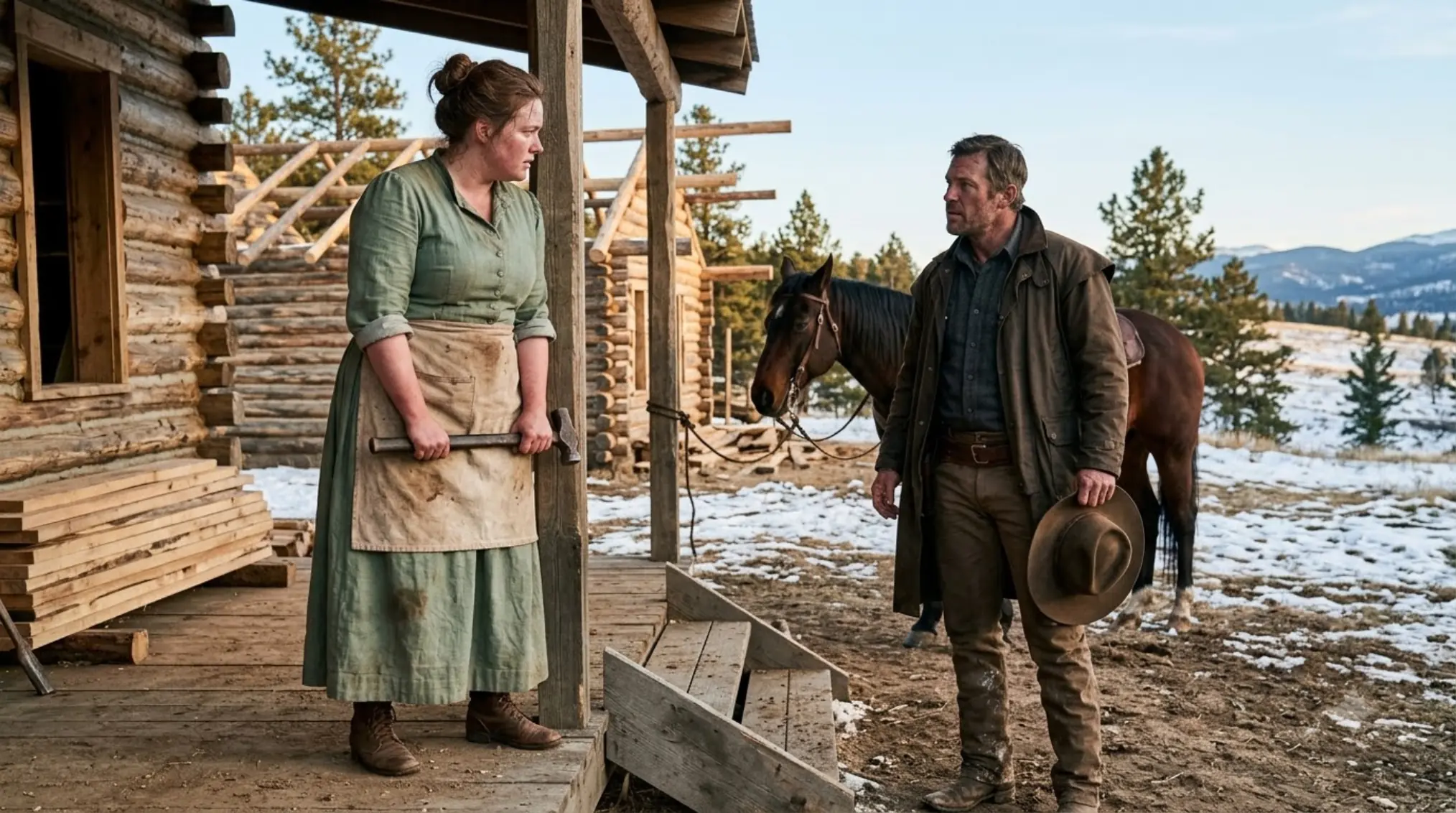
It would not take the cabin.
Emily drove the ax into another length of pine.
The log split with a clean, satisfying snap.
“Good,” she muttered.
Her breath drifted white into the November air.
Thirty-two years old, widowed eight months, nearly broke, and standing alone on a quarter section of land three miles west of Mill Haven, Montana Territory, Emily had stopped expecting life to reward effort. Effort had become its own answer.
Her husband, James Dawson, had worked inside the Harland Creek mine.
He had gone underground one March morning with a sandwich wrapped in paper and had never come home.
The shaft collapsed at 10:17.
Three men died.
The mining company sent Emily a letter expressing regret and accepting no liability.
Six weeks after James was buried, the bank took the small house they had shared.
Emily still remembered the silence after the wagon carrying her furniture pulled away.
Not grief.
Something beyond grief.
The empty sound of a life being dismantled object by object.
Her mother had written from Missouri and suggested she return home.
Emily burned the letter.
Returning meant admitting every person in Mill Haven who whispered that a woman like Emily could not survive alone had been correct.
So she took what remained of James’s life insurance, paid the funeral bills, cleared as much debt as she could, and purchased the ugliest parcel the county had available.
Rocky soil.
Exposed ridge.
No structure.
One narrow creek.
Nobody wanted it.
That made it affordable.
The county clerk looked at Emily over his spectacles when she signed.
“You planning to farm this?”
“Planning to live on it.”
“There’s no house.”
“There will be.”
He looked at her full figure, soft face, broad hips, and heavy arms, then toward the winter sky outside.
“You building it?”
“Yes.”
“With who?”
Emily signed the final line.
“Myself.”
That answer traveled through Mill Haven faster than the deed.
For weeks afterward, people watched her purchase nails, rope, tools, canvas, and used lumber.
She heard every whisper.
“Dawson widow’s building herself a cabin.”
“She’ll quit.”
“She’ll freeze.”
“She can barely climb into a wagon without breathing hard.”
Emily heard that one outside the general store.
She had turned around.
The man who said it looked suddenly interested in a barrel of potatoes.
Emily had not confronted him.
She simply carried two fifty-pound sacks of flour to her wagon without assistance.
Her body had always been a public subject.
Too large.
Too soft.
Too much.
James had been the first man who treated it like home instead of a problem.
When he died, Emily discovered how much of her confidence had quietly lived inside the way he looked at her.
Building the cabin became more than survival.
Every log became an argument.
Every nail answered someone.
Every blister said she was still here.
That afternoon, Emily dragged another split log toward the south wall.
Her unfinished cabin stood chest-high now.
One room.
A small loft planned above.
Stone hearth foundation half complete.
Roof timbers stacked nearby beneath canvas.
It was not beautiful.
It was hers.
Emily bent to lift another log.
Her back screamed.
She stopped.
“One minute.”
She hated negotiating with her own body.
She planted both hands on her thighs and breathed.
The sky had turned flat gray.
Snow soon.
When Emily straightened, movement caught her eye along the ridge.
Horse.
Rider.
Again.
She narrowed her eyes.
The man had been appearing for nearly six weeks.
Always far enough away to claim coincidence.
Always still.
Watching.
Emily knew his name.
William Carter.
Forty-one.
Rancher.
Widower.
His wife, Eleanor, had died two years earlier during childbirth.
The child died too.
Old Pete at the general store had told Emily the story.
“Carter keeps to himself now.”
“How far?”
Pete shrugged.
“Far enough people stopped trying.”
Emily had seen William in town twice before.
Tall.
Broad-shouldered.
Dark-brown hair beginning to gray around the temples.
Blue-gray eyes.
Weathered face.
The kind of man whose body told the story of horses, fence posts, winter cattle, and too many years sleeping less than he needed.
He never spoke to her.
He watched.
Emily disliked being watched.
Especially by men.
She raised one hand.
William remained still.
She lifted the ax.
Then pointed directly toward him with it.
Even at a quarter mile she saw his head tilt.
Emily mouthed, “What?”
The horse shifted.
William touched the brim of his hat.
Emily rolled her eyes and returned to the logs.
“Ridiculous man.”
An hour later, snow began.
Not much.
Small dry flakes.
Then the wind turned north.
Emily stopped working.
Everything inside her changed immediately from building to survival.
She looked toward Mill Haven.
Three miles.
The weather was coming from that direction.
Going back to the boarding house meant walking directly into it.
She looked at the lean-to beside the cabin.
Scrap timber.
Tin roof.
Canvas side.
A wool blanket inside.
Spirit lamp.
Hard biscuits.
Not comfortable.
Safe enough.
Decision made.
Emily started covering the lumber.
The wind rose.
The canvas fought her.
“Come on.”
She pulled harder.
A gust almost tore it from her hands.
Then she heard hoofbeats.
Emily turned.
William Carter was coming down from the ridge.
Fast.
A second horse followed, loaded with supplies.
Emily reached into her coat and pulled James’s revolver.
She kept the barrel toward the ground.
William slowed twenty feet away.
He saw the gun.
Then Emily.
“Ma’am.”
“You’ve been watching me for six weeks.”
William removed his hat.
“Yes.”
“Why?”
He looked toward the cabin.
Then the approaching storm.
“Because I couldn’t understand how you were doing it.”
Emily frowned.
“Doing what?”
“All of it.”
“That isn’t an answer.”
“It’s the best one I’ve got.”
Snow struck harder.
William nodded toward the pack horse.
“Brought rope. Heavy canvas. Two support timbers. Food.”
“I didn’t ask.”
“No.”
“Then why bring it?”
William looked at her.
His eyes were bluer close up.
Tired too.
Not tired from the ride.
A deeper exhaustion.
“I’ve spent two years sitting on that ridge doing nothing useful for anyone.”
Emily said nothing.
William continued.
“Watching you work every day made that start feeling like a waste.”
“A waste of what?”
“Whatever I’ve still got left.”
Emily studied him.
The honesty irritated her less than pity would have.
She lowered the gun.
“Can you tie a proper hitch?”
William almost smiled.
“Yes.”
“Prove it.”
They worked until dark.
William did not take over.
That was the first thing Emily noticed.
Men who offered women help often meant control.
They seized tools.
Changed plans.
Explained things nobody asked them to explain.
William asked one question.
“Where do you want this?”
Then he put things there.
Emily tied the south canvas while William reinforced the northern corner.
When she struggled with one frozen knot, he reached toward it, then stopped.
“Want me?”
Emily looked at him.
The question surprised her.
Not, “Give me that.”
Not, “You’re doing it wrong.”
Want me?
“Yes.”
William stepped beside her.
His gloved fingers covered the rope.
For half a second their hands touched.
Emily noticed.
She wished she had not.
The cold had reddened his cheeks.
Snow clung to his beard.
He smelled like leather, pine, horse, and winter air.
Emily pulled her hand away.
William tightened the knot.
“There.”
“Good.”
They crawled into the lean-to shortly after nightfall.
It was barely large enough.
William sat on one side.
Emily on the other.
Snow hammered the canvas.
The spirit lamp provided a circle of weak yellow light.
Emily handed William a biscuit.
He accepted.
“Thank you.”
They ate silently.
After a while Emily asked, “Eleanor?”
William looked at her.
“Your wife.”
His expression changed.
“Eleanor.”
“Pete told me.”
“Pete tells everybody everything.”
“That is his primary occupation.”
A faint smile appeared.
Emily waited.
William stared at the lamp.
“Fever after childbirth.”
“The baby?”
“Boy.”
“I’m sorry.”
William nodded.
“James?”
“Mine collapse.”
“I know.”
Emily looked at him.
“You don’t say you’re sorry.”
William met her eyes.
“Didn’t think you wanted it.”
She considered that.
“You’re right.”