Samuel Carter was carrying a pine log thick enough to crush an ordinary man’s shoulder when Eleanor Whitmore finally asked him the question she had been swallowing for three months.
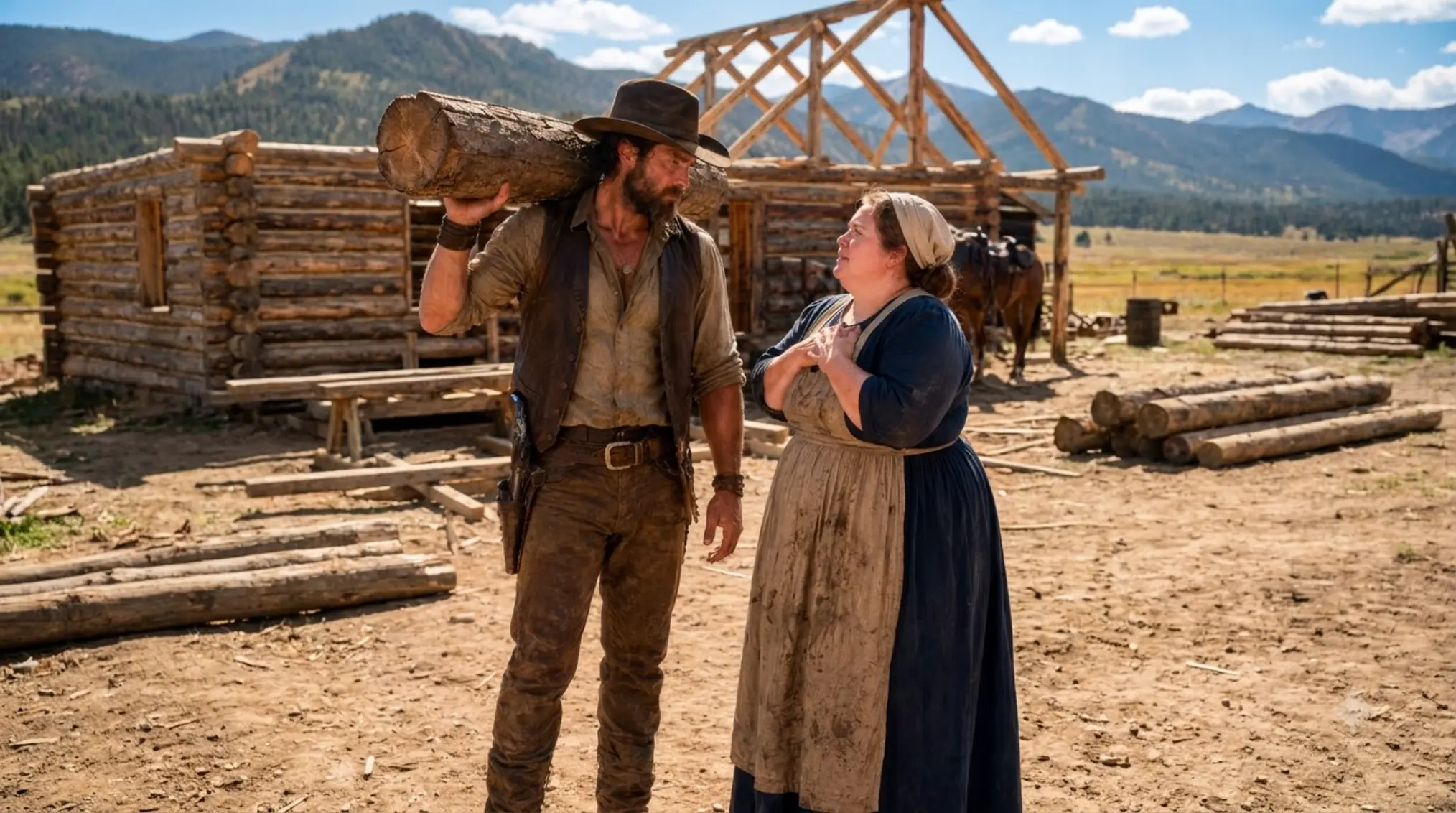
“You keep building rooms for my children, Samuel… what exactly are you building for me?”
The morning seemed to stop around them.
Hammers still struck timber somewhere behind the unfinished ranch house. A horse stamped beside the corral. Wind pushed dust across the yard and caught the edge of Eleanor’s cream headscarf, lifting it just enough to reveal several damp brown curls against her temple.
Samuel did not answer immediately.
He stood less than six feet away with the huge log balanced across one shoulder, broad chest rising beneath a sweat-darkened shirt. His brown vest was dusty from the morning’s work, his beard caught the sunlight, and his expression had gone completely still.
Eleanor pressed one hand against her chest.
She wished she could pull the words back.
Samuel had given her shelter when she had nowhere else to go. He had given her children beds instead of hayloft blankets, meals instead of promises, and jobs around the ranch without ever making her feel she owed him gratitude every time she sat at his table.
She should have been satisfied.
Instead she had started noticing things.
The way Samuel always repaired the chair beside hers first.
The way he made sure there was coffee left in the pot when she returned from feeding chickens.
The way his eyes followed her whenever she laughed with the children.
The way he had spent the last two weeks building an additional bedroom onto the west side of the house when every existing child already had somewhere to sleep.
Eleanor had tried telling herself it was storage.
Then she saw the window.
Storage rooms did not need a wide window facing the mountains.
Samuel finally shifted the log.
“Eleanor.”
“That isn’t an answer.”
His jaw tightened.
“You sure you want one?”
Her heartbeat stumbled.
“That depends on whether you intend to scare me.”
Samuel looked almost offended.
“I’ve spent three months trying not to scare you.”
That was true.
It was also part of the problem.
Before arriving at Black Pine Ridge, Eleanor had known men who treated kindness like bait.
A door opened because something was expected later.
A meal came with a debt.
A compliment became permission.
Samuel had never behaved that way.
Not once.
He had made his restraint impossible to ignore.
Eleanor looked toward the half-built house.
“Then answer me.”
Samuel stared at her.
For a long moment the hard rancher everyone in Willow Creek considered nearly impossible to embarrass looked strangely uncertain.
Then he said quietly:
“A place where you can stop pretending you don’t want to be held.”
Eleanor stopped breathing.
Samuel’s eyes stayed on hers.
“And if I admit I do?”
His voice dropped.
“Then I put down this damned log and spend the rest of the evening proving you never have to ask twice.”
Heat rushed into Eleanor’s face.
Samuel saw it.
He immediately looked away.
“Too much.”
She almost laughed.
“You think?”
“Yes.”
“Samuel Carter embarrassed?”
“Don’t spread it around.”
Eleanor smiled despite herself.
Then the front door of the unfinished house burst open.
“Ma!”
Her twelve-year-old son, Caleb, ran across the yard waving one muddy hand.
Eleanor stepped away from Samuel instinctively.
Samuel’s expression closed.
Not coldly.
Carefully.
That was how they had survived three months.
Every time the space between them became dangerous, life interrupted.
Children.
Livestock.
Work.
Weather.
Something always appeared before either of them had to make a decision.
Caleb stopped.
“Mr. Carter, Jesse says the roof brace is wrong.”
Samuel frowned.
“Jesse’s nine.”
“He says it’s wrong anyway.”
Samuel looked toward the house.
From somewhere inside came another boy’s voice.
“It is!”
Samuel sighed.
“Put this morning on my grave.”
Eleanor laughed.
He looked at her.
The sound changed his expression.
Then he carried the log toward the construction frame.
Eleanor watched him go.
She was still watching when her daughter Ruth stepped outside behind Caleb.
Ruth was fifteen and therefore believed she understood every secret adults imagined they had hidden.
She looked from Samuel to her mother.
Then smiled.
Eleanor pointed at her.
“No.”
Ruth widened her eyes innocently.
“I didn’t say anything.”
“You were about to.”
“Probably.”
“Don’t.”
Ruth walked past.
“He likes you.”
Eleanor closed her eyes.
“Ruth.”
“He does.”
“He gave us work and a roof.”
“He looks at flour differently than he looks at you.”
Eleanor turned.
“What does that mean?”
“I don’t know. I’m fifteen.”
Ruth grinned and ran toward the barn.
Eleanor remained beside the woodpile.
She hated that the girl was right.
Samuel did look at her differently.
The more frightening truth was that Eleanor had begun looking at him the same way.
Three months earlier, she would have considered that impossible.
Three months earlier, she had arrived at Black Pine Ridge with two children, thirty-seven dollars, a wagon with one broken wheel, and absolutely no intention of needing another man again.
Her husband, Nathan Whitmore, had been dead sixteen months.
He had not been cruel.
Eleanor sometimes wished he had been.
Cruelty would have made grief simpler.
Nathan had been decent.
Hardworking.
Kind when life allowed him enough energy.
They married young outside Cheyenne, moved north searching for cheaper land, and spent fourteen years building a life that never quite stopped being difficult.
Nathan became ill during the winter of 1879.
At first they believed it was pneumonia.
By spring he could barely walk.
By summer he was dead.
Debts survived him.
So did Eleanor.
That turned out to be expensive.
The small property they had leased reverted to the owner.
Their cow was sold.
Then the wagon.
Then Eleanor bought another wagon because survival in Wyoming without transportation was not survival at all.
She worked laundry in Willow Creek.
Sewed shirts.
Cooked for railroad laborers.
Cleaned rooms at the town hotel.
Ruth cared for Caleb whenever possible.
They nearly managed.
Then the hotel changed owners.
Eleanor lost three days of work.
Three became ten.
By late April she had enough money for maybe two more weeks.
That was when Samuel Carter walked into the general store and heard her arguing with Mr. Bellamy over a sack of flour.
“You raised the price again.”
Bellamy shrugged.
“Freight costs.”
“You said that last week.”
“Still true.”
Eleanor placed the sack back.
“Half size.”
Bellamy shook his head.
“We don’t split sacks.”
A voice behind her said:
“I’ll take the other half.”
Eleanor turned.
Samuel Carter stood there wearing a dark hat and a coat dusty from the road.
She knew who he was.
Everyone did.
Widower.
Cattle rancher.
Three children.
Owned Black Pine Ridge.
Difficult.
Silent.
Had once allegedly thrown a drunken land agent into a water trough.
Eleanor had never learned whether that last part was true.
She looked at him.
“I don’t need charity.”
“Good.”
He put money on the counter.
“Neither do I.”
Bellamy frowned.
Samuel looked at him.
“Split the sack.”
Bellamy split it.
Samuel carried his half under one arm and left.
Eleanor stood there staring.
Two days later she saw him again at the livery stable.
Her wagon wheel had cracked.
Samuel examined it.
“You planning to move?”
“No.”
“Then why is everything tied down?”
She did not answer.
Samuel looked toward Caleb sitting on the wagon bed.
Then Ruth.
Then Eleanor.
“You’re leaving town.”
“I’m considering options.”
“Where?”
“South.”
“To what?”
She hated him immediately for asking the right question.
“Work.”
“Where?”
“I’ll find some.”
“With two children?”
“That generally doesn’t prevent work.”
“No.”
Samuel leaned against the wagon.
“It prevents bad employers from believing they can take advantage of you.”
Eleanor glared.
“What exactly are you offering?”
“Work.”
She laughed.
“You don’t know me.”
“I know you can cook.”
“How?”
“You worked at the hotel.”
“Badly.”
“I ate there.”
“That proves nothing.”
“It proves I survived.”
Against her will, she smiled.
Samuel continued.
“My cook left.”
“Why?”
“Married a trapper.”
“That sounds like poor judgment.”
“He agrees now.”
“What kind of work?”
“Cooking. Laundry. Whatever else we agree.”
“Pay?”
He named a figure.
Eleanor blinked.
“That’s too much.”
“It includes managing three children who believe breakfast should contain sugar.”
“That explains it.”
“Room comes with it.”
She looked toward Ruth.
Samuel noticed.
“Separate room.”
Eleanor looked back.
“For all three of us?”
“Yes.”
“How long?”
“Until either of us changes our mind.”
“No contracts?”
“No.”
“No debt?”
“No.”
“No expectations?”
Samuel’s expression changed.
“Work.”
“Only work?”
He understood the question.
“Yes.”
Eleanor believed him.
That surprised her.
They arrived at Black Pine Ridge the next morning.
The ranch was larger than she expected and lonelier than she feared.
The main house had been built in stages.
The oldest section was a low log cabin darkened by age.
Newer rooms extended from it unevenly.
The barn needed repairs.
One chicken coop leaned dangerously.
A smokehouse roof had partially collapsed.
Samuel’s three children stood on the porch like a jury.