“Stop staring and step away—you don’t know me.”
The young police officer’s hand tightened around her radio as rain streamed from the brim of her cap. Ethan Carter stood beside the open hood of her disabled cruiser, holding the broken hose clamp he had just removed from the engine. A streetlight flickered above them, illuminating her blue-gray eyes, delicate features, and chestnut-brown hair pulled into a wet ponytail. For one impossible moment, Ethan felt as though the past had stepped onto the highway and demanded an answer.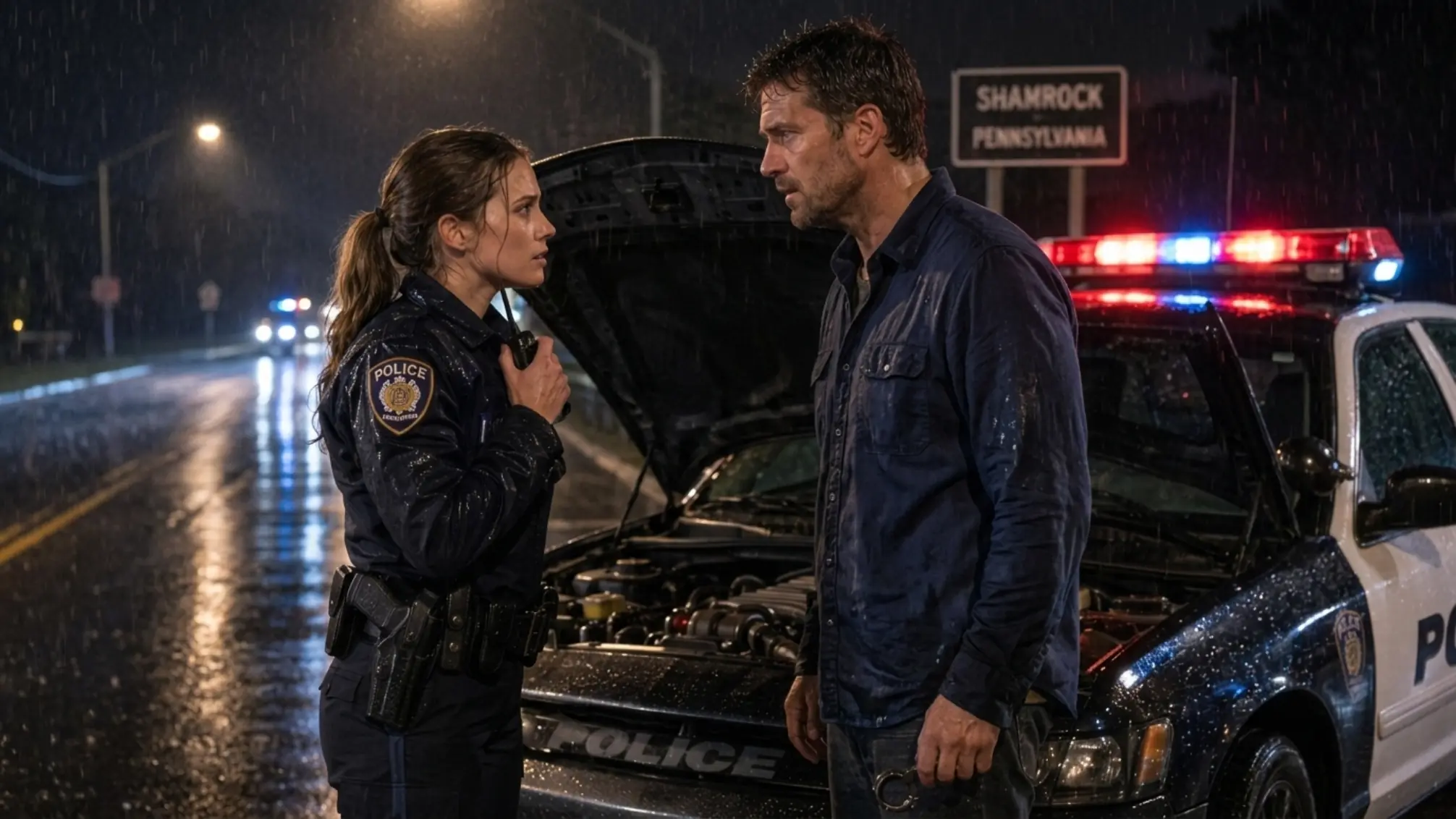
“No,” he said, struggling to keep his voice steady. “But I knew someone who looked exactly like you.”
The officer stepped closer, her posture becoming guarded. “Use my mother’s name without proof, and I’ll put you in cuffs.”
Ethan stared at her face again. The shape of her eyes, the slight tilt of her head, and the faint dimple appearing near one corner of her mouth belonged to a woman he had once planned to marry.
“Then call Claire,” Ethan replied. “Ask why she never told you about Ethan Carter.”
The officer stopped breathing for a second.
Rain tapped against the raised hood between them, and headlights moved through the mist behind Ethan’s old pickup. The woman slowly lowered her radio, though she did not release it.
“How do you know my mother?”
Ethan looked down at the broken clamp in his hand. Ten years of buried memories had returned so quickly that he could barely separate the present from the past.
“It’s a long story.”
The officer’s expression hardened again. “Then start talking.”
Two hours earlier, Ethan had been standing on the tenth floor of an unfinished office building outside Pittsburgh, helping his construction crew secure plastic sheeting before the weather worsened. Wind had pushed cold rain through the open structure while the foreman insisted they finish protecting the electrical equipment before anyone left.
By the time Ethan climbed into his aging pickup, his jacket was soaked, his back ached, and his hands were numb.
His eight-year-old daughter, Lily, was waiting at home with their neighbor, Mrs. Donnelly. Ethan had promised to return before dinner, help Lily complete her science project, and read the next chapter of the mystery novel they had started together.
He was already forty-five minutes late.
Since his wife died five years earlier, every responsibility had belonged to him. He packed lunches, attended parent conferences, worked overtime, learned how to braid hair, and pretended not to panic whenever Lily became sick. He repaired school costumes at midnight, washed soccer uniforms before sunrise, and kept emergency snacks inside his truck because forgetting one small thing could ruin an entire day.
Ethan never called himself heroic.
He was simply the parent who remained.
His wife, Rebecca, had fought cancer for nearly eighteen months. Even during the final weeks, she worried more about Ethan and Lily than herself. On the last evening she could speak clearly, she made him promise that grief would not close their home to the world.
“Lily will watch how you survive this,” Rebecca whispered. “Teach her that losing someone doesn’t mean you stop caring about everyone else.”
Ethan had carried those words through every difficult morning that followed.
When he saw the flashing blue lights ahead on the rain-soaked highway, his first instinct was to continue driving. The cruiser sat on the narrow shoulder with its hood raised, and a female officer stood beside it while passing vehicles threw sheets of dirty water across her uniform.
Dispatch would send help eventually.
Ethan needed to get home.
Then he remembered something his own father used to say: if you could help someone and chose not to, the decision followed you farther than stopping ever would.
Ethan sighed, activated his turn signal, and pulled over behind the cruiser.
The officer turned immediately, one hand moving toward her duty belt. She was younger than Ethan and carried herself with the alertness of someone accustomed to danger appearing without warning.
He stopped several feet away.
“Everything okay?”
“My engine overheated,” she answered. “Dispatch has assistance coming, but every available unit is tied up.”
“I know a little about engines.”
Her eyes moved across his wet construction jacket, muddy boots, and tired face. “How much is a little?”
“Enough to know steam coming from that side usually means coolant.”
She looked toward the open hood. “You a mechanic?”
“Construction supervisor who’s owned bad trucks his entire life.”
The officer hesitated, then moved aside. “Fine. But don’t touch any police equipment.”
“I’m only interested in the engine.”
Ethan retrieved a flashlight and tool bag from his pickup. He inspected the radiator, reservoir, hoses, and water pump before finding a damaged clamp near the upper coolant line. The hose itself remained usable, but pressure had forced it loose enough to drain much of the coolant.
“You were lucky,” he said. “Another few miles could have warped something expensive.”
The officer stepped beside him. “Can you fix it?”
“I can make it hold until the tow truck arrives.”
He selected a replacement clamp from the collection of spare parts he kept behind his seat. Rainwater ran down his face as he secured it, added emergency coolant, and checked the surrounding components.
Then he turned toward the officer to explain what he had done.
That was when the streetlight illuminated her face.
Ethan froze.
Ten years disappeared.
He was twenty-eight again, standing outside a college library while Claire Morgan laughed at his soaked clothing after he ran across campus during a thunderstorm. He remembered the silver bracelet she wore, the way she touched her hair while thinking, and the small scar near her left eyebrow from a childhood accident.
The officer had the same scar.
Not similar.
The same.
“Sir?” she asked. “Are you okay?”
Ethan looked away. “You remind me of someone.”
“Someone who owes you money?”
He almost laughed, but the memories hurt too much.
“Someone who used to mean everything to me.”
The officer’s expression softened slightly. “I’m Sarah Morgan.”
The surname struck him nearly as hard as her face.
“Ethan Carter.”
They shook hands, and something changed in Sarah’s eyes when she heard his name. It was not recognition exactly. It was the sensation of touching a memory that belonged to someone else.
“You said you knew someone who looked like me.”
“Claire.”
Sarah immediately became still.
“What did you say?”
“Her name was Claire Morgan.”
“My mother’s name is Claire.”
Ethan lowered the flashlight.
The rain weakened into a steady drizzle, but neither of them seemed to notice.
“How old are you?” he asked.
Sarah’s suspicion returned. “Why?”
“I’m trying to understand something.”
“I’m twenty-six.”
Ethan looked toward the wet pavement. Claire had once mentioned that her early life was complicated, but she avoided details about her family. She never introduced him to her parents, and whenever he asked about the photographs of a teenage girl inside her apartment, Claire said they belonged to a relative she had lost contact with.
At the time, Ethan believed her.
Now he wondered whether every unfinished conversation had been connected to Sarah.
“Were you and my mother together?” Sarah asked.
“Yes.”
“For how long?”
“Almost four years.”
Sarah’s face tightened. “She never mentioned you.”
“She had reasons to be angry.”
“At you?”
“At herself. At me. At both families. Probably at the entire world.”
The tow truck arrived before Ethan could explain further. Another patrol officer came to collect Sarah, and professional duty replaced the questions gathering in her eyes.
Before entering the second cruiser, Sarah handed Ethan a card.
“If you were really that important to my mother, call me.”
Ethan accepted it.
“And if you’re lying,” she added, “I’ll find out.”
“I believe you.”
She opened the vehicle door, then looked back.
“What happened between you?”
Ethan closed his fingers around the card. “We stopped trusting each other before either of us learned how to tell the truth.”
Sarah left with the other officer.
Ethan remained beside the highway long after the tow truck carried away the disabled cruiser. When he finally returned to his pickup, Lily had sent him four messages.
Are you alive?
Mrs. Donnelly says you probably stopped to help someone.
The volcano is leaning.
Please bring pizza.
Ethan stared at the messages until the tension inside him loosened.
He bought pizza.
At home, Lily ran toward him wearing protective goggles and a sweatshirt covered in baking soda. A papier-mâché volcano stood on the kitchen table, leaning dangerously toward the fruit bowl.
“You’re very late.”
“I know.”
“Did you save somebody?”
“Her car.”
“Was she nice?”
Ethan removed his wet jacket. “Eventually.”
Lily studied his face with Rebecca’s unsettling ability to detect every emotion he attempted to hide.
“What happened?”
“I met someone who reminded me of an old friend.”
“A happy friend or a sad friend?”
“Both.”
Lily nodded as though the distinction made perfect sense. “You can tell me after we fix the volcano.”
They worked until nearly ten. Ethan reinforced the base while Lily painted red lines down the sides and explained exactly how the eruption should behave. He tried to concentrate, but Sarah’s card remained inside his pocket like a question refusing to wait.
After Lily went to bed, Ethan opened an old wooden box in his bedroom closet.
Rebecca had known the box existed.
She never asked him to destroy it.
Inside were college photographs, concert tickets, letters, and a silver keychain Claire gave him on their second anniversary. At the bottom lay a photograph of Claire standing beside a lake, her chestnut hair blowing across her face.
Behind her stood a girl of approximately sixteen.
Ethan had asked who she was.
“My cousin Sarah,” Claire answered.
The memory made him sit down.
Claire had lied.
He turned the photograph over. Written in faded ink were two names:
Claire and Sarah — June 2009.
Ethan did not sleep.
The following morning, he dropped Lily at school and sat inside his pickup with his phone in one hand. He still remembered Claire’s old number, though he assumed it had changed years earlier.
Instead of calling it, he called Sarah.
She answered after the third ring.
“Officer Morgan.”
“It’s Ethan.”
Her voice became guarded. “You decided to call.”
“I found a photograph.”
“What photograph?”
“Your mother and a teenage girl she told me was her cousin.”
Sarah became silent.
“She said that about me?”
“Yes.”
“Why?”
“I was hoping you knew.”
“My grandparents raised me until I was sixteen,” Sarah said slowly. “My mother had me when she was eighteen. They told most people I was her younger sister because they thought having a child would destroy her chances of finishing school.”
Ethan closed his eyes.
Claire had not been hiding an affair or a recent child.
She had been hiding the daughter her own family taught her to treat like a secret.
“Did you live with her when we were together?”
“No. I lived with my grandparents in another state. I moved back after high school.”
“That explains why I never met you.”
“It doesn’t explain why she lied.”
“No.”
Sarah exhaled. “I asked her about you last night.”
Ethan’s grip tightened around the phone.
“What did she say?”
“She cried.”
He looked through the windshield at parents leaving the school parking lot.
“Did she give you my number?”
“No. She told me not to call you again.”
The words hurt more than Ethan expected.
“Then why did you answer?”
“Because she was terrified, and my mother only becomes terrified when the truth is close.”
Sarah sent him Claire’s current number.
Ethan stared at it for nearly an hour.
Then he called.
Claire answered without speaking.
He heard breathing on the other end.
“Claire.”
“Ethan.”
Ten years of silence remained between the two names.
“I met Sarah.”
“I know.”
“Why did you tell me she was your cousin?”
Claire’s voice broke. “Because I was ashamed.”
“Of her?”
“Never of her. Of myself. Of letting my parents decide what kind of mother I was allowed to be.”
Ethan leaned his head against the seat.
“You could have told me.”
“I tried.”
“When?”
“The night you accused me of hiding another man.”
Ethan remembered the argument. He had found letters from Sarah’s father and assumed Claire maintained a secret relationship. Claire refused to explain, then left the apartment.
“I was wrong,” he said.
“So was I. I wanted you to trust me without giving you the truth.”
“Why didn’t you contact me later?”
“Because you married Rebecca.”
Ethan became silent.
Claire continued. “I saw the announcement online. You looked happy. I had no right to return and tear open something you had survived.”
“You could have explained.”
“And said what? That I loved you but chose fear every time you asked me to be honest?”
Ethan looked toward the photograph on the passenger seat.
“Rebecca knew about you.”
Claire inhaled sharply. “You told her?”
“Everything I understood at the time. Which clearly wasn’t everything.”
“How is she?”
Ethan closed his eyes.
“She died five years ago.”
Claire said nothing for several seconds.
“I’m sorry.”
“She was a good person.”
“I’m glad you had her.”
Ethan expected jealousy, bitterness, or awkwardness. Instead, Claire’s words carried only grief for a woman she had never met.
“She gave me Lily.”
“Sarah told me you had a daughter.”
“She’s eight.”
The silence changed.
Claire finally asked, “What do you want from me?”
“The truth.”
“About Sarah?”
“About all of it.”
They agreed to meet one week later at a small café halfway between their homes.
Ethan arrived early but found Claire already sitting near the window. She was older, naturally, with faint lines around her eyes and streaks of silver near her temples. Yet when she looked up, he saw the same woman who once waited outside his college classroom with two coffees and an unreasonable plan for a road trip.
Neither knew whether to hug.
They sat instead.
Claire explained that she gave birth to Sarah at eighteen. Her parents took legal guardianship, insisting it was the only way Claire could attend college and avoid public judgment. Over time, temporary guardianship became emotional separation.
By the time Claire met Ethan, she had only recently begun rebuilding her relationship with Sarah. She feared that revealing a teenage daughter would make him see her as dishonest, irresponsible, or too complicated.
Instead of trusting him, she delayed the conversation.
Ethan’s insecurity made everything worse.
He had grown up watching his father abandon the family, so secrecy felt like betrayal before he understood what it concealed. When he discovered letters from Sarah’s father, he accused Claire of maintaining another relationship.
The letters concerned custody.
Claire refused to explain because Ethan’s accusation confirmed her worst fear: that he would judge her before understanding.
Their final argument ended with Ethan telling her to leave if she could not trust him.
She left.
Two weeks later, Claire accepted a job in another state. Pride kept Ethan from calling, while shame kept Claire from returning.
“Four years disappeared because neither of us could say one honest sentence,” Ethan said.
Claire wiped tears from her cheek. “More than four.”
They spoke for nearly five hours.
There was no attempt to revive the romance they lost. Ethan loved Rebecca and refused to let nostalgia reduce his marriage to an interruption. Claire understood that.
They were not rebuilding the past.
They were finally allowing it to end truthfully.
Sarah joined them near closing time.
She entered wearing civilian clothing rather than her police uniform, but she carried the same guarded posture Ethan saw beside the highway. She sat next to Claire and looked between them.
“So,” Sarah said, “you two managed not to destroy the café.”
“Barely,” Ethan answered.
Claire laughed through the last of her tears.
That laugh broke something open.
In the months that followed, Sarah became part of Ethan and Lily’s life. The connection developed slowly, without anyone forcing it into a definition. Sarah visited for dinner, helped Lily build a model police cruiser for school, and told stories about training that became more exaggerated each time.
Lily adored her.
“You’re like an aunt,” Lily announced one evening.
Sarah looked toward Ethan. “Am I?”
“You’ve been promoted quickly,” he said.
Claire began attending some dinners too. Her relationship with Ethan remained careful at first, but the old tension gradually gave way to something gentler. They talked about Rebecca openly, and Claire never treated the dead woman as a rival.
One evening, Lily asked Claire whether she had known her father when he was young.
“He had terrible hair,” Claire said.
Ethan nearly dropped a plate.
“My hair was excellent.”
“You used too much gel.”
“It was the decade.”
Sarah laughed. “I need photographs.”
“Absolutely not.”
Lily had already seen the wooden box.
Within minutes, four people sat around the kitchen table looking through Ethan’s college years while he attempted to defend clothing choices that deserved no defense.
The house felt full.
Not repaired exactly.
Some losses could never be repaired.
But it no longer felt defined by absence.
Nearly one year after the rainy breakdown, Sarah stopped at Ethan’s house in her patrol cruiser. She carried the damaged hose clamp he had removed from her engine, now cleaned and mounted inside a small wooden frame.
A metal plate beneath it read:
THE PART THAT BROUGHT EVERYONE HOME.
Ethan stared at it.
“You kept that?”
“I took it from the tow yard.”
“Is that legal?”
“I’m a police officer.”
“That is not an answer.”
Sarah smiled. “Claire helped with the frame.”
Lily ran from the hallway and demanded they hang it in the kitchen. Ethan chose a place beside Rebecca’s photograph and the first drawing Lily made after her mother died.
Claire arrived later carrying dinner.
She stopped when she saw the framed clamp.
For a moment, no one spoke.
Then Ethan looked around the kitchen at the woman he once loved, the daughter she once hid, and the child who taught all of them that family could expand without replacing anyone.
He finally understood Rebecca’s last request.
Losing someone did not require closing the door.
Sometimes grief convinced people that moving forward betrayed those who were gone. But opening his life to Sarah and Claire did not erase Rebecca. It honored the kindness she asked him to preserve.
A year earlier, Ethan had been exhausted, late, and tempted to drive past a disabled police cruiser.
He stopped because his father taught him that refusing to help would follow him longer than the delay.
He believed he was repairing a leaking coolant hose.
Instead, he reopened a truth buried for ten years and brought disconnected lives back to the same table.
The woman beneath the streetlight was not a ghost.
She was proof that the past had never truly disappeared.
It had only been waiting beside a lonely road, in the rain, for someone willing to stop.