I told my husband I was trapped at the office finishing reports because it sounded like the safest lie.
Reports were dull.
Reports were believable.
Reports were the kind of thing a tired wife might text at 9:14 p.m. while her husband sat at home, reheating dinner, assuming she was doing the responsible thing.
I typed the message from the parking garage beneath the Langford Hotel.
The lie glowed on my phone screen in a small blue bubble.
Still stuck here. These quarterly reports are a nightmare. Don’t wait up. I’ll eat something later. Love you.
For a few seconds, I stared at the last two words.
Love you.
They looked harmless.
They looked normal.
They looked like something a wife would send without thinking because marriage had made the phrase automatic, like locking the door or turning off the kitchen light.
Then I sent the message.
My name is Laura Bennett.
At the time, I was thirty-eight years old, married for eleven years to a man named Ethan Bennett, and standing in a hotel parking garage with my wedding ring sitting on the bathroom counter at home.
That last detail mattered.
I did not know how much yet.
I had taken the ring off before leaving the house that morning, telling myself I only needed to wash lotion from my hands before work. That was the kind of lie people tell themselves when the larger lie has already become too ugly to face directly.
The truth was simpler.
I had stopped wearing the ring when I met Julian.
Not always.
Not openly.
Just in little moments.
In hotel rooms.
At quiet dinners on the far side of town.
When I wanted to feel like a different woman than the one Ethan kissed goodbye in the kitchen every morning.
The ring was simple: white gold, narrow band, one small diamond, the kind of ring we could afford when we were twenty-seven and still believed love mattered more than impressive things. Ethan had chosen it himself after saving for months. He proposed at a small Italian restaurant in Columbus, Ohio, with sauce on his sleeve and so much nervous hope in his face that I started crying before he opened the box.
For years, I wore that ring like a promise.
Then, slowly, it became something I removed when it got in the way of the person I was pretending to be.
That night, I sat in my car for almost five minutes after sending the text, listening to the engine tick softly beneath the hood. Above me, the hotel lobby waited with marble floors, warm lights, and a man who knew I was lying to my husband and liked me better because of it.
His name was Julian Hayes.
He was forty-two, divorced, handsome in the polished way ambitious men learn to become handsome. He worked at Crestline Development, the company where I was a senior financial analyst. He had a sharp jaw, expensive shoes, silver beginning at his temples, and a way of listening that made every woman feel like she had just said something fascinating.
I was not the first woman to mistake that for intimacy.
I doubt I was the last.
But at the time, I told myself ours was different.
That is how most betrayal begins.
Not with the truth.
With a story that makes the truth easier to carry.
Julian and I first crossed the line at a conference in Cincinnati six months earlier. Before that, there had been compliments, late emails, jokes in the break room, shared rides to client meetings, and long conversations that were never technically inappropriate until they suddenly were.
He noticed everything.
Or at least, he made me believe he did.
He noticed when I changed my hair.
He noticed when I was quiet during meetings.
He noticed when I looked tired.
Ethan noticed those things too, but he noticed them with the steady concern of a husband who already knew me too well. Julian noticed them like discoveries.
That difference fed something selfish in me.
By the time the conference happened, I had already begun making room for him in my mind. I checked my phone too often. I dressed more carefully on days I knew he would be in the office. I laughed longer at his jokes than they deserved. I told myself it was harmless because nothing had happened.
People love that phrase.
Nothing happened.
As if betrayal begins only when hands touch.
As if secrecy itself is not already a kind of door closing.
The first night of the Cincinnati conference, Julian and I stayed in the hotel bar after everyone else went upstairs. We talked about work at first. Then about divorce. Then about marriage. Then about disappointment, which is always dangerous when spoken over wine to someone who is not supposed to comfort you.
I told him Ethan was kind but predictable.
Julian said, “Predictable can start to feel like being unseen.”
I should have ended the conversation there.
Instead, I let the sentence land.
I let it flatter the dissatisfaction I had been nursing in secret.
Ethan was predictable because he was dependable. He paid bills on time. He called when he said he would. He remembered that I hated cilantro and loved old bookstores. He fixed the loose kitchen drawer the same day I mentioned it. He brought me ginger tea when I had stomach aches. He went quiet when he was hurt because he hated making anyone feel guilty.
At some point, I stopped seeing those things as devotion and began treating them like furniture.
Always there.
Useful.
Easy to overlook.
Julian was not furniture.
Julian was weather.
Sudden, exciting, dangerous, and willing to make ordinary life feel dull by comparison.
That night in Cincinnati, he kissed me in the elevator after I said I should go to my room. I kissed him back. For a week afterward, I told myself it had been a mistake.
Then I answered his message.
Then I met him for lunch.
Then lunch became dinner.
Then dinner became the Langford Hotel.
By the time I texted Ethan that I was working late from the parking garage, the affair had been going on for nearly five months.
Five months is long enough for guilt to become routine.
The first time I lied, my hands shook.
By the tenth time, I only checked my reflection before speaking.
That is the part I hate remembering most.
Not that I lied.
That I became good at it.
Ethan texted back at 9:17.
Don’t work too late. I left soup in the fridge. I love you.
I looked at the message.
For a moment, shame rose sharp and hot in my throat.
Then the elevator doors opened nearby, and Julian stepped out wearing a dark coat, his phone in one hand, his smile easy and private.
“There you are,” he said.
Just like that, shame stepped aside.
I followed him upstairs.
The night did not feel dramatic while I was living it.
That is another thing people do not understand about betrayal. It is not always accompanied by thunder. Sometimes it happens under hotel lighting, with polite front desk staff, carpeted hallways, and a woman telling herself she will stop soon.
Soon.
After this week.
After this project.
After Julian loses interest.
After the next lie.
After some future version of myself becomes braver than the woman stepping into room 914.
When I came home that night, it was 11:46 p.m.
The house was quiet.
Our house sat in a middle-class neighborhood outside Columbus, on a street lined with maple trees and small front porches. Ethan and I bought it eight years earlier, after searching for months and arguing over school districts even though we did not have children yet.
We tried for children for years.
At first casually.
Then carefully.
Then medically.
Then desperately.
Grief changed our marriage in ways I did not admit at the time. Every negative test, every doctor’s appointment, every hopeful month followed by disappointment carved something out of us. Ethan wanted to talk. I wanted to stop feeling like my body had become a failed promise.
We survived it.
Or I thought we did.
But surviving is not always healing.
Sometimes it only means the wound stops bleeding where other people can see.
Ethan and I moved forward. We traveled. We hosted holidays. We adopted a dog, then lost him to old age after seven good years. We worked. We saved. We laughed sometimes. We became a stable couple, the kind friends described as solid.
Solid can become a compliment or a coffin depending on what a person wants to hear.
By the time Julian came into my life, I had begun mistaking stability for emptiness.
I unlocked the front door slowly, already preparing the face I would wear.
Tired.
Frustrated.
Responsible.
A woman exhausted by quarterly reports.
The kitchen light was on.
That surprised me.
Usually, when Ethan went to bed before me, he left only the stove light glowing. That night, the overhead light shone bright and clean across the counters.
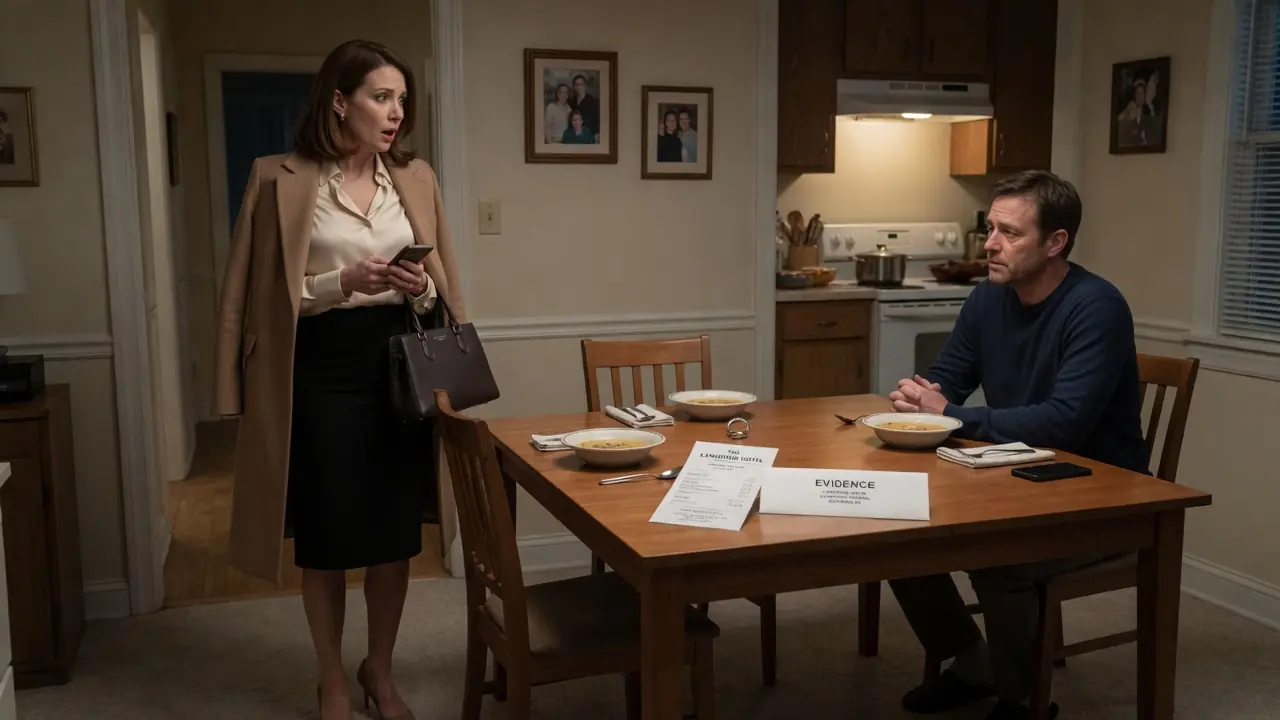
The soup he mentioned sat untouched in a pot on the stove.
Two bowls were set out.
Two spoons.
Two folded napkins.
My stomach tightened.
“Ethan?” I called softly.
No answer.
I stepped into the dining room.
He was sitting at the table.
Not eating.
Not reading.
Just sitting.
His hands were folded in front of him, and his eyes were fixed on the place setting across from him.
My place.
At first, I saw only the white envelope.
Then the receipt.
Then the ring.
My wedding ring sat beside a hotel receipt.
Small.
Bright.
Cruel in its innocence.
The receipt was from the Langford Hotel.
Not from that night.
From three weeks earlier.
I recognized it immediately because I had signed it after Julian ordered wine and a dessert neither of us finished. I had meant to throw it away. I thought I had.
Apparently, I had left it in the pocket of my gray blazer.
Beside it, my wedding ring looked almost delicate.
Like something that had survived a fire and did not yet understand the house was gone.
Ethan looked up.
His face was calm.
That was what frightened me most.
Not anger.
Not shouting.
Calm.
“I warmed the soup three times,” he said.
I opened my mouth.
Nothing came out.
He looked at the ring.
“You left it on the bathroom counter this morning.”
My hand moved automatically toward the empty place on my finger.
I had forgotten.
In the hotel, in Julian’s room, in the elevator, in the car, all the way home, I had forgotten the absence I had created.
Ethan noticed.
Of course he noticed.
That was what he did.
He noticed things.
“I can explain,” I said.
I hate that sentence now.
It is almost never true.
People say it when they want a delay, not when they have an explanation.
Ethan leaned back in his chair.
“Then explain why you texted me from a hotel parking garage while telling me you were at the office.”
My blood went cold.
“You followed me?”
“No.”
His voice stayed even.
“I stopped needing to follow you two weeks ago.”
The room seemed to tilt.
He reached toward the white envelope, opened it, and pulled out several folded pages. Not many. Enough.
Photographs.
Printed messages.
Credit card summaries.
A list of dates.
Each page placed on the table with care.
Not thrown.
Not slammed.
Placed.
That made it worse.
A person who throws papers is still inside the fire.
A person who places them neatly has already walked through it and come out somewhere you cannot reach.
I stared at the first photograph.
Me and Julian outside the Langford Hotel.
His hand near my back.
My face turned toward him.
Smiling.
Not trapped.
Not confused.
Smiling.
“Ethan,” I whispered.
He looked tired then.
Not physically.
Something deeper.
A tiredness I had put there.
“How long?”
I could have told one more lie.
I almost did.
That is how far gone I was.
Five months of lying does not end just because evidence appears on a table. The instinct to protect the false life remains. It rises even when truth is standing in front of you with your ring beside a receipt.
But I looked at Ethan’s face, and for once, I understood that the lie would not protect me.
It would only insult him.
“Five months,” I said.
His eyes closed.
Just briefly.
When he opened them, they looked older.
“Is that the truth?”
My throat tightened.
“Almost six.”
The smallest correction.
The ugliest proof.
Even my first confession had tried to arrive cleaner than reality.
Ethan nodded once, as if he had expected that.
“Julian Hayes?”
“Yes.”
“From work?”
“Yes.”
“Our house?”
I froze.
His jaw moved slightly.
“Did you bring him here?”
“No.”
That was true.
At least there was that.
He looked at me for a long moment, perhaps trying to decide whether he believed anything that came from my mouth anymore.
Then he nodded.
“I wanted to know that.”
The words broke something in me.
Not because they were gentle.
Because they showed how much worse it could have been, and how low he had already had to imagine.
I took a step toward him.
He lifted one hand, not sharply, but enough to stop me.
“Don’t.”
I stopped.
The distance between us was only a few feet.
It might as well have been a continent.
“How did you know?” I asked.
He looked at the receipt.
“The receipt was first.”
Of course.
A stupid, ordinary piece of paper.
No perfume on a collar.
No dramatic phone call.
No lipstick on a shirt.
A receipt.
“You left it in your blazer,” he said. “I took it to the dry cleaner because you said you didn’t have time. It fell out of the pocket when I checked it.”
I remembered that morning.
I had kissed his cheek before leaving and asked if he could drop off the blazer. He said yes. I had thanked him without thinking. He had found proof of my betrayal while doing me a favor.
That detail has never stopped hurting.
“At first,” he continued, “I told myself there could be a reason.”
I stared at the table.
“I wanted there to be a reason,” he said. “A work meeting. A client. Something I didn’t know. But then I checked the date. You told me you were having dinner with Sarah that night.”
Sarah was my friend from college.
I had used her name more than once.
Ethan took another page from the envelope.
“I asked Sarah how dinner was.”
My breath caught.
“She said she hadn’t seen you in weeks.”
I covered my mouth.
“She thought I was being strange,” he said. “She asked if everything was okay.”
“Ethan…”
“I said yes.”
He smiled faintly, without humor.
“I was still protecting you then.”
I sat down slowly because my legs had begun to tremble.
He did not move to help.
I deserved that too.
“For a few days, I tried to convince myself I had misunderstood,” he said. “Then I started noticing everything I had trained myself not to notice.”
His voice remained calm, but the words were heavy.
“The phone turned face down. The late meetings. The way you smelled like hotel soap when you came home. The way you laughed at messages and then stopped when I walked in. The way you started taking your ring off to wash dishes and forgetting to put it back on.”
I looked at the ring.
“I didn’t think you saw.”
His face tightened.
“That is not the defense you think it is.”
I looked away.
He was right.
“I spoke to a lawyer,” he said.
The sentence hit harder than I expected.
A lawyer meant he had moved beyond suspicion.
A lawyer meant time had passed inside him without me knowing.
A lawyer meant the marriage had already begun ending while I was still pretending it could remain available.
“Her name is Dana Miles,” he continued. “She advised me to document everything before making decisions.”
“Everything?”
“Enough.”
He slid another page toward me.
Hotel dates.
Restaurant charges.
Parking entries.
Messages I had deleted from my phone but not from other places I did not understand well enough to erase.
A private investigator’s summary.
I felt suddenly, deeply foolish.
Not because I had been caught.
Because I had mistaken secrecy for intelligence.
I had mistaken Ethan’s trust for blindness.
I had mistaken his quiet for weakness.
“Did you know tonight?” I asked.
“That you were at the hotel?”
He nodded.
“Yes.”
The room seemed to tighten around me.
“Then why didn’t you come there?”
He looked almost surprised.
“To do what?”
I had no answer.
Break the door.
Yell.
Hit Julian.
Humiliate me.
Something loud enough to match what I had done.
Ethan looked back at the ring.
“I have spent three weeks deciding not to become someone I would be ashamed of just because you became someone I didn’t recognize.”
That sentence was the beginning of my punishment.
Not legally.
Not financially.
Deeply.
Because there was no drama in it for me to hide behind.
No rage to call unfair.
No public scene to make him seem cruel.
Only the awful dignity of a man refusing to let my betrayal define his character.
I began crying then.
I wish I could say I cried because I understood fully.
I did not.
Not yet.
At first, I cried because I was scared.
Because I had been caught.
Because the comfortable life I assumed would wait for me had shifted beneath my feet.
Because Julian did not seem worth losing this.
That is an ugly truth, but this story is full of them.
“I’m sorry,” I said.
Ethan looked at me, and for the first time that night, anger broke through.
Just a flash.
“Are you sorry you did it, or sorry you’re sitting here?”
I could not answer quickly.
That was answer enough.
He stood and walked to the kitchen window.
Outside, our backyard was dark. The deck lights glowed over the patio table we bought two summers earlier. I remembered us assembling it together in the heat, sweating, laughing, arguing over instructions. Ethan had kissed me after dropping a screw between the boards and called it a sacrifice to the house gods.
That memory arrived with a cruelty all its own.
“I don’t know how to fix this,” I whispered.
“You don’t.”
He said it softly.
No cruelty.
Just fact.
I stared at his back.
“You don’t want counseling?”
He turned.
“I wanted counseling two years ago.”
My breath caught.
He nodded.
“I asked you if we should talk to someone after the fertility treatments stopped. You said therapy was for people who wanted to turn marriage into homework.”
I remembered saying that.
I had laughed when I said it.
Ethan had not.
“I asked again last winter,” he continued. “When you stopped coming home for dinner. You said we were just in a routine and I was overthinking.”
“I was wrong.”
“Yes.”
“I was unhappy.”
“I know.”
His face tightened.
“I was unhappy too, Laura. But I did not go looking for someone else to help me punish you for it.”
I flinched.
That word reached something I had not wanted named.
Punish.
Had I been punishing him?
For grief.
For sameness.
For not being able to give me the life we imagined.
For loving me steadily when I wanted to feel new.
Julian made me feel chosen.
But maybe what I had really wanted was to feel unburdened.
Ethan carried history.
Julian carried no history at all.
That made him easy.
Not better.
Easy.
Ethan returned to the table and placed another document in front of me.
“This is a temporary separation agreement Dana drafted. It is not the final divorce filing. That comes after we discuss logistics. I’m not asking you to sign tonight. I am asking you to read it by Monday.”
“Divorce,” I said, though he had already made it clear.
“Yes.”
The word had weight.
A legal word.
A social word.
A word for dividing furniture, bank accounts, holidays, friendships, memories, and the invisible habits of eleven years.
I shook my head.
“Ethan, please.”
His eyes softened, and somehow that hurt worse than anger.
“I loved you,” he said.
“Loved?”
“I don’t know what tense to use anymore.”
I bent forward, crying harder now.
“I can end it with Julian.”
“You should.”
“I mean now. Tonight. I’ll call him. I’ll quit if I have to.”
Ethan looked at me.
“Those may be good decisions. They are not repairs.”
I pressed my hands over my face.
He let me cry.
He did not comfort me.
There was a time when he would have crossed the room the moment I cried. He would have knelt in front of me, taken my hands, asked what I needed, blamed himself if there was even a possibility that my pain had touched him.
That man was gone.
Or maybe he was still there and had finally learned not to walk into the fire I set.
Eventually, I looked up.
“What do you want me to do tonight?”
He took a breath.
“I packed a bag. I’m going to my brother’s house.”
His brother, Paul, lived fifteen minutes away with his wife, Megan, and their two children. Paul had always liked me. Megan too. I wondered what they knew.
The thought came from shame first.
Not grief.
Shame is selfish that way.
“What did you tell them?”
“The truth.”
The room spun slightly.
“How much?”
“Enough that I could sleep under their roof without lying for you.”
I nodded slowly.
I had no right to object.
Still, some part of me wanted to ask him to protect me from the consequences of what I had done.
That part of me was exactly why consequences had become necessary.
Ethan picked up his coat from the chair.
The ring remained on the table.
The receipt remained beside it.
He looked at both, then at me.
“I am not taking that,” he said.
I knew he meant the ring.
“Why?”
“Because it stopped meaning what I thought it meant long before tonight.”
He walked toward the front door.
I stood, panicking.
“Ethan.”
He paused but did not turn.
“Was there ever a moment,” I asked, voice breaking, “when you were going to forgive me?”
His shoulders rose and fell.
“I don’t know.”
Then he looked back.
“But you made sure I had to discover the truth alone. That changes what forgiveness costs.”
He left.
The door closed quietly.
No slam.
No final crash.
Just a click.
I sat at the dining table until after two in the morning, staring at my wedding ring beside the hotel receipt.
By dawn, the paper had dried where my tears had fallen.
The next morning, I called Julian.
He did not answer.
I called again.
Still nothing.
At 9:30, he texted.
Can’t talk right now. Everything okay?
I stared at the message and felt something inside me begin to wake up.
Not wisdom yet.
Humiliation.
I typed, Ethan knows.
The reply took eleven minutes.
Eleven minutes was long enough for me to understand more than the eventual message would say.
When Julian finally responded, he wrote:
We need to be careful. Don’t mention my name in writing. I’m so sorry you’re dealing with this.
You’re dealing with this.
Not we.
You.
I read the message three times.
Then I laughed.
It was not a sane laugh.
It came from somewhere cracked.
For months, Julian had told me I deserved passion. I deserved to be seen. I deserved to feel alive. He had said Ethan sounded emotionally unavailable, which was almost funny now, considering Ethan had spent years asking me to speak honestly and I had treated his concern like pressure.
Now that truth had consequences, Julian became careful.
Careful with his job.
Careful with his reputation.
Careful with written records.
Not careful with me.
By noon, he called from a blocked number.
His voice sounded tense.
“Laura, what exactly does Ethan know?”
No Are you okay?
No I’m sorry.
No I love you.
Just risk assessment.
I sat on the edge of the bed Ethan and I had shared for eleven years and looked at the indentation on his pillow.
“He knows enough.”
“Did you say my name?”
“He already had it.”
Julian cursed under his breath.
I closed my eyes.
That sound told me everything I had refused to know.
He was not heartbroken.
He was inconvenienced.
“Julian,” I said quietly, “was any of this real to you?”
He paused.
“Don’t do that.”
“Do what?”
“Turn this into some dramatic emotional thing. We both knew this was complicated.”
Complicated.
Another word people use when they want wrong to sound intelligent.
I felt strangely calm.
“I’m ending it.”
He exhaled.
“That’s probably best for now.”
For now.
I almost thanked him for making the truth so easy.
Instead, I hung up.
Then I blocked him.
That did not make me noble.
It made me late.
Ethan came back Sunday afternoon with Paul.
Paul would not look at me.
That hurt, but again, hurt is not injustice.
It is sometimes only consequence finding the correct address.
Ethan and Paul took boxes from the garage: Ethan’s tools, financial records, winter clothes, books from his office, framed photos of his parents. He left our wedding photographs on the wall.
At first, I thought that was mercy.
Later, I realized he simply did not want them.
Paul carried one box past me, then stopped.
“I’m not going to say what I want to say,” he said.
I looked down.
“Okay.”
“No. Not okay.”
His voice shook with controlled anger.
“My brother spent three weeks trying to make sure he handled this without destroying you. Do you understand how decent that is?”
I nodded, crying silently.
Paul’s jaw tightened.
“You should. Because most people wouldn’t have bothered.”
He walked out before I could answer.
Ethan heard some of it from the hallway.
He did not correct him.
He did not defend me.
That was one of the first moments when I understood how many people I had betrayed beyond my husband.
Betrayal spreads.
It stains rooms you have never entered.
It changes how siblings sleep. How parents worry. How friends choose where to sit at dinner. How people remember old holidays.
By Monday, I met with my own attorney.
Her name was Rachel Kim, and she was practical, sharp, and kinder than I deserved. She reviewed the documents Ethan’s attorney had sent and asked me questions I hated answering.
Was the affair ongoing?
No.
Was the affair with a coworker?
Yes.
Were marital funds used?
Yes.
How much?
I did not know.
She looked at me over her glasses.
“Then we find out before his attorney tells us.”
We found out.
Hotels.
Meals.
Parking.
One weekend conference extension I told Ethan was mandatory but was not.
Some charges were small.
Some were not.
All of them looked worse in black and white.
Rachel folded her hands after reviewing the totals.
“This will affect the settlement.”
“I know.”
“Do you want to contest his documentation?”
“Is there a reason to?”
She studied me.
“Legally or morally?”
“Both.”
“Legally, we can examine accuracy. Morally, that depends on whether you want to make the divorce longer to avoid admitting what receipts already show.”
I looked down.
“No.”
“Good,” she said. “That will save you money and some dignity.”
Some dignity.
Not all.
Some.
I learned that dignity, once damaged by your own choices, does not return all at once. It returns in fragments, usually when no one is applauding. Telling the truth when lying would help. Not making excuses. Paying what you owe. Letting people be angry without demanding quick forgiveness.
Ethan filed for divorce three weeks later.
We did not have children, which made the legal process simpler and the emotional emptiness louder.
There were no custody arrangements to discuss.
No school schedules.
No shared birthday parties.
No reason we had to keep seeing each other after everything was signed.
The absence of children had been one of our old griefs.
Now it became one of the few mercies.
Our house became the hardest part.
Ethan wanted to sell it.
At first, I resisted.
Not because I could afford it alone.
Because losing the house felt like losing proof that our marriage had existed.
Rachel, my attorney, listened patiently before saying, “The marriage existed. The house is not evidence. It is property.”
I hated her for being right.
We agreed to sell.
Before the listing photographs, I had to clean.
That meant touching eleven years.
The blue ceramic bowls Ethan bought at a street market.
The Christmas ornaments from our first year married.
The drawer full of takeout menus.
The guest towels my mother gave us.
The blanket we bought after our first miscarriage because I spent three days on the couch and Ethan said I needed something softer than grief.
In the closet, I found a shoebox full of cards.
Every anniversary card Ethan had given me.
He kept mine too.
I sat on the floor and read his handwriting until I could not breathe.
Year one: I still can’t believe I get to come home to you.
Year four: Hard year. Still us.
Year seven: Whatever we become, I want to become it with you.
Year ten: You are my favorite familiar place.
I pressed the last card to my chest and made a sound that did not feel human.
That was the thing about cheating.
People imagine it is about choosing one person over another.
Sometimes it is about choosing an illusion over the slow, imperfect miracle already beside you.
Julian had made me feel new.
Ethan had made me known.
I had chosen new because known had begun to feel too honest.
Work became unbearable.
Not immediately.
Julian tried to keep everything professional, which in his case meant pretending I had become unstable all by myself. He avoided me in meetings. He stopped replying to emails unless other people were copied. He took three personal days the week HR began asking questions about travel expenses.
HR did not know because Ethan sent some dramatic package.
He never did.
They knew because Elise Hartman from accounting flagged irregular hotel and meal charges under a project code that did not match the dates. Once they began looking, they found patterns involving Julian, me, and at least one previous employee who had transferred to another office after what was described as a “personal complication.”
That phrase made me sick.
I was not special.
I was the latest version of a story Julian knew how to perform.
When HR interviewed me, I told the truth.
Not out of bravery.
Because lying had become exhausting.
Julian resigned before the investigation concluded.
I received a formal reprimand and lost my eligibility for promotion that year. Three months later, I left Crestline voluntarily because every hallway had become a mirror.
My parents found out from me.
I drove to their house in Dayton on a rainy Saturday and told them at their kitchen table. My mother cried quietly. My father stared out the window for a long time before asking one question.
“Did he love you?”
At first, I thought he meant Julian.
Then I realized he meant Ethan.
“Yes,” I said.
My father nodded.
“Then you did not only betray a husband. You betrayed a gift.”
I wanted to defend myself.
I wanted to explain the loneliness, the grief, the emotional distance, the way I had felt invisible. But every explanation sounded like a child trying to blame the rain for the window she broke with her own hand.
So I said, “I know.”
My mother reached across the table and held my hand.
She still loved me.
That almost made it worse.
Love from people you disappoint can feel heavier than anger.
The divorce took seven months.
Ethan and I met in person only twice after the night of the receipt.
The first time was mediation.
He wore a gray suit I had helped him choose for a wedding years earlier. He looked thinner. Tired. But steady.
I wore a navy dress and no wedding ring.
The ring sat in a small box in my purse because I did not know what else to do with it. I did not wear it. I could not leave it at home. I carried it like evidence.
Our attorneys did most of the talking.
House proceeds.
Retirement accounts.
Savings.
Reimbursement for documented marital funds used during the affair.
Division of furniture.
The language was clean, almost bloodless.
But beneath every number was a memory.
Dining table.
Couch.
Bedroom set.
Joint account.
Vacation fund.
Eleven years turned into categories.
At one point, Ethan asked for the record player.
It was old, not worth much financially. We bought it at a flea market during our second year married, then spent winter nights playing used jazz records while cooking dinner.
I looked at him across the table.
“You can have it,” I said.
His eyes met mine briefly.
“Thank you.”
Two words.
Civil.
Distant.
That was all.
The second time we met was at the house after it sold.
We had to do a final walk-through before closing.
The rooms were empty by then, echoing strangely. Without furniture, the house looked smaller and less forgiving. Sunlight fell across bare floors where our dining table had been, where the ring and hotel receipt had sat like a tiny courtroom.
Ethan stood near the kitchen island.
I stood by the back door.
For a while, neither of us spoke.
Then I said, “I’m sorry.”
He looked down.
“I know you are now.”
The now was deserved.
“I was sorry before too,” I said, then corrected myself. “But mostly for myself.”
He nodded slightly.
“I know.”
I swallowed.
“I don’t expect forgiveness.”
“Good.”
The word was not cruel.
It was honest.
Then he looked at me.
“I am trying not to hate you.”
My eyes filled.
“I understand.”
“No,” he said softly. “I don’t think you do. Hate would be easier. It would make you smaller. It would make the good years feel fake, and then maybe I wouldn’t miss them.”
He looked around the empty kitchen.
“But they weren’t fake to me.”
I cried then.
Quietly.
He did not comfort me.
But he did not look away either.
“That’s the part I’m trying to live with,” he said. “That I loved you honestly, and you still lied.”
There was nothing I could say to fix that.
So I gave him what I should have given him months earlier.
No defense.
“I did.”
He nodded.
Then he walked to the front door, paused, and looked back once.
“Take care of yourself, Laura.”
“You too.”
He left.
I stayed in the empty house until the realtor called to ask if everything was okay.
No.
Everything was not okay.
But the house was sold.
The papers were signed.
And the woman who had typed a lie from a hotel parking garage had finally run out of rooms to hide in.
After the divorce, I moved into a one-bedroom apartment near a small park on the north side of Columbus.
It was not terrible.
That almost disappointed me.
Some part of me thought consequences should look dramatic. Cracked walls. Flickering lights. Punishment made visible.
Instead, the apartment was clean, quiet, and plain. Beige carpet. Small balcony. Kitchen too narrow for two people to stand comfortably. A bedroom window facing a brick wall.
It was exactly what I could afford.
It was also the first place in eleven years that contained no shared history.
For months, I did little besides work at my new job, attend therapy, and learn how quiet a life becomes when the person who used to fill it with ordinary kindness is gone.
My therapist was named Dr. Elaine Porter.
She was gentle, but not soft.
In our third session, I told her I felt like a terrible person.
She said, “Feeling terrible is not the same as becoming accountable.”
I hated therapy.
Then I kept going because hating it did not make her wrong.
We talked about grief.
About the children Ethan and I never had.
About my fear of becoming ordinary.
About how I had allowed myself to believe desire was proof of destiny.
About how I had turned Ethan’s steadiness into evidence against him because it made my own restlessness look shallow.
One afternoon, Dr. Porter asked, “What did Julian represent to you?”
I gave the answer I had prepared.
“Attention. Excitement. Feeling seen.”
She waited.
Therapists are dangerous because they know how to survive silence.
Finally, I said, “Escape.”
“From Ethan?”
I shook my head.
“From myself.”
That was the first honest answer.
Not complete.
But honest.
I had not cheated because Ethan failed to love me.
I cheated because there were parts of myself I did not want to sit with: disappointment, aging, grief, envy, resentment, boredom, the fear that my life had become smaller than I imagined it would be. Julian offered a doorway out of those feelings, but doorways built from lies do not lead outside.
They lead deeper in.
Julian contacted me once after the divorce finalized.
A text from an unknown number.
Heard about the settlement. Hope you’re doing okay. I think about you.
I stared at the message for a long time.
There had been a version of me who would have felt chosen by that.
Now I saw it for what it was.
A man knocking softly on a door he had no intention of helping repair.
I deleted it.
Then blocked the number.
No speech.
No final insult.
Just absence.
That felt like one of the first truly adult decisions I had made in a long time.
A year after the divorce, I saw Ethan by accident.
It happened at a bookstore downtown, the kind with narrow aisles, old wood floors, and staff recommendation cards tucked beneath novels. I was reaching for a book on the bottom shelf when I heard his voice behind me.
“Excuse me.”
My body knew him before my mind turned.
He stood three feet away, holding two books and a paper coffee cup. He wore a dark green jacket I did not recognize. His beard was a little fuller. His hair had more gray near the temples.
He looked good.
Not untouched.
Good in the way people look when they have survived something and stopped asking the world to erase it.
“Hi,” I said.
“Hi.”
The silence was awkward but not hostile.
That made it harder.
A woman appeared at the end of the aisle.
She was around his age, maybe slightly younger, with curly black hair and warm brown eyes. She held a stack of books against her chest and smiled at him before noticing me.
Ethan’s expression shifted.
Not guilty.
Careful.
“Laura,” he said, “this is Naomi.”
Naomi looked at me, then understood enough from the air between us.
“Hello,” she said kindly.
Kindly.
Not triumphantly.
That made me like her and resent her for one second before I corrected myself.
“Nice to meet you,” I said.
Ethan looked at me.
“How are you?”
The question was polite.
It still mattered.
“I’m okay,” I said. “Really. I hope you are too.”
“I am.”
I nodded.
“I’m glad.”
And I was.
That surprised me.
It hurt, but beneath the hurt was something clean.
I did not want him broken forever just because I had broken us.
Naomi touched his arm gently.
“I’ll be near the front.”
She gave me a small nod and left.
Ethan watched her go, and I saw affection in his face.
Not the old affection that belonged to me.
Something new.
Something I had no claim over.
I held the book too tightly.
“She seems kind,” I said.
“She is.”
“I’m happy for you.”
He looked at me carefully, perhaps checking whether the words had hooks.
They did not.
“Thank you.”
There was more I could have said.
I still regret everything.
I still have the ring.
I still see the receipt in dreams.
I still miss the person you were before I made you become someone who had to protect himself from me.
But the aisle of a bookstore was not a confessional built for my relief.
So I said only, “Take care, Ethan.”
He nodded.
“You too, Laura.”
This time, when he walked away, it did not feel like abandonment.
It felt like proof that some endings continue walking without you.
That night, I went home and opened the small wooden box in my dresser drawer.
Inside were two things.
My wedding ring.
And the Langford Hotel receipt.
I had kept both.
Not because I wanted to punish myself forever.
Because I am the kind of person who can rewrite history if she misplaces the evidence.
The receipt was faded now at the edges.
The ink had begun to soften.
Date.
Time.
Amount.
Langford Hotel.
A ridiculous, ordinary slip of paper.
It did not show the kiss.
The lies.
The months of deception.
The soup warming on the stove.
The way Ethan looked at the ring.
It did not show the exact moment a marriage became unrecoverable.
But it carried enough.
I took out the ring and held it under the lamp.
For years, I thought the worst thing Ethan did was leave it on the table beside the receipt.
Now I understand that was one of his final acts of truth.
He placed the symbol beside the evidence.
The promise beside the proof.
The marriage beside the lie.
And he let me see, without shouting, what I had done.
That was the justice of it.
Not revenge.
Not humiliation.
A small ring.
A hotel receipt.
A dining room light.
A man calm enough to tell the truth and hurt enough to leave.
I wish I could say I became a completely different person after that.
People like endings that make pain useful quickly.
But real change is slower.
I still have selfish thoughts.
I still sometimes want to be seen by strangers when my own life feels too quiet.
I still have days when I try to soften what I did by remembering only how unhappy I was.
Then I look at the receipt.
Not to torture myself.
To return to accuracy.
I was unhappy.
I was also dishonest.
Both can be true.
One does not excuse the other.
Two years after the divorce, I began volunteering one evening a week at a financial literacy program for women rebuilding after major life changes. Divorce. Death. Job loss. Debt. Starting over after depending on someone else.
The first night, I almost left before walking in.
I felt like a fraud.
Who was I to help anyone rebuild when I had helped destroy my own home?
But the coordinator, a woman named Denise, said something I still remember.
“You do not need to be spotless to be useful. You need to be honest.”
So I stayed.
I taught budgeting basics.
How to read statements.
How to separate accounts.
How to ask questions before signing documents.
I never told the women my whole story unless someone asked why I cared so much about hidden costs.
Then I would say, “Because secrets are always more expensive than people think.”
That was true in every possible way.
One evening, a woman named Pilar stayed after class. She twisted her wedding ring while asking about separating finances before telling her husband she wanted counseling. Her voice trembled. She said, “I don’t want to blindside him, but I don’t want to keep pretending.”
I looked at her ring.
Then at her face.
“Tell the truth before you create a second life,” I said softly.
She began crying.
“I’m scared.”
“I know.”
“What if the truth ruins everything?”
I thought of Ethan.
The soup.
The envelope.
The receipt.
“Lies ruin things too,” I said. “They just let you pretend the ruin hasn’t started yet.”
Pilar nodded through tears.
I never knew what happened in her marriage.
But I knew I had told her the sentence no one could tell me because I refused to ask the right questions until it was too late.
That is the only kind of repayment available for some wrongs.
Not undoing.
Not balancing.
Only becoming someone less willing to pass the damage forward.
Three years after the night Ethan put my ring beside the receipt, I received a letter from him.
A real letter.
Paper.
Handwritten.
My hands shook when I saw his name on the return address.
Inside was no accusation.
No confession of missing me.
No dramatic reopening.
Just a few paragraphs.
Laura,
I found a box of your old books in Paul’s basement. They must have been packed with my things during the move. I am sending them to your apartment this week.
I also wanted to tell you something I have needed time to mean honestly. I forgive you enough to stop carrying the sharpest part every day. I do not know if that is the kind of forgiveness people write about, but it is the kind I have.
I hope you are living truthfully.
Ethan
I sat on my kitchen floor and cried for nearly an hour.
Not because I thought the letter meant he wanted me back.
He did not.
He married Naomi the next spring.
I heard through mutual friends. I did not attend. I sent no message. I simply sat with the news, let it hurt, and wished them peace.
The letter mattered because it released something I had not realized I was still gripping.
The fantasy that if he forgave me, the past would become less real.
It did not.
Forgiveness did not rewrite the receipt.
It did not put the ring back on my finger.
It did not make the house ours again.
But it meant Ethan had found a way to live without my betrayal sitting at the center of every room.
I wanted that for him.
Eventually, I wanted it for myself too.
Now, when I tell this story, people sometimes ask whether I loved Julian.
No.
I loved the reflection of myself I saw in his attention.
That is not the same thing.
They ask whether I loved Ethan.
Yes.
That is what makes the story worse.
People want betrayal to come from loveless places because then it makes sense. A cruel husband. A dead marriage. A villain. A rescue. A grand passion.
Mine was not that clean.
I loved a good man and still betrayed him.
I had reasons, but reasons are not permission.
I had pain, but pain is not a license to create more.
I had chances to speak honestly, and I chose lies because lies let me keep both comfort and excitement for a little while.
Only for a little while.
That is the truth about secret lives.
They do not stay secret forever.
They only borrow time from the future.
And when the future comes to collect, it charges interest.
The night I told Ethan I was working late, I thought I was protecting myself from discomfort. I thought I was buying one more evening before consequence. I thought the safest lie was the one that sounded ordinary.
Reports.
Office.
Late night.
Responsibility.
But Ethan was home with soup on the stove and my wedding ring on the bathroom counter.
He already had the receipt.
He already knew the shape of the truth.
He was not waiting for me to confess.
He was waiting to see whether I would insult him one more time.
I did.
That is another truth I carry.
When I walked into the dining room and saw the ring beside the receipt, some part of me wanted to become the victim of the moment. I wanted his calm to feel cruel. I wanted the evidence to feel invasive. I wanted consequences to seem sudden because I had hidden from the slow road that led there.
But nothing about that night was sudden for Ethan.
He had suffered quietly for weeks.
He had checked dates.
Made calls.
Sat with proof.
Spoken to a lawyer.
Reheated dinner.
Found my ring.
Placed it beside the receipt.
And waited.
I have never raised my voice at him in my memory of that night because he never raised his.
That is what makes the memory impossible to decorate.
His calm stripped away every excuse.
Years later, the ring still sits in its box.
The receipt is fading.
I am not the woman I was in that parking garage, though I am still responsible for her.
I have learned that honesty is not a feeling. It is a practice. It is telling the truth before the truth becomes a weapon in someone else’s hands. It is admitting loneliness before it becomes betrayal. It is saying I am unhappy before seeking comfort in a place that requires darkness.
It is also knowing that apologies do not guarantee restoration.
Some doors close forever.
Some people heal away from you.
Some consequences become the border between who you were and who you are trying to become.
I told my husband I was trapped at the office finishing reports because it sounded like the safest lie.
Reports were dull.
Reports were believable.
Reports were the kind of thing a tired wife might text at 9:14 p.m. while her husband sat at home, reheating dinner, assuming she was doing the responsible thing.
I typed the message from the parking garage beneath the hotel.
Then I went upstairs.
And when I came home, Ethan had placed my wedding ring beside the hotel receipt.
He did not need to shout.
He did not need to call me names.
He did not need to destroy me.
He only needed to show me the promise I had removed and the proof of where I had gone without it.
That was the night my marriage ended.
But it was also the night my lies stopped protecting me.
And sometimes, the first mercy of truth is that it leaves you with nowhere else to hide.